
 简体中文
 English
 Español

News
Refrigerated 60-Inch Sushi Showcase: A Practical Guide to Reliable Product Presentation and Temperature Control
In professional food retail, presentation and preservation must work together. Sushi, sashimi, prepared seafood, chilled side dishes, and other delicate foods need to look attractive while remaining inside a stable refrigerated environment. A sushi showcase is therefore more than a piece of furniture with glass panels. It is a working refrigeration system, a merchandising tool, a food-safety support unit, and an important part of the customer experience.
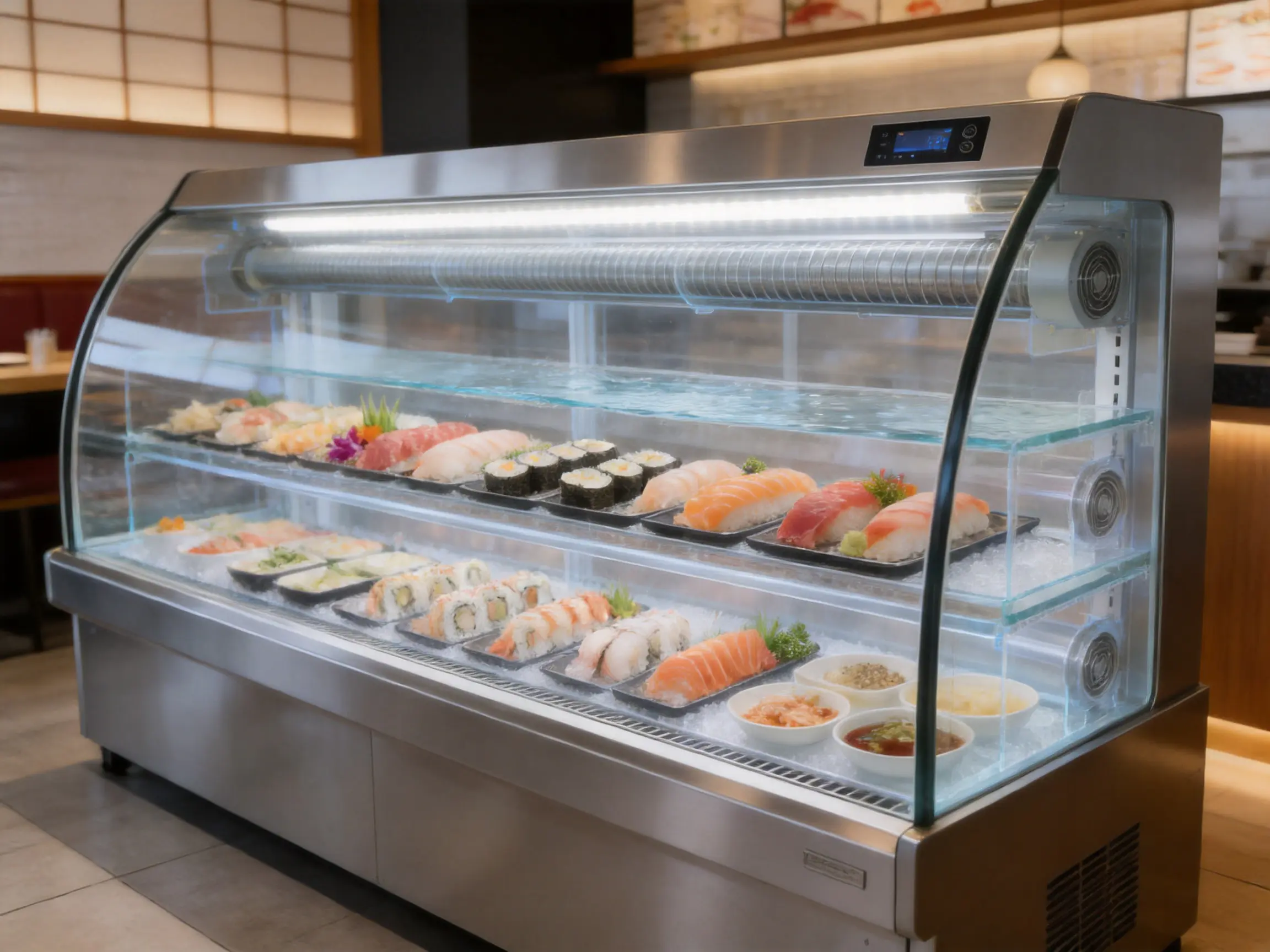
The Refrigerated 60 Inch Sushi Showcase, identified as model XCS-132L, is designed for businesses that need a broad display surface without sacrificing controlled cooling. Its format is suitable for sushi restaurants, Japanese restaurants, supermarket seafood counters, convenience stores, prepared-food outlets, hotel buffets, catering operations, and other commercial food-service environments. The unit combines a long display format with top and bottom evaporators, an integrated water channel, internal top LED lighting, digital temperature control, direct cooling, and automatic defrost.
These features address several common challenges in chilled food merchandising. A long showcase can present more products in a single visual field. Multiple evaporators help support cooling from different areas of the cabinet. The water channel beneath the top evaporator provides a defined path for condensation and defrost water. LED lighting improves product visibility while supporting a clean, modern appearance. Digital controls make temperature monitoring more straightforward, and automatic defrost reduces the need for frequent manual intervention.
The product is manufactured by Ningbo XiangChi Electrical Co., Ltd., a professional producer of vertical display cabinets, cake cabinets, warming cabinets, and related commercial refrigeration equipment. The company reports a 40,000-square-meter modern management garden factory, a dedicated research and development team, advanced testing facilities, and experience dating back to 2007. It also reports certification coverage including CE, GS, CCC, CB, RoHS, and ETL, allowing its products to serve a wide range of international markets.

Refrigerated 60 Inch Sushi Showcase
Why a Dedicated Sushi Showcase Matters
Sushi is visually sensitive food. Customers often judge freshness before they read a menu or ask a member of staff a question. Color, arrangement, moisture, cleanliness, and lighting all influence the perception of quality. A suitable showcase must therefore protect the food while presenting it in a way that encourages customer confidence.
Ordinary open shelving may provide access, but it does not offer the same controlled refrigerated environment as a dedicated showcase. A standard refrigerator may preserve food, yet it may not provide the long, front-facing presentation area needed for active merchandising. A sushi showcase is developed around both functions: cold storage and visual display.
The 60-inch configuration is especially useful for operations that need more display capacity than a compact countertop unit can provide. It can help separate different product groups, create a better visual sequence, and reduce the need to stack trays excessively. Better spacing can make individual products easier to identify and can support faster service during busy periods.
A long format also gives operators greater flexibility in organizing products. One section may be used for nigiri, another for rolls, another for sashimi, and another for seasonal or premium selections. In a supermarket, the same display can be divided by price point, flavor profile, or meal occasion. The showcase becomes an active selling surface rather than merely a storage location.
Core Product Features of the XCS-132L
Top and Bottom Evaporators
The XCS-132L uses both a top evaporator and a bottom evaporator. This arrangement is one of the product’s most important design features because it supports cooling from two positions within the cabinet structure. A single cooling source may create challenges in a wide display, particularly when the cabinet is frequently opened or loaded with products at different temperatures. The top-and-bottom arrangement is intended to promote a more balanced refrigerated environment.
The two evaporators also reflect the needs of a long showcase. Because the unit is designed for a 60-inch presentation format, cooling architecture must be considered across the cabinet rather than only at one small point. The placement of evaporating components at both upper and lower areas can help the refrigeration system respond more effectively to the cabinet’s overall interior volume.
For operators, this design can offer practical advantages. Products displayed at different levels may receive more consistent exposure to cooled air or cooled surfaces. The arrangement also demonstrates that the cabinet has been designed specifically for commercial display use rather than adapted from a basic storage refrigerator.
Water Channel Under the Top Evaporator
A water channel is provided under the top evaporator. Refrigerated cabinets naturally produce condensation, and defrost cycles can also generate water. If moisture is not directed properly, it may collect in unwanted areas, create cleaning difficulties, or affect the appearance of the display area.
The water channel gives condensation and defrost water a defined collection route beneath the top evaporator. This supports more orderly moisture management and can make routine cleaning easier. In commercial food equipment, small details such as drainage paths have a direct effect on daily usability. A well-considered water-management structure can help staff maintain a cleaner working environment.
The channel also contributes to the practical value of automatic defrost. As frost is removed from the evaporator, the resulting water needs to be handled efficiently. Integrating a water channel into the cabinet design shows attention to the complete refrigeration cycle rather than focusing only on cooling performance.
Internal Top LED Light
The showcase includes an internal top LED light. Lighting is essential in a display cabinet because the products must remain visible through the glass. Poor lighting can make food appear dull, obscure labels, and reduce the visual impact of carefully arranged trays.
Positioning the light at the top helps illuminate the display from above. This can create a clear view of the food surface and support a brighter, more inviting presentation. LED lighting is also widely preferred in commercial equipment because it provides strong illumination in a compact format and is well suited to modern retail interiors.
For sushi and sashimi, appropriate lighting is particularly valuable. Customers want to see the color, texture, garnish, and arrangement of each item. A clear display can reduce hesitation and help staff explain product choices. The light also allows the showcase to become a focal point in a restaurant counter or supermarket department.
Digital Thermostat and Display
The XCS-132L is equipped with a digital thermostat and display. Digital controls provide a more direct way to set and observe the operating temperature than purely mechanical controls. Staff can check the displayed value during routine inspections and identify unusual changes more easily.
A visible digital display can also support better operating discipline. Employees do not have to rely only on product appearance or touch to judge whether the cabinet is functioning correctly. Regular temperature checks can become part of opening, closing, and food-safety procedures.
Digital temperature control is especially useful in a food environment where cabinet loading, ambient conditions, door or cover activity, and product turnover can change throughout the day. Although operating procedures remain important, a digital thermostat gives staff a clear control point for daily management.
Direct Cooling System
The product uses a direct cooling system. Direct cooling is a practical approach for applications where products are placed in a refrigerated display and where stable contact with cooled cabinet surfaces is important. The system is designed to provide refrigeration without relying solely on a high-volume circulating-air arrangement.
One potential benefit of direct cooling in a sushi showcase is that it can support a calm display environment. Delicate foods may be less exposed to strong air movement than they would be in some forced-air designs. Operators should still follow appropriate food-handling practices, use suitable trays, and maintain the operating conditions recommended for the equipment.
The direct cooling system also works together with the top and bottom evaporator arrangement. The combination is intended to support the cabinet’s broad display format while maintaining a refrigeration structure suited to chilled food presentation.
Automatic Defrost
Automatic defrost is included as a standard feature. Frost accumulation can reduce refrigeration efficiency and occupy valuable space on evaporating surfaces. Manual defrosting can also interrupt business operations and require staff to remove products or temporarily stop using the cabinet.
Automatic defrost allows the cabinet to manage this routine maintenance task with less direct labor. The defrost cycle helps remove accumulated ice from the evaporator surfaces, while the water channel provides a route for the resulting moisture. This combination supports easier day-to-day operation.
Automatic defrost does not eliminate the need for cleaning or inspection. Staff should still check the display area, drainage path, seals, lighting, and temperature reading according to the operating schedule. Its value is that it reduces the frequency of manual defrost work and helps the equipment remain ready for regular commercial use.
Advantages Compared with General Display Refrigerators
Many display refrigerators can hold chilled products, but not every model is equally suited to sushi presentation. The XCS-132L offers several design characteristics that distinguish it from a basic display cabinet.
Product characteristic |
Practical value for operators |
Customer-facing benefit |
60-inch showcase format |
Provides a broad area for organizing multiple product groups |
Creates a more complete and attractive food presentation |
Top and bottom evaporators |
Supports refrigeration across different cabinet levels |
Helps maintain a consistently chilled display environment |
Water channel beneath top evaporator |
Directs condensation and defrost water in an orderly manner |
Supports a cleaner-looking display area |
Internal top LED light |
Improves visibility during daily merchandising |
Makes food color, shape, and arrangement easier to see |
Digital thermostat and display |
Provides a clear temperature control and monitoring point |
Supports confidence in the refrigerated presentation |
Automatic defrost |
Reduces manual defrosting workload |
Helps keep the showcase ready for regular service |
Compared with a small countertop refrigerator, the 60-inch model provides more merchandising capacity and a stronger visual presence. Compared with a generic vertical display cabinet, its sushi-oriented format and dual evaporator arrangement offer a more application-focused solution. Compared with an open display cooler, the refrigerated showcase provides a more enclosed environment for chilled food presentation.
These advantages should be evaluated in relation to the operator’s menu, available space, product turnover, and local food-safety requirements. No display cabinet replaces good handling practices. However, a purpose-designed unit can make it easier to implement those practices consistently.
Merchandising Benefits for Sushi and Prepared Foods
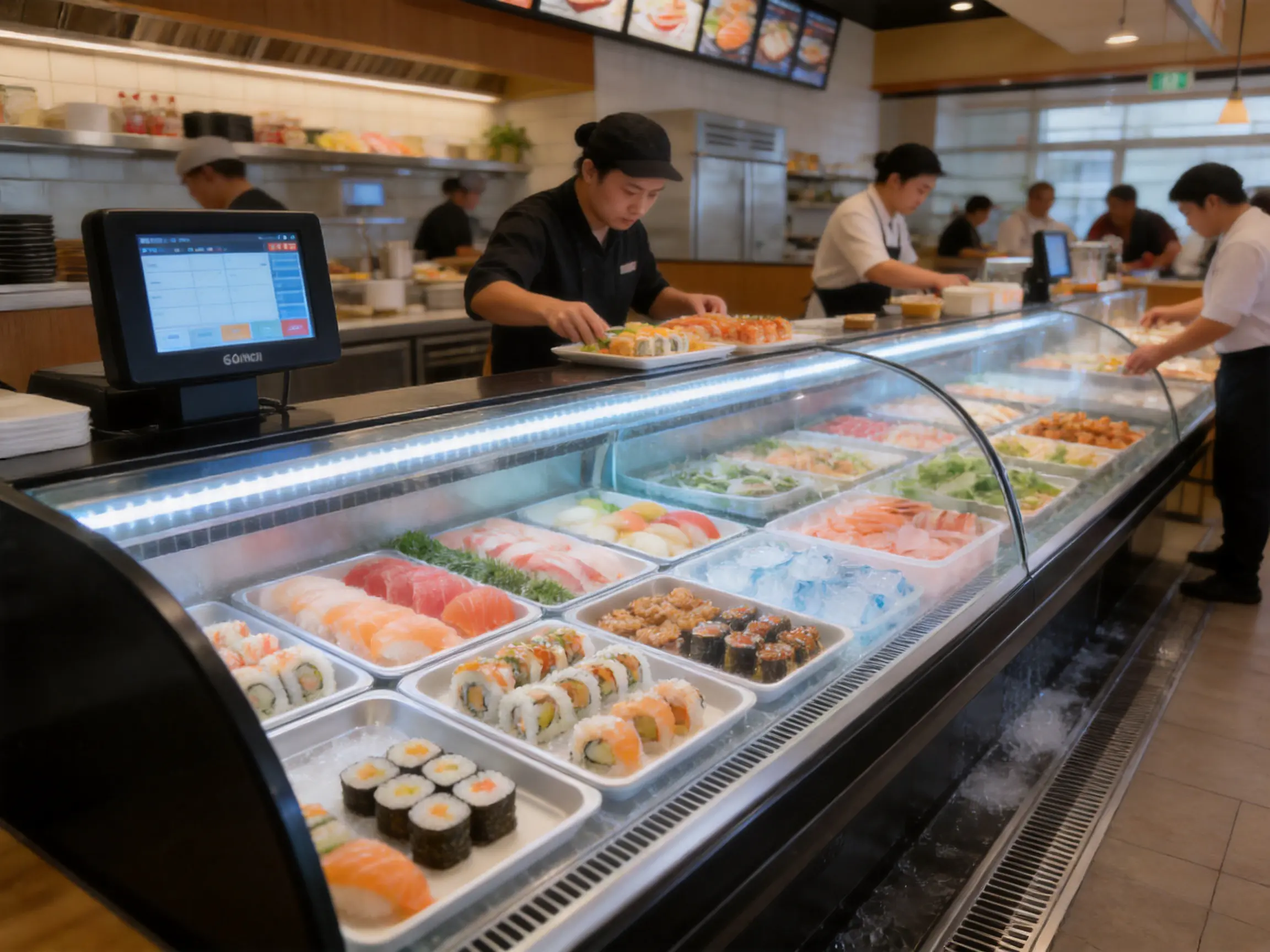
A sushi showcase should help staff present food in a logical and attractive order. The 60-inch length creates room for planned product zoning. A useful arrangement might begin with popular entry-level rolls, continue with specialty rolls, and finish with premium sashimi or chef-selected items. This type of organization can guide customers through the range without requiring excessive signage.
The wide format can also support visual balance. Trays can be spaced so that products are easy to distinguish rather than packed into one crowded row. Color contrast between rice, seafood, vegetables, sauces, and garnishes can be used to make the overall presentation more appealing.
In a supermarket or takeaway environment, the showcase can be arranged according to customer decision speed. Ready-to-go combinations may be placed in the most accessible area, while individual pieces or premium selections can be displayed separately. In a restaurant, the showcase can support direct customer interaction, allowing staff to point out the day’s options.
Lighting adds another merchandising advantage. The internal top LED light can help maintain a bright, clean appearance during both daytime and evening service. It can also reduce the need for excessive surrounding illumination, allowing the refrigerated cabinet to stand out within the room.
Because the unit uses a digital thermostat and display, managers can include temperature observation in their merchandising routine. Product presentation and refrigeration management do not need to be treated as separate tasks. Staff can inspect the display, remove items that no longer meet presentation standards, rotate stock, and verify the displayed temperature during the same check.
Applications Across Different Commercial Environments
Sushi Restaurants
In a sushi restaurant, the showcase can be positioned near the service counter, preparation area, or customer seating zone. It can display ready-to-serve sushi, sashimi trays, side dishes, desserts, or seasonal items. Its long format can help the restaurant present a broader menu without covering the counter with multiple small refrigerators.
The visible internal light can improve the appearance of the food during ordering. The digital display can also support the restaurant’s routine checks before opening and throughout service. Operators should arrange products so that food is easy to inspect, remove, replenish, and rotate.
Supermarkets and Grocery Stores
Supermarkets often need a showcase that supports fast customer decisions. A 60-inch unit can hold several categories of prepared food in one location, helping shoppers compare options efficiently. It may be used for sushi, sashimi, chilled salads, seafood snacks, or ready-to-eat meal combinations.
The product’s display-focused design can help create a dedicated fresh-food section. Its lighting and broad presentation area may contribute to a more organized department appearance. Store employees can use the digital display during scheduled temperature checks and follow the retailer’s established food-safety procedures.
Convenience Stores
Convenience stores need equipment that supports rapid product turnover and straightforward staff operation. The showcase can provide a clearly defined area for packaged sushi and chilled meals. The automatic defrost feature may be particularly useful where employees have many tasks and limited time for manual equipment maintenance.
The 60-inch length should be considered alongside store layout and expected sales volume. In a larger convenience store, it can provide useful capacity for multiple meal categories. In a smaller store, operators should confirm that the cabinet’s footprint allows sufficient customer movement and staff access.
Hotels and Catering Operations
Hotels, event venues, and catering operations may use refrigerated showcases for buffet service, banquet preparation, or display of ready-to-serve selections. The illuminated presentation can help food remain visible in dining areas, while the refrigeration system supports chilled service requirements.
For mobile or temporary catering applications, the equipment should be evaluated according to the venue, electrical supply, transport plan, and applicable regulations. The showcase is most effective when incorporated into a complete service plan that includes food preparation, loading, temperature monitoring, and scheduled replenishment.
Specialty Food Retailers
Seafood shops, Japanese grocery stores, delicatessens, and prepared-food counters can use the cabinet to showcase products that require both cold storage and strong visual presentation. Its broad format allows the operator to create a specialized display rather than mixing products in a general refrigerator.
The unit can also be used for limited-time promotions. Seasonal sushi assortments, holiday packages, chef’s selections, and premium seafood products can be placed in a defined section so customers notice them quickly.
Manufacturing Strengths Behind the Product
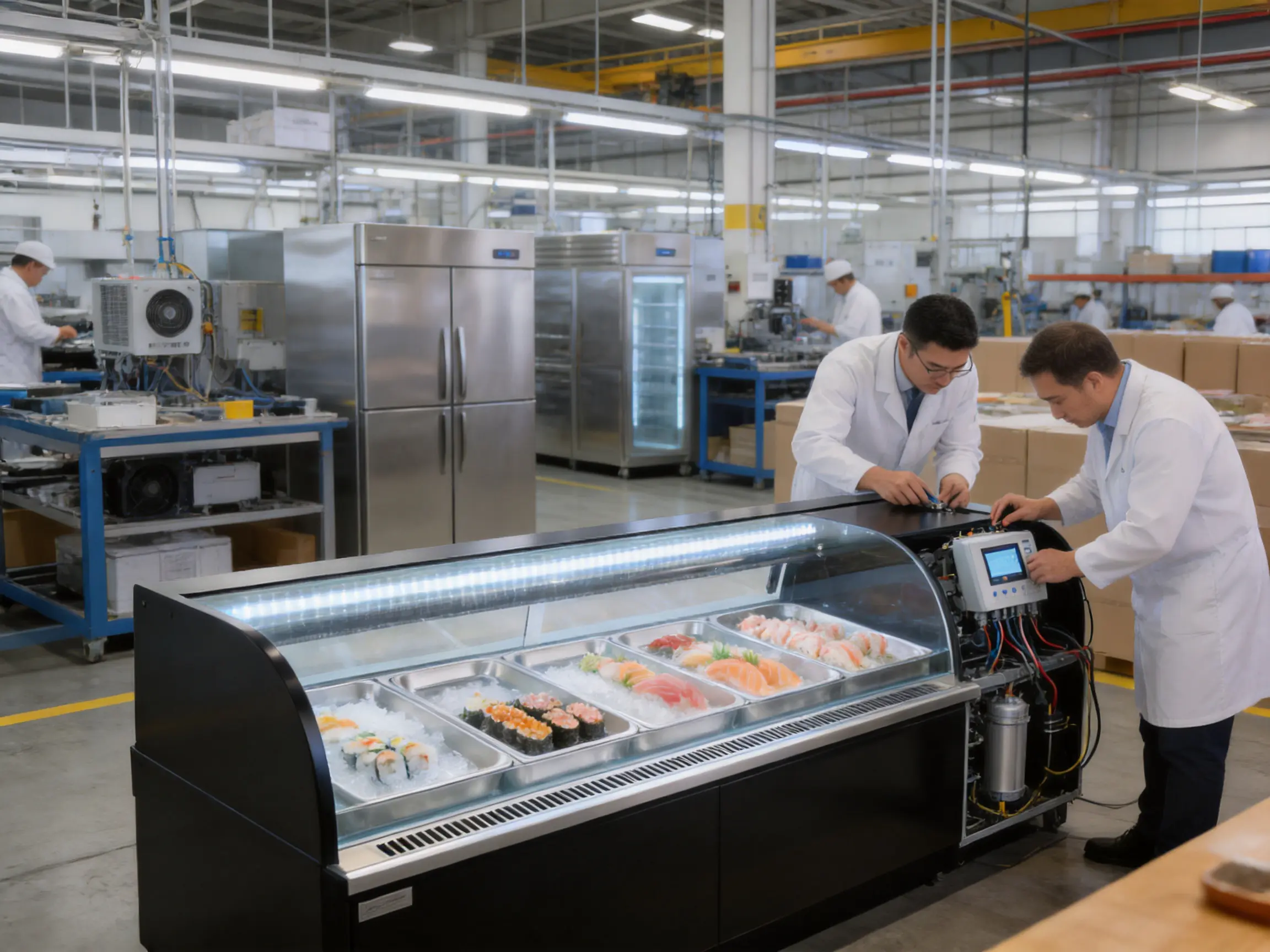
The performance and usability of a commercial refrigeration product depend heavily on the manufacturer’s engineering, production controls, testing procedures, and quality culture. Ningbo XiangChi Electrical Co., Ltd. presents itself as a specialized manufacturer rather than a general trading company. Its product scope includes vertical display cabinets, cake cabinets, warming cabinets, and other commercial equipment.
Experience Since 2007
The company was established in 2007 and reports more than ten years of experience in the industry. Long-term involvement in commercial refrigeration can provide valuable knowledge of cabinet construction, cooling systems, display requirements, service expectations, and international market differences.
Experience is especially important for products such as sushi showcases because the design must balance several factors at once. The cabinet needs to look attractive, maintain a refrigerated environment, manage moisture, provide accessible controls, support cleaning, and withstand repeated commercial use. Product development becomes more reliable when it is informed by accumulated manufacturing and market experience.
40,000-Square-Meter Factory
The company reports a modern management garden factory covering 40,000 square meters. A substantial manufacturing site can support organized production areas, component handling, assembly processes, testing zones, warehousing, and product management.
A larger and well-organized factory can also make production planning more systematic. Commercial refrigeration equipment typically requires coordination among sheet-metal work, insulation, refrigeration components, electrical systems, glass or display structures, lighting, controls, and final assembly. Separating these activities into controlled stages may improve consistency and production efficiency.
Professional Research and Development Team
The company reports its own professional R&D team. Internal research and development is valuable because the manufacturer can adapt product designs based on testing results, customer requirements, component performance, and changing market expectations.
For the XCS-132L, product development involves more than selecting a compressor or adding a glass panel. Engineers must consider the relationship between evaporators, water management, temperature control, lighting, cabinet geometry, defrost behavior, and daily cleaning. An internal R&D capability can help these elements be developed as one integrated system.
It also provides a foundation for future improvements. Different markets may require changes in electrical standards, temperature ranges, cabinet layouts, or certification documentation. A manufacturer with its own engineering resources is better positioned to evaluate these needs and develop appropriate product variations.
Advanced Testing Facilities
Testing facilities are important for commercial refrigeration because visible appearance alone cannot confirm product quality. The cabinet must be evaluated as a functioning system. Temperature behavior, defrost operation, electrical performance, lighting, control response, and general assembly quality all need attention.
The company states that it has advanced testing facilities to support product innovation and quality improvement. Such facilities can help identify problems before products reach customers. Testing can also provide feedback for design refinement, production training, and process control.
For buyers, a manufacturer’s testing capability is a meaningful consideration. It suggests that the product is developed and assessed through structured procedures rather than being assembled without systematic verification. Purchasers should still request the technical documents and certification information relevant to their destination market.
International Certification Coverage
The company reports certifications and compliance marks including CE, GS, CCC, CB, RoHS, and ETL. These certifications address different market and product requirements. Their availability can help support international distribution, although buyers should confirm which certification applies to the exact model, configuration, voltage, and destination country.
Compliance documentation is especially important for commercial equipment used in public food-service locations. Electrical safety, material restrictions, product construction, and regional installation rules may all apply. A manufacturer experienced with international certification is more prepared to organize the documentation required by importers, distributors, and commercial customers.
How the Production Process Supports Quality
A commercial showcase is produced through multiple connected manufacturing stages. Although the detailed internal process may vary by factory and model, the general quality logic is clear: the cabinet body, refrigeration system, electrical controls, display components, and final packaging must be coordinated carefully.
Design and Engineering Review
Production begins with product design and engineering review. The design team considers the intended application, cabinet proportions, evaporator arrangement, control position, lighting location, water channel, insulation, service access, and external appearance.
For a 60-inch sushi showcase, engineering review should pay special attention to the relationship between cabinet length and cooling distribution. The top and bottom evaporators must be integrated into the structure without reducing usable display space. The water channel must fit beneath the top evaporator and remain practical for cleaning and maintenance.
Component Selection
Refrigeration and electrical components must be selected to match the intended cabinet design. The thermostat, display, evaporators, lighting system, wiring, defrost components, and related parts need to operate together. Proper component selection contributes to reliability, serviceability, and consistent performance.
Using standardized and traceable components can also simplify quality control and after-sales support. When a manufacturer has experience with multiple product categories, it can apply knowledge from vertical cabinets, cake showcases, warming cabinets, and other commercial equipment to component selection and system integration.
Cabinet and Display Assembly
The cabinet body and display structure must be assembled with attention to alignment, sealing, appearance, and durability. Glass panels should be installed securely, while joints and access points should be finished in a way that supports routine cleaning.
The internal arrangement must provide adequate room for product trays and staff handling. A showcase that is visually attractive but difficult to load or clean will create operational problems. Manufacturing quality therefore includes both appearance and practical access.
Refrigeration System Integration
The evaporators and associated refrigeration components are integrated into the cabinet during assembly. The top and bottom evaporator arrangement requires careful placement and connection. Refrigeration lines, insulation, and electrical components must be coordinated so that the completed cabinet operates safely and efficiently.
The direct cooling system must be evaluated together with the cabinet structure. A suitable integration process helps ensure that cooling components are positioned correctly and protected during later assembly and transport.
Control, Lighting, and Defrost Installation
The digital thermostat and display are installed so that staff can access and read them conveniently. The internal top LED light is positioned to illuminate the display area effectively. Automatic defrost components and the water channel are integrated into the moisture-management system.
These features may appear simple from the outside, but they influence daily usability. A poorly positioned control can be difficult to inspect. Inadequate lighting can reduce merchandising value. An incorrectly managed drainage path can create cleaning problems. Manufacturing quality is reflected in how well these features function together.
Final Testing and Inspection
Before shipment, the completed showcase should undergo final inspection and functional testing. This stage provides an opportunity to verify the cabinet’s appearance, electrical connections, control response, lighting operation, defrost function, and refrigeration behavior.
Final inspection is also where manufacturing teams can identify cosmetic issues, loose fittings, packaging risks, or inconsistencies between units. A structured inspection process helps protect the customer’s investment and supports a more reliable installation experience.
Operating the Showcase Effectively
Good equipment performance depends on correct use. The XCS-132L is designed for commercial display refrigeration, but operators should still establish clear procedures for loading, cleaning, temperature checks, and stock rotation.
Load Products Without Blocking Cooling Areas
Products should be arranged so that they do not obstruct intended cooling surfaces or interfere with the cabinet’s internal structure. Trays should be placed neatly and should not be overloaded. Leaving appropriate space around products can help maintain a more orderly display and make inspection easier.
Because the cabinet includes top and bottom evaporators, staff should follow the manufacturer’s loading guidance and avoid covering or damaging refrigeration components. The exact loading limit and recommended product arrangement should be confirmed in the equipment documentation.
Use Suitable Packaging and Trays
Sushi and prepared foods should be displayed in clean, food-safe trays or containers appropriate for chilled service. Packaging should prevent unnecessary leakage and should be easy to remove for cleaning. Products should not be placed directly against surfaces if doing so would create hygiene or handling concerns.
Clear labeling can help staff and customers identify product names, ingredients, allergens, prices, and preparation times. Good labeling complements the showcase by turning visual presentation into an informative customer experience.
Monitor the Digital Display
Staff should check the digital thermostat and display according to a written schedule. Readings can be recorded during opening, peak service, closing, and whenever unusual conditions occur. If the displayed temperature changes unexpectedly, the operator should follow the organization’s corrective-action procedure.
Temperature monitoring should be combined with observation of the product, cabinet, and surrounding environment. Unusual noise, water accumulation, lighting failure, frost, or poor cooling should be reported promptly rather than ignored.
Clean the Display and Water Channel
Regular cleaning is necessary for both hygiene and appearance. Food debris, condensation, and spills should be removed using procedures appropriate for commercial refrigeration equipment. The water channel beneath the top evaporator should be kept clear and inspected as part of the cleaning routine.
Cleaning chemicals should be used according to the manufacturer’s instructions and local food-safety requirements. Staff should avoid damaging glass, seals, lighting components, controls, or refrigerated surfaces. Equipment should be disconnected from power when required by the cleaning procedure.
Rotate Stock and Control Display Time
Products should be rotated according to preparation time, use-by information, and the operator’s food-safety plan. The showcase should not be treated as a place to keep food indefinitely. Regular rotation protects product quality and ensures that the display remains attractive.
A well-organized 60-inch cabinet can make rotation easier because different product groups can be separated clearly. Staff can assign sections by preparation time, product type, or sales priority, provided the system is applied consistently.
Purchasing Considerations for Commercial Buyers
Before ordering a refrigerated sushi showcase, buyers should review more than the cabinet’s appearance. The available space, electrical supply, local regulations, delivery route, service support, and expected product volume should all be considered.
Confirm the exact external dimensions and required installation clearance. A 60-inch product offers broad display capacity, but it must fit through doors, corridors, elevators, and the final service area. Buyers should also consider access for maintenance and cleaning.
Verify the electrical specification for the destination market. Certification marks are valuable, but the exact model configuration and voltage must match the local installation requirements. Importers should request product documentation before placing a large order.
Ask for operating instructions, warranty terms, spare-parts information, packaging details, and recommended cleaning procedures. A reliable supplier should be able to explain how the product is intended to be installed and maintained.
For projects involving multiple units, purchasers should discuss production capacity, lead times, inspection procedures, shipping protection, and labeling requirements. The manufacturer’s factory scale, R&D resources, and international certification experience can be important advantages for commercial rollouts.
Frequently Asked Questions
What type of product is the XCS-132L?
The XCS-132L is a refrigerated 60-inch sushi showcase. It is designed for commercial display of sushi, sashimi, prepared foods, and other chilled products that benefit from visible presentation and controlled refrigeration.
What are the main refrigeration features?
The main refrigeration features are top and bottom evaporators, a direct cooling system, automatic defrost, and a digital thermostat with display. Together, these features support cooling, monitoring, and routine operation.
Why does the showcase have both top and bottom evaporators?
The two evaporators are intended to support cooling across the cabinet’s broad display format. Their arrangement addresses different areas of the cabinet and is more application-focused than a simple single-point cooling design.
What is the purpose of the water channel?
The water channel is positioned under the top evaporator. It provides a defined route for condensation and water produced during defrost, supporting more orderly moisture management and easier maintenance.
How does the internal LED light help a business?
The internal top LED light improves visibility of the displayed products. It can make food color, shape, garnish, and arrangement easier for customers to see, strengthening the showcase’s merchandising function.
Does automatic defrost remove the need for cleaning?
No. Automatic defrost reduces manual defrosting work, but staff must still clean the display, inspect the water channel, remove spills, and follow the operator’s hygiene and maintenance procedures.
Is the showcase suitable only for sushi?
No. Although it is categorized as a sushi showcase, it may also be used for sashimi, chilled prepared foods, seafood products, salads, meal combinations, and other items that require refrigerated display. Suitability depends on the product, operating conditions, and applicable food-safety requirements.
What makes the 60-inch format useful?
The 60-inch format provides a broad presentation area. It allows operators to organize several product categories, create a stronger visual display, and reduce dependence on multiple small refrigerated units.
How should the showcase be loaded?
Products should be loaded in clean, suitable trays and arranged without blocking cooling components or interfering with the cabinet structure. Operators should follow the manufacturer’s loading guidance and avoid overfilling the display.
What should buyers request before ordering?
Buyers should request the exact technical specification, electrical requirements, dimensions, operating instructions, certification information, warranty terms, spare-parts details, and recommended maintenance procedures. They should also confirm that the selected configuration is suitable for the destination market.
What manufacturing capabilities does the supplier report?
The supplier reports a factory of 40,000 square meters, an internal R&D team, advanced testing facilities, experience dating from 2007, and certifications or compliance marks including CE, GS, CCC, CB, RoHS, and ETL.
Conclusion
The Refrigerated 60 Inch Sushi Showcase XCS-132L is designed to bring together refrigeration, food presentation, temperature monitoring, moisture management, and operating convenience. Its top and bottom evaporators are suited to the needs of a broad display cabinet. The water channel supports condensation and defrost-water management. The internal top LED light improves visibility, while the digital thermostat and display provide a clear operating reference. Direct cooling and automatic defrost complete a practical feature set for commercial use.
Its greatest advantage over a basic refrigerator is that it treats product presentation as an essential part of refrigerated food service. The 60-inch format offers room for product zoning, attractive tray arrangement, and high-visibility merchandising. This makes the unit relevant to sushi restaurants, supermarkets, convenience stores, hotels, caterers, specialty retailers, and other businesses that need a professional chilled display.
The supplier’s reported manufacturing strengths add further value. Experience since 2007, a 40,000-square-meter factory, an internal R&D team, advanced testing facilities, and international certification coverage indicate a production organization prepared to serve commercial and export markets. These capabilities support a product development process that considers refrigeration performance, cabinet design, lighting, controls, defrost, moisture handling, and long-term usability together.
For the best results, operators should combine the showcase with disciplined loading, temperature monitoring, stock rotation, cleaning, and preventive maintenance. When correctly installed and managed, the XCS-132L can serve as both a dependable refrigerated cabinet and a strong visual centerpiece for fresh, prepared, and premium chilled foods.
References
1. Product specification information for the Refrigerated 60 Inch Sushi Showcase, model XCS-132L.
2. Manufacturer-provided standard feature list covering evaporators, water channel, LED lighting, digital thermostat, direct cooling, and automatic defrost.
3. Manufacturer profile and company information concerning factory scale, research and development, testing facilities, experience, and certification coverage.
4. General commercial refrigeration principles relating to display merchandising, condensation management, automatic defrost, temperature monitoring, and food-service equipment maintenance.
5. General food-retail practices relating to chilled product handling, stock rotation, display organization, cleaning, and routine temperature verification.
Product: Refrigerated 60 Inch Sushi Showcase

You May Also Like





-
- Navigation
- Home
- About Us
- Products
- News
- Contact Us
 East Zone, Guanhaiwei Industrial Park, Cixi City, Ningbo, Zhejiang, China
 +86-574-63668678
 +86-574-63668108

Copyright © Ningbo XiangChi Electrical Co.,Ltd All Rights Reserved.
