
 简体中文
简体中文 English
 Español
News
Open Sliding-Door Refrigerated Showcase: A Practical Guide to High-Visibility Commercial Cooling
In food retail, refrigeration is not only a matter of keeping products cold. It is also a matter of presenting products attractively, protecting quality, controlling operating costs, and helping staff serve customers efficiently. A refrigerated showcase must perform all of these functions in a demanding commercial environment. It needs to maintain a stable temperature, withstand frequent use, provide excellent product visibility, use space effectively, and remain simple to clean and maintain.
The Open Sliding Doors Refrigerated Showcase series, including the XCS-520L, XC-520Z, XC-720Z, XC-920Z, and XC-1120Z configurations, is designed for these requirements. It belongs to the open display cooler category and is suitable for supermarkets, convenience stores, cafés, bakeries, delicatessens, restaurants, food halls, and other commercial locations where chilled products need to be displayed clearly and accessed regularly.
With a temperature range of 2–10°C, ventilated cooling, automatic defrost, tempered glass, a stainless-steel body, digital temperature control, and optional sliding doors, the series combines product visibility with practical commercial refrigeration. Its range of widths allows buyers to select a cabinet appropriate for the available floor space, expected sales volume, and merchandising plan.
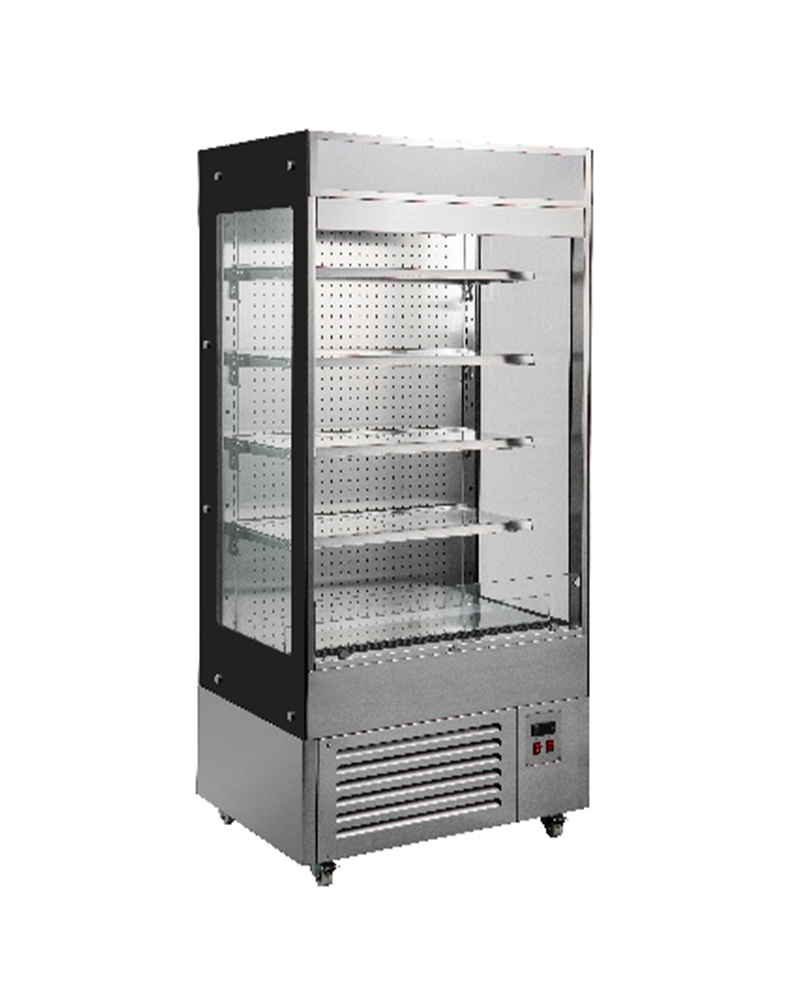
Open Sliding Doors Refrigerated Showcase XCS-520L /520Z /720Z /920Z /1120Z
1. The Role of a Refrigerated Display Showcase in Modern Retail
Commercial refrigeration equipment has two connected responsibilities. The first is preservation. Chilled foods must be held within a suitable temperature range to protect freshness and help maintain food safety. The second is presentation. Products must be easy to see, easy to reach, and arranged in a way that supports customer decisions.
A basic storage refrigerator can preserve food, but it is not designed to encourage purchasing. A refrigerated display showcase is different because its front-facing design places the merchandise at the center of the shopping experience. Customers can see packaged foods, beverages, desserts, dairy products, prepared meals, sandwiches, salads, and other chilled products before opening the door or asking an employee for assistance.
The XCS series is especially suitable for businesses that need a balance between open merchandising and controlled access. The display area is designed for visibility, while the optional sliding doors can help reduce direct exposure to the surrounding environment. This flexibility allows the same product family to serve different retail strategies.
In a high-traffic store, open display can support quick customer access. In a location where energy control, dust protection, or product security is more important, sliding doors can provide an additional barrier. The availability of multiple models and configurations makes the series more adaptable than a single-size cabinet intended for only one type of operation.
2. Product Overview and Model Range
The product family consists of several nominal capacity and width options. The supplied specifications identify the XCS-520L and XC-520Z as 520-liter models, while the XC-720Z is a 720-liter model. The series title also includes the XC-920Z and XC-1120Z, extending the range for businesses that require larger display capacity.
The 520-liter versions are appropriate for smaller supermarkets, convenience stores, cafés, bakeries, and compact foodservice locations. They offer a practical balance between display volume and footprint. The 720-liter version provides a wider merchandising area for stores with a broader product selection or higher daily turnover.
The model naming also indicates that different configurations may use different refrigeration arrangements and electrical specifications. For example, the XCS-520L is listed with an input power of 1,350 W, while the XC-520Z and XC-720Z are listed at 690 W. Buyers should confirm the exact configuration, voltage, frequency, plug standard, and operating conditions before placing an order, particularly when purchasing for export markets.
| Model | Gross Capacity | Temperature Range | Input Power | Refrigerant | Climate Type |
|---|---|---|---|---|---|
| XCS-520L | 520 L / 18.4 cu. ft. | 2–10°C / 35.6–50°F | 1,350 W | R290 | 3 |
| XC-520Z | 520 L / 18.4 cu. ft. | 2–10°C / 35.6–50°F | 690 W | R290 | 4 |
| XC-720Z | 720 L / 25.4 cu. ft. | 2–10°C / 35.6–50°F | 690 W | R290 | 4 |
| XC-920Z | To be confirmed | 2–10°C target range | To be confirmed | R290 configuration | To be confirmed |
| XC-1120Z | To be confirmed | 2–10°C target range | To be confirmed | R290 configuration | To be confirmed |
Exact specifications for the XC-920Z and XC-1120Z should be confirmed through the quotation and technical data sheet. This is a normal purchasing step because larger cabinet versions may use different compressor arrangements, internal layouts, packaging dimensions, and electrical loads.
3. Product Visibility as a Commercial Advantage
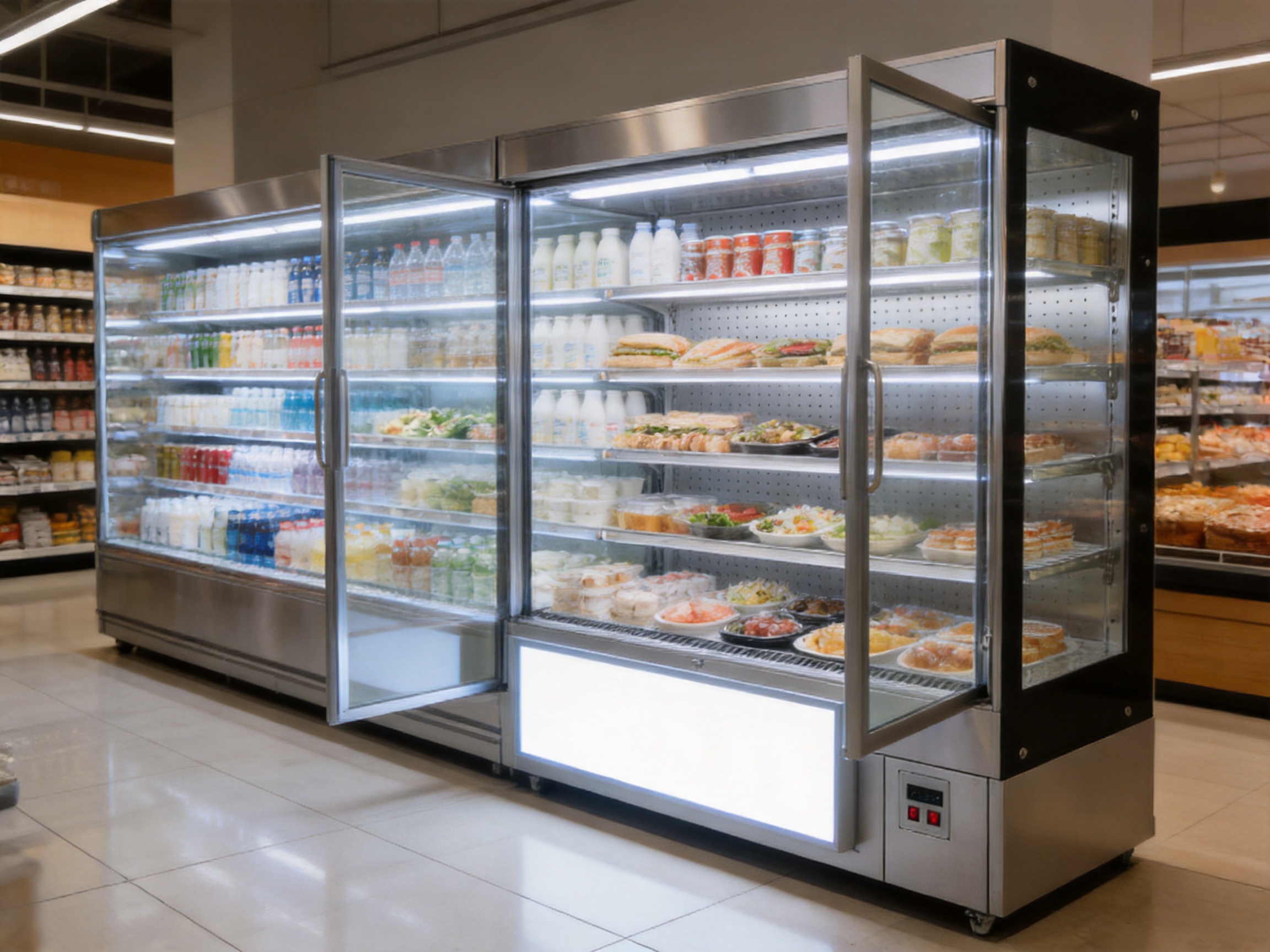
One of the most important advantages of a display cooler is the ability to merchandise products at eye level and within direct view. Tempered glass allows customers to inspect the contents without opening a door. This is valuable for products whose appearance, packaging, color, or arrangement influences purchasing decisions.
For bakeries and cafés, the cabinet can display chilled cakes, cream desserts, fruit cups, puddings, sandwiches, and prepared beverages. For supermarkets, it can present dairy products, ready-to-eat meals, packaged meats, salads, and chilled drinks. For restaurants and catering businesses, it can organize ingredients or finished products while keeping them visible to customers and staff.
Clear visibility can also reduce the time required for product selection. Customers do not need to open multiple doors or search through a deep storage cabinet. Staff can quickly identify which products require replenishment, and managers can monitor stock levels during routine operations.
The tempered-glass construction contributes to this merchandising function while providing a durable transparent barrier. Compared with ordinary glass, properly processed tempered glass is better suited to commercial environments where contact, cleaning, temperature changes, and daily handling are expected. It should still be treated carefully, and damaged glass should be replaced by qualified service personnel.
The cabinet’s light box provides a space for advertising or promotional communication. This feature can be used for product categories, seasonal campaigns, pricing messages, or store branding. A display cooler therefore becomes more than a refrigeration appliance; it becomes part of the store’s visual communication system.
4. Temperature Control and Product Protection
The specified temperature range of 2–10°C is suitable for many chilled food applications. It provides flexibility for different product categories while remaining within the general operating range expected from commercial refrigerated display equipment. The correct set point depends on the product, packaging, local food regulations, loading pattern, and operating environment.
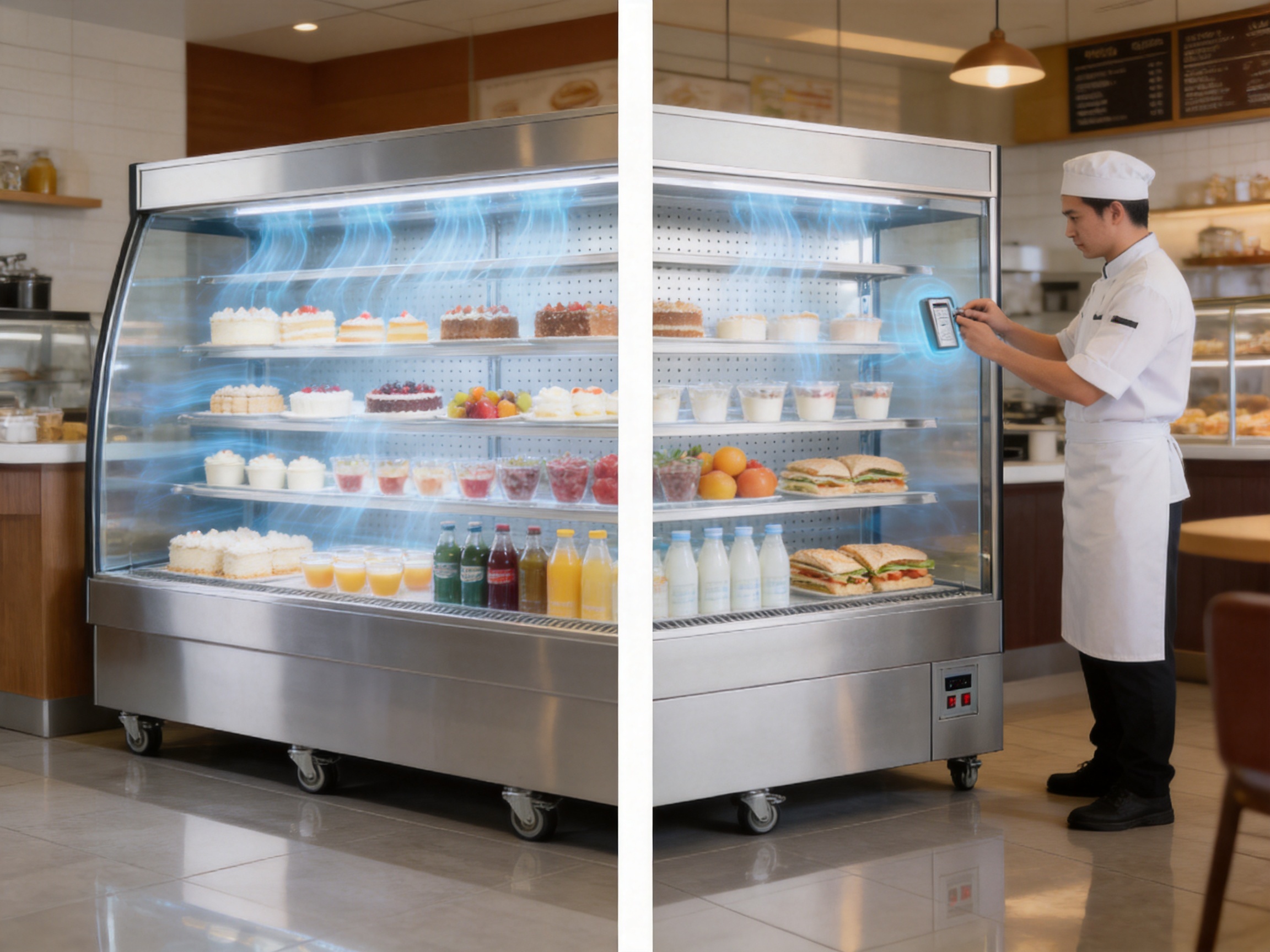
A digital temperature controller and display allow staff to check the cabinet condition without relying on guesswork. Digital monitoring supports more consistent operation because employees can see the current reading and adjust the setting when necessary. It also makes routine inspections easier for managers and service technicians.
Temperature control should not be considered separately from loading practice. Air circulation requires sufficient space around products. Overloading the shelves, blocking air outlets, or placing warm products into the cabinet in excessive quantities can reduce cooling performance. Proper merchandising should leave room for refrigerated air to move through the display area.
The ventilated cooling system is designed to distribute cold air through the cabinet rather than relying solely on natural convection. This approach can support more uniform cooling across the display area. Uniformity is especially important when the cabinet is fully stocked, because products at different levels and positions should remain within an appropriate temperature range.
Actual performance depends on ambient temperature, humidity, door or curtain configuration, product load, installation clearance, maintenance, and electrical conditions. The climate type ratings listed for the models provide guidance about the intended operating environment, but buyers should still evaluate the location carefully before installation.
Digital Monitoring for Daily Operations
The digital display supports several practical tasks. Employees can verify the operating temperature during opening checks, after restocking, and before closing. Managers can compare the displayed reading with an independent thermometer during commissioning or preventive maintenance. Service technicians can use the controller information as one part of the diagnostic process.
The separated power button and separated light button are also useful operational details. The refrigeration system and lighting can be managed independently. For example, service staff can switch off the lighting while maintaining other functions, or they can control the display illumination according to store hours and merchandising requirements.
5. Energy and Refrigerant Considerations
The series uses R290 refrigerant in the listed configurations. R290 is propane-based refrigerant used in many modern commercial refrigeration applications. It has a very low global warming potential compared with many traditional refrigerants, making it an important option for manufacturers and buyers seeking to reduce the environmental impact associated with refrigerant selection.
Because R290 is classified as a flammable refrigerant, installation, servicing, charging, and recovery must be performed by trained technicians using appropriate procedures and equipment. Operators should not attempt to open the refrigeration circuit. Safety labels, service instructions, local codes, and applicable transport requirements must be followed.
Energy performance is influenced by much more than the nominal wattage printed on a specification sheet. Ambient conditions, product temperature at loading, frequency of access, defrost operation, lighting use, condenser cleanliness, and cabinet placement all affect electricity consumption.
The optional sliding doors can provide a practical energy-management benefit in suitable operating environments. When closed, the doors reduce the exchange of refrigerated air with the surrounding room. They may also help protect products from airborne dust and reduce the effects of nearby ventilation or customer traffic. The actual energy benefit depends on usage and the quality of door adjustment and sealing.
Compared with a conventional open cabinet, a sliding-door configuration can be particularly helpful in stores that operate for long hours or in locations with warm, humid conditions. Compared with a fully enclosed upright refrigerator, the showcase offers a more direct merchandising experience. The choice should therefore be based on the store’s priorities rather than on one feature alone.
6. Construction and Materials
The stainless-steel body is a major structural feature of the cabinet. Stainless steel is widely used in commercial food equipment because it offers a clean appearance, resists corrosion under ordinary operating conditions, and can be wiped down regularly. A smooth exterior also supports professional presentation in customer-facing areas.
Food retail environments require frequent cleaning. Spills, condensation, packaging residue, and dust can accumulate quickly if the cabinet is not maintained. Stainless-steel surfaces are generally practical for routine cleaning when operators use suitable non-abrasive products and follow the manufacturer’s care recommendations.
The cabinet combines the stainless-steel body with tempered glass panels. This combination provides a balance between durability, hygiene, and visibility. The transparent surfaces make products easier to inspect, while the metal body gives the unit a robust commercial appearance.
The four castors improve mobility during installation, cleaning, and store reconfiguration. The front two castors include brakes, allowing the cabinet to be secured after positioning. This is important because a large refrigerated cabinet should not move unintentionally when customers or employees approach it.
Before loading the cabinet, installers should confirm that the floor is level and capable of supporting the equipment and its contents. The castors should be locked after final positioning. Adequate clearance around ventilation areas must also be maintained so that the refrigeration system can release heat efficiently.
Designed for Commercial Handling
Commercial equipment is exposed to more demanding use than domestic refrigeration. Doors, handles, shelves, controls, lighting, and surfaces may be used continuously throughout the day. The XCS family addresses this environment with practical features rather than unnecessary complexity.
The product’s design supports repeated access, regular cleaning, visible merchandising, and movement during installation. Its features are focused on the daily tasks that influence the total cost of ownership: loading, checking, cleaning, securing, servicing, and rearranging.
7. Open Access and Sliding-Door Flexibility
The product category is an open display cooler, but the listed options include sliding doors. This combination gives operators flexibility in how the cabinet is used. Open access is valuable when customers need to select items quickly, while sliding doors are useful when the operator wants to limit exposure to ambient air and protect the merchandise.
Sliding doors can be useful in convenience stores, hotel breakfast areas, staff canteens, and self-service food locations. They help define the customer interaction: the product remains visible, but the customer opens the cabinet only when selecting an item. In other settings, the doors may be used during non-peak hours and opened or removed according to the operating plan, if the configuration permits.
Door alignment is important. Sliding panels should move smoothly and should not be forced. Tracks should be kept clean, and operators should remove debris before it interferes with movement. A door that does not close correctly can increase air leakage and affect temperature stability.
For high-volume stores, open access may reduce service time because customers and staff can reach products without repeatedly sliding panels. For premium products, sensitive foods, or locations with strong air-conditioning currents, the door option may provide improved protection. The best configuration depends on the store layout, product type, and customer behavior.
8. Capacity and Space Planning
Gross capacity provides a useful indication of the cabinet’s overall internal volume, but merchandising capacity is affected by shelves, air channels, product packaging, and the amount of clearance required for ventilation. A 520-liter cabinet should not be filled to the point that air movement is obstructed.
The listed product dimensions for the 520-liter models are approximately 900 × 656 × 1,900 mm. The 720-liter model is approximately 1,200 × 656 × 1,900 mm. These dimensions create a tall vertical display with a relatively narrow front-to-back depth, making the equipment suitable for many retail aisles and wall-side layouts.
| Model Group | Approximate Product Dimensions | Approximate Product Dimensions in Inches | Approximate Package Dimensions | 20GP / 40HQ Loading Quantity |
|---|---|---|---|---|
| 520-liter models | 900 × 656 × 1,900 mm | 35.4 × 25.8 × 74.8 in. | 970 × 750 × 2,060 mm | 17 / 36 pcs |
| 720-liter model | 1,200 × 656 × 1,900 mm | 47.2 × 25.8 × 74.8 in. | 1,270 × 750 × 2,060 mm | 12 / 27 pcs |
| 920-liter model | Confirm with order documentation | Confirm with order documentation | Confirm with order documentation | Confirm with supplier |
| 1120-liter model | Confirm with order documentation | Confirm with order documentation | Confirm with order documentation | Confirm with supplier |
In addition to cabinet width and depth, planners must consider the space needed for unpacking, installation, cleaning, and customer circulation. The packaged dimensions are larger than the finished cabinet dimensions and should be used when planning delivery access, elevators, doors, loading docks, and storage areas.
The 520-liter configuration can be installed where a store needs vertical display without occupying the floor area required by a wide multi-door case. The 720-liter version is better suited to locations that need additional horizontal merchandising space. Larger models can support centralized product categories or high-volume stores, subject to confirmation of their detailed specifications.
9. Applications Across Food Retail and Foodservice
Supermarkets and Grocery Stores
Supermarkets can use the showcase for chilled ready meals, dairy products, beverages, salads, sandwiches, desserts, and packaged foods. The vertical format allows a store to create a dedicated category display while keeping products visible from a distance.
The light box can reinforce category recognition. For example, a store may position chilled meals in one section and desserts in another, using signage to guide customers. The cabinet can also be placed near checkout areas for impulse purchases, provided the location does not obstruct customer circulation or ventilation.
Convenience Stores
Convenience stores typically need fast product access, high visibility, and equipment that can operate for long hours. A refrigerated showcase can hold bottled drinks, sandwiches, snacks, fresh fruit, dairy items, and grab-and-go meals. Sliding doors can help protect products during quieter periods or in locations where the store wants to control air exchange.
The vertical layout also makes it easier for customers to compare products. Store staff can restock from the front or rear according to the cabinet layout and operating procedure. The digital controller helps employees complete quick temperature checks during busy shifts.
Bakeries and Cafés
Cakes, pastries with cream fillings, chilled desserts, tiramisu, puddings, fruit desserts, and prepared drinks require attractive presentation. Transparent glass helps customers see product decoration and portion size, while the refrigerated environment supports the quality of temperature-sensitive items.
A bakery can position the cabinet near the point of sale to encourage additional purchases. The stainless-steel body also complements professional foodservice interiors. Operators should arrange products so that labels, decorations, and packaging face the customer without blocking air outlets.
Restaurants and Catering Operations
Restaurants may use the unit for prepared dishes, salads, desserts, beverages, or ingredients that need to remain visible and accessible. Catering operations can use it for temporary service areas, buffet support, or event preparation, provided that the installation environment meets the equipment requirements.
Because foodservice operations often involve frequent cleaning, the stainless-steel construction and accessible display format are practical advantages. Operators should establish a cleaning schedule that includes glass, shelves, door tracks, castors, air outlets, and condenser areas.
10. Manufacturing Capability and Quality Strengths
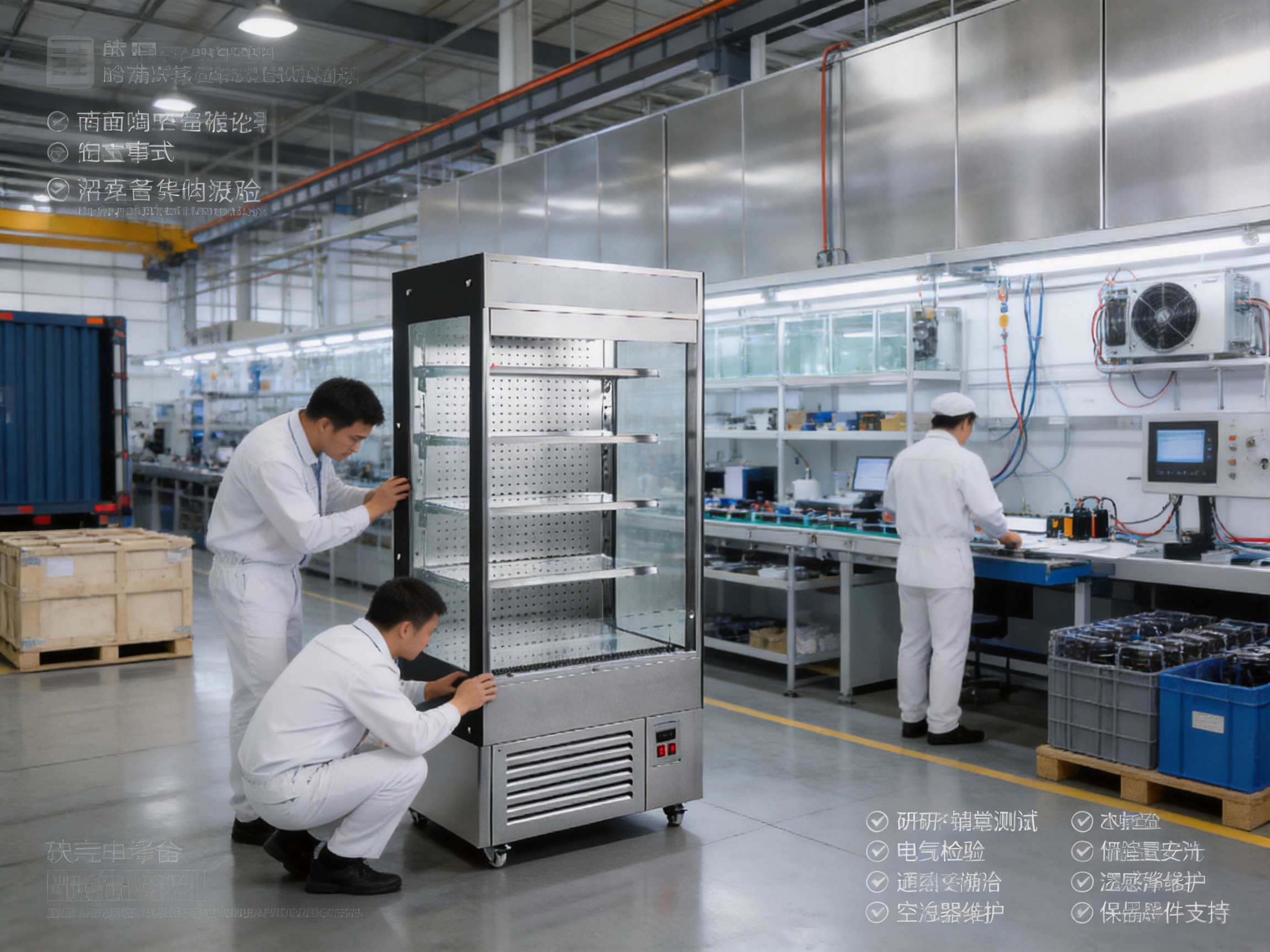
The manufacturer, Ningbo XiangChi Electrical Co., Ltd., was established in 2007 and has developed experience in vertical display cabinets, cake cabinets, warming cabinets, and related commercial refrigeration products. The company operates a modern management and production facility covering approximately 40,000 square meters.
A large manufacturing site can support organized production planning, dedicated assembly areas, controlled material movement, and more efficient coordination between engineering, testing, procurement, and quality teams. These capabilities are important for commercial refrigeration because a finished cabinet depends on the correct integration of structural parts, glass, electrical controls, lighting, insulation, refrigeration components, doors, castors, and packaging.
The company has its own professional research and development team. In commercial refrigeration, in-house development supports the ability to adapt cabinet dimensions, improve internal layouts, refine cooling performance, and respond to market requirements. It can also shorten communication between product designers, production engineers, and quality personnel.
Advanced testing facilities are another stated strength. Testing is essential because refrigeration performance cannot be judged by exterior appearance alone. A cabinet must be checked for temperature behavior, electrical operation, defrost performance, lighting, door movement, structural quality, noise, packaging protection, and other functional requirements.
The company reports certifications including CE, GS, CCC, CB, RoHS, ETL, and other major certifications. Certification requirements vary by destination market and product configuration. Buyers should request current certificates and verify that the certificate scope matches the exact model, electrical version, and intended market.
From Material Preparation to Final Assembly
A reliable commercial cabinet begins with consistent material preparation. Stainless-steel sheets must be cut and formed accurately so that panels align correctly. Glass components must be produced and inspected to the required dimensions. Insulation, shelving, electrical components, refrigeration parts, and hardware must be matched with the relevant model configuration.
During assembly, production personnel must ensure that the cabinet body remains square, the doors operate smoothly, and the refrigeration system is installed without damage to tubing or wiring. Electrical connections should be secure and protected. The controller and display should be checked before the product enters final testing.
Quality control is most effective when it is performed throughout the process rather than only at the end. Incoming material checks, process inspections, assembly verification, and final performance tests create several opportunities to identify problems before shipment. This approach can reduce rework and improve consistency between production batches.
Packaging is also an important part of manufacturing strength. Refrigerated showcases contain glass and precision components that can be damaged during handling. The listed package dimensions show that the equipment is prepared for export logistics. Proper protection, secure internal positioning, and clear handling instructions are necessary to reduce transport risk.
11. Advantages Over Basic Display Refrigerators
The XCS series offers several advantages when compared with basic display refrigerators that provide only a cabinet and a cooling unit.
First, the product combines display visibility with optional sliding-door functionality. Some cabinets are designed exclusively for open access, while others prioritize enclosed storage. This series allows buyers to select a more adaptable operating method.
Second, the cabinet includes a digital temperature controller and display. This supports more precise daily supervision than a simple mechanical dial without a visible temperature reading.
Third, the separated power and light controls give operators greater control over the cabinet’s functions. Lighting can be managed according to store hours and merchandising requirements without necessarily changing the refrigeration operating schedule.
Fourth, the stainless-steel body and tempered glass provide a professional appearance suited to customer-facing commercial spaces. The material combination is more appropriate for regular cleaning and high-frequency use than many lightweight domestic-style products.
Fifth, ventilated cooling and automatic defrost reduce the amount of manual intervention required. Automatic defrost helps limit ice accumulation, while ventilated cooling supports the distribution of refrigerated air throughout the display space.
Sixth, the range includes different capacity and width options. A buyer can use a narrower 520-liter cabinet where floor space is limited, or select a wider version for greater display capacity. This is more practical than forcing every store to use one standard size.
Finally, the use of R290 demonstrates attention to current refrigerant trends and environmental considerations. Its use must be managed according to safety requirements, but it provides a modern option for commercial refrigeration projects.
12. Installation Recommendations
Correct installation is necessary for good refrigeration performance. The cabinet should be placed on a stable, level floor with sufficient clearance around ventilation and service areas. It should not be positioned directly beside equipment that releases large amounts of heat unless the installation design accounts for that heat source.
The unit should be protected from continuous direct sunlight, strong hot-air discharge, and excessive moisture. High ambient heat can increase compressor workload and reduce energy efficiency. Extremely humid conditions can also contribute to condensation on glass and surfaces.
After positioning the cabinet, the front castor brakes should be engaged. The power supply must match the rating shown on the product nameplate. A qualified electrician should verify that the circuit, grounding, plug, and protective devices meet local requirements.
The cabinet should be allowed to stabilize at its operating temperature before being fully loaded. Products should be pre-chilled whenever possible. Loading large quantities of warm food can cause the internal temperature to rise and may extend the time needed to reach the desired range.
Sliding doors should be checked for alignment and smooth movement. If the doors are difficult to operate, staff should not force them. The tracks may need cleaning or adjustment. Any damaged glass, seal, electrical cable, or refrigeration component should be handled by qualified service personnel.
13. Maintenance and Operating Best Practices
Regular maintenance protects both product quality and equipment life. Staff should clean visible surfaces routinely and remove spills as soon as possible. Glass should be cleaned with a suitable product that does not leave heavy residue or damage seals, frames, or printed surfaces.
Door tracks should be inspected because dust and packaging fragments can interfere with sliding movement. The cabinet interior should be emptied and cleaned according to the operating schedule. Shelves should be checked for stability, and products should be arranged so they do not block air outlets.
The condenser and ventilation areas should remain free from dust. A dirty condenser can reduce heat transfer and increase the workload on the refrigeration system. Cleaning intervals depend on the environment. Stores with heavy dust, flour, grease, or frequent deliveries may need more frequent inspection.
Automatic defrost reduces manual defrost work, but it does not eliminate the need for maintenance. Operators should monitor abnormal ice formation, unusual noise, temperature fluctuations, water leakage, or repeated controller alarms. Early attention can prevent a small issue from becoming a major service problem.
Temperature readings should be recorded according to the store’s food safety procedure. An independent calibrated thermometer may be used for periodic verification. If the displayed temperature and independent reading differ significantly, the cabinet should be inspected before sensitive products are placed inside.
Efficient Merchandising Practices
Good merchandising improves both sales potential and cooling performance. Products should be grouped by category, with labels facing forward. Older products should be placed where they will be sold first, following the store’s stock rotation policy.
Operators should avoid pressing packages tightly against the rear panel or air outlets. A visually full cabinet is not necessarily an efficiently loaded cabinet. Maintaining clear air paths helps support temperature uniformity and prevents unnecessary strain on the refrigeration system.
Heavy items should be placed securely on lower shelves when possible. Fragile desserts and decorated cakes should be positioned to reduce the risk of movement or contact with glass. Products should also remain within the recommended loading boundary indicated by the manufacturer.
14. Purchasing and Customization Considerations
Commercial buyers should evaluate the application before selecting a model. Important questions include the required capacity, available width, expected daily turnover, product temperature, store climate, customer access pattern, electricity supply, door preference, and delivery route.
The buyer should confirm whether the project requires open access, sliding doors, specific shelf arrangements, a particular lighting color, customized exterior graphics, or a certain plug standard. The light box can be useful for promotional communication, but artwork dimensions and printing requirements should be confirmed during the order process.
For export projects, the buyer should request the final technical drawing, packing list, electrical data, refrigerant information, certificates, warranty terms, spare-parts policy, and installation instructions. These documents support customs clearance, local installation, service planning, and internal purchasing approval.
Container loading information is valuable for distributors and wholesalers. The listed loading quantities indicate approximately 17 units of a 520-liter configuration in a 20-foot general-purpose container and 36 units in a 40-foot high-cube container. The 720-liter model is listed at approximately 12 units in a 20-foot container and 27 units in a 40-foot high-cube container.
Actual loading quantities can vary according to packaging, container type, loading method, protective materials, and other cargo restrictions. Final logistics planning should therefore use the confirmed package dimensions and an approved loading plan.
15. Why Manufacturer Support Matters
A commercial refrigeration purchase is a long-term operating decision. The initial cabinet price is only one part of the total cost. Availability of spare parts, technical documentation, product training, warranty response, and communication with the factory can influence the value of the equipment over its service life.
A manufacturer with experience in several related product categories can offer broader technical knowledge. The company’s product background includes vertical display cabinets, cake cabinets, and warming cabinets, which suggests familiarity with the different requirements of food presentation, temperature management, glass construction, lighting, and commercial cabinet design.
In-house research and development can also support future product improvements. Buyers working with distributors or multi-store operators may benefit from discussing standardization, replacement planning, cabinet appearance, and technical compatibility across different locations.
Strong manufacturing support is particularly important for international customers. Electrical standards, documentation, certification, packaging, language requirements, and service expectations differ from market to market. Clear communication before production helps prevent delays and ensures that the delivered cabinet matches the application.
16. Q&A
Q1: What type of equipment is this product?
It is a commercial open display cooler and refrigerated showcase with a range of model sizes. The series is designed to display chilled food and beverage products while maintaining a temperature range of approximately 2–10°C.
Q2: Which products can be displayed in the cabinet?
Typical applications include beverages, dairy products, sandwiches, salads, ready meals, chilled desserts, cakes, puddings, fruit cups, packaged foods, and other products that require refrigerated display. The exact suitability depends on the food manufacturer’s storage requirements and local regulations.
Q3: Does the product have sliding doors?
Sliding doors are listed as an option. Buyers should confirm the exact door configuration for the selected model because the final arrangement may affect capacity, energy use, operation, and installation requirements.
Q4: What is the temperature range?
The listed temperature range is 2–10°C, or 35.6–50°F. The correct setting should be selected according to the product type, ambient environment, loading pattern, and applicable food safety requirements.
Q5: What refrigerant does the showcase use?
The listed models use R290 refrigerant. R290 has a low global warming potential, but it is flammable and must be serviced only by trained technicians following the applicable safety procedures.
Q6: What are the main advantages of the digital controller?
The digital controller provides a visible temperature reading and allows operating conditions to be managed more precisely than with a simple non-display control. It supports opening checks, routine monitoring, and service diagnostics.
Q7: Can the lighting be controlled separately?
Yes. The standard features include a separated light button and separated power button. This allows operators to manage display lighting independently from the main refrigeration operation.
Q8: Is the cabinet easy to move?
The unit is equipped with four castors, and the front two castors have brakes. This supports movement during installation and cleaning while allowing the cabinet to be secured in its operating position.
Q9: What are the approximate dimensions of the 520-liter model?
The listed product dimensions are approximately 900 × 656 × 1,900 mm, equivalent to about 35.4 × 25.8 × 74.8 inches. Buyers should use the final technical drawing for installation planning.
Q10: What is the difference between the 520-liter and 720-liter versions?
The 720-liter version provides greater gross capacity and is wider, with listed dimensions of approximately 1,200 × 656 × 1,900 mm. The 520-liter versions are narrower and may be better for locations with limited floor space.
Q11: What should be checked before ordering?
Buyers should confirm the exact model, dimensions, voltage, frequency, input power, door arrangement, capacity, shelf layout, certification, packaging, warranty, spare parts, and delivery requirements. The specifications for the XC-920Z and XC-1120Z should be confirmed directly in the final quotation.
Q12: How should the cabinet be maintained?
Operators should clean the interior and exterior, keep the glass and sliding tracks free from residue, avoid blocking air outlets, inspect the condenser and ventilation areas, monitor temperature, and arrange professional service when abnormal noise, icing, leakage, or temperature changes occur.
17. Conclusion
The Open Sliding Doors Refrigerated Showcase series is designed for businesses that need attractive chilled merchandising combined with practical commercial performance. Its core strengths include a 2–10°C operating range, ventilated cooling, automatic defrost, digital temperature control, tempered glass, stainless-steel construction, independent lighting control, castors with front brakes, and R290 refrigerant in the listed configurations.
The product range provides different capacity and width options, helping retailers and foodservice operators match the cabinet to available space and product turnover. The optional sliding doors add flexibility, allowing businesses to balance customer access, product protection, and air-exchange control.
Its value is also supported by the manufacturer’s experience, research and development capability, testing facilities, production infrastructure, and international certification experience. These strengths are important when purchasing equipment for demanding retail environments and export projects.
As with all commercial refrigeration equipment, final performance depends on correct installation, suitable loading, regular maintenance, and operation within the intended environmental conditions. When properly selected and managed, this refrigerated showcase can support product quality, efficient merchandising, professional store presentation, and dependable daily operation.
References
1. Product specification sheet for the Open Sliding Doors Refrigerated Showcase series, including the XCS-520L, XC-520Z, and XC-720Z configurations.
2. Commercial refrigeration installation and maintenance principles for ventilated display cabinets.
3. General guidance on refrigerated food display temperatures and cold-chain management.
4. Technical guidance concerning R290 hydrocarbon refrigerant safety in commercial refrigeration equipment.
5. General standards and conformity practices associated with CE, GS, CCC, CB, RoHS, and ETL-certified electrical appliances.
6. Manufacturer information concerning vertical display cabinets, cake cabinets, warming cabinets, research and development, production facilities, and quality testing.
Product: Open Sliding Doors Refrigerated Showcase XCS-520L /520Z /720Z /920Z /1120Z

You May Also Like
.jpg?imageView2/2/w/500/h/500/format/jp2/q/100 "Four Sides Glasses Display Cooler")
.jpg?imageView2/2/w/500/h/500/format/jp2/q/100 "White 4-Sided Glass Refrigerated Display Case")
.jpg?imageView2/2/w/500/h/500/format/jp2/q/100 "Refrigerated Display Cake Countertop Four Sides Glasses Display Cooler")
.jpg?imageView2/2/w/500/h/500/format/jp2/q/100 "Four Sides Glasses Display Cooler")

-
- Navigation
- Home
- About Us
- Products
- News
- Contact Us
 East Zone, Guanhaiwei Industrial Park, Cixi City, Ningbo, Zhejiang, China
 +86-574-63668678
 +86-574-63668108
Copyright © Ningbo XiangChi Electrical Co.,Ltd All Rights Reserved.
