
 简体中文
 English
 Español

News
Heated Countertop Display Warmer: A Practical Guide to XCR-25L Performance, Design, and Commercial Value
Introduction
Food presentation is an important part of modern retail, hospitality, and foodservice operations. Customers often make purchasing decisions based not only on taste, price, and convenience, but also on how appealingly products are displayed. Hot snacks, pastries, baked goods, prepared meals, breakfast items, and other ready-to-serve foods need a display solution that keeps them warm, visible, organized, and accessible. A well-designed heated display can therefore support both product quality and sales performance.
The XCR-25L heated display is a compact countertop display warmer developed for commercial environments that need reliable warming in a relatively small footprint. With a gross capacity of 25 liters, an operating temperature range of 30–90°C, an 800-watt heating system, stainless steel construction, and non-adjustable chrome-plated shelves, the unit is designed to combine practical food presentation with straightforward operation.
Unlike large floor-standing heated cabinets, this countertop model is intended for locations where space is limited or where products need to be placed directly within the customer’s line of sight. Cafés, bakeries, convenience stores, hotel breakfast areas, snack bars, quick-service restaurants, kiosks, and catering counters can all benefit from a compact warmer that supports attractive merchandising without requiring a large installation area.
This article examines the product’s construction, operating characteristics, commercial advantages, manufacturing background, maintenance requirements, and possible applications. It also explains how the unit compares with generic countertop warming equipment and why a purpose-built display warmer can provide greater value than a basic hot-holding appliance.
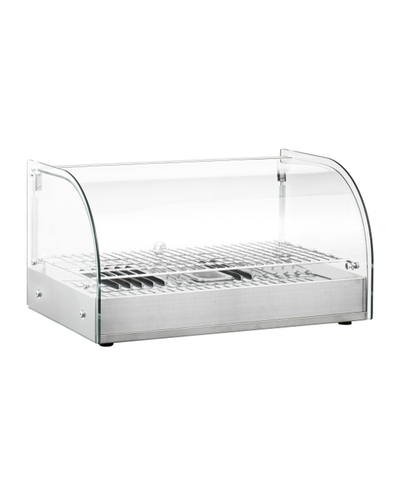
Heated Display With Non-adjustable Chrome-plated Shelves XCR-25L
Product Overview
The XCR-25L is a heated countertop display cabinet with a stated gross capacity of 25 liters, equivalent to approximately 0.9 cubic feet. Its external dimensions are 555 × 380 × 303 millimeters, or approximately 21.9 × 15.0 × 11.9 inches. These dimensions make it suitable for counters, service stations, food stalls, compact retail areas, and other locations where every square meter of working space matters.
The cabinet operates across a temperature range of 30–90°C, equivalent to 86–194°F. This range allows operators to select a suitable holding temperature for different types of prepared food. Lower settings may be appropriate for gentle warming, while higher settings can support the holding of hotter products when required by the operation and applicable food-safety procedures.
An 800-watt input power rating provides the heating capacity needed for a small commercial display. The product is not designed to replace a cooking oven or a high-volume production warmer. Instead, its role is to maintain the serving temperature and presentation quality of food that has already been prepared. This distinction is important because display warming is primarily about holding, merchandising, and service efficiency.
The product uses a stainless steel body, which contributes to durability, cleanability, and a professional appearance. Inside the cabinet are chrome-plated shelves that are non-adjustable. Fixed shelves provide consistent positioning and eliminate the need for operators to repeatedly reconfigure the interior. The shelves are intended to support organized presentation and stable loading for products of compatible size.
The unit includes an adjustable temperature controller. This feature allows the operator to adapt the cabinet’s heat level to the food type, ambient conditions, loading quantity, and service requirements. The controller gives the warmer more flexibility than equipment with only a single preset temperature.
Key Specifications
| Specification | Value |
|---|---|
| Model | XCR-25L |
| Product category | Display warmer |
| Gross capacity | 25 liters / 0.9 cubic feet |
| Temperature range | 30–90°C / 86–194°F |
| Input power | 800 watts |
| Product dimensions | 555 × 380 × 303 mm |
| Product dimensions in inches | 21.9 × 15.0 × 11.9 inches |
| Net weight | 12.5 kg |
| Gross weight | 17 kg |
| Packaging dimensions | 706 × 497 × 431 mm |
| Shelf type | Non-adjustable chrome-plated shelves |
| Body material | Stainless steel |
Design Advantages for Commercial Food Display
Compact Countertop Footprint
The primary design advantage of the XCR-25L is its compact countertop format. Many businesses do not have enough space for a large heated cabinet, especially when the same counter must accommodate a cash register, beverage equipment, refrigerated displays, packaging supplies, and customer service space. A smaller warmer makes it possible to add hot-food merchandising without redesigning the entire counter.
The width of approximately 555 millimeters provides a practical balance between display area and space efficiency. The cabinet can be positioned near a point of sale, beside a coffee machine, at the end of a buffet line, or on a service counter. Its relatively shallow depth also helps reduce interference with staff movement and customer access.
Compared with floor-standing heated cabinets, a countertop warmer can be easier to install and relocate. It does not generally require a dedicated floor position, complex anchoring, or a major change to the layout. This flexibility is particularly valuable for seasonal promotions, temporary food counters, catering operations, and businesses that frequently change their merchandising arrangement.
Visibility and Product Presentation
A display warmer must do more than produce heat. It must also present food in a way that encourages customers to purchase it. The heated display format places products where customers can see them before ordering. This can increase impulse purchases and make freshly prepared food appear more accessible and convenient.
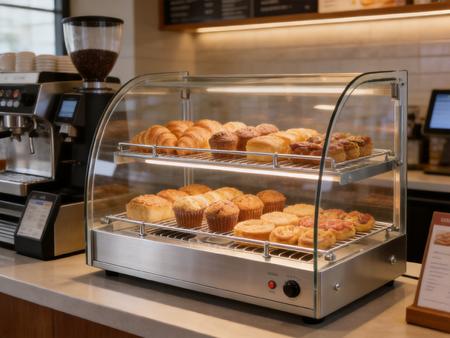
The internal chrome-plated shelves help create a structured presentation. Products can be separated by type, flavor, size, or price. For example, a café may use one shelf for filled pastries and another for savory snacks. A convenience store may present sandwiches, hot rolls, or packaged breakfast products in an organized sequence. A hotel breakfast counter may use the cabinet for selected baked goods or small prepared items.
Because the shelves are non-adjustable, the internal layout is consistent. This can be an advantage in high-frequency commercial use. Employees do not need to spend time deciding where to place shelves or repeatedly checking whether shelf supports are correctly installed. A fixed shelf arrangement also reduces the risk of loose or incorrectly positioned shelves during daily cleaning and restocking.
Adjustable Temperature Control
The adjustable temperature controller is one of the most important functional features of the unit. Different foods respond differently to heat. A delicate pastry may require gentle warming, while a dense savory item may need a higher holding setting. Ambient temperature, door-opening frequency, food quantity, and service speed can also affect internal conditions.
By providing a range from 30°C to 90°C, the XCR-25L gives operators the ability to select a suitable operating point rather than being restricted to one fixed setting. This improves day-to-day flexibility and can help reduce unnecessary energy use when a lower temperature is adequate.
Temperature control should always be used together with an operator’s food-safety plan. The cabinet is a warming and display appliance, not a substitute for safe preparation, rapid cooling where applicable, or temperature verification. Businesses should determine appropriate holding temperatures according to the type of food, local regulations, and internal procedures.
Stainless Steel Construction
The stainless steel body supports the demands of commercial foodservice. Stainless steel is widely used in professional kitchens and display equipment because it offers a combination of strength, corrosion resistance, and ease of cleaning. It also presents a clean, neutral appearance that fits many interior styles, from modern cafés to traditional bakeries.
A stainless steel exterior is especially useful in areas exposed to food particles, moisture, grease, and frequent handling. When cleaned using suitable procedures, the surface can help maintain a hygienic appearance throughout the working day. The material is also more appropriate for long-term commercial use than many lightweight domestic-grade housings.
The body’s durability can provide value over the equipment’s service life. A display warmer is often placed in a highly visible location, where dents, discoloration, or surface deterioration can negatively affect the customer’s perception of the business. A robust stainless steel cabinet helps maintain a professional presentation while supporting regular operational use.
How the XCR-25L Compares with Generic Countertop Warmers
Generic warming appliances are available in many forms, including open trays, enclosed hot boxes, household ovens, and simple heat lamps. These options may appear less expensive initially, but they do not always provide the same combination of food visibility, temperature control, structured storage, and commercial durability.
Compared with Open Heating Trays
Open heating trays can keep food warm, but they often provide limited protection from dust, accidental contact, and environmental exposure. They may also offer less organized presentation, particularly when several product types are displayed together. An enclosed display warmer provides a more defined presentation zone and can help separate the food from surrounding counter activity.
The enclosed format can also make the display look more deliberate and professional. Instead of placing food in open containers across a counter, the operator can create a compact merchandising area that is easier for customers to understand and easier for staff to manage.
Compared with Household Ovens
A household oven is primarily designed for cooking and may not offer the visibility required for retail display. Its internal racks, door design, controls, and exterior styling may be unsuitable for customer-facing use. Household equipment may also be less practical for continuous commercial operation.
The XCR-25L is purpose-built for display warming. Its countertop dimensions, shelves, stainless steel body, and display-oriented format are more aligned with retail and foodservice requirements. Businesses can use it as part of their customer-facing merchandising system instead of adapting a back-of-house cooking appliance for front-of-house service.
Compared with Heat Lamps
Heat lamps can provide localized warming and are useful in certain service environments, but they may heat the surface of food unevenly. They also leave products exposed and can create visual clutter when several lamps are required. A cabinet warmer distributes the display function within a defined enclosure, allowing products to be arranged on multiple levels.
The enclosed cabinet is especially useful when the business wants a clean, compact appearance. It keeps the heating function and product presentation together in one piece of equipment, rather than requiring separate trays, lamps, stands, or protective arrangements.
Compared with Large Floor-Standing Cabinets
Large floor-standing cabinets can provide greater capacity, but their size may not be justified for smaller operations. They require more floor space, may be more difficult to move, and can represent a larger capital investment. The XCR-25L is better suited to businesses that need a focused display for a limited range of high-turnover items.
The smaller capacity may also encourage better stock rotation. Operators can load a practical quantity of product, monitor sales more closely, and replenish the cabinet as needed. This can be preferable to filling a large cabinet with more food than the business can sell during the service period.
Commercial Applications
Bakeries and Pastry Shops
Bakeries can use the XCR-25L to display warm pastries, rolls, savory baked goods, and other ready-to-serve products. The cabinet can be positioned near the checkout counter, allowing customers to see the selection while waiting to order. It may also support a separate warm-snack section alongside refrigerated cake showcases or ambient bread displays.
For bakeries, appearance is closely connected to perceived freshness. A clean heated cabinet can communicate that selected products are ready to enjoy. Operators can use the adjustable temperature control to match the requirements of different products while maintaining a consistent display arrangement throughout the day.
Cafés and Coffee Shops
Cafés often need compact equipment because counter space is shared by espresso machines, grinders, refrigerators, payment systems, and customer pickup areas. A 25-liter countertop warmer can provide a dedicated location for breakfast items, croissants, muffins, sandwiches, and savory snacks without overwhelming the counter.
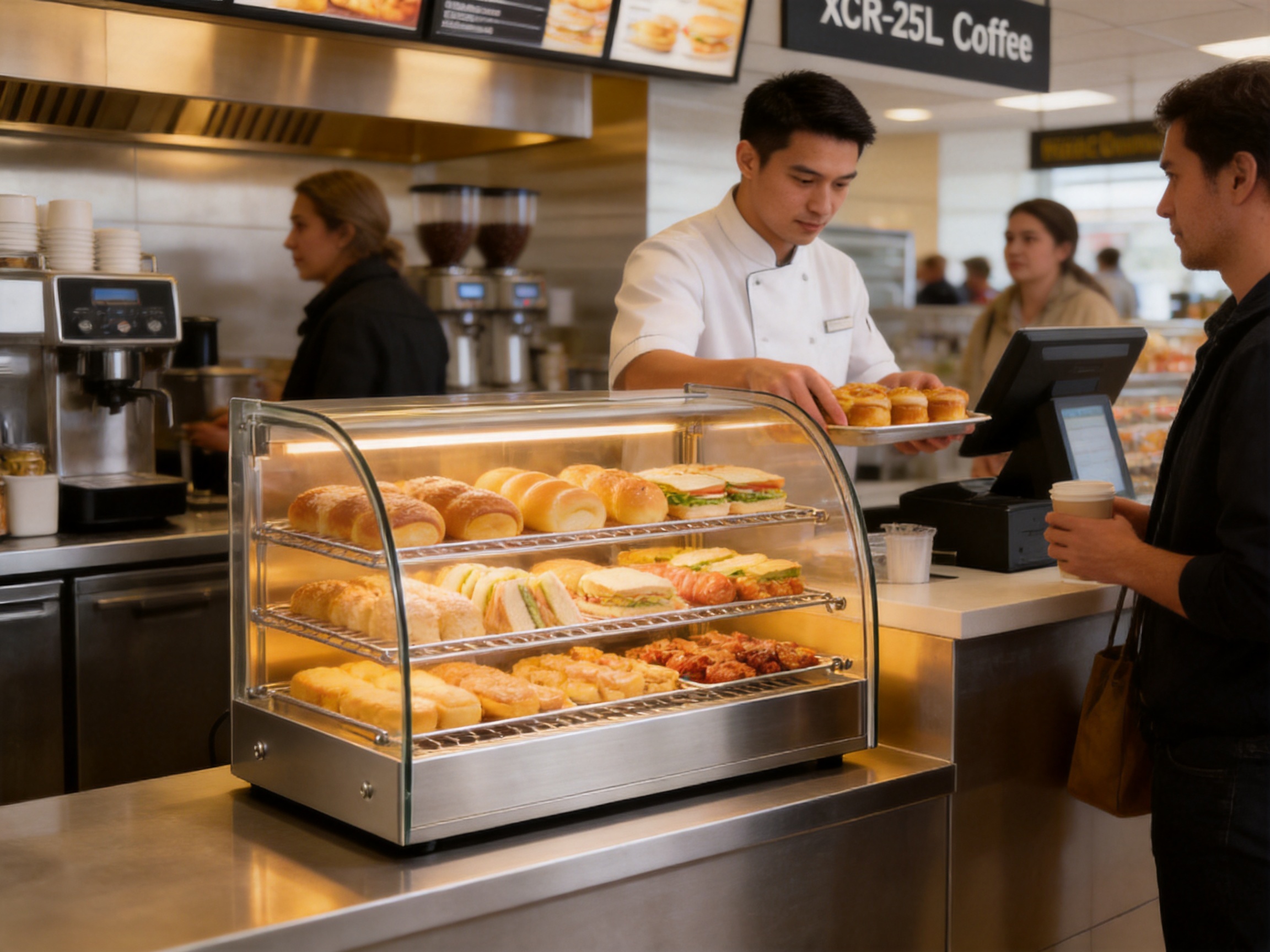
The warmer can also support bundle merchandising. For example, hot pastries may be displayed near the coffee ordering point, encouraging customers to add a food item to their beverage purchase. Because the unit is visible and accessible, staff can quickly check stock levels and replenish popular products.
Convenience Stores
Convenience stores frequently rely on quick decisions and impulse purchases. A heated display positioned near the checkout zone can draw attention to hot snacks and ready-to-eat items. The compact design allows the cabinet to be integrated into a limited retail footprint, including small neighborhood stores, fuel-station shops, and compact urban outlets.
The stainless steel body is suitable for an environment where equipment may be handled frequently and cleaned regularly. The fixed shelves also make it easier to maintain a predictable product layout, which supports quick visual inventory checks.
Quick-Service Restaurants
Quick-service restaurants can use a heated display to hold selected items during peak service periods. The cabinet may be placed near the pickup counter or in an area where staff can serve customers quickly. It can reduce the time between ordering and handover for products that have already been prepared.
The equipment is most effective when used for products with a predictable sales rhythm. Operators can load smaller batches, monitor demand, and replenish the display according to actual order patterns. This approach may help balance product availability with waste control.
Hotels and Breakfast Areas
Hotels, guesthouses, and serviced apartments can use a countertop warmer for breakfast pastries, warm rolls, filled baked goods, and selected prepared items. Its compact size makes it appropriate for buffet counters where the operator wants to provide a warm-food option without installing a large buffet cabinet.
The stainless steel appearance can complement professional hospitality environments. The temperature range also gives staff flexibility when the cabinet is used for different breakfast menus or during special events.
Catering and Event Service
Caterers can use the warmer as part of a temporary serving station. Its manageable size and 17-kilogram gross shipping weight make it more practical to transport and position than many large commercial cabinets, although the operator should always use suitable handling procedures.
At events, the cabinet can help maintain an orderly display of warm snacks while reducing the need for multiple open trays. It is suitable for selected products and moderate-volume service rather than very large banquet production. Its value is greatest when presentation and compact organization are priorities.
Capacity, Loading, and Workflow Considerations
A gross capacity of 25 liters provides useful space for a focused product assortment. The actual usable capacity will depend on the dimensions, packaging, spacing, and shape of the food being displayed. Operators should avoid overloading the shelves because excessive loading can restrict heat circulation, obstruct visibility, and make restocking more difficult.
Products should be arranged so that customers can easily identify them and staff can remove items without disturbing the rest of the display. A simple first-in, first-out rotation method can be applied where appropriate. Newly prepared products should not automatically be placed in front of older products if doing so would prevent proper rotation.
The fixed shelf design supports repeatable workflow. Staff can establish a standard layout and train employees to follow it. For example, the upper shelf may be used for smaller premium items, while the lower shelf may be used for heavier or larger products. The exact arrangement should reflect product size, customer visibility, and safe handling practices.
Because the unit is compact, it is especially important to consider the surrounding workspace. Adequate clearance should be provided for ventilation, electrical access, cleaning, and service. The cabinet should be placed on a stable, level surface that can support its operating weight and withstand exposure to commercial activity.
Energy and Operating Efficiency
The 800-watt input rating indicates the electrical power required by the heating system under specified operating conditions. Actual energy consumption may vary according to ambient temperature, selected thermostat setting, loading, door-opening frequency, and operating duration.
Efficient use begins with selecting the lowest temperature that safely and effectively meets the product requirement. Operating at the maximum setting at all times may not be necessary for every food type. A suitable temperature can help maintain quality while avoiding excessive heat exposure and unnecessary energy use.
Operators should also minimize unnecessary door opening or handling. Every opening can affect the internal temperature and increase the time required to recover the desired condition. Staff training, clear product labeling, and a planned replenishment routine can improve efficiency.
Regular cleaning also contributes to stable operation. Food residue, grease, or debris can affect surfaces, obstruct airflow, and make the equipment harder to manage. Cleaning should follow the manufacturer’s instructions, with attention to electrical safety and the use of compatible cleaning products.
Manufacturing Strengths and Quality Approach
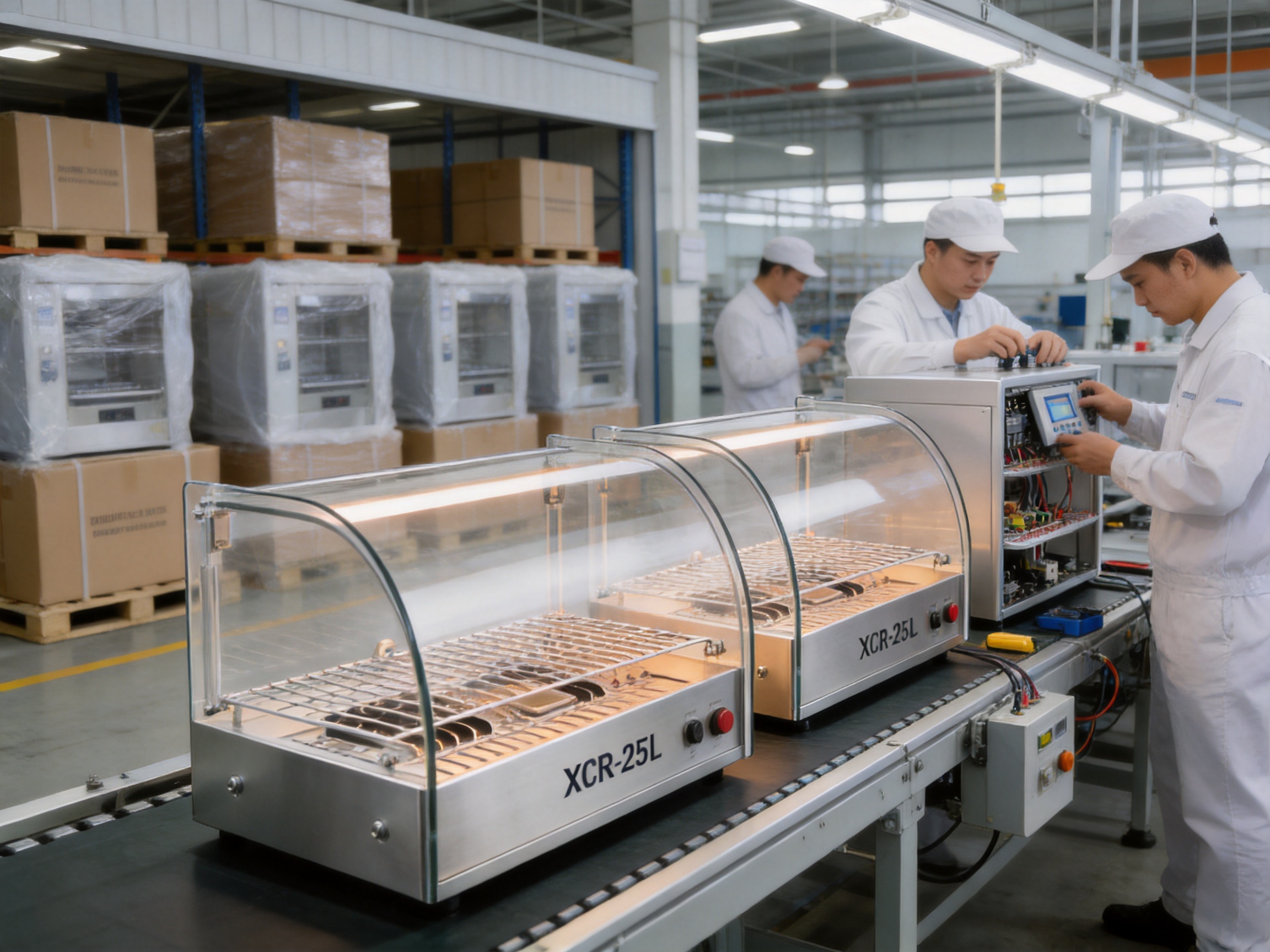
The product is manufactured by Ningbo XiangChi Electrical Co., Ltd., a company focused on vertical display cabinets, cake cabinets, and warming cabinets. The company was established in 2007 and operates a modern management and production site covering approximately 40,000 square meters. This scale provides a foundation for organized production, product development, quality control, and export-oriented manufacturing.
A dedicated professional research and development team is an important strength for a manufacturer of commercial display equipment. Product performance depends on more than the visible cabinet design. It requires attention to heating behavior, temperature control, material selection, shelf construction, electrical safety, user operation, packaging, and long-term serviceability.
Advanced testing facilities help a manufacturer evaluate products before they enter the market. Testing may cover electrical performance, temperature behavior, component reliability, structural integrity, packaging protection, and general operating safety. While individual test procedures depend on the product and destination market, a systematic testing capability supports more consistent production outcomes.
Research and Development Capability
Commercial food equipment must respond to changing customer needs. Retailers may request smaller footprints, greater visibility, improved energy performance, alternative voltage configurations, different shelf layouts, or modified exterior finishes. An established R&D team allows a manufacturer to adapt products rather than relying only on fixed, outdated designs.
For a display warmer such as the XCR-25L, design development may involve balancing cabinet size, internal volume, heating power, temperature range, surface materials, shelf spacing, and shipping dimensions. Each change can influence cost, performance, usability, and compliance. A structured engineering process helps manage these relationships.
Production and Process Control
Modern production lines support repeatability. Consistent fabrication of the stainless steel body, accurate assembly of heating components, dependable installation of the temperature controller, and secure shelf fitting all contribute to finished-product quality. Process control is particularly important when units are produced for different markets and shipped over long distances.
A well-organized factory environment can also improve material handling, work sequencing, inspection, and inventory management. These factors influence not only the quality of individual products but also the manufacturer’s ability to meet wholesale orders and maintain delivery schedules.
Testing and Certification Orientation
The company reports obtaining major international and regional certifications, including CE, GS, CCC, CB, RoHS, and ETL for applicable products and markets. Certifications are not a substitute for correct installation or responsible operation, but they demonstrate an orientation toward formal compliance and international market requirements.
For distributors and commercial buyers, certification capability can simplify market entry and product documentation. Importers should nevertheless confirm the exact certification status, voltage configuration, plug type, test report, and labeling requirements for the particular model and destination country before placing an order.
Export and Partner Support
A manufacturer with experience serving international customers is often better positioned to support distributors, wholesalers, and private-label partners. Commercial buyers may need documentation, packaging specifications, spare-parts information, electrical details, product photographs, and coordinated shipment planning.
The reported loading quantity of 175 pieces in a 20-foot general-purpose container and 438 pieces in a 40-foot high-cube container indicates that the product is suitable for organized volume logistics. Actual loading quantities can depend on packaging method, container configuration, and shipping conditions, but standardized package dimensions help buyers plan procurement and freight capacity.
Packaging and Logistics
The packaged dimensions are approximately 706 × 497 × 431 millimeters, or 27.8 × 19.6 × 17.0 inches. The gross weight is 17 kilograms, compared with a net product weight of 12.5 kilograms. The difference accounts for packaging materials and shipping protection.
Packaging is especially important for glass display equipment and electrical appliances. A suitable package should protect the cabinet from impact, vibration, compression, and moisture exposure during handling and transportation. Commercial buyers should inspect incoming shipments for visible damage and follow their receiving procedures before placing units into service.
For importers, package dimensions are useful for warehouse planning. They help determine pallet configurations, storage requirements, container utilization, and final-mile handling. A relatively compact package can reduce the space required in a distribution center and may make regional delivery easier.
Businesses purchasing multiple units should consider the complete logistics cycle, including unloading, internal movement, installation, and future relocation. Although the unit is compact compared with floor-standing cabinets, it should still be moved carefully and placed on an appropriate counter or support surface.
Installation and Commissioning
Before installation, the operator should verify that the electrical supply matches the unit’s required configuration. Voltage, frequency, plug type, grounding, and local electrical rules should be confirmed by the buyer or a qualified technician. The appliance should be connected to a suitable, properly protected outlet.
The warmer should be installed on a firm, level, heat-resistant surface. The surrounding area should provide sufficient clearance for ventilation and access to controls. It should not be placed directly beside materials that may be damaged by heat or in a location where water can easily reach electrical components.
After positioning the unit, the operator should inspect the cabinet, shelves, controller, power cord, and visible fittings. Any transit damage should be reported before operation. The first operating cycle can be used to confirm that the controller responds correctly and that the cabinet reaches the selected temperature.
Food should be loaded only after the unit has been prepared according to operating instructions. Preheating may help the cabinet reach a stable condition before products are added. The appropriate preheating period depends on the ambient environment and operating requirements.
Cleaning and Preventive Maintenance
Regular cleaning is essential for food presentation, hygiene, and equipment life. Operators should establish a cleaning schedule based on the frequency of use, product type, and local foodservice practices. Spills and crumbs should be removed promptly rather than being allowed to accumulate.
The cabinet should be switched off and disconnected from the power supply before cleaning procedures that could expose electrical parts to moisture. Abrasive tools and unsuitable chemicals should be avoided because they may scratch surfaces, damage finishes, or affect component labels.
Chrome-plated shelves should be cleaned carefully using compatible products and dried thoroughly before being returned to the cabinet. Food residue on the shelves can affect appearance and may create hygiene concerns. Fixed shelves can make cleaning more predictable because the interior arrangement remains standardized.
The stainless steel body should be wiped in a manner that preserves its appearance. Operators should pay attention to handles, corners, seams, shelf contact points, and areas near product loading. A clean exterior is particularly important because the unit is normally positioned in a customer-facing location.
Preventive maintenance should include inspection of the power cord, controller, heating performance, door or access components where applicable, shelf condition, and general cabinet stability. Any abnormal noise, odor, temperature behavior, or electrical issue should be investigated before continued use.
Food Quality and Service Performance
A heated display is most effective when the product selection matches the equipment’s purpose. Foods that benefit from short-term warm holding and visual merchandising are generally better candidates than foods that require active cooking, precise humidity control, or long-term storage.
Operators should evaluate how heat affects texture over time. Some pastries may dry out if held too long, while some savory products may lose crispness or become overly soft. Product testing under actual operating conditions can help determine appropriate temperatures, loading quantities, holding times, and replenishment intervals.
The temperature controller provides flexibility, but it does not eliminate the need for operational judgment. The selected setting should be based on the product and service plan rather than simply choosing the highest available temperature. A controlled, repeatable process supports more consistent customer experiences.
Display organization also affects service performance. Products should be easy to identify, remove, and replace. Where necessary, businesses can add labels or price signs outside the heated area, provided those additions do not obstruct ventilation, access, or visibility.
Business and Merchandising Benefits
Encouraging Impulse Purchases
Visible warm food can stimulate impulse buying, particularly when the display is placed near beverages, payment areas, or customer queues. A dedicated warmer makes the products appear intentional and available, which can be more effective than keeping them behind the counter or inside a back-of-house oven.
Supporting Product Differentiation
A display warmer gives retailers another way to distinguish fresh or warm products from chilled and ambient products. This can support menu variety and allow a business to offer a broader range of purchasing occasions throughout the day.
Improving Counter Organization
Instead of using multiple loose trays, containers, or temporary stands, a cabinet warmer consolidates the display into one defined unit. This can make the counter easier to clean and the product assortment easier for customers to understand.
Supporting Consistent Staff Procedures
The fixed internal layout and adjustable controller can help staff follow repeatable procedures. Employees can be trained to use standard temperature settings, loading patterns, cleaning routines, and stock rotation methods. Consistency is valuable in businesses with multiple shifts or multiple locations.
Purchasing Considerations for Distributors and Operators
Buyers should first identify the intended products and expected sales volume. A 25-liter cabinet is suitable for a focused assortment, but businesses requiring high-volume holding may need several units or a larger model. Capacity should be assessed based on usable shelf space rather than gross volume alone.
Electrical compatibility is another important consideration. Buyers should confirm the available voltage and frequency before ordering. Importers should also review country-specific requirements for plugs, labels, manuals, certification, and warranty documentation.
Future service support should be discussed during procurement. Important questions may include the availability of replacement controllers, heating components, shelves, electrical parts, and technical documentation. A manufacturer’s R&D, testing, and production capabilities can be valuable, but the distributor should still establish a clear after-sales process.
Packaging and freight costs should be calculated using the packaged dimensions and gross weight. Container loading information can support larger purchasing decisions, while warehouse teams should plan for safe receiving and storage.
Frequently Asked Questions
What type of equipment is the XCR-25L?
The XCR-25L is a heated countertop display warmer. It is designed to hold and present prepared food at controlled warm temperatures rather than function as a primary cooking oven.
What is its capacity?
The stated gross capacity is 25 liters, or approximately 0.9 cubic feet. Usable capacity depends on the size, shape, packaging, and arrangement of the products placed on the shelves.
Can the temperature be adjusted?
Yes. The unit includes an adjustable temperature controller and has a stated temperature range of 30–90°C, or 86–194°F.
Are the shelves adjustable?
No. The product is specified with non-adjustable chrome-plated shelves. The fixed arrangement provides consistent organization but may be less suitable for unusually tall products.
What is the advantage of fixed shelves?
Fixed shelves provide a stable, repeatable internal layout. They can simplify staff training, restocking, and daily operation because employees do not need to reconfigure the cabinet.
What is the input power?
The listed input power is 800 watts. Actual energy consumption can vary according to the selected temperature, operating time, ambient conditions, loading, and door-opening frequency.
What materials are used?
The body is made from stainless steel, and the shelves are chrome-plated. These materials support a professional appearance, regular cleaning, and commercial use.
Where can this warmer be used?
Possible applications include bakeries, cafés, convenience stores, quick-service restaurants, hotel breakfast areas, snack bars, kiosks, catering counters, and other retail or foodservice environments.
Is the warmer suitable for cooking food?
It should be treated as a holding and display appliance, not as a replacement for a cooking oven. Food should be prepared using appropriate equipment and then held according to the operator’s food-safety procedures.
How should operators select a temperature?
The setting should reflect the food type, desired serving condition, holding period, loading level, and applicable regulations. Operators should test products under actual conditions and use the lowest suitable setting that meets their requirements.
What are the product dimensions?
The product dimensions are approximately 555 × 380 × 303 millimeters, or 21.9 × 15.0 × 11.9 inches.
What are the shipping dimensions and weights?
The package measures approximately 706 × 497 × 431 millimeters, or 27.8 × 19.6 × 17.0 inches. Net weight is listed as 12.5 kilograms, and gross weight is 17 kilograms.
What should buyers confirm before ordering?
Buyers should confirm electrical specifications, destination-market compliance, packaging details, warranty terms, spare-parts availability, delivery conditions, and the exact shelf and controller configuration for the ordered model.
Conclusion
The XCR-25L heated display warmer is designed for businesses that need an attractive and practical way to hold prepared food in a compact customer-facing format. Its 25-liter capacity, 30–90°C temperature range, 800-watt heating system, stainless steel body, adjustable temperature controller, and fixed chrome-plated shelves create a balanced solution for small and medium-volume display applications.
Its principal advantage over generic warming trays and adapted household appliances is the combination of warming, visibility, organization, and commercial presentation in one countertop unit. Compared with larger floor-standing cabinets, it provides a more space-conscious option for focused product assortments and locations with limited floor area.
The manufacturer’s experience since 2007, dedicated R&D resources, modern production site, testing capabilities, and reported international certification portfolio provide a foundation for serving distributors and commercial buyers. These strengths are relevant to businesses seeking not only a single appliance but also a dependable supply partner for display equipment.
For best results, operators should match the cabinet to suitable products, avoid overloading, use temperature settings carefully, follow food-safety procedures, maintain a consistent cleaning routine, and verify electrical and compliance requirements before installation. When integrated into a thoughtful merchandising and service plan, the XCR-25L can help businesses present warm food attractively while making efficient use of valuable counter space.
References
1. Product specification sheet for the XCR-25L heated display with non-adjustable chrome-plated shelves.
2. Commercial foodservice equipment planning principles for countertop warming and display applications.
3. General stainless steel care and cleaning guidance for foodservice equipment.
4. Food safety principles for the controlled holding and service of prepared foods.
5. International commercial appliance compliance and certification documentation, including CE, GS, CCC, CB, RoHS, and ETL frameworks.
6. Manufacturer-provided company profile and production capability information for Ningbo XiangChi Electrical Co., Ltd.
Product: Heated Display With Non-adjustable Chrome-plated Shelves XCR-25L

You May Also Like





-
- Navigation
- Home
- About Us
- Products
- News
- Contact Us
 East Zone, Guanhaiwei Industrial Park, Cixi City, Ningbo, Zhejiang, China
 +86-574-63668678
 +86-574-63668108

Copyright © Ningbo XiangChi Electrical Co.,Ltd All Rights Reserved.
