
 简体中文
简体中文 English
 Español
News
Commercial Cake Display Fridge and Bakery Showcase: Performance, Design, and Manufacturing Value
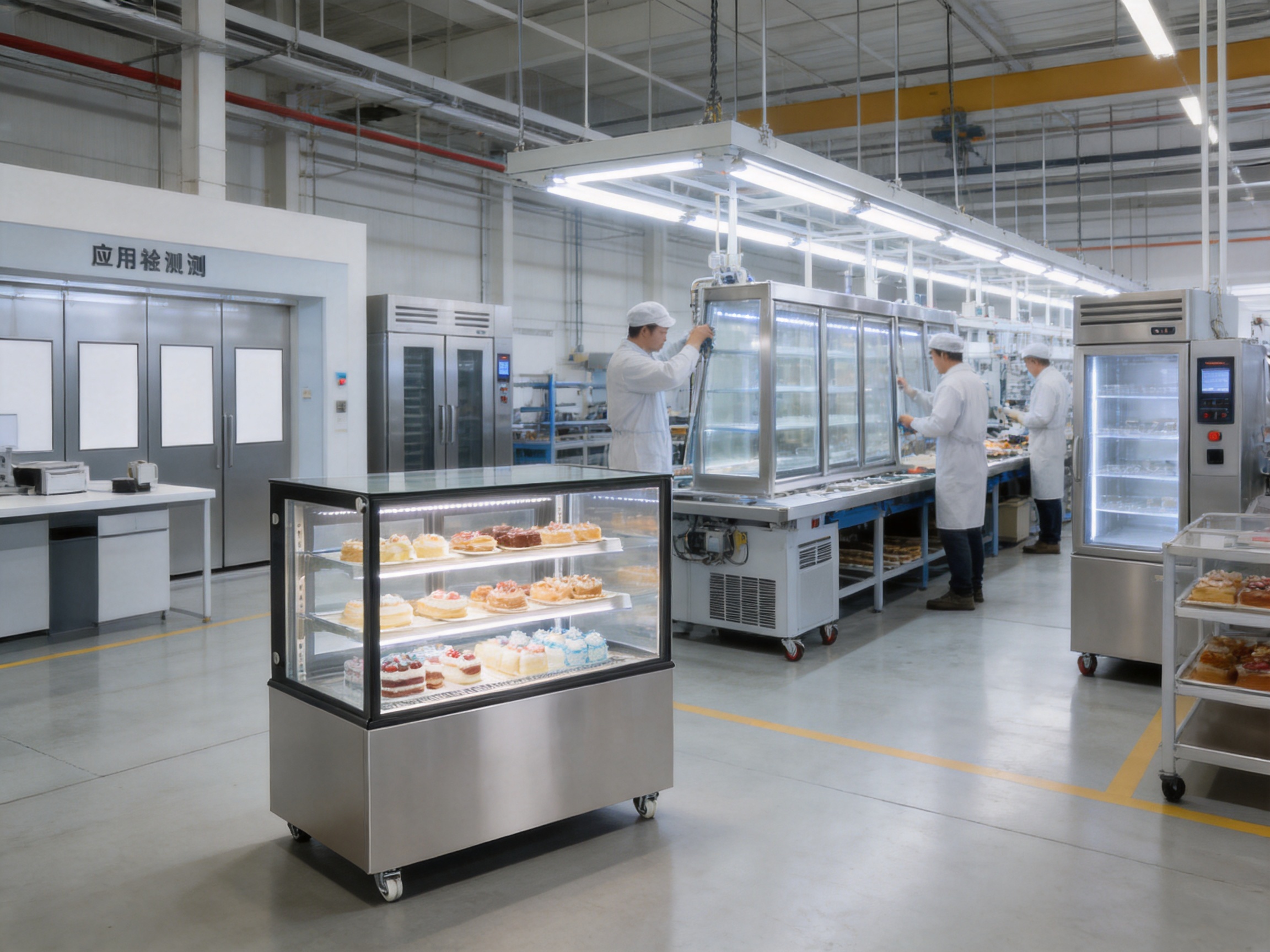
In professional bakeries, cafés, pastry shops, hotels, restaurants, supermarkets, and food-service counters, presentation is closely connected with product quality. A cake may be carefully prepared with premium ingredients and decorated with precision, yet it can lose commercial appeal if customers cannot see it clearly, if the display cabinet does not maintain a stable temperature, or if the equipment is difficult for staff to clean and operate. The XC-270Y/Z cake display fridge and bakery showcase is designed to address these practical requirements in one compact commercial refrigeration solution.
With a 270-liter capacity, a 2–8°C temperature range, double tempered glass, LED illumination, ventilated cooling, automatic defrost, sliding rear doors, and a stainless steel base, this cake showcase provides a balanced combination of product visibility, refrigerated storage, and service convenience. It is suitable for displaying cakes, pastries, desserts, sandwiches, chilled snacks, and other products that require a controlled refrigerated environment.
The cabinet is intended for businesses that need more than a simple refrigerator. It is a merchandising tool, a food-preservation appliance, and a working station positioned where customers can easily observe the products. Its four-sided visual openness helps operators use the showcase in locations where presentation from several angles is important, while the rear sliding doors allow staff to load and serve products efficiently.
Manufactured by Ningbo XiangChi Electrical Co., Ltd., the product reflects the company’s specialization in vertical display cabinets, cake cabinets, warming cabinets, and related commercial refrigeration equipment. The manufacturer combines product development, testing facilities, production capability, and international certification experience to serve professional buyers in different markets.
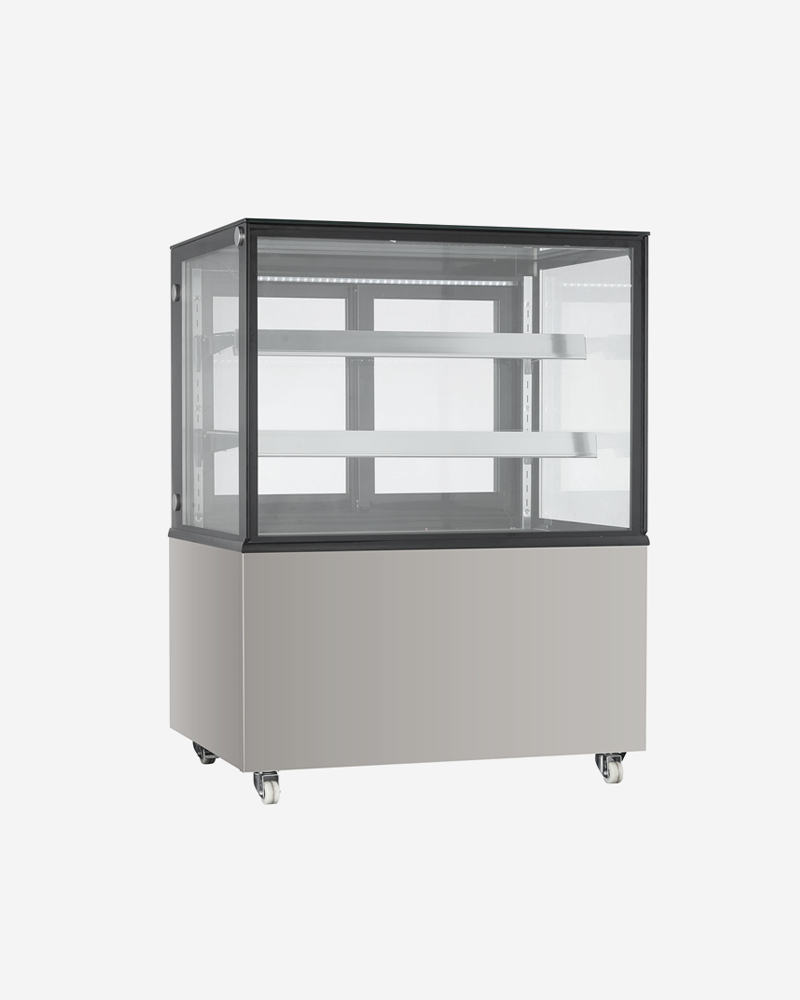
Cake Display Fridge and Bakery Showcase Cake Showcase
1. Why a Dedicated Cake Showcase Matters
A conventional upright refrigerator is mainly designed to store food. A commercial cake showcase has a broader purpose: it must preserve food while encouraging customers to purchase it. This difference affects the structure, glass arrangement, lighting, shelf design, temperature control, and access system.
Cakes and pastries are highly visual products. Frosting color, decoration, fruit toppings, chocolate finishes, cream layers, and carefully arranged portions all influence buying decisions. A dark, narrow, or fogged refrigerator can reduce the impact of these products. By contrast, a well-lit glass showcase allows customers to inspect the display without opening the cabinet, helping preserve the internal temperature and reducing unnecessary door movement.
Temperature control is equally important. Many cakes contain cream, custard, fresh fruit, mousse, dairy fillings, or other ingredients that require chilled storage. The XC-270Y/Z is specified for a temperature range of 2–8°C, a range commonly used for refrigerated bakery and dessert displays. The controlled environment helps businesses maintain product quality during service hours while keeping the display attractive and accessible.
A dedicated showcase also supports better merchandising. Products can be grouped by flavor, size, price, or occasion. Multiple shelves provide vertical display space without requiring a large floor footprint. The cabinet can be placed behind or beside a service counter, at the front of a bakery, or in a café area where customers can make a selection before ordering.
Suitable Product Applications
The principal application is refrigerated cake display. However, the cabinet can also be used for a broad range of products, depending on the operator’s food-safety procedures and local regulations. Potential applications include whole cakes, cake slices, cheesecakes, mousse desserts, cream pastries, fruit tarts, éclairs, chilled pies, sandwiches, prepared desserts, and selected dairy-based products.
For bakeries, the showcase can serve as a finished-product display near the point of sale. For cafés, it can present desserts and ready-to-serve snacks beside the ordering area. In hotels and restaurants, it can be used for buffet-style dessert presentation or as a front-of-house display. In supermarkets, the cabinet can support an attractive bakery section while maintaining a professional refrigerated environment.
The actual load should always be selected according to the product’s storage requirements, shelf spacing, packaging, air circulation needs, and local food-handling rules. The cabinet is a commercial display refrigerator, not a blast chiller or a replacement for specialized frozen storage.
2. Product Overview and Main Specifications
The product description identifies the unit as XC-270Z, while the technical information lists the model family as XC-270Y/Z. This indicates a related model designation within the same product series. Buyers should confirm the exact suffix, electrical configuration, refrigerant option, and final production specification before placing an order, particularly when purchasing for export markets with different voltage and certification requirements.
| Specification | Product Information |
|---|---|
| Model family | XC-270Y/Z |
| Nominal capacity | 270 liters |
| Temperature range | 2–8°C |
| Input power | 480 W |
| Refrigerant options | R134a or R290 |
| Climate classification | 4 |
| Net weight | 135 kg |
| Gross weight | 154 kg |
| Product dimensions | 915 × 675 × 1215 mm |
| Listed package dimensions | 1025 × 765 × 1195 mm |
| Alternative listed package dimensions | 1045 × 785 × 1180 mm |
| Lighting | Three LED light bars |
| Shelves | Two glass shelves |
| Glass construction | Double tempered glass |
| Cooling method | Ventilated cooling |
| Defrost system | Automatic defrost |
| Mobility | Four castors, two with brakes |
The 270-liter capacity places the cabinet in a practical middle range for commercial display. It is larger than many small countertop units while remaining more compact than a large multi-door display refrigerator. This makes it appropriate for businesses that want visible product volume without dedicating excessive floor space to refrigeration.
The stated product dimensions of 915 × 675 × 1215 mm provide a relatively compact footprint and a convenient display height. The exact clearance required around the cabinet depends on the installation environment, ventilation requirements, power access, and service arrangements. Operators should measure entrances, lifts, counter layouts, and final placement areas before delivery.
The net weight is listed as 135 kg, with a gross shipping weight of 154 kg. The difference reflects packaging materials and shipping protection. Because the cabinet is a substantial commercial appliance, moving and installation should be handled by trained personnel using suitable equipment and safe lifting procedures.
3. Product Visibility and Customer Appeal
The central strength of a cake showcase is its ability to make food visible. The XC-270Y/Z uses double tempered glass to provide a clear viewing area while offering improved structural strength compared with ordinary untreated glass. Tempered glass is processed to provide greater resistance to everyday mechanical stress and, if breakage occurs, to reduce the risk of large sharp shards.
Clear glass helps customers review the selection without repeatedly opening the cabinet. This supports two objectives at the same time: better customer engagement and reduced exposure of the internal compartment to warm ambient air. A stable display environment is easier to maintain when unnecessary opening is minimized.
Three LED light bars are included as standard. LED lighting is well suited to commercial display because it can provide bright, consistent illumination with relatively low heat output compared with older lighting technologies. Properly positioned light bars can emphasize the shape and color of cakes while making labels and product layers easier to see.
Lighting also influences the perceived cleanliness of the cabinet. Even illumination helps eliminate dark corners and makes it easier for staff to identify spills, crumbs, condensation, and products that require rotation. For a bakery or café, a clean and evenly illuminated display can reinforce customer confidence.
Unlike a closed opaque refrigerator, a glass showcase contributes to the visual identity of the store. It allows the products themselves to become part of the interior design. Seasonal cakes, decorated celebration cakes, colorful fruit pastries, and premium desserts can be arranged as a visual feature rather than hidden in back-of-house storage.
4. Refrigeration Performance and Temperature Management
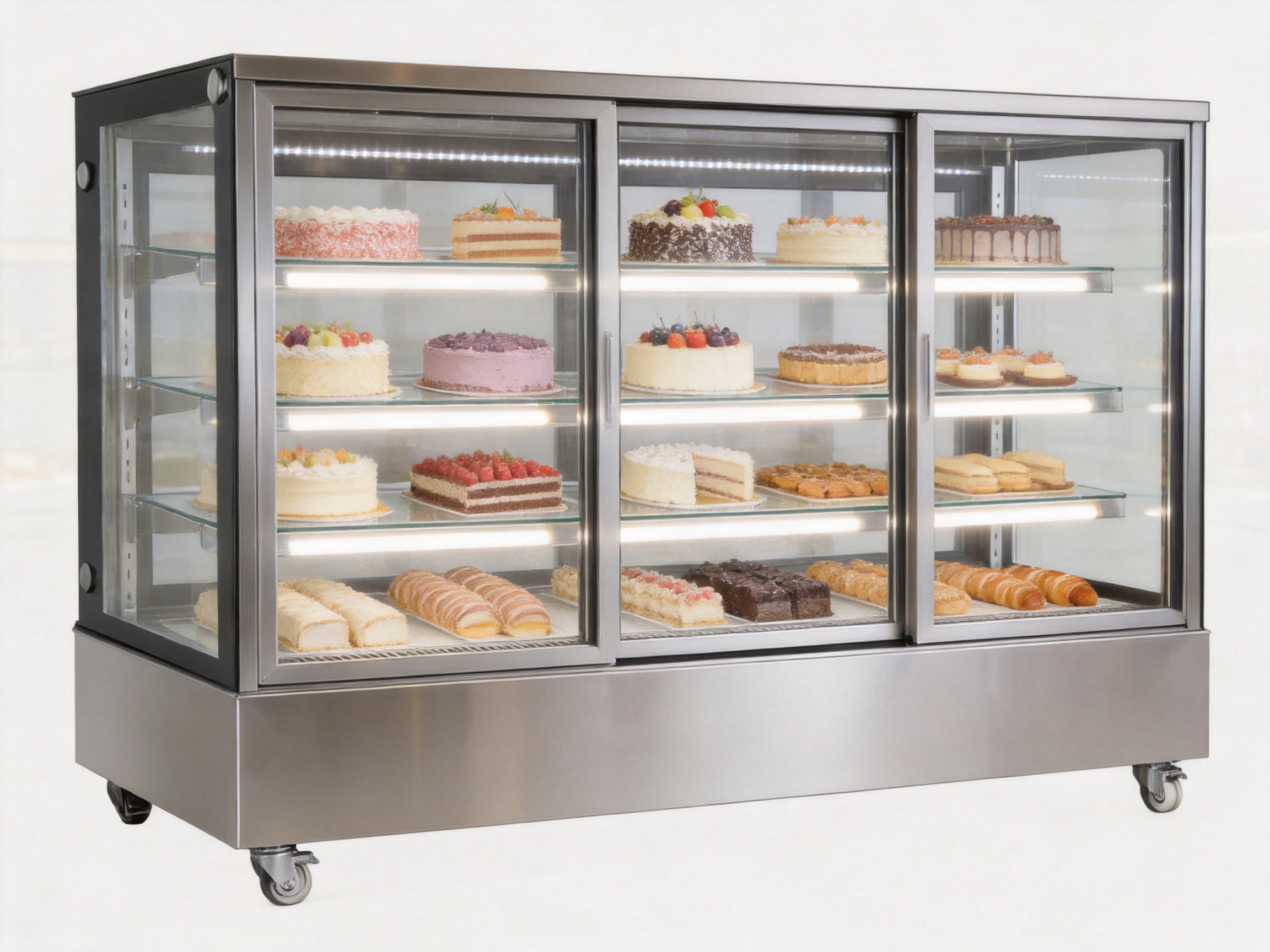
The XC-270Y/Z is specified with a 2–8°C operating temperature range. This makes it suitable for chilled display applications in which cakes and other refrigerated products must remain within a controlled temperature environment. The correct set point depends on the product formulation, loading pattern, ambient conditions, and the operator’s food-safety plan.
The ventilated cooling system is designed to circulate cooled air through the display compartment. Compared with a purely static cooling arrangement, ventilated cooling can help distribute temperature more evenly among the shelves when the cabinet is loaded correctly. It is especially useful in a showcase where several levels of products need to remain visible and appropriately chilled.
Air circulation must not be obstructed. Products should be arranged with sufficient space around them so that cooled air can move through the cabinet. Overloading shelves, covering air outlets, placing hot products inside, or blocking the return-air path can reduce cooling performance. Operators should follow the final installation and operating instructions supplied with the equipment.
The digital thermostat and display provide a clear method for monitoring and adjusting the cabinet temperature. A digital control interface is valuable in a commercial environment because staff can check the setting quickly and identify changes more easily than with a basic mechanical dial. It also supports more consistent operating procedures between shifts.
Automatic defrost is another important feature. Ice accumulation can reduce heat transfer, obstruct airflow, and increase maintenance requirements. An automatic defrost system helps manage normal frost formation without requiring staff to stop operation and manually remove ice at frequent intervals. Defrost cycles should still be considered when establishing food-handling routines, especially for sensitive products.
The listed climate type is 4. Climate classification is relevant because a commercial refrigerator may be installed in a warm or humid service environment. The cabinet’s performance depends not only on its refrigeration components but also on the ambient temperature, humidity, air movement, installation clearance, and frequency of loading. A suitable climate rating gives buyers a clearer basis for comparing equipment intended for demanding commercial use.
Refrigerant Flexibility
The product information lists R134a/R290 as refrigerant options. These refrigerants represent different technical and regulatory considerations. R290, or propane refrigerant, is recognized in many modern refrigeration applications for its low global warming potential, although it is classified as flammable and therefore requires appropriate system design, servicing procedures, and compliance with applicable standards. R134a has been widely used in refrigeration, but market regulations and phase-down policies vary by region.
Because refrigerant availability and legal requirements differ between countries, buyers should confirm which refrigerant will be supplied in the purchased configuration. Importers should also verify service capability, labeling, documentation, and local compliance before shipment. The availability of alternative refrigerant configurations can help the manufacturer adapt the product to different market expectations.
5. Construction Details That Support Daily Operation
Double Tempered Glass
Double tempered glass combines visibility with a more robust enclosure. In a commercial store, the cabinet may be exposed to repeated cleaning, customer contact, trolley movement, and frequent service activity. Stronger glass construction helps the display withstand normal use while protecting the products inside.
Glass surfaces should be cleaned with appropriate non-abrasive products. Staff should avoid striking the edges, placing heavy objects on the glass, or using unsuitable tools that could scratch or damage the surface. Good cleaning procedures preserve clarity and maintain the visual quality that makes a cake showcase commercially effective.
Sliding Rear Doors
The smooth back sliding glass doors give staff access from the service side of the cabinet. Sliding doors are practical where the display is positioned against a wall, behind a counter, or in a narrow service area. They do not require the forward swing clearance associated with hinged doors, which can help businesses use floor space more efficiently.
Rear access also supports a separation between customer viewing and staff handling. Customers can see the products from the front while employees load, remove, portion, or replenish items from the back. This arrangement can improve workflow during busy periods and reduce interruptions at the customer-facing side.
Door tracks should be kept clean and free of crumbs, packaging fragments, and spilled ingredients. Smooth operation depends on correct alignment and routine maintenance. Staff should close the doors fully after loading to support temperature stability and reduce energy loss.
Glass Shelves
Two glass shelves create multiple vertical levels for displaying products. Shelf arrangement can be adjusted according to the height of the cakes, the size of trays, and the desired visual composition. Tall celebration cakes may require more vertical clearance, while individual slices and pastries can be arranged in more compact rows.
Glass shelves help maintain a clean, modern appearance and allow light to pass through the display. They should be loaded within the recommended weight limit and removed carefully for cleaning. A sensible merchandising plan should leave enough space for air circulation and should avoid placing products directly against interior walls or airflow openings.
Stainless Steel Base
The stainless steel base provides a durable foundation for a commercial environment. Stainless steel is commonly selected for food-service equipment because it is resistant to corrosion, relatively easy to clean, and visually compatible with bakery and restaurant interiors. The base also gives the cabinet a professional appearance while supporting the refrigeration compartment and castor system.
Cleaning chemicals should be selected according to the manufacturer’s recommendations. Chloride-rich or highly abrasive substances may damage stainless steel over time. Wiping away moisture and food residue promptly helps preserve the finish and supports good hygiene practices.
Castors and Brakes
Four castors make the cabinet easier to position during installation, cleaning, or layout changes. Two castors are equipped with brakes, allowing the operator to secure the cabinet after it has been placed. This combination provides mobility when needed and stability during normal service.
The brakes should be engaged whenever the cabinet is in its operating position. The floor should be level and capable of supporting the full loaded weight. Staff should not use the cabinet as a surface to push against or attempt to move it while heavily loaded unless suitable procedures are in place.
6. Advantages Compared with Basic Display Refrigerators
Many basic display refrigerators provide cold storage, but the XC-270Y/Z combines several features specifically relevant to bakery merchandising. Its advantages are not based on one component alone. They result from the interaction of display visibility, temperature control, access design, mobility, lighting, and commercial construction.
Better Merchandising Than Opaque Refrigeration
An opaque refrigerator protects products from view, requiring customers to ask staff for assistance. This can slow service and reduce impulse purchases. The glass-front design of the cake showcase allows customers to browse independently and compare products before ordering. The visual display can also communicate freshness, variety, and premium presentation.
More Practical Than a Small Countertop Unit for Larger Displays
Small countertop refrigerators are useful where space is limited, but their capacity and shelf area may not be enough for a bakery with several product categories. The 270-liter format offers greater display volume while remaining more compact than a large floor-standing multi-section cabinet. This balance can help businesses expand their selection without immediately committing to a much larger installation.
More Efficient Service Access Than Front-Opening Cabinets in Tight Areas
Rear sliding doors are beneficial when staff work behind the cabinet. They reduce the clearance needed for door operation and allow products to be replenished without blocking the customer-facing area. In a busy café or bakery, this can support a more orderly service flow.
More Consistent Illumination Than a Single Interior Lamp
Three LED light bars can distribute illumination more effectively than a single basic lamp. Consistent lighting helps products remain visible at different shelf levels and reduces shadows. This is particularly useful for layered cakes, small pastries, and products displayed in trays.
More Convenient Maintenance Than Manual-Defrost Equipment
Automatic defrost reduces the need for frequent manual ice removal. Combined with a digital thermostat, ventilated cooling, and accessible sliding doors, it supports a simpler daily operating routine. These features do not eliminate maintenance, but they can reduce avoidable interruptions and make routine supervision easier.
More Flexible Placement Than Fixed Cabinets
The castor system allows the cabinet to be positioned according to changing store layouts. This is useful for seasonal promotions, renovations, cleaning, or event-based service arrangements. The integrated brakes help secure the cabinet once the preferred position has been selected.
7. Advantages Compared with Competing Commercial Models
Commercial refrigeration products vary widely in capacity, construction, refrigeration method, energy performance, certifications, and service support. A fair comparison should consider the complete operating value rather than focusing only on purchase price.
Compared with low-cost cabinets built primarily for short-term retail use, the XC-270Y/Z offers a more complete standard feature package. Double tempered glass, three LED light bars, automatic defrost, digital temperature control, ventilated cooling, stainless steel construction, and castors with brakes are included as part of the stated standard configuration.
Compared with larger premium cabinets, the 270-liter model may require less floor space and lower initial investment while still offering professional display characteristics. This can be particularly attractive to independent bakeries, small chains, cafés, and restaurants that need commercial performance but do not require the capacity of a full-size multideck cabinet.
Compared with cabinets using static cooling, ventilated cooling can offer better air distribution when the product load is arranged correctly. This may support more uniform refrigeration across the display area. However, buyers should compare measured performance, energy data, noise levels, and test conditions because refrigeration results depend on the entire system and installation environment.
Compared with models using ordinary glass, double tempered glass provides a stronger and more professional display enclosure. It can also contribute to a cleaner visual appearance and improved durability in customer-facing locations. Buyers should still evaluate whether additional glass specifications, anti-condensation treatment, or heated glass are required for their climate and application.
Compared with equipment from suppliers that offer limited technical support, a manufacturer with its own research and development team and testing facilities can provide greater confidence during product customization, quality improvement, and certification preparation. This is especially important for importers that need stable production, documentation, and communication over repeated orders.
8. Manufacturing Strengths and Production Capability
Ningbo XiangChi Electrical Co., Ltd. was established in 2007 and has developed experience in the commercial refrigeration field. The company is described as operating a modern management garden factory covering 40,000 square meters. A facility of this scale can support coordinated production, warehousing, assembly, quality-control activity, and product development.
The company’s product range includes vertical display cabinets, cake cabinets, and warming cabinets. This specialization is valuable because related products share knowledge in cabinet design, refrigeration systems, glass integration, lighting, electrical controls, insulation, and commercial service requirements.
Dedicated Research and Development
The manufacturer maintains a professional research and development team. In commercial refrigeration, research and development is not limited to exterior styling. It includes airflow design, refrigeration matching, thermal insulation, temperature stability, defrost performance, electrical safety, glass construction, lighting placement, user access, and manufacturing repeatability.
A dedicated R&D function allows improvements to be tested across product families. Lessons learned from a cake showcase may support the development of another display cooler, while experience with warming cabinets may contribute to better service access or control layouts. This cross-product knowledge can help the manufacturer respond to different customer requirements.
Advanced Testing Facilities
Testing facilities are important because a display cabinet must perform under defined conditions before it is shipped to customers. Testing may include temperature performance, electrical safety, insulation integrity, component operation, door function, lighting, defrost behavior, and general assembly quality. The specific tests applied to each unit or production batch depend on the manufacturer’s quality system and the destination market.
For buyers, a supplier with testing capability offers a stronger basis for quality assurance than a supplier that relies only on visual inspection. Consistent testing can identify problems earlier, reduce variation between production batches, and provide technical information needed for certification and market entry.
Production Line Integration
Advanced production lines help coordinate metal processing, cabinet assembly, refrigeration installation, electrical wiring, glass fitting, inspection, and packaging. The goal is not simply to increase output. A well-managed line can improve consistency by standardizing work instructions, component placement, torque procedures, wiring routes, sealing processes, and inspection points.
For a product such as the XC-270Y/Z, production quality depends on the relationship between many parts. The glass must fit correctly, the doors must slide smoothly, the shelves must be supported securely, the thermostat must read accurately, the cooling system must be assembled properly, and the cabinet must be packaged to withstand transportation. Production-line discipline supports all of these requirements.
Certification Experience
The company reports certifications and approvals including CE, GS, CCC, CB, RoHS, and ETL, along with other major international certifications. Certification requirements vary by product configuration and destination market, so buyers should request the relevant current documents for the exact model and electrical version being ordered.
Experience with international certification can simplify export projects. It indicates that the manufacturer is familiar with technical files, testing procedures, labeling, electrical requirements, and market-specific documentation. This does not replace the importer’s responsibility to verify local compliance, but it can reduce the administrative and technical burden of sourcing.
9. Quality-Oriented Design for Commercial Users
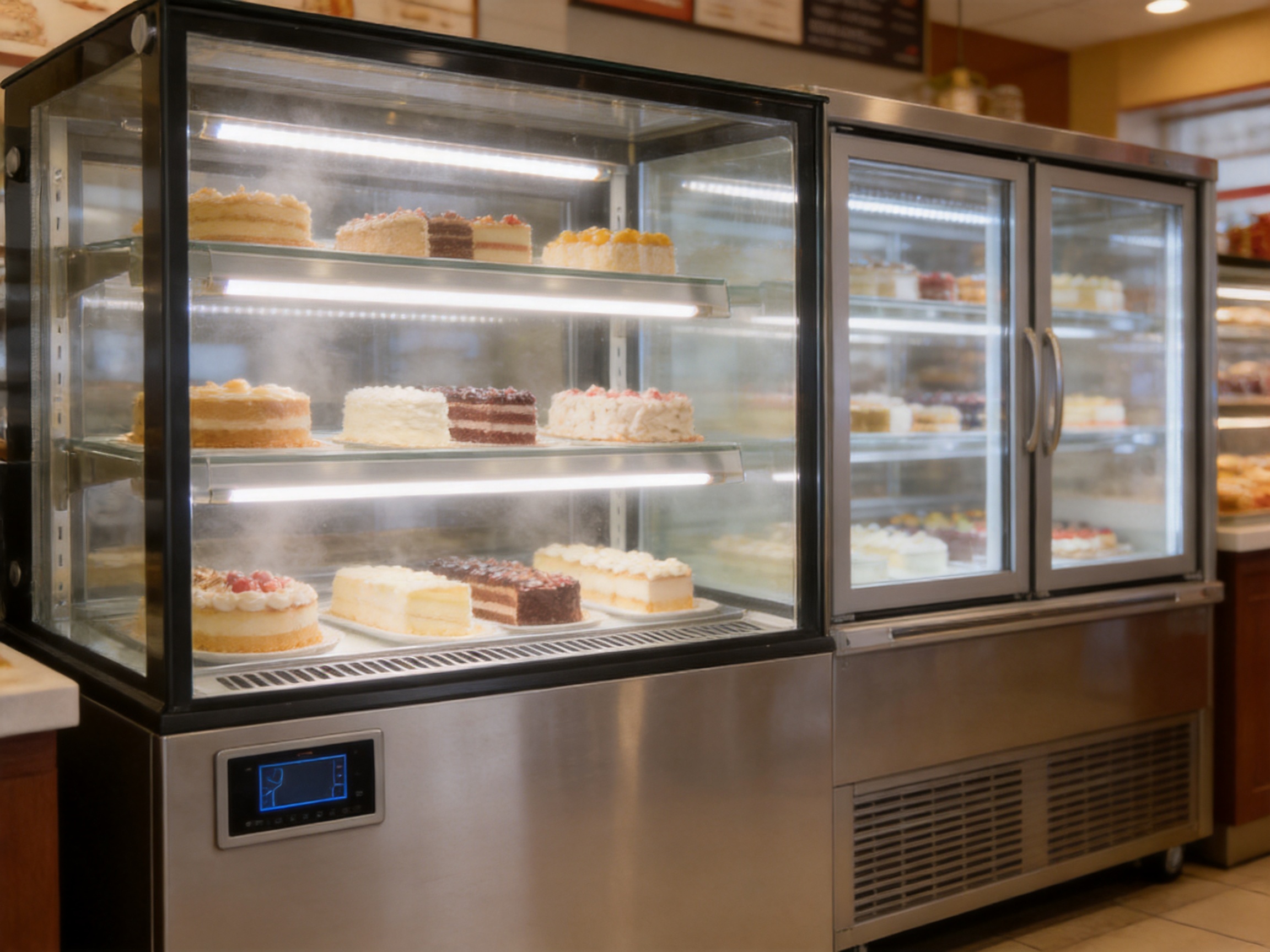
Commercial equipment must operate repeatedly, often for long hours and under changing loads. A bakery may open early, replenish products throughout the day, and continue serving customers until evening. The showcase must therefore be designed for routine use rather than occasional domestic operation.
The stainless steel base, tempered glass, digital controller, ventilated cooling, and automatic defrost all contribute to this commercial orientation. The components support practical use, but operating procedures remain essential. Equipment performance depends on correct installation, suitable ambient conditions, proper loading, regular cleaning, and timely service.
The cabinet should be installed away from direct heat sources, ovens, strong sunlight, and areas with restricted airflow. Adequate clearance around the refrigeration system helps heat dissipate. If the condenser area becomes blocked by dust or the cabinet is placed in a very hot location, energy consumption and cooling stress may increase.
Staff training should cover temperature monitoring, product loading, door closure, cleaning, castor brakes, alarm or fault response, and escalation procedures. A short daily checklist can help maintain consistency between shifts. The checklist may include checking the displayed temperature, confirming that doors close correctly, inspecting shelves and glass, removing spills, and verifying that ventilation paths are unobstructed.
10. Energy and Operating Considerations
The listed input power is 480 W. Input power is a useful reference for electrical planning, but it should not be interpreted as the exact energy consumption over a full day. Actual consumption varies according to ambient temperature, humidity, product load, set point, defrost cycles, door opening frequency, installation clearance, and refrigeration system operation.
Businesses can support efficient operation by pre-chilling products before placing them in the showcase, avoiding unnecessary door opening, keeping the sliding doors closed, maintaining clean ventilation areas, and arranging products without blocking airflow. Temperature should be set according to product needs rather than unnecessarily low values.
LED lighting can also support efficient display operation because it generally produces less heat and consumes less power than traditional lighting technologies. Reduced heat within the cabinet may lower the cooling burden, although total performance depends on the design of the lighting system and refrigeration circuit.
Automatic defrost should be allowed to operate according to the control design. Interrupting or bypassing defrost functions can cause ice accumulation and impair performance. Maintenance personnel should inspect the refrigeration system and electrical components in accordance with the service schedule and local safety requirements.
11. Installation and Commissioning Guidance
Before delivery, the purchaser should confirm the site dimensions, entrance width, floor strength, power supply, ventilation, ambient conditions, and access for future service. The listed product size and package sizes should be compared with the actual route from unloading point to installation area.
Because two package-size entries are provided in the technical information, buyers should verify the final shipping dimensions with the supplier before arranging transportation. Packaging can differ according to export method, pallet configuration, protective materials, or order requirements.
After positioning, the cabinet should be leveled and the two locking castors engaged. The unit should be connected to a suitable electrical supply using the required grounding and protection arrangements. Electrical installation should be performed by qualified personnel where required by local regulations.
The cabinet may need time to stabilize after installation or relocation. Operators should allow the refrigeration system to reach the appropriate operating condition before loading temperature-sensitive products. The exact stabilization period should follow the supplier’s operating instructions.
Initial commissioning should include checking the digital display, LED light bars, sliding doors, shelf supports, castor brakes, cooling operation, and defrost control. Any transport damage, unusual noise, glass damage, loose components, or control irregularity should be reported before the equipment is placed into normal service.
12. Cleaning, Hygiene, and Maintenance
Product presentation depends on cleanliness. Fingerprints, crumbs, frosting residue, condensation, and dust can quickly reduce the professional appearance of a cake showcase. A cleaning schedule should cover the glass, shelves, interior surfaces, door tracks, stainless steel base, castors, and accessible ventilation areas.
Products should be removed or protected before cleaning. Cleaning agents must be suitable for food-service equipment and compatible with glass, stainless steel, plastic components, and seals. Abrasive pads and aggressive chemicals should be avoided unless specifically approved.
The sliding door tracks deserve particular attention. Small particles can prevent smooth movement and cause misalignment. Staff should wipe the tracks regularly and check that the doors close fully. Damaged seals or rollers should be inspected by qualified service personnel.
Glass shelves should be handled carefully during removal. They should not be placed directly on hard or uneven surfaces where edge damage may occur. After cleaning, shelves must be completely dry and securely positioned before products are returned.
The refrigeration system and ventilation area should be kept free of dust. Restricted airflow can increase operating stress and reduce cooling performance. Service access should be maintained so that technicians can inspect electrical connections, refrigerant components, fans, thermostats, and defrost functions safely.
Food safety procedures should be based on the products being stored and the laws governing the business location. The cabinet’s 2–8°C specification supports refrigerated display, but it does not replace temperature records, stock rotation, allergen controls, cleaning programs, or other required food-safety measures.
13. Display Planning for Cakes and Pastries
A well-designed product arrangement can increase the commercial value of the cabinet. Larger cakes can be positioned where their decoration is easily visible, while individual slices and smaller pastries can be grouped on lower or upper shelves. Color contrast should be considered so that products do not visually blend into one another.
Labels should be placed where customers can read them without obstructing the product view. Information may include product name, flavor, portion size, price, allergens, and storage instructions. Clear labeling reduces staff interruptions and helps customers make decisions more quickly.
Products should be rotated according to the bakery’s stock-control system. Newer products should not automatically be placed in front of older products. A consistent first-in, first-out procedure can help reduce waste and maintain freshness.
The cabinet should not be filled beyond a point at which products touch the glass, obstruct airflow, or create a crowded appearance. A slightly more open arrangement can improve visibility and make premium products appear more attractive. The best display uses the available 270-liter capacity efficiently without compromising refrigeration or presentation.
Seasonal merchandising can make the cabinet more dynamic. Holiday cakes, celebration desserts, fruit-based products, chocolate collections, and limited-time pastries can be displayed in coordinated groups. The three LED light bars help make these arrangements visible throughout the service period.
14. Purchasing Considerations for Importers and Distributors
Commercial buyers should evaluate more than the cabinet’s appearance and nominal capacity. Important purchasing questions include the exact model suffix, voltage and frequency, refrigerant configuration, plug type, temperature test conditions, climate classification, certifications, packaging method, spare parts, warranty terms, lead time, and after-sales support.
Importers should request technical documentation for the exact configuration rather than relying on information from a similar model. Electrical ratings, refrigerants, packaging dimensions, and certification markings may differ by market. Confirming these details before production can prevent delays at customs or during installation.
Distributors should also consider the product’s position in their portfolio. The XC-270Y/Z can complement countertop display refrigerators, larger vertical display coolers, open display coolers, display warmers, and four-sided glass freezers. A product family allows distributors to serve customers with different capacity, temperature, and merchandising requirements.
Replacement parts and service training can influence long-term customer satisfaction. Components such as controllers, LED light bars, door hardware, fans, shelves, seals, and castors may eventually require replacement. Buyers should discuss the availability and identification of these components when establishing a commercial supply relationship.
Packaging protection is particularly important because the cabinet contains glass panels and precision-fitted doors. The listed gross weight and package dimensions should be used for transport planning, while the final shipping specification should be confirmed for each order. Inspection at delivery should include the glass, cabinet panels, doors, shelves, castors, and visible electrical components.
15. Why Manufacturer Experience Benefits the Product
A product’s performance is influenced by the capability of the organization behind it. Ningbo XiangChi Electrical Co., Ltd. has more than a decade of experience since its establishment in 2007 and focuses on commercial display and warming equipment. This experience supports familiarity with the practical needs of food retailers and food-service operators.
The company’s own R&D team can help transform customer feedback into product improvements. Commercial users often request changes related to shelf arrangement, lighting, dimensions, branding, electrical configurations, refrigerants, or market compliance. A manufacturer with internal engineering resources is better positioned to evaluate these requests than a trading company with no direct control over design and production.
A modern factory and advanced testing facilities can also support repeat orders. Consistency is essential for distributors that sell the same cabinet to multiple customers or operate under a private-label program. Repeated production should maintain stable dimensions, component compatibility, appearance, temperature performance, and documentation.
The company’s reported experience with CE, GS, CCC, CB, RoHS, ETL, and other certifications demonstrates an orientation toward international markets. Certification is not only a label applied at the end of production. It affects component selection, electrical design, testing, technical files, and manufacturing controls. International certification experience can therefore contribute to more disciplined product development.
The company states that it follows the principles of innovation, quality, and service. For a commercial refrigeration customer, these principles can be assessed through measurable factors: response speed, technical documentation, sample quality, production inspection, delivery reliability, warranty handling, and the ability to provide practical service support.
16. Limitations and Points to Confirm
Responsible product selection requires recognition of both strengths and limitations. The cabinet is designed for refrigerated display within a stated 2–8°C range. It should not be treated as a frozen display cabinet, a rapid cooling appliance, or a substitute for long-term cold storage unless the exact product specification confirms such use.
The stated 480 W input power does not by itself establish a complete energy-efficiency rating. Buyers requiring energy comparisons should request daily or annual consumption data measured under defined conditions. They should also evaluate the local climate, operating schedule, and electricity tariff.
The listed package information contains two different package-size entries. This should be clarified before shipping. The difference may reflect alternative packaging arrangements, but the final dimensions matter for freight quotation, container loading, warehouse handling, and delivery access.
The refrigerant entry lists R134a/R290 rather than identifying one universal configuration. Buyers must confirm the actual refrigerant, system charge, service requirements, and regulatory status for the destination country. R290 systems require appropriate safety procedures because the refrigerant is flammable.
Additional features such as heated glass, anti-condensation control, remote monitoring, custom colors, adjustable shelving, or special electrical versions should not be assumed unless included in the confirmed quotation. Buyers should distinguish between standard features and optional configurations before comparing competing products.
17. Recommended Use Cases
Independent Bakeries
Independent bakeries can use the cabinet to display a daily assortment of cakes and pastries near the service counter. Its 270-liter capacity can support product variety while keeping the footprint manageable. The professional glass construction and LED lighting can improve the appearance of a compact retail space.
Cafés and Dessert Shops
Cafés often need to present desserts beside coffee and beverage ordering points. Rear sliding doors allow staff to replenish products from behind the display, while customers can browse from the front. The refrigerated range is suitable for many cream-based and chilled dessert applications, subject to product-specific requirements.
Hotels and Restaurants
Hotels and restaurants can use a cake showcase for breakfast pastries, chilled desserts, banquet service, or front-of-house cake presentation. The castors may help reposition the cabinet for events or layout changes, while the brakes provide stability during service.
Supermarkets and Specialty Food Stores
Supermarkets can place the unit in a bakery or prepared-dessert section. The transparent cabinet helps customers compare products without opening a door, and the vertical shelf layout uses display height effectively. Store operators should adapt the merchandising plan to product packaging, traffic flow, and replenishment schedules.
Catering and Event Operations
Catering businesses may use the cabinet in a permanent preparation or sales location rather than as a mobile transport refrigerator. The castor system supports indoor repositioning, but the cabinet should not be moved over unsuitable surfaces or used as a transport appliance unless the manufacturer specifically approves that application.
18. Q&A
Q1: What products can be stored in this cake display fridge?
The primary application is the refrigerated display of cakes, pastries, desserts, and bakery products. It may also be suitable for sandwiches, chilled snacks, fruit tarts, mousse products, and other refrigerated foods, provided their storage requirements match the 2–8°C temperature range and the operator follows applicable food-safety procedures.
Q2: What is the capacity of the cabinet?
The nominal capacity is 270 liters. The usable display capacity can vary depending on shelf arrangement, product size, packaging, required airflow, and the space needed for staff handling.
Q3: What temperature range does the cabinet provide?
The stated temperature range is 2–8°C. The correct operating setting should be selected according to the food products, ambient conditions, and the business’s food-safety procedures.
Q4: Does the cabinet use ventilated cooling?
Yes. Ventilated cooling is listed as a standard feature. It circulates cooled air through the display compartment, although correct loading and unobstructed airflow are necessary for proper performance.
Q5: Does it have automatic defrost?
Yes. Automatic defrost is included among the standard features. The defrost system helps manage normal frost accumulation and reduces the need for frequent manual defrosting.
Q6: How many shelves are included?
The standard specification lists two glass shelves. Buyers should confirm whether additional shelves or alternative shelf arrangements are available for a particular order.
Q7: Why are three LED light bars useful?
Three LED light bars provide more consistent illumination across the display area. They help customers see cake decoration, colors, layers, and product arrangement while supporting a bright and professional retail presentation.
Q8: Are the rear doors hinged or sliding?
The standard features specify smooth rear sliding glass doors. This access design is convenient for staff working behind the cabinet and requires less front clearance than a hinged-door arrangement.
Q9: Can the cabinet be moved?
Yes. It has four castors, with two equipped with brakes. The cabinet can be repositioned on a suitable level floor, and the brakes should be engaged when it is in its operating position.
Q10: What refrigerants are available?
The product information lists R134a/R290. The exact refrigerant depends on the confirmed production configuration and destination market. Buyers should verify the refrigerant, applicable regulations, servicing requirements, and certification documents before ordering.
Q11: Is the cabinet suitable for a hot commercial environment?
The listed climate type is 4, indicating a design intended for a defined commercial climate condition. Actual suitability depends on ambient temperature, humidity, installation clearance, ventilation, and operating practices. The final technical documentation should be reviewed for the intended site.
Q12: What should be checked before installation?
Buyers should check the available floor area, entrance dimensions, package size, floor strength, power supply, ventilation clearance, ambient conditions, and service access. The final package dimensions should be confirmed because two package-size entries are listed in the product information.
Q13: Is the cabinet energy efficient?
The cabinet uses LED lighting and a controlled refrigeration system, but the supplied information does not provide a complete daily or annual energy-consumption figure. Actual energy use depends on ambient conditions, loading, set point, door openings, defrost cycles, and installation.
Q14: What makes the manufacturer suitable for international buyers?
The manufacturer has operated since 2007, maintains a professional R&D team, operates a 40,000-square-meter factory, and reports experience with CE, GS, CCC, CB, RoHS, ETL, and other certifications. Buyers should still request current documents for the exact model and market configuration.
Q15: Can the cabinet be customized?
Possible customization should be discussed directly with the manufacturer. Items such as voltage, frequency, refrigerant, color, branding, shelf layout, packaging, and certification may depend on order quantity and technical feasibility. Only confirmed quotation details should be treated as part of the final specification.
19. Final Assessment
The XC-270Y/Z cake display fridge and bakery showcase is designed for businesses that need reliable refrigerated presentation in a compact commercial format. Its 270-liter capacity provides useful display volume, while the 2–8°C range supports a broad selection of chilled cakes, pastries, and desserts. Double tempered glass and three LED light bars strengthen the merchandising function, allowing products to remain visible and attractive throughout the service period.
Ventilated cooling, automatic defrost, a digital thermostat, and display controls support practical daily operation. Rear sliding doors improve staff access, while the stainless steel base and castors with brakes contribute to durability, hygiene, mobility, and installation flexibility. Together, these features distinguish the cabinet from basic storage refrigerators and low-feature display units.
The manufacturer’s experience is another important consideration. Since 2007, Ningbo XiangChi Electrical Co., Ltd. has focused on commercial display and warming equipment. Its reported R&D capability, advanced testing facilities, modern factory, production-line resources, and international certification experience provide a foundation for serving wholesalers, distributors, project buyers, and food-service operators.
For the best result, buyers should evaluate the cabinet as part of a complete operating system. Correct installation, suitable ambient conditions, disciplined loading, regular cleaning, temperature monitoring, and planned maintenance are essential. Refrigerant configuration, electrical requirements, packaging dimensions, certification, and optional features should be confirmed before purchase.
When these factors are properly addressed, the cake showcase can become more than a refrigeration appliance. It can support product quality, improve customer choice, strengthen visual merchandising, streamline staff service, and help bakeries and food-service businesses present their products with greater consistency and professionalism.
References
1. Product specification sheet for the XC-270Y/Z cake display fridge and bakery showcase, including capacity, temperature range, dimensions, power, refrigerant, construction, and standard features.
2. Manufacturer company information for Ningbo XiangChi Electrical Co., Ltd., including company history, factory scale, R&D capability, testing facilities, product categories, and certification experience.
3. General commercial refrigeration guidance concerning temperature control, ventilated cooling, automatic defrost, cabinet loading, installation clearance, cleaning, and maintenance.
4. General food-service equipment principles relating to refrigerated display merchandising, glass safety, stainless steel hygiene, LED lighting, and customer-facing bakery presentation.
5. General international refrigeration and electrical compliance considerations for commercial display cabinets, including refrigerant selection, market-specific certification, electrical configuration, and servicing procedures.
Product: Cake Display Fridge and Bakery Showcase Cake Showcase

You May Also Like
.jpg?imageView2/2/w/500/h/500/format/jp2/q/100 "Four Sides Glasses Display Cooler")
.jpg?imageView2/2/w/500/h/500/format/jp2/q/100 "White 4-Sided Glass Refrigerated Display Case")
.jpg?imageView2/2/w/500/h/500/format/jp2/q/100 "Refrigerated Display Cake Countertop Four Sides Glasses Display Cooler")
.jpg?imageView2/2/w/500/h/500/format/jp2/q/100 "Four Sides Glasses Display Cooler")

-
- Navigation
- Home
- About Us
- Products
- News
- Contact Us
 East Zone, Guanhaiwei Industrial Park, Cixi City, Ningbo, Zhejiang, China
 +86-574-63668678
 +86-574-63668108
Copyright © Ningbo XiangChi Electrical Co.,Ltd All Rights Reserved.
