
 简体中文
简体中文 English
 Español
News
Refrigerated Display Flat Glass 4 Layer Cake Showcase for Professional Food Retail
In commercial food retail, presentation and preservation must work together. Cakes, pastries, desserts, sandwiches, sushi, prepared foods, and other chilled products need to look attractive while remaining within a safe and consistent temperature range. A display cabinet that provides excellent visibility but weak refrigeration can damage product quality. Conversely, a technically capable refrigerator with poor presentation may fail to encourage customer purchases. The refrigerated display flat glass 4 layer cake showcase is designed to address both requirements through a combination of controlled cooling, broad product visibility, practical storage capacity, energy-conscious lighting, and convenient service features.
The XC-275Y model is a 390-liter refrigerated cake showcase with a working temperature range of 2–8°C. Its four-sided display concept, flat glass presentation area, rear sliding doors, internal LED illumination, ventilated cooling, automatic defrost, stainless steel base, and castor mobility make it suitable for bakeries, cafés, restaurants, hotels, dessert shops, supermarkets, convenience stores, and catering operations. The cabinet is designed not merely as a cold storage unit, but as a sales-support tool that keeps products visible, organized, and ready for customer selection.
For operators, the value of a display refrigerator is measured by more than its nominal capacity. It must support quick service, stable operation, simple cleaning, reliable product protection, attractive merchandising, and efficient use of floor space. The XC-275Y combines these practical priorities in a commercial format intended for demanding daily use.
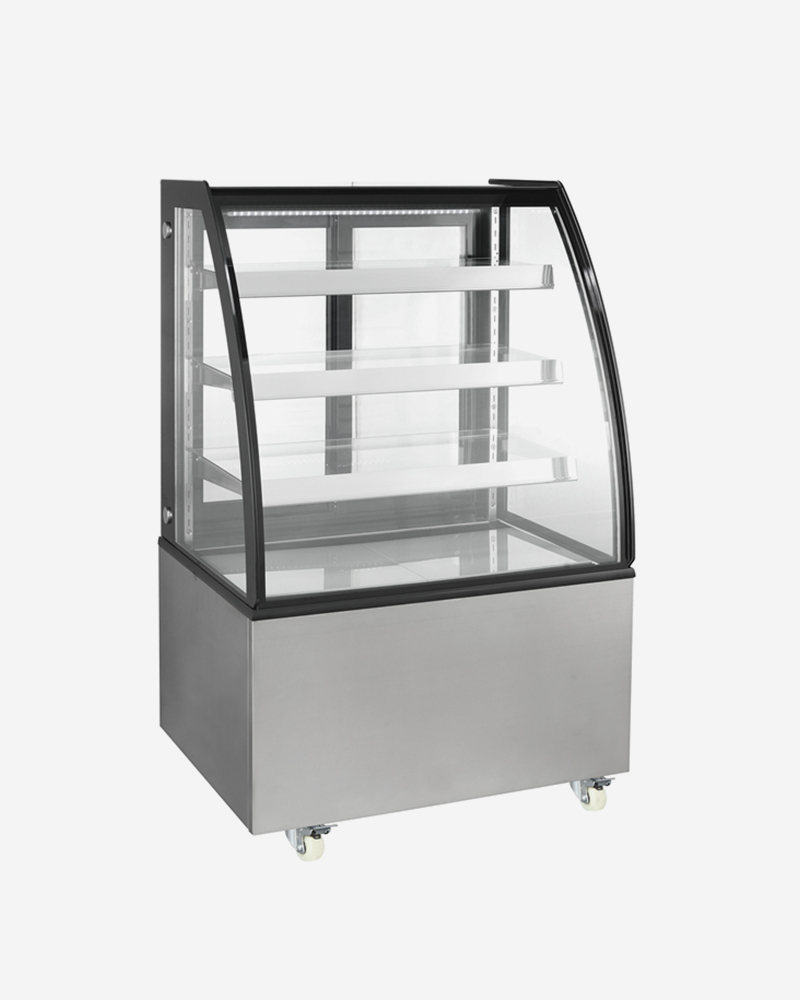
Refrigerated Display Flat Glass 4 Layer Cake Showcase
Product Overview and Commercial Purpose
The refrigerated display flat glass 4 layer cake showcase is designed for businesses that need to merchandise chilled products at the point of sale. Its flat glass format creates a clean, modern appearance and provides customers with an unobstructed view of cakes and other products arranged across the internal display levels. The cabinet allows staff to load and remove goods from the rear through smooth sliding glass doors, helping separate customer-facing presentation from service activity.
With a 390-liter capacity, the XC-275Y offers a substantial display area without the footprint of a large walk-in or multi-door supermarket cabinet. Its product size is listed as 1025 × 765 × 1395 mm, giving the unit a practical vertical format for businesses that want to use available floor area efficiently. The height supports layered product presentation, while the front-facing glass structure allows customers to compare products without opening the cabinet.
The working temperature range of 2–8°C is appropriate for many chilled bakery and food-service applications. Cakes containing cream, mousse, fruit, custard, chocolate, dairy fillings, or other temperature-sensitive ingredients can be displayed in a controlled environment when the cabinet is installed, loaded, and maintained correctly. The temperature range also supports the display of selected desserts, chilled beverages, pastries, prepared foods, and similar products, provided that the food producer’s storage requirements are followed.
The model is identified as XC-275Y. It uses a 470-watt input power rating and is specified with R134a/R290 refrigerant options in the supplied product information. Because refrigerant selection can depend on market, production configuration, regulations, and customer requirements, buyers should confirm the final refrigerant specification before ordering.
Key Technical Specifications
The following table summarizes the principal information supplied for the XC-275Y refrigerated display showcase.
| Specification | Details |
|---|---|
| Model | XC-275Y |
| Product category | Cake showcase and refrigerated display cabinet |
| Capacity | 390 liters |
| Temperature range | 2–8°C |
| Input power | 470 W |
| Refrigerant | R134a/R290, depending on configuration |
| Listed climate type | 145, as provided in the product data |
| Net weight | 175 kg |
| Product dimensions | 1025 × 765 × 1395 mm |
| Package dimensions | 1045 × 785 × 1380 mm, as provided |
| Lighting | Three LED light bars |
| Cooling method | Ventilated cooling system |
| Defrost system | Automatic defrost |
| Glass construction | Double tempered glass |
| Base construction | Stainless steel base |
| Mobility | Four castors, including two with brakes |
Some of the original specification entries appear to require confirmation before technical approval. In particular, the supplied “climate type” value is shown as “145,” and the gross-weight field is shown as “905*688*1412,” which resembles a dimensional measurement rather than a weight. The package dimensions are also supplied separately. These values should be checked against the final technical drawing, packing list, and product data sheet. This clarification process is normal in international commercial equipment procurement and helps ensure that installation, shipping, and compliance plans are accurate.
Why Flat Glass Improves Product Presentation
Glass is one of the most important features of a cake showcase because customers purchase with their eyes. A flat glass display surface presents products in a visually organized and professional manner. Straight glass panels make the cabinet appear clean and contemporary, while the transparent enclosure allows customers to see cake shapes, colors, toppings, layers, and decoration details from outside.
The use of double tempered glass provides an additional combination of strength and safety compared with ordinary single-pane glass. Tempered glass is processed to improve resistance to mechanical stress and thermal variation. In a commercial environment where doors are opened repeatedly and staff work quickly, strengthened glass can provide greater practical durability. If breakage occurs, properly tempered glass is also designed to fracture into smaller granules rather than large sharp shards, although appropriate handling and safety procedures remain essential.
Flat glass can also simplify merchandising. Products can be aligned in straight rows, making it easier for staff to create consistent visual spacing. Different cake sizes can be positioned across the available shelves, and product labels or price cards can be placed in a neat arrangement outside or below the viewing area. The result is a display that supports brand presentation without requiring excessive decoration or complicated cabinet structures.
Compared with some curved-glass showcases, a flat-glass cabinet may offer a more straightforward visual design and easier replacement planning. Glass panels, sliding doors, seals, shelves, and lighting components can be inspected more easily during routine maintenance. The clean geometry is particularly appropriate for modern bakeries, minimalist cafés, hotel dessert counters, and retail stores where equipment must complement the interior design.
Four-Level Merchandising Concept
The product title identifies the cabinet as a four-layer cake showcase. A multi-level interior allows the operator to use vertical space and separate products by type, size, flavor, price, or sales priority. Layered merchandising is especially valuable for cakes and pastries because each level can present a different visual group. For example, the upper level may display premium individual desserts, the middle levels may hold standard cakes and pastries, and the lower level may accommodate larger boxed or packaged products.
The supplied standard feature list specifies two glass shelves. This means buyers should confirm the final shelf configuration and the number of usable display levels when placing an order. Depending on the manufacturing configuration, the cabinet may be promoted as a four-layer showcase because of its internal display arrangement, while the standard component list may identify two removable glass shelves in addition to the cabinet base and upper display area. Confirmation is important for businesses with a specific merchandising plan.
Removable shelves provide useful flexibility. A bakery can adjust the distance between levels to accommodate tall celebration cakes, multi-tier desserts, cake boxes, or large trays. When the cabinet is used for individual pastries, the shelves can support a denser arrangement. When larger products are displayed, one shelf can be removed or repositioned. This adaptability helps the same cabinet serve different product ranges throughout the day or across different seasons.
Good shelf planning also supports stock rotation. Staff can place newer products behind or below older products and keep best-selling items at the most visible level. Clear organization reduces unnecessary door opening and makes replenishment faster. In a busy shop, these small operational improvements can contribute to better customer service and lower product handling time.
Stable Refrigeration from 2–8°C
The central purpose of the XC-275Y is to maintain a chilled display environment. Its stated temperature range of 2–8°C is designed for products that require refrigeration rather than frozen storage. A stable temperature helps preserve texture, appearance, flavor, and freshness while reducing the risk of excessive warming during display.
The ventilated cooling system distributes cooled air through the cabinet instead of relying only on passive cold transfer. This approach can help reduce temperature differences between different display areas when the cabinet is properly loaded and the airflow paths are not blocked. Even cooling is particularly important in a tall showcase because products positioned near the top, middle, and bottom should remain within the intended operating conditions.
Ventilated cooling also supports quicker recovery after the door is opened. Every door opening allows warmer ambient air to enter. In a retail setting, this can happen frequently, especially during busy service periods. A well-designed air circulation system helps the cabinet return to its target temperature after normal access, supporting product protection and operational consistency.
The digital thermostat and display provide a direct way to monitor cabinet temperature. Staff can view the operating condition without opening the doors, and managers can include the displayed reading in routine food-safety checks. A visible digital control system is also useful for identifying abnormal conditions early, such as a door that has not closed correctly, an overloaded shelf, blocked airflow, or a refrigeration issue.
Temperature performance depends on installation and operating conditions. The cabinet should be placed away from ovens, direct sunlight, hot air outlets, and other heat sources. Adequate clearance around ventilation areas should be maintained, and the cabinet should not be loaded beyond its designed capacity. Products should be pre-chilled before placement whenever possible. These practices help the refrigerator operate efficiently and reduce stress on the refrigeration system.
Automatic Defrost for Easier Daily Operation
Ice accumulation can reduce cooling performance and occupy valuable internal space. The XC-275Y includes automatic defrost, which helps manage frost and moisture without requiring staff to shut down the cabinet for frequent manual defrosting. This is a significant operational advantage for bakeries and food retailers that need the showcase available throughout the business day.
Automatic defrost can reduce routine labor and help maintain a more consistent display environment. Staff can focus on cleaning, replenishment, customer service, and food preparation instead of repeatedly removing ice from internal surfaces. The feature also contributes to more predictable maintenance planning because defrost cycles are integrated into the cabinet’s operating design.
Automatic defrost does not eliminate the need for cleaning. Condensation, spills, crumbs, packaging debris, and food residue still need to be removed promptly. Door seals, shelf supports, drainage areas, and accessible internal surfaces should be inspected according to the operator’s sanitation schedule. A clean cabinet looks more attractive to customers and reduces the possibility of odors or cross-contamination.
LED Illumination and Sales Visibility
The showcase is equipped with three LED light bars. Internal lighting is a direct merchandising advantage because it allows the products to remain visible even in stores with subdued ambient lighting. LED light can emphasize the color and texture of fruit, cream, chocolate, icing, and pastry layers, helping products appear fresh and appealing.
Compared with many traditional lighting technologies, LED illumination generally produces less heat and offers efficient long-term operation. Lower heat near chilled products can reduce the unnecessary thermal load placed on the refrigeration system. LED components also typically have a long service life and require less frequent replacement than older lamp technologies, although the exact service life depends on component quality and operating conditions.
Three light bars can create more balanced illumination than a single light source. When positioned correctly, they help reduce dark areas between shelves and make products on different display levels easier to see. Consistent lighting also supports professional photography and in-store promotional activity. A customer browsing a cake cabinet should be able to understand the product selection quickly without needing to open the cabinet.
Lighting should be considered as part of the overall display strategy. Products with strong color contrast, decorative toppings, or visible layers can be arranged so that the LED illumination highlights their most attractive features. Staff should avoid blocking light bars with large packaging or tall products, and any lighting covers should be cleaned as part of routine cabinet maintenance.
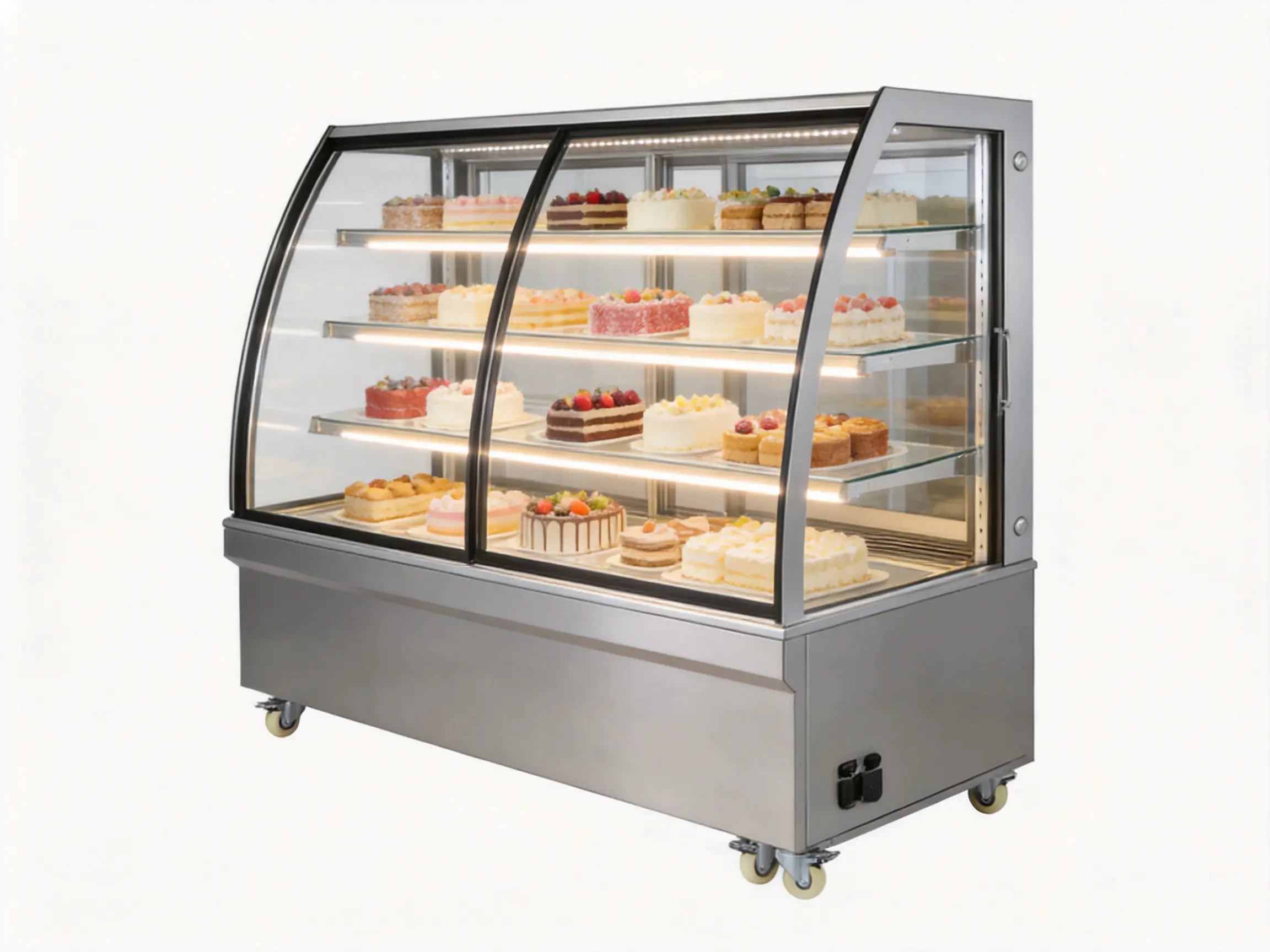
Rear Sliding Glass Doors and Service Efficiency
The XC-275Y uses smooth back sliding glass doors. This configuration separates the customer viewing side from the staff access side, making it well suited to service counters and retail displays. Staff can reach products from behind the cabinet while customers view the front. This arrangement helps maintain a controlled presentation and reduces the need for customers to operate the doors themselves.
Sliding doors can be particularly useful where front clearance is limited. Unlike hinged doors, they do not swing outward into a customer walkway or service area. This can improve traffic flow in compact cafés, bakeries, and restaurant counters. The doors can also be opened partially, allowing staff to access a specific section while limiting the amount of warm air entering the cabinet.
Smooth movement is important in high-frequency commercial use. Doors that glide properly reduce staff effort and help avoid sudden impact. Operators should keep the tracks clean and check the door seals periodically. Food particles, dust, or packaging material in the track can affect movement, while damaged seals may reduce temperature stability and increase refrigeration workload.
The rear-door arrangement also supports attractive front-of-house presentation. Customers see a clean glass façade without handles, hinges, or staff activity interrupting the display. This creates a more organized purchasing experience and allows the showcase to act as a visual centerpiece for the bakery or dessert counter.
Stainless Steel Base and Commercial Durability
The cabinet includes a stainless steel base. Stainless steel is widely used in commercial food equipment because it offers a durable, hygienic, and professional surface. It is resistant to many common cleaning agents and can be wiped down efficiently after spills or routine service activity.
The base is exposed to demanding conditions. It may encounter moisture, dust, packaging materials, accidental impacts from carts, and frequent contact with cleaning equipment. A robust stainless steel construction helps the cabinet retain a professional appearance during long-term commercial use. It also supports sanitation because smooth metal surfaces are easier to clean than porous or heavily textured alternatives.
Durability is not limited to the visible exterior. Commercial equipment must be designed for repeated loading, unloading, door operation, temperature changes, and daily cleaning. The use of tempered glass, stainless steel, digital temperature control, automatic defrost, and mobile castors reflects a product approach focused on practical service life rather than temporary display use.
Mobility with Four Castors
Four castors are fitted to the unit, with two equipped with brakes. This provides useful flexibility during installation, cleaning, layout changes, and maintenance. The cabinet can be moved into position more easily than a fixed unit, which is valuable when the store layout changes or when technicians need access to the rear and sides.
The two brakes help secure the cabinet after positioning. Locking the castors reduces unintended movement during door operation and customer service. The cabinet should be placed on a suitable level surface, and the brakes should be engaged whenever the unit is in normal operation. Mobility should not replace proper floor assessment, safe handling, or appropriate anchoring practices where local regulations require them.
Castors also make deep cleaning more practical. Dust and debris can accumulate around refrigeration equipment, especially near walls and counters. A movable showcase can be pulled forward for access, allowing staff to clean the floor and inspect ventilation areas. This supports better hygiene and can help preserve refrigeration performance by preventing dust buildup around heat-exchange components.
Advantages Compared with Conventional Display Refrigerators
Better Balance Between Display and Preservation
Some display units emphasize appearance but provide limited temperature control, while some storage refrigerators provide reliable cooling but offer poor product visibility. The XC-275Y is designed to combine both functions. Its temperature range, ventilated cooling, digital thermostat, and automatic defrost support chilled storage, while the flat tempered glass, LED lighting, and multi-level interior support merchandising.
Efficient Use of Vertical Space
A vertical cabinet can present a broad selection without requiring a large horizontal footprint. This is valuable for businesses with limited floor space or high rental costs. By using multiple levels, operators can display more product categories within one organized cabinet. The vertical layout can also draw customer attention from across the shop because the products are positioned at different visual heights.
Professional Customer-Facing Appearance
Double tempered glass, flat lines, stainless steel, and integrated lighting create a clean commercial appearance. The unit can fit into premium bakery interiors as well as practical supermarket or convenience-store environments. A professional cabinet supports customer confidence because it communicates cleanliness, organization, and investment in product quality.
Reduced Service Disruption
Rear sliding doors allow staff to serve customers while remaining behind the display. Automatic defrost reduces manual intervention, and castors make access easier during cleaning or service. Together, these features can reduce disruption during routine operation compared with a cabinet that requires frequent shutdowns, front access, or difficult repositioning.
Adaptable Product Merchandising
Removable or adjustable glass shelves can accommodate products with different heights and dimensions. This flexibility makes the cabinet useful for more than one product line. A bakery may use it for cakes in the morning, individual desserts during the afternoon, and packaged chilled products during a promotional period. The cabinet becomes a flexible retail asset rather than a single-purpose fixture.
Manufacturing Strengths and Quality-Oriented Production
The manufacturer, Ningbo XiangChi Electrical Co., Ltd, is identified as a professional producer of vertical display cabinets, cake cabinets, and warming cabinets. The company was established in 2007 and operates a modern management garden factory covering 40,000 square meters. This production scale provides a foundation for organized manufacturing, product development, testing, assembly, quality control, and international order fulfillment.
A dedicated professional research and development team is an important advantage in commercial refrigeration manufacturing. Display cabinets must balance thermal performance, cabinet geometry, airflow, glass design, lighting, electrical safety, serviceability, and appearance. An experienced R&D team can evaluate these elements together rather than treating them as isolated components. This integrated approach is essential for developing products that perform reliably in real retail environments.
Advanced testing facilities support the transition from design concept to commercial product. Refrigeration equipment must be evaluated under controlled conditions to verify temperature behavior, electrical performance, component operation, defrost function, door sealing, lighting, and general reliability. Testing helps identify issues before products are shipped and provides information for continuous improvement.
The company reports certification experience that includes CE, GS, CCC, CB, RoHS, ETL, and other major international certifications. Certification requirements vary by market and by exact product configuration. Buyers should request the current certificates and confirm that they apply to the ordered model, voltage, refrigerant system, and destination market. Nevertheless, experience with multiple certification systems demonstrates an understanding of the regulatory expectations associated with global commercial refrigeration.
Manufacturing capability is also reflected in production-line organization. A modern factory can support repeatable assembly processes, standardized component installation, inspection checkpoints, and controlled packaging. Repeatability is particularly important for commercial cabinets because customers expect the same dimensions, temperature performance, shelf configuration, electrical characteristics, and finish across multiple units.
Quality improvement should continue beyond final assembly. Supplier control, incoming component inspection, process checks, refrigeration-system testing, electrical safety inspection, cosmetic review, and packaging verification all contribute to product consistency. A cabinet may contain many interconnected parts, including compressors, condensers, evaporators, fans, thermostats, door systems, lighting, glass, shelves, castors, and control components. Each element must be assembled and verified as part of the complete system.
Research, Development, and Product Innovation
Commercial refrigeration is a competitive industry in which product innovation must respond to practical customer needs. Retailers want better visibility, lower operating complexity, improved energy performance, easier cleaning, reliable temperature control, and attractive designs. The XC-275Y reflects several of these priorities through its digital display, LED lighting, ventilated cooling, automatic defrost, tempered glass, and mobile base.
Product development also requires attention to regional requirements. Different markets may use different electrical voltages, plugs, refrigerants, climate conditions, food-safety standards, and certification procedures. A manufacturer with international experience is better positioned to adapt products and documentation to specific customer requirements. Buyers should discuss voltage, frequency, plug type, refrigerant, climate rating, packaging, language of manuals, and certification before confirming an order.
Innovation does not always mean adding complex features. In many commercial environments, the most valuable improvements are straightforward: doors that slide smoothly, shelves that can be cleaned easily, lights that show products clearly, castors that simplify movement, controls that are easy to read, and refrigeration systems that maintain consistent temperatures. Practical innovation can reduce training requirements and improve the daily experience of staff.
Installation and Operating Recommendations
The showcase should be installed in a clean, dry, and adequately ventilated indoor location. It should not be placed directly beside ovens, cooking lines, hot-water equipment, radiators, or areas exposed to strong sunlight. Excessive ambient heat can increase refrigeration demand and make it more difficult for the cabinet to maintain its target temperature.
Before loading products, the cabinet should be allowed to reach its operating temperature. Cakes and other chilled products should preferably be cooled before being placed inside. Loading warm products can raise the internal temperature and increase the time required for recovery. Products should be arranged so that air can circulate around them, and internal air outlets should never be blocked.
The cabinet should not be overloaded beyond the available shelf area or the manufacturer’s recommended loading pattern. Excessive product density can restrict airflow and reduce visibility. A well-organized display usually performs better than a crowded one because it supports circulation, improves product presentation, and makes stock rotation easier.
The digital thermostat should be checked regularly. Operators can establish a daily monitoring routine that records the displayed temperature at opening, during peak service, and at closing. If the temperature moves outside the intended range, staff should check whether the doors are fully closed, the cabinet is overloaded, the surrounding temperature is excessive, or the ventilation path is obstructed. Persistent problems should be referred to qualified service personnel.
Food products should be arranged according to their specific storage requirements. The 2–8°C operating range is a general cabinet specification and does not replace product-specific food-safety instructions. Cakes with cream, dairy, eggs, fresh fruit, or other sensitive ingredients may have distinct handling requirements. Operators remain responsible for following local food regulations and safe food-handling procedures.
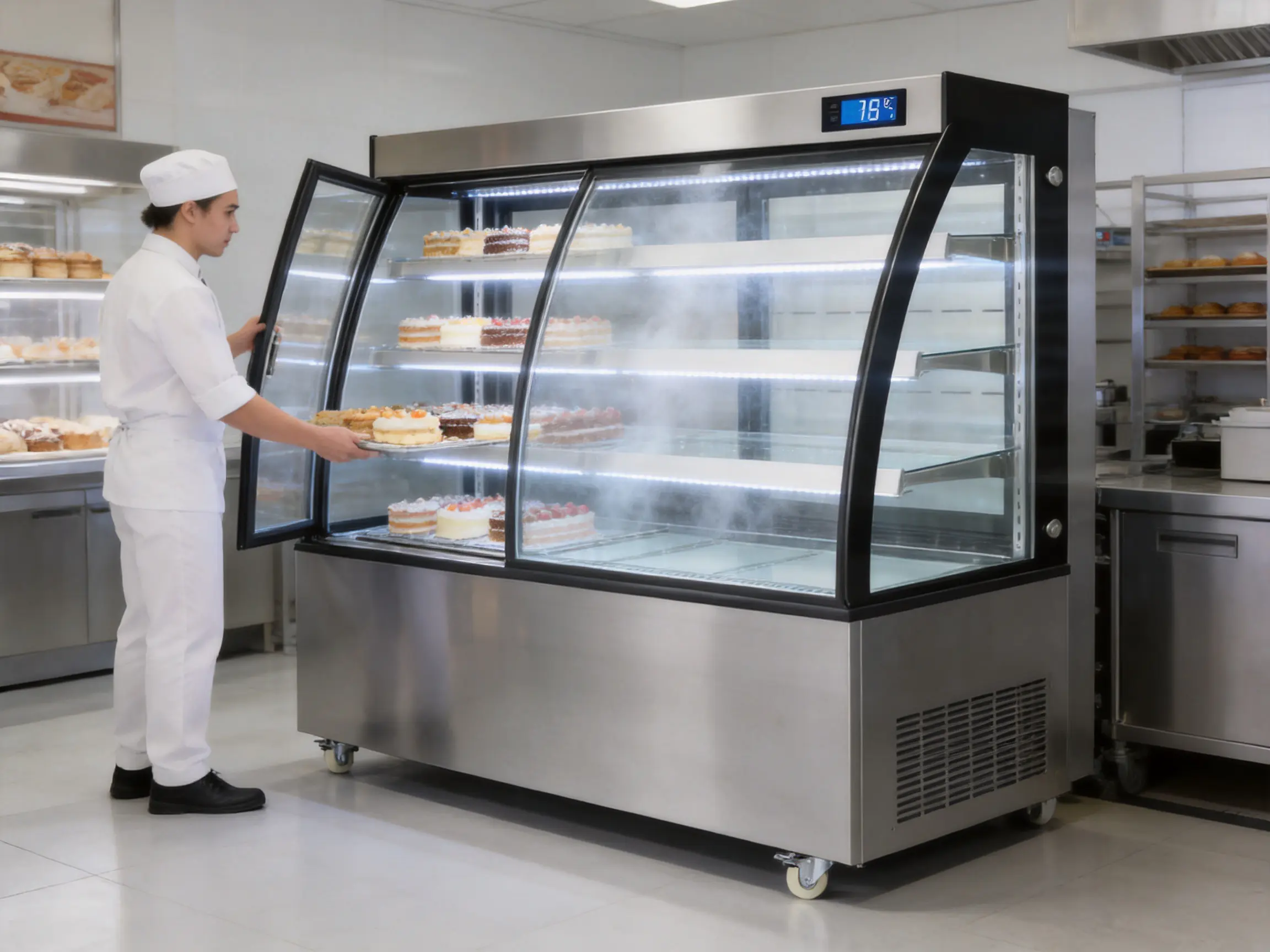
Cleaning and Preventive Maintenance
Regular cleaning protects both hygiene and appearance. The glass should be cleaned with a suitable non-abrasive product, while shelves and internal surfaces should be washed using procedures appropriate for food-contact environments. Strong chemicals that may damage seals, coatings, stainless steel, or electrical components should be avoided unless approved for the relevant surface.
Spills should be removed as soon as possible. Cream, icing, fruit juice, chocolate, and syrup can become difficult to clean if allowed to dry. Prompt cleaning also helps prevent unpleasant odors and keeps the display attractive to customers. Staff should use clean cloths and avoid abrasive pads that could scratch glass or metal surfaces.
Door tracks require particular attention because sliding doors depend on smooth movement. Dust, crumbs, and packaging fragments should be removed from the track. Door seals should be checked for cracks, deformation, or loss of contact. A properly closing door helps retain cold air and reduces the refrigeration load.
Ventilation openings and refrigeration components should be kept free from dust. The frequency of cleaning depends on the environment. A busy bakery with flour, sugar, and packaging dust may require more frequent inspection than a low-dust retail environment. Maintenance personnel should follow safe electrical procedures and disconnect power when required before servicing components.
Castors and brakes should also be inspected. The cabinet must remain stable during operation, and damaged castors should be replaced promptly. When moving the showcase, staff should use suitable handling methods and avoid pulling it by glass doors, shelves, or electrical cables.
Applications Across Different Businesses
Bakeries and Pastry Shops
For bakeries, the showcase can display celebration cakes, individual slices, mousse cakes, cheesecakes, fruit tarts, cream pastries, and seasonal desserts. The glass enclosure protects products from unnecessary customer contact while allowing staff to present a broad selection. Multiple levels help separate premium products from everyday items or organize products by size and price.
Cafés and Coffee Shops
Cafés can use the cabinet to place chilled desserts beside the ordering counter. Customers can see cakes and pastries while choosing coffee or other beverages. The vertical display format makes efficient use of limited counter-side space, and rear access allows employees to replenish products without interrupting the customer-facing presentation.
Hotels and Catering Operations
Hotels may use refrigerated showcases in breakfast areas, banquet preparation zones, lobby cafés, or dessert counters. Catering businesses can use them for temporary event service, provided that the electrical supply, ambient conditions, transportation, and food-safety procedures are suitable. The castors make repositioning easier when a service area changes.
Restaurants and Sushi Counters
Restaurants may use a chilled display for desserts, cold appetizers, prepared dishes, or selected sushi products, subject to product-specific temperature and hygiene requirements. The transparent cabinet helps customers understand the available selection and supports efficient service during busy periods.
Supermarkets and Convenience Stores
Retail stores can use the showcase for premium cakes, packaged desserts, chilled pastries, or ready-to-eat products. The lighting and glass design help attract attention, while the 390-liter capacity provides a useful balance between assortment and footprint. Product categories can be changed according to sales data, holidays, or promotional campaigns.
Purchasing Considerations for Commercial Buyers
Before ordering, buyers should confirm the exact configuration required for their market and operation. Important questions include the final shelf quantity, usable shelf dimensions, electrical voltage and frequency, plug type, refrigerant choice, climate classification, package dimensions, gross shipping weight, warranty terms, spare parts availability, and delivery conditions.
The supplied data identifies the product dimensions as 1025 × 765 × 1395 mm and the package dimensions as 1045 × 785 × 1380 mm. Because the listed package height appears lower than the listed product height, these measurements should be verified against the final packing drawing. Accurate dimensions are essential for door clearance, elevator access, pallet planning, container loading, and installation-site preparation.
The listed net weight is 175 kg. The gross-weight entry appears as “905*688*1412,” which is more consistent with a dimensional notation than a mass value. Buyers should request a confirmed gross weight for freight quotation and handling planning. This is especially important when shipping multiple units or arranging unloading equipment.
Electrical and certification requirements should be addressed at the quotation stage. A product intended for one country may require different testing, labeling, plug systems, or electrical components in another country. The manufacturer’s reported experience with CE, GS, CCC, CB, RoHS, ETL, and other certifications can support international procurement, but the applicable certification must always be confirmed for the exact order.
Business Value and Total Cost Perspective
The value of a refrigerated display cabinet should be considered over its entire service life rather than judged only by purchase price. A cabinet that presents products attractively can support impulse purchases and improve customer confidence. A cabinet that maintains stable temperatures can help reduce product waste. A cabinet that is easy to clean and move can reduce labor and maintenance disruption.
LED lighting, automatic defrost, ventilated cooling, and digital temperature control contribute to operational convenience. These features do not eliminate energy consumption or maintenance, but they can help the operator manage the cabinet more effectively. Correct installation, regular cleaning, proper loading, and timely service are essential to achieving good long-term performance.
The cabinet may also reduce the need for separate display and storage equipment in small retail environments. By combining refrigerated preservation with customer-facing merchandising, one unit can perform two important functions. This can simplify the store layout and allow more efficient use of available floor area.
Company Manufacturing and Service Strengths
Ningbo XiangChi Electrical Co., Ltd has more than a decade of experience in the commercial display refrigeration field, according to the supplied company information. Its product scope includes vertical display cabinets, cake cabinets, warming cabinets, countertop display coolers, and related commercial refrigeration equipment. A focused product range can help the manufacturer build specialized knowledge in cabinet design, refrigeration integration, display presentation, and retail application requirements.
The company’s 40,000-square-meter factory provides space for production, research and development, testing, management, and logistics activities. A modern factory environment can help separate material handling, assembly, inspection, and packaging processes. This organization is important for reducing variation and supporting consistent output for wholesale and international customers.
The company states that its R&D and testing capabilities support product innovation and quality improvement. This is particularly relevant to display refrigeration because improvements must be evaluated in terms of both technical operation and commercial usability. A design may be thermally effective but difficult to clean, or visually attractive but inefficient to service. Product development must consider the complete ownership experience.
International certification experience can also assist customers who operate across multiple markets. Certification knowledge helps manufacturers prepare technical files, select compliant components, manage labeling, and adapt products to destination requirements. Customers should still conduct their own compliance review and request current documentation before importation or installation.
The company’s stated philosophy emphasizes innovation, quality, and service. For commercial buyers, service includes more than responding to a sales inquiry. It can involve accurate technical documentation, configuration support, packaging coordination, spare-parts planning, warranty communication, and assistance with installation questions. These factors can influence the practical success of a long-term equipment investment.
Comparison with Open Display and Non-Refrigerated Cases
Open display coolers can provide rapid access and strong product visibility, but they may expose products to more ambient air and customer contact. A closed glass showcase offers a physical barrier that helps protect displayed goods and supports a more controlled internal environment. For cakes and delicate desserts, this added protection can be valuable.
Non-refrigerated display cases may be suitable for products that do not require chilling, but they cannot provide the temperature control needed for cream-based, dairy-based, fruit-filled, or other temperature-sensitive desserts. The XC-275Y is designed specifically for refrigerated display, allowing businesses to offer a wider range of chilled products while keeping them visible at the point of sale.
Chest-style or horizontal refrigerators can offer storage capacity but may make product browsing less convenient. Customers often need to look down into the cabinet, and staff may need to bend or reach across a wide surface. The vertical showcase format presents products at a more accessible viewing height and can make the assortment easier to understand.
Environmental and Refrigerant Considerations
The supplied specification identifies R134a/R290 refrigerant options. Refrigerant requirements continue to evolve as governments and industries address environmental impact, energy performance, and safety. R290 is propane-based and is commonly associated with low global warming potential, but it is also classified as flammable and therefore requires equipment designed, tested, labeled, and serviced according to applicable safety standards. R134a has been widely used in refrigeration but is subject to regulatory restrictions in some markets.
Because the correct refrigerant depends on the final product configuration and destination market, customers should confirm the refrigerant before purchase. Service technicians must use the correct procedures, tools, and replacement refrigerant. Operators should never modify the refrigeration circuit or substitute refrigerants without authorization from qualified professionals.
Environmental performance also depends on operating practices. Keeping the cabinet clean, maintaining door seals, avoiding excessive heat exposure, and preventing overloading can reduce unnecessary refrigeration workload. Proper maintenance helps the equipment operate closer to its intended design conditions and may extend component service life.
Recommended Merchandising Strategy
A successful cake showcase should be arranged for both visual impact and operational efficiency. High-margin or signature products can be positioned at eye level. Best-selling products should be easy to identify, while seasonal products can occupy a prominent area during promotional periods. Similar products should be grouped together so that customers can compare sizes, flavors, and prices quickly.
Staff should avoid filling every available space. A small amount of visual separation makes each product easier to see and creates a premium appearance. Product labels should be concise and positioned where they do not block the glass or lighting. Transparent cake boards, clean trays, and uniform packaging can reinforce the professional appearance of the display.
Stock rotation should follow a consistent system. New products should not obscure older products, and staff should check dates, appearance, packaging, and temperature requirements during replenishment. A visually attractive cabinet must also operate as a disciplined food-handling system.
Lighting can be used to emphasize product diversity. Colorful fruit cakes, dark chocolate desserts, pale cream pastries, and brightly decorated celebration cakes can be distributed across the shelves to create contrast. The objective is not simply to fill the cabinet, but to make the selection easy to understand and attractive from a distance.
Quality Assurance from Factory to Store
Quality assurance begins with design and continues through production, testing, packaging, transport, installation, and operation. At the factory, component quality and assembly consistency are important. Refrigeration lines must be assembled correctly, electrical connections must be secure, glass must be handled safely, and doors must be aligned for proper closure.
Testing should verify that the cabinet reaches and maintains its intended temperature range under appropriate conditions. Other checks may include fan operation, thermostat response, defrost behavior, lighting, door movement, castor stability, electrical safety, and visual finish. These inspections help reduce the risk of receiving a cabinet that requires immediate correction after delivery.
Packaging is also important because glass display cabinets can be vulnerable during transportation. Proper protection around glass panels, corners, doors, and control areas helps reduce the chance of damage. Buyers should inspect the shipment upon arrival and record any visible damage according to the agreed delivery procedure.
After installation, the customer should follow the operating instructions and allow the unit to stabilize before loading products. Training staff in temperature monitoring, cleaning, loading, door use, and emergency procedures can improve results. A high-quality product performs best when supported by high-quality operation.
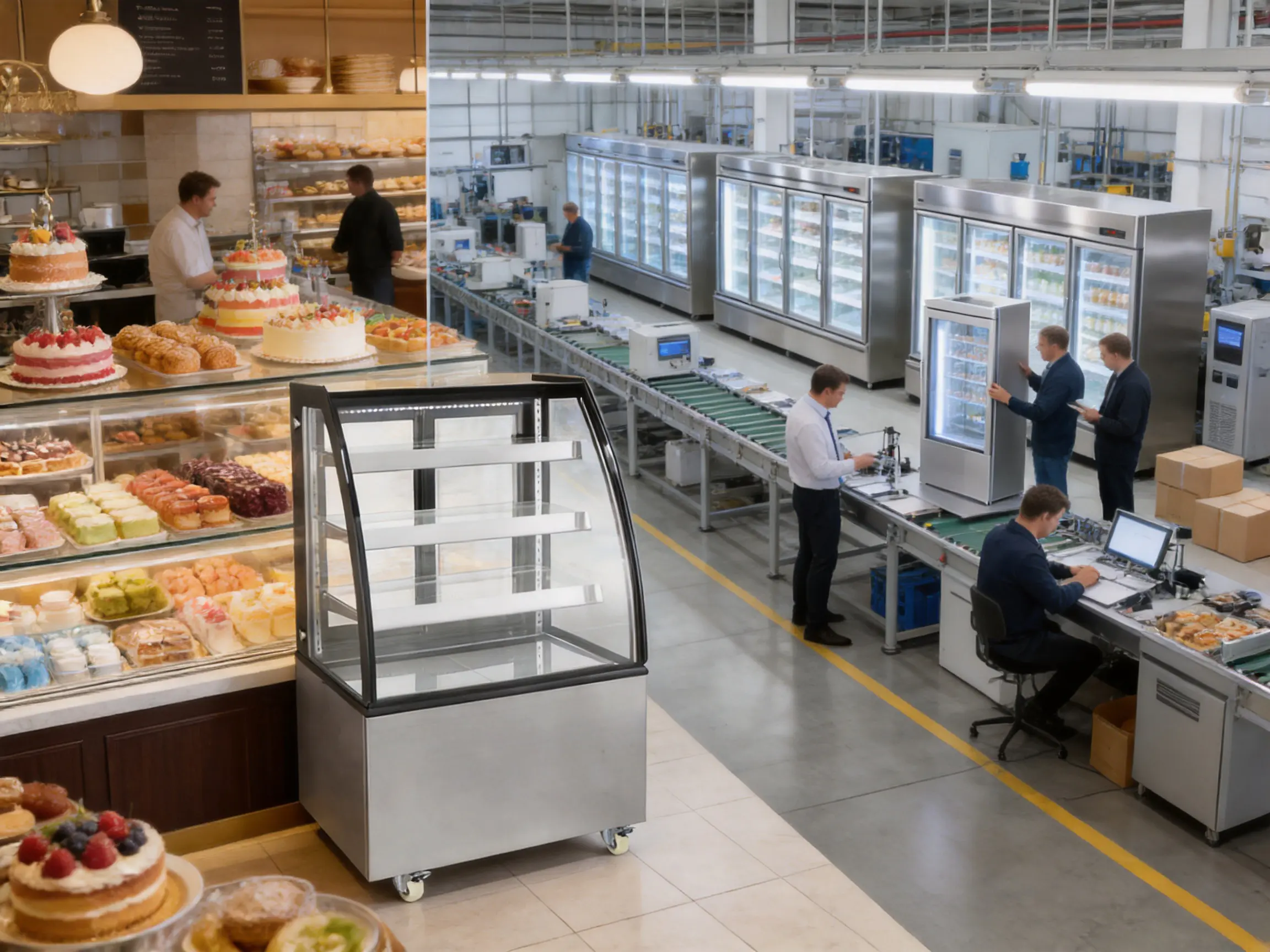
Q&A: Refrigerated Display Flat Glass Cake Showcase
What type of business is the XC-275Y suitable for?
The XC-275Y is suitable for bakeries, cafés, pastry shops, dessert counters, restaurants, hotels, supermarkets, convenience stores, and catering businesses that need refrigerated product presentation. It can display cakes, pastries, desserts, and other chilled foods when their storage requirements are compatible with the cabinet’s 2–8°C range.
What is the capacity of the cabinet?
The listed capacity is 390 liters. Actual usable capacity depends on shelf placement, product size, packaging, and the amount of space required for air circulation. Operators should not pack the cabinet so tightly that airflow or product visibility is restricted.
What temperature range does it provide?
The stated temperature range is 2–8°C. This range is intended for chilled display applications. Operators should always follow the storage instructions for the specific products being sold and comply with applicable food-safety regulations.
Does the cabinet use static or ventilated cooling?
The XC-275Y is specified with a ventilated cooling system. Air circulation helps distribute cooled air through the display area and can support more consistent conditions when products are loaded correctly.
Does it require manual defrosting?
The standard features include automatic defrost. This reduces the need for frequent manual defrosting, although routine cleaning and maintenance remain necessary.
How are products accessed?
Products are accessed through smooth rear sliding glass doors. This allows staff to load and remove products from behind the cabinet while customers view the display from the front.
How many shelves are included?
The supplied standard feature list specifies two glass shelves, while the product title describes a four-layer showcase. Buyers should confirm the final number of shelves and display levels, as well as shelf dimensions and adjustability, before ordering.
What type of lighting is installed?
The standard features list three LED light bars. These illuminate the products and help create a clear, attractive presentation across the internal display area.
Is the glass safe for commercial use?
The showcase is specified with double tempered glass. Tempered glass is designed for improved strength and safer fracture behavior compared with ordinary glass, but it must still be handled, cleaned, and serviced according to appropriate safety procedures.
Can the cabinet be moved?
Yes. The unit includes four castors, two of which have brakes. The castors support positioning and cleaning access, while the brakes help secure the cabinet during normal use.
What refrigerant does the cabinet use?
The supplied product information lists R134a/R290. The final refrigerant should be confirmed because the applicable option may depend on the production configuration, destination market, regulations, and certification requirements.
What should buyers verify before placing an order?
Buyers should confirm voltage, frequency, plug type, refrigerant, shelf configuration, climate classification, product and package dimensions, gross shipping weight, certificates, warranty terms, spare parts, delivery conditions, and installation requirements. The supplied climate-type and gross-weight entries should receive particular confirmation.
How can operators improve cabinet performance?
The cabinet should be installed away from heat sources, loaded with pre-chilled products, kept clear around ventilation areas, cleaned regularly, and monitored through the digital thermostat. Door seals, sliding tracks, lighting, castors, and refrigeration components should be inspected as part of preventive maintenance.
Conclusion
The refrigerated display flat glass 4 layer cake showcase is a practical solution for businesses that need to combine product preservation with high-impact merchandising. The XC-275Y provides 390 liters of refrigerated display capacity, a stated 2–8°C operating range, ventilated cooling, automatic defrost, digital temperature monitoring, three LED light bars, double tempered glass, rear sliding doors, a stainless steel base, and four castors with two brakes.
These features create advantages in product visibility, temperature management, cleaning, service access, mobility, and retail presentation. Compared with conventional non-refrigerated cases, open displays, or storage-focused refrigerators, the cabinet offers a more balanced solution for businesses selling chilled cakes, desserts, pastries, and selected prepared foods.
The product is supported by a manufacturer with experience in vertical display cabinets, cake showcases, warming cabinets, research and development, testing, international certification, and commercial refrigeration production. Its 40,000-square-meter factory and reported certification capabilities provide a foundation for consistent manufacturing and global customer support.
For the best purchasing decision, buyers should confirm all configuration details, including the shelf arrangement, climate classification, package dimensions, gross weight, refrigerant, electrical specifications, and destination-market certifications. With correct installation, disciplined loading, regular cleaning, and preventive maintenance, the XC-275Y can serve as both a reliable refrigeration appliance and a powerful sales presentation system.
References
1. Product specification sheet for refrigerated display flat glass 4 layer cake showcase, model XC-275Y.
2. Manufacturer-provided standard feature list for commercial cake showcase equipment.
3. Manufacturer company information concerning research and development, factory facilities, product categories, and international certification experience.
4. General commercial refrigeration principles for temperature control, ventilated cooling, automatic defrost, display merchandising, and preventive maintenance.
5. General food-retail guidance concerning chilled product storage, temperature monitoring, sanitation, stock rotation, and safe equipment operation.
Product: Refrigerated Display Flat Glass 4 Layer Cake Showcase

You May Also Like
.jpg?imageView2/2/w/500/h/500/format/jp2/q/100 "Four Sides Glasses Display Cooler")
.jpg?imageView2/2/w/500/h/500/format/jp2/q/100 "White 4-Sided Glass Refrigerated Display Case")
.jpg?imageView2/2/w/500/h/500/format/jp2/q/100 "Refrigerated Display Cake Countertop Four Sides Glasses Display Cooler")
.jpg?imageView2/2/w/500/h/500/format/jp2/q/100 "Four Sides Glasses Display Cooler")

-
- Navigation
- Home
- About Us
- Products
- News
- Contact Us
 East Zone, Guanhaiwei Industrial Park, Cixi City, Ningbo, Zhejiang, China
 +86-574-63668678
 +86-574-63668108
Copyright © Ningbo XiangChi Electrical Co.,Ltd All Rights Reserved.
