
 简体中文
简体中文 English
 Español
News
Digital Temperature-Controlled Commercial Heated Display for Efficient Food Presentation
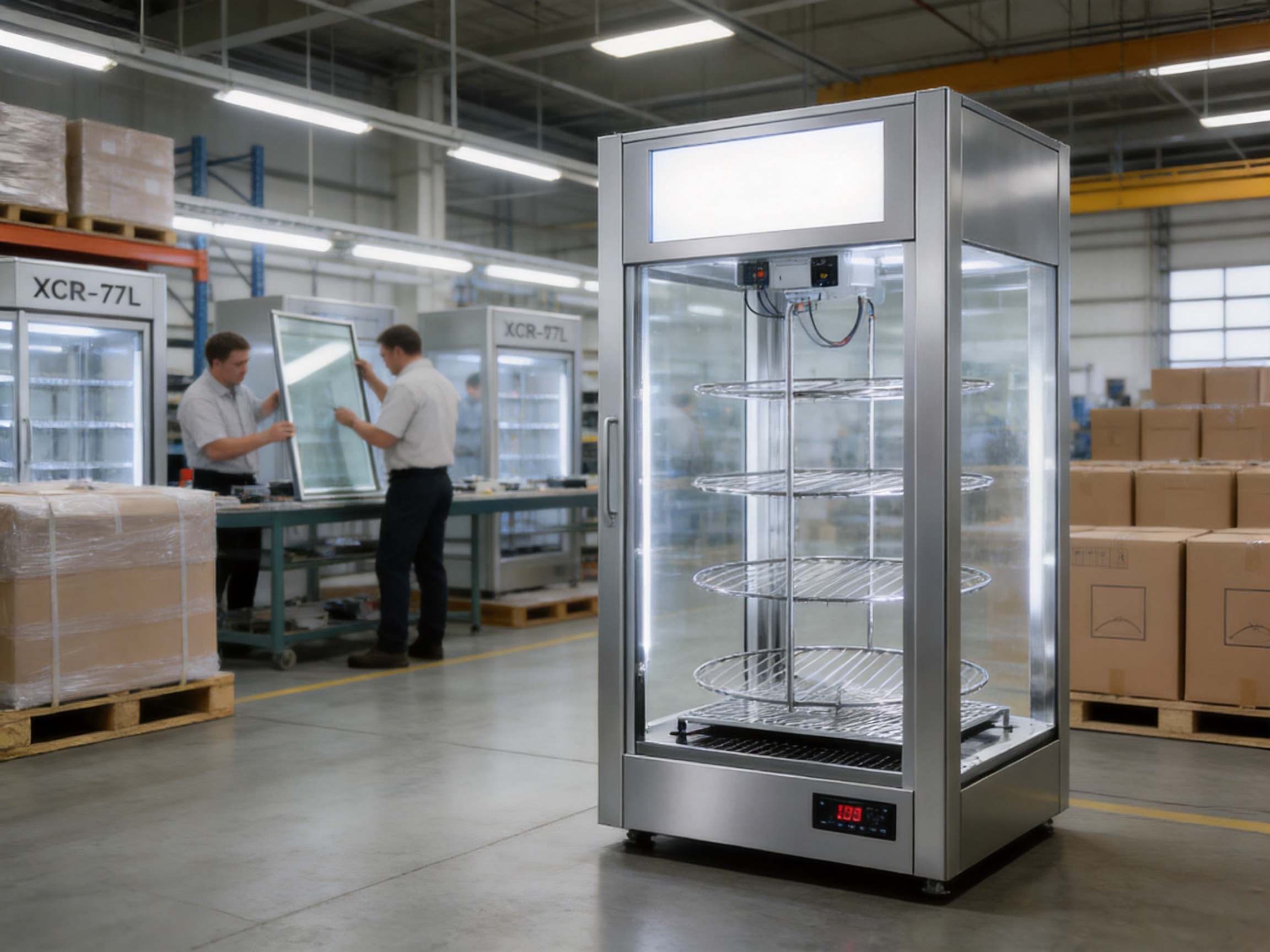
In foodservice, presentation and temperature control are closely connected. A product may look attractive in a service area, but its quality can decline rapidly if it is not maintained at an appropriate serving temperature. The Digital Temperature-Controlled Commercial Heated Display XCR-97L is designed to address this challenge by combining heated food holding, all-around visibility, organized shelf presentation, and straightforward digital operation in a compact commercial cabinet.
With a gross capacity of 97 liters, a temperature range of 30–90°C, an 800W heating system, tempered glass construction, stainless steel bodywork, internal LED lighting, a dedicated advertising light box, and rotational chrome-plated shelves, the XCR-97L is suited to cafés, bakeries, restaurants, convenience stores, hotels, snack bars, catering counters, and other businesses that need warm products to remain visible and ready for service.
The cabinet is particularly useful for displaying baked goods, prepared snacks, pastries, sandwiches, fried foods, breakfast items, and other products that benefit from warm holding. Its countertop-oriented footprint allows operators to place it near a checkout area, serving counter, buffet line, or front-of-house display zone without requiring the floor space associated with a large heated cabinet.
More than a simple warming appliance, this unit functions as a merchandising tool. Customers can view products from multiple sides, illuminated items can attract attention, and the internal shelves help operators arrange products in a way that supports faster selection and more effective use of display space.
Product Overview
The XCR-97L belongs to the display warmer category within a broader range of commercial display equipment. Unlike a refrigerated display cabinet, which is intended to preserve chilled products, this model is designed for controlled heated presentation. Its operating range of 30–90°C, equivalent to 86–194°F, gives foodservice operators flexibility when holding different warm products under different operating conditions.
The digital controller allows users to set and monitor the cabinet temperature more conveniently than a basic mechanical control. A separated power button and separated light button further simplify operation. Staff can energize the cabinet, activate the lighting, adjust the temperature, and monitor the display without relying on complicated menus or unnecessary controls.
| Specification | Details |
|---|---|
| Model | XCR-97L |
| Product category | Commercial display warmer |
| Gross capacity | 97L / 3.4 cu.ft |
| Temperature range | 30–90°C / 86–194°F |
| Input power | 800W |
| Net weight | 24.5kg |
| Gross weight | 27kg |
| Product dimensions | 460 × 436 × 785mm |
| Product dimensions | 18.1 × 17.2 × 30.9 inches |
| Package dimensions | 560 × 502 × 867mm |
| Package dimensions | 22.0 × 19.8 × 34.1 inches |
| Loading quantity | 88 pieces in a 20GP container; 276 pieces in a 40HQ container |
Designed for Commercial Food Presentation
The central purpose of the XCR-97L is to hold food at a controlled warm temperature while keeping it attractive and accessible to customers. In many retail and foodservice environments, products are prepared in batches and then displayed for a period of time. A display warmer helps bridge the gap between preparation and final sale.
Without suitable heated storage, products may cool too quickly, lose their intended texture, or appear less appetizing. Placing prepared food inside a commercial warming display provides a more organized alternative to leaving products on open trays or repeatedly transferring them between the kitchen and service counter.
The transparent cabinet makes the contents visible from multiple directions. This visibility can be valuable in busy environments where customers make quick purchasing decisions. A customer waiting at a counter can see available products without asking staff to open a door or explain every option. For operators, this can help reduce repeated handling and make the service area more efficient.
The cabinet is also appropriate for locations where product presentation is part of the customer experience. Bakeries may use it for warm pastries and savory baked goods. Cafés can display breakfast items, filled rolls, or heated snacks. Convenience stores may use it for ready-to-eat products. Hotels and catering businesses can place it in buffet or service areas where warm food needs to remain visually accessible.
Because the unit has a relatively narrow footprint compared with many larger commercial warming cabinets, it can serve as a practical solution where counter space is available but floor space is limited. Its 460mm width and 436mm depth allow the cabinet to fit into many counter layouts while retaining a useful 97-liter gross volume.
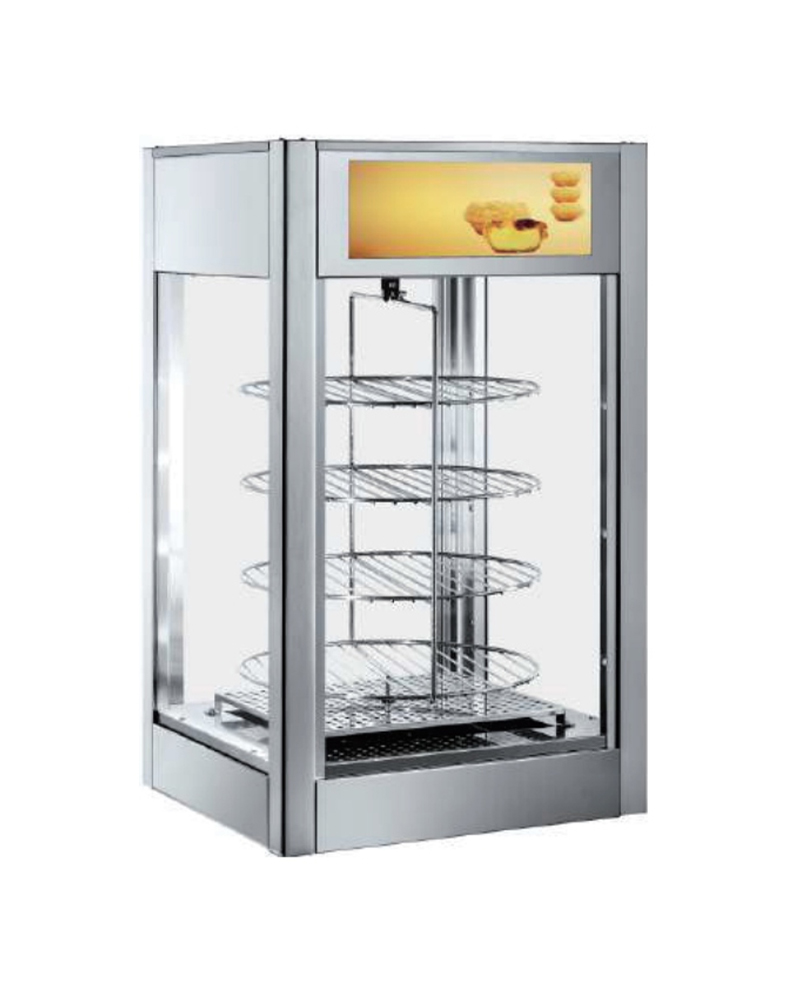
Digital Temperature-Controlled Commercial Heated Display XCR-97L
Temperature Control and Operating Flexibility
Temperature management is one of the most important advantages of a commercial heated display. The XCR-97L provides a selectable range from 30°C to 90°C. This broad range allows operators to choose a lower setting for gentle warming or a higher setting for products requiring stronger heat retention.
The digital temperature controller gives staff a clear operating reference. Digital control is generally easier to read and adjust than a simple dial, particularly in a busy service environment where staff need to confirm the setting quickly. The display can also support more consistent day-to-day operation because employees can return to a defined temperature rather than estimating a position on a mechanical scale.
The 30°C lower limit is useful when operators want to prevent products from becoming cold without exposing them to a high holding temperature. The upper setting of 90°C provides additional capacity for applications requiring a hotter display environment. The ideal setting will depend on the type of food, the service period, the quantity loaded, local food-handling procedures, and the operator’s product requirements.
It is important to understand that a display warmer is not a substitute for cooking, rapid reheating, or a complete food safety management system. Products should be prepared, handled, and monitored according to applicable food safety regulations. The XCR-97L provides controlled heated holding and display; operators remain responsible for selecting suitable settings and procedures for the foods being served.
The separated power switch is another practical operating feature. Instead of relying on a single combined control, staff can switch the heating cabinet on or off in a direct manner. The separated light button also allows the display lighting to be controlled independently. This may be helpful when the cabinet is being cleaned, loaded, or used outside normal customer-facing hours.
Benefits of Digital Operation
Digital controls support several useful operating habits. First, they make the selected temperature easier to identify. Second, they help different shifts use the same operating settings. Third, they can reduce uncertainty during product changeovers. Finally, they create a more professional control interface for commercial environments where equipment may be used frequently throughout the day.
A clear controller is especially useful for businesses with multiple employees. When instructions require a display warmer to operate within a particular temperature range, a digital control can make the procedure easier to communicate. Employees can also identify an incorrect setting more quickly than they might with an unlabeled or poorly marked dial.
Although the XCR-97L is compact, the controls are intended for commercial use rather than occasional domestic warming. The design combines the heating function with a visible merchandising area, making the unit a better fit for customer-facing businesses than a concealed warming box.
All-Sided Visibility for Stronger Merchandising
The XCR-97L uses tempered glass to create an open visual relationship between the product and the customer. Transparent panels allow the contents to remain visible while the cabinet maintains a defined display boundary. This is particularly helpful when the unit is positioned where customers approach from more than one direction.
Many foodservice counters are not viewed from a single fixed angle. A customer may approach from the front, move alongside the cabinet, or view the products while waiting in line. An all-sided glass display can make more of the product area visible compared with a cabinet that presents products through only one front-facing window.
Improved visibility also supports product organization. Operators can arrange different product types on different levels and use the shelves to create a clear visual sequence. Popular items can be placed at prominent viewing positions, while smaller or specialty products can occupy other shelf areas.
Tempered glass is an important material choice for a commercial display. It is designed to provide increased resistance compared with ordinary glass and is commonly used in equipment where visibility, durability, and customer-facing presentation are required. As with all glass equipment, users should avoid impact, follow handling procedures, and inspect the panels regularly for damage.
The glass enclosure also helps separate displayed food from the surrounding service environment. This can provide a cleaner presentation than uncovered trays, while allowing customers to see the products before making a selection. The cabinet therefore combines a display function with a degree of physical separation that is valuable in busy retail spaces.
Internal LED Lighting and Advertising Light Box
Lighting can influence how customers perceive food products. The XCR-97L includes brilliant internal LED lighting on two sides, helping illuminate the displayed products and improve visibility inside the cabinet. The lighting is particularly useful in locations where ambient light is uneven or where the cabinet is positioned beneath shelves, signage, or other equipment.
Two-sided internal lighting can reduce dark areas within the display and help products remain visible across multiple viewing angles. This supports the all-sided glass design because the cabinet is not dependent on a single front-facing light source. When products are arranged carefully, the illumination can give the display a more balanced and professional appearance.
LED lighting is also a practical choice for commercial equipment because it provides strong illumination in a compact format. It does not require the same physical space as larger traditional lighting components, which helps preserve the cabinet’s usable display area. The separate light button allows the operator to control the lighting independently from the heating function.
The built-in light box for advertising provides another merchandising opportunity. Operators can use the upper display area to communicate a store name, product category, promotional message, meal deal, or other customer-facing information. A light box can make the cabinet more noticeable, especially when it is positioned in a busy counter area with several competing visual elements.
For a small business, the light box may be useful because it turns part of the equipment into a communication surface. Instead of treating the warmer as a purely functional appliance, operators can incorporate it into a broader visual merchandising plan. The product display, internal lighting, and advertising area can work together to attract attention and encourage impulse purchases.
Stainless Steel Body for Commercial Environments
The stainless steel body contributes to the XCR-97L’s commercial appearance and practical durability. Stainless steel is widely used in foodservice equipment because it provides a smooth, professional surface that is suitable for regular cleaning when maintained correctly.
In a busy foodservice setting, equipment may be exposed to heat, moisture, food particles, and frequent contact. A stainless steel exterior can support a more hygienic-looking service area and fit naturally alongside stainless steel preparation tables, counters, ovens, and other commercial appliances.
The material also gives the cabinet a solid appearance. This is important for front-of-house equipment, where customers can see the appliance throughout the day. A well-finished stainless steel body can complement both modern and traditional commercial interiors.
Routine care remains essential. Operators should follow appropriate cleaning procedures, use compatible cleaning products, avoid abrasive materials that may scratch surfaces, and ensure that the cabinet is disconnected from power when required by the cleaning procedure. The glass, shelves, control area, and external body should be kept clean to maintain both hygiene and presentation quality.
Rotational Chrome-Plated Shelves
The rotational chrome-plated shelves are among the XCR-97L’s most distinctive presentation features. Rather than using only fixed flat shelves, the cabinet is equipped with shelves that support a more dynamic arrangement of products. Rotation can make it easier to view different items and may help staff present products from multiple sides.
For customers, rotational shelving can increase the visibility of products placed toward the rear or sides of the cabinet. For staff, it can simplify loading and product arrangement. Depending on the food type and packaging format, the shelves may be used to create a circular or layered presentation that makes more of the display area visible.
The chrome-plated finish complements the stainless steel body and glass panels. It gives the interior a bright, clean appearance and can help products stand out against the shelf structure. The shelves also contribute to a more premium visual impression than a plain, unstructured interior.
Operators should load the shelves evenly and remain within the equipment’s intended operating capacity. Products should be arranged so that hot air can circulate appropriately and so that containers do not obstruct the glass or controls. Careful loading is important for both appearance and consistent heating performance.
Compact 97-Liter Capacity
A 97-liter gross capacity provides a balance between display volume and countertop practicality. The cabinet is large enough to hold a meaningful assortment of products, yet compact enough for businesses that do not require a full-size floor-standing warmer.
Capacity planning is important in foodservice. A unit that is too small may require frequent refilling, while a unit that is too large may occupy unnecessary space and encourage operators to hold more food than they can sell within the desired service period. The XCR-97L gives smaller and medium-sized operations an intermediate option for daily product presentation.
The internal volume can be organized by product category, serving time, or sales priority. For example, a bakery may place sweet pastries on one shelf and savory products on another. A café may separate breakfast items from afternoon snacks. A convenience store may use different levels for packaged hot foods and ready-to-serve products.
Because the cabinet is 785mm high, it provides a strong vertical display presence without becoming an oversized floor unit. Its height can help products remain visible over a counter while preserving a relatively small base area. The 460mm width and 436mm depth further support installation in compact service environments.
Comparison with Basic Warming Equipment
Compared with a basic warming tray or concealed hot-holding box, the XCR-97L offers a more complete customer-facing solution. A warming tray may keep products warm, but it often provides limited protection, limited visibility, and little opportunity for organized vertical presentation. The XCR-97L combines the heating function with glass visibility, internal lighting, shelving, and advertising space.
Compared with an open shelf, the cabinet provides a more defined enclosure. Open shelves can be useful for quick access, but they may expose products to the surrounding environment and create a less controlled presentation. The XCR-97L gives the operator a visible cabinet that can be positioned as a dedicated food display.
Compared with a large floor-standing warmer, the countertop format may reduce the space commitment. This can be beneficial for cafés, small bakeries, kiosks, and convenience stores where every square meter must support sales, preparation, or customer circulation.
Compared with a non-digital warmer, the digital controller provides a clearer reference for temperature selection. Operators who value repeatability across shifts may find the digital interface easier to manage than a basic mechanical control.
Compared with a cabinet that uses only one front-facing window, the four-sided glass concept can improve visibility when the unit is placed in an island position or where customers can approach from different directions. This may support stronger merchandising and reduce hidden product areas.
Comparison with Refrigerated Display Cabinets
The XCR-97L should be selected for warm food presentation rather than chilled storage. Refrigerated display cabinets are designed to maintain lower temperatures for products such as cakes, dairy items, beverages, desserts, sushi, and other chilled foods. A heated display warmer serves a different commercial purpose.
This distinction is important when planning a foodservice layout. A business may need both refrigerated and heated display equipment if it sells products from different temperature categories. The XCR-97L can occupy the heated section of a counter while a refrigerated showcase serves chilled or temperature-sensitive products.
The product category includes display equipment for several applications, including four-sided glass display coolers, countertop display refrigerators, cake showcases, sushi showcases, open display coolers, display warmers, and four-sided glass freezers. Within this broader equipment range, the XCR-97L is specifically positioned as a commercial heated display unit.
Choosing the correct cabinet helps avoid unsuitable operating practices. Warm products should not be stored in a refrigerator simply because it is visually convenient, and chilled products should not be placed in a heated cabinet. Each product type should be matched with equipment that supports its intended temperature and handling requirements.
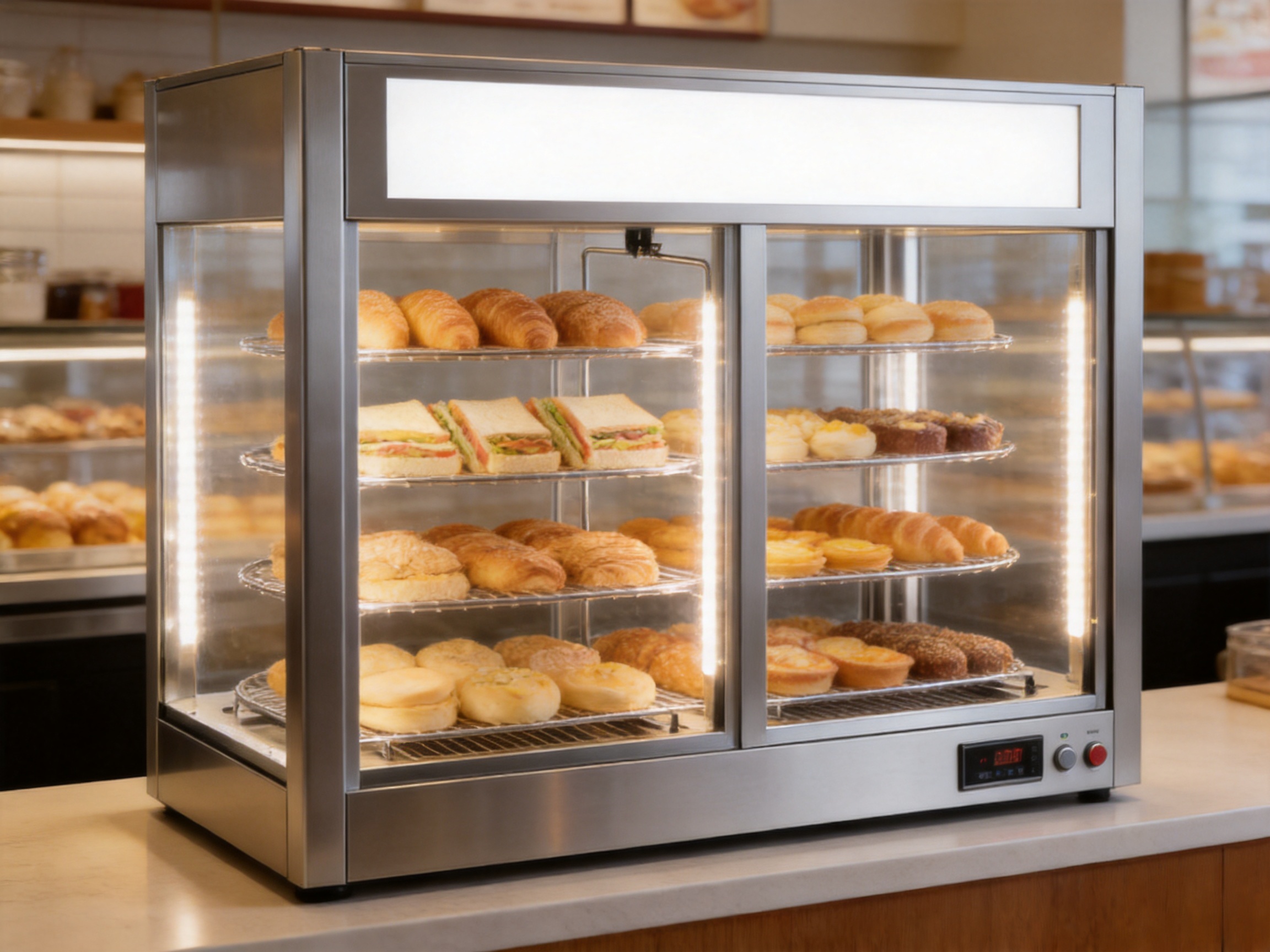
Applications Across Different Businesses
Bakeries and Pastry Shops
Bakeries can use the XCR-97L to display warm pastries, croissants, rolls, savory pies, filled buns, and similar products. The illuminated glass cabinet allows customers to view the range while the heated environment helps maintain a warm serving condition.
The advertising light box can be used to highlight daily specials, breakfast combinations, seasonal products, or freshly baked selections. Rotational shelves can also help showcase products in a layered arrangement rather than placing everything on a single tray.
Cafés and Coffee Shops
Cafés often sell warm snacks alongside beverages. A countertop display warmer can be positioned near the ordering point so that customers see sandwiches, pastries, toasted items, or breakfast products while selecting drinks.
The compact footprint is useful in cafés where counter space is limited. The unit can serve as both a food display and a visual divider between staff and customers. Its stainless steel appearance can coordinate with espresso machines, preparation counters, and other commercial fixtures.
Convenience Stores
Convenience stores frequently depend on quick purchasing decisions. A visible heated display can help promote ready-to-eat items and encourage customers to add a snack or meal to their purchase. The all-sided viewing design is suitable for positioning near checkout lanes or in a central sales area.
The digital temperature controller also helps store staff follow a consistent operating routine. Products can be loaded, displayed, monitored, and replenished throughout the trading day.
Hotels and Buffet Areas
Hotels can use the XCR-97L for breakfast pastries, warm bread products, snacks, or selected buffet items. Its glass construction allows guests to identify the contents while helping the service area remain visually organized.
For catering and buffet use, product arrangement should be planned around access, serving sequence, and food safety procedures. The cabinet may be used as one component of a larger service line rather than as a complete buffet solution for every food type.
Restaurants and Quick-Service Counters
Restaurants can place the unit near the entrance, pickup counter, or takeaway station. Warm products can be held in an attractive display while customers wait for orders or select additional items.
For quick-service businesses, clear product visibility may help reduce ordering time. Customers can see the available choices directly, while staff can maintain a more structured service counter.
Manufacturing Expertise and Quality-Oriented Production
The XCR-97L is produced by Ningbo XiangChi Electrical Co., Ltd., a manufacturer specializing in vertical display cabinets, cake cabinets, and warming cabinets. The company was established in 2007 and has more than ten years of experience in the field, according to the supplied company information.
The company operates a modern management garden factory covering 40,000 square meters. A facility of this scale can support coordinated manufacturing, assembly, quality inspection, warehousing, and product development activities. For international buyers, an established production base is important because commercial equipment programs often require stable capacity, consistent specifications, and reliable communication across repeated orders.
The company’s own professional research and development team supports product innovation and quality improvement. In the display equipment sector, research and development can involve heating performance, temperature control, cabinet layout, lighting integration, glass installation, shelf design, electrical safety, energy use, and ease of maintenance.
Advanced testing facilities are also identified as part of the company’s manufacturing strengths. Testing is essential for commercial appliances because the equipment must operate under repeated use rather than occasional household conditions. Functional testing can help verify heating behavior, controller operation, lighting performance, electrical components, structural assembly, and product stability before shipment.
The company states that it has obtained CE, GS, CCC, CB, RoHS, ETL, and other major certifications. Certification requirements vary by market, product configuration, and applicable standard. Nevertheless, the presence of multiple international certifications indicates an effort to prepare products for different regional compliance environments and customer requirements.
Integrated Product Development
A display warmer requires coordination between several disciplines. The cabinet must provide attractive visibility while accommodating a heating system, digital controller, lighting, shelves, electrical wiring, and structural supports. These components must work together within a relatively compact enclosure.
An integrated R&D approach can help reduce design conflicts. For example, internal lighting must illuminate products without compromising shelf space. The heating system must provide the intended temperature range while the glass and body remain suitable for commercial operation. The control system must be accessible to staff while remaining visually appropriate for a front-of-house cabinet.
The XCR-97L reflects this integrated approach through its combination of digital temperature control, separated power and light buttons, two-sided internal LED lighting, a light box, stainless steel body, tempered glass, and rotational shelves. These are not isolated features; together they create a product intended for both food holding and sales presentation.
Production Capacity for International Orders
The stated loading quantity is 88 pieces in a 20GP container and 276 pieces in a 40HQ container. These figures provide buyers with a reference for shipping and order planning. Importers, distributors, and foodservice equipment dealers can use the information when estimating container utilization and logistics requirements.
Actual loading arrangements may depend on packaging configuration, shipment conditions, and the final order. However, published container-loading information is useful because it helps commercial buyers compare transportation requirements and prepare procurement plans.
The package dimensions are 560 × 502 × 867mm, or 22.0 × 19.8 × 34.1 inches. The gross packaged weight is 27kg, compared with a net product weight of 24.5kg. The difference accounts for packaging materials and shipping protection. Buyers should use the packaged dimensions when planning warehouse storage, delivery access, container loading, and installation routes.
Installation and Placement Considerations
The XCR-97L should be installed on a stable, level counter or support surface capable of carrying its operating weight and loaded contents. The selected location should provide sufficient clearance for staff to load products, operate the controls, clean the cabinet, and perform routine inspections.
Placement also affects merchandising performance. A position near a checkout counter, customer queue, entrance, or beverage station may increase visibility. The four-sided glass design is especially valuable when the unit can be viewed from more than one side. If it is placed tightly against a wall, some of the visibility advantage may be reduced.
Operators should consider the relationship between the warmer and nearby equipment. The cabinet should not be placed where it obstructs customer movement, blocks emergency access, interferes with preparation work, or is exposed to unsuitable water spray. The electrical supply should be compatible with the equipment requirements and local installation rules.
Before first use, the cabinet should be unpacked carefully and inspected for possible shipping damage. Glass panels, shelves, controls, power cables, and external surfaces should be checked. Packaging materials should be removed from the cabinet, and the interior should be cleaned according to the operating instructions before food is loaded.
The 27kg gross shipping weight means that delivery and installation may require two people or suitable handling equipment, particularly when the cabinet is moved through narrow corridors or placed on a high counter. Proper handling helps reduce the risk of damage to the glass and exterior surfaces.
Daily Operating Practices
For consistent operation, staff should allow the cabinet to reach the selected temperature before loading products when the operating procedure requires preheating. The chosen setting should reflect the food type, expected holding time, product volume, and applicable food safety requirements.
Products should be loaded in a way that preserves visibility and allows appropriate air movement. Overloading can make the cabinet look crowded and may affect the distribution of heat. An organized arrangement also helps customers understand the selection and makes restocking easier for staff.
The separated light control allows the lighting to be switched on when the cabinet is being used for customer presentation. During cleaning or non-operating periods, staff may switch the light off as part of the business’s equipment management routine.
Staff should monitor product quality during the holding period. Heating equipment can maintain a warm environment, but the condition of food may still change over time. Products should be rotated, replenished, or removed according to the operator’s product policy and food safety procedures.
At the end of a service period, the cabinet should be emptied and cleaned as appropriate. Food residue should not be allowed to accumulate on shelves, glass surfaces, or the base of the display area. Regular cleaning supports appearance, hygiene, and long-term equipment care.
Maintenance and Care
Routine maintenance begins with regular cleaning. The glass should be cleaned with a suitable non-abrasive method, while stainless steel surfaces should be wiped in a manner that minimizes scratching and preserves the finish. Shelves should be removed or handled according to the equipment’s instructions before cleaning.
Electrical components, digital controls, switches, and lighting connections should not be exposed to excessive moisture. Cleaning procedures should be carried out with attention to electrical safety, and the cabinet should be disconnected from power when required.
Operators should inspect the tempered glass periodically for chips, cracks, or other damage. Damaged glass should not be ignored because it can affect both safety and the appearance of the display. Shelf supports, rotating components, switches, and the power cable should also be checked during routine inspections.
If the cabinet does not heat correctly, staff should first confirm that the power supply is available, the power button is activated, the temperature setting is appropriate, and the cabinet is not overloaded. If a problem remains, trained service personnel should be contacted rather than attempting unauthorized electrical repairs.
Preventive care is especially important in commercial environments because equipment may operate for long periods and be handled by multiple employees. A clear cleaning and inspection schedule can help businesses maintain reliable presentation quality and identify potential issues early.
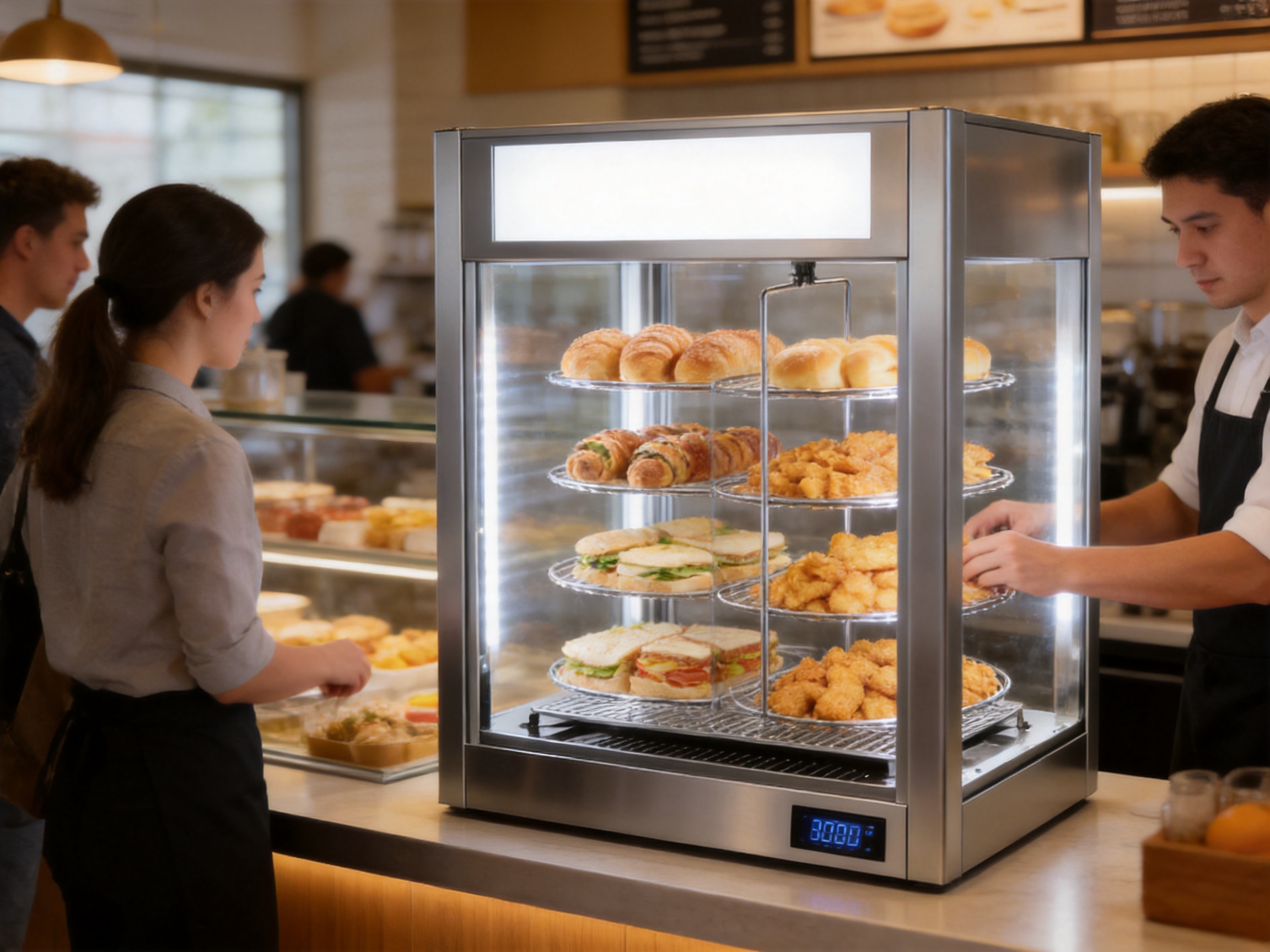
Advantages for Distributors and Commercial Buyers
For distributors, the XCR-97L offers a defined product position within the foodservice equipment market. It is not limited to a single business type because the same basic requirement—warm product display—exists in bakeries, cafés, convenience stores, restaurants, hotels, and catering operations.
The technical specification is straightforward and easy to communicate. Buyers can identify the 97-liter capacity, 30–90°C temperature range, 800W input power, compact dimensions, and commercial construction without navigating an overly complicated product structure.
The product also offers several visible selling points. The four-sided glass appearance, two-sided LED lighting, light box, stainless steel body, digital temperature display, and rotational shelves are features that can be demonstrated easily in catalogs, showrooms, and customer presentations.
Container-loading information supports wholesale planning. With a stated capacity of 88 pieces per 20GP container and 276 pieces per 40HQ container, distributors can estimate order quantities and discuss logistics with freight partners. This is useful for importers who need to balance product availability against warehouse and shipping costs.
The manufacturer’s experience, R&D resources, testing facilities, and range of stated certifications may also support distributor confidence. Commercial buyers often need more than a visually attractive product; they need a supplier capable of maintaining product development, quality procedures, and export-oriented production.
Why the XCR-97L Is a Practical Alternative to Larger Cabinets
Large display warmers can provide substantial capacity, but they may not be appropriate for every operation. Smaller shops may not have enough floor space, electrical capacity, or product volume to justify a large cabinet. The XCR-97L offers a more compact approach while retaining several features associated with professional display equipment.
The countertop format allows businesses to use vertical space above an existing counter. This can be particularly effective in narrow stores and café environments. The cabinet can be positioned where customers naturally look, while the counter below may remain available for packaging, payment, or beverage service.
A compact unit may also be easier to integrate into a new store design or a retrofit project. Businesses can add heated display capacity without completely redesigning the sales floor. This flexibility can be valuable for operators testing a new product line or expanding from packaged goods into freshly prepared snacks.
The 97-liter volume is large enough to support product variety but controlled enough to encourage practical inventory planning. Operators can focus on a selected range of high-demand items rather than filling an oversized display with products that may not sell quickly.
Operational Value and Customer Experience
Food display equipment influences more than temperature. It can affect how customers navigate a store, how quickly they choose products, and how staff organize the service process. The XCR-97L supports these goals by combining visibility, illumination, shelving, and temperature control in one cabinet.
Customers often respond to products they can see clearly. Transparent glass reduces uncertainty about what is available, while internal lighting helps make the selection easier to evaluate. A well-arranged display can communicate freshness, variety, and convenience before a customer speaks with an employee.
For staff, organized shelves can make replenishment more systematic. Products can be arranged according to sales priority or service timing, and the display can be inspected from multiple angles. The digital controller provides a quick operating reference, while the separated switches simplify daily use.
For owners and managers, the cabinet can support a more consistent retail image. Stainless steel, tempered glass, chrome-plated shelves, and illuminated products create a professional appearance that can fit a variety of commercial settings. The light box adds an additional area for promotional communication.
Purchasing Checklist
Before purchasing a commercial heated display, buyers should confirm that the temperature range suits the intended products. The XCR-97L operates from 30°C to 90°C, but each business should determine the appropriate setting based on its own product and food-handling procedures.
Buyers should also measure the intended installation area. The product dimensions are 460 × 436 × 785mm, while the packaged dimensions are 560 × 502 × 867mm. The larger packaging dimensions should be considered when planning delivery and access.
Electrical requirements, local certification needs, and regional operating conditions should be verified before order confirmation. The manufacturer identifies CE, GS, CCC, CB, RoHS, ETL, and other certifications, but buyers should confirm the specific certification and configuration required for their market.
Product capacity should be compared with expected sales volume. The 97-liter gross capacity may be suitable for many countertop operations, but businesses with very high throughput may need multiple units or a larger display system. Conversely, very small businesses should consider whether the available product range justifies the cabinet volume.
Buyers should also evaluate cleaning access, shelf arrangement, visibility from the proposed location, service support, spare parts availability, packaging requirements, and delivery schedules. A thorough purchasing review helps ensure that the equipment supports the complete workflow rather than only the initial display concept.
Q&A
What type of equipment is the XCR-97L?
The XCR-97L is a digital temperature-controlled commercial heated display cabinet. It belongs to the display warmer category and is designed for warm food holding and customer-facing presentation.
What is the capacity of the cabinet?
The cabinet has a gross capacity of 97 liters, equivalent to approximately 3.4 cubic feet.
What temperature range does it provide?
The temperature range is 30–90°C, or 86–194°F. Operators should select settings according to the product type, holding requirements, and applicable food safety procedures.
Is this unit intended for chilled food?
No. The XCR-97L is a heated display warmer, not a refrigerated display cabinet. It is intended for products that require warm presentation rather than chilled storage.
What is the input power?
The stated input power is 800W.
Does the cabinet have digital temperature control?
Yes. It includes a digital temperature controller and display. The power button and light button are separated for more direct operation.
What type of lighting is included?
The unit includes internal LED lighting on two sides. It also includes a light box that can be used for advertising or promotional communication.
What materials are used in the construction?
The cabinet uses a stainless steel body, tempered glass, and rotational chrome-plated shelves.
Can customers see the products from multiple directions?
Yes. The four-sided glass design supports visibility from multiple viewing angles, making the unit suitable for island counters, customer queues, and other open service areas.
What products can be displayed?
Potential applications include pastries, baked goods, sandwiches, warm snacks, breakfast products, savory rolls, and other foods that benefit from heated presentation. Operators should confirm that the selected products are suitable for the cabinet and follow applicable food-handling procedures.
What are the product dimensions?
The product measures 460 × 436 × 785mm, or 18.1 × 17.2 × 30.9 inches.
What are the package dimensions?
The package measures 560 × 502 × 867mm, or 22.0 × 19.8 × 34.1 inches.
How much does the cabinet weigh?
The net weight is 24.5kg, and the gross packaged weight is 27kg.
How many units can be loaded into shipping containers?
The stated loading quantity is 88 pieces in a 20GP container and 276 pieces in a 40HQ container. Final loading arrangements should be confirmed for the specific order and packaging configuration.
Who manufactures the product?
The product is manufactured by Ningbo XiangChi Electrical Co., Ltd., a Chinese manufacturer of vertical display cabinets, cake cabinets, and warming cabinets.
What manufacturing strengths does the supplier have?
The supplied company information identifies a 40,000-square-meter factory, more than ten years of industry experience, a professional R&D team, advanced testing facilities, and certifications including CE, GS, CCC, CB, RoHS, and ETL.
Is the cabinet suitable for small stores?
Its countertop dimensions and 97-liter capacity make it potentially suitable for cafés, bakeries, kiosks, convenience stores, and other businesses with limited floor space. The final suitability depends on available counter space, electrical requirements, product volume, and local operating conditions.
How should the cabinet be maintained?
Operators should clean the glass, stainless steel body, shelves, and display area regularly using suitable non-abrasive methods. Electrical controls and connections should be protected from excessive moisture, and damaged glass or electrical components should be inspected and serviced by qualified personnel.
Conclusion
The Digital Temperature-Controlled Commercial Heated Display XCR-97L is designed to combine controlled warm holding with effective food merchandising. Its 97-liter gross capacity, 30–90°C temperature range, 800W input power, digital controller, separated switches, tempered glass enclosure, stainless steel body, two-sided LED lighting, advertising light box, and rotational chrome-plated shelves provide a balanced feature set for customer-facing foodservice applications.
Its principal advantage over basic warming equipment is the integration of presentation and operation. The unit does not simply keep products warm; it helps display them clearly, organize them vertically, illuminate them attractively, and position them within a professional commercial cabinet. Compared with larger floor-standing equipment, its countertop format can provide a more flexible solution for businesses with limited space.
The manufacturing background of Ningbo XiangChi Electrical Co., Ltd. further supports the product’s commercial positioning. The company’s stated factory scale, industry experience, R&D team, testing facilities, and international certifications demonstrate an established approach to product development and export-oriented production.
For bakeries, cafés, convenience stores, hotels, restaurants, and catering operations, the XCR-97L can serve as a practical tool for improving warm food presentation and organizing the customer service area. When installed correctly, operated at suitable settings, loaded responsibly, and maintained regularly, it can help businesses create a more visible, consistent, and professional display for products intended to be served warm.
References
1. Product specification sheet for Digital Temperature-Controlled Commercial Heated Display XCR-97L, supplied technical data.
2. Manufacturer product feature information for commercial display warmers, including lighting, shelving, temperature control, stainless steel construction, and tempered glass.
3. Manufacturer company profile for Ningbo XiangChi Electrical Co., Ltd., including factory development, R&D capability, testing facilities, and certification information.
4. General commercial foodservice equipment principles concerning heated holding, display organization, cleaning, installation, and equipment maintenance.
5. General food safety management principles for temperature-controlled food preparation, holding, presentation, and service.
Product: Digital Temperature-Controlled Commercial Heated Display XCR-97L

You May Also Like
.jpg?imageView2/2/w/500/h/500/format/jp2/q/100 "Four Sides Glasses Display Cooler")
.jpg?imageView2/2/w/500/h/500/format/jp2/q/100 "White 4-Sided Glass Refrigerated Display Case")
.jpg?imageView2/2/w/500/h/500/format/jp2/q/100 "Refrigerated Display Cake Countertop Four Sides Glasses Display Cooler")
.jpg?imageView2/2/w/500/h/500/format/jp2/q/100 "Four Sides Glasses Display Cooler")

-
- Navigation
- Home
- About Us
- Products
- News
- Contact Us
 East Zone, Guanhaiwei Industrial Park, Cixi City, Ningbo, Zhejiang, China
 +86-574-63668678
 +86-574-63668108
Copyright © Ningbo XiangChi Electrical Co.,Ltd All Rights Reserved.
