
 简体中文
 English
 Español

News
Refrigerated Countertop Bakery Display Case with LED: A Practical Guide to Performance, Design, and Commercial Value
A refrigerated countertop bakery display case is more than a compact refrigerator. In a bakery, café, dessert shop, hotel, convenience store, or food-service counter, it serves three important purposes at the same time: it protects temperature-sensitive food, presents products attractively, and helps staff use valuable service-counter space efficiently. The XCW-100L refrigerated countertop bakery display case with LED is designed around these requirements, combining a 100-liter refrigerated display area, curved double-layer tempered glass, internal LED lighting, adjustable chromed shelves, and a ventilated cooling system in a compact countertop format.
For businesses that sell cakes, pastries, sandwiches, desserts, dairy products, prepared foods, and other chilled items, the display case can influence both product quality and customer purchasing behavior. A cabinet that maintains a stable temperature while providing a clear view of the merchandise can help reduce unnecessary handling, improve product presentation, and support a more organized sales environment. The XCW-100L is intended to provide these benefits without requiring the floor space associated with a large vertical display cabinet.
This article examines the product’s construction, refrigeration performance, display advantages, operating features, maintenance requirements, manufacturing background, and commercial applications. It also explains how the cabinet compares with common alternatives and provides practical questions and answers for buyers, operators, importers, and food-service professionals.

Refrigerated Countertop Bakery Display Case with LED
1. Product Overview
The XCW-100L is a countertop display refrigerator with a nominal capacity of 100 liters. Its operating temperature range is listed as 2–10°C, making it suitable for chilled bakery products and many other foods that require refrigerated presentation rather than frozen storage. The unit has a stated input power of 220 watts, a net weight of 35 kilograms, and a gross shipping weight of 39 kilograms.
The cabinet measures approximately 682 millimeters in width, 450 millimeters in depth, and 675 millimeters in height. These dimensions allow it to sit on a sales counter, preparation counter, checkout island, or service station. Compared with a full-height upright display refrigerator, the countertop format can be particularly useful for businesses with limited floor area or for retailers that want to place impulse products directly beside the point of sale.
The product includes internal strip LED lights, a digital thermostat and temperature display, adjustable chromed shelves, back sliding glass doors, front curved tempered glass with double layers, ventilated cooling, automatic defrost, a separate power button, and a design intended specifically for countertop use. Together, these features address the main operational needs of a small commercial display cabinet: visibility, temperature control, access, cleaning, and flexible merchandising.
Key specification summary
Item |
Specification |
Model |
XCW-100L |
Product type |
Refrigerated countertop display case |
Nominal capacity |
100 liters |
Temperature range |
2–10°C |
Input power |
220 watts |
Refrigerant |
R134a/R600a as listed; final configuration should be confirmed before ordering |
Climate class |
4 |
Net weight |
35 kilograms |
Gross weight |
39 kilograms |
Product dimensions |
682 × 450 × 675 millimeters |
Package dimensions |
756 × 524 × 760 millimeters |
Container loading reference |
99 units in a 20-foot general-purpose container; 198 units in a 40-foot high-cube container |
The refrigerant information supplied for this model is written as “R1 34a/R600a.” This is commonly interpreted as R134a/R600a, but buyers should confirm the exact refrigerant, compressor configuration, and regulatory requirements for the destination market before placing a production order. Refrigerant selection can affect energy performance, servicing procedures, transportation rules, and compliance requirements.
2. Why Countertop Refrigeration Matters
Traditional upright display refrigerators offer substantial capacity, but they are not always the best solution for a small bakery or café. A full-height cabinet occupies floor space, may require a dedicated location, and can separate the merchandise from the staff and customers working at the main counter. A countertop model places the products closer to the customer’s eye level and allows the operator to integrate the refrigerator into the existing sales layout.
The XCW-100L is especially useful where the main objective is selective product display. A bakery may use it for slices of cake, cream-based desserts, chilled pastries, cheesecakes, mousse cups, fruit desserts, or packaged sandwiches. A café may reserve it for yogurt, cold drinks, prepared desserts, and grab-and-go foods. A hotel breakfast or reception area may use it for small portions and premium snacks.
Countertop placement also supports merchandising flexibility. The cabinet can be positioned near a register, beside a coffee machine, next to a cake preparation area, or at a self-service point. Because it has a relatively small footprint, operators can change the layout of a shop without moving a heavy upright refrigerator or redesigning a complete sales wall.
Another advantage is direct visual communication. Customers can see the products through the front curved glass while staff can access the interior through the rear sliding doors. This arrangement supports a service-counter workflow in which the customer chooses an item and the employee retrieves it from the back. It can also reduce the frequency of customers opening the cabinet, helping limit unnecessary exposure to ambient air.
3. Refrigeration Performance and Temperature Control
The stated temperature range of 2–10°C covers the requirements of many chilled display applications. The lower end of the range is appropriate for products that need consistent refrigeration, while the upper end can be useful for foods that require cool presentation without excessive chilling. The correct operating point will depend on the product formulation, packaging, local food-safety rules, cabinet loading, ambient conditions, and the recommendations of the food manufacturer.
A digital thermostat and temperature display provide a more practical control method than a basic mechanical dial. Operators can check the displayed cabinet temperature during routine inspections and make adjustments when product requirements or ambient conditions change. A digital readout also makes it easier to establish opening and closing procedures, such as recording the temperature at the beginning of a shift and checking it during peak service periods.
The ventilated cooling system is an important feature for a multi-shelf display case. In a static cooling design, cold air may remain concentrated near the evaporator or at the bottom of the cabinet, creating temperature differences between shelves. Ventilated cooling circulates air through the display area to promote more uniform cooling. Although loading practices and product arrangement still affect performance, air movement can help the cabinet maintain a more consistent environment across the available shelf levels.
Automatic defrost reduces the need for staff to stop operation and manually remove accumulated ice. In a commercial setting, this can make a meaningful difference because manual defrosting interrupts sales, requires product relocation, and increases cleaning labor. Automatic defrost does not eliminate the need for cleaning and inspection, but it simplifies routine operation and supports more reliable daily use.
The climate type is listed as 4. Buyers should interpret this rating together with the installation environment. A display refrigerator performs best when it has adequate ventilation around the refrigeration system and is not placed beside an oven, under intense sunlight, or next to another heat-producing appliance. Climate classification provides a useful operating reference, but it cannot compensate for poor installation or extreme ambient conditions.
Practical temperature-management recommendations
Operators should pre-chill products before placing them into the display case. The cabinet is designed to maintain chilled products, not to rapidly cool large quantities of warm food. Loading hot products can raise the internal temperature, increase compressor workload, and affect items that are already inside the cabinet.
The shelves should not be overloaded or packed so tightly that air circulation is blocked. Products should be arranged with enough space for cold air to move around them. The front glass and rear doors should remain closed except when necessary, and staff should avoid leaving the sliding doors open during busy service periods.
Temperature checks should be conducted with a calibrated procedure appropriate to the business. The displayed thermostat reading is useful for routine monitoring, but food operators may also require independent verification according to local regulations and internal quality systems. If the temperature rises unexpectedly, staff should inspect the door position, product load, ventilation clearance, condenser condition, and surrounding room temperature before assuming that a major refrigeration failure has occurred.
4. Display Design and Customer Appeal
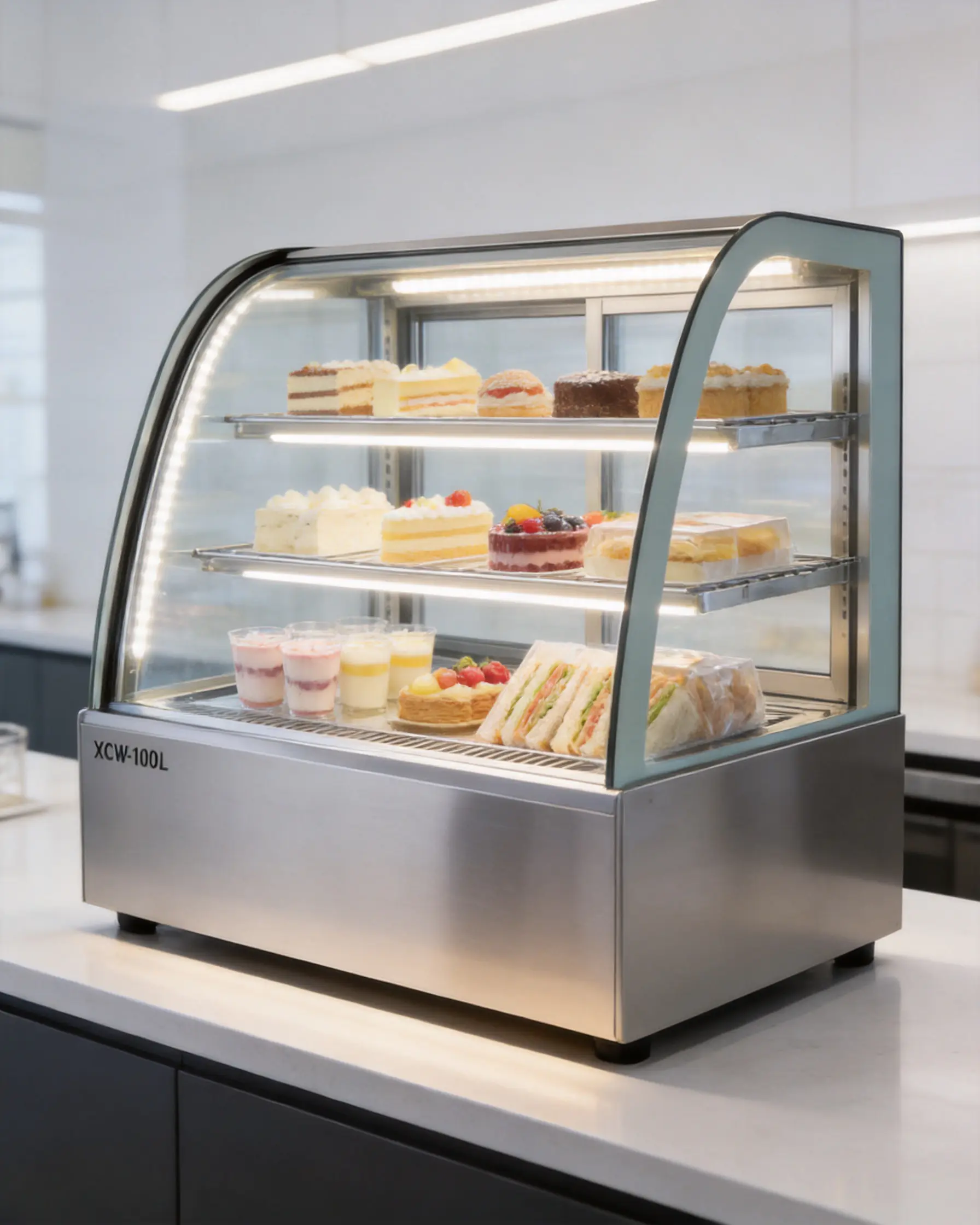
Food display is a commercial function as well as an engineering function. Customers often make purchasing decisions based on visual appearance, freshness cues, product arrangement, and the ease with which they can identify an item. The XCW-100L uses a front curved tempered-glass panel and internal strip LED lighting to create a clear, bright presentation area.
Curved glass can provide a broad viewing angle while reducing the visual interruption created by sharp front corners. It gives the cabinet a professional appearance that fits naturally into bakeries, cafés, dessert stores, and hotel service areas. The double-layer construction also contributes to insulation and helps reduce the transfer of heat from the surrounding room into the refrigerated compartment.
Tempered glass is selected for improved safety and durability compared with ordinary untreated glass. If damaged, tempered glass is designed to break into smaller granules rather than large, sharp shards. Operators should still handle the glass carefully and inspect it periodically for chips, cracks, or edge damage. A damaged panel should be taken out of service and replaced by qualified personnel.
The internal LED strip improves product visibility while generally consuming less power and producing less heat than older display-lighting technologies. Bright, even lighting can enhance the appearance of cream layers, fruit toppings, icing, chocolate decoration, and colorful packaging. It can also help staff identify products quickly during service, reducing the time the rear doors remain open.
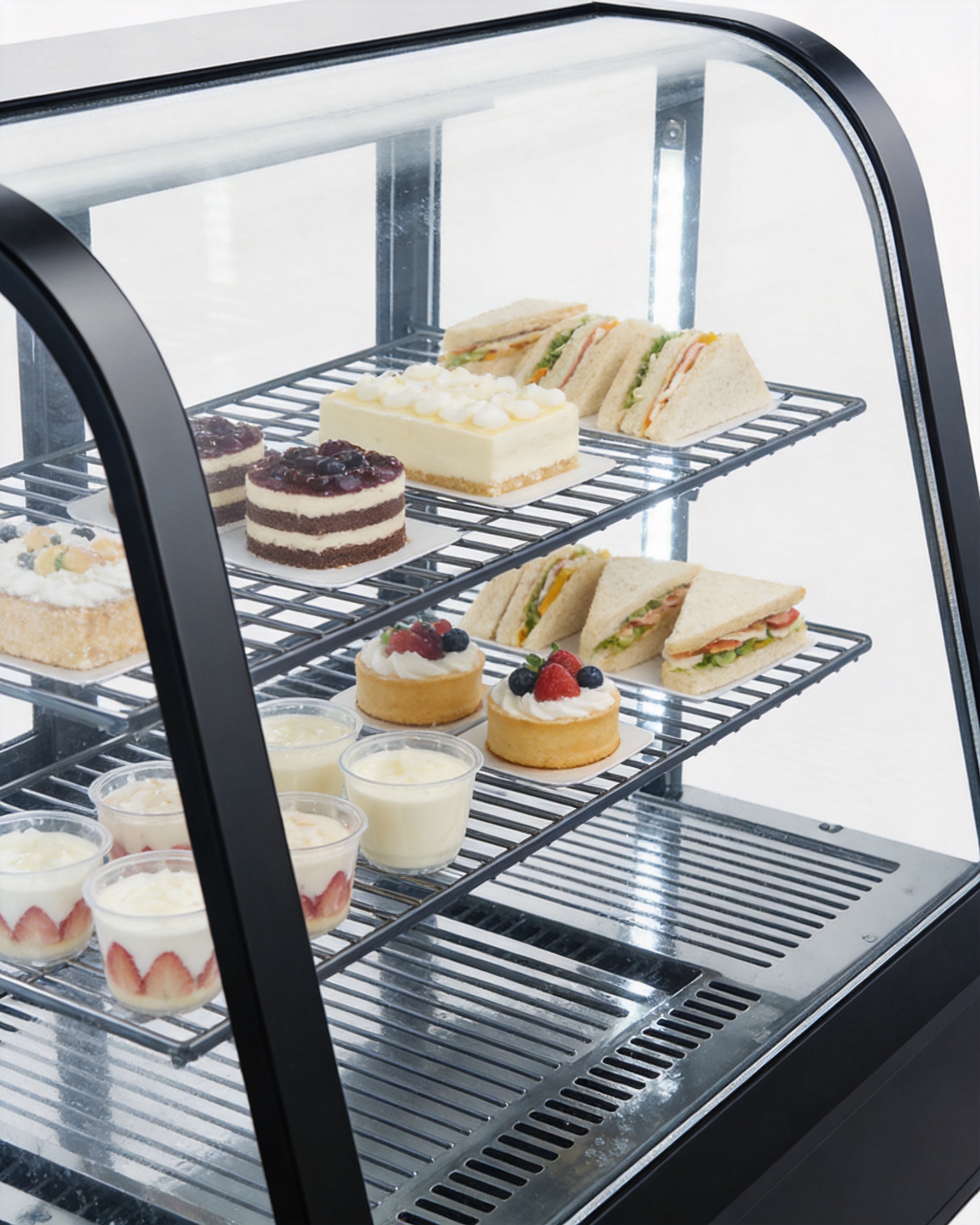
Adjustable chromed shelves allow the internal layout to be changed according to product height and presentation style. A bakery may need closely spaced shelves for individual pastries or dessert cups, while a cake shop may need more vertical room for larger slices, boxes, or display trays. Shelf adjustment enables the same cabinet to support different product categories throughout the year.
Merchandising strategies for a 100-liter cabinet
A compact display cabinet should be merchandised selectively rather than filled indiscriminately. The most attractive or profitable items can be placed at the most visible shelf levels. Products with strong color contrast can be grouped to create a clean visual rhythm, while similar products can be arranged together to make selection easier.
Packaging should face forward, labels should remain visible, and price information should be positioned where customers can read it without opening the cabinet. For unwrapped products, trays and containers should be clean, food-safe, and sized appropriately for the shelves. Staff should rotate stock according to the business’s food-safety procedures and remove products that no longer meet quality standards.
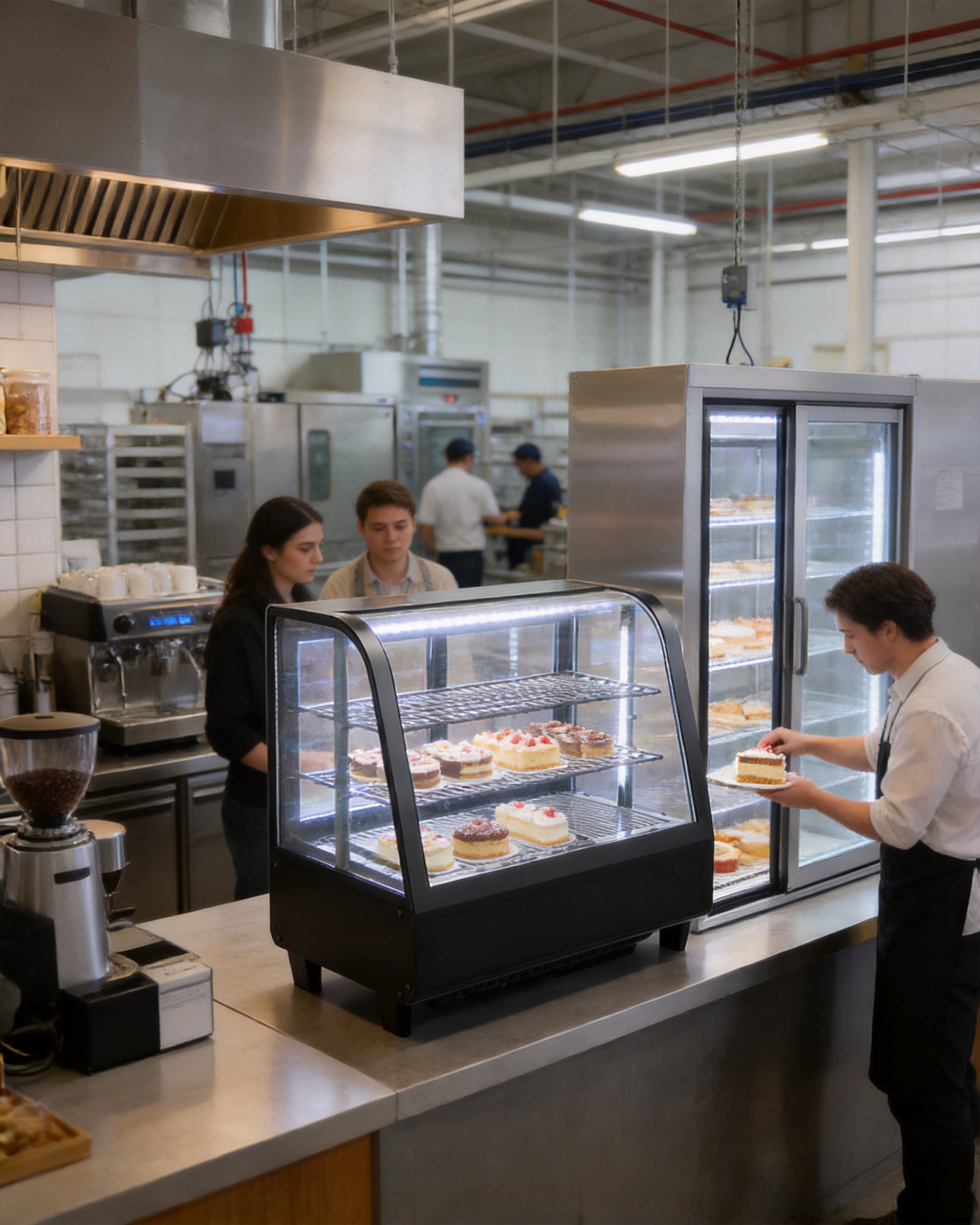
The cabinet can also be used for cross-selling. For example, chilled cake slices may be displayed beside a coffee service point, or premium desserts may be placed near takeaway orders. A small countertop footprint makes it possible to connect the display directly with the customer’s purchasing path.
5. Construction Features That Support Commercial Use
Commercial equipment must withstand repeated daily use, frequent door opening, cleaning, shelf adjustment, and changes in product assortment. The XCW-100L includes several features intended to support this environment.
The rear sliding glass doors are suitable for service-counter operation. Employees can stand behind the unit and retrieve products without reaching over the front glass or moving the cabinet. Sliding doors also avoid the outward swing associated with hinged doors, which can be useful where counter space behind the cabinet is limited.
The separate power button gives staff a direct way to switch the unit on or off without relying only on a thermostat control. This can simplify cleaning, planned shutdowns, and basic operating procedures. As with any commercial refrigeration equipment, the power should be disconnected according to safe electrical procedures before internal cleaning or service.
Chromed shelves provide a clean, professional appearance and can be removed or repositioned for cleaning and product organization. The shelving system should not be treated as a load-bearing platform for excessive weight. Operators should distribute products evenly and follow any manufacturer instructions regarding shelf loading.
The compact dimensions and 35-kilogram net weight make the unit more manageable than a full-size commercial display refrigerator. Two trained people can generally plan and carry out countertop placement more easily than they could with a large upright cabinet, although the actual handling method should account for stairs, narrow doors, counter strength, and workplace safety.
6. Advantages Compared with Common Alternatives
The XCW-100L competes with several types of equipment, including open-front display coolers, non-refrigerated bakery cases, small domestic refrigerators, and large upright commercial display cabinets. Its advantages become clearer when the intended application is considered.
Compared with an open display cooler
Open display coolers provide rapid customer access, but the open front allows refrigerated air to escape continuously. This can increase energy demand and may create greater temperature variation, particularly in a busy store. The XCW-100L uses a closed glass display design with rear sliding access, which can better separate the product environment from the surrounding room during normal service.
A closed cabinet may also provide better protection from dust, accidental contact, and excessive customer handling. For products such as decorated cakes, delicate pastries, and plated desserts, this protection is an important part of presentation quality.
Compared with a non-refrigerated bakery case
A non-refrigerated case may be appropriate for dry pastries, bread, cookies, and products that do not require chilling. It is not a substitute for a refrigerated cabinet when products contain fresh cream, custard, dairy fillings, or other temperature-sensitive ingredients. The 2–10°C operating range of the XCW-100L allows businesses to display products that require a controlled chilled environment while keeping them visible to customers.
Compared with a domestic refrigerator
Domestic refrigerators are designed primarily for household storage, not continuous commercial display. They may lack curved front glass, customer-facing lighting, adjustable commercial shelving, rear service doors, and a presentation-oriented layout. Using a household refrigerator in a commercial counter can also create concerns related to durability, serviceability, food presentation, and local commercial-equipment requirements.
Compared with a large upright display cabinet
Upright cabinets normally offer more total storage capacity, but they require more floor space and may be excessive for a small selection of premium products. The countertop design of the XCW-100L allows a business to add refrigerated merchandising without sacrificing a large section of the sales floor. It can also function as a supplementary display next to a larger refrigerator.
Compared with basic countertop chillers
Some compact chillers offer refrigeration but limited presentation features. The XCW-100L combines refrigeration with double-layer curved glass, LED illumination, adjustable shelves, a digital temperature display, and rear sliding doors. This combination makes it more suitable for front-of-house merchandising than a simple under-counter storage refrigerator.
7. Manufacturing Capability and Quality Strengths
The product is manufactured by Ningbo XiangChi Electrical Co., Ltd., a specialist in vertical display cabinets, cake cabinets, warming cabinets, and related commercial refrigeration equipment. The company was established in 2007 and operates a modern management garden factory covering approximately 40,000 square meters. This scale provides a foundation for organized production, equipment assembly, quality inspection, and product development.
A dedicated manufacturing site can support better coordination between engineering, procurement, assembly, testing, and shipping. For commercial refrigeration products, consistent process control is important because performance depends on the interaction of many components: compressor selection, refrigeration tubing, insulation, glass construction, thermostat calibration, fan operation, shelf placement, electrical protection, and final assembly quality.
The company reports having a professional research and development team and advanced testing facilities. These capabilities are particularly relevant to display refrigerators because the product must satisfy both thermal and visual requirements. Engineering teams need to consider cooling distribution, cabinet insulation, glass condensation, air movement, lighting placement, defrost behavior, noise, energy use, and the physical demands of commercial operation.
Testing facilities can help identify problems before shipment. A structured testing program may include electrical safety checks, refrigeration performance checks, temperature stability checks, door and sliding-track inspection, lighting verification, thermostat operation, appearance inspection, and packaging evaluation. While specific internal test procedures are not detailed in the supplied information, the existence of dedicated testing resources indicates an emphasis on product verification and quality improvement.
The company also states that it has obtained CE, GS, CCC, CB, RoHS, ETL, and other major certifications. Certification applicability depends on the exact model, electrical configuration, destination market, and current certificate status. Buyers should request the relevant documentation for the specific XCW-100L configuration rather than assuming that every certification applies automatically to every export version.
Process integration from development to delivery
Advanced manufacturing is not limited to the final assembly line. It begins with product planning. A countertop display refrigerator must be designed around the dimensions of available counters, the required viewing area, the position of the refrigeration system, the arrangement of shelves, the location of the thermostat, and the accessibility of service components.
During component preparation, dimensional consistency is important. Glass panels, metal parts, sliding-door tracks, shelves, insulation materials, electrical components, and refrigeration assemblies must fit together accurately. Poor dimensional control can lead to door alignment problems, air leakage, vibration, difficult cleaning, or cosmetic defects.
During assembly, wiring should be routed securely and protected from abrasion. Refrigeration lines should be installed and checked carefully. Fans, thermostats, lights, switches, and defrost components should be verified before the cabinet is closed. A disciplined assembly process helps reduce avoidable service problems and improves repeatability between production batches.
At the testing stage, each unit should be evaluated for basic operation and visible quality. A cabinet that looks attractive but does not maintain its specified temperature is not commercially successful. Likewise, a technically functional cabinet with poorly aligned glass, weak lighting, or difficult-to-use doors may not deliver the expected value in a customer-facing environment.
Packaging is also a manufacturing strength when export distribution is involved. The listed package dimensions are approximately 756 × 524 × 760 millimeters, compared with product dimensions of 682 × 450 × 675 millimeters. This packaging must protect the curved glass, corners, doors, shelves, and refrigeration components during handling. The stated container-loading figures of 99 units in a 20-foot general-purpose container and 198 units in a 40-foot high-cube container can assist importers with preliminary logistics planning.
8. Commercial Applications
Bakery and pastry shops
The most direct application is the display of chilled bakery products. Cakes and pastries with cream, mousse, custard, fresh fruit, or dairy-based fillings may require refrigeration to preserve texture, appearance, and food safety. The curved front glass and LED lighting help customers view decorated products, while adjustable shelves allow the cabinet to accommodate different tray heights.
Cafés and coffee shops
Cafés can use the case to display desserts, sandwiches, cold snacks, yogurt, and ready-to-eat items. Placing the cabinet close to the coffee ordering station encourages customers to consider an additional food purchase. The rear sliding doors also allow baristas or counter staff to retrieve products without disrupting customer movement in front of the counter.
Hotels and catering venues
Hotels may use a countertop refrigerated case in breakfast areas, lounges, conference rooms, or reception cafés. Catering businesses can use it for temporary food presentation where a compact refrigerated solution is preferred. The equipment should always be used according to the food-safety procedures applicable to the specific venue and event.
Convenience stores and specialty food retailers
Small retailers may use the cabinet for premium desserts, chilled snacks, packaged meals, or specialty foods. Because the unit does not require a large floor footprint, it can be placed on an existing service counter or merchandise island. Its glass construction supports quick customer recognition of available products.
Restaurants and dessert counters
Restaurants can place the display case near the host stand, takeaway counter, or dessert preparation area. It can be used to present finished desserts while keeping them at a controlled chilled temperature. A visible dessert display may also reduce the need for staff to describe every available option verbally.
9. Installation and Operating Guidance
Before installation, the counter should be checked to confirm that it can support the cabinet’s weight together with the product load. The surface should be level, stable, and large enough to provide safe clearance around the unit. The cabinet should not be positioned where its ventilation openings are blocked.
Heat-producing equipment should be kept away from the display case. Ovens, hot plates, espresso machines, direct sunlight, and poorly ventilated corners can increase the ambient temperature around the refrigeration system. Higher surrounding temperatures may increase operating time and reduce the cabinet’s ability to maintain its target temperature.
The electrical supply should match the rating and plug configuration of the unit intended for the destination country. Installation should be carried out in accordance with local electrical requirements. If the product is exported, the buyer should confirm voltage, frequency, plug type, grounding, protective devices, and certification requirements before shipment.
After positioning the cabinet, allow the refrigeration system to settle according to the supplier’s transportation instructions before starting it. The cabinet should reach its operating temperature before products are loaded. This is particularly important when the unit has been transported over a long distance or handled in a position that differs from its normal operating orientation.
Products should be loaded in a manner that leaves air circulation paths open. The evaporator or air outlet should not be blocked by trays, boxes, or packaging. Heavy items should be distributed across the shelves, and products should not be placed directly against areas where condensation or cold-air discharge could affect their condition.
Staff should be trained to operate the rear sliding doors smoothly and to avoid forcing them if the tracks become obstructed. Spills should be cleaned promptly. The glass, shelves, door tracks, interior surfaces, and exterior panels should be included in the daily or scheduled sanitation plan appropriate to the food environment.
10. Cleaning, Maintenance, and Service
Regular cleaning helps preserve both hygiene and appearance. Before cleaning electrical components or the interior, staff should follow safe shutdown procedures. Cleaning materials should be compatible with stainless steel, coated metal, tempered glass, plastic parts, and shelf finishes. Abrasive pads and harsh chemicals may damage surfaces or leave residues.
The rear sliding-door tracks deserve particular attention because crumbs, sugar, packaging fragments, and liquid residue can accumulate in the channels. Dirty tracks may make the doors difficult to slide and can prevent proper closure. A clean and correctly aligned door supports both usability and refrigeration efficiency.
The condenser and ventilation areas should be inspected according to the maintenance schedule. Dust accumulation can restrict airflow and increase heat transfer difficulty, which may cause longer compressor operation and higher energy consumption. Cleaning should be performed by trained personnel using procedures that protect electrical and refrigeration components.
Operators should periodically inspect the glass for damage, the shelves for corrosion or deformation, the LED strip for flickering, and the temperature display for abnormal readings. Unusual noise, excessive condensation, repeated temperature alarms, or prolonged compressor operation should be investigated rather than ignored.
Refrigeration service should be carried out by qualified technicians. The refrigerant type must be confirmed before any repair or recharge. If the configuration uses a flammable refrigerant such as R600a, service procedures must follow the applicable safety requirements for flammable refrigerants, including ventilation, ignition-source control, and appropriate tools.
11. Energy and Operating Efficiency
The listed input power is 220 watts, although actual energy consumption over a full day depends on ambient temperature, loading, thermostat settings, door opening frequency, defrost operation, installation clearance, and product temperature at loading. A lower nominal input power does not guarantee identical energy consumption in every environment, so buyers should request measured energy data when it is important for operating-cost calculations.
The closed display format can support efficient operation by limiting the direct escape of cold air. Double-layer front glass helps reduce heat transfer, while LED lighting can provide illumination with relatively low heat output. Automatic defrost and ventilated cooling also support practical operation, although they should be evaluated together with the complete refrigeration system rather than as isolated features.
Operators can improve efficiency by keeping the cabinet away from heat sources, maintaining clear ventilation, loading only pre-chilled products, minimizing door-open time, cleaning the condenser area, and avoiding unnecessary temperature settings below the product requirement. Overcooling can increase operating cost and may negatively affect the texture of certain bakery products.
12. Purchasing Considerations for Importers and Distributors
Importers should evaluate more than the product photograph and headline capacity. The most important questions concern the exact electrical version, refrigerant, certifications, packaging, warranty, spare parts, minimum order quantity, production lead time, and after-sales support.
The stated container-loading quantity can help with preliminary freight planning, but final loading may vary according to packaging revisions, pallet use, container regulations, and shipping arrangements. Buyers should obtain a confirmed packing list before booking freight. They should also verify whether units are shipped individually boxed, palletized, or protected using a combination of internal and external materials.
Distributors should consider which products their customers will display. A cabinet marketed for cakes may need different shelf spacing and operating guidance from one marketed for packaged beverages or prepared meals. Product literature should clearly communicate the temperature range, capacity, dimensions, installation requirements, and recommended applications.
Spare parts availability is another important factor. Common service items may include LED components, thermostats, fans, door tracks, glass panels, switches, shelves, gaskets, and refrigeration-system components. A supplier with organized technical documentation and responsive communication can help distributors reduce downtime for their customers.
Certification documents should be matched to the destination market. CE, GS, CCC, CB, RoHS, and ETL references can be valuable, but the buyer should confirm the certificate number, product scope, voltage configuration, issuing body, and validity. Local authorities or import agents may require additional documents.
13. The Company Behind the Product
Ningbo XiangChi Electrical Co., Ltd. focuses on commercial display and warming equipment, including vertical display cabinets, cake cabinets, warming cabinets, and related refrigeration products. Its experience since 2007 provides a long-term manufacturing background in a specialized product category.
The company’s approximately 40,000-square-meter factory and dedicated research and development team support the production of equipment that must combine mechanical construction, refrigeration engineering, electrical control, lighting, glass processing, and commercial design. This multidisciplinary nature is important because display refrigeration is not simply a matter of placing a cooling system inside a box. The product must maintain temperature while also providing visibility, accessibility, structural stability, and a professional appearance.
The company states that it follows the principles of innovation, quality, and service and seeks to work with global partners. Its reported international certifications and testing capabilities indicate an orientation toward export markets. For overseas buyers, the ability to communicate about electrical specifications, documentation, packaging, and product customization can be as important as the basic cabinet design.
A manufacturer with its own product development resources can also respond more effectively to market requirements. Different countries and customer segments may request changes in voltage, plug type, shelf configuration, lighting, branding, packaging, or operating instructions. Any customization should be evaluated technically and confirmed in writing before production.
14. Limitations and Points to Confirm
A responsible product evaluation should also identify matters that require confirmation. The 100-liter capacity is useful for compact merchandising, but it may not be sufficient for businesses that need to display large cakes, many full-size trays, or high volumes during peak periods. In those cases, a larger countertop unit or upright display cabinet may be more appropriate.
The 2–10°C range is suitable for chilled applications, but the cabinet is not a freezer. Products requiring frozen storage should be placed in equipment designed for the relevant sub-zero temperature range. Similarly, products that require strict humidity control may need specialized equipment beyond a standard refrigerated display case.
The supplied material does not state the sound level, daily energy consumption, shelf load rating, internal usable dimensions, compressor brand, door gasket specification, or warranty period. These details may be important for a final purchasing decision and should be requested from the supplier.
The refrigerant designation should also be clarified because the supplied text contains a spacing or typographical variation. The buyer should confirm whether the unit uses R134a, R600a, or another configuration, and should ensure that the documentation, label, service instructions, and certification records all match the actual production model.
15. Frequently Asked Questions
Q1: What is the XCW-100L primarily designed for?
The XCW-100L is designed for countertop refrigerated display applications. It is suitable for bakeries, cafés, dessert shops, hotels, restaurants, convenience stores, and other food-service businesses that need to present chilled products in a compact glass cabinet.
Q2: What products can be displayed in this cabinet?
Typical applications include cake slices, chilled pastries, mousse desserts, cheesecakes, cream-based products, sandwiches, yogurt, prepared foods, fruit desserts, and packaged snacks that require refrigeration. The exact suitability depends on the food product, packaging, food-safety requirements, and operating temperature recommended by the producer.
Q3: Is this unit suitable for frozen food?
No. The listed temperature range is 2–10°C, which is intended for chilled—not frozen—storage and display. Frozen products require a freezer designed to maintain appropriate sub-zero temperatures.
Q4: How does the ventilated cooling system help?
Ventilated cooling circulates refrigerated air through the display area. This can promote more even cooling between shelves than a purely static system, provided that the cabinet is loaded correctly and air outlets are not blocked.
Q5: Why are the rear sliding doors useful?
The rear sliding doors allow staff to retrieve products from behind the counter while customers view the items through the front glass. They do not swing outward, which can save space in a busy service area and support a practical counter-service workflow.
Q6: Can the shelves be adjusted?
Yes. The product includes adjustable chromed shelves. Operators can change the spacing to accommodate different products, trays, containers, or packaging heights.
Q7: Does the display case defrost automatically?
Yes. Automatic defrost is listed as a standard feature. Routine cleaning and inspection are still required, but automatic defrost reduces the need for frequent manual ice removal.
Q8: Does the cabinet require a large amount of floor space?
No. It is specifically designed for countertop placement and measures approximately 682 × 450 × 675 millimeters. The counter must still be strong, level, and large enough to provide safe ventilation clearance.
Q9: What does the LED lighting contribute?
The internal LED strip illuminates the merchandise and helps customers see product details more clearly. It can enhance the presentation of cakes, pastries, toppings, fillings, colors, and packaging while generally producing less heat than older lighting technologies.
Q10: What should be confirmed about the refrigerant?
The supplied specification states “R1 34a/R600a,” which appears to contain a typographical spacing issue. Buyers should confirm the exact refrigerant and production configuration with the supplier before ordering, especially because refrigerant requirements vary by market and servicing procedures.
Q11: How should products be loaded?
Products should be pre-chilled, arranged with sufficient space for air circulation, and distributed evenly across the shelves. The cabinet should not be overloaded, and air outlets should not be blocked by trays, boxes, or packaging.
Q12: What certifications are associated with the manufacturer?
The company states that it has obtained CE, GS, CCC, CB, RoHS, ETL, and other major certifications. The buyer should request documentation for the exact model, voltage, and destination-market configuration.
Q13: Is the unit suitable for export distribution?
The listed package dimensions and container-loading references indicate that it is prepared for commercial shipment planning. Importers should confirm final packing details, loading quantities, electrical specifications, documentation, and shipping protection before placing an order.
Q14: What maintenance does the cabinet need?
Maintenance includes cleaning the interior, shelves, glass, door tracks, and exterior surfaces; checking the sliding doors; maintaining ventilation and condenser cleanliness; inspecting the LED light and temperature display; and arranging qualified refrigeration service when necessary.
Q15: Who should consider this product?
The product is especially appropriate for businesses that need an attractive, compact, refrigerated display for a focused range of products. It is a strong option when counter visibility and space efficiency are more important than the very large capacity of a floor-standing cabinet.
16. Overall Assessment
The XCW-100L refrigerated countertop bakery display case combines the essential functions of commercial refrigeration and front-of-house merchandising. Its 100-liter capacity and compact dimensions make it practical for businesses that need a controlled chilled environment without dedicating substantial floor space to a large upright cabinet.
Its principal advantages include a 2–10°C operating range, ventilated cooling, automatic defrost, digital temperature control, double-layer curved tempered glass, internal LED lighting, adjustable chromed shelves, and rear sliding access. These features work together to support product protection, visual presentation, staff efficiency, and flexible merchandising.
Compared with open display equipment, the closed glass design can provide better separation from the surrounding environment. Compared with domestic refrigeration, the cabinet offers a more suitable commercial presentation format. Compared with a large upright display cabinet, it provides a space-saving option for focused product selections.
The manufacturing background of Ningbo XiangChi Electrical Co., Ltd. adds further value for commercial buyers. Experience in display cabinets, a large production facility, professional research and development resources, advanced testing facilities, and reported international certifications provide a foundation for serving distributors and food-service customers in different markets.
Before purchase, buyers should confirm the exact refrigerant, electrical configuration, certification documents, warranty, noise level, energy data, shelf capacity, service arrangements, and final packaging. With these points verified, the XCW-100L can serve as a versatile countertop solution for chilled bakery products, desserts, snacks, and other refrigerated merchandise where product visibility and efficient use of space are essential.
References
1. Product specification sheet for the XCW-100L refrigerated countertop bakery display case.
2. Manufacturer information for Ningbo XiangChi Electrical Co., Ltd., including company history, factory scale, research and development capabilities, testing facilities, and certification statements.
3. General commercial refrigeration operating and maintenance principles for countertop display cabinets.
4. General food-service guidance concerning chilled food storage, temperature monitoring, product loading, sanitation, and equipment installation.
5. General technical guidance concerning refrigerated display cases, ventilated cooling systems, automatic defrost, glass construction, LED display lighting, and refrigerant-service safety.
Product: Refrigerated Countertop Bakery Display Case with LED

You May Also Like





-
- Navigation
- Home
- About Us
- Products
- News
- Contact Us
 East Zone, Guanhaiwei Industrial Park, Cixi City, Ningbo, Zhejiang, China
 +86-574-63668678
 +86-574-63668108

Copyright © Ningbo XiangChi Electrical Co.,Ltd All Rights Reserved.
