
 简体中文
简体中文 English
 Español
News
Exquisite Four-Level Cake Display Fridge: A Professional Showcase for Fresh Desserts
In a modern bakery, pastry shop, café, hotel, restaurant, or supermarket, presentation is nearly as important as flavor. Customers often make their first purchasing decision after seeing the color, texture, decoration, and freshness of a product through a clean glass display. A professional cake showcase therefore has two essential responsibilities: it must preserve food at a stable temperature, and it must present every item in an attractive, highly visible way.
The XC-400L four-level cake display fridge is designed for businesses that need reliable chilled storage combined with strong visual merchandising. With a listed capacity of 500 liters, a temperature range of 2–8°C, double tempered glass, LED lighting, ventilated cooling, automatic defrost, and a stainless steel base, the unit is suitable for displaying cakes, pastries, desserts, sandwiches, fruit cups, and other temperature-sensitive products.
Its vertical format uses valuable floor space efficiently while giving customers a broad view of the products inside. The combination of four-sided visibility, organized shelving, smooth sliding doors, and controlled refrigeration creates an attractive service point for both self-service and staff-assisted retail environments.
Why a Professional Cake Showcase Matters
Fresh cakes and pastries have special storage requirements. They may contain cream, custard, mousse, fruit, chocolate, dairy fillings, or other ingredients that require chilled conditions. If a display cabinet cannot maintain an appropriate temperature, product quality may decline quickly. Frosting can lose its structure, cream can soften, fruit can deteriorate, and food safety risks may increase.
A professional cake showcase helps reduce these concerns by combining an enclosed refrigerated environment with an accessible display area. Unlike an ordinary refrigerator, it is designed to make products visible from the customer side. Unlike an open shelf, it provides a controlled internal environment that helps protect the merchandise from surrounding heat, airborne contaminants, and unnecessary handling.
The XC-400L is particularly useful for businesses that want the display cabinet to become part of the sales experience. Its glass construction allows customers to inspect the products before ordering, while the LED light bars enhance the appearance of colorful cakes and decorative desserts. A well-organized cabinet can encourage impulse purchases and make a store look more professional.
In retail food service, the cabinet also supports better inventory management. Products can be arranged by flavor, price, size, or product type. Staff can quickly identify stock levels, rotate items, and clean individual shelves without disrupting the whole sales area. This combination of preservation, merchandising, and organization gives a commercial display refrigerator a clear advantage over improvised storage solutions.
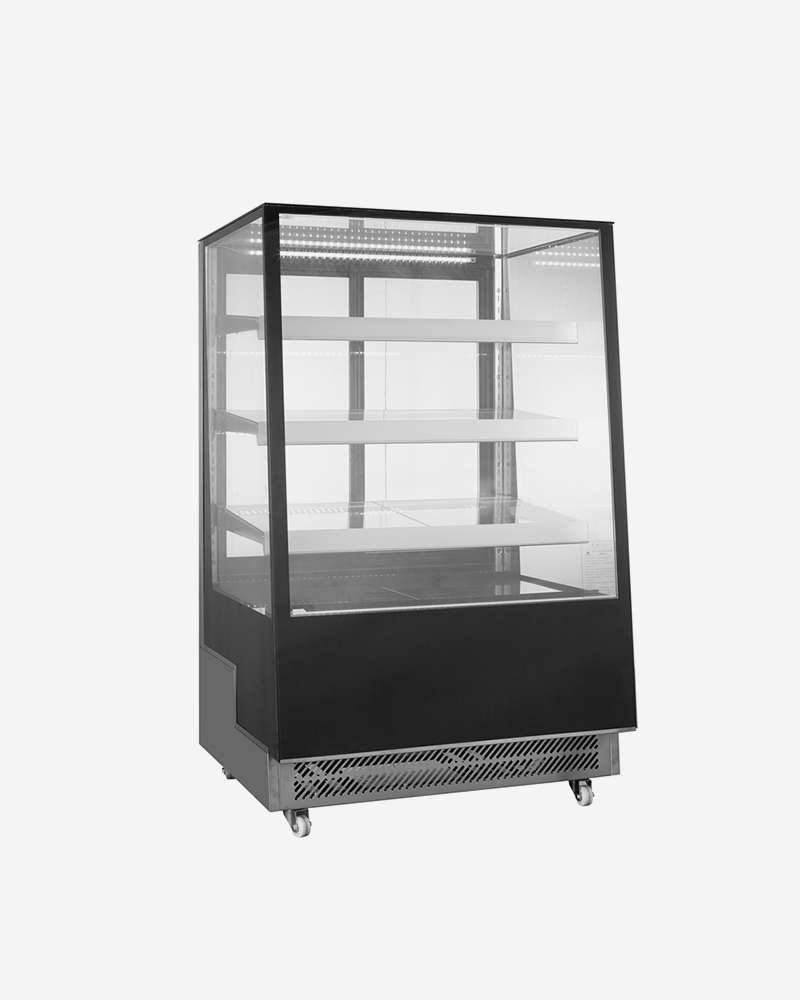
Exquisite 4 Level Cake Display Fridge Cake Showcase
Product Overview
The XC-400L is a vertical cake display refrigerator developed for commercial use. It has a listed capacity of 500 liters and a temperature range of 2–8°C. This range is appropriate for many chilled desserts and ready-to-serve food products, subject to the product manufacturer’s storage guidance and applicable food safety requirements.
The cabinet is designed around a four-level display concept. Multiple shelves create separate presentation zones, allowing staff to use the available internal height efficiently. Cakes can be placed on one level, individual pastries on another, and packaged desserts or beverages on additional levels. This arrangement makes the cabinet suitable for both specialized cake retailing and broader food merchandising.
Its product dimensions are listed as 900 × 810 × 1454 millimeters. This footprint provides a substantial display area without requiring the floor space of a wide horizontal case. The package dimensions are listed as 850 × 950 × 1635 millimeters, which should be considered when planning receiving, transport, door access, and installation.
The listed input power is 460/490 watts, depending on the selected configuration. Refrigerant options are listed as R134a/R290. The cabinet is identified with climate type 4, indicating that it is designed for demanding commercial ambient conditions within the applicable operating limits. Buyers should confirm the final electrical, refrigerant, and compliance configuration before ordering.
| Item | Specification |
|---|---|
| Model | XC-400L |
| Product category | Cake showcase and commercial display refrigerator |
| Listed capacity | 500 liters |
| Temperature range | 2–8°C |
| Input power | 460/490 watts |
| Refrigerant options | R134a/R290 |
| Climate type | 4 |
| Net weight | Approximately 160 kilograms as listed |
| Gross weight | Approximately 180 kilograms as listed |
| Product size | 900 × 810 × 1454 millimeters |
| Package size | 850 × 950 × 1635 millimeters |
| Lighting | Three LED light bars |
| Cooling method | Ventilated cooling system |
| Defrosting | Automatic defrost |
| Doors | Smooth sliding glass doors |
| Mobility | Four castors, including two with brakes |
Key Advantage: Attractive Four-Level Product Presentation
The central advantage of a vertical cake showcase is the ability to present a large selection of products at eye level and within a relatively compact footprint. A horizontal case may offer a broad surface, but it can require more floor space and may limit the number of vertical presentation zones. The four-level design of the XC-400L allows the cabinet to make better use of its height.
Different shelves can be assigned to different product groups. For example, the upper level may display premium celebration cakes, the middle levels may hold slices and pastries, and the lower level may contain packaged desserts or backup items. This arrangement supports a logical shopping experience and helps staff maintain a consistent visual presentation.
Vertical organization also makes product comparison easier. Customers can view several flavors and formats at the same time rather than asking staff to retrieve products from a back room. When products are clearly visible, customers may spend more time considering their options and may be more likely to add an additional item to the order.
The glass enclosure creates a clean visual boundary between the customer and the food. It helps protect the products while preserving the open, attractive appearance that food retailers want. In a bakery or café, the display cabinet can serve as a focal point near the entrance, ordering counter, or checkout area.
Compared with a standard upright refrigerator that is designed primarily for storage, this unit is purpose-built for presentation. Its lighting, glass doors, shelf layout, and professional exterior are intended to support sales rather than simply hold inventory.
Double Tempered Glass for Visibility and Protection
The cabinet uses double tempered glass as a standard feature. This construction provides several practical benefits in a commercial setting. Multiple glass layers can improve insulation performance compared with a single pane, helping reduce the influence of surrounding room temperature on the refrigerated interior. Better insulation can also support more stable operation when the doors are opened during busy service periods.
Tempered glass is processed to provide improved strength and thermal resistance compared with ordinary untreated glass. In a busy bakery, café, or restaurant, the doors may be opened and closed frequently, and the cabinet may be exposed to regular cleaning and daily handling. Stronger glass is therefore an important feature for commercial durability.
The transparent front also supports customer confidence. Products remain visible without requiring staff to open the cabinet repeatedly. This reduces unnecessary door opening and can help limit the loss of cold air. Staff can identify an item before opening the door, which makes service faster and more organized.
Glass performance can be influenced by installation conditions, humidity, door usage, and cleaning practices. For best results, the cabinet should be positioned in a well-ventilated location away from direct sunlight, ovens, cooking equipment, and other heat sources. The glass should be cleaned with suitable products and dried properly to preserve clarity.
Three LED Light Bars Improve Merchandising
Lighting is a critical part of food presentation. Decorative cakes often rely on subtle differences in color, texture, glaze, cream, fruit, and chocolate work. Poor lighting can make products appear dull, while properly positioned illumination can make the display look fresh and inviting.
The XC-400L includes three LED light bars. LED lighting offers several advantages for a refrigerated display. It generally produces less heat than traditional lighting, which is beneficial inside a temperature-controlled cabinet. It also provides bright, consistent illumination while consuming relatively little power.
Three light bars can help distribute light across multiple shelf levels rather than concentrating illumination in a single location. This is important in a four-level showcase, where products on the lower shelves should remain as visible as those near the top. Even lighting supports a more balanced appearance and reduces dark areas that may hide merchandise.
For bakery operators, the lighting arrangement can improve the presentation of signature products. A colorful fruit tart, layered mousse cake, decorated birthday cake, or row of individual pastries can become more visually attractive when illuminated from the appropriate position.
Lighting also supports staff operations. Employees can inspect labels, product condition, and shelf cleanliness more easily. Clear visibility may help reduce mistakes during busy periods when several customers are ordering different items at the same time.
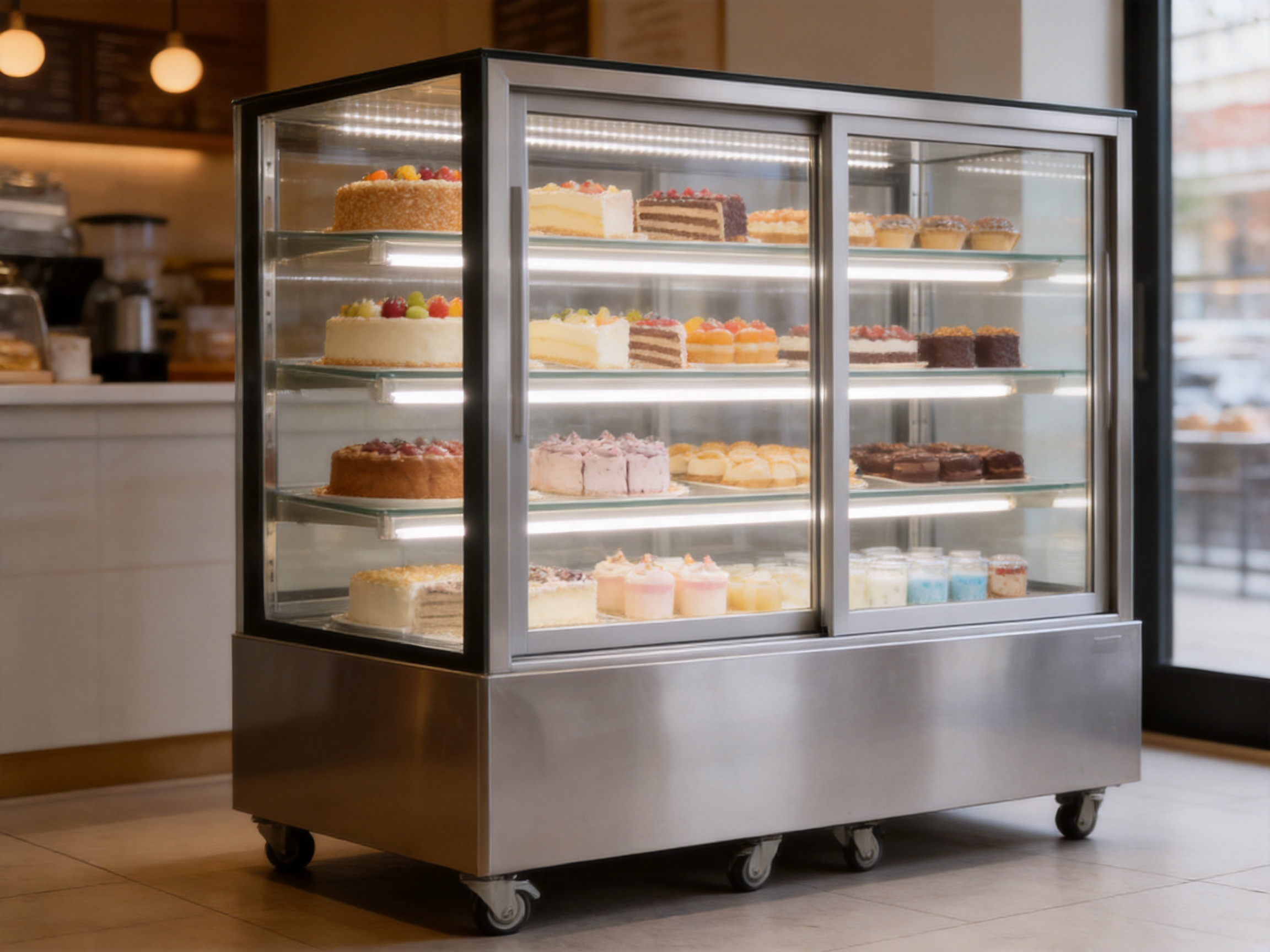
Stable 2–8°C Refrigeration
The listed temperature range of 2–8°C makes the XC-400L suitable for many chilled food applications. Cakes containing dairy cream, custard, mousse, fresh fruit, or other perishable components often require refrigeration. Maintaining a controlled temperature helps preserve texture and freshness while supporting appropriate food handling procedures.
The temperature range is broad enough to support different types of chilled products, but operators should always follow the storage instructions for each food item. Some products may require a narrower range, while others may be sensitive to cold air movement or moisture. Proper product loading and regular temperature monitoring remain essential.
The digital thermostat and display allow staff to see and manage the operating temperature more conveniently than with a basic mechanical control. A visible digital reading helps operators identify changes quickly and provides a practical reference during opening inspections, shift changes, and closing procedures.
Temperature stability depends on several factors, including ambient temperature, product temperature at loading, door-opening frequency, clearance around the cabinet, and the amount of merchandise inside. The cabinet should not be overloaded beyond its intended capacity, and air circulation paths should remain clear. Hot products should be cooled according to proper food handling procedures before being placed inside.
The ventilated cooling system supports more even distribution of chilled air throughout the cabinet. This is particularly useful in a tall display cabinet, where differences between upper and lower levels can occur if air is not circulated effectively. Proper air movement helps each shelf maintain a more consistent environment, although the exact temperature of individual products may vary depending on placement and packaging.
Ventilated Cooling for Commercial Operation
Ventilated cooling, sometimes called forced-air cooling, uses a fan to circulate refrigerated air through the cabinet. This method is commonly used in commercial display equipment because it can cool products more evenly than static cooling alone.
For a cake display, air distribution must be balanced. Excessively direct airflow may dry or damage certain delicate items, while insufficient circulation can create warm zones. A well-designed ventilated system aims to distribute cooling throughout the display space while maintaining an appropriate environment for the products.
The XC-400L’s ventilated cooling system complements its vertical four-level structure. It supports the cabinet’s role as a display refrigerator rather than a simple cold storage box. Products placed at different heights can benefit from circulating air, while the glass front allows customers and staff to monitor the display continuously.
Operators should avoid blocking air outlets with large trays, cartons, or tightly packed products. Cakes should be arranged with reasonable space between them, especially when they are placed in tall boxes or on large serving boards. Good loading practice helps the cooling system work efficiently and supports faster recovery after door openings.
Automatic Defrost for Easier Maintenance
Automatic defrost is another important standard feature. In a refrigerated cabinet, moisture from the surrounding air can accumulate as frost on cooling components. Excessive frost may reduce cooling efficiency and limit airflow. Automatic defrost helps manage this buildup without requiring staff to shut down the cabinet for frequent manual defrosting.
For a busy food business, reduced maintenance time is a practical advantage. Staff can focus on production, customer service, cleaning, and stock rotation rather than performing repeated manual defrost procedures. Automatic defrost also helps maintain more consistent cabinet performance over time.
Although the system reduces manual work, the cabinet still requires routine care. Operators should clean the interior, shelves, door tracks, glass surfaces, condenser area, and drainage components according to the maintenance instructions. Spilled cream, fruit, syrup, and crumbs should be removed promptly to maintain hygiene and prevent odors.
Maintenance should be carried out by trained personnel when electrical, refrigeration, or control components require attention. The unit should be disconnected from the power supply before appropriate cleaning or servicing procedures begin. A regular inspection schedule can help identify unusual noise, poor temperature recovery, damaged seals, or blocked ventilation before they become serious problems.
Smooth Sliding Glass Doors for Efficient Service
The XC-400L is equipped with smooth back sliding glass doors. Sliding doors are particularly useful in commercial service environments because they do not swing into customer walkways or occupy additional clearance behind the cabinet. This can make them suitable for placement near counters, walls, or narrow service areas.
A smooth sliding mechanism supports quick access during busy periods. Staff can open the appropriate section, retrieve a cake or pastry, and close the door with minimal movement. This can reduce the amount of time the cabinet remains open and help limit the loss of cold air.
Sliding doors also allow customers to view products without creating the obstruction that a hinged door may cause. In a self-service environment, customers can access products more conveniently, provided that the store’s food handling procedures permit customer access.
Door tracks should be kept clean and free from crumbs, packaging fragments, and sticky food residues. A clean track allows the doors to move smoothly and reduces unnecessary strain on rollers and guides. Door seals should also be inspected regularly to ensure that they remain properly positioned and undamaged.
For businesses serving custom cakes, staff may choose to operate the sliding doors while customers select a product. This keeps the display orderly and gives employees better control over hygiene, product handling, and inventory rotation.
Stainless Steel Base for Durability and Hygiene
The stainless steel base provides a strong foundation for a commercial display cabinet. Stainless steel is widely used in food service equipment because it is durable, resistant to corrosion under normal conditions, and relatively easy to clean.
A stainless steel lower section can help the cabinet withstand the demands of daily business operation. It may be exposed to contact with delivery carts, cleaning equipment, packaging, and occasional splashes. Compared with less durable materials, stainless steel offers a professional appearance that can remain attractive with regular care.
The base also helps create a visual separation between the refrigerated display area and the floor. This can give the unit a more finished appearance and make it easier to integrate into a bakery, restaurant, hotel, or retail store interior.
Cleaning should be performed with appropriate food-service cleaning materials. Abrasive pads, aggressive chemicals, and unsuitable chlorine-based products may damage the finish if used improperly. Wiping spills promptly and drying the surface after cleaning can help maintain its appearance.
Mobility and Flexible Store Layouts
Four castors are included, with two fitted with brakes. This arrangement allows the cabinet to be moved during installation, cleaning, store reorganization, or maintenance. Once it has been positioned correctly, the brakes help keep it stable during normal operation.
Mobility is especially valuable for businesses that regularly change their sales layout. A bakery may move the cabinet closer to the entrance during a seasonal promotion, place it beside a coffee counter during busy mornings, or reposition it to create space for special events.
The castors can also make floor cleaning easier. Instead of trying to clean around a heavy fixed cabinet, trained staff may be able to move the unit carefully when appropriate. Because the product is substantial in size and weight, movement should be performed by enough personnel using safe handling procedures.
After positioning, the cabinet should stand level and stable. Uneven floors may affect door movement, drainage, or overall operation. The brakes should be engaged, and sufficient clearance should be maintained around ventilation areas to support heat release and equipment performance.
Separated Power Button and Practical Controls
A separated power button provides a simple and accessible way to control the cabinet. This can be useful when the unit needs to be switched off for cleaning, relocation, inspection, or scheduled maintenance.
The digital thermostat and display provide a more professional control arrangement than a basic on-and-off switch. Staff can check the displayed temperature during routine operations and respond more quickly if the reading moves outside the desired range.
Commercial refrigeration equipment benefits from clear controls because it may be operated by multiple employees across different shifts. Simple controls reduce confusion and make it easier to establish standard operating procedures. Businesses can include temperature checks in opening and closing checklists, along with cleaning and stock rotation tasks.
Operators should avoid changing temperature settings unnecessarily. Frequent adjustments may make it more difficult to maintain consistent product conditions. A suitable temperature should be selected based on the products being displayed, the manufacturer’s guidance, and local food safety requirements.
Advantages Compared with Ordinary Refrigerators
An ordinary household refrigerator is designed mainly for personal food storage. It may not provide the visibility, capacity, durability, lighting, or access required in a commercial retail environment. The XC-400L is designed around the specific needs of food display.
First, its glass enclosure allows products to function as merchandise. Customers can see the cakes without opening a solid door. Second, the LED light bars make the cabinet more effective as a sales tool. Third, the four-level structure increases the number of visible presentation areas. Fourth, the commercial cabinet includes features such as automatic defrost, ventilated cooling, castors, and a stainless steel base.
Compared with a basic open display shelf, the refrigerated enclosure provides better control over temperature and product protection. Open shelves may expose desserts to warm air, airborne particles, accidental contact, and rapid quality changes. The enclosed design of the XC-400L provides a more controlled environment while preserving visibility.
Compared with a horizontal cake counter, the vertical structure can make better use of floor area. It is especially useful where the store has limited width but sufficient ceiling height. The product dimensions should still be checked carefully against the planned installation area, but its upright format can support more efficient layout planning.
Compared with a low-cost display cabinet without commercial features, this model offers a more complete operating package. Digital controls, ventilated cooling, automatic defrost, double tempered glass, LED lighting, and castors are not merely cosmetic additions. They contribute to usability, product visibility, maintenance, and day-to-day operational efficiency.
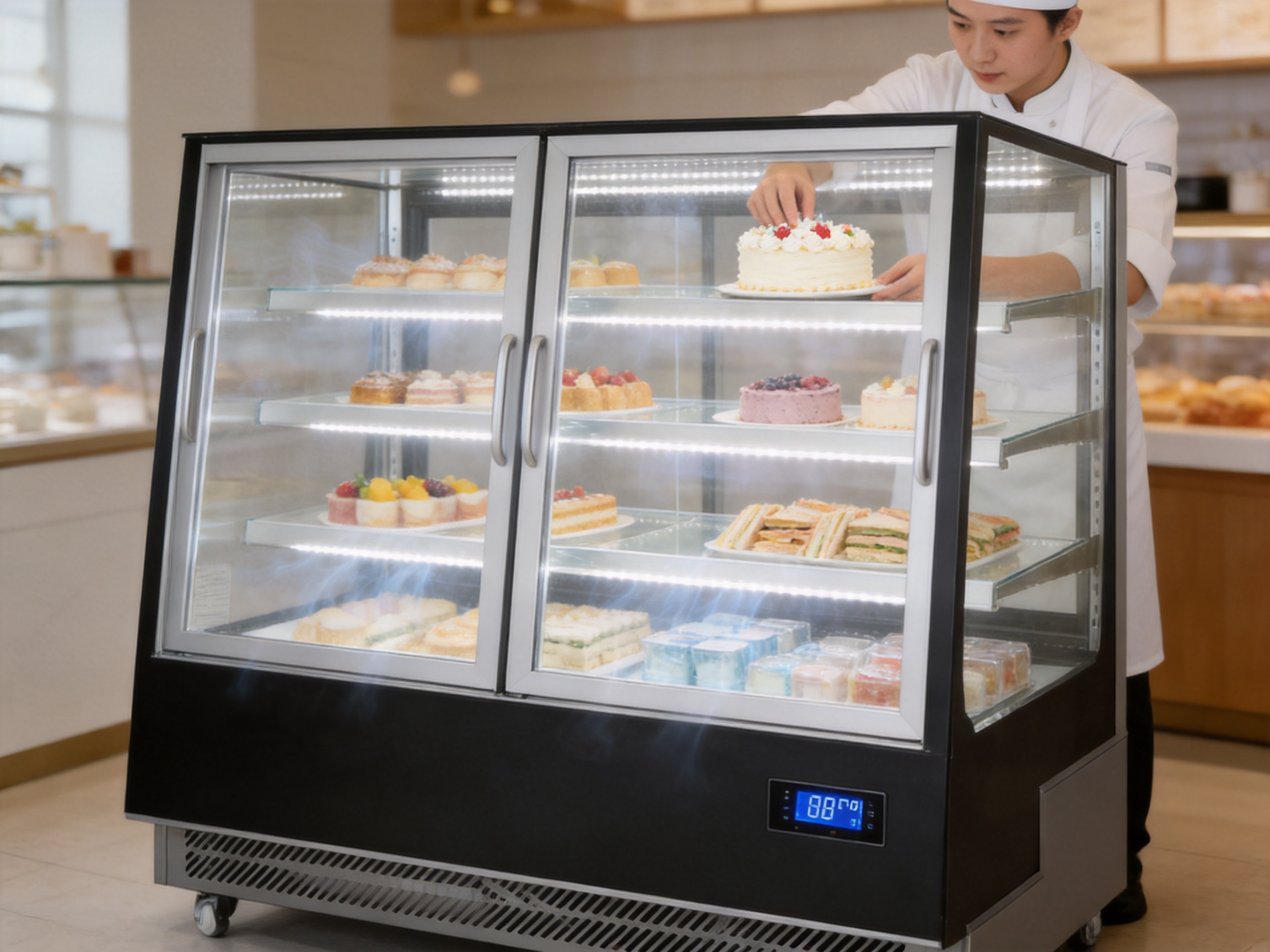
Suitable Applications
The XC-400L can support a wide range of food service and retail applications. Its primary use is as a cake showcase, but its temperature range and display format allow it to serve other chilled products as well.
Bakeries and Pastry Shops
Bakeries can use the cabinet to present whole cakes, cake slices, tarts, éclairs, cream pastries, mousse desserts, and seasonal specialties. The multiple levels make it easier to separate premium products from everyday selections or to organize items by flavor and size.
Cafés and Coffee Shops
Cafés can place the cabinet near the ordering counter to encourage customers to combine drinks with desserts. Individual pastries and cake slices can be displayed at eye level, while packaged chilled products may be placed on another shelf for convenient service.
Hotels and Restaurants
Hotels may use the showcase in breakfast areas, lobby cafés, banquet preparation zones, or dessert counters. Restaurants can display prepared desserts near the host stand or service counter, helping customers understand the available selection before ordering.
Supermarkets and Specialty Food Stores
Retail stores can use the cabinet for premium cakes, ready-to-eat desserts, fresh fruit preparations, and other chilled products. The glass display supports self-service shopping, while the vertical design makes efficient use of valuable sales-floor space.
Catering and Event Businesses
Catering companies may use a professional showcase for temporary event preparation, product staging, or in-store sales. The castors make it easier to position the cabinet in a flexible working environment, subject to safe transportation and appropriate electrical access.
Manufacturing Strength and Product Development Capability
The company behind the product is a professional manufacturer of vertical display cabinets, cake cabinets, and warming cabinets. Its manufacturing experience began in 2007, providing more than a decade of experience at the time the product information was prepared. The company operates a modern management and production facility covering approximately 40,000 square meters.
A substantial manufacturing site can support more organized production planning, component control, assembly management, and quality inspection. For commercial refrigeration, these capabilities are important because product performance depends on the coordinated operation of the cabinet structure, refrigeration system, electrical controls, glass, lighting, doors, shelves, and mobility components.
The manufacturer has its own professional research and development team. In practical terms, an internal R&D capability can help a company respond to changing market requirements, develop new cabinet formats, refine cooling layouts, improve energy performance, and adapt products for different commercial environments.
Advanced testing facilities are also identified as part of the company’s strengths. Testing is essential for display refrigerators because performance cannot be evaluated only by visual inspection. Temperature behavior, door sealing, electrical safety, cooling recovery, lighting, defrosting, and mechanical operation should be evaluated through appropriate procedures.
A product manufacturer with dedicated development and testing resources is better positioned to improve designs over time. This can support more consistent quality and help identify potential problems before products are shipped. It also allows product specifications to be reviewed against the needs of international customers and different operating conditions.
International Certifications and Quality Orientation
The company reports obtaining CE, GS, CCC, CB, RoHS, ETL, and other major certifications. These certifications and approvals are associated with different markets and regulatory requirements. The specific certification available for a particular model, voltage, refrigerant, or destination should always be confirmed in the final technical documentation.
International certification capability demonstrates that the manufacturer understands the importance of electrical safety, material requirements, product testing, and market compliance. For importers and distributors, this can simplify the process of evaluating equipment for different regions.
Certification is not a replacement for correct installation or responsible operation. The cabinet must still be connected to a suitable power supply, installed according to instructions, operated within its environmental limits, and maintained by qualified personnel. However, a documented compliance system provides an important foundation for commercial buyers.
The company’s stated focus on innovation, quality, and service also reflects the long-term requirements of the commercial refrigeration market. Buyers often need more than a single shipment. They may require technical documents, spare parts, packaging support, customization, after-sales communication, and stable production capacity. A manufacturer with established export experience can be valuable in these areas.
How Advanced Manufacturing Supports the XC-400L
The performance of a cake showcase depends on precise integration of many parts. The glass must fit correctly within the cabinet structure. Sliding doors must align with their tracks. Shelves must support the intended load. LED bars must be positioned to illuminate the display. The cooling system must circulate air through the cabinet without creating unacceptable temperature differences.
Modern production lines can help improve repeatability in these areas. Standardized assembly procedures reduce variation between units, while inspection stages can identify problems with wiring, door movement, surface finish, and component installation. A controlled production environment also supports more consistent packaging and shipment preparation.
Research and development teams can evaluate changes to airflow, insulation, cabinet geometry, shelf spacing, lighting position, and user controls. These improvements can be based on customer feedback, laboratory testing, field experience, and changing regulations.
Testing facilities are particularly important for products intended for warm or demanding commercial environments. Climate type 4 indicates that the model is designed for a defined class of ambient conditions, but operating performance still depends on proper installation. Controlled testing helps manufacturers understand how the cabinet responds to temperature, humidity, loading, and door-opening conditions.
Manufacturing strength also contributes to supply reliability. Commercial customers often plan store openings, renovations, or equipment replacement schedules months in advance. A manufacturer with established production capacity may be better able to support repeat orders and consistent model availability.
Installation Recommendations
Before installation, measure the doorway, elevator, corridor, and final placement area. The product and package dimensions should both be considered. Because the packaged unit is larger than the operating cabinet, access limitations should be identified before delivery.
Place the cabinet on a stable, level surface with adequate clearance around the refrigeration equipment. Do not install it directly beside ovens, cooking ranges, heaters, or other appliances that release substantial heat. Direct sunlight should also be avoided because it can increase the cooling load and affect visibility.
Connect the cabinet to a suitable electrical supply that matches the approved configuration. The voltage, frequency, plug type, grounding, and local electrical requirements should be verified by a qualified professional. Extension cords and overloaded circuits should be avoided unless specifically approved for the application.
After positioning the cabinet, engage the two castor brakes and verify that the unit is stable. Allow the refrigeration system to operate according to the manufacturer’s start-up instructions before loading products. Confirm that the displayed temperature reaches the desired range and that the doors close and slide properly.
Products should be loaded only after the cabinet has reached a suitable operating temperature. Avoid placing oversized trays or packages where they can block air circulation. Keep products away from areas that may interfere with the doors, fans, sensors, or drainage paths.
Cleaning and Daily Operating Practices
Cleanliness is essential in any cake and dessert display. Cream, fruit, chocolate, syrup, and crumbs can accumulate quickly, particularly during busy service. A daily cleaning schedule should include the glass, shelves, door tracks, interior surfaces, handles, base, and accessible exterior areas.
Use food-safe cleaning products that are compatible with glass, stainless steel, plastic, and coated surfaces. Avoid abrasive materials that may scratch the glass or damage the finish. After cleaning, surfaces should be dried thoroughly to reduce streaks, moisture accumulation, and potential hygiene issues.
Check the temperature at regular intervals and record the results if required by the store’s food safety system. A digital display provides a useful operating reference, but businesses may also use an independent calibrated thermometer for verification according to their procedures.
Rotate products using a first-in, first-out approach where appropriate. Clearly identifying production dates and use-by dates can help reduce waste and support food safety. The four-level display should be kept organized so that older products are not hidden behind newer stock.
Do not leave the sliding doors open longer than necessary. Train staff to identify the required product before opening the cabinet. During peak service, organized shelf placement can make retrieval faster and reduce temperature fluctuations caused by repeated searching.
Merchandising Strategies for Better Sales
A display refrigerator should be treated as a sales tool, not only as an equipment item. Product arrangement can influence customer attention and purchasing behavior. Place high-margin or signature products in prominent positions, while ensuring that all products remain within suitable temperature and loading conditions.
Use visual contrast to make the cabinet attractive. Cakes with bright fruit, dark chocolate, light cream, and colorful decorations can be arranged so that neighboring products complement one another. Uniform labels and trays can create a more organized professional appearance.
Keep the front of every product visible. Avoid placing tall boxes in front of smaller items or allowing price tags to cover decorative details. The LED lighting should be used to support visibility rather than create glare. If reflections occur, consider adjusting the cabinet’s position or the surrounding lighting.
Seasonal merchandising can also improve the value of the showcase. Holiday desserts, birthday cakes, wedding samples, specialty pastries, and limited-time flavors can receive dedicated shelf space. Because the cabinet is mobile, the store may be able to reposition it as the sales floor changes.
Clear organization helps staff answer customer questions quickly. Products can be grouped into categories such as whole cakes, individual slices, fruit desserts, chocolate desserts, and low-sugar selections. A well-planned arrangement makes the cabinet easier to shop and easier to restock.
Energy and Operating Efficiency
Efficient operation begins with correct installation. The cabinet should have sufficient ventilation and should not be exposed to unnecessary heat. Maintaining suitable room conditions can reduce the workload on the refrigeration system.
Keeping the doors closed is equally important. Every open-door event allows warm, moist air to enter the cabinet. Repeated or prolonged opening can increase the cooling load and may contribute to condensation. Smooth sliding doors make quick access possible, but staff habits remain an important part of efficient operation.
Regular cleaning also supports performance. Dust and grease around ventilation areas can restrict heat release and reduce refrigeration efficiency. The condenser area should be inspected and cleaned according to the service instructions, with technical work carried out by qualified personnel where necessary.
LED lighting contributes to efficient merchandising because it provides strong illumination with relatively low heat generation. Automatic defrost can also reduce the need for manual shutdowns and help the cabinet maintain useful cooling performance when properly serviced.
Actual energy consumption will vary according to ambient temperature, product load, door-opening frequency, set temperature, maintenance, and electrical configuration. Buyers should use the final technical data for accurate energy planning.
Quality, Safety, and Long-Term Value
Commercial equipment should be evaluated over its full operating life rather than by purchase price alone. A cabinet that presents products attractively, maintains suitable temperature, reduces manual maintenance, and supports efficient staff service can provide greater value than a lower-cost unit with fewer features.
The XC-400L combines several features that support long-term commercial use: a durable stainless steel base, double tempered glass, automatic defrost, ventilated cooling, digital temperature control, LED illumination, sliding doors, and lockable mobility. Together, these features create a complete display solution rather than a basic refrigerated box.
Food safety remains the responsibility of the operator. The cabinet can support proper storage, but it cannot compensate for incorrect product handling, excessive loading, inadequate cleaning, or failure to monitor temperature. Businesses should establish written procedures for loading, cleaning, temperature checks, stock rotation, and service response.
Long-term performance also depends on selecting the correct cabinet for the intended environment. Buyers should confirm the product’s electrical specification, refrigerant version, certification documentation, available service support, spare parts, warranty terms, and delivery requirements before placing an order.
Purchasing Considerations for Commercial Buyers
When evaluating the XC-400L for a new or existing business, buyers should begin by estimating the expected product volume. A listed capacity of 500 liters provides substantial display space, but usable capacity depends on shelf arrangement, cake dimensions, trays, packaging, and the need to preserve airflow.
The next consideration is store layout. The cabinet measures 900 millimeters in width, 810 millimeters in depth, and 1454 millimeters in height according to the supplied information. Buyers should leave enough space for customer movement, door operation, cleaning, ventilation, and service access.
Businesses should also consider whether products will be loaded from the front or rear and whether staff or customers will operate the doors. The smooth sliding glass door design can support efficient service, but the final placement should allow employees to use the doors comfortably.
Climate and ambient conditions should be reviewed. The stated climate type is 4, but every installation has its own heat, humidity, and airflow characteristics. A cabinet located beside a hot production area may experience a heavier cooling load than one placed in an air-conditioned retail area.
Finally, buyers should request current technical documents and confirm any model variations. Details such as voltage, frequency, refrigerant, shelf quantity, net weight, gross weight, packaging, and certification may differ according to market or production configuration.
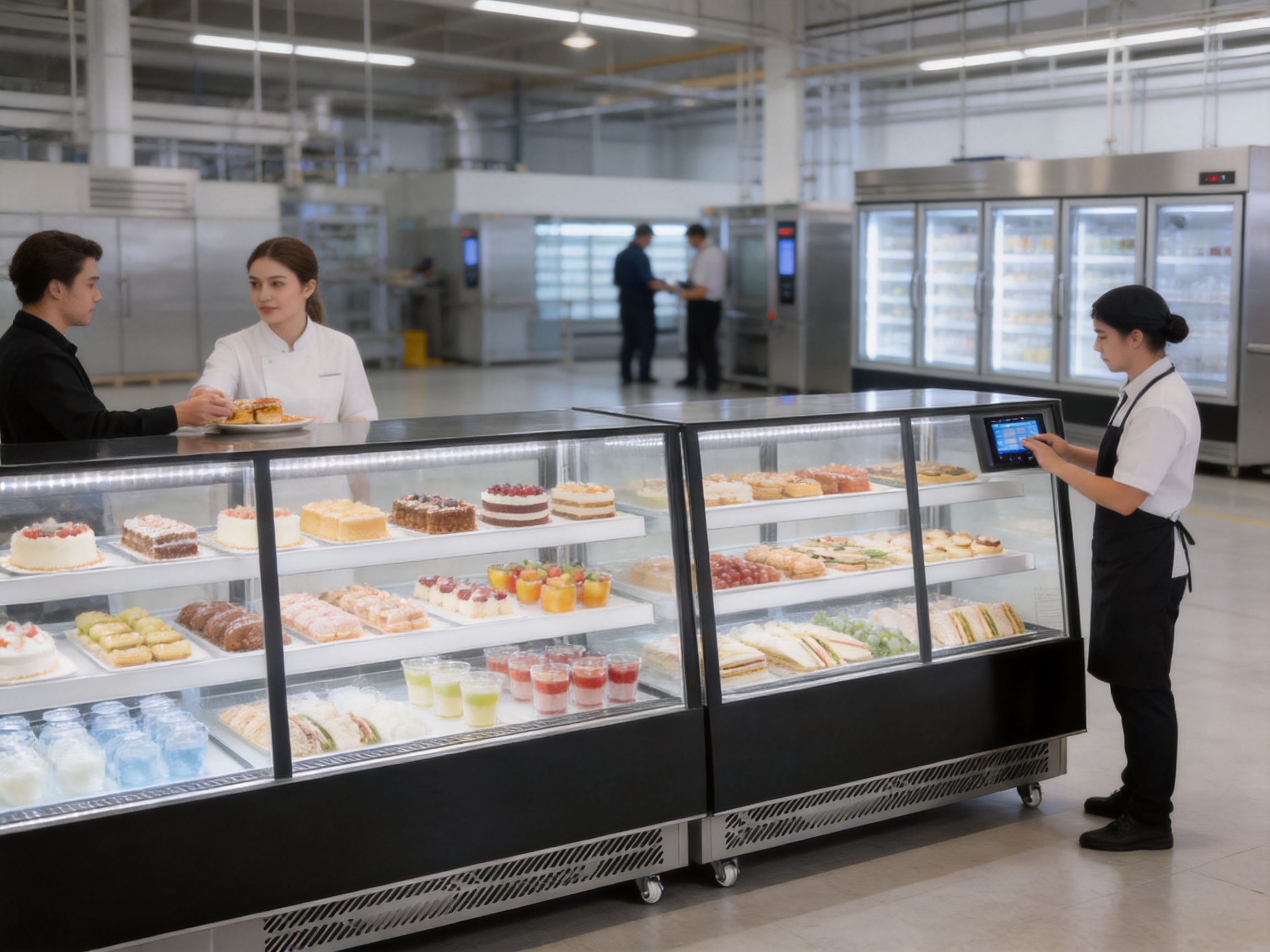
Frequently Asked Questions
What is the main purpose of the XC-400L?
The XC-400L is a commercial cake showcase and refrigerated display cabinet. It is designed to keep chilled cakes, pastries, desserts, and other suitable food products visible and organized while maintaining a listed temperature range of 2–8°C.
How much product can the cabinet hold?
The listed capacity is 500 liters. Actual usable display capacity will depend on the size of the cakes, trays, packaging, shelf spacing, and the need to leave sufficient space for cold-air circulation.
How many display levels does the cabinet have?
The product title identifies it as a four-level cake display fridge. The supplied standard-feature information also lists glass shelving. Buyers should confirm the final shelf quantity and configuration on the commercial quotation or technical specification before ordering.
Is the cabinet suitable for cream cakes?
The 2–8°C temperature range is suitable for many chilled cream cakes and desserts when used correctly. However, storage requirements vary by recipe and ingredient. Operators should follow the food producer’s instructions and local food safety regulations.
What type of cooling system does it use?
The cabinet uses a ventilated cooling system. Circulated chilled air helps support more even cooling throughout the vertical display area. Products should still be loaded without blocking air outlets or circulation paths.
Does the unit require manual defrosting?
Automatic defrost is listed as a standard feature. This reduces the need for frequent manual defrosting, although routine cleaning, inspection, and professional servicing remain necessary.
Why are double tempered glass doors beneficial?
Double tempered glass improves visibility, supports insulation, and provides stronger protection than ordinary single-pane glass. It also allows customers to inspect the products without opening the cabinet, which can help reduce unnecessary cold-air loss.
Can the cabinet be moved after installation?
Four castors are included, and two have brakes. The castors support movement during installation, cleaning, or layout changes. The cabinet should be moved carefully by trained personnel, and the brakes should be engaged once it is in the correct position.
What is the purpose of the LED light bars?
The three LED light bars illuminate the products and help improve visual merchandising. They can make cakes, pastries, fruit, cream, chocolate, and decorative details easier for customers to see.
Is this cabinet only for cakes?
No. Although it is designed primarily as a cake showcase, it may also be used for suitable chilled pastries, desserts, sandwiches, fruit cups, beverages, and other food products. The operator must confirm that each product is compatible with the cabinet’s temperature and airflow conditions.
What should be checked before installation?
Check the package dimensions, delivery route, doorway and elevator access, floor strength, electrical supply, ventilation clearance, ambient temperature, and final placement. The cabinet should be installed level and away from direct sunlight and heat-producing equipment.
How can the cabinet be kept hygienic?
Clean the glass, shelves, door tracks, interior, handles, and exterior regularly using suitable food-safe cleaning materials. Remove spills promptly, avoid abrasive tools, and follow the business’s documented cleaning and food safety procedures.
What manufacturing capabilities support this product?
The manufacturer has its own R&D team, advanced testing facilities, a modern production facility of approximately 40,000 square meters, and experience producing vertical display cabinets, cake cabinets, and warming cabinets. These capabilities support product development, testing, assembly, and quality improvement.
Which certifications are associated with the manufacturer?
The company reports certifications and approvals including CE, GS, CCC, CB, RoHS, and ETL. The exact certification applicable to a specific XC-400L configuration and destination should be confirmed in the current product documentation.
Conclusion
The XC-400L four-level cake display fridge is a practical solution for businesses that need both reliable chilled storage and attractive product presentation. Its 500-liter listed capacity, 2–8°C temperature range, ventilated cooling, automatic defrost, digital thermostat, double tempered glass, three LED light bars, sliding doors, stainless steel base, and mobile castors form a comprehensive commercial equipment package.
Its strongest advantage over ordinary refrigerators and basic display shelves is the way it combines preservation with merchandising. Products remain visible, organized, illuminated, and protected, while staff benefit from accessible controls, convenient sliding doors, automatic defrost, and flexible mobility.
The manufacturer’s experience, internal R&D team, testing facilities, modern production site, and reported international certifications provide additional support for professional buyers. These capabilities are important for commercial refrigeration because consistent performance depends on careful design, accurate assembly, effective testing, and ongoing quality improvement.
For bakeries, cafés, hotels, restaurants, supermarkets, and specialty dessert retailers, the cabinet can become a central part of the customer experience. When installed correctly, loaded responsibly, and maintained regularly, it can help preserve product quality, improve store organization, strengthen visual presentation, and support more efficient daily service.
References
1. Product specification sheet for the XC-400L commercial cake showcase, including capacity, temperature range, dimensions, cooling method, and standard features.
2. Commercial refrigeration equipment maintenance principles, including temperature monitoring, condenser care, door-seal inspection, and airflow management.
3. Food retail display guidance concerning chilled product handling, stock rotation, cleaning procedures, and customer-facing merchandising.
4. General technical guidance for tempered glass, LED lighting, ventilated cooling systems, and automatic defrost applications in commercial refrigeration.
5. Manufacturer-provided company information concerning research and development, production facilities, testing capabilities, manufacturing experience, and international certifications.
Product: Exquisite 4 Level Cake Display Fridge Cake Showcase

You May Also Like
.jpg?imageView2/2/w/500/h/500/format/jp2/q/100 "Four Sides Glasses Display Cooler")
.jpg?imageView2/2/w/500/h/500/format/jp2/q/100 "White 4-Sided Glass Refrigerated Display Case")
.jpg?imageView2/2/w/500/h/500/format/jp2/q/100 "Refrigerated Display Cake Countertop Four Sides Glasses Display Cooler")
.jpg?imageView2/2/w/500/h/500/format/jp2/q/100 "Four Sides Glasses Display Cooler")

-
- Navigation
- Home
- About Us
- Products
- News
- Contact Us
 East Zone, Guanhaiwei Industrial Park, Cixi City, Ningbo, Zhejiang, China
 +86-574-63668678
 +86-574-63668108
Copyright © Ningbo XiangChi Electrical Co.,Ltd All Rights Reserved.
