
 简体中文
 English
 Español

News
Heated Display Warmers with Adjustable Divider Rods: A Complete Guide to Commercial Food Presentation and Holding
Commercial foodservice operators need equipment that does more than keep prepared food warm. A successful heated display warmer must preserve serving temperature, support attractive merchandising, provide reliable visibility, simplify cleaning, and withstand the demanding pace of daily restaurant, bakery, catering, and retail operations. The XCR-85D, XCR-102D, XCR-121D, XCR-138D, and XCR-152D series is designed around these requirements.
This family of heated display warmers combines a stainless steel body, glass-front presentation, adjustable thermostat control, independent heat and light controls for each shelf, adjustable divider rods, and adjustable feet. Together, these features create a flexible solution for displaying pastries, prepared meals, fried foods, sandwiches, snacks, bakery products, and other products that should remain warm and visually appealing during service.
Available in five sizes, the series allows foodservice businesses to select a cabinet that matches their available counter space, product volume, electrical capacity, and merchandising goals. The smallest model offers a compact footprint for limited service areas, while the largest model provides a broad display area for higher-volume operations. Despite the size differences, all models maintain the same stated temperature range of 30–90°C, or 86–194°F.
Why Heated Display Equipment Matters in Modern Foodservice
Prepared food often loses its appeal when it is left uncovered or held in unsuitable conditions. Heat loss can affect texture, flavor, and customer perception. A warm sandwich may become unappealing when it cools, while fried foods can lose their serving quality when left exposed to ambient air. Bakery products may also appear less inviting if they are displayed without appropriate illumination or organization.
A heated display warmer provides a controlled presentation environment. It allows operators to place food where customers can see it while maintaining a selected holding temperature. This supports faster purchasing decisions, encourages impulse sales, and reduces the need for staff to repeatedly retrieve products from a back-of-house kitchen.
For cafés, convenience stores, bakeries, hotels, restaurants, institutional dining facilities, and catering counters, front-of-house display can be an important part of the sales process. The cabinet itself becomes a merchandising tool. Food is not only stored; it is presented in an orderly, accessible, and professional manner.
The XCR series is especially suitable for operations that need a combination of warming capability and visual display. Its design supports food presentation from multiple viewing angles across the front and side glass areas, while its adjustable internal organization makes it easier to accommodate products with different sizes and shapes.
Product Range and Model Selection
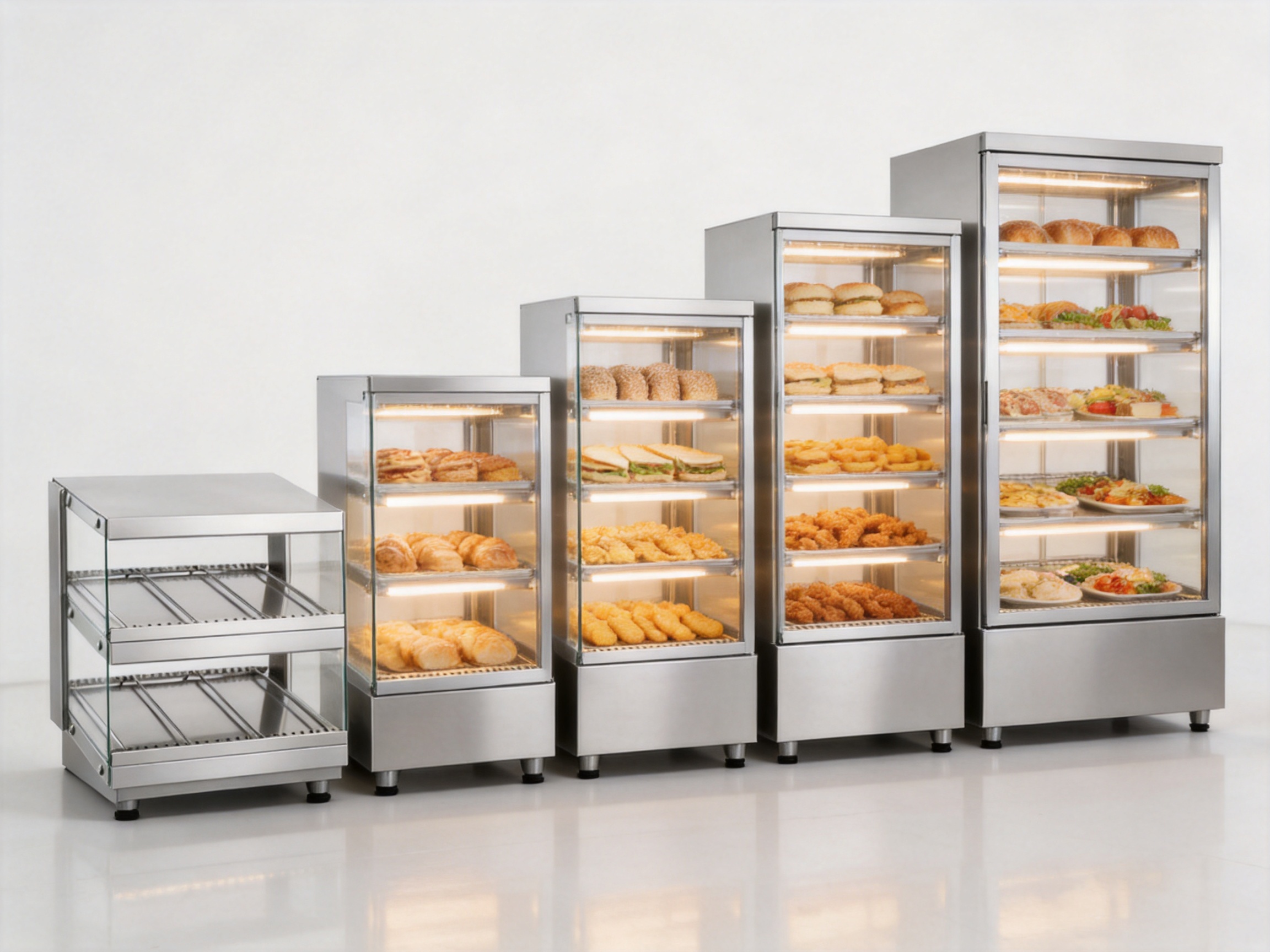
The five available models are identified by their approximate gross display capacities: 0.85, 1.02, 1.21, 1.38, and 1.52 square meters. The model numbers correspond to the XCR-85D, XCR-102D, XCR-121D, XCR-138D, and XCR-152D versions.
| Model | Gross Capacity | Input Power | Net Weight | Gross Weight | Product Size |
|---|---|---|---|---|---|
| XCR-85D | 0.85 m² | 1500 W | 41 kg | 44 kg | 800 × 700 × 688 mm |
| XCR-102D | 1.02 m² | 1500 W | 49 kg | 52 kg | 953 × 700 × 688 mm |
| XCR-121D | 1.21 m² | 1800 W | 55 kg | 58 kg | 1106 × 700 × 688 mm |
| XCR-138D | 1.38 m² | 1800 W | 65 kg | 68 kg | 1259 × 700 × 688 mm |
| XCR-152D | 1.52 m² | 2200 W | 74 kg | 78 kg | 1400 × 700 × 688 mm |
The XCR-85D is appropriate for compact counters, small cafés, kiosks, and locations with modest product turnover. Its 800 mm width provides a practical display area without demanding extensive counter space.
The XCR-102D adds display length while maintaining the same 1500 W input power as the smallest model. This makes it suitable for operators that need additional merchandising capacity but still want to work within a similar power range.
The XCR-121D and XCR-138D offer larger presentation areas and use 1800 W input power. These models are well suited to busier service counters, bakeries, convenience stores, and restaurants offering several categories of hot or warm food.
The XCR-152D is the largest model in the series. With a width of 1400 mm, 1.52 square meters of stated gross capacity, and 2200 W input power, it is designed for operations requiring the highest display volume in this range.
All five models share a depth of 700 mm and a height of 688 mm. This consistent depth and height can simplify planning when several units are being installed across a common counter line. Businesses can select different widths without dramatically changing the overall visual arrangement of the service area.
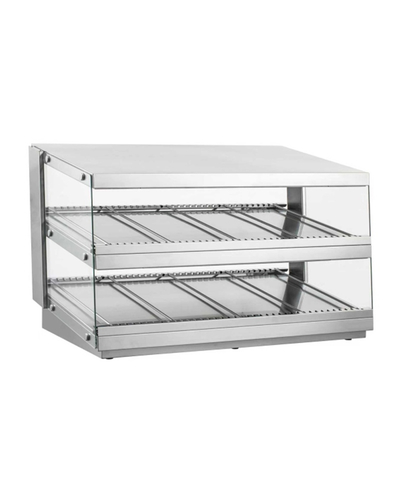
Heated Display Warmers With Adjustable Divider Rods XCR-85D/102D/121D/138D/152D
Core Product Advantages
Controlled Temperature Holding
The series provides a temperature range of 30–90°C, equivalent to 86–194°F. This broad adjustment range gives operators flexibility for different categories of warm food and different service conditions. The adjustable thermostat enables users to select a suitable setting rather than relying on a single fixed heat level.
Temperature control is important because different products respond differently to heat. A pastry may require a gentler holding environment than a fried snack, while a prepared meal may need a higher setting to remain suitable for service. Operators can adapt the cabinet to the product instead of using the same temperature for every item.
The thermostat also supports operational consistency. Staff can establish standard settings for common menu items, document those settings in internal procedures, and make adjustments when the product mix or ambient conditions change. This can help reduce unnecessary temperature fluctuations caused by informal or inconsistent operation.
Independent Heat and Light Controls
One of the most useful features of the XCR series is the provision of independent heat and light controls for each shelf. This gives operators more precise control over the display environment than a cabinet with one shared control for the entire interior.
Independent heat control can be useful when different shelves hold different products. Some items may require more warming support, while others may be adequately held with less heat. Shelf-level management allows the operator to respond to these differences and avoid treating the entire display as a single undifferentiated space.
Independent lighting control also provides operational flexibility. Staff can illuminate shelves that contain products available for sale and reduce lighting in sections that are temporarily empty or being cleaned. This can contribute to better energy management and a more organized visual presentation.
From a merchandising perspective, shelf-level lighting allows products to be emphasized without relying on additional countertop fixtures. Proper illumination can make colors, shapes, textures, and packaging easier for customers to recognize, particularly in busy retail environments.
Adjustable Divider Rods
The adjustable divider rods are a practical advantage for businesses with changing product assortments. Food products vary in length, height, packaging, and serving format. Fixed partitions can leave wasted space or make it difficult to create a neat arrangement. Adjustable rods allow the interior to be reconfigured as needed.
Operators can use the divider rods to separate different product categories, create individual product lanes, prevent items from shifting, or maintain orderly rows during peak service. For example, a bakery may use them to separate different pastry varieties, while a convenience store may create dedicated spaces for sandwiches, rolls, snacks, and packaged meals.
Adjustable organization also supports better stock rotation. When products are separated clearly, staff can identify older items, refill individual sections, and monitor inventory more efficiently. A visually organized cabinet can make it easier to identify low-stock areas before the display appears empty to customers.
The rods are particularly helpful when product dimensions change throughout the day. A morning display may hold large breakfast items, while an afternoon arrangement may contain smaller snacks or desserts. Instead of purchasing separate fixtures, operators can adjust the same display warmer to meet the new arrangement.
Stainless Steel Body Construction
The stainless steel body is designed for commercial use, where equipment is exposed to frequent handling, cleaning, heat, moisture, and food-service activity. Stainless steel offers a clean professional appearance and is widely used in foodservice environments because it is durable and relatively easy to maintain.
A stainless steel exterior can also coordinate with other commercial equipment, including refrigerated display cases, preparation counters, ovens, shelves, and service stations. This helps businesses create a consistent visual identity across the front and back of the house.
Maintenance remains essential regardless of material. Operators should follow their sanitation procedures, remove food residue promptly, use appropriate cleaning products, and avoid practices that could scratch or damage surfaces. Proper maintenance helps preserve both hygiene and appearance over the service life of the cabinet.
Adjustable Feet for Installation Stability
Commercial floors are not always perfectly level. Adjustable feet help compensate for minor irregularities and support a stable installation. A stable cabinet is important for safe operation, consistent door or glass alignment, and an orderly presentation of food on the shelves.
Adjustable feet also make it easier to align the unit with nearby counters or display equipment. This can improve the appearance of a complete service line and reduce unwanted movement during cleaning or customer-facing operation.
Display and Merchandising Benefits
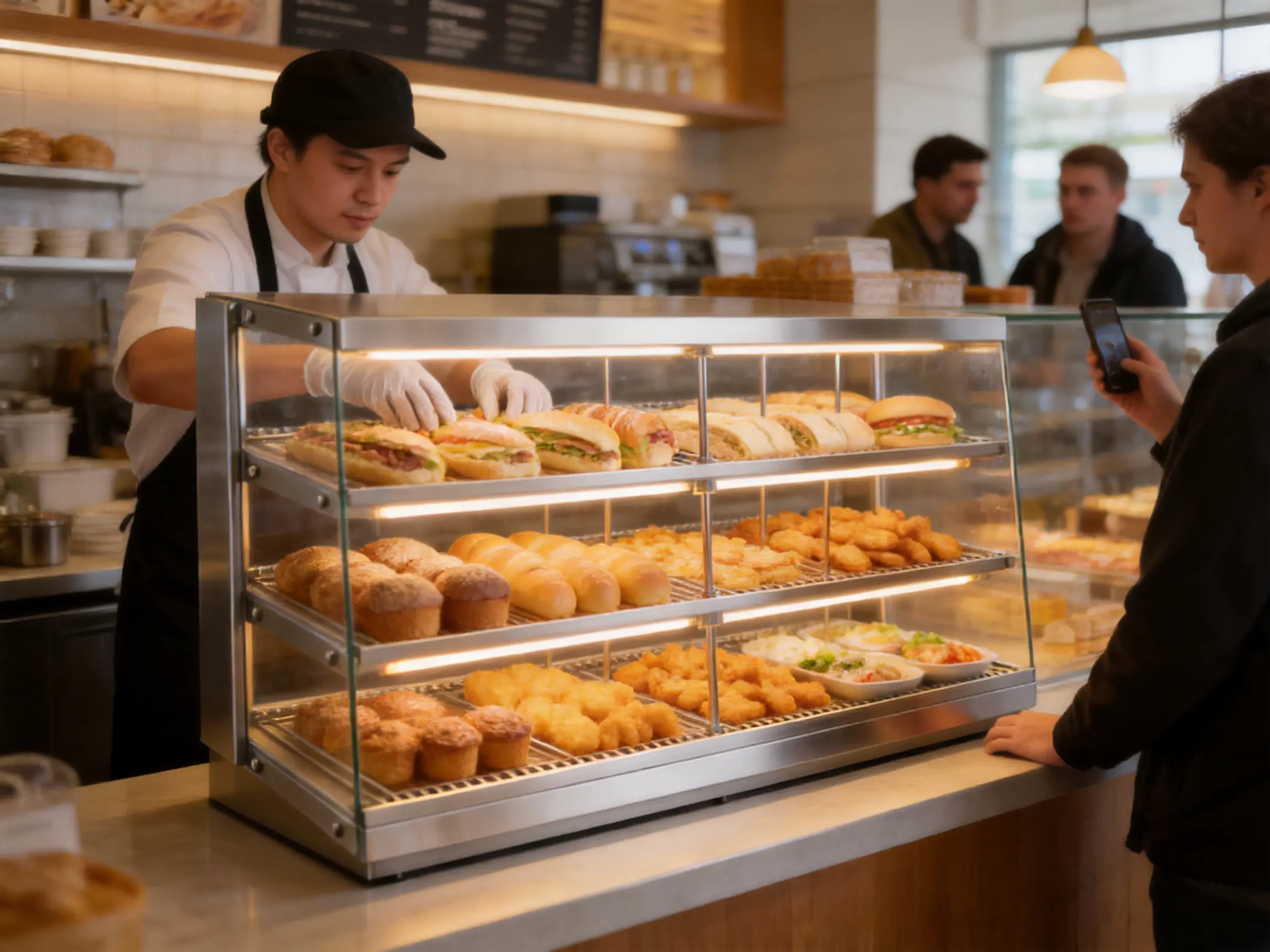
A heated display warmer should be evaluated not only as a heating appliance but also as a sales-support tool. Customers often make purchasing decisions quickly. Clear visibility, good organization, and a clean presentation can influence whether a customer chooses one product over another.
The glass display format allows products to remain visible while being protected from unnecessary contact. Customers can review the available selection before making a choice, and staff can maintain the display without repeatedly opening a large storage compartment.
A well-arranged display should use product grouping, height variation, color contrast, and clear separation. Adjustable divider rods support these principles by helping staff create defined sections. Independent lighting can then be used to make the arrangement more visible during daytime and evening service.
For bakeries, the cabinet can display pastries, rolls, muffins, pies, and other warm bakery products. For cafés, it can present breakfast items, toasted sandwiches, filled rolls, and prepared snacks. For convenience stores, it can serve as a front-of-house area for quick-service food. In restaurants and hotels, it can be used for buffet service, breakfast lines, banquet preparation, or takeaway counters.
The cabinet can also support promotional planning. A high-margin product can be placed in a well-lit central section, while complementary items can be arranged nearby. Because the divider system is adjustable, the layout can change for seasonal menus, special events, or different periods of the day.
Operational Efficiency in Busy Environments
Commercial equipment must be simple enough for multiple employees to use consistently. The XCR series includes controls that are straightforward in concept: adjustable thermostat settings, independent heat controls, and independent lighting controls. This arrangement can help staff understand how each part of the cabinet operates.
Training can focus on a few essential procedures. Employees should learn how to set the thermostat, activate the appropriate shelf heating, turn on the necessary lighting, arrange products using the divider rods, and complete routine cleaning. Clear internal instructions can help ensure that the equipment is used correctly during busy shifts.
The ability to control shelves independently can also support more efficient opening and closing procedures. Staff may activate only the areas required for early service, then bring additional shelves into operation as product volume increases. At the end of the day, unused sections can be turned off while products are removed and the cabinet is cleaned according to the operator’s procedures.
Operators should always follow applicable food safety rules and their local regulations. A display warmer is intended to support holding and presentation, but it does not replace proper food preparation, temperature monitoring, cleaning, stock rotation, or staff hygiene.
Comparison with Less Flexible Display Solutions
Many basic warming displays use a single thermostat or one shared heating circuit. Such equipment may be functional, but it offers less flexibility when shelves contain different products. The XCR series provides separate heat and light controls for each shelf, giving operators more control over the display environment.
Another common limitation is fixed internal spacing. Fixed shelves or partitions can make it difficult to accommodate products with different dimensions. Adjustable divider rods address this issue by enabling the operator to change the internal layout without replacing the cabinet or adding improvised separators.
Some low-capacity display solutions are designed primarily for storage and offer limited merchandising value. A commercial heated display warmer should perform both functions: it should help hold products in a suitable warm condition and present them in a way that supports sales. The XCR series is designed around this dual purpose.
Equipment also differs in how well it fits into a growing business. A small operator may begin with the XCR-85D, while a larger location may select the XCR-138D or XCR-152D. The five-model range makes it possible to select capacity according to current demand and available space rather than accepting a single standard size.
These advantages do not mean that one model is suitable for every application. Businesses should compare available electrical service, expected product volume, installation space, cleaning requirements, local compliance obligations, and menu needs before making a purchasing decision. The strength of the series is its range of practical configurations and operating controls.
Technical Specifications in Detail
Temperature Range
Every model in the series is specified for 30–90°C or 86–194°F. This range accommodates a variety of warming applications. The actual operating setting should be selected according to the food type, service duration, packaging, moisture requirements, and applicable food safety practices.
Power Requirements
The XCR-85D and XCR-102D use a stated input power of 1500 W. The XCR-121D and XCR-138D use 1800 W, while the XCR-152D uses 2200 W. Larger cabinets require more power because they provide more display area and heating capacity.
Before installation, the purchaser should confirm that the electrical circuit can safely support the selected model. Electrical connection and commissioning should be handled according to local regulations and by qualified personnel where required.
Dimensions
The product dimensions are listed in millimeters as follows: 800 × 700 × 688 mm for the XCR-85D, 953 × 700 × 688 mm for the XCR-102D, 1106 × 700 × 688 mm for the XCR-121D, 1259 × 700 × 688 mm for the XCR-138D, and 1400 × 700 × 688 mm for the XCR-152D.
Approximate inch dimensions are 31.5 × 27.6 × 27.1 inches, 37.5 × 27.6 × 27.1 inches, 43.5 × 27.6 × 27.1 inches, 49.6 × 27.6 × 27.1 inches, and 55.1 × 27.6 × 27.1 inches respectively.
Businesses should allow additional clearance around the cabinet where necessary for ventilation, service access, cleaning, electrical connection, and safe movement of staff. The exact installation clearance should be confirmed from the applicable technical documentation and local requirements.
Shipping Weights and Packaging
Net weights range from 41 kg for the XCR-85D to 74 kg for the XCR-152D. Gross weights range from 44 kg to 78 kg. The difference between net and gross weight reflects packaging and shipping materials.
| Model | Package Size | Approximate Package Size in Inches | 20GP Loading Quantity | 40HQ Loading Quantity |
|---|---|---|---|---|
| XCR-85D | 878 × 772 × 734 mm | 34.6 × 30.4 × 28.9 in | 42 pcs | 90 pcs |
| XCR-102D | 1031 × 772 × 734 mm | 40.6 × 30.4 × 28.9 in | 42 pcs | 90 pcs |
| XCR-121D | 1184 × 772 × 734 mm | 46.6 × 30.4 × 28.9 in | 33 pcs | 72 pcs |
| XCR-138D | 1337 × 772 × 734 mm | 52.6 × 30.4 × 28.9 in | 33 pcs | 69 pcs |
| XCR-152D | 1478 × 772 × 734 mm | 58.2 × 30.4 × 28.9 in | 30 pcs | 66 pcs |
The listed loading quantities can assist distributors, importers, and project purchasers with preliminary logistics planning. Final loading arrangements may depend on packaging configuration, container specifications, cargo protection, and shipping requirements.
Suitable Applications
Bakery and Pastry Shops
Bakery products depend heavily on appearance and freshness perception. A warm display can help create an inviting atmosphere and make products more noticeable. Adjustable divider rods can separate sweet pastries, savory pastries, rolls, and individual portions.
Because product dimensions vary substantially in a bakery, flexible internal organization is valuable. Staff can create wider spaces for larger products and narrower lanes for smaller items. Shelf-level lighting can also help highlight products with different colors and textures.
Cafés and Coffee Shops
Cafés frequently sell food alongside hot and cold beverages. A heated display warmer placed near the ordering point can make breakfast foods, sandwiches, toast products, and snacks easy to see while customers wait.
The compact XCR-85D or XCR-102D may be suitable for smaller cafés, while larger models can support locations with a broader food menu. Operators can organize the display according to breakfast, lunch, and afternoon snack periods.
Convenience Stores
Convenience stores require quick service, visible product identification, and efficient replenishment. A heated display warmer can support grab-and-go sales by placing prepared food in a prominent customer-facing area.
Divider rods can help separate products by category or price point. Independent lighting can keep the active product sections visible, while adjustable thermostat control provides flexibility for different food types.
Hotels and Buffet Counters
Hotels, resorts, and banquet facilities often need presentation equipment that can be adapted for breakfast, meetings, events, and special functions. The range of available widths allows a buyer to match the equipment to the expected number of guests and counter layout.
The stainless steel body coordinates well with professional buffet environments. Adjustable feet can help align the unit with other buffet furniture, while the internal dividers support clear product organization during high-volume service.
Restaurants and Takeaway Counters
Restaurants can use heated displays for prepared side dishes, takeaway foods, sandwiches, snacks, and other products intended for rapid service. A visible display can reduce ordering time by allowing customers to identify available products before speaking with staff.
For takeaway counters, the display warmer can support service speed while maintaining an organized appearance. For dine-in restaurants, it may also be used for self-service or buffet-style applications where local food safety procedures permit.
Manufacturing Strengths and Quality Approach
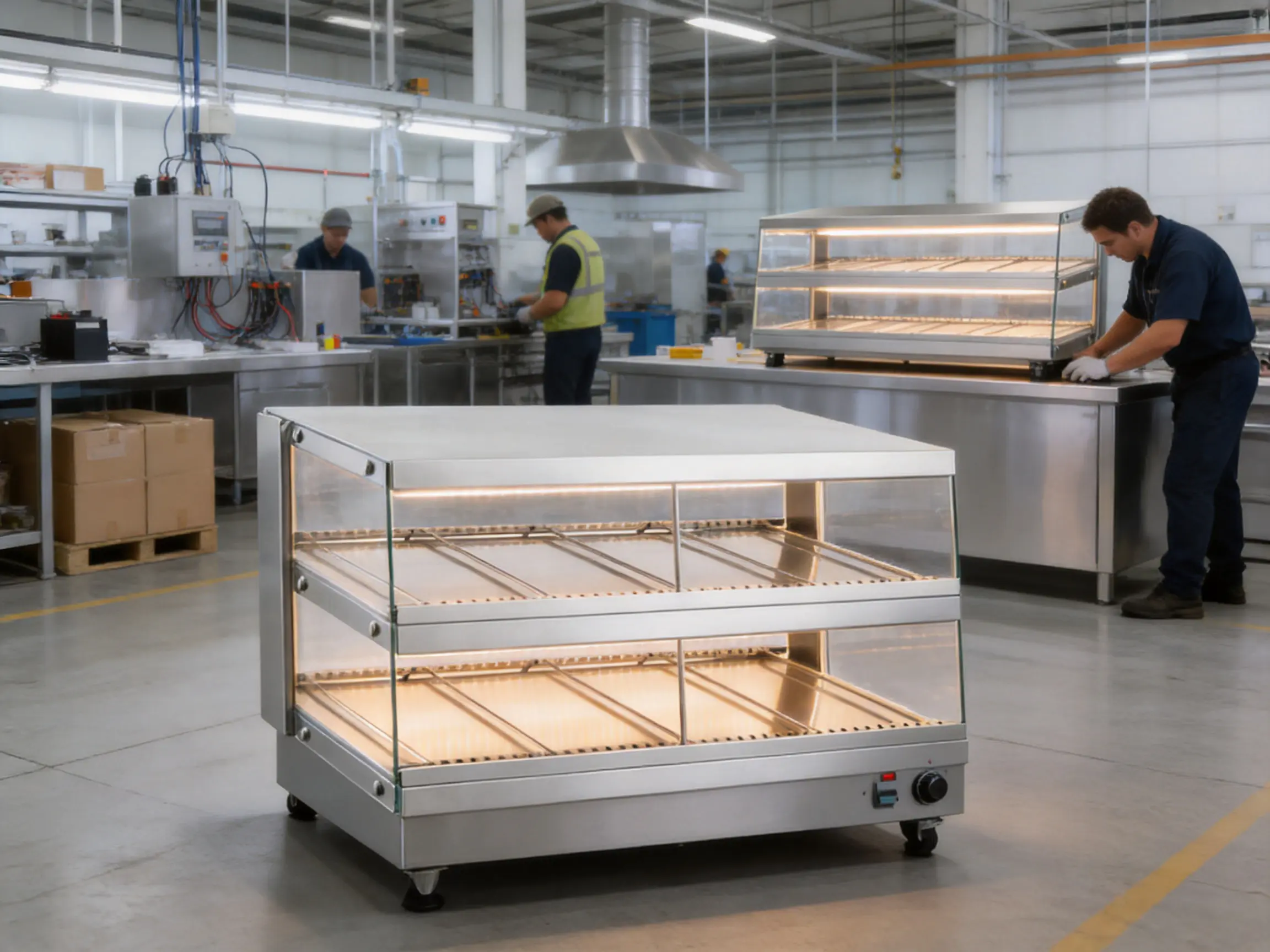
The product is manufactured by Ningbo XiangChi Electrical Co., Ltd., a company identified in the supplied information as a professional manufacturer of vertical display cabinets, cake cabinets, and warming cabinets. The company was established in 2007 and operates a modern management garden factory covering approximately 40,000 square meters.
A manufacturer with dedicated production space and established experience in commercial display equipment can develop knowledge across product design, fabrication, assembly, testing, packaging, and export logistics. This integrated understanding is important because a display warmer is not a single-component product. Its performance depends on the interaction of the cabinet structure, heating system, controls, glass, lighting, shelves, electrical components, and packaging.
The company reports having its own professional research and development team. In commercial equipment manufacturing, an internal R&D function can support product refinement in areas such as thermal distribution, control layout, material selection, ease of cleaning, structural durability, and visual presentation.
In-house development also allows a manufacturer to respond more directly to market requirements. Different countries and business sectors may request different electrical standards, temperature units, packaging configurations, certification documentation, or cabinet arrangements. A dedicated technical team can help coordinate these requirements with production and quality departments.
Testing and Product Improvement
The supplied company information states that advanced testing facilities are used to support product innovation and quality improvement. Testing is particularly important for heated display equipment because the cabinet must operate under elevated temperatures and repeated daily cycles.
Relevant quality checks may include inspection of heating performance, thermostat response, lighting operation, electrical safety, structural assembly, surface finish, glass installation, and packaging protection. The specific tests applied to an individual order should be confirmed through the manufacturer’s quality documentation and product specifications.
Testing also helps identify potential issues before shipment. A well-controlled inspection process can reduce the risk of damage, incomplete assembly, control malfunction, or inconsistent operation reaching the customer. For distributors and commercial project buyers, this can support more predictable installation and after-sales service.
International Certification Experience
The company reports certifications and compliance experience including CE, GS, CCC, CB, RoHS, and ETL, as well as other major international certifications. These designations cover different regulatory and market requirements, and the applicable certification depends on the specific model, electrical configuration, destination market, and current certification scope.
Purchasers should request the relevant certificates, test reports, declaration documents, and technical files for the exact model being ordered. Certification markings should not be assumed to apply automatically to every version or every destination. Verification is an important part of responsible commercial equipment procurement.
Experience with international certifications can nevertheless be a meaningful supplier strength. It indicates familiarity with formal product requirements, documentation, electrical safety expectations, and market access procedures. This can be especially useful for importers and distributors serving multiple regions.
Designing an Effective Display Layout
The performance of a heated display warmer depends partly on how it is loaded. Food should not be stacked in a way that blocks visibility, restricts heat circulation, or makes individual products difficult to remove. The adjustable divider rods should be positioned to create stable, clearly defined sections.
Products with similar characteristics should generally be grouped together. This can improve customer understanding and make replenishment easier. Labels, price cards, or product identifiers should be positioned so they remain visible without obstructing the glass or interfering with cleaning.
Operators should avoid overloading the cabinet. Excessive loading can reduce visibility and may affect how heat reaches individual products. A display warmer should support a balance between capacity and presentation rather than simply being filled to its maximum physical volume.
Stock rotation should be built into daily procedures. New products should be placed according to the operator’s rotation system, and older products should be served first where appropriate. Divider rods can help maintain separate lanes and reduce accidental mixing during replenishment.
Cleaning and Maintenance Considerations
Regular cleaning is essential for any food display appliance. Food particles, grease, condensation, and fingerprints should be removed according to the operator’s sanitation schedule. Cleaning should be performed with the equipment switched off and safely cooled when required by the manufacturer’s instructions.
The stainless steel body should be cleaned with suitable products that do not damage the finish. Abrasive tools and harsh chemicals should be avoided unless specifically approved. Glass panels should be kept clear so that customers can see the products and staff can inspect the display easily.
Divider rods should be removed or repositioned as necessary during cleaning. Their adjustability is beneficial not only for merchandising but also for access to different parts of the display area. Any food residue around shelves, corners, edges, or support points should be addressed promptly.
Controls, electrical connections, heating elements, and lighting components should be inspected by qualified personnel when maintenance is required. Operators should not attempt electrical repairs without appropriate training and authorization. Preventive maintenance can help preserve performance and reduce unexpected downtime.
Equipment should also be checked for unusual noise, abnormal heat, damaged glass, loose components, unstable feet, or inconsistent temperature behavior. Any issue that could affect safety or food quality should be investigated before continued commercial use.
Choosing the Right Model for a Business
Model selection should begin with the required display width. Measure the intended counter or service area and consider the space needed for staff movement, cleaning, ventilation, and customer access. The cabinet should fit the working environment without creating congestion.
Next, estimate the amount and type of food that will be displayed. A business with a limited menu and moderate turnover may not benefit from the largest cabinet. A high-volume operation may find a smaller model insufficient, especially during peak service periods.
Electrical capacity is another important factor. The 1500 W models may be appropriate where power availability is limited, while the larger 1800 W and 2200 W models provide greater capacity but require corresponding electrical planning.
Buyers should also consider shipping and installation. The gross weights range from 44 kg to 78 kg, so delivery routes, lifting equipment, door widths, stairs, and installation labor should be planned in advance. Packaging dimensions are larger than product dimensions and must be considered when moving the unit into the premises.
Finally, the buyer should evaluate the supplier’s documentation, certification support, warranty terms, spare parts availability, technical assistance, and export experience. Product features are important, but long-term value also depends on the manufacturer’s ability to support the equipment after delivery.
Why This Series Can Be a Strong Commercial Investment
The value of the XCR series comes from the combination of capacity choice, temperature adjustment, shelf-level controls, flexible organization, stainless steel construction, and professional manufacturing support. These features address both operational and merchandising needs.
Compared with a basic warming unit, the series gives the operator more control over how food is displayed and held. Compared with a fixed-layout cabinet, it provides greater flexibility for changing menus and product sizes. Compared with a small single-size product range, it gives businesses room to select equipment according to their current location and expected sales volume.
The range can also support business growth. A small café may begin with a compact model and later add a larger unit at a new location. A distributor may offer several widths to different customer segments. A chain operator may standardize the same product family while selecting different sizes for different store formats.
Durability, controls, organization, and appearance all contribute to the total cost of ownership. Equipment that is easy to clean, simple to adjust, and suitable for changing product assortments can help reduce operational friction over time.
Q&A
What type of equipment is the XCR series?
The XCR-85D, XCR-102D, XCR-121D, XCR-138D, and XCR-152D are heated commercial display warmers. They are designed to present and hold warm food products in foodservice, retail, hospitality, and catering environments.
What temperature range do the models provide?
All listed models have a stated temperature range of 30–90°C, equivalent to 86–194°F. The appropriate setting depends on the food product, service requirements, and applicable food safety procedures.
Do the models have adjustable thermostats?
Yes. An adjustable thermostat is listed as a standard feature. It allows operators to select a suitable operating temperature within the specified range.
Can each shelf be controlled independently?
Yes. The product information lists independent heat and light controls for each shelf. This allows operators to manage different sections of the display according to product needs and merchandising requirements.
What are adjustable divider rods used for?
Adjustable divider rods help organize food products into separate sections. They can be repositioned to accommodate different product sizes, support stock rotation, prevent items from shifting, and maintain a neat presentation.
Which model is the most compact?
The XCR-85D is the most compact model, with product dimensions of approximately 800 × 700 × 688 mm and a stated gross capacity of 0.85 square meters.
Which model provides the largest display area?
The XCR-152D is the largest model in the listed range. It provides a stated gross capacity of 1.52 square meters and has product dimensions of approximately 1400 × 700 × 688 mm.
What is the power input of the largest model?
The XCR-152D has a stated input power of 2200 W. Electrical installation should be planned according to local regulations and the requirements of the specific site.
Are the cabinets made of stainless steel?
Yes. Stainless steel construction is listed as a standard feature. It supports a professional commercial appearance and provides a practical surface for foodservice environments when properly maintained.
What businesses can use these display warmers?
Potential applications include bakeries, cafés, convenience stores, restaurants, hotels, buffet counters, catering operations, takeaway shops, institutional dining facilities, and other businesses that need to present and hold warm food products.
How should a buyer select the correct model?
The buyer should compare available counter space, desired display capacity, product volume, power availability, shipping access, budget, and expected business growth. The five widths provide options for both compact and high-volume locations.
Does the manufacturer support international markets?
The supplied information states that the manufacturer has experience with international certifications including CE, GS, CCC, CB, RoHS, and ETL. Buyers should request current documentation for the exact model and destination market.
What should be checked before placing an order?
Buyers should confirm the exact model, dimensions, electrical specifications, temperature range, certification requirements, packaging details, warranty conditions, spare parts support, delivery terms, and installation instructions.
Conclusion
The XCR series of heated display warmers is designed to combine warm food holding with attractive front-of-house presentation. Its five-model range provides different display widths, while the shared 30–90°C temperature range offers flexibility for varied foodservice applications.
Independent heat and light controls for each shelf give operators more precise control than a basic single-zone cabinet. Adjustable divider rods allow the display to change with the menu, product size, and service period. Stainless steel construction supports commercial use, and adjustable feet help with installation stability.
The manufacturing background supplied for Ningbo XiangChi Electrical Co., Ltd. adds further value through established industry experience, a large production facility, dedicated R&D resources, advanced testing facilities, and reported experience with major international certifications. These strengths are relevant to distributors, importers, chain operators, and foodservice businesses seeking a commercial display warmer supported by an experienced manufacturing partner.
When properly selected, installed, loaded, cleaned, and maintained, the XCR-85D, XCR-102D, XCR-121D, XCR-138D, and XCR-152D models can help businesses improve food visibility, maintain a more organized service counter, support warm product presentation, and create a professional customer-facing display.
References
1. Product specification information for the XCR-85D, XCR-102D, XCR-121D, XCR-138D, and XCR-152D heated display warmer series.
2. Manufacturer-provided standard feature information covering adjustable thermostats, stainless steel construction, shelf-level heat and light controls, adjustable divider rods, and adjustable feet.
3. Manufacturer profile information concerning production history, research and development resources, testing facilities, factory capacity, and international certification experience.
4. General commercial foodservice equipment principles relating to heated food holding, display organization, sanitation, stock rotation, and equipment maintenance.
5. General retail merchandising principles relating to product visibility, shelf organization, lighting, customer decision-making, and point-of-sale presentation.
Product: Heated Display Warmers With Adjustable Divider Rods XCR-85D/102D/121D/138D/152D

You May Also Like





-
- Navigation
- Home
- About Us
- Products
- News
- Contact Us
 East Zone, Guanhaiwei Industrial Park, Cixi City, Ningbo, Zhejiang, China
 +86-574-63668678
 +86-574-63668108

Copyright © Ningbo XiangChi Electrical Co.,Ltd All Rights Reserved.
