
 简体中文
 English
 Español

News
Heated Display Warmers With Adjustable Divider Rods: A Complete Commercial Guide to the XCR-85D, XCR-102D, XCR-121D, XCR-138D, and XCR-152D Series
Introduction
Commercial foodservice businesses need more than attractive equipment. They need display systems that protect product quality, maintain safe serving temperatures, support efficient merchandising, and remain dependable during demanding daily operation. The XCR-85D, XCR-102D, XCR-121D, XCR-138D, and XCR-152D heated display warmer series is designed to address these requirements through a combination of controlled heating, stainless steel construction, adjustable product organization, and multiple size options.
These heated display warmers are suitable for bakeries, cafés, restaurants, hotels, convenience stores, supermarkets, food courts, catering operations, takeaway counters, and other commercial environments where prepared food must remain warm and presentable. Instead of placing cooked products behind a closed cabinet or leaving them exposed on an unprotected counter, operators can use a heated display warmer to create a clean, organized, and inviting presentation area.
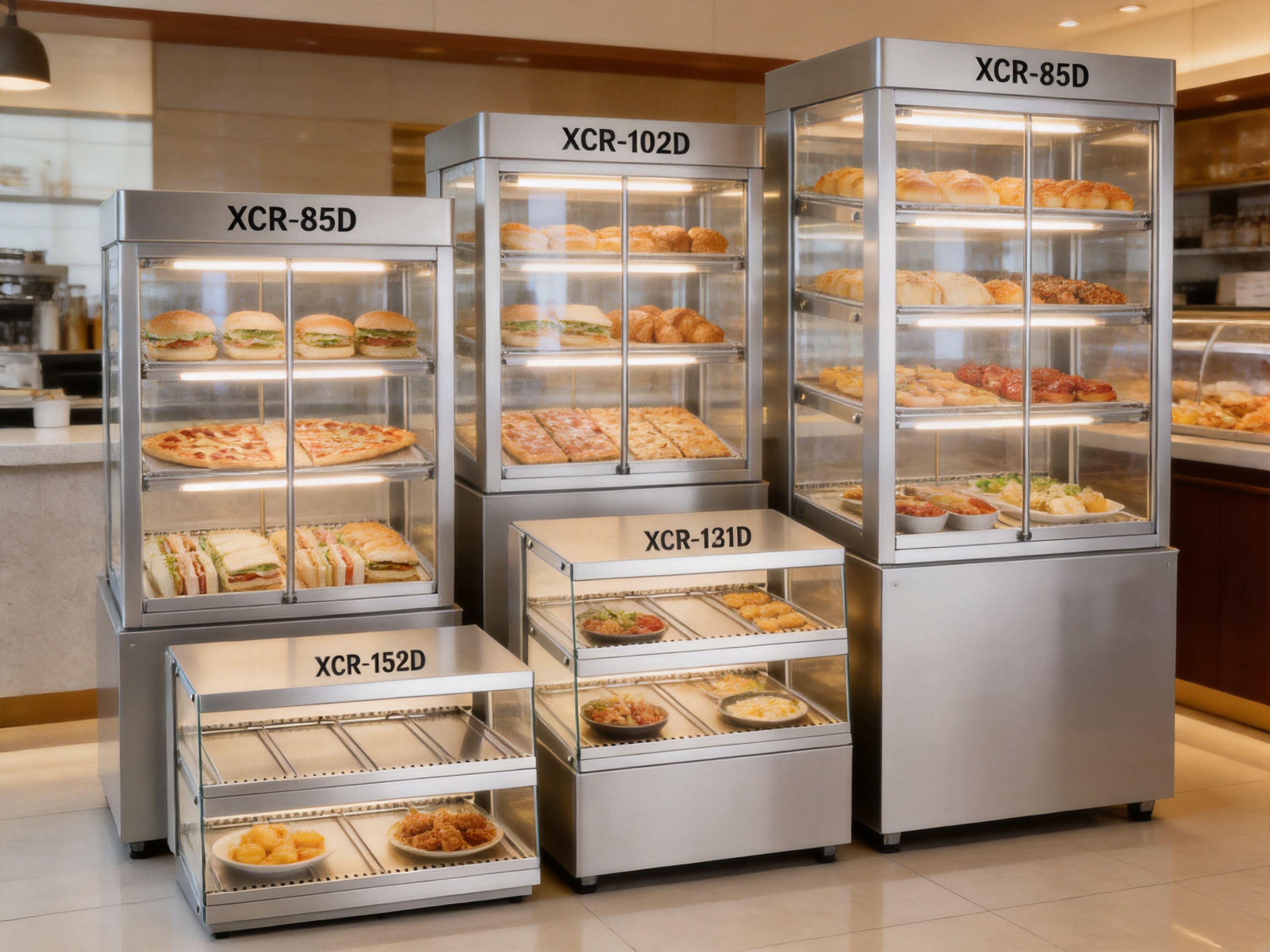
The series offers five cabinet sizes, allowing businesses to select equipment according to available counter space, expected food volume, and merchandising requirements. The models provide stated gross display capacities from 0.85 m² to 1.52 m², temperature control from 30°C to 90°C, and input power ratings from 1,500 W to 2,200 W. This range makes the series suitable for both compact service points and higher-volume food display applications.
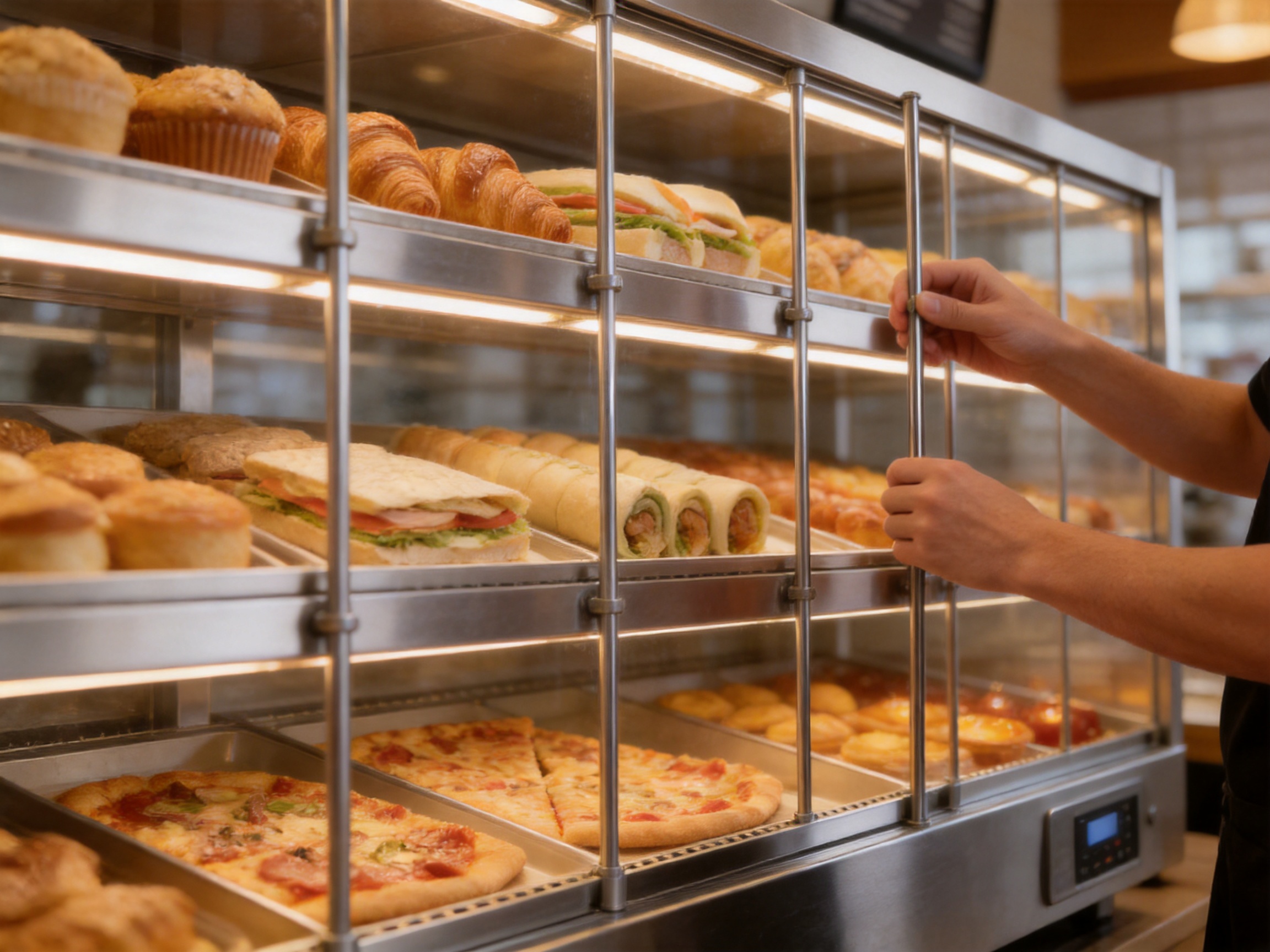
A key feature is the use of adjustable divider rods. These rods allow operators to separate different food products, create orderly presentation zones, and adapt the interior layout when the menu changes. Combined with independent heat and light controls for each shelf, the divider system gives businesses greater flexibility than a fixed-layout warmer.
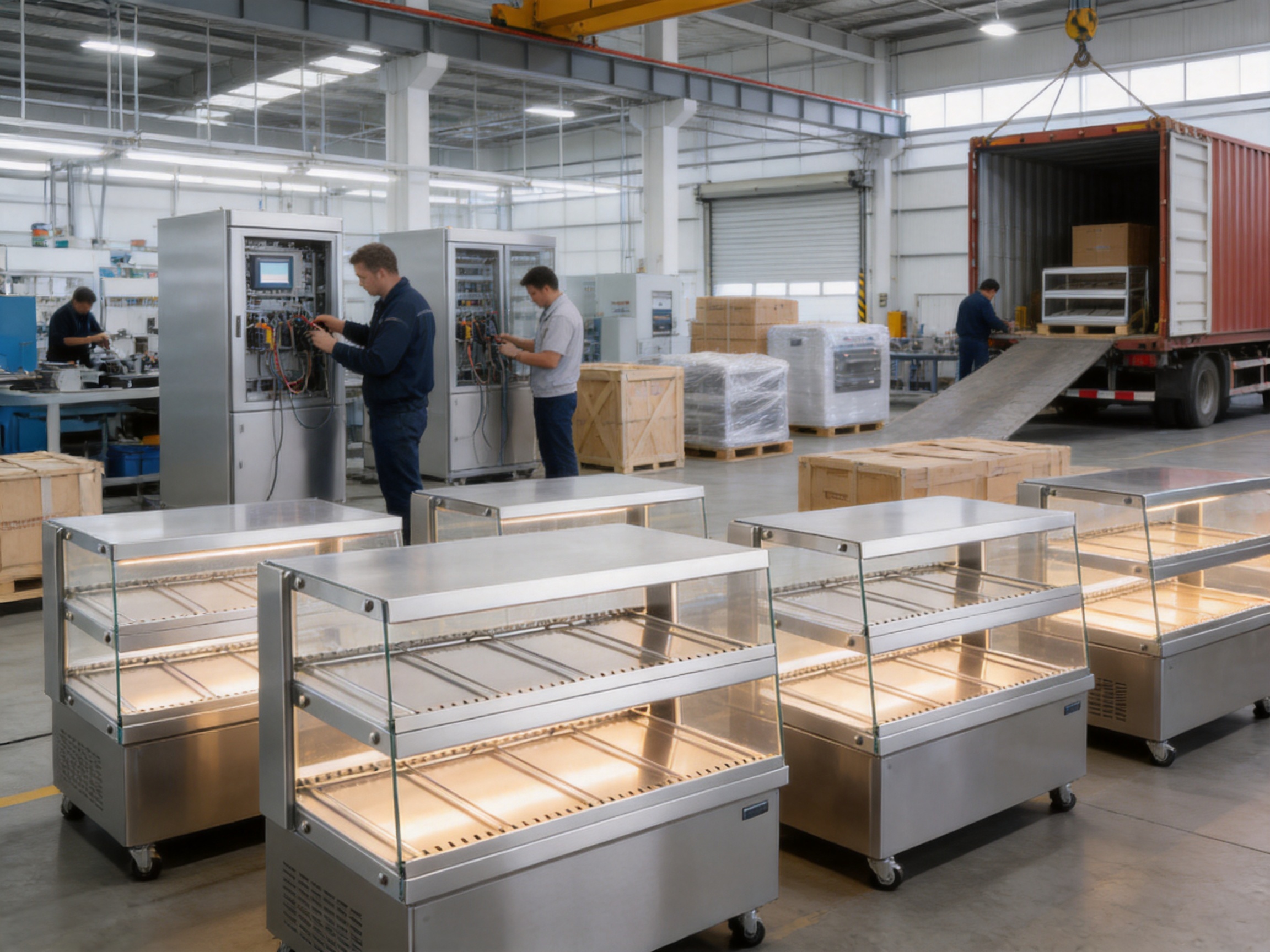
The product line is manufactured by Ningbo XiangChi Electrical Co., Ltd., a Chinese commercial refrigeration and food display equipment manufacturer established in 2007. The company operates a modern 40,000-square-meter factory, maintains professional research and development capabilities, and uses testing facilities intended to support product innovation and quality improvement. Its certifications include CE, GS, CCC, CB, RoHS, and ETL, helping the company serve customers in multiple international markets.
Heated Display Warmers With Adjustable Divider Rods XCR-85D/102D/121D/138D/152D
Product Overview
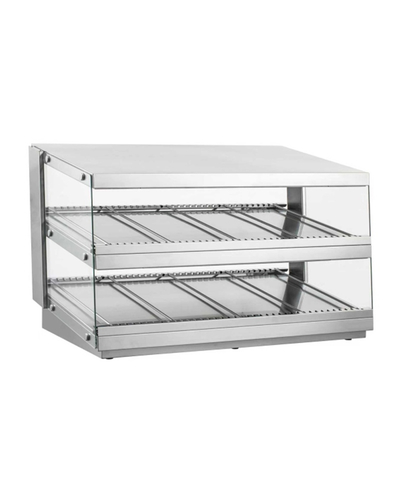
The XCR-D series is a family of heated display warmers developed for the professional presentation and short-term holding of prepared foods. The cabinet is built around three essential commercial functions: keeping food warm, displaying food clearly, and allowing the operator to manage the interior space efficiently.
The temperature range of 30°C to 90°C, equivalent to 86°F to 194°F, gives operators a broad adjustment range for different food categories. Lower settings can be used for gentle warming or temperature-sensitive products, while higher settings are available for foods that require a stronger holding temperature. Actual operating temperatures should always be selected according to the food type, local food safety rules, preparation procedures, and the recommendations of the food manufacturer or kitchen manager.
Each shelf includes independent heat and light controls. This arrangement is particularly useful for businesses that display products with different holding requirements. One shelf may need a higher temperature for savory snacks, while another may require gentler warming for pastries or baked goods. Independent control can also reduce unnecessary energy use when a shelf is empty or when a product does not need illumination.
The stainless steel body provides a professional appearance and supports the practical demands of commercial foodservice. Stainless steel is widely used in food equipment because it is durable, relatively easy to clean, resistant to corrosion under normal operating conditions, and compatible with regular sanitation procedures. It also gives the cabinet a clean appearance that supports modern front-of-house design.
Adjustable feet help operators level the cabinet on the counter or service surface. Proper leveling is important for appearance, door and shelf alignment where applicable, stability, and easier cleaning around the unit. The adjustable feet also provide some flexibility when the equipment is installed on commercial counters that are not perfectly even.
Available Models
The five models share the same basic operating concept while offering different display capacities and external widths. The XCR-85D is the most compact option, while the XCR-152D offers the largest stated display area and the highest input power in the range.
| Model | Stated Capacity-Gross | Temperature Range | Input Power | Net Weight | Gross Weight |
|---|---|---|---|---|---|
| XCR-85D | 0.85 m² | 30–90°C / 86–194°F | 1,500 W | 41 kg | 44 kg |
| XCR-102D | 1.02 m² | 30–90°C / 86–194°F | 1,500 W | 49 kg | 52 kg |
| XCR-121D | 1.21 m² | 30–90°C / 86–194°F | 1,800 W | 55 kg | 58 kg |
| XCR-138D | 1.38 m² | 30–90°C / 86–194°F | 1,800 W | 65 kg | 68 kg |
| XCR-152D | 1.52 m² | 30–90°C / 86–194°F | 2,200 W | 74 kg | 78 kg |
The capacity figures are supplied as square-meter values and should be understood as the manufacturer’s stated capacity-gross specification. Buyers should confirm the exact internal shelf arrangement, usable shelf dimensions, and product loading recommendations before placing the warmer into a specific operating layout.
Why Heated Display Warmers Matter in Foodservice
Food presentation has a direct influence on customer perception and purchasing behavior. When customers can see freshly prepared products arranged neatly behind clean glass, they can make decisions more quickly and confidently. A heated display warmer turns the food counter into a merchandising area rather than simply a holding station.
Warm food often loses appeal when it is allowed to cool, become disorganized, or remain exposed to the surrounding environment. A properly operated warmer helps maintain a more consistent serving condition during busy service periods. It also allows staff to prepare food in batches and hold it for a reasonable period while continuing to serve customers efficiently.
The display function is equally important. Clear visibility allows customers to see the shape, color, texture, and portion size of products before ordering. This can be particularly valuable for products such as sandwiches, pastries, pizza slices, fried snacks, roasted items, prepared meals, and other ready-to-eat foods. Better visibility can reduce the time staff spend explaining product options and can encourage impulse purchases.
In a high-volume environment, speed and organization are closely connected. Food that is placed in clearly separated zones is easier for staff to identify and replenish. The adjustable divider rods in the XCR-D series are designed to support this type of organization. Instead of using a single open shelf where products can shift or become mixed, operators can create practical compartments that match their menu.
Major Product Advantages
Flexible Interior Organization
One of the clearest advantages of this series is its adjustable divider rod system. A fixed shelf layout may work for one menu but become inconvenient when the product range changes. Adjustable rods allow the operator to change the spacing between product groups and use the same cabinet for different service periods.
For example, a bakery may use wider sections for boxed pastries during the morning, then rearrange the cabinet for individual sandwiches and savory snacks at lunchtime. A café may separate muffins, croissants, toasted rolls, and packaged meals without requiring additional display equipment. A convenience store may reserve individual zones for hot dogs, filled buns, prepared snacks, and seasonal items.
Divider rods can also help improve product presentation. Products are less likely to spread across the full shelf, lean into neighboring products, or create an untidy appearance. A well-organized cabinet communicates freshness, cleanliness, and professional management.
Independent Heat and Light Controls
Independent controls for each shelf offer operational flexibility that is not available in many basic warming cabinets. The operator can adjust shelf conditions according to the products being displayed rather than treating the entire cabinet as one uniform space.
Independent light controls support visual merchandising while allowing staff to turn off illumination in unused areas. Independent heat controls allow the business to manage different food categories more precisely. This can be especially helpful in mixed-use settings where a single cabinet contains products with different warming preferences.
Separate controls can also help during partial loading. A smaller business may not need to operate every shelf at full capacity throughout the day. Turning off an unused shelf can help reduce avoidable consumption and may also limit unnecessary heat generation in the service area.
Wide Temperature Adjustment
The 30°C to 90°C operating range provides a broad adjustment window for commercial warming applications. It gives operators the ability to select a lower setting for delicate products or a higher setting for foods that benefit from stronger heat retention.
Temperature adjustment should be treated as a process-control tool rather than a substitute for safe food handling. The cabinet is intended to maintain food in a warmed display environment, but food must be prepared, cooked, stored, loaded, monitored, and discarded according to applicable regulations and internal procedures. Operators should use calibrated thermometers when required and avoid holding food longer than recommended.
Stainless Steel Construction
The stainless steel body is a major practical advantage for commercial use. Foodservice equipment is frequently exposed to moisture, heat, oil vapors, food particles, cleaning agents, and repeated handling. A robust metal exterior is better suited to this environment than a fragile residential-style cabinet.
Stainless steel also supports a consistent professional appearance. This matters in open kitchens, customer-facing counters, hotel breakfast areas, cafés, and retail food stores where the equipment is visible to customers. The neutral finish can coordinate with other commercial appliances and interior design styles.
To preserve the appearance and service life of the cabinet, operators should follow appropriate cleaning procedures. Abrasive pads, harsh chemicals, and unsuitable chlorine concentrations may damage surfaces. Glass should be cleaned with products suitable for heated food display equipment, and the cabinet should be allowed to cool according to the operating instructions before intensive cleaning.
Multiple Width Options
The five available widths allow businesses to select capacity without being forced into a single cabinet format. The product sizes range from 800 mm wide for the XCR-85D to 1,400 mm wide for the XCR-152D. All listed models share a depth of 700 mm and a height of 688 mm.
| Model | Product Size in Millimeters | Product Size in Inches | Package Size in Millimeters | Package Size in Inches |
|---|---|---|---|---|
| XCR-85D | 800 × 700 × 688 mm | 31.5 × 27.6 × 27.1 in | 878 × 772 × 734 mm | 34.6 × 30.4 × 28.9 in |
| XCR-102D | 953 × 700 × 688 mm | 37.5 × 27.6 × 27.1 in | 1,031 × 772 × 734 mm | 40.6 × 30.4 × 28.9 in |
| XCR-121D | 1,106 × 700 × 688 mm | 43.5 × 27.6 × 27.1 in | 1,184 × 772 × 734 mm | 46.6 × 30.4 × 28.9 in |
| XCR-138D | 1,259 × 700 × 688 mm | 49.6 × 27.6 × 27.1 in | 1,337 × 772 × 734 mm | 52.6 × 30.4 × 28.9 in |
| XCR-152D | 1,400 × 700 × 688 mm | 55.1 × 27.6 × 27.1 in | 1,478 × 772 × 734 mm | 58.2 × 30.4 × 28.9 in |
The consistent depth and height make the series relatively easy to compare during space planning. Businesses can select a wider model as demand grows while maintaining a similar counter height and depth profile. The compact XCR-85D may be suitable for smaller cafés, while the XCR-138D and XCR-152D may be more appropriate for supermarket counters, hotel service areas, and high-volume food outlets.
Commercial Weight and Stability
Net weights range from 41 kg to 74 kg, while gross shipping weights range from 44 kg to 78 kg. These weights reflect the use of commercial construction and glass display components. The equipment should be installed on a counter or support structure capable of carrying the selected model safely.
Because these are substantial commercial units, delivery planning is important. Buyers should verify door widths, elevator dimensions, corridor access, counter strength, and final positioning before shipment. The packaged dimensions should also be considered when planning warehouse receiving and installation.
Model Selection Guide
XCR-85D
The XCR-85D is the smallest model in the series, with a stated gross capacity of 0.85 m² and a product width of 800 mm. Its 1,500 W input power makes it a practical option for compact counters and businesses with moderate display requirements.
This model may suit independent cafés, small bakeries, kiosks, canteens, and limited-service counters. It can provide a professional heated display without occupying as much horizontal space as the larger models. It is also the lightest unit in the range, which may simplify handling during installation.
XCR-102D
The XCR-102D increases the width to 953 mm and the stated display capacity to 1.02 m² while maintaining a 1,500 W input rating. It is a balanced option for operators who need more presentation area than the compact model but still have moderate counter space.
This model can be useful where the menu includes several product categories but the available service counter is not large enough for a wide cabinet. Its additional width may make it easier to separate products with the adjustable divider rods.
XCR-121D
The XCR-121D provides a 1,106 mm width and a stated capacity of 1.21 m². Its input power rises to 1,800 W, matching the larger warming area. This model can serve busy cafés, restaurants, food courts, and retail food counters that need a more substantial display footprint.
The XCR-121D represents a useful middle-to-large configuration. It can provide additional merchandising space while remaining narrower than the two largest models. Businesses can use it when product variety and customer visibility are more important than minimizing cabinet width.
XCR-138D
The XCR-138D has a width of 1,259 mm and a stated capacity of 1.38 m². Its 1,800 W power rating provides a higher heating input suitable for its larger display volume.
This model may be selected by operations with steady customer traffic and a broad range of ready-to-serve products. The additional space can reduce the need to stack products excessively and can create more clearly defined display zones.
XCR-152D
The XCR-152D is the largest model, measuring 1,400 mm wide and offering a stated capacity of 1.52 m². Its input power is 2,200 W, and its net weight is 74 kg.
This model is designed for businesses that need maximum display area within this product family. It may be suitable for large cafés, supermarkets, hotel breakfast counters, food halls, high-volume takeaway locations, and institutional catering operations. Before installation, the operator should verify available electrical capacity and ensure that the counter or support base can safely carry the unit.
Advantages Over Basic Competitor Warmers
Commercial buyers often compare heated display warmers based on more than purchase price. The most important comparison points include control flexibility, interior organization, construction, serviceability, available sizes, product presentation, and long-term operating value.
Many basic warmers use a single thermostat for the entire cabinet. This approach may be adequate when all products have identical requirements, but it provides less control in a mixed-product environment. The XCR-D series uses independent heat controls for each shelf, allowing the operator to adjust display zones separately.
Another common limitation is a fixed interior layout. Fixed shelves or open, undivided surfaces can make it more difficult to maintain a neat presentation. The adjustable divider rods in this series give the operator a practical way to reorganize the cabinet as product sizes and menu categories change.
Some lower-cost display units may use less durable materials or may be intended for light-duty use. The stainless steel body of the XCR-D series is more aligned with commercial foodservice requirements. It offers a robust exterior that can withstand routine handling and repeated cleaning when used correctly.
Size availability is another competitive advantage. A single cabinet size cannot meet every operation’s needs. With five widths, this series gives distributors and end users more choice. Operators can select a compact model for a small counter or a larger model for a high-volume food display without changing to a completely different product platform.
Independent shelf lighting also supports better merchandising. A well-lit product display can improve visibility, especially in indoor retail spaces or service counters with uneven ambient lighting. The ability to control lighting by shelf can help the operator adapt the display to the time of day and current product load.
The combination of adjustable organization, shelf-level controls, stainless steel construction, and multiple sizes creates a more adaptable solution than a basic single-zone warming cabinet. These features can help businesses improve product presentation while maintaining greater control over daily operation.
Applications Across Different Businesses
Bakeries and Pastry Shops
Bakeries can use the warmer to present savory pastries, filled rolls, pizza slices, breakfast items, and other products intended for warm service. Divider rods can separate different product types, while shelf lighting can emphasize color and texture.
Because bakery menus often change during the day, adjustable organization is valuable. Breakfast products may dominate in the morning, while sandwiches, hot snacks, and prepared lunch products become more important later. The cabinet can be reorganized without replacing the equipment.
Cafés and Coffee Shops
Cafés frequently sell a combination of baked goods and prepared foods. A heated display warmer can support the sale of warm sandwiches, savory pastries, toast-based products, and ready-to-eat snacks alongside coffee and cold beverages.
The compact models may fit behind a limited service counter, while the wider models can support cafés with substantial food programs. Independent controls allow staff to operate only the shelves needed during quieter periods.
Restaurants and Quick-Service Operations
Restaurants can use the cabinet for pre-portioned food, side dishes, snack items, and products prepared for rapid service. A visible display can help customers make quick selections and can reduce pressure on the cooking line during peak periods.
In quick-service environments, organization is particularly important. Divider rods can make it easier to identify product groups, monitor remaining portions, and replenish the cabinet in a consistent manner.
Convenience Stores and Supermarkets
Retail food operators often need to display products in a way that encourages impulse purchases. A heated cabinet positioned near the checkout area, beverage station, or prepared-food counter can provide a clear presentation of hot snacks and ready-to-eat items.
The larger models offer more display area for stores with strong prepared-food sales. The stainless steel exterior can also complement other commercial fixtures and help create a consistent professional appearance.
Hotels and Catering Facilities
Hotels, breakfast venues, conference centers, and catering operations may require flexible warming equipment for changing service formats. A cabinet can be used for breakfast pastries during one service period and for savory prepared foods during another.
The series is also useful when a venue needs to maintain a clean display while serving a large number of guests. A visible and organized cabinet can support self-service or assisted service, depending on the operation’s workflow and food safety procedures.
Manufacturing Strengths and Quality Approach
The quality of a commercial display warmer depends not only on its visible features but also on the manufacturing systems used to design, assemble, test, and support it. Ningbo XiangChi Electrical Co., Ltd. was established in 2007 and has developed experience in the production of vertical display cabinets, cake cabinets, and warming cabinets.
The company operates a modern management garden factory covering approximately 40,000 square meters. A facility of this scale can support dedicated production areas, material handling, assembly processes, quality inspection, warehousing, and product development activities. For international buyers, manufacturing scale is important because it can affect production capacity, delivery coordination, and the ability to support repeat orders.
The company maintains its own professional research and development team. In commercial refrigeration and warming equipment, product development involves the coordination of heating systems, temperature control, electrical components, cabinet structure, glass elements, lighting, ergonomics, packaging, and compliance requirements. An internal R&D capability helps the manufacturer respond to market requirements and refine product designs over time.
Advanced testing facilities are another stated strength. Testing is essential for verifying operating performance, temperature behavior, electrical safety, component reliability, and product consistency. Although specific test procedures vary by model and target market, a structured testing program can help identify issues before products reach customers.
The manufacturer reports compliance or certification coverage including CE, GS, CCC, CB, RoHS, and ETL. These certifications and conformity marks are relevant to different markets and regulatory systems. Buyers should confirm the exact certification applicable to their selected model, voltage configuration, and destination country before ordering.
International production also requires attention to packaging and logistics. The XCR-D models are supplied with defined package dimensions and shipping weights, which helps importers calculate container utilization, warehouse requirements, and freight planning. The listed loading quantities include estimated 20GP and 40HQ container capacities.
| Model | 20GP Loading Quantity | 40HQ Loading Quantity |
|---|---|---|
| XCR-85D | 42 pieces | 90 pieces |
| XCR-102D | 42 pieces | 90 pieces |
| XCR-121D | 33 pieces | 72 pieces |
| XCR-138D | 33 pieces | 69 pieces |
| XCR-152D | 30 pieces | 66 pieces |
Loading quantities are planning references rather than guaranteed shipment quantities. Actual container loading may depend on packaging configuration, palletization, destination requirements, shipping regulations, and the final order arrangement.
Installation and Operating Considerations
Correct installation is important for safe and reliable performance. The cabinet should be positioned on a stable, level, and sufficiently strong counter. Operators should maintain suitable clearance around electrical connections and follow the installation instructions supplied with the unit.
The electrical supply must match the model’s rated requirements and the destination market’s voltage and frequency. The XCR-85D and XCR-102D are rated at 1,500 W, the XCR-121D and XCR-138D at 1,800 W, and the XCR-152D at 2,200 W. A qualified technician or responsible facilities professional should verify the electrical installation before operation.
Before loading food, staff should allow the warmer to reach the desired operating temperature. Products should be placed in a manner that allows appropriate air circulation and visibility. Overloading shelves can reduce the effectiveness of warming and make the display look disorganized.
Food should not be placed directly against heating elements or in positions that obstruct controls, lighting, or ventilation areas. The divider rods should be adjusted to support the product without restricting access or creating unstable stacks.
Operators should establish a routine for checking temperatures, replenishing food, removing expired items, cleaning surfaces, and inspecting the electrical system. The cabinet is a commercial holding and display appliance; it should be integrated into the business’s wider food safety and equipment maintenance program.
Cleaning and Maintenance
Regular cleaning helps protect hygiene, appearance, and equipment life. Food particles, grease, and condensation should not be allowed to accumulate on shelves, divider rods, glass surfaces, controls, or cabinet joints.
Before cleaning, staff should follow the manufacturer’s instructions regarding power isolation and cooling. Electrical components should not be sprayed directly with water. Removable or accessible components should be cleaned using approved methods, then dried thoroughly before being returned to service.
Glass panels should be cleaned with a suitable non-abrasive product. Scrapers, abrasive powders, and rough cleaning pads may cause scratches or surface damage. Stainless steel surfaces should be wiped in the direction of the grain where applicable to maintain a consistent appearance.
Divider rods deserve particular attention because food particles can collect around contact points. Staff should inspect them during each cleaning cycle and verify that they remain secure and adjustable. Adjustable feet and cabinet supports should also be checked periodically to ensure the warmer remains level and stable.
Maintenance records can help commercial operators identify recurring issues and plan service before a failure affects business operations. A record may include temperature checks, cleaning dates, electrical inspections, component replacements, and observations from staff.
Energy and Operational Efficiency
Energy consumption depends on the selected model, input power, operating temperature, ambient conditions, usage time, loading pattern, and the frequency with which doors or access areas are opened, where applicable. The rated input power provides a useful reference for electrical planning but does not by itself represent total daily energy consumption.
Businesses can improve operating efficiency by selecting the correct model rather than automatically choosing the largest unit. A cabinet that is too large for the menu may require unnecessary energy and counter space. Conversely, a cabinet that is too small may become overloaded and require frequent replenishment.
Independent shelf controls provide another efficiency opportunity. Operators can turn off heat or lighting on unused shelves when appropriate. They can also adjust the temperature according to the actual product requirements instead of operating every zone at the highest setting.
Efficient product rotation is equally important. Food should be loaded in manageable quantities, rotated according to the business’s procedures, and removed when it no longer meets quality or safety standards. The aim is not merely to keep food warm, but to maintain an appealing and responsible display.
Commercial Value and Return on Investment
The value of a heated display warmer comes from the combination of food holding, merchandising, workflow improvement, and customer convenience. A cabinet that makes products easier to see and purchase may contribute to higher sales, while organized storage can help staff serve customers more quickly.
The adjustable design can also extend the useful life of the equipment from a business-planning perspective. Menus change, product dimensions change, and seasonal offerings change. A cabinet that can be reorganized is more adaptable than one designed around a single fixed product format.
Having five size options can help distributors and foodservice groups standardize equipment across different locations. A small branch may use the XCR-85D, while a larger store may select the XCR-138D or XCR-152D. Common operating principles across the series can simplify staff training and purchasing management.
When comparing total value, buyers should consider capacity, control features, material quality, certification requirements, service support, spare parts availability, shipping costs, and expected operating conditions. The lowest initial purchase price does not always represent the lowest long-term cost if the equipment is difficult to clean, inflexible, or unsuitable for the intended workload.
Purchasing Checklist
Before selecting a model, the buyer should measure the available counter width, depth, and height. The package dimensions should also be reviewed to ensure the unit can reach its final installation position without difficulty.
The expected food volume should be estimated for normal and peak service periods. Buyers should consider the number of product categories, the average product size, the desired separation between items, and the frequency of replenishment.
Electrical requirements should be confirmed with the supplier and a qualified local professional. The buyer should specify destination country, voltage, frequency, plug requirements, and any local certification needs.
Buyers should request confirmation of the exact internal configuration, shelf arrangement, control operation, lighting specification, warranty terms, spare parts availability, and after-sales process. They should also confirm whether the stated capacity is based on gross display area or usable product volume.
For importers and distributors, packaging, container loading, lead time, labeling, manuals, and export documentation should be included in the purchasing discussion. A clear technical specification reduces the risk of misunderstandings during production and delivery.
Frequently Asked Questions
What type of equipment is the XCR-D series?
The XCR-D series is a family of commercial heated display warmers. It is designed to present and hold prepared food in a warmed, organized, and visible display environment.
What models are available?
The series includes the XCR-85D, XCR-102D, XCR-121D, XCR-138D, and XCR-152D. The models differ primarily in width, stated display capacity, input power, weight, and package size.
What temperature range is available?
All five listed models have a stated temperature range of 30°C to 90°C, or 86°F to 194°F. The appropriate setting depends on the product, food safety requirements, and operating procedure.
Do the shelves have independent controls?
Yes. The standard features include independent heat and light controls for each shelf. This allows operators to manage different display zones separately.
What is the purpose of the adjustable divider rods?
The divider rods help separate food products and organize the display. Their adjustable design allows the interior arrangement to change according to product size, menu category, and service period.
Is the cabinet suitable for mixed food products?
It can be used for a variety of prepared food products, provided the operator selects suitable temperatures and follows food safety procedures. Independent shelf controls make mixed-product display more manageable.
Which model is best for a small café?
The XCR-85D or XCR-102D may be suitable for a smaller café, depending on available counter space and expected product volume. The final choice should be based on actual menu requirements and electrical capacity.
Which model provides the largest display area?
The XCR-152D is the largest model in the series, with a stated capacity-gross value of 1.52 m² and a product width of 1,400 mm.
What materials are used for the cabinet body?
The standard features specify a stainless steel body. Stainless steel is selected for its commercial appearance, durability, cleanability, and suitability for foodservice environments.
Does the warmer replace proper food safety procedures?
No. The warmer is a food display and holding appliance. Operators must still follow applicable food safety regulations, temperature monitoring procedures, time limits, cleaning requirements, and product rotation practices.
How should the correct model be selected?
Selection should consider counter width, display area, product volume, number of food categories, electrical supply, staff workflow, package dimensions, and future menu requirements.
Where is the product manufactured?
The product is manufactured by Ningbo XiangChi Electrical Co., Ltd. in Ningbo, Zhejiang, China. The company operates a reported 40,000-square-meter manufacturing facility and has produced commercial display and warming equipment since 2007.
What certifications does the manufacturer report?
The company reports certifications and conformity coverage including CE, GS, CCC, CB, RoHS, and ETL. Buyers should confirm the exact certification documentation for the model and destination market.
Conclusion
The XCR-85D, XCR-102D, XCR-121D, XCR-138D, and XCR-152D heated display warmers provide a flexible platform for commercial food display and warming. Their main strengths include a 30°C to 90°C temperature range, independent shelf heat and light controls, stainless steel construction, adjustable divider rods, adjustable feet, and five available cabinet widths.
The adjustable divider system gives the series an important advantage in changing commercial environments. Businesses can reorganize the display as menus, product dimensions, and service periods change. Independent controls provide additional flexibility for mixed-product operation and partial cabinet loading.
With sizes ranging from a compact 800 mm model to a 1,400 mm model, the series can serve a broad range of businesses, from small cafés and bakeries to supermarkets, hotel counters, food courts, and high-volume takeaway operations. The manufacturer’s factory scale, internal R&D team, testing capabilities, international certifications, and experience in commercial display equipment further support the product’s suitability for global distribution.
For buyers seeking a heated display warmer that combines presentation, organization, temperature adjustment, and commercial durability, the XCR-D series offers a practical and adaptable solution. The best model will depend on the customer’s available space, product range, service volume, electrical conditions, and local compliance requirements.
References
Ningbo XiangChi Electrical Co., Ltd. Product specification information for the XCR-85D, XCR-102D, XCR-121D, XCR-138D, and XCR-152D heated display warmer series.
Ningbo XiangChi Electrical Co., Ltd. Company information, manufacturing background, product development capabilities, and certification overview.
Commercial foodservice equipment maintenance principles for stainless steel surfaces, heated display equipment, electrical safety, and routine sanitation.
General food safety guidance concerning hot food holding, temperature monitoring, product rotation, cleaning, and safe commercial food handling.
Commercial equipment planning principles covering counter dimensions, electrical capacity, packaging dimensions, warehouse handling, and container loading.
Product: Heated Display Warmers With Adjustable Divider Rods XCR-85D/102D/121D/138D/152D

You May Also Like





-
- Navigation
- Home
- About Us
- Products
- News
- Contact Us
 East Zone, Guanhaiwei Industrial Park, Cixi City, Ningbo, Zhejiang, China
 +86-574-63668678
 +86-574-63668108

Copyright © Ningbo XiangChi Electrical Co.,Ltd All Rights Reserved.
