
 简体中文
 English
 Español

News
Four-Sided Glass Display Cooler for High-Visibility Commercial Refrigeration
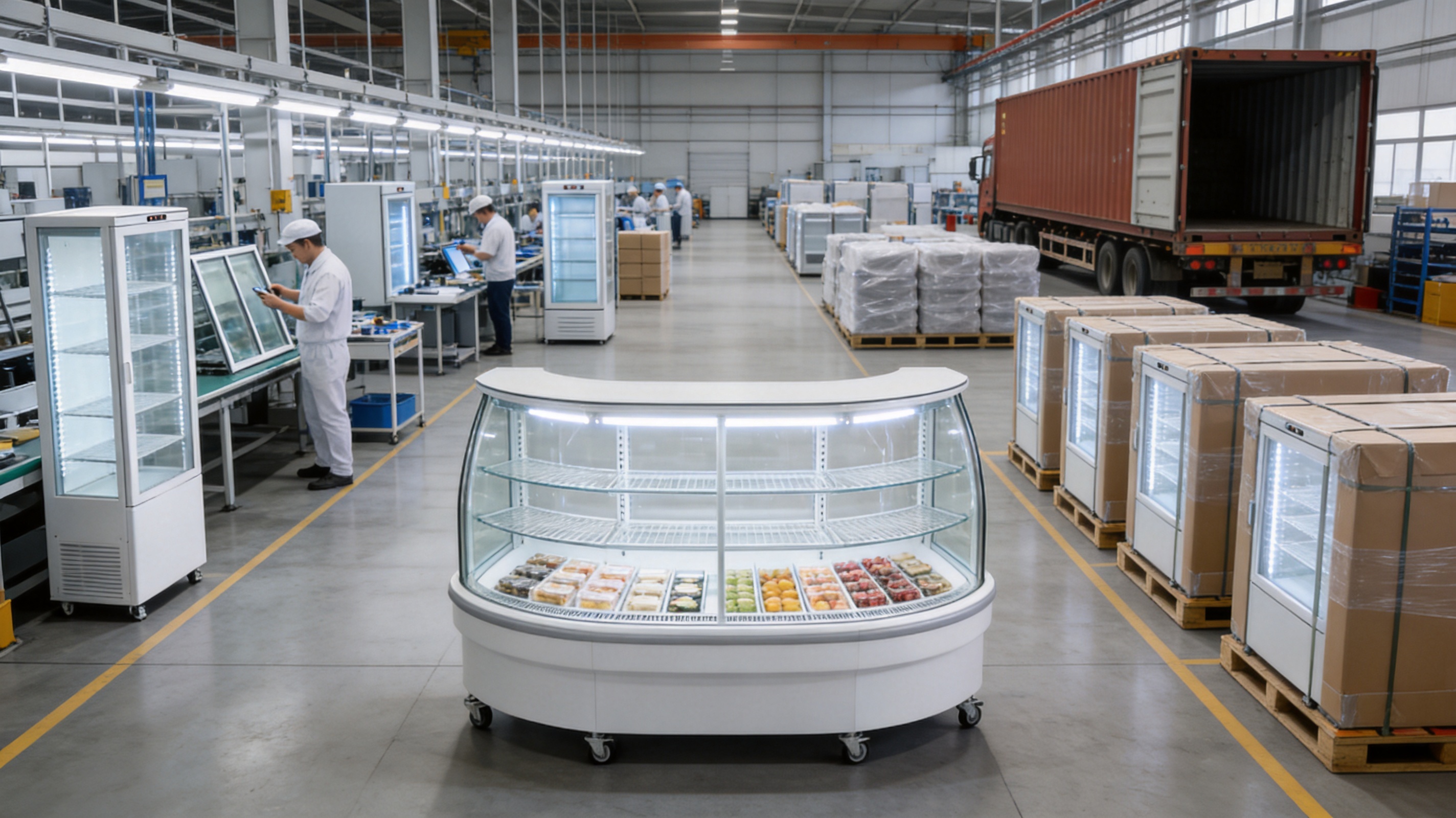
In food retail, presentation is part of product quality. Customers want to see beverages, desserts, prepared foods, dairy products, packaged meals, and other chilled merchandise before making a purchase. A commercial display refrigerator must therefore do more than maintain a safe and attractive temperature. It must make products visible from multiple directions, support organized merchandising, operate consistently throughout the working day, and fit efficiently into a professional retail environment.
The XC-278L four-sided glass display cooler is designed for these requirements. With a 278-liter capacity, a temperature range of 2–10°C, ventilated cooling, automatic defrost, internal LED lighting, adjustable shelves, and four-sided double glazing, it provides a practical combination of product visibility and refrigerated storage. Its vertical format makes it suitable for shops, cafés, restaurants, bakeries, convenience stores, hotel breakfast areas, supermarkets, and other commercial locations where attractive chilled presentation is important.
Unlike a conventional solid-door refrigerator, a glass display cooler helps merchandise communicate its value. Customers can view products without opening the door or searching through opaque storage. Staff can arrange items in a clean, organized display, while the vertical cabinet uses valuable floor space efficiently. The front curved glass adds a more refined appearance and provides a broad viewing angle, while the four-sided glass construction helps products remain visible from different positions around the cabinet.
The product is manufactured by Ningbo XiangChi Electrical Co., Ltd., a specialist producer of vertical display cabinets, cake cabinets, and warming cabinets. The company has operated since 2007 and has developed a 40,000-square-meter management garden factory, professional research and development resources, advanced testing facilities, and dedicated production lines. Its certification portfolio includes CE, GS, CCC, CB, RoHS, and ETL approvals, supporting its participation in international markets.

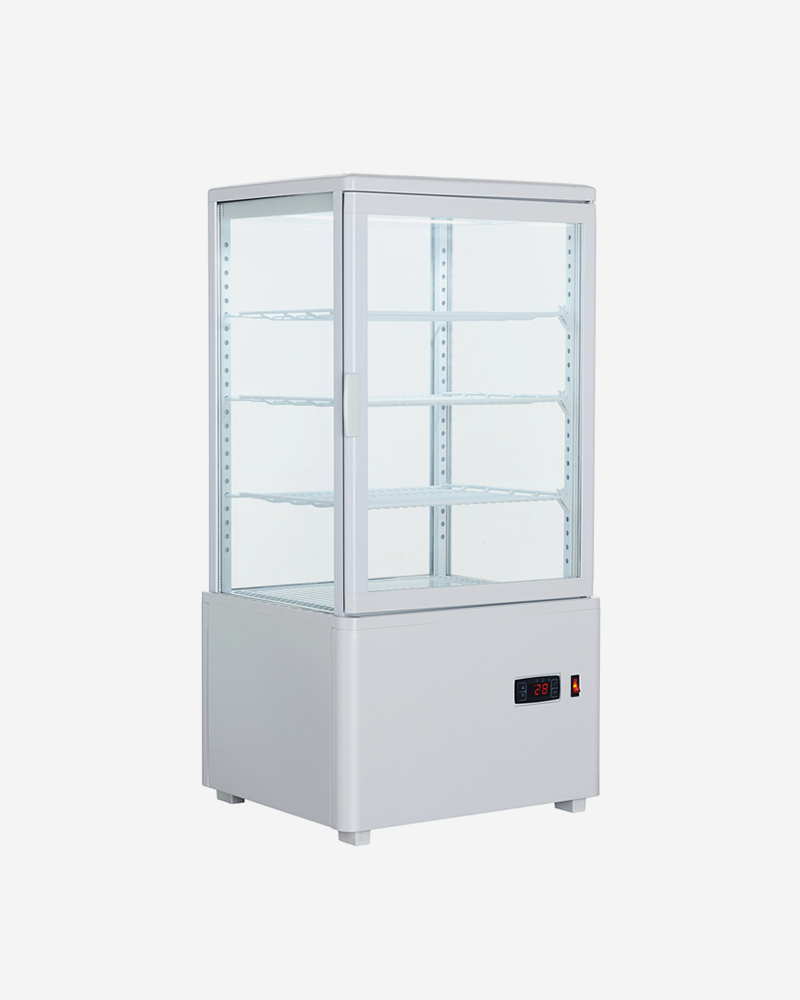
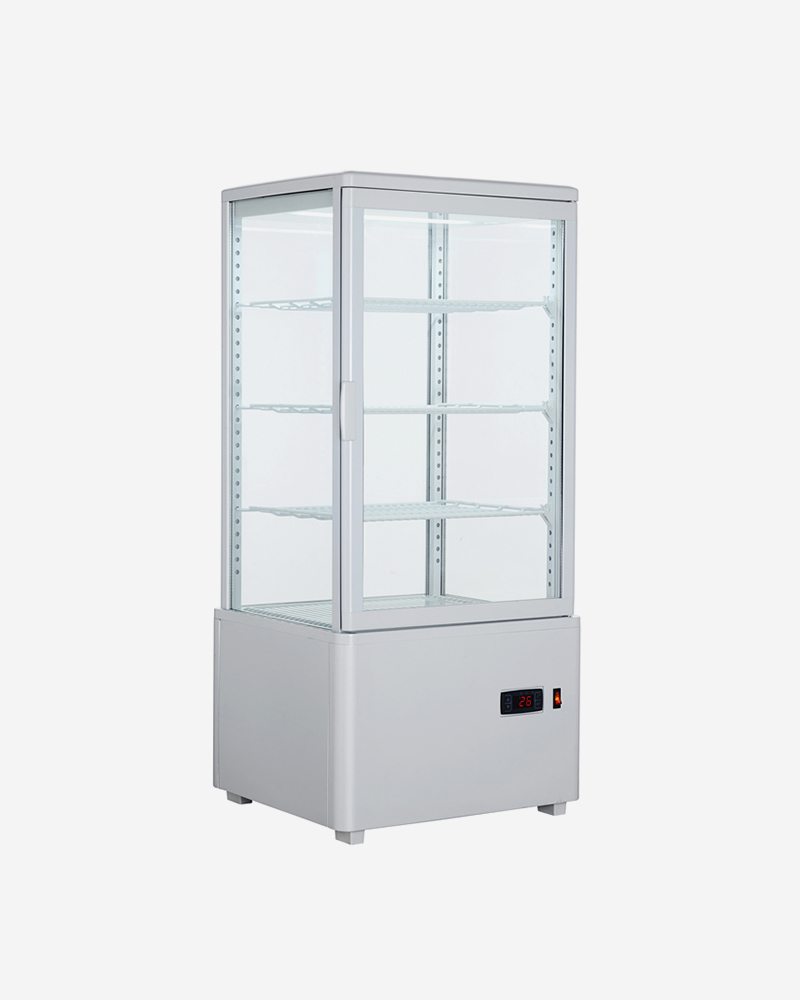
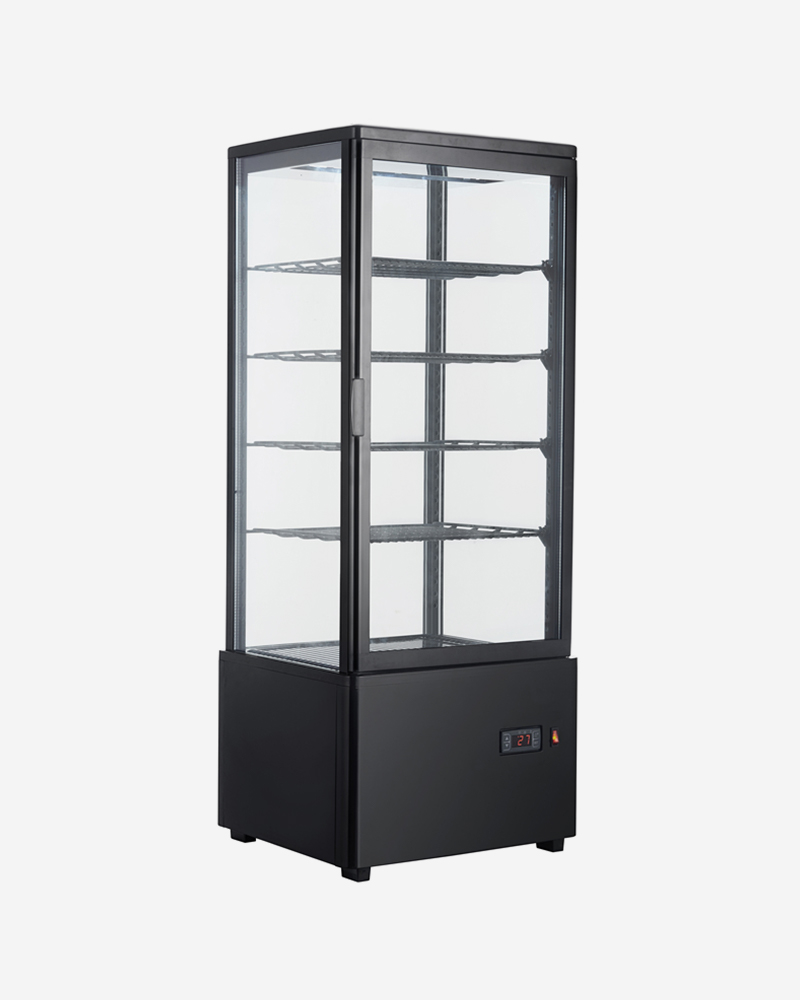
Four Sides Glasses Display Cooler
Product Overview and Commercial Purpose
The XC-278L is a vertical four-sided glass display cooler intended for commercial refrigeration applications. Its 278-liter internal capacity offers enough room for a useful assortment of chilled products while keeping the cabinet relatively narrow and upright. This makes it appropriate for locations where floor area is limited but product visibility remains a priority.
The cabinet operates within a temperature range of 2–10°C. This range is suitable for many common refrigerated products, including bottled and canned drinks, packaged desserts, sandwiches, dairy items, fresh snacks, prepared foods, and selected bakery products that require chilled storage. Operators should always confirm the storage requirements of each product category and load the cabinet according to applicable food-safety procedures.
The unit has a rated input power of 340 watts. Its climate type is listed as 4, indicating that the cabinet is designed for demanding commercial ambient conditions within the relevant climate classification. Actual performance can depend on room temperature, ventilation, loading practice, door or access conditions, product temperature at loading, and maintenance quality.
The refrigerant specification is R134a/R290. The exact refrigerant configuration may depend on the production version, market requirement, or customer specification. Importers and buyers should confirm the applicable refrigerant before ordering, especially when local regulations, installation standards, or environmental policies apply.
Key Technical Specifications
| Specification | Details |
|---|---|
| Model | XC-278L |
| Product category | Four-sided glass display cooler |
| Capacity | 278 liters |
| Temperature range | 2–10°C |
| Input power | 340 watts |
| Refrigerant | R134a/R290 |
| Climate type | 4 |
| Net weight | 93 kilograms |
| Gross weight | 98 kilograms |
| Product dimensions | 515 × 485 × 1915 millimeters |
| Package dimensions | 590 × 550 × 1960 millimeters |
| 20-foot general-purpose container loading | 36 units |
| 40-foot high-cube container loading | 80 units |
The listed dimensions show a tall, space-conscious cabinet. At approximately 515 millimeters wide and 485 millimeters deep, the unit can be positioned in many retail layouts without occupying the footprint of a wide horizontal merchandiser. Its height of 1915 millimeters creates a substantial display area and allows products to be arranged over multiple shelf levels.
The packaging dimensions of 590 × 550 × 1960 millimeters help buyers plan warehouse and logistics requirements. The gross weight is 98 kilograms, compared with a net product weight of 93 kilograms. The five-kilogram difference represents packaging and shipping materials and should be considered when planning receiving, movement, and installation.
Four-Sided Glass Visibility
The primary advantage of this cabinet is its visibility. The four-sided double-glass design exposes products from the front, sides, and other viewing angles. In a retail environment, customers do not always approach a display directly from the front. They may pass beside it, view it from an adjacent aisle, or stand at an angle near a service counter. A cabinet that remains visually open from multiple directions can attract attention more effectively than a conventional refrigerator with solid side panels.
The front curved glass contributes to the presentation quality of the cabinet. Curved glass can create a softer, more modern visual profile than a flat-front box and can help reduce the impression of a heavy industrial appliance. It also supports a broad viewing field for customers standing in front of the display.
Double-glass construction helps create a more stable barrier between the refrigerated interior and the surrounding room. It can also provide a clearer, more polished appearance when properly maintained. Because glass surfaces are highly visible, cleaning should form part of the daily operating routine. Fingerprints, condensation, dust, and product labels can reduce the visual impact of an otherwise well-organized display.
Four-sided visibility is particularly valuable for impulse-oriented products. Cold drinks, individual desserts, ready-to-eat snacks, and attractive packaged foods often benefit from being visible before the customer has consciously decided to shop for them. A well-positioned display cooler can serve as both storage equipment and a merchandising tool.
Efficient Vertical Merchandising
The vertical arrangement of the XC-278L makes it possible to present products at several eye levels. The cabinet includes adjustable PVC-coated shelves, allowing operators to adapt the interior to different product sizes. Tall bottles, small dessert containers, cans, cartons, and packaged food products can be arranged with more flexibility than in a cabinet with fixed shelf positions.
Adjustable shelves support seasonal merchandising as well. A retailer may need to display larger beverage bottles during one sales period and smaller impulse products during another. A bakery or café may use more vertical space for boxed cakes or dessert trays, then reconfigure the shelves for cups, jars, and bottled drinks. The ability to change shelf positions helps the cabinet remain useful as the product mix evolves.
PVC-coated shelves are practical for commercial environments because the coating provides a finished surface suitable for routine use and cleaning. Operators should avoid exceeding shelf load limits and should distribute products evenly. Overloading can restrict airflow, reduce visibility, and place unnecessary stress on shelf supports.
The tall cabinet format can also help store operators separate products by category. For example, the upper shelf area may be used for premium or high-margin products, the middle area for best-selling items at comfortable viewing height, and the lower area for larger or heavier packages. Clear category organization can shorten customer decision time and simplify restocking.
Compared with a low horizontal cooler, a vertical four-sided display cabinet can provide greater product-facing area relative to its floor footprint. This is a significant advantage in convenience stores, cafés, reception areas, compact supermarkets, and foodservice environments where every square meter must serve a commercial purpose.
Temperature Management and Cooling Performance
The XC-278L uses a ventilated cooling system. Instead of relying only on natural temperature movement, ventilated refrigeration circulates cooled air through the cabinet interior. This approach helps distribute temperature more evenly across the display area when products are loaded correctly and internal airflow is not blocked.
The 2–10°C temperature range covers a broad selection of chilled retail products. The digital thermostat and display allow operators to monitor the cabinet setting and make adjustments according to the product load and operating environment. A visible digital readout is useful during opening checks, routine inspections, and temperature documentation.
Temperature stability depends on more than the refrigeration system alone. The cabinet should be installed away from direct sunlight, ovens, cooking equipment, radiators, and other heat sources. Adequate clearance around ventilation areas is important because restricted airflow can cause the compressor and condenser system to work harder. Products should be loaded at suitable temperatures rather than using the cabinet as a rapid-cooling device for warm goods.
Operators should avoid blocking air outlets and should leave reasonable space between product packages. A display cooler performs best when cold air can move around the merchandise. Overcrowding may create warm spots, obscure products, and reduce the effectiveness of the ventilated system.
The digital thermostat provides a practical control interface, but it should not replace regular temperature verification when food-safety procedures require independent monitoring. A store may use a separate calibrated thermometer or a documented monitoring system to confirm that the actual product environment remains suitable.
Automatic Defrost and Daily Convenience
Ice accumulation can reduce heat-transfer efficiency and take up valuable internal space. The automatic defrost function helps manage frost formation during normal operation and reduces the need for frequent manual defrosting. This is especially useful in busy commercial locations where staff time is limited.
Automatic defrost does not eliminate the need for cleaning and inspection. Staff should still check the interior, shelves, drainage areas, door or glass seals where applicable, and ventilation openings. Spilled liquids should be removed promptly, and food residues should not be allowed to remain inside the cabinet.
A clear maintenance schedule can protect performance over the service life of the cabinet. Cleaning intervals may vary according to product type, traffic level, ambient humidity, and operating hours. High-volume foodservice operations may need more frequent attention than a low-traffic office or hotel display area.
Integrated LED Lighting
The standard cabinet includes an internal top LED light. Lighting is essential in a glass display cooler because refrigeration alone does not guarantee strong visual merchandising. Products that are technically well arranged may appear less attractive if the interior is dim or unevenly illuminated.
LED lighting can provide a bright, clean appearance while supporting product identification. Customers can read labels, distinguish colors, and compare product choices more easily. Internal lighting is also useful for staff during replenishment and inventory checks, particularly in areas with variable ambient light.
The product options include two strip LED light bars or four strip LED light bars. These options provide additional flexibility for buyers who want stronger or more distributed illumination. A retailer displaying colorful desserts, premium beverages, cakes, or packaged specialty foods may prefer an expanded lighting arrangement to improve shelf-level visibility.
Lighting should be selected according to the product category and cabinet layout. Too little light can make products difficult to see, while excessive brightness or poor positioning may create reflections on the glass. Buyers should discuss the desired lighting configuration when specifying the unit for a particular retail concept.
Mobility and Placement Flexibility
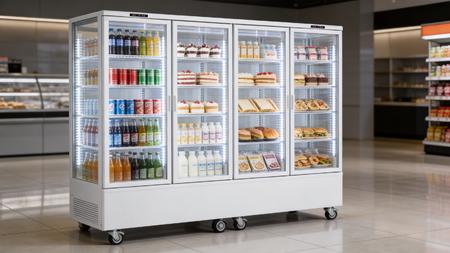
The XC-278L is equipped with four castors, two of which include brakes. This arrangement makes the cabinet easier to move during installation, cleaning, store rearrangement, or seasonal layout changes. Once the cabinet is in its intended position, the two braked castors help secure it and reduce unwanted movement.
Mobility can be valuable in commercial environments that change frequently. A café may move the cabinet closer to a service counter during a promotion. A supermarket may reposition it near a seasonal aisle. A hotel may change the breakfast or event layout. Castors reduce the effort required for these adjustments, although the cabinet should be moved carefully and secured correctly after relocation.
The tall format requires attention to floor stability and overhead clearance. The installation area should be level and strong enough to support the cabinet when fully loaded. Staff should avoid pushing the unit by its glass panels, shelves, or decorative components. Relocation should follow safe handling procedures suitable for a 93-kilogram net appliance.
Standard Features and Available Options
The standard features of the cabinet include front curved glass, an internal top LED light, a digital thermostat and display, adjustable PVC-coated shelves, four-sided double glass, ventilated cooling, automatic defrost, and four castors with two brakes.
Optional features include two strip LED light bars, four strip LED light bars, chromed shelves, and tempered glass. Chromed shelves may be selected when a different visual style or display finish is desired. Tempered glass is an option for customers who require a specified glass treatment for their market, application, or internal purchasing standard.
Optional specifications should be confirmed before production because they may influence the final configuration, appearance, packaging, and pricing. Buyers should also verify whether the selected options affect loading arrangements or shipping quantities.
| Feature or option | Commercial benefit |
|---|---|
| Front curved glass | Improves presentation and provides a broad front viewing angle |
| Four-sided double glass | Supports visibility from multiple directions and gives the cabinet a premium appearance |
| Internal top LED light | Improves product visibility and supports merchandising |
| Two or four LED light bars | Allows buyers to select a stronger or more distributed lighting arrangement |
| Digital thermostat and display | Provides accessible temperature control and operating information |
| Adjustable PVC-coated shelves | Accommodates different product sizes and merchandising layouts |
| Chromed shelves | Offers an alternative display finish |
| Ventilated cooling | Promotes circulation of cooled air through the cabinet |
| Automatic defrost | Reduces the need for frequent manual defrosting |
| Four castors with two brakes | Supports repositioning and stable placement |
| Tempered glass option | Provides an alternative glass specification for selected requirements |
Advantages Compared with Conventional Display Equipment
A major competitive advantage of the four-sided glass format is the combination of visibility and capacity. A countertop display refrigerator may offer convenient access and a compact footprint, but its capacity is usually limited. A wide horizontal merchandiser may hold more products, but it can consume valuable floor space and present merchandise mainly from one viewing direction. The XC-278L occupies a narrow vertical footprint while offering substantial internal volume and multi-angle presentation.
Compared with a solid-door refrigerator, the glass display format improves product recognition and reduces the need for customers to open the cabinet. This can help create a more orderly shopping experience and may reduce unnecessary door opening in applications where the display is designed for open customer viewing or frequent staff access. The exact access arrangement depends on the final cabinet configuration and operating environment.
Compared with a basic glass-front cabinet, the XC-278L adds four-sided glass, internal LED lighting, ventilated cooling, automatic defrost, adjustable shelves, and mobility. These features address both presentation and operating convenience. The result is not simply a refrigerated box with a window; it is a complete merchandising fixture intended to support daily commercial activity.
The curved front, double glazing, and optional shelf and lighting configurations also help the cabinet adapt to different brand environments. A modern café, premium dessert shop, hotel lobby, and convenience store may all use the same basic cabinet while arranging the interior and exterior surroundings to match their own design language.
Its climate type 4 classification further supports use in demanding commercial conditions, provided the installation and operating environment remain within the specified requirements. Buyers comparing models should evaluate not only nominal capacity but also climate performance, cooling method, defrost system, lighting, shelf flexibility, mobility, service support, and certification status.
Suitable Commercial Applications
Cafés and Beverage Shops
Cafés can use the cabinet for bottled drinks, cans, dairy beverages, chilled desserts, sandwiches, and packaged snacks. Its narrow vertical footprint can fit near a checkout counter, service area, or customer waiting zone without creating a large obstruction. The LED-lit interior can make cold beverages visible from across the room.
Bakeries and Dessert Retailers
Bakeries and dessert shops often depend on visual appeal. Chilled cakes, individual portions, mousse desserts, cream-based products, and specialty pastries can be arranged on adjustable shelves. The curved glass front and optional lighting help customers view product details while maintaining a refrigerated environment suitable for applicable products.
Convenience Stores
Convenience stores need equipment that supports quick customer decisions. A tall, multi-angle display cooler can be positioned near high-traffic areas or alongside complementary products. Beverages, ready-to-eat food, snacks, and refrigerated convenience items can be grouped by category and replenished throughout the day.
Restaurants and Foodservice Locations
Restaurants may use the cabinet for prepared desserts, bottled beverages, salads, chilled appetizers, or packaged takeaway products. The adjustable interior supports changes in menu and presentation. Castors can also help restaurants modify the dining or service layout for different operating periods.
Hotels and Hospitality Facilities
Hotels can install the cabinet in breakfast areas, lobby cafés, banquet preparation areas, or guest-facing food outlets. Multi-sided visibility is helpful in open hospitality environments where customers approach from several directions. The cabinet can display chilled refreshments while maintaining a professional appearance.
Supermarkets and Specialty Food Stores
Supermarkets and specialty retailers can use the unit for premium chilled products, promotional assortments, regional specialties, and impulse purchases. A vertical display may be placed at the end of an aisle, near a checkout zone, or in a dedicated food presentation area.
Manufacturing Capability and Quality Approach
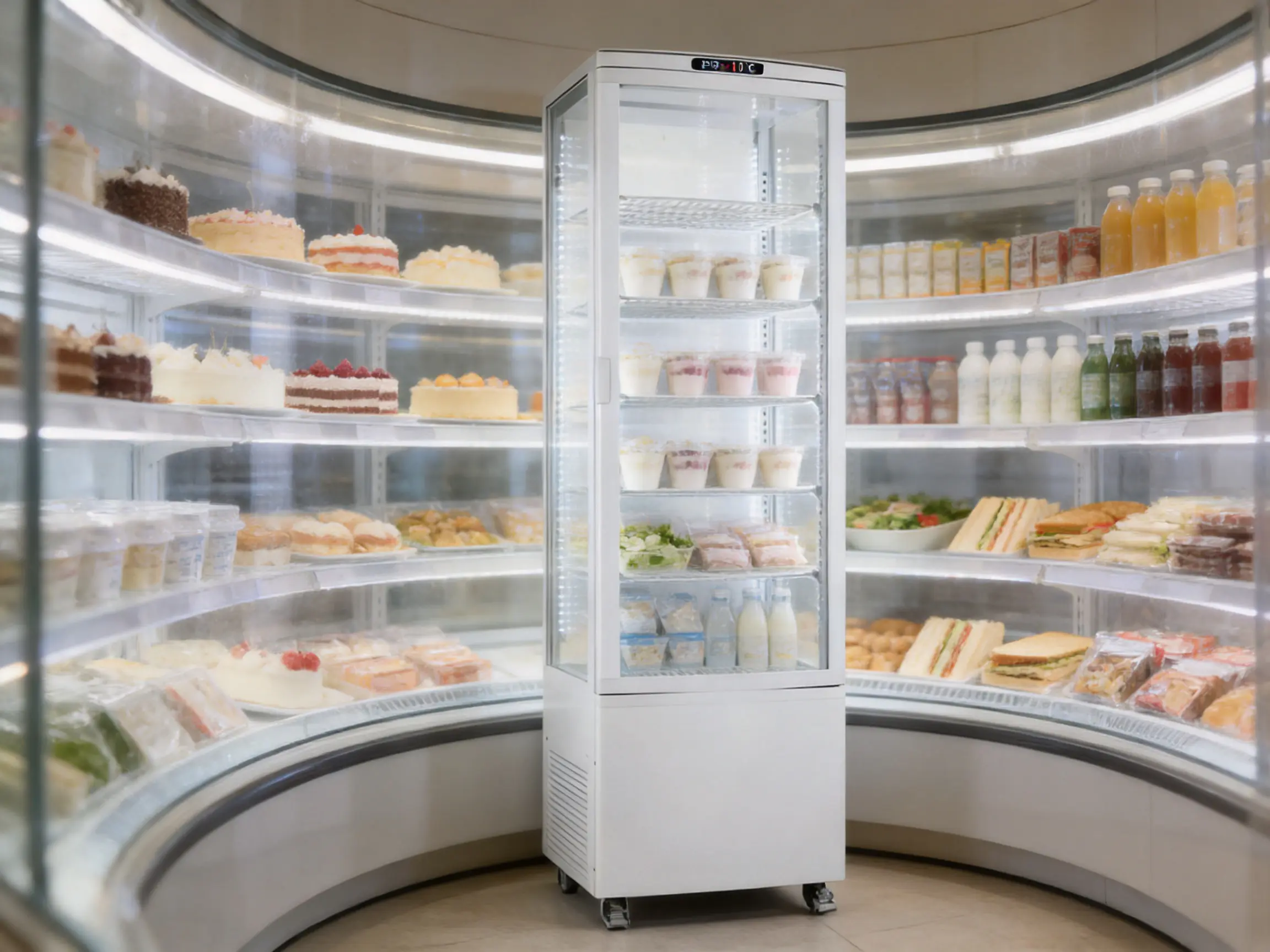
The manufacturer behind the product has specialized in vertical display cabinets, cake cabinets, and warming cabinets since 2007. This focused product experience is important because commercial refrigeration requires more than general appliance assembly. Cabinet structure, glass integration, airflow, lighting, temperature control, insulation, shelf support, electrical safety, and packaging must work together as a dependable system.
The company operates a modern management garden factory covering 40,000 square meters. A facility of this scale provides room for organized production areas, material handling, assembly operations, testing, storage, and shipping coordination. Effective factory organization can help reduce production confusion, support repeatable processes, and improve control over commercial orders.
Professional research and development resources support continued product improvement. For a display cooler, research and development may involve cabinet proportions, glass construction, airflow paths, lighting integration, shelf adjustment, control interfaces, energy-related improvements, refrigerant selection, and ease of assembly. Product innovation is most valuable when it responds to actual retailer and foodservice requirements.
Advanced testing facilities provide a basis for evaluating product operation before shipment. Testing may include temperature behavior, electrical functions, lighting operation, defrost performance, control accuracy, mechanical fit, and packaging suitability. Specific test procedures can vary by model, order, market, and certification requirement, so buyers should request the relevant quality documentation for their purchase.
Dedicated production lines support manufacturing consistency. Repeatable assembly sequences can help maintain alignment between glass, frame, shelves, electrical components, refrigeration components, and exterior panels. Consistency is especially important for export products because cabinets may travel long distances before installation at the customer’s facility.
The company’s certifications include CE, GS, CCC, CB, RoHS, and ETL. These certifications and compliance marks are associated with different markets and technical requirements. The applicable certification for a particular model should always be confirmed against the exact product configuration, voltage, refrigerant, options, and destination market.
Quality Control Considerations for Commercial Buyers
Commercial buyers should evaluate the complete supply capability rather than focusing only on the product photograph or headline capacity. Important questions include whether the supplier can maintain model consistency, provide the requested electrical configuration, support required certifications, package the cabinet securely, and supply replacement parts or technical information.
For the XC-278L, buyers should confirm the final refrigerant, power supply, plug specification, lighting option, shelf configuration, glass option, thermostat arrangement, and carton markings. They should also confirm the production lead time, minimum order quantity, warranty terms, installation requirements, and documentation supplied with the shipment.
Quality assurance continues after production. Proper packaging protects glass panels, frame edges, shelves, and control components during transportation. The listed package dimensions and gross weight provide a starting point for freight planning, but shipping providers may require additional information regarding palletization, stacking, container loading, and handling symbols.
Receiving staff should inspect the packaging before unloading and examine the cabinet for visible transportation damage. After installation, the cabinet should be allowed to stabilize according to the supplier’s instructions before full operation. A commissioning check should include power connection, lighting, temperature display, cooling operation, castor stability, shelf installation, and glass condition.
Installation and Operating Best Practices
The cabinet should be installed on a level surface with sufficient room for ventilation, cleaning, door or access movement where applicable, and customer circulation. Direct sunlight and nearby heat-producing equipment should be avoided. A crowded installation can reduce refrigeration efficiency and make routine maintenance more difficult.
Before loading, clean the interior and shelves using appropriate procedures. Products should be arranged without blocking air circulation. Heavy products should be placed on shelves that are suitable for their load, while fragile or premium products should be positioned where they can be seen clearly and handled safely.
Operators should avoid placing hot products directly into the cabinet. Warm merchandise increases the refrigeration load and can affect the temperature of products already inside. Stock rotation should follow a suitable first-in, first-out method where applicable, and expired or damaged items should be removed promptly.
The digital temperature display should be checked at regular intervals. If the displayed temperature moves outside the expected range, staff should investigate loading, ventilation, ambient conditions, door or access behavior, condenser cleanliness, and power supply before assuming a major component failure.
The glass should be cleaned with materials that will not scratch or damage the surface. Abrasive chemicals, rough pads, and excessive water around electrical components should be avoided. Shelves should be removed and cleaned according to the operating instructions, then replaced securely before products are returned.
Castor brakes should be engaged after the cabinet is positioned. When the unit is moved, staff should remove or secure products, use appropriate handling methods, and confirm that the cabinet is stable afterward. The glass should never be used as a pushing or pulling point.
Energy and Operating Efficiency
Commercial refrigeration efficiency depends on operating discipline as well as equipment design. The 340-watt input specification gives buyers a useful reference for electrical planning, but actual energy consumption can vary with ambient temperature, product load, operating hours, defrost cycles, thermostat settings, and installation conditions.
Efficient operation begins with correct placement. A cabinet exposed to strong heat will require more refrigeration effort. Keeping the air circulation paths clear helps the system reject heat and maintain the desired internal conditions. Regular cleaning of relevant ventilation and heat-exchange areas can also support stable operation.
Product organization affects efficiency. Excessive empty space may reduce merchandising effectiveness, while excessive loading can restrict airflow. A balanced load with visible, evenly distributed products usually provides a better combination of presentation and cooling performance.
Lighting selection can also be matched to the application. The standard top LED light may be sufficient for many installations, while optional light bars may be appropriate for premium displays or darker environments. Buyers should choose the lighting arrangement that supports sales presentation without adding unnecessary complexity.
Why the Product Supports Stronger Merchandising
A successful display cabinet must attract attention, explain the product selection visually, and make purchase decisions easy. The XC-278L supports these goals through its tall display area, four-sided glass, curved front, LED illumination, and adjustable shelves. Products can be arranged according to size, color, price, flavor, brand, or promotional theme.
The cabinet can also help create a more open store layout. Because customers can see through the glass from several directions, the unit may be positioned as a freestanding merchandising element rather than being limited to a wall line. This creates opportunities for cross-merchandising. For example, a chilled dessert display may be placed near coffee service, while a bottled drink display may be placed near takeaway food.
Visibility also supports staff efficiency. Employees can identify low-stock areas without opening a conventional refrigerator repeatedly. A clear display can make replenishment priorities obvious and help staff keep the cabinet presentable throughout the day.
For owners and purchasing managers, the commercial value of the unit is therefore broader than storage volume. It combines refrigerated preservation with visual communication, flexible merchandising, and a professional physical presence.
Frequently Asked Questions
What is the capacity of the XC-278L display cooler?
The listed capacity is 278 liters. The usable space may vary depending on shelf positions, product dimensions, packaging, and the amount of clearance required for proper air circulation.
What temperature range does the cabinet provide?
The specified temperature range is 2–10°C. Products should be selected and stored according to their individual requirements and applicable food-safety regulations.
What type of cooling system does it use?
The cabinet uses a ventilated cooling system. This supports the circulation of cooled air within the display area when the cabinet is installed and loaded correctly.
Does the cabinet defrost automatically?
Yes. Automatic defrost is listed as a standard feature. Routine cleaning and inspection are still required.
What lighting is included?
The standard configuration includes an internal top LED light. Optional configurations include two strip LED light bars or four strip LED light bars.
Are the shelves adjustable?
Yes. The standard cabinet includes adjustable PVC-coated shelves. Chromed shelves are available as an option, subject to the selected configuration.
Can the cabinet be moved?
Yes. It includes four castors, with two equipped with brakes. The brakes should be engaged once the cabinet has been positioned.
What refrigerant does the product use?
The specification lists R134a/R290. Buyers should confirm the exact refrigerant configuration for their order and destination market before purchase.
Is the cabinet suitable for a small retail space?
Its vertical design and approximately 515 × 485 millimeter footprint make it suitable for many space-conscious commercial layouts. Buyers should still allow sufficient room for ventilation, cleaning, service access, and customer movement.
Which businesses can use this display cooler?
Potential applications include cafés, bakeries, dessert shops, convenience stores, supermarkets, restaurants, hotels, specialty food retailers, and other commercial locations requiring visible chilled merchandising.
What should buyers confirm before placing an order?
Buyers should confirm voltage, plug type, refrigerant, lighting configuration, shelf type, glass option, certification requirements, packaging details, delivery terms, warranty conditions, and any destination-specific compliance requirements.
What makes it different from a conventional refrigerator?
It combines refrigerated storage with four-sided visibility, a curved front, internal lighting, adjustable shelves, ventilated cooling, automatic defrost, and mobile castors. These features make it suitable for product presentation as well as cold storage.
Conclusion
The XC-278L four-sided glass display cooler is designed for commercial operators that want refrigeration to support both product protection and product presentation. Its 278-liter capacity, 2–10°C temperature range, ventilated cooling system, automatic defrost, digital thermostat, LED lighting, adjustable shelves, and four-sided double-glass construction create a balanced solution for many retail and foodservice environments.
Its vertical format helps preserve floor space while providing a large, visible merchandising area. The curved front and multi-angle glass design can draw attention from different directions, while optional lighting and shelf configurations allow buyers to adapt the display to their product mix. Four castors, including two braked castors, add practical flexibility during installation and store layout changes.
The product is supported by a manufacturer with experience dating from 2007, a 40,000-square-meter factory, professional research and development resources, advanced testing facilities, dedicated production lines, and a broad range of international certifications. These capabilities provide a foundation for consistent manufacturing and global commercial supply.
For buyers comparing vertical display cabinets, the most important evaluation should include more than appearance or nominal capacity. Cooling performance, glass construction, lighting, shelf flexibility, defrost operation, climate suitability, certification, packaging, technical support, and long-term manufacturing capability should all be considered. Within this broader evaluation, the XC-278L offers a strong combination of visibility, practical storage, flexible merchandising, and commercial usability.
References
1. Product specification sheet for the XC-278L four-sided glass display cooler.
2. Commercial refrigeration equipment selection and installation practices.
3. General principles of refrigerated food display and temperature management.
4. Manufacturer-provided information on vertical display cabinets, research and development, factory operations, and certifications.
5. General retail merchandising principles for chilled food and beverage displays.
Product: Four Sides Glasses Display Cooler

You May Also Like





-
- Navigation
- Home
- About Us
- Products
- News
- Contact Us
 East Zone, Guanhaiwei Industrial Park, Cixi City, Ningbo, Zhejiang, China
 +86-574-63668678
 +86-574-63668108

Copyright © Ningbo XiangChi Electrical Co.,Ltd All Rights Reserved.
