
 简体中文
简体中文 English
 Español
News
Direct-Cooling Countertop Display Refrigerators: A Practical Guide to Capacity, Performance, and Commercial Value
Introduction
Countertop refrigeration has become an important part of modern food retail, hospitality, catering, and convenience operations. Businesses increasingly need equipment that can preserve chilled products while also presenting them attractively to customers. A refrigerator hidden beneath a counter may protect food, but it does not support impulse purchasing or visual merchandising. A countertop display refrigerator addresses both requirements by combining cold storage, product visibility, compact installation, and front-of-house presentation.
The Direct Cooling Countertop Display Refrigerators XCW-118L, XCW-138L, and XCW-248L are designed for commercial users who need a reliable chilled display in different sizes. The three models provide gross capacities of 118 liters, 138 liters, and 248 liters respectively. Each model operates within a temperature range of 2–8°C, uses R290 refrigerant, and includes a direct cooling system, digital temperature control, front curved glass, sliding doors, adjustable feet, and separate power and lighting controls.
This product family is suitable for displaying cakes, desserts, sandwiches, beverages, prepared foods, dairy products, fruit cups, salads, packaged snacks, and other temperature-sensitive merchandise. Its countertop format allows the cabinet to be positioned on service counters, preparation counters, checkout areas, bakery counters, café counters, buffet stations, and other locations where floor space is limited but product visibility is essential.
Compared with many general-purpose commercial refrigerators, these display models emphasize customer-facing presentation. Compared with larger upright display cabinets, they can be easier to place in compact shops and service environments. Their three-size configuration also allows businesses to select a cabinet according to available space, expected sales volume, and display requirements rather than adapting every operation to one standard size.
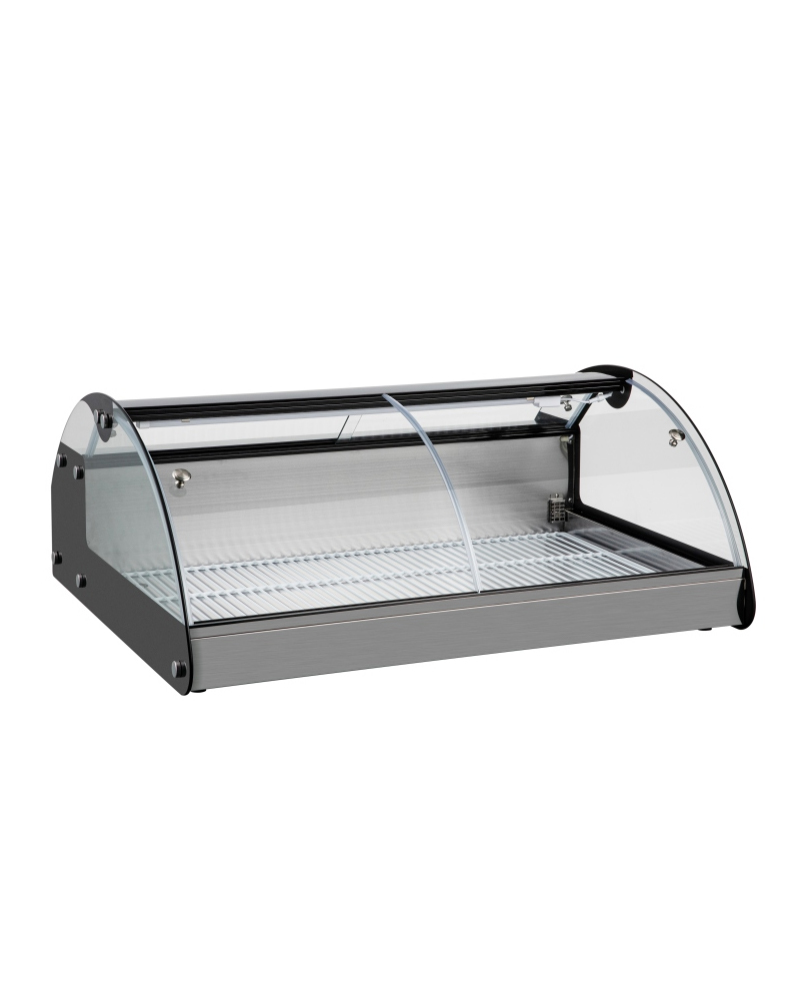
Direct Cooling Countertop Display Refrigerators XCW-118L/138L/248L
Product Family Overview
The XCW series is built around a straightforward commercial refrigeration concept: use direct cooling to maintain a chilled display environment, provide clear visibility through glass, and offer practical access through front and rear sliding doors. This configuration is particularly useful for businesses where staff replenish products from one side while customers view or receive items from the other.
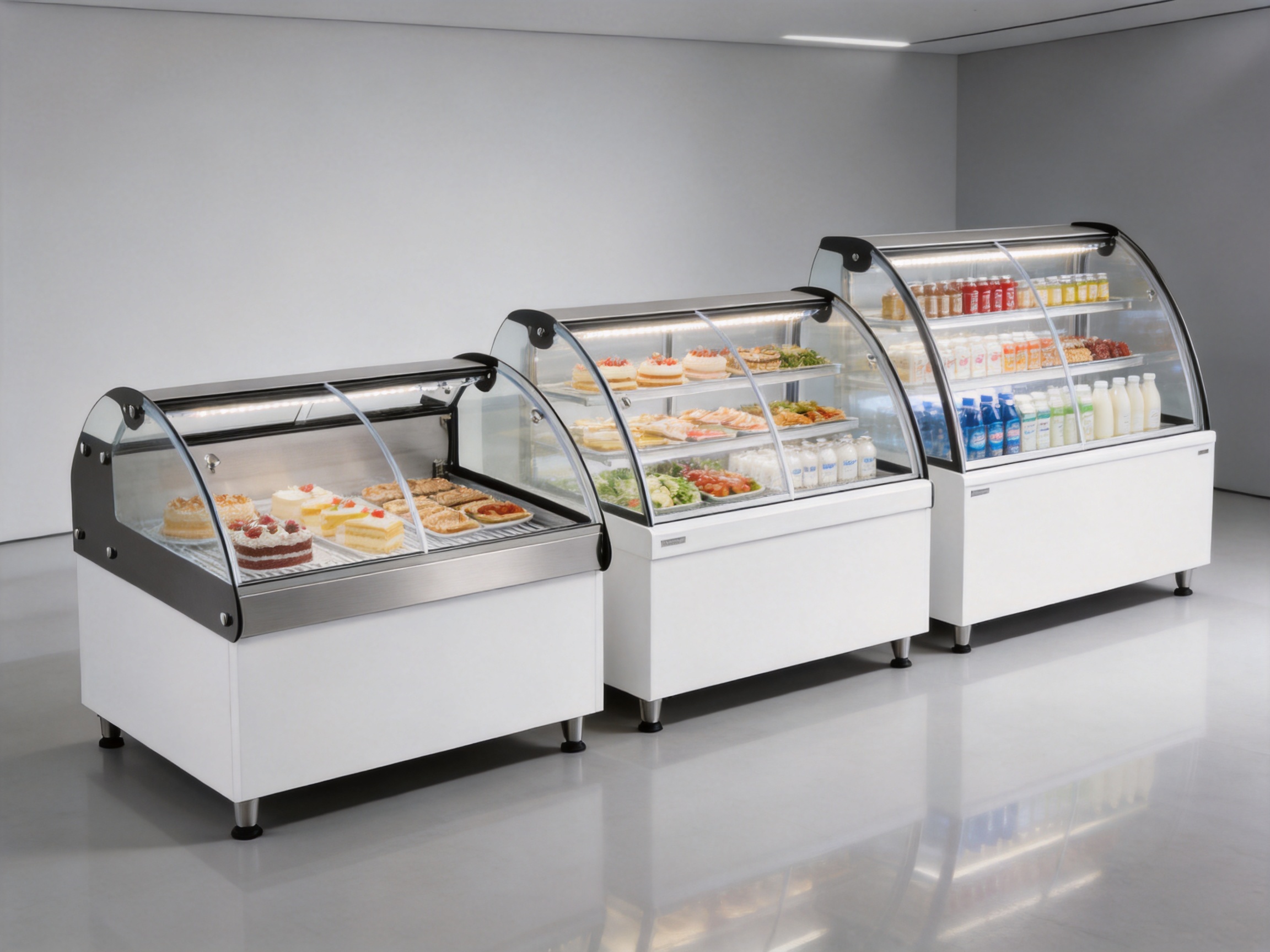
The XCW-118L is the smallest model in the series. It offers a gross capacity of 118 liters and measures approximately 700 × 845 × 410 millimeters. Its compact width makes it suitable for smaller counters, cafés, kiosks, bakery stalls, and limited-service food outlets. It can provide a professional display without occupying the footprint of a full-size upright cabinet.
The XCW-138L provides a gross capacity of 138 liters and measures approximately 1000 × 845 × 410 millimeters. This longer cabinet creates a wider horizontal display area while retaining the same height and depth as the smaller model. It is well suited to businesses that need additional product frontage, more presentation space, or a greater selection of chilled merchandise.
The XCW-248L is the largest model in the group. It provides a gross capacity of 248 liters and measures approximately 1800 × 845 × 410 millimeters. Its extended length makes it suitable for high-volume counters, larger bakeries, supermarkets, convenience stores, cafés, buffet operations, and food-service venues that require a substantial chilled display without moving to a deeper floor-standing format.
All three models share the same listed temperature range, input power, refrigerant, climate type, and basic operating features. This common specification simplifies product selection and can make staff training easier when a business uses multiple sizes in different locations.
| Specification | XCW-118L | XCW-138L | XCW-248L |
|---|---|---|---|
| Gross capacity | 118 L / 4.2 cu. ft. | 138 L / 4.9 cu. ft. | 248 L / 8.8 cu. ft. |
| Temperature range | 2–8°C / 35.6–46.4°F | 2–8°C / 35.6–46.4°F | 2–8°C / 35.6–46.4°F |
| Input power | 150 W | 150 W | 150 W |
| Refrigerant | R290 | R290 | R290 |
| Climate type | 6 | 6 | 6 |
| Net weight | 39 kg | 50 kg | 62 kg |
| Gross weight | 42 kg | 54 kg | 98.5 kg |
| Product dimensions | 700 × 845 × 410 mm | 1000 × 845 × 410 mm | 1800 × 845 × 410 mm |
| Packaging dimensions | 800 × 950 × 590 mm | 1100 × 950 × 590 mm | 1900 × 950 × 590 mm |
| Loading quantity, 20GP / 40HQ | 56 / 140 pcs | 48 / 120 pcs | 18 / 48 pcs |
Direct Cooling and Temperature Control
How Direct Cooling Supports Display Refrigeration
The series uses a direct cooling system. In a direct cooling cabinet, the refrigerated surfaces and internal structure transfer cooling directly into the storage and display area. This design is commonly valued for its mechanical simplicity and its ability to provide stable cooling for products arranged inside a showcase.
Direct cooling can be especially appropriate for products that benefit from a consistent chilled environment without the strong air movement associated with some ventilated systems. Cakes, desserts, packaged foods, dairy products, and prepared dishes can be displayed in a calm cabinet environment where excessive airflow is not desirable.
Businesses should still arrange products properly and avoid blocking internal cooling paths. Product loading, ambient temperature, door-opening frequency, and the temperature of goods placed inside the cabinet will influence actual performance. The listed 2–8°C range provides a useful operating target for chilled merchandise, but operators should use appropriate procedures and verify product temperatures according to their food-safety requirements.
Digital Temperature Controller and Display
Each model includes a digital temperature controller and display. This feature gives operators a clear way to monitor the cabinet setting and make adjustments when operating conditions change. A digital interface is generally easier to read than an analog dial, particularly in busy commercial environments where quick checks are part of the daily routine.
Digital temperature visibility also supports more disciplined equipment management. Staff can check the cabinet during opening procedures, after replenishment, during high-traffic periods, and before closing. When combined with internal temperature checks and scheduled cleaning, the controller helps create a more consistent operating routine.
The control arrangement is practical for different types of businesses. A bakery can monitor chilled desserts throughout the trading day. A café can check sandwich and beverage storage before service. A supermarket can monitor ready-to-eat products during periods of frequent door access. A catering business can use the cabinet as a presentation and short-term holding unit for prepared products.
Display Design and Customer Presentation
Front Curved Glass
The front curved glass is one of the most visible design features of the product family. It provides a broad viewing area and gives the cabinet a more refined appearance than a basic solid-door refrigerator. Curved glass can also help reduce visual barriers between the customer and the products, allowing cakes, pastries, desserts, and prepared foods to become part of the retail environment.
Product presentation has a direct effect on perceived quality. A well-arranged display can help customers understand the available selection before speaking with staff. It can also support impulse purchases by making attractive products visible at the point of service. In bakery and café applications, the cabinet itself becomes part of the merchandising system rather than simply a storage appliance.
Clear glass also assists staff operations. Employees can inspect the display without opening the cabinet, which may reduce unnecessary access and help maintain a more stable internal temperature. Staff can identify low-stock products, reorganize trays, and check presentation quality through the glass.
Front and Rear Sliding Doors
The front and rear sliding door arrangement supports two-sided operation. Customers can view products from the service side, while employees can replenish and organize products from the opposite side. This arrangement is particularly useful for counters positioned between a preparation area and a customer area.
Sliding doors can be advantageous where swinging doors would interfere with staff movement, neighboring equipment, or customer queues. They are also suitable for narrow service counters because the door panels move within the cabinet footprint rather than projecting outward into an aisle.
Two-sided access can improve workflow. In a bakery, staff may load cakes from the production side and serve customers from the front. In a café, employees can replenish sandwiches and desserts from behind the counter while customers view the products from the service side. In a buffet or hotel setting, staff can organize chilled items without repeatedly crossing the customer-facing area.
Separate Power and Lighting Controls
The standard features include a separate power button and a separate light button. Independent controls give operators greater flexibility. The display lighting can be used during business hours to improve product visibility, while the cabinet can be managed according to the establishment’s operating schedule.
Separate controls are also useful during cleaning, maintenance, and store preparation. Staff can turn off the lighting while retaining refrigeration or manage the display according to the requirements of the venue. Although simple, this type of control separation can contribute to practical day-to-day operation.
Capacity Selection for Different Businesses
XCW-118L for Compact Counters
The XCW-118L is designed for operators who need a commercial display but have limited counter space. With a width of approximately 700 millimeters, it can fit into smaller cafés, boutique bakeries, kiosks, hotel lounges, convenience counters, and specialty food stores.
Its 118-liter gross capacity can accommodate a focused assortment rather than a very broad product range. This can be an advantage for businesses that want to highlight best-selling products, seasonal desserts, signature cakes, packaged sandwiches, or premium beverages. A compact assortment is often easier to rotate, replenish, and keep visually organized.
The smaller footprint can also support flexible store planning. Businesses may position the cabinet near a checkout area, beside a coffee machine, next to a cake preparation counter, or at the entrance to a compact retail space. Operators should confirm the available counter load capacity and allow sufficient clearance for ventilation, service access, cleaning, and door operation.
XCW-138L for Wider Product Selection
The XCW-138L adds display width while preserving the same approximate height and depth as the 118-liter model. This makes it a logical option for businesses that need more horizontal presentation but do not want a substantially deeper or taller appliance.
The 138-liter capacity can support a wider selection of cakes, desserts, drinks, salads, sandwiches, or chilled packaged foods. The additional display length may also help separate product categories. For example, a café may reserve one section for desserts, another for sandwiches, and another for bottled drinks or specialty items.
Because the cabinet remains countertop-oriented, it can be integrated with existing service furniture. This may be useful during renovations, expansions, or new store openings where the operator wants to increase chilled merchandising without redesigning the entire floor plan.
XCW-248L for High-Volume Display
The XCW-248L provides the greatest capacity and display length in the family. Its approximate 1800-millimeter width creates a long visual presentation area suited to larger retail counters and higher-volume operations.
This model can be appropriate when the display itself is an important part of sales activity. A bakery may use it to present multiple cake styles and dessert categories. A supermarket may use it for ready-to-eat foods, dairy products, or packaged chilled meals. A hotel or buffet operator may use it to present a broad assortment across a long service counter.
The larger cabinet requires more planning than the smaller models. Operators should consider counter strength, delivery access, installation space, electrical positioning, cleaning access, and the relationship between the cabinet and customer traffic. Its 62-kilogram net weight and larger packaging dimensions also require suitable handling during delivery and installation.
Comparison with Conventional Display Equipment
The product family offers several practical advantages when compared with basic refrigerated storage units. A solid-door refrigerator may provide cold storage, but it does not offer the same immediate product visibility. Customers must often ask staff what is available or wait for a door to be opened. The glass display format turns products into visible merchandise.
Compared with open display coolers, the sliding-door design provides a more enclosed environment. Open cases can offer quick access, but they may be more exposed to ambient air, dust, customer contact, and frequent temperature fluctuations. The enclosed glass configuration provides a controlled display boundary while still allowing customers to see the products clearly.
Compared with large upright glass-door refrigerators, a countertop case can be easier to incorporate into a service counter. It does not necessarily require a dedicated floor position, and it can be placed where staff and customers are already interacting. This may be valuable in small-format retail spaces and food-service businesses.
Compared with some fan-assisted systems, direct cooling may offer a simpler refrigeration approach with less emphasis on strong internal air circulation. Product suitability depends on the application, but the system is well aligned with chilled display use where visual presentation and a controlled temperature range are the primary goals.
| Evaluation factor | Countertop display refrigerator | Solid-door storage refrigerator | Open display cooler |
|---|---|---|---|
| Product visibility | High, through curved glass | Low until the door is opened | Very high |
| Customer-facing merchandising | Strong | Limited | Strong |
| Protection from ambient exposure | Enclosed glass display | Enclosed solid cabinet | More exposed |
| Counter integration | Designed for countertop placement | Depends on model | Depends on model |
| Access arrangement | Front and rear sliding doors | Usually front access | Open access |
| Best use | Chilled merchandise presentation | Back-room or concealed storage | Fast-access merchandising |
The comparison does not mean that one type of equipment is suitable for every situation. A business may use several refrigeration formats together. For example, a back-room refrigerator can store reserve stock, while a countertop display refrigerator presents the current selection to customers. The XCW series is strongest where storage and visible selling need to be combined in one unit.
Use in Bakeries, Cafés, and Dessert Shops
Bakeries and dessert shops are natural applications for a curved-glass countertop display. Cakes, slices, pastries, mousse desserts, cheesecakes, cream-based products, and chilled specialty items often benefit from visual presentation. Customers can compare shapes, colors, decorations, and portion sizes before making a purchase.
The 2–8°C temperature range is appropriate for many chilled food display applications, subject to the food manufacturer’s storage instructions and local regulations. Businesses should verify the requirements of each product category and avoid placing items in the cabinet that require temperatures outside the equipment’s intended operating range.
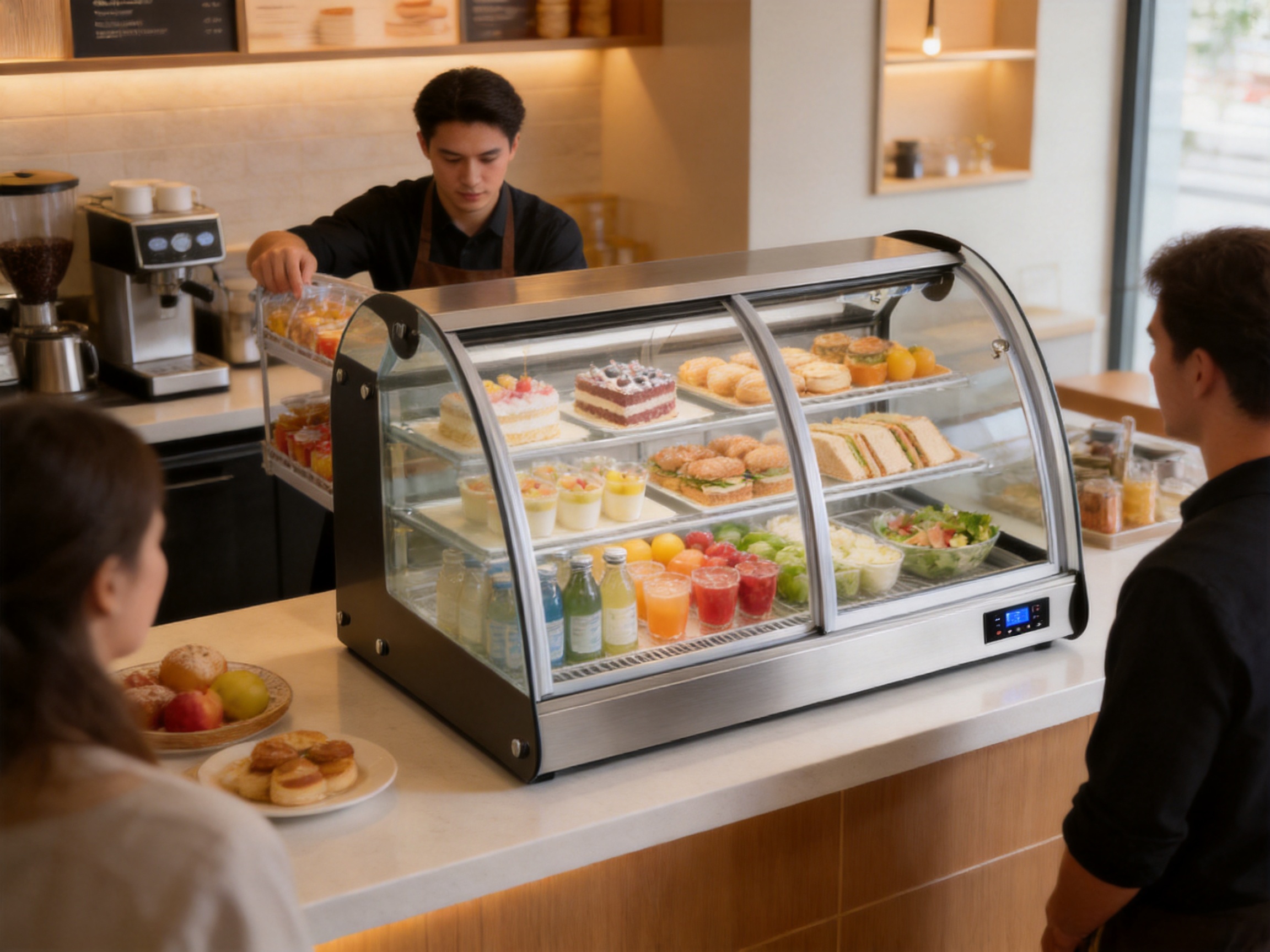
The curved glass helps create a premium presentation. Clean trays, consistent product spacing, appropriate labels, and organized sections can make the display look more attractive. The display light can draw attention to decorated cakes and colorful desserts, while the front sliding doors allow staff to serve products without moving the cabinet.
For bakeries with limited space, the 118-liter model can provide a focused cake or dessert display. A medium-sized café may prefer the 138-liter model for a combination of desserts and ready-to-eat foods. Larger bakeries, hotel pastry departments, and high-volume retail counters may benefit from the 248-liter model’s long display area.
Use in Cafés, Restaurants, and Hospitality
Cafés often need to display products that are prepared in advance and sold throughout the day. Sandwiches, salads, yogurt, chilled desserts, fruit cups, bottled drinks, and other ready-to-eat items can be arranged in a countertop display near the ordering area.
Visibility can reduce the time customers need to decide. Instead of reading a long menu or asking staff about every option, customers can see the available products directly. This can support faster service during busy periods and encourage additional purchases alongside coffee, tea, or other beverages.
Restaurants can use the cabinet for dessert presentation, cold starters, specialty foods, or prepared take-away items. In hotel environments, the cabinet may be placed in a lobby café, breakfast service area, executive lounge, or banquet preparation space. The front and rear access arrangement can be particularly helpful where the counter separates employees from guests.
The cabinet should be positioned away from direct heat sources such as ovens, hot cooking lines, radiators, and strong sunlight. Adequate space around the refrigeration system is also important. Correct placement supports efficient operation and helps protect the cabinet from unnecessary thermal stress.
Use in Convenience Stores and Supermarkets
Convenience stores and supermarkets can use countertop refrigeration to create focused chilled merchandising zones. The cabinet may be placed near checkout points, service counters, bakery sections, prepared-food stations, or promotional areas.
The product family offers three widths that can support different store layouts. The 118-liter model can serve as a compact promotional or specialty display. The 138-liter model can provide a wider selection in a moderate footprint. The 248-liter model can create a long, highly visible display for stores with greater sales volume.
Because customers can see the merchandise without opening the doors, the cabinet can help staff maintain product organization. Staff can identify empty areas and replenish items at scheduled intervals. The glass also makes promotional arrangements visible from a distance, although product rotation and display discipline remain essential for good results.
For retail use, operators should consider product security, customer access, cleaning frequency, labeling, and stock rotation. Foods with short shelf lives should be managed according to a documented first-in, first-out system. The display cabinet supports refrigeration and presentation, but it does not replace safe handling procedures.
Refrigerant and Environmental Considerations
The models use R290 refrigerant. R290 is propane refrigerant and is widely used in certain commercial refrigeration applications because of its low global warming potential compared with many traditional refrigerants. Its use reflects the broader industry movement toward refrigerant solutions with reduced environmental impact.
R290 systems must be handled in accordance with applicable safety standards because the refrigerant is flammable. Installation, servicing, refrigerant recovery, and repair should be performed by qualified technicians using appropriate procedures and equipment. Operators should not modify the refrigeration circuit or attempt unauthorized repairs.
Environmental performance depends on more than refrigerant selection. Proper installation, regular cleaning, correct loading, suitable ambient conditions, door management, and timely maintenance all influence energy use and equipment life. A clean condenser and unobstructed airflow can help the refrigeration system operate more effectively.
The listed input power for each model is 150 watts. Actual energy consumption will vary according to ambient temperature, operating hours, product loading, door openings, control settings, and maintenance conditions. Buyers should evaluate the equipment within the complete operating environment rather than treating input power as a direct statement of annual energy consumption.
Climate Type and Commercial Operating Conditions
Each model is listed with climate type 6. Climate classifications are used to indicate the ambient conditions under which refrigeration equipment is designed to operate. A higher climate rating generally suggests that the cabinet has been developed for demanding commercial environments, although users should always confirm the applicable test standard and installation requirements for their market.
Commercial food-service areas can become warm, especially during summer, peak production, or high customer traffic. Ovens, cooking equipment, sunlight, and crowded layouts may raise the surrounding temperature. Positioning the cabinet in a reasonably cool, ventilated location helps maintain performance and reduces unnecessary load on the refrigeration system.
Operators should avoid placing the cabinet directly beside equipment that produces heat or moisture. The cabinet should be level, stable, and accessible for cleaning. Adjustable feet assist with leveling and can help compensate for minor irregularities in the installation surface.
Manufacturing Capabilities and Quality Strengths
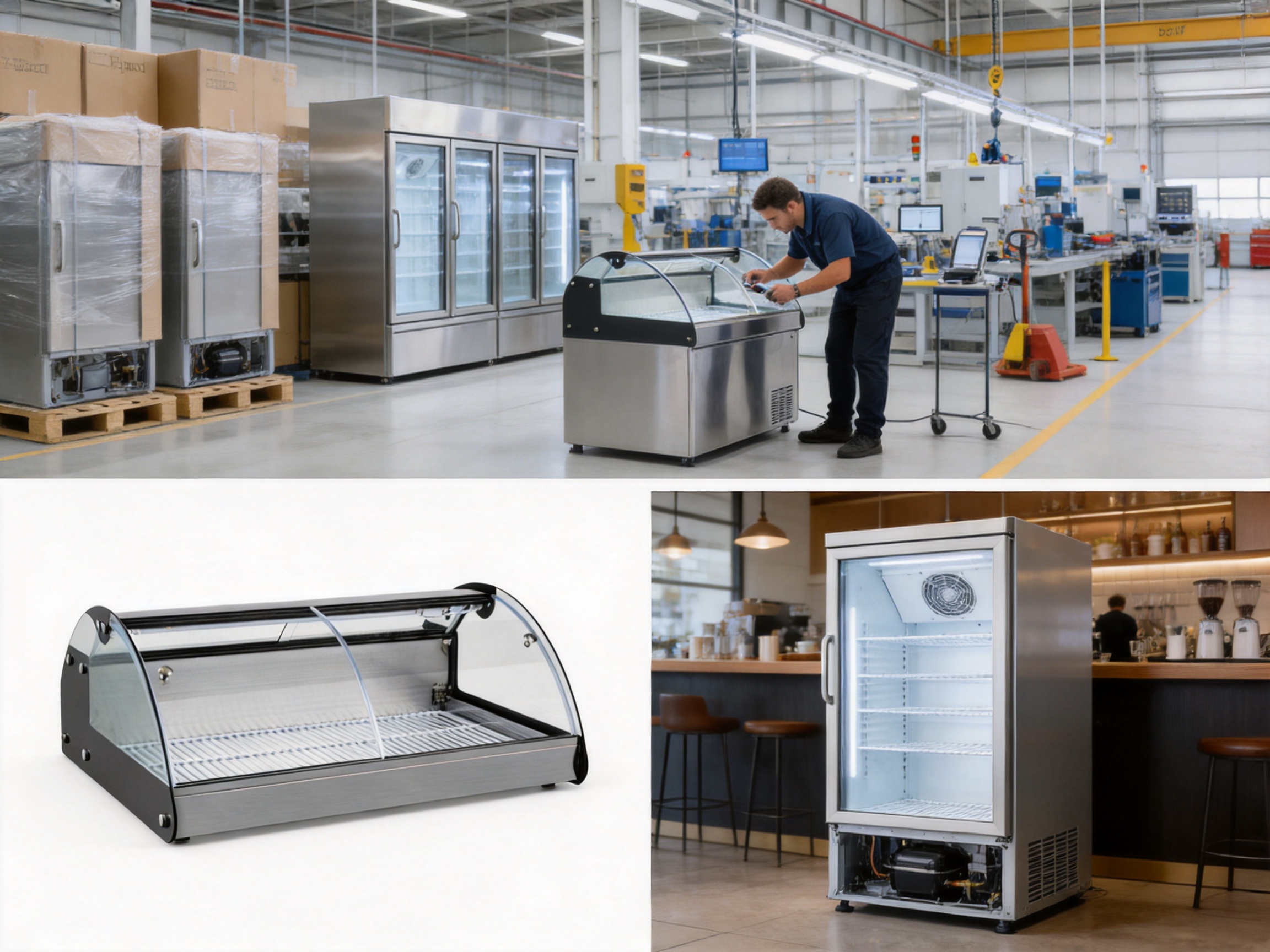
Ningbo XiangChi Electrical Co., Ltd. was established in 2007 and has developed experience in vertical display cabinets, cake cabinets, warming cabinets, and related commercial equipment. The company operates a modern management garden factory covering approximately 40,000 square meters. This industrial base provides room for organized production, assembly, testing, warehousing, and product development activities.
A dedicated manufacturing facility is important for commercial refrigeration because product quality depends on the coordination of multiple processes. Cabinet forming, glass installation, refrigeration assembly, electrical wiring, insulation, finishing, inspection, and packaging must work together. A structured factory environment can help standardize these steps and improve consistency between production batches.
The company maintains a professional research and development team and advanced testing facilities. These resources support the development of new products and the improvement of existing models. For a display refrigerator, product development may involve the cooling system, temperature control, cabinet structure, glass configuration, lighting, door movement, energy performance, and production efficiency.
Testing facilities are particularly valuable in commercial refrigeration. A cabinet must be evaluated as a complete system rather than as a collection of separate parts. Temperature stability, electrical performance, refrigeration operation, door fit, lighting, noise, packaging integrity, and general safety all influence the product’s performance after delivery.
The company states that it has obtained CE, GS, CCC, CB, RoHS, ETL, and other major certifications. Certification requirements vary by market and product configuration, so buyers should confirm which certifications apply to the exact model and destination country. Nevertheless, experience with international certification systems can support export-oriented manufacturing and help the factory address different regulatory expectations.
The company’s stated approach emphasizes innovation, quality, and service. These priorities are relevant to commercial buyers because refrigeration equipment is part of an ongoing business operation. A supplier must be able to provide not only a cabinet, but also technical information, production coordination, documentation, packaging, and after-sales communication.
Production Process Considerations
The first stage of a commercial display refrigerator production process typically involves material preparation and cabinet component fabrication. Accurate dimensions are important because the glass, doors, shelves, insulation, refrigeration components, and outer cabinet must fit together correctly. Consistent fabrication helps support smooth assembly and reliable door operation.
Insulation and cabinet construction are central to temperature retention. The refrigerated space must be separated from the warmer external environment, while the structure must remain sufficiently rigid to support glass panels and sliding doors. Proper assembly of these components contributes to the cabinet’s ability to maintain a stable display environment.
Refrigeration assembly requires careful integration of the compressor, condenser, evaporator, tubing, controls, wiring, and refrigerant circuit. Since the models use R290, qualified manufacturing and service procedures are especially important. Correct component selection and circuit testing help reduce the risk of leakage and support reliable operation.
Glass installation is another important stage. The front curved glass must be positioned securely and aligned with the cabinet structure. Sliding doors should move smoothly and close properly. Good alignment helps protect the display area, supports convenient staff access, and contributes to the professional appearance expected in customer-facing equipment.
Electrical assembly includes the digital temperature controller, display, power controls, lighting controls, and internal connections. Wiring should be organized and protected, while controls should be tested before the finished cabinet is packaged. Lighting performance is also relevant because the display must illuminate products without creating excessive heat inside the refrigerated space.
Final inspection may include visual checks, operational testing, temperature verification, electrical testing, door movement checks, and packaging inspection. The exact testing procedure depends on the factory’s quality system and the requirements of the destination market. A comprehensive inspection process helps identify assembly issues before shipment.
Packaging, Shipping, and Export Readiness
Commercial refrigeration equipment must be packaged carefully because glass, doors, controls, and cabinet surfaces can be vulnerable during transport. The listed package dimensions are larger than the finished product dimensions, reflecting the need for protective materials and shipping clearance.
The XCW-118L has a listed package size of approximately 800 × 950 × 590 millimeters, while the XCW-138L is listed at approximately 1100 × 950 × 590 millimeters. The XCW-248L has a listed package size of approximately 1900 × 950 × 590 millimeters. These measurements should be considered when planning warehouse receiving, container unloading, doorway access, and installation routes.
Loading quantities are also provided for 20-foot general-purpose containers and 40-foot high-cube containers. The XCW-118L is listed at 56 pieces for a 20GP container and 140 pieces for a 40HQ container. The XCW-138L is listed at 48 and 120 pieces respectively, while the XCW-248L is listed at 18 and 48 pieces.
| Model | 20GP loading quantity | 40HQ loading quantity | Commercial logistics consideration |
|---|---|---|---|
| XCW-118L | 56 pieces | 140 pieces | Efficient for compact outlets and multi-location orders |
| XCW-138L | 48 pieces | 120 pieces | Suitable for medium-width display programs |
| XCW-248L | 18 pieces | 48 pieces | Designed for larger display requirements and higher capacity |
Actual loading arrangements may depend on packaging design, shipping regulations, container dimensions, palletization, and the buyer’s logistics plan. Importers should confirm final carton dimensions, gross weights, stacking instructions, and loading plans with the supplier before placing a production order.
Installation and Daily Operating Practices
Installation Planning
Before installation, the operator should confirm that the counter is level, stable, and strong enough to support the selected model. The cabinet should not be positioned where it can be struck by carts, exposed to continuous water spray, or placed in direct sunlight.
Clearance around the refrigeration system should be maintained according to the supplier’s installation instructions. Restricted airflow can increase operating stress and reduce cooling efficiency. The electrical supply should match the product’s rating and the requirements of the destination market. A suitable protective electrical device may be required by local regulations.
The adjustable feet should be set so that the cabinet sits securely and the sliding doors operate correctly. A level cabinet can help prevent door movement problems and reduce unnecessary stress on the frame.
Product Loading
Products should be loaded in a way that allows cold air and cooling surfaces to function properly. Operators should avoid overloading the cabinet beyond its practical display capacity or covering temperature sensors and internal cooling areas.
Warm products should not be placed into the cabinet in large quantities because they can raise the internal temperature and increase the refrigeration load. Food should be cooled in accordance with the applicable preparation procedure before being placed on display.
Product arrangement should balance presentation and airflow. Attractive displays should not be so dense that they restrict cooling or make it difficult for staff to inspect dates and labels. Regular product rotation helps maintain freshness and keeps the display visually appealing.
Cleaning and Maintenance
Glass surfaces should be cleaned regularly with suitable materials that do not scratch or damage the panels. Sliding door tracks should be kept free from crumbs, packaging fragments, and other debris that could interfere with movement.
Internal surfaces, shelves, trays, and contact areas should be cleaned according to the type of food displayed and the business’s sanitation schedule. Spills should be addressed quickly to prevent odors, staining, and hygiene concerns.
The refrigeration system should be inspected and serviced by qualified personnel. Condenser areas must remain clean and unobstructed. Electrical components, refrigerant circuits, and temperature controls should not be modified by untrained staff.
Preventive maintenance can help extend equipment life. A practical maintenance plan may include daily visual checks, regular glass and interior cleaning, scheduled condenser cleaning, inspection of door movement, verification of temperature readings, and professional service at appropriate intervals.
Advantages for Commercial Buyers
Three Sizes from One Product Platform
One important advantage of the XCW series is the availability of three capacities within a common product family. Businesses can select the size that best matches each location while maintaining a consistent appearance and operating concept.
A chain café, bakery group, or supermarket operator may use the 118-liter model in small branches, the 138-liter model in medium-sized locations, and the 248-liter model in flagship stores or high-volume sites. Common operating features can reduce the learning curve when staff move between locations.
Efficient Use of Counter Space
The countertop format helps businesses use existing service furniture more effectively. Instead of dedicating valuable floor space to a separate upright cabinet, an operator can integrate chilled display into the counter layout.
This can be particularly valuable in urban stores, kiosks, hotel lounges, small cafés, and compact bakeries. Space efficiency does not mean that installation requirements can be ignored, but it does provide more flexibility in planning the customer area.
Improved Product Visibility
The front curved glass and internal lighting support a clear presentation. Product visibility can help customers make decisions faster and may encourage impulse purchases. It also allows businesses to use the cabinet as a promotional tool for seasonal products, new recipes, premium desserts, and high-margin items.
Practical Two-Sided Access
Front and rear sliding doors support efficient replenishment and service. This is a useful advantage over cabinets that can only be accessed from the customer-facing side. Staff can load products from the preparation area and serve or present products from the front without moving the unit.
Commercial Temperature Range
The listed 2–8°C operating range is appropriate for many chilled food display applications. A consistent temperature target, digital monitoring, and enclosed glass construction create a practical platform for businesses that need both refrigeration and merchandising.
R290 Refrigerant
The use of R290 aligns the product with current interest in lower-global-warming-potential refrigerants. Buyers should still ensure that installation and servicing are performed according to applicable safety requirements, but the refrigerant choice can be an important consideration in a modern commercial refrigeration purchasing program.
How the Manufacturer Supports Product Value
Product value is influenced by more than the visible cabinet. The manufacturer’s experience, factory infrastructure, engineering resources, testing capabilities, certification experience, and ability to support export markets all affect the purchasing decision.
Ningbo XiangChi Electrical Co., Ltd. has operated since 2007 and focuses on commercial display and warming equipment. This specialization is relevant because manufacturers that work regularly with display cabinets are familiar with the combined demands of refrigeration, glass presentation, lighting, door systems, and commercial finishing.
The company’s approximately 40,000-square-meter facility provides a substantial base for production and management. A facility of this scale can support dedicated areas for raw materials, assembly, quality control, testing, finished goods, and shipping. It may also help the manufacturer coordinate larger orders and different model configurations.
The stated R&D team and advanced testing facilities are additional strengths. Commercial customers often require product adaptations, market-specific documentation, packaging adjustments, or technical discussions before ordering. A manufacturer with internal development resources is generally better positioned to evaluate those requirements than a trading company with no direct engineering or production capability.
International certifications including CE, GS, CCC, CB, RoHS, and ETL demonstrate experience with multiple compliance environments. Certification alone does not guarantee that every installation will be suitable, and buyers should always request current documents for the exact product. However, certification capability is a useful indicator for importers who serve regulated markets.
The company’s focus on innovation, quality, and service also supports long-term cooperation. For distributors and wholesalers, dependable communication, production scheduling, spare-parts coordination, packaging consistency, and technical support can be as important as the initial product specification.
Purchasing Considerations for Distributors and Project Buyers
Distributors should identify the customer segments most likely to purchase each size. The XCW-118L may be attractive to small cafés, kiosks, and specialty stores. The XCW-138L may fit medium-sized food-service outlets and retail counters. The XCW-248L may appeal to larger bakeries, supermarkets, hotels, and commercial display projects.
Buyers should confirm the electrical voltage, frequency, plug type, labeling, certification, and documentation required for the destination market. They should also confirm whether the listed dimensions include external handles, feet, door tracks, or other projections.
It is advisable to request detailed information about shelves, internal layout, lighting type, glass specifications, controller operation, defrost method, ambient temperature conditions, warranty terms, spare parts, and service procedures. These details can affect the suitability of the cabinet for a specific application.
Importers should also evaluate total landed cost rather than purchase price alone. Freight, insurance, customs duties, warehouse handling, installation, local certification, technical service, and replacement parts may all affect the final cost of ownership.
For large projects, buyers may consider ordering samples or conducting a site evaluation before committing to a full rollout. A sample installation can verify counter compatibility, customer visibility, door access, cleaning practicality, temperature performance, and staff acceptance.
Q&A
What products can be displayed in these refrigerators?
The cabinets are suitable for many chilled products, including cakes, desserts, sandwiches, salads, dairy items, fruit cups, prepared foods, packaged snacks, and beverages. The operator must confirm that each product’s required storage temperature falls within the cabinet’s intended 2–8°C range.
What is the difference between the three models?
The main differences are gross capacity, width, weight, packaging size, and loading quantity. The XCW-118L provides 118 liters, the XCW-138L provides 138 liters, and the XCW-248L provides 248 liters. All three models share the listed 2–8°C temperature range, 150-watt input power, R290 refrigerant, and climate type 6.
Which model is best for a small café?
The XCW-118L is generally the most space-conscious choice for a small café, kiosk, or compact bakery. The XCW-138L may be preferable if the business needs a wider product selection while retaining a similar cabinet height and depth.
Which model offers the largest display area?
The XCW-248L is the largest model in the product family. Its approximate 1800-millimeter width provides the longest display area and the greatest listed gross capacity.
Does the cabinet have glass on the front and access from both sides?
The listed standard features include front curved glass and front and rear sliding doors. This arrangement allows products to be viewed from the customer side while staff can access the cabinet from the opposite side for replenishment and organization.
What is direct cooling?
Direct cooling is a refrigeration method in which cooling is transferred directly through refrigerated surfaces and the cabinet structure rather than relying primarily on forced air circulation. It can be suitable for chilled display applications, provided that products are loaded correctly and internal cooling areas are not obstructed.
Why is R290 used?
R290 is used in many modern refrigeration products because it has a low global warming potential compared with several traditional refrigerants. It is flammable, however, so servicing and installation must be performed by qualified technicians using procedures appropriate for hydrocarbon refrigerants.
Can the cabinet be placed anywhere on a counter?
The cabinet should be installed on a stable, level counter that can support its weight. It should be kept away from direct sunlight, ovens, hot equipment, excessive moisture, and locations that restrict ventilation. Buyers should follow the supplier’s installation instructions and local electrical requirements.
Is the temperature controller digital?
Yes. The standard features include a digital temperature controller and display. This allows staff to monitor and adjust the operating setting more conveniently than with a simple mechanical dial.
Does the cabinet include lighting?
The standard features include a separate light button, indicating that the display lighting can be controlled independently from the main power function. The exact lighting specification should be confirmed for the purchase order.
How should the cabinet be maintained?
Operators should clean the glass, interior, shelves, trays, and sliding door tracks regularly. The condenser and ventilation areas should be kept clean and unobstructed. Refrigerant, electrical, and refrigeration-system service should be performed by qualified personnel.
What certifications are associated with the manufacturer?
The manufacturer states that it has obtained CE, GS, CCC, CB, RoHS, ETL, and other major certifications. Buyers should request current certification documents for the exact model and destination market before importation or installation.
Can the models be used in a chain-store project?
Yes. The three-model family can support different store sizes while maintaining a common product concept. A chain may use the smaller model in compact branches and the larger models in locations with greater display requirements. Project buyers should confirm supply capacity, packaging, documentation, warranty, and service arrangements.
Conclusion
The Direct Cooling Countertop Display Refrigerators XCW-118L, XCW-138L, and XCW-248L combine chilled storage with customer-facing merchandising. Their 2–8°C operating range, direct cooling system, digital temperature controller, curved front glass, two-sided sliding doors, separate lighting control, adjustable feet, and R290 refrigerant make them suitable for a broad range of commercial applications.
The three capacities allow businesses to select a cabinet according to available counter space and expected product volume. The 118-liter model supports compact operations, the 138-liter model provides a wider medium-capacity display, and the 248-liter model offers a long presentation area for higher-volume outlets.
The products also benefit from the manufacturing resources of Ningbo XiangChi Electrical Co., Ltd., including experience since 2007, a reported 40,000-square-meter factory, professional R&D capabilities, testing facilities, and experience with international certifications. These strengths support the company’s ability to produce commercial refrigeration equipment for distributors, retailers, food-service businesses, and international project customers.
For the best results, buyers should select the model according to display needs, verify technical and regulatory requirements, plan installation carefully, and establish appropriate cleaning and maintenance procedures. When integrated into a well-managed food-service or retail operation, the XCW series can function not only as refrigeration equipment, but also as an effective product presentation and sales-support tool.
References
1. Product specification materials for Direct Cooling Countertop Display Refrigerators XCW-118L, XCW-138L, and XCW-248L.
2. Manufacturer information supplied by Ningbo XiangChi Electrical Co., Ltd.
3. General commercial refrigeration installation, operation, and maintenance practices.
4. General guidance concerning R290 hydrocarbon refrigerant applications and technician safety.
5. General food-service principles for chilled food storage, product rotation, sanitation, and display management.
Product: Direct Cooling Countertop Display Refrigerators XCW-118L/138L/248L

You May Also Like
.jpg?imageView2/2/w/500/h/500/format/jp2/q/100 "Four Sides Glasses Display Cooler")
.jpg?imageView2/2/w/500/h/500/format/jp2/q/100 "White 4-Sided Glass Refrigerated Display Case")
.jpg?imageView2/2/w/500/h/500/format/jp2/q/100 "Refrigerated Display Cake Countertop Four Sides Glasses Display Cooler")
.jpg?imageView2/2/w/500/h/500/format/jp2/q/100 "Four Sides Glasses Display Cooler")

-
- Navigation
- Home
- About Us
- Products
- News
- Contact Us
 East Zone, Guanhaiwei Industrial Park, Cixi City, Ningbo, Zhejiang, China
 +86-574-63668678
 +86-574-63668108
Copyright © Ningbo XiangChi Electrical Co.,Ltd All Rights Reserved.
