
 简体中文
简体中文 English
 Español
News
XC-218L Four-Sided Glass Display Cooler: A Practical Guide to High-Visibility Beverage Merchandising
In modern retail, refrigeration is no longer limited to keeping products cold. A commercial display cooler must also present merchandise attractively, protect product quality, use space efficiently, support daily staff operations, and contribute to a consistent customer experience. The XC-218L four-sided glass display cooler is designed around these combined requirements. With a 218-liter capacity, a temperature range of 2 to 10°C, ventilated cooling, automatic defrost, internal LED illumination, adjustable shelves, and glass visibility on all four sides, it provides a balanced solution for beverages and other chilled products.
The unit is suitable for convenience stores, supermarkets, cafés, restaurants, hotels, bakeries, reception areas, food-service counters, specialty beverage shops, and other commercial environments where products need to remain visible and ready for selection. Its vertical format provides a useful display area while occupying a relatively limited floor footprint. The four-sided double-glass construction helps create a clear product presentation from different directions, making the cooler especially useful when customers approach merchandise from more than one side.
This article examines the product’s design, operating advantages, merchandising capabilities, technical specifications, maintenance requirements, purchasing considerations, and the manufacturing strengths behind it. It also explains how the XC-218L compares with common alternatives, including solid-door refrigerators, single-view display cabinets, open-front coolers, and basic glass chillers.
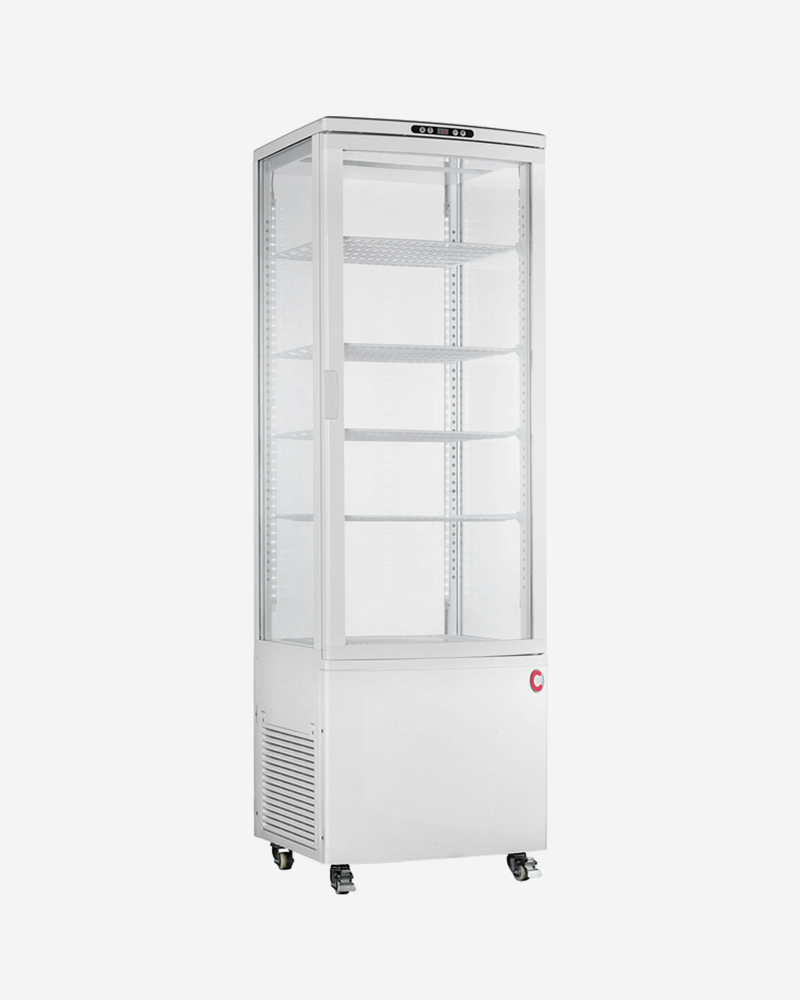
Countertop Four Sides Glass Beer Display Cooler Beverage Chiller Refridge
1. Product Overview
The XC-218L is a vertical four-sided glass display cooler developed for commercial beverage merchandising. Its stated capacity is 218 liters, with a product size of 515 × 485 × 1615 millimeters. This combination gives the cabinet a narrow and tall profile, allowing operators to create a prominent product display without requiring the floor area of a wide horizontal refrigerator.
The cabinet operates within a temperature range of 2 to 10°C. This range is appropriate for many chilled beverages, including bottled water, carbonated drinks, juices, energy drinks, dairy beverages, packaged refreshments, and selected ready-to-eat items that are compatible with refrigerated display conditions. Actual storage suitability should always be confirmed against the product manufacturer’s requirements and applicable food-safety procedures.
A 340-watt input power rating supports the refrigeration system, lighting, control system, and related operating components. The refrigerant specification is listed as R134a/R290, allowing configuration according to the intended market, production arrangement, and applicable regulatory requirements. The climate classification is listed as 4, indicating that the cabinet is designed for demanding commercial ambient conditions within the appropriate operating limits.
The standard design includes a curved front glass panel, double glass on four sides, an internal top LED light, a digital thermostat and display, PVC-coated adjustable shelves, ventilated cooling, automatic defrost, and four castors, two of which have brakes. These features combine product visibility, temperature management, mobility, and practical daily use.
1.1 Core Technical Specifications
| Item | Specification |
|---|---|
| Model | XC-218L |
| Product category | Four-sided glass display cooler |
| Capacity | 218 liters |
| Temperature range | 2 to 10°C |
| Input power | 340 watts |
| Refrigerant | R134a or R290, depending on configuration |
| Climate type | 4 |
| Net weight | 77 kilograms |
| Gross weight | 81 kilograms |
| Product dimensions | 515 × 485 × 1615 millimeters |
| Package dimensions | 590 × 550 × 1660 millimeters |
| 20-foot GP loading quantity | 36 units |
| 40-foot HQ loading quantity | 80 units |
The dimensions and loading information are particularly relevant for wholesalers, importers, chain-store buyers, and project contractors. The packaging dimensions provide a basis for warehouse planning and transport calculations, while the container quantities help buyers estimate shipping efficiency during procurement.
2. Why Four-Sided Glass Matters in Commercial Merchandising
Traditional refrigerators often make products visible only from the front. That arrangement can work well against a wall, but it becomes less effective when the cabinet is positioned in the middle of a sales area, beside a checkout zone, or within an open plan hospitality environment. The four-sided glass concept allows merchandise to be seen from multiple directions and gives operators more flexibility when arranging the store.
The XC-218L uses double glass on four sides. Double-glass construction can help improve insulation compared with a single-pane design, while also supporting a cleaner, more stable appearance. The transparent enclosure creates a visual connection between the product and the customer. Shoppers can inspect the available selection before opening the door, which may reduce unnecessary door opening and help the sales area remain orderly.
The curved front glass adds a distinct display effect. A curved surface can soften the visual appearance of a tall cabinet and reduce the hard, box-like impression associated with some commercial refrigerators. It can also provide a broader visual angle for products placed near the front of the shelves. In locations where presentation influences impulse purchases, this can be a valuable merchandising advantage.
2.1 Visibility from Different Approaches
Retail customers do not always approach a refrigerator from a predictable direction. In a convenience store, traffic may flow from the entrance toward the checkout. In a café or hotel, guests may move around a central service area. In a restaurant, staff and customers may view the cabinet from opposite sides. A four-sided display cooler can respond to these traffic patterns more effectively than a cabinet intended for one-direction viewing.
Visibility from multiple sides is also useful for promotional layouts. Operators can group bottled drinks, cans, specialty beverages, or seasonal products so that the display remains recognizable from several angles. This reduces the need to place the cabinet directly against a wall and can support more flexible interior design.
2.2 Display Visibility and Buying Behavior
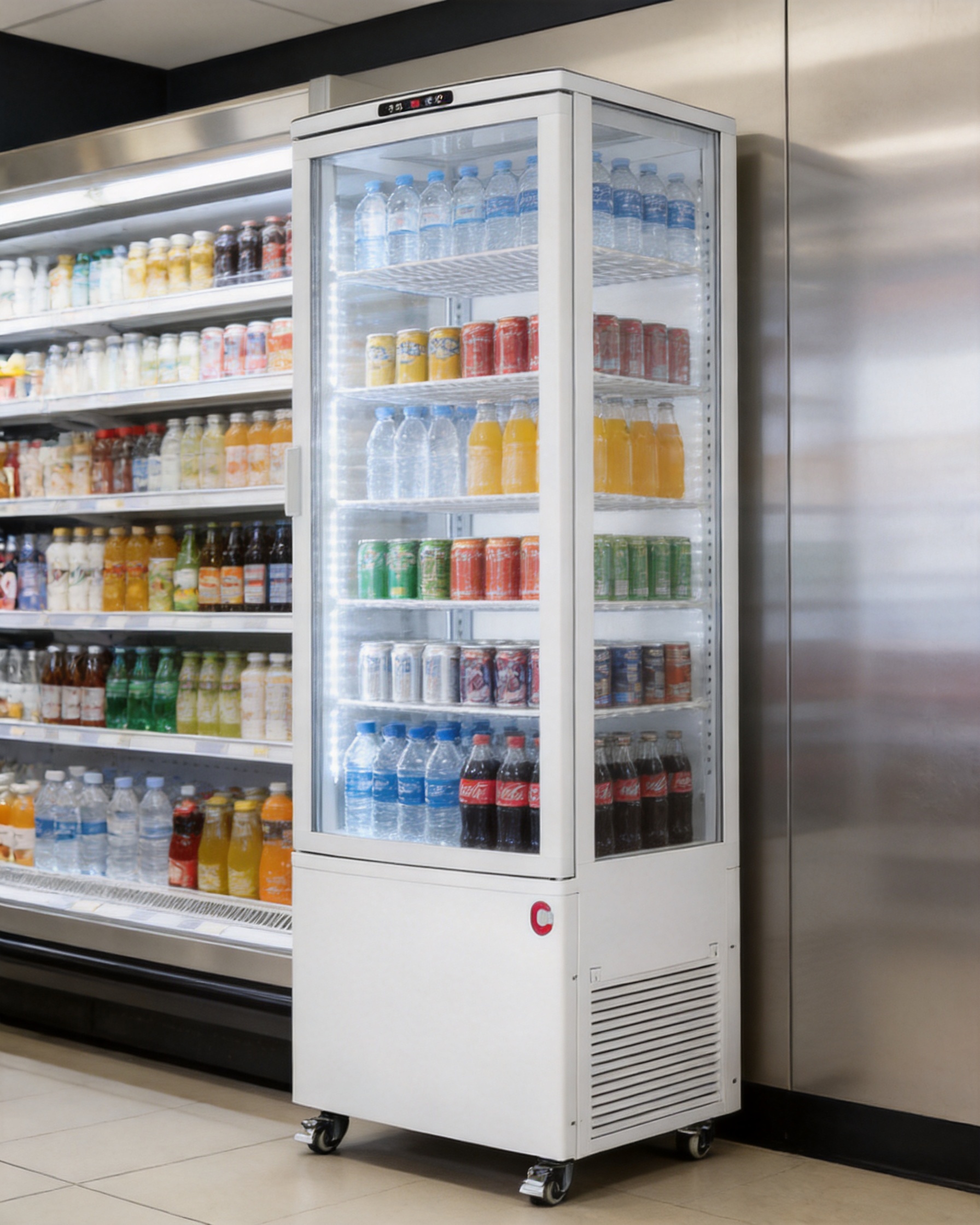
Clear product presentation helps customers make faster decisions. When labels, colors, sizes, and product categories are easy to see, shoppers can compare options without repeatedly opening the door. An illuminated cabinet can also attract attention in areas with moderate ambient lighting. The internal top LED light is positioned to support overall product visibility while maintaining a clean and professional appearance.
Good merchandising is not only about brightness. It also requires organized shelves, consistent facing, and enough spacing for customers to identify products. The adjustable shelf system allows operators to adapt the internal layout according to product height and package type. This is important because a beverage display may contain small cans, medium bottles, large bottles, cartons, or mixed promotional packs at different times of the year.
3. Refrigeration Performance and Temperature Control
The XC-218L has a temperature range of 2 to 10°C, providing flexibility for a wide selection of chilled commercial products. The digital thermostat and display allow operators to monitor the set temperature and make adjustments according to the operating requirements of the merchandise. Digital controls are generally easier to read and manage than mechanical dial controls, particularly in busy retail environments where staff need quick confirmation.
The ventilated cooling system distributes refrigerated air through the cabinet rather than relying only on natural convection. This is useful in a vertical display cabinet because different shelf levels need consistent exposure to cooled air. Proper air circulation can help reduce temperature variation between the upper and lower portions of the cabinet, provided that shelves are not overloaded and air passages remain unobstructed.
3.1 Benefits of Ventilated Cooling
Ventilated cooling supports faster recovery after the door is opened. In a commercial environment, the door may be opened frequently throughout the day. Each opening allows warm ambient air to enter. A circulating cooling system helps the cabinet return toward the target temperature after these interruptions.
Ventilation also supports product consistency when the cabinet is loaded with multiple beverage types. Cans and bottles can be arranged across several shelves, while air movement helps maintain a more uniform refrigerated environment. Operators should still follow loading instructions, avoid blocking the air outlet, and maintain suitable clearance around the cabinet.
3.2 Automatic Defrost
Ice accumulation can reduce cooling efficiency and occupy valuable internal space. The automatic defrost function helps manage frost formation during normal operation. Instead of requiring staff to stop the cabinet and perform frequent manual defrosting, the system carries out the process according to its control logic.
Automatic defrost improves daily convenience, but it does not eliminate the need for cleaning and inspection. Staff should check that drain passages remain clear, wipe away spills, and confirm that the door closes correctly. If unusual frost, water accumulation, or temperature instability appears, the cabinet should be inspected by qualified service personnel.
3.3 Temperature Management in Commercial Use
Temperature performance depends on more than the refrigeration system alone. Ambient temperature, humidity, door-opening frequency, product loading, ventilation clearance, and condenser cleanliness all influence results. The climate type 4 designation indicates that the unit is intended for a commercial environment with a defined ambient condition, but it should not be placed next to ovens, boilers, direct sunlight, or other strong heat sources.
Products should be pre-chilled when possible. Loading a large quantity of warm beverages into a display cooler can increase pull-down time and temporarily raise the internal temperature. A better practice is to rotate stock, load products in manageable quantities, and avoid covering the internal circulation path.
4. Shelf Flexibility and Product Organization
The standard PVC-coated shelves are adjustable, making the cabinet adaptable to different product assortments. Shelf adjustment is an important feature because beverage packaging is not standardized. One operator may primarily display slim cans, while another may need space for tall bottles or larger containers.
PVC coating offers a practical surface for commercial use. It helps provide a finished appearance, supports routine cleaning, and protects the metal shelf structure during normal handling. The shelves can be positioned to create a logical hierarchy, such as frequently purchased products at eye level, larger bottles on lower shelves, and promotional items in a high-visibility zone.
4.1 Merchandising Configurations
A beverage retailer can organize the cabinet by brand, beverage type, package size, flavor, price level, or consumption occasion. For example, bottled water can be grouped on the lower shelves, carbonated drinks can occupy the middle shelves, and premium or functional beverages can be placed at eye level. Restaurants may use the shelves for bottled drinks, packaged desserts, or chilled ingredients that are suitable for display and service.
Mixed loading should be planned carefully. Heavy products should be placed on lower shelves to improve stability and reduce handling risk. Products should face forward, labels should remain visible, and enough space should be left between merchandise and the internal air outlets. Overloading can restrict air circulation and make the display look crowded.
4.2 Optional Shelf and Lighting Configurations
The listed options include chromed shelves, tempered glasses, and either two or four strip LED light bars. These options allow buyers to adapt the cabinet to a particular market position. Chromed shelves can provide a more decorative appearance for premium beverage displays. Tempered glass options may be selected when a buyer requires a particular safety or durability specification.
Additional LED light bars can create more even illumination across several shelf levels. Two strip lights may be sufficient for a simple arrangement, while four strips may be preferred for a denser or more presentation-focused display. The appropriate choice depends on the product mix, store lighting, desired visual effect, and purchasing specification.
5. Mobility, Placement, and Space Efficiency
The XC-218L is fitted with four castors, including two castors with brakes. Mobility is useful during store installation, cleaning, layout changes, and seasonal merchandising. Staff can reposition the cabinet when preparing a promotional campaign or reorganizing a service area, subject to safe handling procedures.
The two braking castors help stabilize the unit once it reaches its intended location. After positioning the cabinet, operators should engage the brakes and confirm that the cabinet is stable. The cooler should be installed on a level surface, with sufficient clearance for ventilation, maintenance access, door movement, and cleaning.
With a width of 515 millimeters and a depth of 485 millimeters, the cabinet is suited to locations where a full-size upright refrigerator would occupy too much space. Its height of 1615 millimeters provides a substantial vertical display area. This footprint can be especially useful in compact convenience stores, cafés, hotel lobbies, bakery sales areas, and commercial counters with limited floor space.
5.1 A More Flexible Alternative to Wide Refrigerators
Wide horizontal display coolers can offer high capacity, but they require more linear floor space and may interrupt customer circulation. A tall cabinet can use vertical space more effectively while preserving walkways. It also gives customers a clear line of sight to several shelf levels.
Compared with a basic under-counter refrigerator, the XC-218L offers a much stronger visual merchandising function. An under-counter unit may be practical for back-of-house storage, but it does not actively present products to customers. The four-sided glass cabinet is designed for front-of-house selling and product communication.
6. Comparison with Common Display Cooler Alternatives
Buyers often compare commercial refrigeration equipment based on price, capacity, appearance, energy use, serviceability, and product visibility. No single cabinet is ideal for every application, but the XC-218L has several distinct advantages within the four-sided display cooler category.
| Alternative | Typical limitation | XC-218L advantage |
|---|---|---|
| Solid-door refrigerator | Products are hidden until the door is opened | Four-sided glass provides continuous product visibility |
| Single-front glass cabinet | Best suited to wall placement and one-direction viewing | Four-sided visibility supports central or multi-directional placement |
| Open-front cooler | Greater exposure to ambient air and possible temperature loss | Enclosed glass construction supports a more controlled refrigerated space |
| Basic glass chiller | May have fixed shelves, limited lighting, or basic controls | Adjustable shelves, LED lighting, digital control, and automatic defrost are standard |
| Large horizontal merchandiser | Requires greater floor width | Tall, narrow format uses vertical display space |
| Back-of-house refrigerator | Designed primarily for storage rather than selling | Curved glass and internal lighting emphasize customer-facing presentation |
6.1 Compared with Solid-Door Refrigerators
Solid-door refrigerators are often selected for storage efficiency and insulation. However, they require customers or staff to open the door to see the contents. The XC-218L is more appropriate where product visibility and impulse purchasing are priorities. Customers can inspect the available assortment immediately, while staff can identify low-stock shelves without opening the cabinet.
6.2 Compared with Open Display Coolers
Open display coolers provide immediate access, which may be useful in high-volume self-service environments. Their open design, however, exposes the refrigerated area to warm ambient air and may increase the challenge of maintaining stable temperatures. The enclosed glass structure of the XC-218L offers a compromise between visibility and controlled refrigeration. Customers can see the products clearly while the refrigerated space remains enclosed.
6.3 Compared with Narrow-View Cabinets
A front-facing glass cabinet can be highly effective when installed against a wall. In a central position, however, its unused sides may make the display less attractive and less productive. The XC-218L is designed to remain visually active from multiple directions, giving operators more freedom to place the unit where customer movement is strongest.
7. Manufacturing Strengths and Production Capability
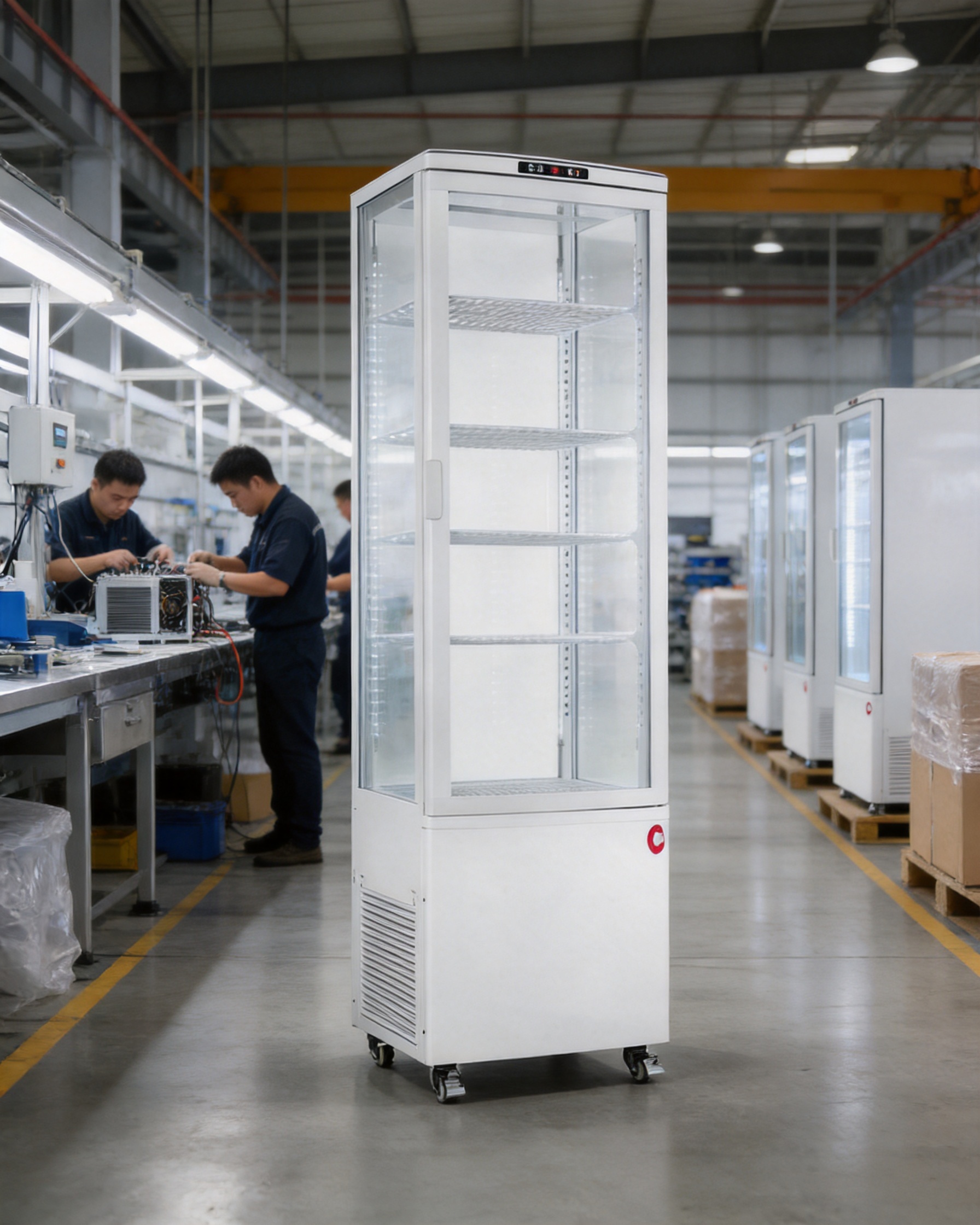
The product is manufactured by Ningbo XiangChi Electrical Co., Ltd., a specialist producer of vertical display cabinets, cake cabinets, warming cabinets, and related commercial refrigeration equipment. The company was established in 2007 and has developed more than a decade of experience in the field. Its stated facility covers approximately 40,000 square meters and includes production, management, research, development, and testing functions.
A dedicated manufacturing base is important for commercial refrigeration because product performance depends on the coordination of many components. Glass, sheet metal, insulation, refrigeration parts, electrical controls, lighting, shelves, castors, and packaging must work together as one finished system. An experienced manufacturer can coordinate these processes more effectively than a trading operation that relies entirely on unrelated external suppliers.
7.1 Research and Development
The company maintains a professional research and development team. In commercial refrigeration, research and development may involve cabinet structure, airflow, temperature uniformity, lighting placement, glass configuration, energy performance, control logic, assembly efficiency, and ease of maintenance.
For a product such as the XC-218L, design decisions influence both refrigeration performance and sales performance. The position of the internal light affects how products are seen. Shelf spacing affects air circulation and usable capacity. Glass construction affects appearance and insulation. Castor placement affects mobility and stability. R&D coordination helps bring these elements into a practical commercial product rather than treating them as isolated features.
7.2 Testing Facilities and Quality Improvement
The company reports having advanced testing facilities. Testing is a central part of commercial refrigeration manufacturing because a cabinet may operate continuously for long periods in demanding environments. Temperature tests, electrical checks, component inspections, glass and door examinations, lighting checks, and operating-cycle evaluations can help identify problems before shipment.
Factory testing also supports consistency between production batches. A buyer purchasing multiple units needs more than a good sample; the buyer needs predictable performance across the order. Standardized assembly processes, documented inspections, and testing procedures help reduce variation and support after-sales service.
7.3 Production Lines and Process Coordination
Advanced production lines provide the capacity to manufacture products in a repeatable manner. Typical commercial refrigeration production may involve sheet-metal forming, cabinet assembly, insulation preparation, glass installation, refrigeration-system assembly, electrical wiring, shelf and accessory fitting, final testing, and packaging.
Process coordination is especially important for four-sided glass cabinets. Glass panels must be installed accurately to maintain appearance and structural integrity. Doors and curved glass components must align correctly. Refrigeration and electrical parts must be protected within the cabinet structure. The final product must also withstand transport from the factory to the customer’s facility.
The stated factory scale and production capability support both standard orders and broader commercial projects. Buyers can discuss model configurations, optional lighting, shelf types, glass requirements, refrigerant preferences, packaging, and shipping quantities with a manufacturer that is familiar with product customization and international supply requirements.
7.4 International Certifications
The company reports obtaining CE, GS, CCC, CB, RoHS, ETL, and other major certifications. Certification requirements vary by country, product configuration, electrical system, refrigerant, and intended market. Buyers should request current certificates and verify that the documentation applies to the exact model and configuration being purchased.
Even when certification is not legally required in a particular market, recognized testing and compliance documentation can support importer reviews, distributor qualification, project tenders, and internal quality-control procedures. It also demonstrates that the manufacturer has experience addressing different regulatory expectations.
8. Materials, Construction, and Daily Usability
Commercial display equipment must balance appearance with durability. The XC-218L combines glass visibility, coated shelves, a digital control system, castors, and a ventilated refrigeration structure. Each feature contributes to the user experience.
8.1 Double Glass Construction
Double glass is valuable in a refrigerated display because it can provide a better thermal barrier than single glass while maintaining transparency. It also creates a more substantial cabinet appearance. Clear glass allows customers to view labels and colors, while the enclosed construction helps separate the refrigerated interior from the surrounding room.
Glass should be cleaned regularly with suitable materials that do not scratch or leave residue. Operators should avoid striking the panels with bottles, shelf supports, or cleaning equipment. If a panel becomes damaged, the cabinet should be taken out of service as appropriate and inspected by qualified personnel.
8.2 Digital Thermostat and Display
A digital thermostat offers clear temperature information and more controlled operation. Staff can review the display during opening checks, product replenishment, and closing procedures. Digital controls also make it easier to establish a standard operating routine across several units in the same store.
Operators should avoid unnecessary temperature adjustments. The set point should be selected according to the products being stored and the operating conditions. Frequent changes may make it more difficult to evaluate performance and can lead to inconsistent product temperatures.
8.3 Internal LED Lighting
LED lighting is well suited to commercial display applications because it provides bright, focused illumination with a clean appearance. The internal top light helps highlight products from the upper area of the cabinet and improves visibility in indoor locations with uneven lighting.
Optional strip LED bars extend the presentation capability. They may be useful when the operator wants more uniform illumination from top to bottom or when the cabinet is used for premium products that benefit from a stronger display effect.
8.4 Castors and Brakes
Castors simplify installation and movement. They are particularly useful during floor cleaning or store remodeling. The braking function helps prevent unintended movement after the cabinet has been placed. Staff should move the unit carefully, avoid pulling it by the door or glass, and ensure that the power cable is protected during relocation.
9. Recommended Commercial Applications
The XC-218L can support a wide range of customer-facing applications. Its suitability depends on the product temperature requirements, local electrical conditions, ambient environment, and available installation space.
9.1 Convenience Stores
Convenience stores require fast product recognition and quick replenishment. Bottled water, soft drinks, juices, sports beverages, energy drinks, and ready-to-drink coffee can be arranged for rapid customer selection. The vertical layout creates a recognizable chilled-drink zone without occupying the space of a wide merchandiser.
9.2 Cafés and Restaurants
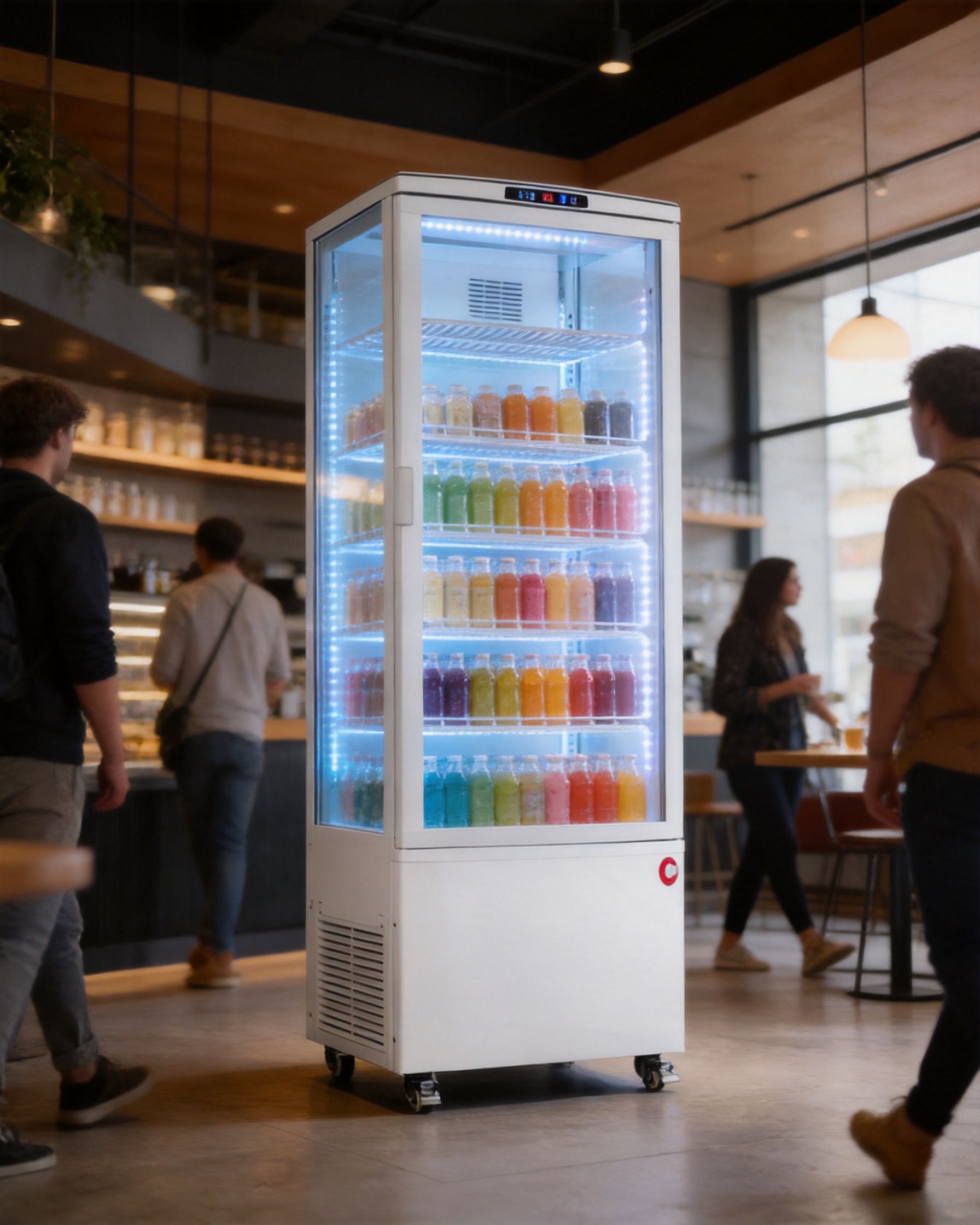
Cafés can use the cabinet to present bottled beverages, canned drinks, chilled desserts, or packaged products near the ordering counter. Restaurants may place it in a customer-facing service area or near a takeaway station. The glass design allows the cabinet to function as both refrigeration equipment and part of the interior presentation.
9.3 Hotels and Hospitality Areas
Hotels may use a four-sided display cooler in a lobby, breakfast area, lounge, meeting space, or event service zone. Because guests may approach from several directions, four-sided visibility can be more useful than a wall-oriented cabinet. The adjustable shelves also allow the display to change between daily service and special events.
9.4 Bakeries and Specialty Food Shops
Although the product is primarily described as a beverage display cooler, its 2 to 10°C operating range may suit selected packaged chilled foods and desserts, provided that the products are compatible with the cabinet’s conditions. Bakeries and specialty shops can use the unit to present bottled drinks beside cakes, pastries, sandwiches, or other products in accordance with food-safety requirements.
9.5 Promotional and Seasonal Merchandising
Retailers frequently change product ranges during holidays, sporting events, summer promotions, or local festivals. The XC-218L can be repositioned using its castors and reconfigured through shelf adjustment. Additional lighting and decorative shelf options can support temporary promotional themes.
10. Installation and Operating Recommendations
Correct installation is essential for reliable performance. Before placing the cooler, the operator should confirm that the floor is level, the electrical supply is suitable, and the location provides adequate ventilation. The cabinet should not be exposed to direct sunlight or installed beside equipment that produces significant heat.
After delivery, the unit should be inspected for transport damage. Glass panels, doors, shelves, castors, electrical cables, and external surfaces should be checked. If the cabinet has been transported in a position other than upright, it may require sufficient settling time before being connected, according to the manufacturer’s instructions and the transportation conditions.
10.1 Loading the Cabinet
Products should be arranged without blocking air circulation. The shelves should not be overloaded beyond their intended capacity. Heavy items should be placed lower, and products should be distributed evenly across the cabinet. Staff should avoid pushing merchandise tightly against the rear wall or air outlets.
Stock rotation should follow the first-in, first-out principle where appropriate. Labels should face forward, damaged packaging should be removed, and spilled liquids should be cleaned promptly. A well-organized cabinet improves both hygiene and sales presentation.
10.2 Door Management
Frequent or prolonged door opening increases the refrigeration load. Staff should keep the door closed when not actively loading or retrieving products. A damaged gasket, misaligned door, or obstruction on the shelf may prevent a complete seal and should be corrected promptly.
10.3 Cleaning and Maintenance
Routine cleaning should include the glass, shelves, door frame, interior surfaces, castors, and accessible exterior areas. Cleaning products should be compatible with glass, coated metal, plastic, and gasket materials. The condenser and ventilation areas should be inspected and cleaned according to the maintenance schedule.
Temperature records can help identify changes in performance. If the cabinet takes longer than usual to cool, develops abnormal noise, shows repeated temperature fluctuations, or produces unusual frost or water accumulation, service should be requested. Refrigerant-related work and electrical repairs should be carried out only by qualified technicians.
11. Procurement, Logistics, and Project Planning
For commercial buyers, equipment selection includes more than product features. The buyer must consider shipping, storage, installation, regulatory compliance, spare parts, warranty arrangements, and future expansion. The XC-218L’s listed package dimensions of 590 × 550 × 1660 millimeters help importers calculate warehouse requirements and delivery access.
The stated loading quantities of 36 units in a 20-foot general-purpose container and 80 units in a 40-foot high-cube container provide an initial reference for shipment planning. Actual quantities may vary according to packaging design, loading method, container limitations, and the inclusion of accessories. Buyers should confirm final packing and loading details before placing an order.
11.1 Configuration Confirmation
Buyers should confirm the following points before production:
• Refrigerant configuration and local regulatory suitability.
• Electrical voltage, frequency, plug type, and control requirements.
• Glass specification, including whether tempered glass is required.
• Shelf type, number, dimensions, and coating.
• Lighting configuration, including standard top lighting or optional LED bars.
• Product labeling, manuals, packaging marks, and language requirements.
• Warranty coverage, replacement parts, and service procedures.
• Delivery schedule, inspection requirements, and shipping documentation.
11.2 Private Label and Wholesale Opportunities
Manufacturers with established production lines and R&D capabilities may be able to support wholesale programs, distributor orders, and selected customization requirements. A buyer should evaluate not only the unit price but also production consistency, quality documentation, sample approval, communication efficiency, and the manufacturer’s ability to maintain supply over time.
For distributors, a product with a clear feature set can serve several customer segments. The same basic cabinet may be sold to beverage retailers, hospitality operators, cafés, restaurants, and food-service contractors, with optional lighting, shelves, and glass specifications selected for each application.
12. Advantages of the XC-218L in Competitive Use
The XC-218L’s main competitive advantage is the way it combines display visibility with practical refrigeration control. Some cabinets emphasize appearance but offer limited temperature management. Others provide reliable cooling but are designed mainly for storage. This model brings together a customer-facing presentation and a commercial cooling system.
Its four-sided double-glass design is valuable for flexible placement. The curved front glass gives the cabinet a polished visual profile. The internal LED light improves product recognition. Adjustable shelves support different beverage formats. Digital control simplifies monitoring. Ventilated cooling supports air distribution. Automatic defrost reduces routine labor. Castors and brakes support installation and stability.
The model also offers a practical balance between capacity and footprint. A 218-liter cabinet is large enough for a meaningful beverage selection while remaining narrow enough for locations where floor space is limited. Its vertical height enables several merchandising levels without requiring a wide horizontal footprint.
From a supplier perspective, the manufacturer’s experience, stated factory scale, R&D team, testing facilities, production lines, and international certifications add confidence for buyers seeking a long-term commercial refrigeration partner. These strengths do not replace product-specific inspection, but they provide an important foundation for consistent manufacturing and global distribution.
13. Sustainability and Responsible Operation
Responsible refrigeration management involves selecting suitable components, maintaining the cabinet correctly, and avoiding unnecessary energy loss. The use of LED lighting can support efficient product illumination compared with older lighting technologies. Double glass can help reduce the exchange of heat between the interior and the surrounding environment. Proper door sealing, condenser cleaning, and correct loading also contribute to efficient operation.
The refrigerant option should be selected according to the destination market, environmental regulations, safety requirements, and service availability. R290 is widely recognized as a lower-global-warming-potential refrigerant option, but it is flammable and must be handled according to applicable safety procedures. R134a may be used in configurations where permitted and appropriate. Buyers should confirm the exact refrigerant before ordering.
Long service life is another aspect of responsible equipment ownership. Regular cleaning, correct installation, timely repair, and the availability of replacement parts can help extend the useful life of a cabinet. Replacing a component or gasket is often more sustainable than discarding an otherwise serviceable unit.
14. Frequently Asked Questions
Q1: What products are suitable for the XC-218L?
The cabinet is primarily suitable for chilled beverages and other packaged products that require storage between 2 and 10°C. Typical examples include bottled water, soft drinks, juices, energy drinks, dairy beverages, and ready-to-drink refreshments. Product suitability should always be confirmed against the product label and food-safety requirements.
Q2: Is the XC-218L suitable for use in the center of a store?
Its four-sided glass design makes it suitable for applications where customers approach from multiple directions. The final placement must still provide sufficient ventilation, electrical access, cleaning space, and safe customer circulation.
Q3: What is the capacity of the cooler?
The stated capacity is 218 liters. Usable merchandising capacity may vary depending on shelf arrangement, product packaging, and the space required for proper air circulation.
Q4: What temperature range does the cabinet provide?
The listed temperature range is 2 to 10°C. The correct setting depends on the products, ambient conditions, loading pattern, and applicable operating instructions.
Q5: Does the cooler have automatic defrost?
Yes. Automatic defrost is included as a standard feature. Routine cleaning and inspection are still necessary to maintain hygienic and reliable operation.
Q6: Are the shelves adjustable?
Yes. The standard cabinet includes adjustable PVC-coated shelves. Optional chromed shelves are also listed for buyers who require a different appearance or specification.
Q7: Does the cabinet include lighting?
Yes. An internal top LED light is included as standard. Two or four strip LED light bars are available as options for enhanced illumination.
Q8: Can the cooler be moved after installation?
Yes. It is fitted with four castors, two with brakes. The unit should be moved carefully on a suitable level surface, and the brakes should be engaged after final positioning.
Q9: What refrigerant does the model use?
The specification lists R134a/R290. The exact configuration should be confirmed according to the destination market, local regulations, safety requirements, and the purchase order.
Q10: What should buyers confirm before ordering?
Buyers should confirm voltage, frequency, plug type, refrigerant, glass specification, shelf configuration, lighting options, packaging, certifications, warranty terms, spare parts, and delivery requirements. A current technical sheet and approved sample should be used for project orders.
Q11: How does the cooler compare with an open-front display unit?
The XC-218L provides enclosed glass visibility rather than an open front. This can help maintain a more controlled refrigerated space while still allowing customers to see the products clearly. An open-front unit may offer faster access, but it can also experience greater exposure to ambient air.
Q12: Is the cabinet intended for commercial or household use?
The product is designed as commercial display refrigeration. Its features, capacity, glass construction, shelving, castors, and merchandising format are intended for customer-facing business environments rather than ordinary household storage.
15. Conclusion
The XC-218L four-sided glass display cooler is a versatile commercial refrigeration solution for businesses that need both product protection and strong visual merchandising. Its 218-liter capacity, 2 to 10°C temperature range, ventilated cooling system, automatic defrost, digital thermostat, internal LED lighting, adjustable shelves, and mobile castor base create a practical equipment package for beverage display and selected chilled products.
Its greatest distinction is the combination of four-sided visibility and vertical space efficiency. Unlike a solid-door refrigerator, it communicates product availability immediately. Unlike a single-front display cabinet, it can be positioned where customers approach from different directions. Unlike an open-front cooler, it maintains an enclosed refrigerated environment. These advantages make it appropriate for convenience stores, cafés, restaurants, hotels, bakeries, specialty retailers, and other customer-facing locations.
The manufacturing background is also important. Ningbo XiangChi Electrical Co., Ltd. brings experience dating from 2007, a stated 40,000-square-meter factory, professional R&D resources, testing facilities, production lines, and international certification experience. Together, these capabilities support product development, quality control, configuration flexibility, and wholesale supply.
For buyers seeking a display cooler that is attractive, adaptable, and commercially practical, the XC-218L provides a strong foundation. The final purchase decision should be based on confirmed technical documentation, local compliance, operating conditions, product requirements, service support, and the exact selected configuration.
References
1. Manufacturer-supplied XC-218L product specification sheet.
2. Manufacturer-supplied standard features and optional configuration information.
3. Commercial refrigeration installation, operation, and maintenance principles.
4. General food-retail guidance on chilled product storage and temperature monitoring.
5. General technical guidance on ventilated cooling systems and automatic defrost operation.
6. General commercial display merchandising practices for refrigerated beverages.
7. International electrical and product-safety certification principles applicable to commercial refrigeration equipment.
8. General guidance on refrigerant selection, handling, and destination-market compliance.
Product: Countertop Four Sides Glass Beer Display Cooler Beverage Chiller Refridge

You May Also Like
.jpg?imageView2/2/w/500/h/500/format/jp2/q/100 "Four Sides Glasses Display Cooler")
.jpg?imageView2/2/w/500/h/500/format/jp2/q/100 "White 4-Sided Glass Refrigerated Display Case")
.jpg?imageView2/2/w/500/h/500/format/jp2/q/100 "Refrigerated Display Cake Countertop Four Sides Glasses Display Cooler")
.jpg?imageView2/2/w/500/h/500/format/jp2/q/100 "Four Sides Glasses Display Cooler")

-
- Navigation
- Home
- About Us
- Products
- News
- Contact Us
 East Zone, Guanhaiwei Industrial Park, Cixi City, Ningbo, Zhejiang, China
 +86-574-63668678
 +86-574-63668108
Copyright © Ningbo XiangChi Electrical Co.,Ltd All Rights Reserved.
