
 简体中文
 English
 Español

News
4-Sided Glass Refrigerated Standing Display Cooler: Efficient Merchandising for Modern Retail
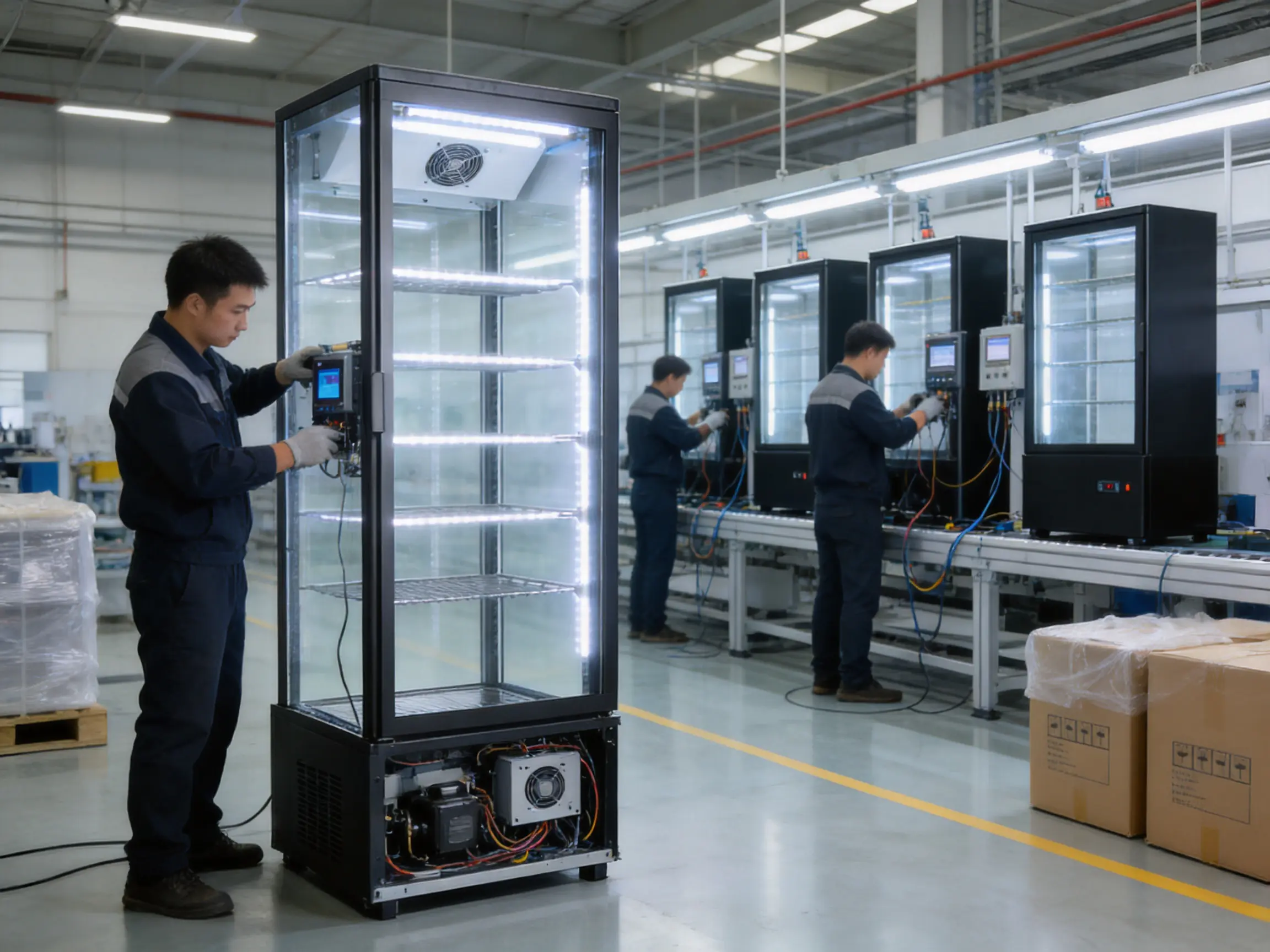
In food retail, hospitality, catering, and commercial service environments, refrigeration is not only about keeping products cold. It is also about presentation, accessibility, hygiene, energy-conscious operation, and the efficient use of valuable floor space. A well-designed display cooler must protect food quality while making products easy to see and attractive to purchase. The XC-98L 4-sided glass refrigerated standing display cooler addresses these requirements with a compact vertical format, a 98-liter capacity, ventilated cooling, internal LED illumination, adjustable shelving, and a temperature range suitable for many chilled products.
Unlike a standard closed refrigerator, a glass display cabinet allows customers and staff to view the merchandise from multiple directions. This feature is particularly valuable in convenience stores, cafés, bakeries, hotel breakfast areas, restaurants, delicatessens, reception areas, and other locations where products must be displayed professionally. The four-sided double-glass construction creates a clear visual presentation while helping maintain the internal refrigerated environment.
Manufactured by Ningbo XiangChi Electrical Co., Ltd., the XC-98L is designed for commercial display applications that require reliable refrigeration in a relatively small footprint. Its standing cabinet structure provides more vertical display volume than many countertop units, while its dimensions of 447 × 400 × 1119 millimeters allow it to fit into compact commercial layouts. With a rated input power of 200 watts and a temperature range of 2–10°C, it is suitable for displaying chilled beverages, prepared foods, desserts, dairy products, packaged snacks, and other temperature-sensitive merchandise, subject to the specific storage requirements of each product.
Product Overview
The XC-98L is a vertical, four-sided glass refrigerated display cabinet with a nominal capacity of 98 liters. It is designed to place products at an elevated viewing height and to provide a clear display from the front, sides, and top-facing glass areas. This configuration can help retailers make better use of limited floor space while creating a more open and attractive product presentation.
The cabinet uses a ventilated cooling system to distribute refrigerated air throughout the interior. This is an important advantage over basic static-cooling equipment, especially when several shelves are used. Ventilated air circulation can help reduce temperature differences between storage levels when the cabinet is loaded correctly and operated under appropriate ambient conditions.
A digital thermostat and display provide a convenient way to monitor and manage the operating temperature. The temperature range is listed as 2–10°C, giving operators flexibility for a variety of chilled products. Automatic defrost reduces the need for manual intervention, while the glass fog-preventing system supports visibility in humid or frequently accessed environments.
Inside the cabinet, adjustable PVC-coated shelves allow the display layout to be adapted to different product sizes. Shelving can be positioned to create more vertical clearance for bottles, containers, dessert boxes, or packaged food. The PVC coating is also practical for commercial use because it creates a finished surface that is easy to clean and suitable for repeated handling.
The standard configuration includes an internal top LED light. LED lighting illuminates the products without requiring a large lighting system, and it helps emphasize package colors, labels, and product arrangement. Optional two-strip or four-strip LED light bars are available for customers who require additional illumination or a more intensive merchandising effect.
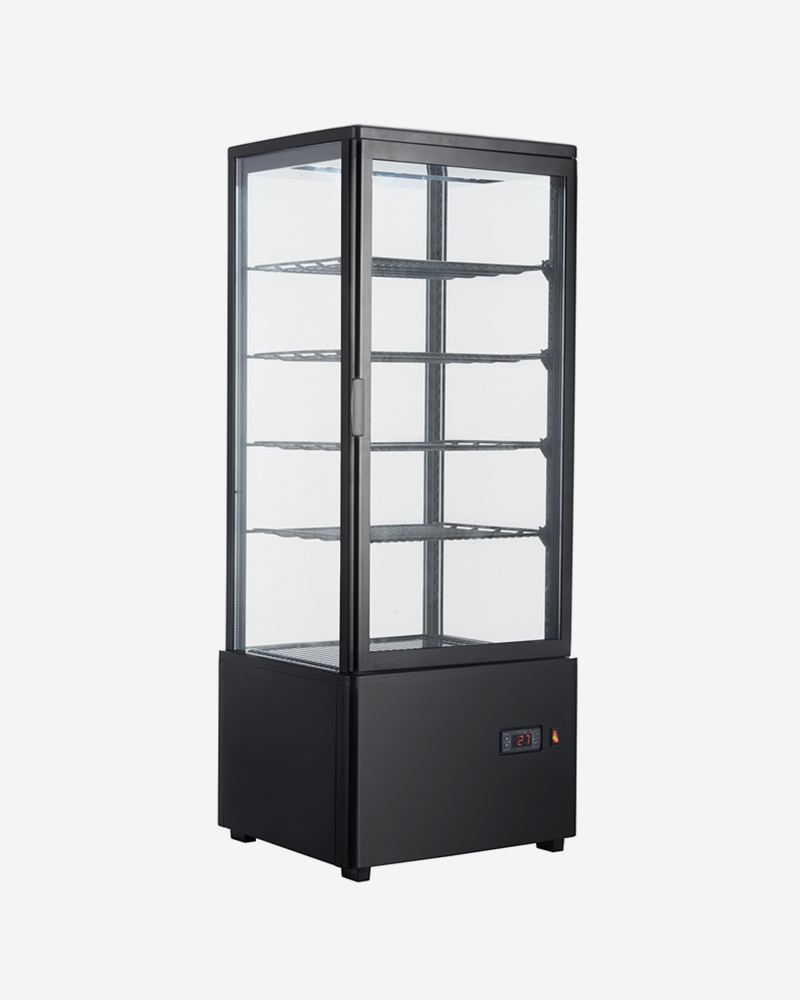
4 Sided Glass Refrigerated Standing Display Cooler
Key Technical Specifications
The following table summarizes the principal product specifications supplied for the XC-98L model.
| Specification | Details |
|---|---|
| Model | XC-98L |
| Product type | 4-sided glass refrigerated standing display cooler |
| Capacity | 98 liters |
| Temperature range | 2–10°C |
| Input power | 200 W |
| Refrigerant | R134a/R600a, depending on configuration |
| Climate type | 4 |
| Net weight | 39 kg |
| Gross weight | 42 kg |
| Product dimensions | 447 × 400 × 1119 mm |
| Package dimensions | 502 × 456 × 1160 mm |
| Standard illumination | Internal top LED light |
| Cooling method | Ventilated cooling system |
| Defrost system | Automatic defrost |
| Standard shelving | Adjustable PVC-coated shelves |
The compact dimensions and moderate weight make the cabinet easier to position and relocate than many larger commercial display refrigerators. Its gross shipping weight of 42 kilograms also provides a useful reference for logistics planning. The listed container-loading figures are 110 units in a 20-foot general-purpose container and 230 units in a 40-foot high-cube container, although actual loading quantities may depend on packaging arrangements, shipping restrictions, and the final configuration.
Why Four-Sided Glass Matters
The four-sided glass design is one of the most important differences between this model and conventional front-opening or solid-wall refrigeration equipment. A standard refrigerator may show products only from one direction. By contrast, a four-sided glass cabinet supports visibility from several angles, making it suitable for central placement, counter-adjacent placement, or positioning along a customer circulation route.
Visibility can influence purchasing behavior. Customers are more likely to notice products when they are clearly illuminated and arranged at an accessible height. A transparent cabinet can also reduce the need for customers to open doors simply to inspect products. This may support a cleaner shopping experience and help operators maintain a more organized presentation.
The glass construction is especially useful for impulse merchandise. Chilled drinks, cakes, sandwiches, dairy products, fresh desserts, and pre-packed foods can be presented where customers naturally wait, queue, or pass through. In a café, the cooler can be placed near the ordering area. In a bakery, it can showcase refrigerated cakes and desserts. In a hotel, it can be used near a reception, lounge, or breakfast service area. In a convenience store, it can provide a compact merchandising station for high-turnover chilled products.
The double-glass structure contributes to the cabinet’s display performance by creating a more substantial barrier between the internal refrigerated space and the surrounding environment. The glass fog-preventing system further supports product visibility. This is important because condensation or fog can quickly reduce the commercial value of a display cabinet, even when the refrigeration system itself is operating properly.
Four-sided visibility also improves staff supervision. Operators can check stock levels and product arrangement from different positions without constantly opening the cabinet. This can make replenishment planning easier and may help staff notice when shelves require cleaning or restocking.
Cooling Performance and Temperature Control
The XC-98L is specified with a temperature range of 2–10°C. This range covers many common chilled display applications, including bottled and canned beverages, dairy products, sandwiches, salads, desserts, and other packaged food items. Operators should always confirm the manufacturer’s storage guidance for each product, because different foods may require different temperature limits and handling procedures.
The ventilated cooling system is intended to circulate cold air through the cabinet rather than relying solely on natural convection. This approach is valuable in a multi-shelf display unit because products on upper and lower shelves may otherwise experience different conditions. Air circulation can help create a more uniform refrigerated environment when the cabinet is loaded in a way that does not block air passages.
Proper loading remains essential. Products should not be packed tightly against the air outlets or internal circulation channels. Shelves should be arranged to provide sufficient clearance around merchandise, and warm products should not be placed into the cabinet in quantities that exceed its cooling capacity. Good loading practice supports faster temperature recovery after door openings or restocking.
The digital thermostat and display help operators set and observe the cabinet’s operating temperature. Digital controls are generally easier to read than analog indicators and can make routine checks more consistent. They also help staff identify potential operating changes before product quality is affected.
Automatic defrost is another practical feature. Frost accumulation can reduce cooling efficiency and restrict airflow, but manual defrosting can interrupt merchandising and require additional labor. An automatic system helps reduce these interruptions. It does not eliminate the need for cleaning or maintenance, but it can make routine operation more convenient.
The climate type is listed as 4, which indicates a specified environmental performance category for the equipment. Actual performance can vary depending on ambient temperature, humidity, installation location, ventilation around the cabinet, loading level, and frequency of access. For best results, the cooler should be installed away from direct sunlight, ovens, cooking equipment, and other heat sources.
Energy-Conscious Commercial Operation
The listed input power of 200 watts is appropriate for a compact commercial display cooler of this capacity. Energy consumption in actual operation will depend on ambient conditions, thermostat settings, defrost cycles, lighting use, product loading, and door or access conditions. Nevertheless, a relatively compact cabinet can be advantageous for businesses that need refrigerated merchandising without installing a large multidoor display system.
The vertical design makes efficient use of floor area. Instead of spreading products across a wide horizontal counter, the cabinet uses height to create display volume. This can be useful in small shops, compact cafés, hotel areas, pharmacies with approved chilled products, and food-service counters where every square meter matters.
LED illumination also supports efficient display lighting. LEDs generally provide strong visibility with low power demand and limited heat output compared with older lighting technologies. The internal top LED light is included as a standard feature, while additional light bars can be selected when a brighter or more evenly distributed display is required.
Energy-conscious operation also depends on installation and staff habits. The cabinet should have adequate clearance for ventilation, should not be overloaded, and should be kept closed or properly sealed during operation where applicable. The condenser and air passages should be inspected and cleaned according to the maintenance schedule. These practices can help preserve cooling performance and reduce unnecessary energy use.
Display Flexibility and Merchandising Value
One of the strengths of the XC-98L is its adaptability. Adjustable PVC-coated shelves allow the internal display to be configured according to the merchandise being sold. A business displaying small dessert cups may use closer shelf spacing, while a business displaying tall bottles may require greater vertical clearance. This flexibility makes the cabinet more useful than a fixed-shelf unit designed around only one product type.
Merchandising arrangements can also be changed seasonally. A bakery might display individual desserts during normal operation and larger packaged cakes during holiday periods. A café might use one shelf for bottled drinks, another for sandwiches, and another for chilled desserts. A convenience store might reorganize the shelves according to promotional campaigns or changes in customer demand.
Chromed shelves are available as an option for customers seeking a different visual finish. Tempered glass options are also available, depending on the required configuration and market specification. A door lock can be selected for environments where access control, product security, or after-hours protection is important.
Additional two-strip or four-strip LED light bars can help businesses create a more intensive retail presentation. Extra lighting may be especially beneficial where the cabinet is positioned in a darker corner, in a low-light hospitality environment, or in a store with strong merchandising standards.
The cabinet’s compact width and depth also make it suitable for single-unit or multiple-unit layouts. One unit can serve as a focused display for premium products. Several units can be installed together to create a category display while maintaining separation between different product groups. Operators should leave sufficient space for ventilation, cleaning, and service access when planning multiple-unit installations.
Advantages Compared with Conventional Display Refrigerators
Better visibility from multiple directions
A front-facing display refrigerator usually depends on a single customer approach direction. The four-sided glass configuration allows the XC-98L to attract attention from more than one side. This is valuable in open-plan retail environments and high-traffic locations where customers may not approach from a fixed direction.
Efficient use of limited floor space
The standing vertical format provides display height without requiring a large footprint. Compared with wide horizontal cases, it may allow a business to present a useful quantity of chilled merchandise in a narrower area. This can improve layout flexibility and preserve space for customer movement, seating, or additional merchandise.
Flexible internal arrangement
Adjustable shelves provide more flexibility than fixed shelves. Retailers can change the arrangement as product dimensions, packaging, or promotional priorities change. This reduces the risk that the cabinet becomes unsuitable when the business expands its product range.
Improved product presentation
Internal LED lighting, clear glass, and an organized vertical arrangement can give products a more premium appearance. Good presentation is particularly important for cakes, desserts, prepared meals, specialty beverages, and other products where visual appeal contributes to sales.
Convenient temperature management
The digital thermostat and display provide a clear operating interface. Automatic defrost and ventilated cooling further reduce the amount of routine intervention required compared with simpler refrigeration equipment.
Commercially useful optional features
The available options allow customers to adjust the cabinet to their application. A door lock can support security, extra LED strips can improve illumination, chromed shelves can change the interior appearance, and tempered glass can be selected for specific market or operating requirements.
Applications Across Different Business Environments
Cafés and coffee shops
Cafés often need to display chilled bottled drinks, desserts, sandwiches, yogurt, and ready-to-eat products near the ordering point. The XC-98L can provide a dedicated refrigerated display while taking up less space than a large service counter. The glass design allows customers to see available products while waiting to order.
Bakeries and dessert shops
Cakes, cream desserts, pastries requiring refrigeration, and individual dessert portions benefit from attractive presentation. The adjustable shelves make it possible to accommodate different package heights. LED illumination can emphasize colors and decorative details, while temperature control supports chilled storage requirements.
Restaurants and food-service counters
Restaurants may use the cabinet for prepared salads, desserts, cold drinks, packaged meals, or promotional products. Its compact dimensions can make it suitable for front-of-house service areas where a large walk-in or under-counter system is not appropriate for merchandising.
Hotels and hospitality venues
Hotels may install a display cooler in a lobby café, breakfast area, lounge, or meeting facility. The four-sided presentation is useful in open hospitality spaces where customers approach from different directions. A lock option may be considered when the cabinet is used in areas that are unattended for part of the day.
Convenience stores and specialty retailers
Convenience stores can use a compact display unit for products that need to be separated from a larger beverage cooler. Specialty retailers may use it for premium drinks, dairy products, desserts, or other merchandise that benefits from focused display positioning.
Catering and event service
For catering venues and event facilities, a vertical glass cabinet can provide chilled product presentation without occupying excessive floor space. It may be used for packaged desserts, bottled beverages, or pre-portioned food items during service periods. Appropriate transportation, installation, and operating procedures should be followed when equipment is moved between locations.
Manufacturing Strengths and Quality Orientation
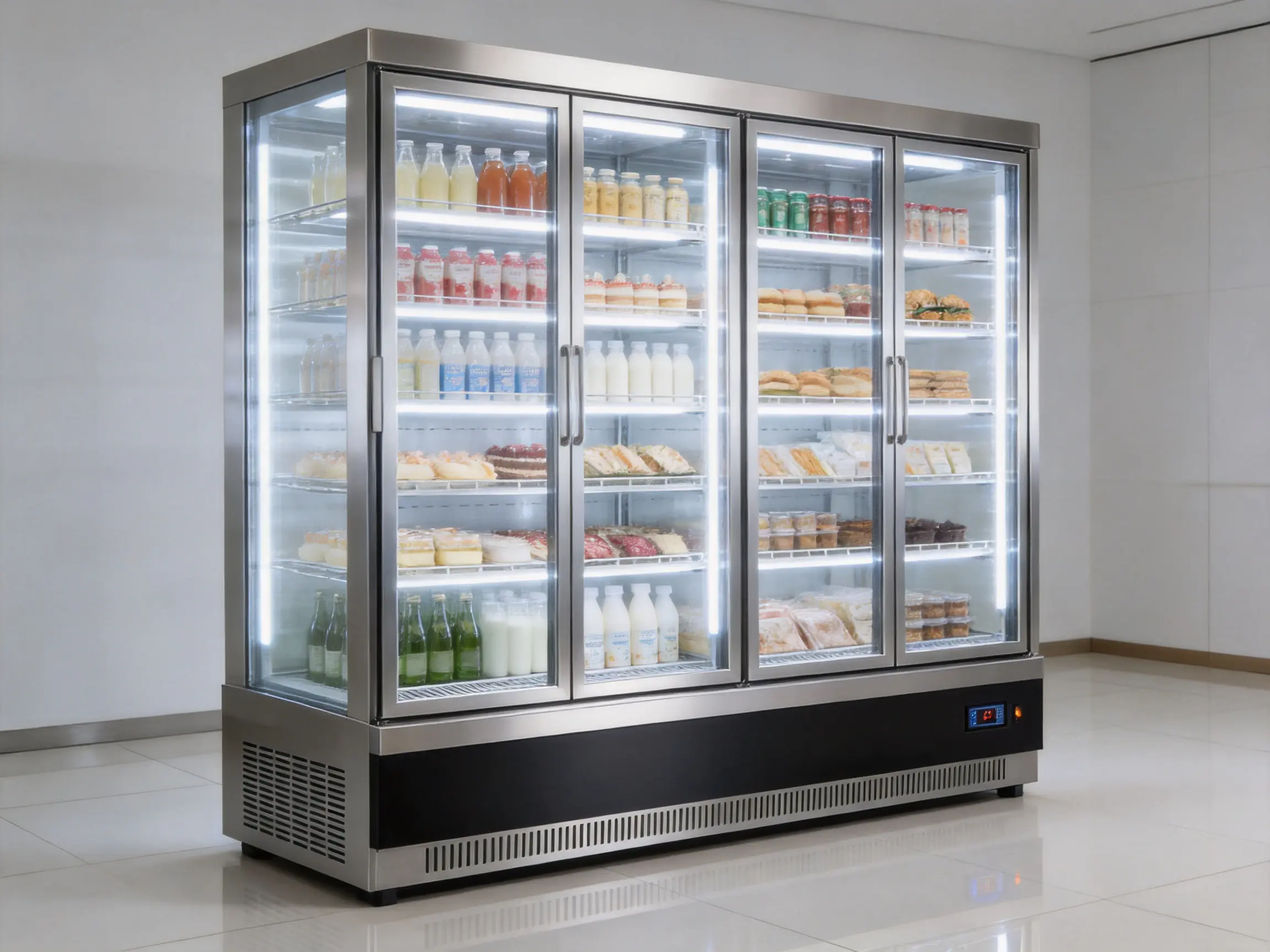
The XC-98L is produced by Ningbo XiangChi Electrical Co., Ltd., a manufacturer specializing in vertical display cabinets, cake cabinets, and warming cabinets. The company was established in 2007 and has developed more than a decade of experience in the commercial refrigeration and display equipment field. Its stated manufacturing base includes a modern management garden factory covering approximately 40,000 square meters.
A substantial manufacturing site can support specialized production areas, controlled assembly processes, component management, testing operations, and coordinated logistics. For commercial refrigeration equipment, these capabilities are important because product quality depends on the interaction of many systems, including the cabinet structure, glass assembly, refrigeration circuit, thermostat, lighting, shelving, insulation, wiring, and packaging.
The company reports having its own professional research and development team and advanced testing facilities. In practical terms, an internal R&D structure can help a manufacturer refine cabinet layouts, improve display performance, test refrigeration systems, evaluate new components, and respond to customer requirements. It also supports the development of product options, such as additional lighting, different shelving finishes, tempered glass, and locking systems.
Testing facilities are particularly relevant for commercial refrigeration. Before shipment, equipment may need to be evaluated for cooling performance, temperature stability, electrical operation, defrost behavior, lighting function, glass condition, and general assembly quality. A structured testing approach helps reduce the risk of shipping units with operational defects and supports consistent performance across production batches.
The company states that it has obtained CE, GS, CCC, CB, RoHS, ETL, and other major international certifications. Certification requirements vary by market and product configuration, so buyers should confirm the applicable certification documentation for the exact model, voltage, refrigerant, and destination country. Nevertheless, experience with multiple certification systems indicates an established awareness of international compliance requirements.
Manufacturing strength is also reflected in the ability to support wholesale and export orders. The listed container-loading capacity provides a reference for larger procurement programs. Export-oriented production requires attention to packaging, product protection, shipping dimensions, documentation, voltage specifications, and consistent model identification. These factors are important for distributors, supermarket groups, hospitality suppliers, and commercial equipment dealers.
Ningbo’s location in Zhejiang Province also places the manufacturer within an important Chinese industrial and logistics region. Access to component suppliers, transportation networks, ports, and manufacturing services can support efficient sourcing and international delivery. For buyers, this may simplify the coordination of repeat orders and product customization discussions.
Production Process and Engineering Considerations
Cabinet design and material preparation
The manufacturing process begins with the design of the cabinet structure and the preparation of materials. A commercial display cooler must balance appearance, strength, thermal performance, service access, and shipping efficiency. The four-sided glass arrangement requires careful dimensional control because multiple panels must align correctly with the frame and sealing components.
Material preparation may include the cutting and forming of metal panels, preparation of internal supports, fabrication of shelf brackets, and assembly of the base and top structures. Consistent dimensions are important for maintaining a clean appearance and ensuring that glass panels, shelves, lighting elements, and refrigeration components fit correctly.
Glass processing and installation
Glass is a central functional and visual component of the XC-98L. The panels must be handled carefully during processing, transportation within the factory, and final assembly. Double-glass construction requires accurate positioning and secure installation to support insulation, clarity, and durability.
Where tempered glass is selected as an option, the applicable processing and quality requirements must be followed. Glass fog prevention also depends on the correct integration of heating, sealing, airflow, or other design elements specified for the model. The result should provide clear product visibility under normal commercial operating conditions.
Refrigeration-system assembly
The refrigeration system includes the compressor, condenser, evaporator, refrigerant circuit, fans, controls, and associated electrical components. Each part must be installed according to the intended system design. Refrigerant selection may be R134a or R600a depending on the configuration and market requirements.
Refrigeration assembly requires attention to tubing connections, circuit cleanliness, leak prevention, vacuum procedures, charge accuracy, and electrical safety. Proper assembly contributes to stable cooling performance and helps protect the system during long-term operation. The ventilated cooling design also requires correct fan placement and airflow pathways so that refrigerated air can circulate throughout the display chamber.
Control and electrical integration
The digital thermostat, temperature display, LED lighting, separated power button, defrost control, and fan system must operate together as an integrated system. A separated power button is a useful practical feature because it gives operators a clear way to control the cabinet independently from other equipment or lighting functions, according to the final electrical configuration.
Electrical integration should include appropriate wiring organization, insulation, grounding, component protection, and functional testing. International commercial equipment may be ordered for different voltage and frequency requirements, so buyers should confirm the electrical specification before placing an order.
Final inspection and testing
Final inspection should verify the appearance and operation of the completed cabinet. Typical checks may include glass alignment, door or access-panel operation where applicable, shelf fit, LED function, thermostat response, temperature display accuracy, fan operation, defrost behavior, electrical safety, and general cabinet stability.
Packaging is also important. The cabinet must be protected against vibration, impact, moisture, and movement during transportation. The listed package size of 502 × 456 × 1160 millimeters provides a basis for shipping planning, but distributors should also consider palletization, warehouse access, lifting equipment, and final delivery conditions.
Installation and Operating Recommendations
The cabinet should be placed on a stable, level surface. Level installation helps maintain proper cabinet alignment and supports the correct operation of internal components. The surrounding area should be kept clean and should provide sufficient clearance for ventilation and service access.
Direct exposure to sunlight should be avoided because solar heat can increase the refrigeration load and make it more difficult to maintain the target temperature. The cooler should also be positioned away from ovens, fryers, hot-water equipment, radiators, and other heat-producing appliances.
After installation, the unit should be allowed to reach its operating condition before it is fully loaded with products. The thermostat should be set according to the merchandise being stored. Products should be arranged without blocking air outlets, fans, or circulation passages. Overloading can reduce airflow and cause uneven cooling.
Staff should monitor the digital temperature display during daily operation. Any unusual temperature rise, abnormal noise, excessive condensation, or loss of lighting should be investigated promptly. Products should be rotated according to the business’s food-safety procedures, and shelves should be cleaned regularly to prevent spills and residue from accumulating.
When cleaning the cabinet, operators should follow the equipment instructions and disconnect electrical power when required. Abrasive cleaners, sharp tools, or unsuitable chemicals may damage glass, coatings, seals, or internal surfaces. The refrigeration system should be serviced only by qualified personnel familiar with the applicable refrigerant and electrical requirements.
Maintenance Practices for Long-Term Performance
Routine maintenance helps preserve both refrigeration performance and product presentation. The glass should be cleaned frequently because fingerprints, dust, and condensation can reduce visibility. Clear glass contributes directly to the display function, so cleaning is not merely cosmetic.
Shelves should be removed and cleaned as needed. PVC-coated shelves should be inspected for damage, especially at support points and edges. If chromed shelves are selected, the finish should also be checked for corrosion or surface damage caused by unsuitable cleaning products.
Air inlets and outlets must remain unobstructed. Dust accumulation around ventilation areas can restrict airflow and increase the operating load. In commercial environments, inspection frequency should reflect the amount of dust, grease, packaging debris, and foot traffic around the cabinet.
The condenser and other serviceable refrigeration components should be maintained according to the manufacturer’s recommendations. Refrigeration maintenance should include checking for abnormal operating sounds, unusual temperature patterns, refrigerant leakage, and electrical problems. Any repair involving the refrigerant circuit should be performed by qualified technicians.
The door lock, lighting bars, thermostat, power button, and display should be checked periodically when those features are included. Early detection of a fault can reduce downtime and help prevent the loss of chilled products.
Purchasing Considerations for Distributors and Commercial Buyers
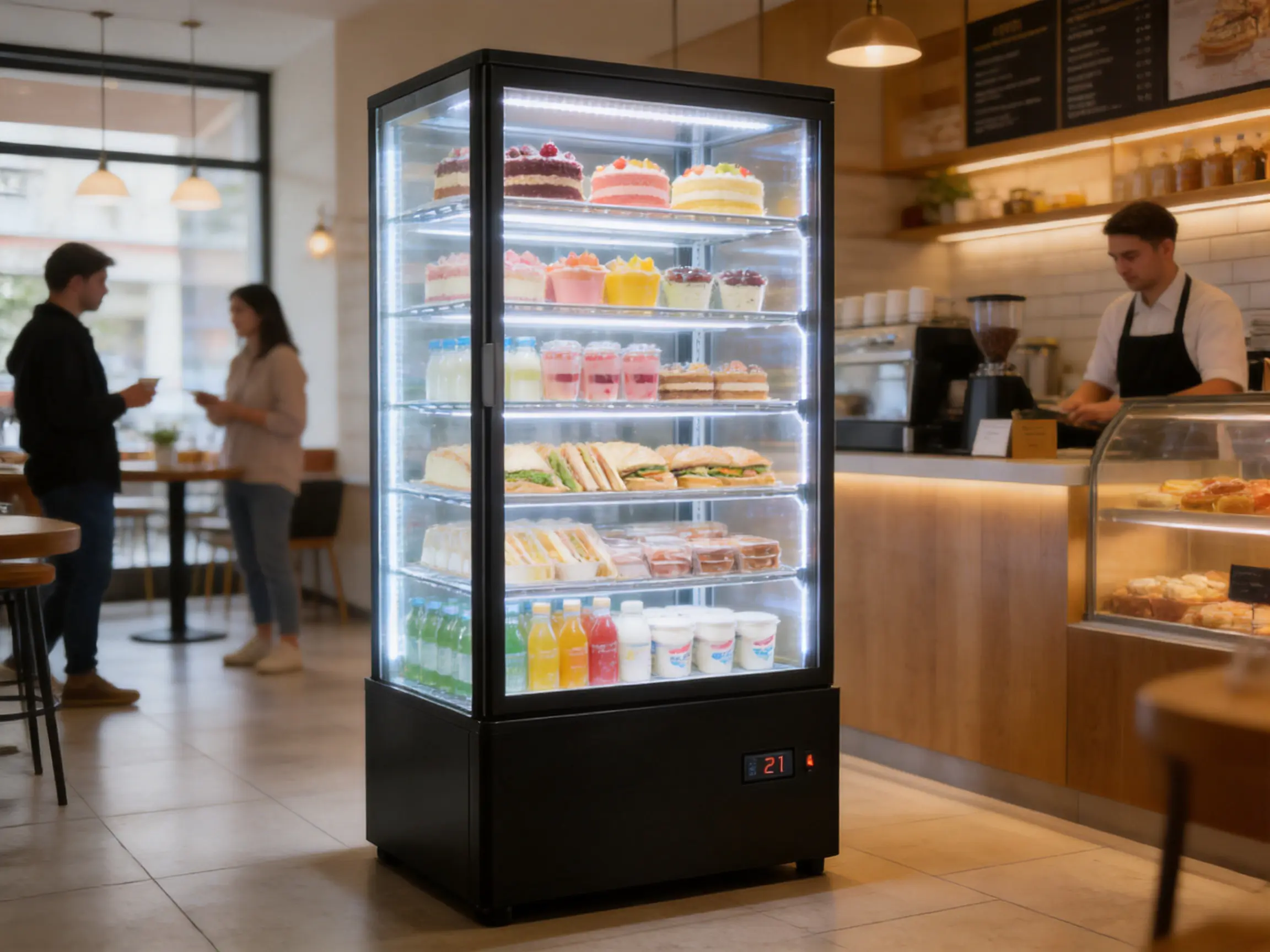
When purchasing the XC-98L for commercial use, buyers should first define the intended product category. The 2–10°C range is suitable for many chilled items, but not every product has the same storage requirements. The buyer should confirm that the cabinet’s temperature performance, capacity, shelving arrangement, and access design match the merchandise.
Electrical requirements should be confirmed before ordering. Voltage, frequency, plug type, refrigerant configuration, certification requirements, and labeling may vary according to the destination market. Buyers should also verify whether the required certification applies to the complete unit or to specific components and configurations.
The available options should be selected at the quotation stage. These may include a door lock, two-strip LED light bars, four-strip LED light bars, chromed shelves, and tempered glass. Selecting options in advance helps ensure that the production specification, packaging, documentation, and final price are aligned with the buyer’s requirements.
For wholesale orders, logistics planning should include product dimensions, package dimensions, container quantity, unloading arrangements, warehouse space, and after-sales support. The listed loading quantities of 110 units in a 20-foot general-purpose container and 230 units in a 40-foot high-cube container can assist with preliminary planning, but final quantities should be confirmed with the supplier based on the shipping method and packing configuration.
Distributors should also consider the intended retail environment. A unit for a bakery may require enhanced lighting and a different shelf layout from a unit intended for bottled beverages. A hotel may prioritize a lock and quiet presentation, while a convenience store may prioritize fast restocking and product visibility from multiple directions.
Why Work with an Experienced Manufacturer?
Commercial refrigeration buyers generally require more than a product catalog. They need dependable specifications, consistent manufacturing, documentation, technical communication, and support for repeat orders. An experienced manufacturer can provide a stronger foundation for these requirements.
Ningbo XiangChi Electrical Co., Ltd. has focused on vertical display cabinets, cake cabinets, and warming cabinets since its establishment in 2007. This product specialization can support practical knowledge of display merchandising, cabinet construction, refrigeration integration, and the demands of commercial users.
The company’s stated R&D resources and testing facilities support ongoing product development and quality improvement. Its range of international certifications also reflects experience with different market expectations. For importers and distributors, such experience can be useful when preparing product documentation, reviewing compliance needs, and planning market-specific configurations.
The company also describes an operating philosophy centered on innovation, quality, and service. For commercial customers, these principles are most valuable when they are reflected in measurable practices: consistent product specifications, controlled assembly, functional testing, responsive communication, reliable packaging, and clear after-sales procedures.
Because the manufacturer offers several types of display and warming equipment, customers may also be able to coordinate related product categories through one supplier. This can simplify sourcing for businesses that need refrigerated display cabinets, cake showcases, countertop coolers, or warming cabinets within the same commercial project.
Frequently Asked Questions
What is the capacity of the XC-98L?
The nominal capacity is 98 liters. The usable display volume may vary depending on shelf arrangement, product packaging, required air circulation, and the space reserved around internal components.
What temperature range does the cooler provide?
The specified temperature range is 2–10°C. Operators should select the appropriate setting for the products being stored and should follow the applicable food-safety and product-storage requirements.
What type of cooling system does it use?
The unit uses a ventilated cooling system. This circulates refrigerated air through the cabinet and is intended to support more even cooling across the display area when the cabinet is correctly loaded.
Does the cabinet include lighting?
Yes. An internal top LED light is listed as a standard feature. Two-strip and four-strip LED light bars are available as options for customers who want additional illumination.
Are the shelves adjustable?
Yes. Adjustable PVC-coated shelves are included as a standard feature. Chromed shelves are available as an option.
Does it have automatic defrost?
Yes. Automatic defrost is included in the standard feature list. Regular cleaning and maintenance are still necessary for reliable long-term operation.
Can the glass be supplied as tempered glass?
Tempered glass is listed as an available option. Buyers should confirm the exact glass specification and availability for the required market configuration before ordering.
Is a door lock available?
Yes. A door lock is listed as an option. This can be useful in unattended areas, controlled-access environments, or applications where products must be secured outside operating hours.
What are the product dimensions?
The listed product dimensions are 447 × 400 × 1119 millimeters. The package dimensions are 502 × 456 × 1160 millimeters.
How much does the unit weigh?
The net weight is listed as 39 kilograms, and the gross weight is listed as 42 kilograms. The gross weight should be used for shipping and handling planning.
Which refrigerant is used?
The specification lists R134a/R600a. The exact refrigerant may depend on the product configuration, destination market, and applicable regulations. Buyers should confirm the refrigerant before placing an order.
What does climate type 4 mean?
Climate type 4 identifies a specified environmental performance category for the equipment. Actual results still depend on ambient temperature, humidity, installation conditions, ventilation, loading, and usage frequency.
Can the cooler be used for cakes and desserts?
It can be used for suitable chilled cakes, desserts, and other refrigerated products, provided that the required storage temperature and product dimensions are compatible with the cabinet. The adjustable shelves and internal LED lighting are useful for dessert presentation.
Is it suitable for a small café or bakery?
Yes. Its vertical format, 98-liter capacity, compact footprint, four-sided visibility, and display lighting make it suitable for many small and medium-sized food-service environments. The final suitability depends on the intended merchandise and available installation space.
How should products be arranged inside the cabinet?
Products should be arranged with sufficient clearance for air circulation. Air outlets should not be blocked, and the cabinet should not be overloaded. Shelves can be adjusted to provide appropriate clearance for different product sizes.
What should buyers confirm before ordering?
Buyers should confirm the electrical specification, refrigerant, glass type, shelf type, lighting options, lock requirement, certification documentation, packaging, delivery terms, and any destination-market requirements. They should also verify the final product configuration and available accessories.
Conclusion
The XC-98L 4-sided glass refrigerated standing display cooler combines compact commercial refrigeration with strong product visibility. Its 98-liter capacity, 2–10°C temperature range, ventilated cooling, automatic defrost, digital thermostat, fog-preventing glass system, adjustable PVC-coated shelves, and internal LED lighting create a practical solution for businesses that need both reliable chilling and effective merchandising.
Its four-sided double-glass design gives it an advantage over conventional front-facing refrigerators in open retail and hospitality environments. Products can be seen from multiple directions, while the vertical structure makes efficient use of floor space. Optional locks, lighting bars, chromed shelves, and tempered glass allow the cabinet to be adapted to different commercial requirements.
The product is supported by the manufacturing capabilities of Ningbo XiangChi Electrical Co., Ltd., an experienced producer of vertical display cabinets, cake cabinets, and warming cabinets. The company’s R&D team, testing facilities, large manufacturing base, export experience, and stated international certifications provide a foundation for serving distributors, retailers, food-service businesses, and commercial equipment buyers.
For applications requiring attractive chilled presentation in a compact footprint, the XC-98L offers a balanced combination of display performance, operational convenience, configuration flexibility, and manufacturer support. Correct installation, appropriate loading, regular cleaning, and professional maintenance will help ensure that the cooler continues to protect products while contributing to a more organized and appealing commercial environment.
References
1. Product specification sheet for the XC-98L 4-sided glass refrigerated standing display cooler.
2. Manufacturer-provided standard features and optional configuration information for commercial display cabinets.
3. Manufacturer-provided company profile describing production history, R&D capabilities, factory facilities, and international certifications.
4. General commercial refrigeration practices concerning temperature control, airflow, installation, cleaning, and preventive maintenance.
5. General retail merchandising principles concerning product visibility, vertical display design, lighting, and efficient use of floor space.
Product: 4 Sided Glass Refrigerated Standing Display Cooler

You May Also Like





-
- Navigation
- Home
- About Us
- Products
- News
- Contact Us
 East Zone, Guanhaiwei Industrial Park, Cixi City, Ningbo, Zhejiang, China
 +86-574-63668678
 +86-574-63668108

Copyright © Ningbo XiangChi Electrical Co.,Ltd All Rights Reserved.
