
 简体中文
简体中文 English
 Español
News
Open Automatic Defrost Refrigerated Showcase for Modern Retail Display
Open refrigerated showcases are essential equipment for supermarkets, convenience stores, cafés, bakeries, food halls, restaurants, and other businesses that need to present chilled products attractively while keeping them within a safe and consistent temperature range. The Open Automatic Defrost Refrigerated Showcase XCS-950Z, XCS-1250Z, and XCS-1550Z is designed for this purpose. It combines an open-front merchandising format with ventilated cooling, automatic defrosting, stainless steel construction, tempered glass, LED lighting control, and a digital temperature display.
The series is intended for businesses that want to make chilled food easy to see and easy to reach. Unlike a traditional glass-door refrigerator, an open display cooler allows customers to select products quickly without opening and closing doors. This can improve shopping convenience and create a more inviting presentation for beverages, dairy products, packaged meals, desserts, fruit, vegetables, sandwiches, and other chilled merchandise.
Available in three practical lengths, the showcase can be selected according to floor space, product volume, and expected customer traffic. The XCS-950Z offers a gross capacity of 300 liters, the XCS-1250Z provides 410 liters, and the XCS-1550Z provides 510 liters. All models use the same target temperature range of 2–10°C, use R290 refrigerant, and provide a 1,500-watt input power specification.
The equipment is manufactured by Ningbo XiangChi Electrical Co., Ltd., a Chinese manufacturer with experience in vertical display cabinets, cake cabinets, warming cabinets, and related commercial refrigeration products. The company combines product research and development, production capabilities, testing facilities, and international certification experience to supply equipment for professional users and global distribution markets.
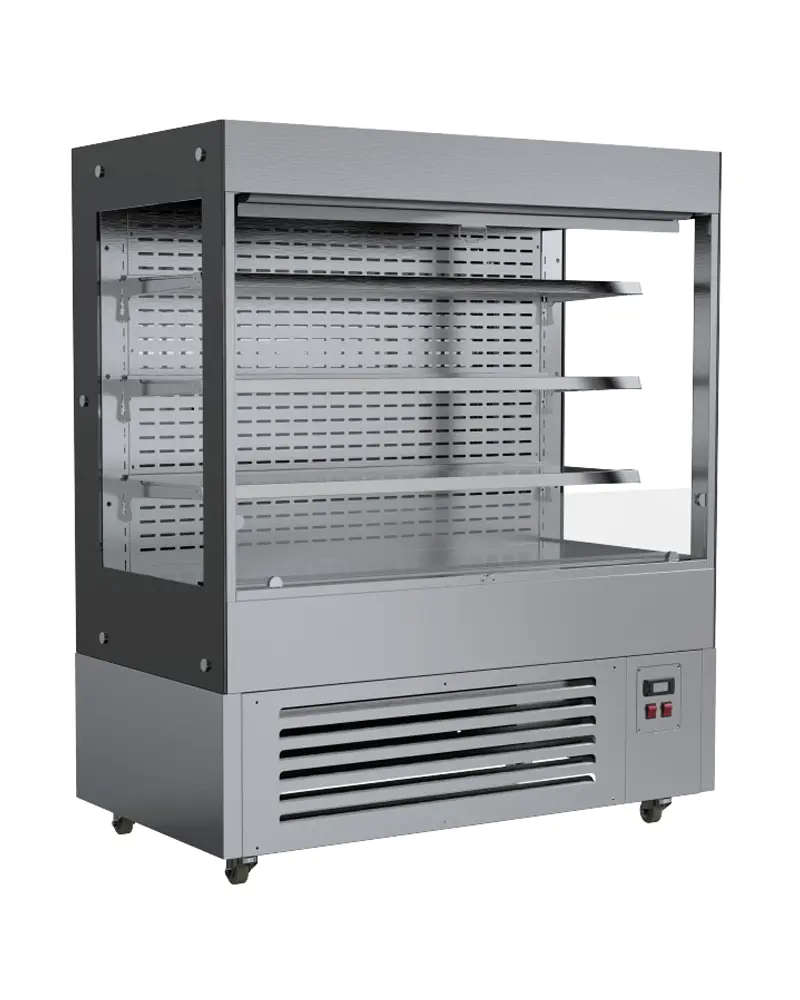
Open Automatic Defrost Refrigerated Showcase XCS-950Z/1250Z/1550Z/1550Z
Why Open Refrigerated Merchandising Matters
In commercial food retail, refrigeration is not only a preservation function. It is also a merchandising tool. A well-designed display cooler must maintain suitable product temperatures while presenting the merchandise in a clear and attractive way. The cabinet should be convenient for customers, practical for store staff, efficient to operate, and durable enough for continuous commercial use.
Open display refrigeration supports fast customer interaction. Shoppers can see the available products immediately and reach into the cabinet without handling a door. This format is particularly useful in high-traffic areas where customers make quick purchasing decisions. It is also suitable for self-service environments such as supermarkets, cafés, hotel breakfast areas, convenience stores, and prepared-food counters.
For retailers, the open design can create a stronger visual connection between the product and the customer. Labels, packaging, colors, and product arrangement are easier to observe. The cabinet can also be placed along a sales aisle or beside a checkout area to encourage impulse purchases of chilled beverages, snacks, desserts, and ready-to-eat products.
However, an open refrigerated cabinet must be engineered carefully. Since the front is not closed by a door, the cooling system must circulate cold air consistently through the product zone. The cabinet must also be loaded correctly, cleaned regularly, and positioned away from strong heat sources or obstructed airflow. The XCS series addresses these commercial requirements through a ventilated cooling system and a practical cabinet layout.
Product Series Overview
The XCS series is available in three sizes. The model number corresponds broadly to the cabinet length, while the depth and height remain consistent across the listed versions. This makes it easier for businesses to create a coordinated display area using different capacities within the same product family.
| Specification | XCS-950Z | XCS-1250Z | XCS-1550Z |
|---|---|---|---|
| Gross capacity | 300 L / 10.6 cu. ft. | 410 L / 14.5 cu. ft. | 510 L / 18.0 cu. ft. |
| Temperature range | 2–10°C / 35.6–50°F | 2–10°C / 35.6–50°F | 2–10°C / 35.6–50°F |
| Input power | 1,500 W | 1,500 W | 1,500 W |
| Refrigerant | R290 | R290 | R290 |
| Climate class | 6 | 6 | 6 |
| Net weight | 126 kg | 155 kg | 190 kg |
| Gross weight | 172 kg | 210 kg | 257 kg |
| Product dimensions | 900 × 656 × 1,435 mm | 1,200 × 656 × 1,435 mm | 1,500 × 656 × 1,435 mm |
| Product dimensions | 35.4 × 25.8 × 56.5 in | 47.2 × 25.8 × 56.5 in | 59.1 × 25.8 × 56.5 in |
| Loading quantity, 20GP / 40HQ | 18 / 36 pcs | 13 / 27 pcs | 10 / 22 pcs |
The consistent 656-millimeter depth is useful for planning a store layout. It provides a relatively compact footprint compared with deeper cold-room equipment while still offering a substantial product presentation area. The uniform 1,435-millimeter height also helps retailers create a consistent visual line when placing multiple cabinets together.
The XCS-950Z is appropriate for smaller shops, cafés, compact supermarkets, and locations where floor space is limited. Its 300-liter gross capacity provides a useful balance between display presence and footprint. The XCS-1250Z increases the available merchandising area for businesses with moderate product turnover. The XCS-1550Z is the largest listed option and is suited to high-volume retail environments that need more product capacity and a longer front-facing display.
Open Front Design for Customer Convenience
The most visible advantage of the series is its open display format. Customers do not need to pull a handle, open a door, or wait for a door to close before selecting an item. This is especially valuable when a store experiences frequent customer interaction with the cabinet throughout the day.
An open front can also reduce friction during product selection. Customers can compare multiple products at a glance, reach for an item quickly, and continue shopping without interrupting the aisle flow. Store staff can replenish products from the front or rear according to the shop layout, while the exposed display encourages regular stock rotation and visual inspection.
Compared with closed-door display refrigerators, open showcases can deliver stronger product visibility. Doors may reflect overhead lighting, create visual barriers, or require customers to open several sections when comparing products. An open cabinet presents the entire front display more directly, which can be beneficial for colorful packaged goods, beverages, desserts, prepared foods, and promotional products.
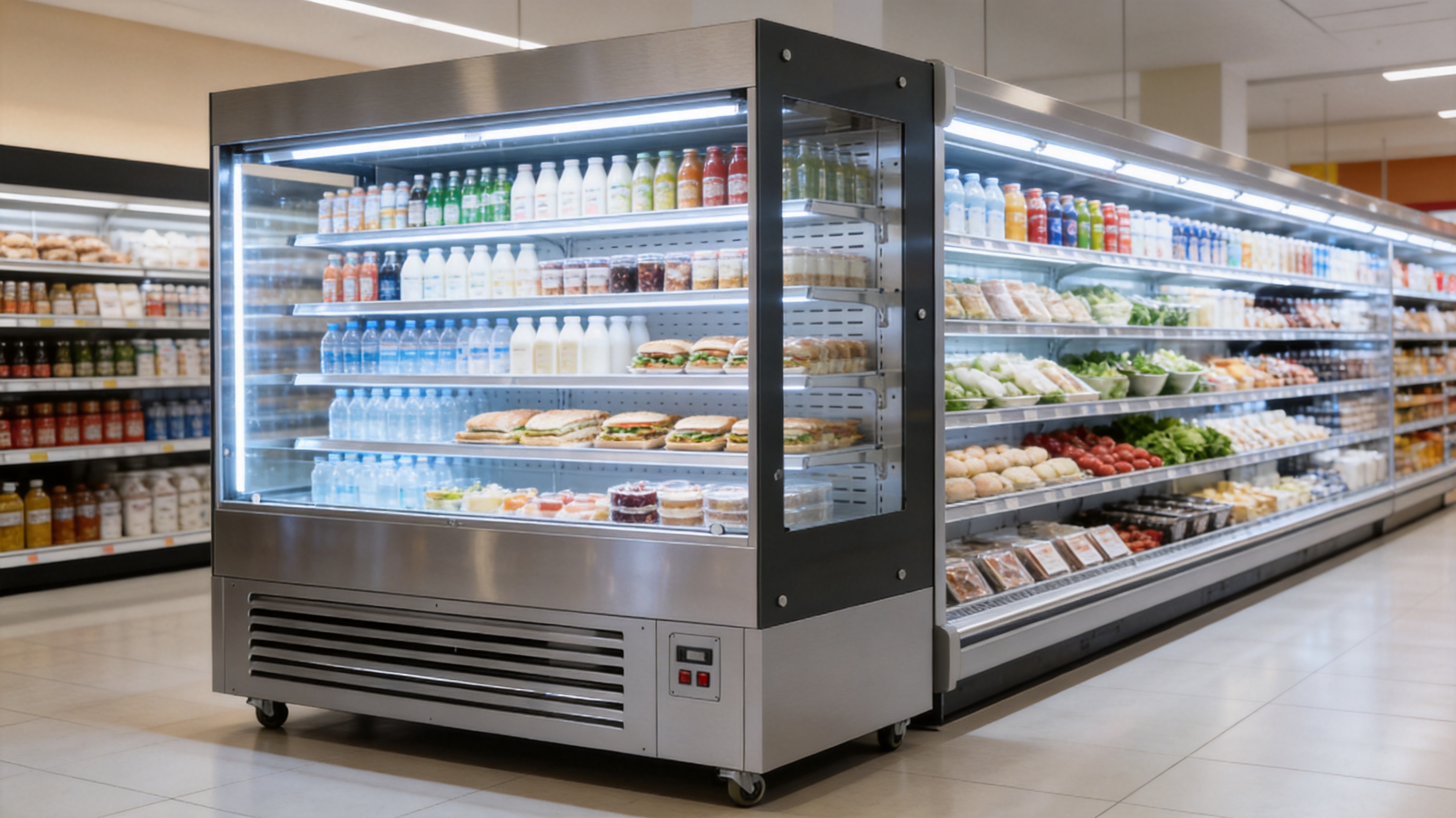
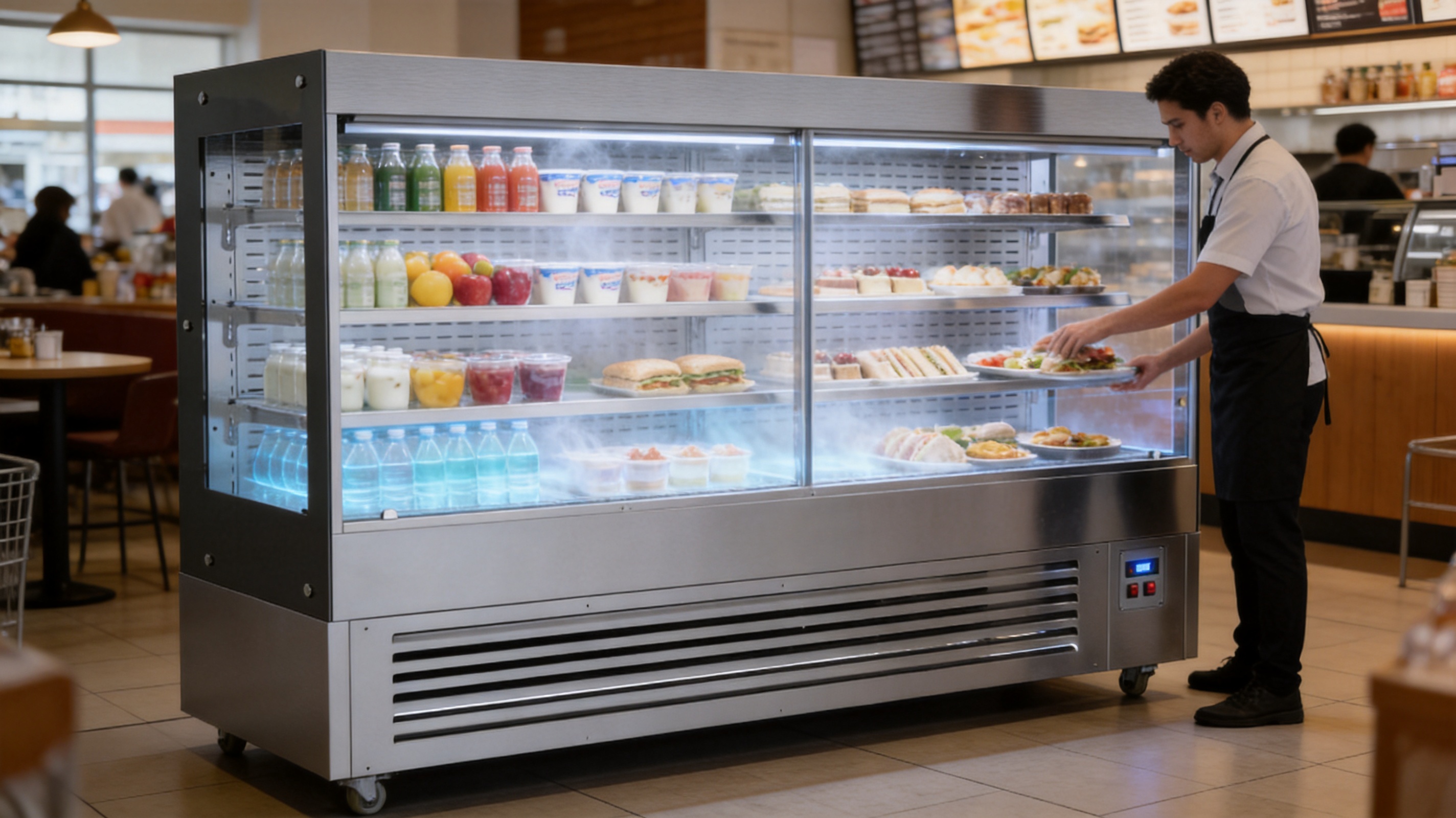
The open design is also useful for food-service counters. A café can place bottled drinks, yogurt, sandwiches, cakes, or prepared salads within easy reach of staff and customers. A hotel or catering operation can use the cabinet to present chilled breakfast items or grab-and-go meals. In each case, the equipment functions as both a refrigeration system and a point-of-sale presentation fixture.
Ventilated Cooling System
The XCS series uses a ventilated cooling system. This type of system circulates cooled air through the cabinet to support a stable temperature environment across the display area. Air circulation is particularly important in an open cabinet because the system must continuously manage air exchange at the front of the unit.
Ventilated cooling helps distribute cold air more evenly than a system relying only on static cooling surfaces. When products are arranged correctly and air outlets are not blocked, the system can support a consistent chilled environment throughout the display area. This is important for retailers that need to maintain similar conditions for products placed at different positions within the showcase.
The temperature range is specified as 2–10°C, or 35.6–50°F. This range covers many common chilled-food applications, although the suitability of a particular product depends on its packaging, food-safety requirements, local regulations, loading conditions, and operating environment. Retailers should always follow the storage instructions supplied by food manufacturers and relevant health authorities.
To achieve the best results, products should not be stacked beyond the recommended loading area. Merchandise should not cover air outlets or return-air openings. Adequate spacing allows cold air to move around the products and helps prevent localized warm spots. Regular monitoring with an appropriate thermometer is also recommended, especially when the cabinet is first installed or when ambient conditions change.
Automatic Defrost for Commercial Convenience
Automatic defrosting is another important feature of the XCS refrigerated showcase. In a refrigeration system, moisture from the surrounding air can accumulate as frost on cold surfaces. If frost is allowed to build up, it may reduce heat-transfer performance, restrict airflow, increase operating stress, and reduce usable display space.
An automatic defrost function helps manage this accumulation without requiring staff to shut down the cabinet and perform frequent manual defrosting. The system initiates a controlled defrost cycle according to its operating design, allowing frost to be removed more conveniently. This can reduce routine labor and support more consistent refrigeration performance over time.
Automatic defrost does not eliminate the need for cleaning and maintenance. Staff should still keep the air passages clear, clean the interior and exterior surfaces, inspect the drain area, and follow the equipment maintenance instructions. The cabinet should also be allowed to complete its defrost process properly rather than being repeatedly switched off during a cycle.
For busy retail operations, the practical benefit is significant. Manual defrosting can require staff time, temporary product relocation, and interruptions to sales activity. An automatic system helps the cabinet remain available for daily merchandising while reducing the frequency of disruptive maintenance tasks.
Digital Temperature Control and Display
The cabinet includes a digital temperature controller and display. This provides a clear way for operators to view and manage the refrigeration setting. Digital controls are generally easier to read than mechanical dial indicators, particularly in a busy commercial environment where staff need to check equipment quickly.
A visible temperature display supports daily operating discipline. Staff can inspect the cabinet during opening procedures, product replenishment, cleaning, and closing checks. If the displayed temperature moves outside the expected range, operators can investigate possible causes such as excessive loading, blocked airflow, frequent exposure to warm ambient air, a dirty condenser, or a service issue.
The control arrangement also supports a more organized maintenance routine. Temperature checks can be recorded as part of a store’s food-safety documentation. This is particularly useful for businesses handling ready-to-eat foods, dairy products, desserts, meat products, or other temperature-sensitive goods.
Temperature settings should be selected according to the product category and operating instructions. A lower setting is not automatically better for every product. The objective is to maintain safe and appropriate conditions while avoiding unnecessary energy use or product quality problems caused by excessive cooling.
Separated Power and Light Controls
The XCS series includes a separated power button and a separated light button. This simple control arrangement gives operators greater flexibility than a single combined switch. The main refrigeration system and the display lighting can be managed independently according to store requirements.
Separate lighting control can be useful outside peak sales hours. For example, a store may keep refrigeration operating while reducing display lighting during cleaning, stocking, or closed hours. It may also switch the lights on only when the cabinet is being used for active merchandising. The exact operating policy depends on the business, local energy practices, and product presentation requirements.
Independent controls also make troubleshooting more straightforward. If lighting requires attention, the refrigeration system does not necessarily need to be switched off. Similarly, operators can confirm whether a presentation issue is related to the light circuit or to the main cabinet power supply.
Display lighting helps products stand out under indoor retail illumination. Bright, even lighting can improve visibility of packaging, labels, and product colors. It can also make the cabinet look cleaner and more organized, provided that the display is regularly replenished and cleaned.
Stainless Steel Body Construction
The cabinet uses a stainless steel body. Stainless steel is widely used in commercial food equipment because it offers a combination of durability, cleanability, and resistance to everyday commercial wear. Its smooth surface can be wiped down efficiently, which supports hygiene routines in food retail and food-service environments.
A stainless steel exterior also provides a professional appearance. It can coordinate with other commercial kitchen appliances, preparation counters, bakery equipment, and food-service fixtures. For a customer-facing cabinet, the material creates a clean visual impression while helping the equipment withstand regular contact from staff, carts, cleaning tools, and nearby retail activity.
Correct cleaning practices remain important. Operators should use cleaning products that are suitable for stainless steel and avoid harsh methods that could scratch or damage the surface. Spills should be removed promptly, and areas around the base and casters should be checked because dust and residue can collect in these locations.
The body material is only one part of overall durability. Long service life also depends on correct installation, suitable electrical supply, proper loading, regular condenser maintenance, stable floor placement, and timely professional servicing. When these practices are followed, the stainless steel construction can contribute to dependable commercial use.
Tempered Glass for Visibility and Protection
Tempered glass is incorporated into the showcase design. Glass allows customers to observe the display while helping define and protect the refrigerated merchandising area. In a busy store, the glass can help reduce accidental contact with products and provide a clear visual boundary around the cabinet.
Tempered glass is processed to provide improved resistance compared with ordinary glass. It is commonly selected for commercial equipment because it can better withstand the normal temperature changes and handling conditions associated with professional use. Nevertheless, glass should always be treated with care. Staff should inspect it regularly and avoid impact from heavy objects or cleaning equipment.
The glass elements also support a premium product presentation. Chilled goods can be displayed in an orderly, visible format while the cabinet retains a clean architectural appearance. When combined with integrated lighting and a stainless steel body, the result is suitable for both back-of-house food-service areas and front-of-house retail locations.
Cleaning the glass should be included in daily or scheduled maintenance. Fingerprints, condensation residue, dust, and food splashes can reduce visibility and make a cabinet appear poorly maintained. A clear glass surface helps the equipment perform its merchandising role more effectively.
Mobility and Floor Positioning
Each unit is equipped with four casters, with brakes on the front two casters. This arrangement allows the showcase to be moved during installation, cleaning, layout changes, and maintenance. Once the cabinet is placed in its operating position, the front brakes can be engaged to help hold it securely.
Mobility is a practical advantage over fixed display structures. Retailers may need to reorganize a sales floor for seasonal promotions, renovate an area, create additional aisle space, or clean behind the cabinet. Casters make these tasks easier and can reduce the need for lifting equipment during routine movement.
The brakes should be applied whenever the cabinet is in normal operation. The unit should stand on a stable, level surface, and the casters should be checked periodically for damage or excessive wear. Staff should not use the cabinet as a support to push other heavy equipment or attempt to move it while it is heavily loaded unless appropriate safety procedures are followed.
Because the showcase is a powered refrigeration appliance, movement should be performed carefully. The electrical cable must not be stretched, trapped, or damaged. After transportation or repositioning, the cabinet should be allowed to settle according to the manufacturer’s instructions before being returned to service, particularly if it has been tilted.
Climate Class 6 and Commercial Operating Conditions
The listed climate type for the XCS models is 6. Climate classification is relevant when selecting commercial refrigeration for demanding environments. It indicates that the cabinet is designed with a high ambient-temperature operating condition in mind, although actual performance depends on installation, ventilation, maintenance, electrical conditions, and product loading.
A high climate-class rating is valuable for businesses located in warm regions, busy kitchens, crowded retail spaces, or areas where ambient heat may be elevated. Open display refrigeration is exposed to the surrounding room air, so the cabinet must be selected with the intended operating environment in mind.
Retailers should avoid placing the cabinet next to ovens, cooking equipment, radiators, direct sunlight, or other sources of heat. Adequate clearance around ventilation areas is necessary so that the refrigeration system can release heat effectively. Poor ventilation may increase energy consumption and place additional stress on refrigeration components.
Climate class should be considered together with local conditions. A cabinet installed in a hot, humid shop with frequent customer access may experience a different load profile from one installed in an air-conditioned café. Proper site planning and routine temperature checks are therefore important even when the equipment has a high climate classification.
R290 Refrigerant and Contemporary Refrigeration Design
The XCS series uses R290 refrigerant. R290 is propane used as a refrigerant and is recognized in modern refrigeration applications for its low global warming potential compared with many traditional refrigerants. Its use reflects the broader movement toward refrigerant technologies with reduced environmental impact.
Because R290 is flammable, refrigeration equipment using it must be designed, manufactured, installed, and serviced according to applicable safety standards and regulations. Only qualified technicians should open the refrigeration circuit or perform refrigerant-related repairs. Operators should follow all instructions on the equipment rating label and in the product documentation.
The use of R290 can be an advantage for distributors and commercial users who are seeking equipment aligned with current environmental expectations. It may also support compliance with regional refrigerant policies, depending on the destination market and the applicable regulations. Buyers should confirm local requirements before import, installation, or resale.
Refrigerant choice alone does not determine total environmental performance. Energy consumption, cabinet loading, maintenance, operating temperature, component quality, store conditions, and end-of-life handling all influence the equipment’s overall impact. Efficient daily operation and responsible servicing are equally important.
Capacity Selection for Different Businesses
XCS-950Z: Compact Commercial Display
The XCS-950Z provides a gross capacity of 300 liters. It is a practical option for smaller stores, cafés, bakeries, offices with food-service areas, and specialty retailers. Its 900-millimeter width can fit into locations where a larger cabinet would restrict customer movement or reduce available floor space.
This model can be used for a focused product range, such as bottled drinks, sandwiches, dairy products, dessert cups, packaged salads, or grab-and-go meals. It may also work as a supplementary cabinet beside a larger refrigeration system, allowing a store to place promotional products in a high-visibility location.
XCS-1250Z: Balanced Display and Capacity
The XCS-1250Z provides 410 liters of gross capacity and a 1,200-millimeter width. It offers more presentation space without changing the cabinet’s depth or height. This makes it suitable for medium-sized food retailers, cafés with higher traffic, convenience stores, and supermarket departments with a broader assortment of chilled products.
The longer display area can make product grouping easier. Retailers may allocate different sections to beverages, dairy items, prepared foods, desserts, or promotional merchandise. It can also provide additional space for maintaining a full and visually attractive display during busy periods.
XCS-1550Z: High-Volume Merchandising
The XCS-1550Z is the largest listed version, with a gross capacity of 510 liters and a 1,500-millimeter width. It is designed for businesses that need a longer customer-facing display and greater stocking capacity. Supermarkets, larger convenience stores, food halls, and high-volume cafés may benefit from its extended presentation area.
The larger cabinet requires careful floor planning. Its gross weight is listed as 257 kilograms when packaged, and its net weight is 190 kilograms. The installation area should be checked for floor capacity, access routes, door widths, elevator dimensions, and electrical connection requirements before delivery.
Advantages Compared with Conventional Display Refrigerators
The XCS series offers several advantages compared with conventional closed-door display refrigerators. The open front improves accessibility and reduces the physical barrier between the customer and the product. This can be particularly valuable in fast-paced retail environments where customers need to select items quickly.
The cabinet also provides a broad visual presentation. Products can be seen from the aisle without requiring customers to look through a door or open multiple sections. This supports impulse merchandising and makes promotional displays easier to notice.
Automatic defrosting reduces the need for frequent manual intervention. In contrast, basic refrigeration cabinets may require more frequent shutdowns and manual frost removal. A digitally controlled temperature system also gives operators a clearer view of operating conditions than a simple mechanical indicator.
The stainless steel body and tempered glass create a professional commercial appearance. Four casters with two front brakes provide more flexibility than a permanently fixed cabinet. Separate power and lighting controls give the operator more control over presentation and operating routines.
R290 refrigerant is another differentiating feature for buyers comparing older and newer refrigeration equipment. While every model must be evaluated for its complete technical and energy profile, the refrigerant choice is consistent with the industry’s movement toward lower-impact alternatives.
The product range itself is also an advantage. Businesses can select a cabinet length that matches their sales volume and available space while retaining a consistent appearance and core specification. This is useful for chains, distributors, and retailers planning multiple installations.
Manufacturing Capabilities and Company Strengths
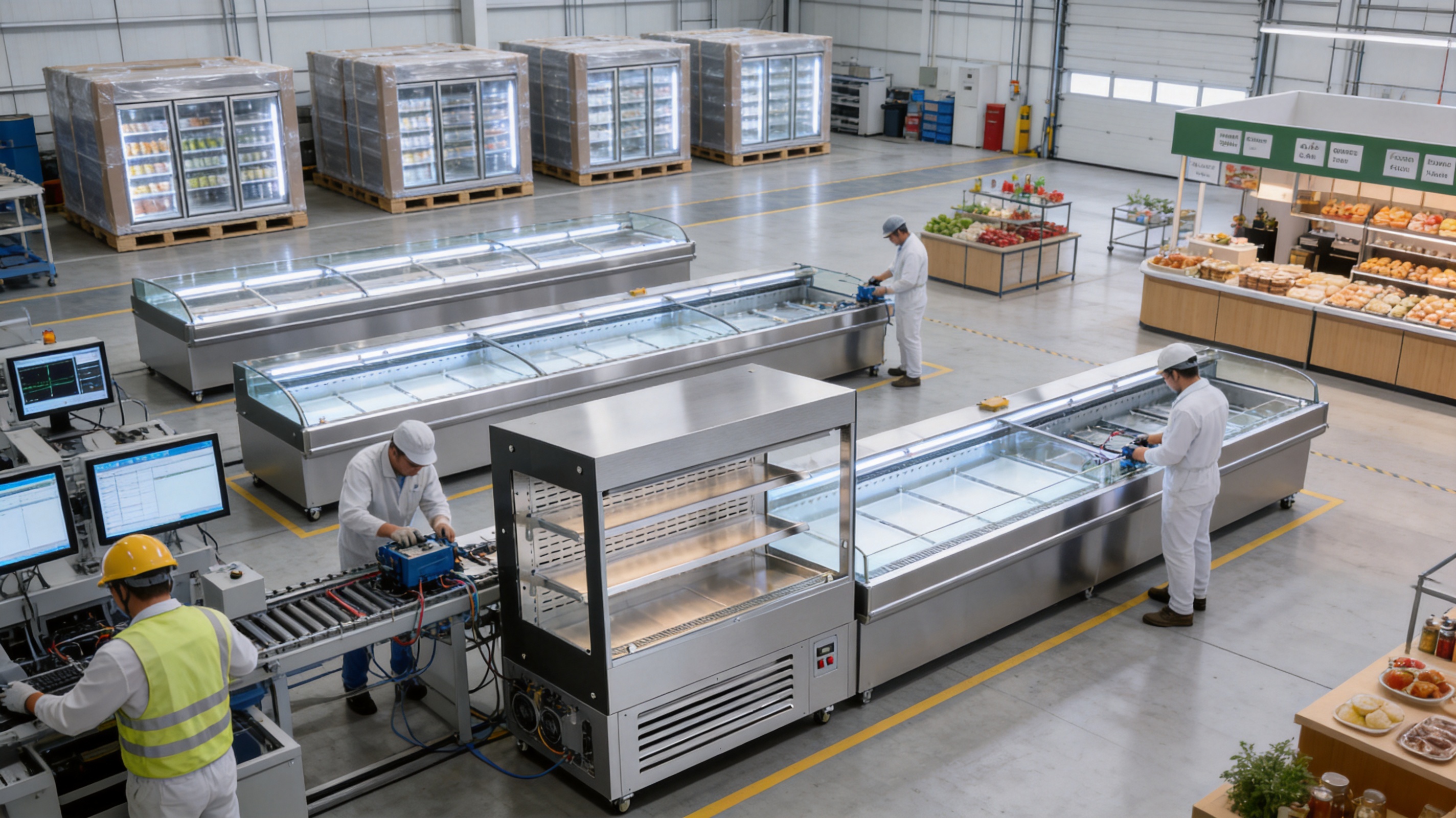
Ningbo XiangChi Electrical Co., Ltd. was established in 2007 and specializes in vertical display cabinets, cake cabinets, warming cabinets, and related commercial refrigeration equipment. The company reports more than ten years of industry experience and operates a modern management and production facility covering approximately 40,000 square meters.
A dedicated production base gives a manufacturer the ability to coordinate several important stages of product development and manufacturing. These stages may include structural design, sheet-metal processing, insulation assembly, refrigeration-system integration, electrical installation, glass fitting, quality inspection, packaging, and shipment preparation.
The company has its own professional research and development team. In commercial refrigeration, R&D capability is important because the equipment must combine thermal performance, product visibility, structural durability, electrical safety, serviceability, and manufacturing efficiency. A product is successful only when these elements work together in actual retail conditions.
Advanced testing facilities are also identified as part of the company’s capabilities. Testing supports quality improvement by allowing manufacturers to evaluate refrigeration performance, temperature stability, electrical operation, component compatibility, structural integrity, and other product characteristics before shipment.
For international customers, production consistency is especially important. Export equipment must be packaged securely, labeled appropriately, and prepared for different market requirements. The listed packaging dimensions and container-loading quantities help importers plan logistics, warehouse space, and shipping costs.
The company reports obtaining CE, GS, CCC, CB, RoHS, ETL, and other major certifications. Certification requirements differ by market and by product configuration, so buyers should confirm which approvals apply to the exact model, voltage, plug, and destination country. Nevertheless, experience with multiple certification systems indicates an orientation toward international product compliance.
The company’s stated philosophy emphasizes innovation, quality, and service. These priorities are relevant to commercial refrigeration buyers because the purchasing decision involves more than the initial equipment price. Product reliability, technical communication, spare-parts support, warranty handling, and long-term cooperation can strongly influence the total value of a refrigeration project.
Production and Quality-Control Considerations
Commercial display refrigeration requires close attention to manufacturing detail. The cabinet must maintain dimensional accuracy so that glass, panels, shelves, doors or service sections, lighting components, and refrigeration parts fit correctly. Poor alignment can affect appearance, sealing, structural stability, or service access.
Sheet-metal work is also important. Stainless steel panels should be formed and finished consistently, with edges treated appropriately for safe handling and easy cleaning. Interior surfaces should be designed to minimize dirt traps and support routine sanitation. The final cabinet should present a durable appearance suitable for customer-facing use.
Insulation quality influences refrigeration performance. A well-assembled insulated cabinet reduces unwanted heat transfer and helps the cooling system maintain the required temperature. Insulation must be installed consistently around the product compartment and cabinet structure, with attention to joints, corners, and service openings.
The refrigeration system requires careful integration. The compressor, condenser, evaporator, fans, controls, tubing, drainage, and refrigerant circuit must operate as a coordinated system. R290 equipment additionally requires appropriate component selection, safety controls, labeling, assembly procedures, and service practices.
Electrical installation is another important quality area. The digital controller, display, lighting, fan motors, power button, and other components must be wired correctly and protected appropriately. Factory testing can help identify issues before shipment, reducing the likelihood of installation problems for distributors and end users.
Final inspection should include visual checks, temperature-related checks, control operation, lighting operation, caster movement, brake function, glass condition, packaging protection, and identification labels. Consistent inspection is especially important when products are shipped internationally and may be handled several times before reaching the final installation site.
Installation Guidance for Best Performance
The showcase should be installed in a clean, dry, and adequately ventilated indoor location unless the product documentation states otherwise. The cabinet should not be placed where it is exposed to rain, water spray, excessive dust, direct sunlight, or strong heat.
Before installation, measure the access route. Check entrances, corridors, elevators, ramps, and final placement areas. The product dimensions are approximately 900, 1,200, or 1,500 millimeters wide, 656 millimeters deep, and 1,435 millimeters high. Packaging dimensions are larger, so delivery planning must be based on the packaged size rather than only the cabinet size.
Once positioned, engage the front caster brakes. Confirm that the cabinet is stable and that the power cable is not pinched or routed through a wet area. The electrical supply must match the rating information for the specific order configuration. Voltage, frequency, plug type, and local electrical protection should be confirmed before shipment and installation.
Leave sufficient clearance around ventilation and service areas. Do not place boxes, cartons, signs, or other equipment against air inlets or outlets. Restricted airflow can increase the refrigeration load and may lead to poor temperature performance.
After commissioning, allow the cabinet to reach its operating condition before loading it fully. Check the displayed temperature, verify the lighting, listen for unusual noise, and inspect for abnormal vibration or water accumulation. Product loading should begin only after the equipment is operating normally.
Loading and Daily Operation
Products should be loaded in an organized manner that allows air to circulate. Avoid pressing packages directly against air outlets or stacking items above the recommended product line. A full cabinet is not necessarily an efficient cabinet if the airflow is blocked.
Use the temperature range appropriate for the products being displayed. Chilled products should be placed in the cabinet according to their storage requirements, and products that require freezing should not be placed in this refrigerated showcase. The series is designed for chilled operation at 2–10°C, not for frozen-food storage.
Staff should rotate stock according to the store’s inventory policy. Older products should generally be positioned for earlier sale, subject to applicable food-safety procedures. Spills, damaged packaging, and expired items should be removed promptly to protect hygiene and product presentation.
The open front makes replenishment convenient, but frequent exposure to warm ambient air can increase the refrigeration load. Staff should avoid leaving the cabinet overloaded with open cartons or standing in front of it for extended periods while stocking. Efficient replenishment helps preserve the intended temperature environment.
The digital display should be checked at regular intervals. A sudden temperature change may indicate a blocked airflow path, excessive ambient heat, a door or panel issue elsewhere in the system, a dirty condenser, a power interruption, or a refrigeration fault. Early attention can prevent product loss and more serious equipment problems.
Cleaning and Maintenance
Regular cleaning is essential for both hygiene and equipment performance. The interior display surfaces, stainless steel body, tempered glass, product supports, air passages, and drainage areas should be cleaned according to a documented schedule. Cleaning frequency should reflect the product types, store traffic, and local food-safety requirements.
Before cleaning electrical areas, follow the appropriate safety procedure and disconnect power when required. Water should not be sprayed directly into controls, lighting components, fans, or other electrical parts. Use suitable cloths and approved cleaning agents, and dry surfaces after cleaning.
Air vents and condenser areas should remain free from dust and debris. A dirty condenser can reduce heat rejection and make the refrigeration system work harder. Maintenance personnel should inspect these areas at suitable intervals and follow the manufacturer’s recommendations for cleaning and servicing.
The drain system should also be checked. Blocked drainage can cause water accumulation, unpleasant odors, or leakage around the cabinet. Any unusual water, frost, noise, vibration, or temperature behavior should be investigated by qualified service personnel.
Inspect the casters and front brakes periodically. A damaged caster can make movement unsafe, while a worn brake may allow the cabinet to shift during use. The glass should be checked for chips or cracks, and any damaged tempered-glass component should be handled according to professional replacement procedures.
Commercial Applications
The XCS series can serve a broad range of applications. In supermarkets, it can display dairy products, packaged meals, desserts, beverages, sandwiches, salads, and other chilled merchandise. The open front is suitable for high-frequency customer access and quick product selection.
Convenience stores can use the cabinet for bottled drinks, cans, ready-to-eat food, chilled snacks, and promotional items. The different widths allow the store to select a compact unit for a small location or a longer unit for a high-volume sales area.
Cafés and bakeries can use the showcase to present chilled cakes, dessert cups, yogurt, fruit, sandwiches, and beverages. The stainless steel and glass combination can complement both modern and traditional food-service interiors.
Hotels and catering businesses may use the equipment for breakfast service, buffet presentation, or grab-and-go areas. The open design allows guests to see available products clearly, while staff can monitor stock and replenish the cabinet quickly.
Food halls and prepared-food counters can benefit from a longer display format. The XCS-1550Z can provide a broad front-facing area for grouping several product categories, although the cabinet must be loaded in a way that preserves airflow and the required temperature conditions.
Institutional facilities such as schools, hospitals, offices, and community dining areas may also consider open refrigerated showcases for controlled food-service environments. Product suitability and applicable hygiene rules should always be evaluated before installation.
Packaging, Shipping, and Distribution
The listed package dimensions support planning for export logistics. The XCS-950Z package is approximately 970 × 750 × 1,580 millimeters, the XCS-1250Z package is approximately 1,270 × 750 × 1,580 millimeters, and the XCS-1550Z package is approximately 1,570 × 750 × 1,580 millimeters.
Container loading quantities are listed as 18/36 pieces for the XCS-950Z, 13/27 pieces for the XCS-1250Z, and 10/22 pieces for the XCS-1550Z in 20GP/40HQ containers. These figures can help importers estimate shipment volumes, warehouse requirements, and expected landed costs.
Gross weights are higher than net weights because they include packaging and shipping protection. The packaged weights are listed as 172 kilograms, 210 kilograms, and 257 kilograms for the three models respectively. Handling plans should account for these figures and should use suitable lifting or moving equipment where necessary.
Distributors should confirm the final packing method, shipping marks, accessory list, voltage configuration, documentation, and inspection requirements before placing a large order. These details are especially important when the product is being shipped to multiple countries with different electrical and regulatory requirements.
How the Series Supports Total Business Value
The value of commercial refrigeration should be considered across the entire operating life of the equipment. A cabinet that is inexpensive to purchase but difficult to clean, inconvenient to maintain, or unreliable under demanding conditions may create higher costs over time.
The XCS series supports practical daily value through automatic defrosting, digital temperature management, separate lighting control, movable casters, stainless steel construction, and a range of capacities. These features can reduce routine inconvenience and help staff keep the display attractive and operational.
The open display format can also contribute to sales performance by improving product visibility and access. While sales results depend on product selection, pricing, store design, and customer behavior, a well-positioned refrigerated showcase can support stronger merchandising than hidden or poorly presented stock.
For distributors, the product family offers a standardized platform with three size options. This can simplify product selection for different customer segments and allow a supplier to address small, medium, and large retail installations with related models.
For international buyers, the manufacturer’s reported experience with global certifications and export-oriented production can support communication during specification, documentation, and compliance review. Buyers should still perform their own technical verification and request the documents required for the intended market.
Recommended Selection Process
First, identify the product categories that will be stored. Confirm whether the merchandise requires chilled, frozen, ambient, or heated conditions. The XCS series is a refrigerated showcase intended for products suitable for a 2–10°C environment.
Second, estimate daily sales volume and replenishment frequency. A compact cabinet may be suitable for a focused range, while a longer cabinet can reduce replenishment frequency and provide more room for product grouping.
Third, measure the available floor area and access route. Include clearance for customer movement, staff replenishment, ventilation, cleaning, and future servicing. Do not select a model based only on its front width.
Fourth, evaluate the ambient environment. Consider room temperature, humidity, nearby cooking equipment, direct sunlight, store traffic, and air-conditioning performance. The listed climate type is useful information, but correct installation remains essential.
Fifth, confirm the electrical and regulatory requirements. Check voltage, frequency, plug style, safety approvals, labeling, and local import rules. If the equipment will be installed in a market requiring specific certification, obtain confirmation for the exact model configuration.
Finally, assess after-sales support. Ask about warranty conditions, spare parts, service procedures, operating manuals, packaging, lead time, and technical assistance. A dependable supplier relationship can be as important as the cabinet’s initial specification.
Q&A
What products can be displayed in the refrigerated showcase?
The cabinet can be used for many chilled products, including beverages, dairy items, sandwiches, packaged salads, desserts, ready-to-eat meals, and other food products suitable for storage between 2 and 10°C. The final application should follow product-label instructions and local food-safety regulations.
Is the XCS series a freezer?
No. The listed models are open refrigerated showcases with a temperature range of 2–10°C. They are not specified for frozen-food storage. Buyers requiring frozen display should select equipment specifically designed as a commercial freezer.
What is the difference between the three models?
The principal difference is cabinet width and gross capacity. The XCS-950Z is 900 millimeters wide with 300 liters of gross capacity. The XCS-1250Z is 1,200 millimeters wide with 410 liters. The XCS-1550Z is 1,500 millimeters wide with 510 liters. Their listed depth, height, temperature range, input power, refrigerant, and climate type are the same.
What does automatic defrost do?
Automatic defrost removes accumulated frost through a controlled defrost cycle. It reduces the need for frequent manual defrosting and helps support continued refrigeration performance. It does not replace regular cleaning, condenser maintenance, drainage checks, or professional servicing.
Why is R290 used?
R290 is a refrigerant with a low global warming potential compared with many older refrigerants. It is used in modern refrigeration equipment, but it is flammable. Only qualified technicians should service the refrigerant circuit, and all applicable safety requirements must be followed.
Can the cabinet be moved after installation?
Yes. The cabinet has four casters, and the front two include brakes. The brakes should be engaged during normal operation. When moving the unit, staff should protect the power cable, avoid excessive tilting, use suitable handling practices, and confirm stability after repositioning.
Does the cabinet have lighting controls?
Yes. The series includes a separated light button, allowing the display lighting to be controlled independently from the main power button. This gives operators more flexibility during merchandising, cleaning, stocking, and non-sales periods.
What maintenance does the cabinet require?
Routine maintenance includes cleaning the interior and exterior, keeping air passages clear, inspecting the condenser area, checking drainage, monitoring temperature, cleaning the glass, inspecting casters and brakes, and arranging qualified technical service when unusual noise, frost, water, or temperature problems occur.
What is the advantage of choosing a series with several widths?
Multiple widths allow businesses to choose a capacity that matches their floor space and product turnover. They also help retailers create a consistent appearance across different locations or departments while using a model appropriate for each sales area.
What should importers confirm before ordering?
Importers should confirm the exact model, dimensions, voltage, frequency, plug type, certification documents, packaging details, accessories, warranty terms, shipping marks, lead time, spare-parts support, and destination-market requirements. They should also verify that the selected cabinet is suitable for the intended ambient conditions and product categories.
Conclusion
The Open Automatic Defrost Refrigerated Showcase XCS-950Z, XCS-1250Z, and XCS-1550Z provides a practical refrigeration and merchandising solution for professional food retail and food-service environments. Its open front supports quick customer access and clear product visibility, while ventilated cooling is designed to maintain a chilled display environment within the listed 2–10°C range.
Automatic defrosting can reduce routine labor, and the digital controller and display make temperature management more visible. The stainless steel body supports a professional appearance and straightforward cleaning, while tempered glass improves product visibility. Four casters, front brakes, separated power and lighting controls, R290 refrigerant, and a climate type of 6 add practical value for commercial users.
The three available sizes make the series adaptable to different store formats. The 300-liter XCS-950Z suits compact locations, the 410-liter XCS-1250Z offers a balanced capacity, and the 510-liter XCS-1550Z provides a longer display for higher-volume operations. Businesses can select the appropriate model without abandoning a consistent equipment design.
Ningbo XiangChi Electrical Co., Ltd. strengthens the product offering through its experience in commercial display equipment, reported 40,000-square-meter facility, professional R&D team, testing capabilities, and experience with international certifications. For buyers comparing suppliers, these manufacturing and quality-oriented resources are important factors alongside the cabinet’s visible features.
As with all commercial refrigeration, the best results depend on appropriate installation, correct loading, regular cleaning, temperature monitoring, and qualified maintenance. When properly selected and operated, the XCS series can help businesses protect chilled products, improve merchandising, and create a more convenient shopping experience.
References
1. Product specification information for the Open Automatic Defrost Refrigerated Showcase XCS-950Z, XCS-1250Z, and XCS-1550Z.
2. Manufacturer information for Ningbo XiangChi Electrical Co., Ltd., including company history, manufacturing facilities, research and development capabilities, and certification experience.
3. General commercial refrigeration principles concerning ventilated cooling, automatic defrost, temperature monitoring, cabinet loading, and routine maintenance.
4. General food-retail equipment guidance concerning chilled-food storage, display merchandising, sanitation, and safe equipment operation.
5. General technical information concerning R290 hydrocarbon refrigerant and the need for qualified service procedures.
Product: Open Automatic Defrost Refrigerated Showcase XCS-950Z/1250Z/1550Z/1550Z

You May Also Like
.jpg?imageView2/2/w/500/h/500/format/jp2/q/100 "Four Sides Glasses Display Cooler")
.jpg?imageView2/2/w/500/h/500/format/jp2/q/100 "White 4-Sided Glass Refrigerated Display Case")
.jpg?imageView2/2/w/500/h/500/format/jp2/q/100 "Refrigerated Display Cake Countertop Four Sides Glasses Display Cooler")
.jpg?imageView2/2/w/500/h/500/format/jp2/q/100 "Four Sides Glasses Display Cooler")

-
- Navigation
- Home
- About Us
- Products
- News
- Contact Us
 East Zone, Guanhaiwei Industrial Park, Cixi City, Ningbo, Zhejiang, China
 +86-574-63668678
 +86-574-63668108
Copyright © Ningbo XiangChi Electrical Co.,Ltd All Rights Reserved.
