
 简体中文
简体中文 English
 Español
News
4-Sided Glass Refrigerated Standing Display Cooler: A Practical Guide to Efficient Commercial Product Presentation
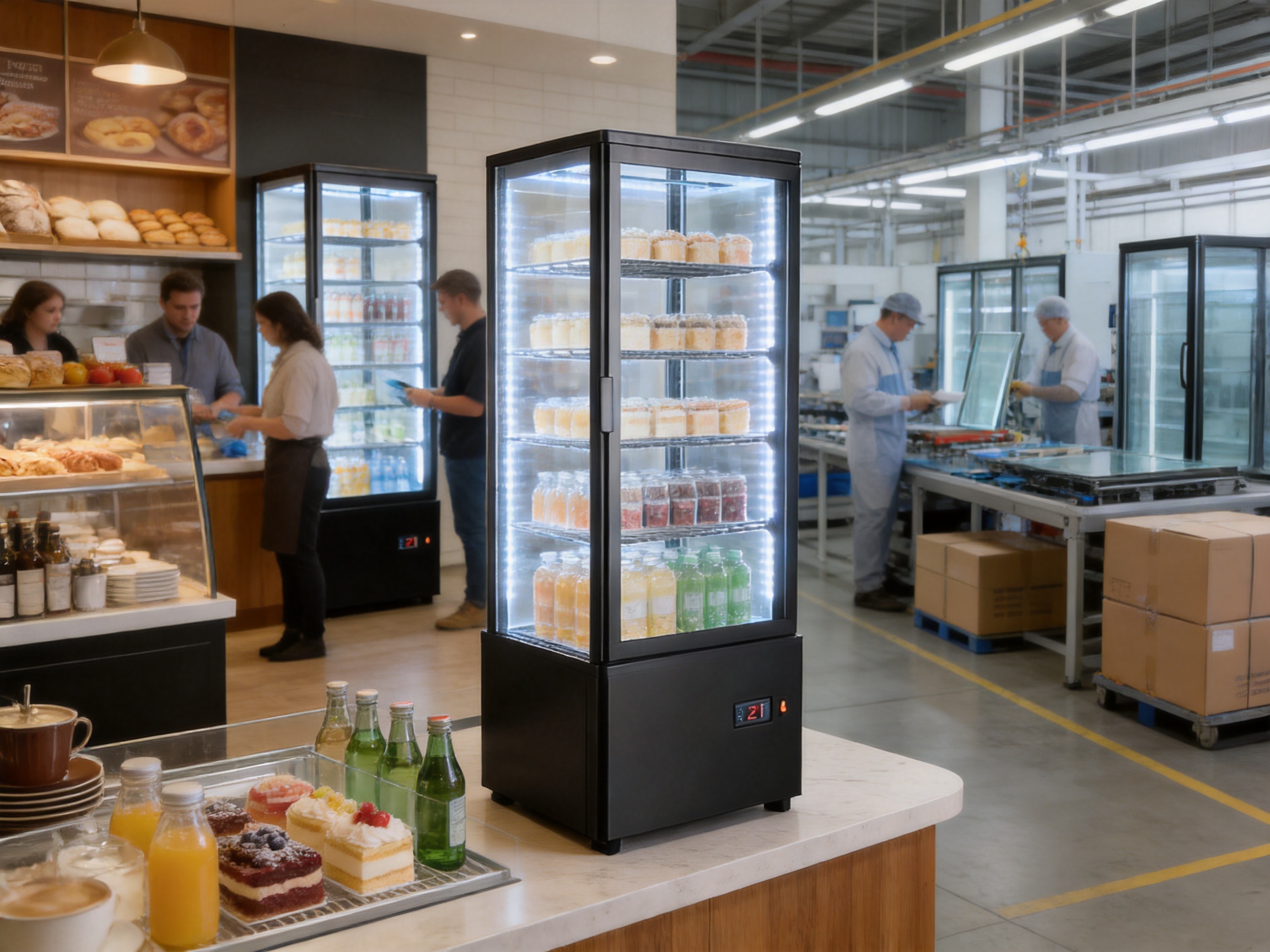
Commercial refrigeration is no longer limited to keeping food and beverages cold. In modern retail, hospitality, and food-service environments, a refrigerator must also present products attractively, use floor space efficiently, protect food quality, and support a smooth daily operating routine. The 4 Sided Glass Refrigerated Standing Display Cooler is designed to meet these combined requirements in a compact vertical format.
With a 98-liter capacity, a temperature range of 2–10°C, four-sided double-glazed construction, internal LED lighting, ventilated cooling, automatic defrost, and adjustable shelves, the XC-98L provides a balanced solution for displaying chilled products. It is suitable for convenience stores, cafés, bakeries, hotels, restaurants, supermarkets, reception areas, offices, and other commercial locations where products need to remain visible and properly refrigerated.
Unlike a conventional solid-door refrigerator, this display cooler allows customers and staff to see the stored products from multiple directions. The transparent cabinet improves product visibility, while the vertical design helps create a clear presentation without requiring a large footprint. For businesses that want to combine merchandising and refrigeration in one appliance, this configuration offers meaningful operational and commercial advantages.
Understanding the 4-Sided Glass Display Concept
A four-sided glass display cooler is built around visibility. The front, sides, and glass sections of the cabinet allow products to be viewed from different angles. This makes the appliance especially useful in locations where customers approach from more than one direction, such as the center of a store, a café service area, a hotel lobby, or an exhibition-style food presentation zone.
The XC-98L uses double glass on all four sides. Double glazing contributes to the separation between the refrigerated interior and the surrounding room environment. It can help reduce the influence of ambient temperature on the cabinet and supports a more stable internal cooling environment. The glass also creates a clean and modern appearance that helps packaged food, drinks, desserts, dairy products, and other chilled goods stand out.
Product visibility is particularly important for impulse purchases. When consumers can immediately see the selection, packaging, color, and quantity of products, they can make decisions more quickly. A well-organized glass cabinet can therefore support both customer convenience and better merchandising. Staff can also inspect the contents without repeatedly opening the door, which helps reduce unnecessary temperature fluctuations and saves time during routine checks.
The vertical standing format offers another advantage. Instead of spreading products across a wide horizontal counter, the cooler uses several levels of vertical space. This allows businesses to display a variety of products while preserving valuable floor area. The footprint of the XC-98L is approximately 447 millimeters wide by 400 millimeters deep, making it suitable for many locations where a full-size commercial refrigerator would be excessive.
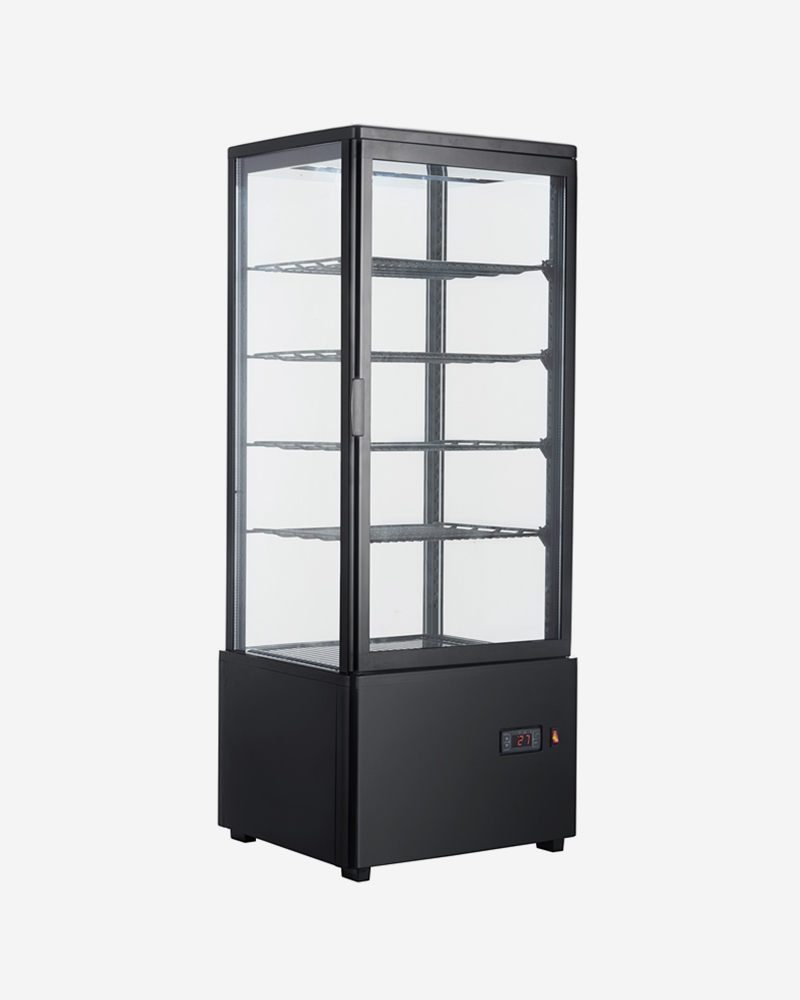
4 Sided Glass Refrigerated Standing Display Cooler
Product Overview and Main Specifications
The XC-98L is a compact commercial display refrigerator developed for chilled product presentation. Its 98-liter capacity provides enough room for a focused selection of merchandise without creating an oversized cabinet that is difficult to position or maintain. The appliance is designed as a standing unit, allowing products to be presented at an accessible height for both shoppers and staff.
Specification |
Details |
Model |
XC-98L |
Product category |
Four-sided glass refrigerated standing display cooler |
Capacity |
98 liters |
Temperature range |
2–10°C |
Input power |
200 watts |
Refrigerant |
R134a or R600a, depending on configuration |
Climate type |
4 |
Net weight |
39 kilograms |
Gross weight |
42 kilograms |
Product dimensions |
447 × 400 × 1119 millimeters |
Package dimensions |
502 × 456 × 1160 millimeters |
Loading quantity |
110 units in a 20-foot general-purpose container |
Loading quantity |
230 units in a 40-foot high-cube container |
The temperature range of 2–10°C is appropriate for many chilled display applications. It can support the presentation of bottled beverages, cans, dairy products, packaged snacks requiring refrigeration, sandwiches, desserts, prepared foods, and similar merchandise. The precise suitability of any product should always be confirmed according to its storage instructions, local food regulations, and the operating conditions of the installation site.
The 200-watt input power rating reflects the compact nature of the unit. Energy use in actual operation can vary according to ambient temperature, loading pattern, door configuration, thermostat setting, cleaning condition, and usage frequency. Correct installation and regular maintenance are therefore important for obtaining efficient performance.
Why Four-Sided Double Glass Is Valuable in Commercial Use
Improved Product Visibility
The most obvious advantage of four-sided glass is that the merchandise is visible from several directions. A traditional refrigerator with an opaque outer cabinet may protect the contents, but customers usually need to open the door or wait for staff assistance before they can see what is available. A transparent display cooler makes the product selection immediately apparent.
This visibility can improve the shopping experience in busy commercial environments. Customers can quickly identify the products they want, compare different items, and notice new or promotional merchandise. Staff can also monitor stock levels from outside the cabinet, making replenishment planning easier.
Better Use of Vertical Space
Vertical display refrigeration makes practical use of height. The XC-98L measures approximately 1119 millimeters high, giving the cabinet a standing presentation format while maintaining a relatively narrow width and depth. This arrangement is particularly useful for small shops, cafés, hotel breakfast areas, compact restaurants, and counter-service businesses.
Compared with a wide horizontal display, a vertical cabinet can help separate product groups by shelf. Drinks can be organized on one level, desserts on another, and packaged foods on a third. This improves visual order and allows staff to create a more deliberate sales presentation.
Reduced Need for Repeated Door Opening
When products can be seen through the glass, shoppers can inspect the selection before opening the door. In staff-operated environments, employees can check stock without opening the cabinet every time. Reducing unnecessary access can help limit the amount of warm ambient air entering the refrigerated compartment.
Less frequent door opening may also support more consistent operating conditions. The result depends on the specific installation and usage pattern, but the transparent design naturally encourages more efficient product inspection.
Professional Appearance
Commercial equipment contributes to the overall image of a business. A clean, illuminated, organized refrigerator can make a food-service area appear more professional. Four-sided glass creates a contemporary visual effect and allows the cabinet to function as both a refrigeration appliance and a merchandising fixture.
This is especially useful for products where appearance influences purchase decisions. Cakes, desserts, premium beverages, prepared foods, and packaged specialty items benefit from a display environment that presents them clearly and attractively.
Cooling Performance and Temperature Management
The XC-98L is equipped with a ventilated cooling system. Unlike a purely static cooling arrangement, ventilated cooling circulates cooled air within the cabinet. Air movement can help distribute temperature more evenly across the storage area when the shelves are arranged correctly and the cabinet is not overloaded.
Even cooling is important in a display refrigerator because products are often placed at several levels. A forced-air system can help reduce excessive temperature differences between upper and lower sections. However, airflow must not be blocked by tightly packed products. Staff should leave appropriate spaces around the internal air outlets and avoid covering circulation paths.
The adjustable PVC-coated shelves support flexible product organization. Different merchandise has different packaging sizes, so fixed shelves may create wasted space or make loading inconvenient. Adjustable shelves allow the internal layout to be adapted to bottles, cans, cartons, trays, cups, and packaged food products.
The stated temperature range is 2–10°C. The digital thermostat and display make it easier for operators to monitor the set temperature and identify changes in cabinet conditions. A visible temperature display is more practical than relying only on an external dial because it gives staff a direct reading during routine inspections.
Temperature control should be considered together with installation conditions. The unit should be positioned away from direct sunlight, ovens, cooking equipment, radiators, and other heat sources. Adequate clearance around the refrigeration system is also important, because restricted ventilation can increase operating strain and reduce cooling effectiveness.
Automatic Defrost Function
Ice accumulation can interfere with cooling performance and reduce usable storage space. The automatic defrost function helps limit the need for frequent manual defrosting. This is a valuable feature for commercial operators because it reduces routine labor and helps keep the cabinet ready for daily use.
Automatic defrost does not eliminate the need for cleaning and inspection. Operators should still check the interior, drain area, shelves, door seals, and ventilation openings according to a regular maintenance schedule. Food residues, dust, and packaging debris can affect hygiene and performance if they are allowed to accumulate.
Glass Fog Prevention
Condensation and fogging can make a glass display difficult to view, especially when warm, humid air enters the cabinet area. The XC-98L includes a glass fog-preventing system. This feature helps preserve a clearer view of the merchandise and supports the main purpose of the appliance: visible refrigerated presentation.
Clear glass improves the effectiveness of internal lighting and makes shelves easier to inspect. It also reduces the need for staff to repeatedly wipe the glass during busy operating periods. As with all refrigeration features, the actual result depends on ambient humidity, door use, installation, and maintenance.
Internal LED Lighting and Merchandising Benefits
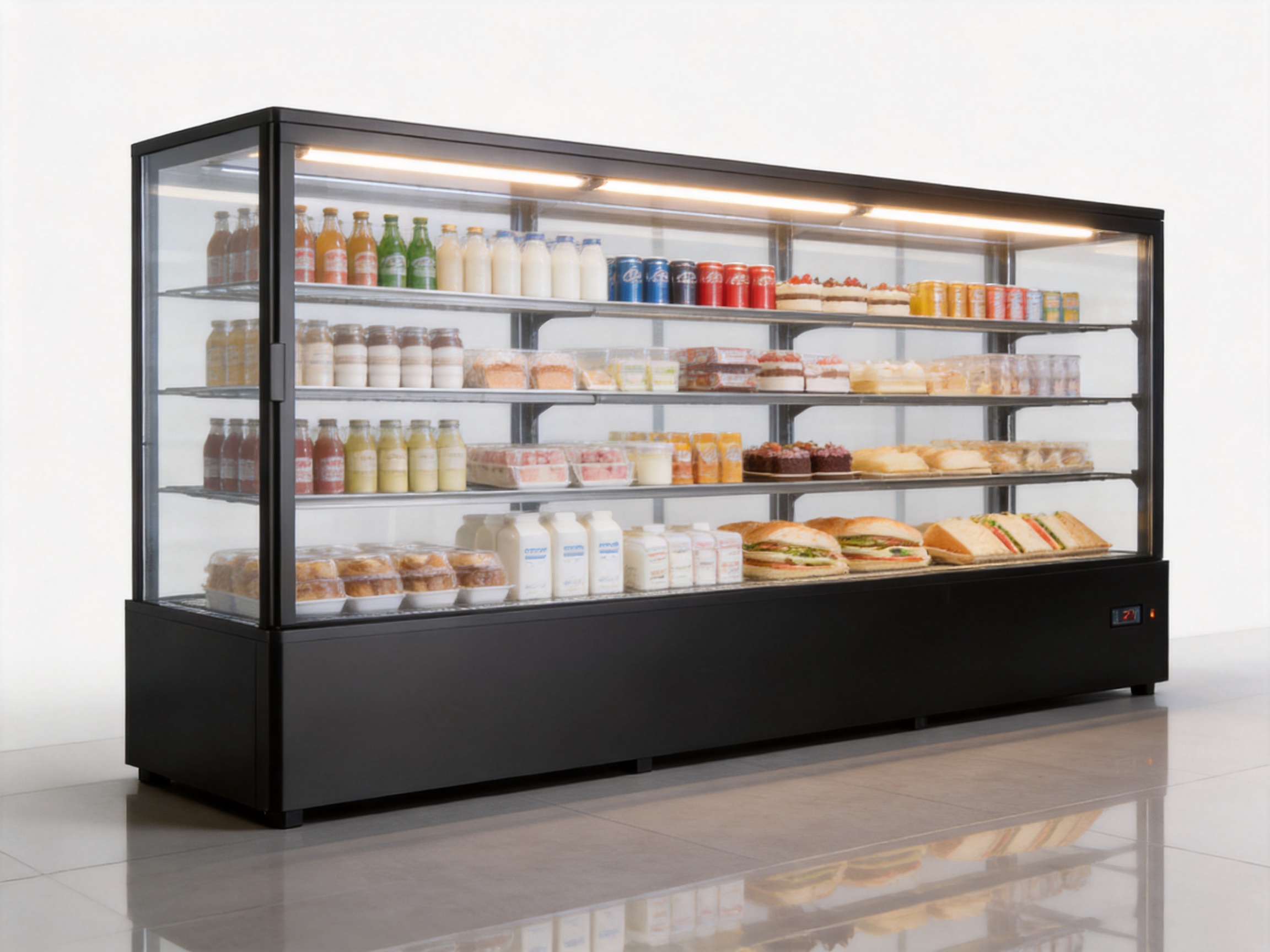
The standard configuration includes an internal top LED light. LED lighting is well suited to display refrigeration because it provides illumination with a compact format and helps products remain visible in the cabinet. Good lighting is especially important in shops with low ambient light, evening operation, or products that use visually distinctive packaging.
Lighting can be used to organize attention. A business may place high-margin products at eye level, arrange products by flavor or size, or use contrasting packaging to create a clear visual pattern. The internal top light helps shoppers see the contents without requiring the cabinet to be opened.
Additional lighting options are available. The listed options include two-strip LED light bars and four-strip LED light bars. These configurations can provide expanded illumination for businesses that want a brighter or more evenly lit presentation. The appropriate choice depends on the type of merchandise, the desired appearance, and the lighting conditions of the store.
Lighting should be combined with disciplined product arrangement. Shelves should not be overloaded, labels should face forward, and frequently selected products should be easy to reach. A display cooler is most effective when refrigeration, lighting, shelf organization, and product rotation are managed as one system.
Adjustable PVC-Coated Shelves
The standard PVC-coated shelves provide a practical surface for everyday commercial use. PVC coating can make shelves easier to clean and provides a protective finish for regular handling. The adjustable design allows the internal space to be configured according to product height and packaging format.
For example, a café may need a taller shelf for bottled drinks and a shorter shelf for yogurt cups or packaged desserts. A hotel may use the cabinet for juices, dairy products, and ready-to-eat breakfast items. A bakery may arrange chilled cakes, mousse desserts, and cream-based products using different shelf positions. Adjustable shelves make these changes easier without replacing the appliance.
Chromed shelves are available as an option for customers who prefer a different visual finish. Tempered glass is also available as an option. These choices allow businesses, distributors, and project buyers to select a configuration that suits their presentation standards and market requirements.
Operating Convenience and Control Features
Digital Thermostat and Display
The digital thermostat and display provide a straightforward way to set and monitor operating temperature. In a commercial environment, simple controls are valuable because equipment may be used by several employees. Clear digital information reduces uncertainty and makes routine checks more consistent.
Operators should establish a daily or scheduled temperature-check procedure. Readings can be recorded in accordance with internal food-safety policies and local requirements. If the display shows an unusual temperature, staff should check loading density, door closure, ventilation, ambient conditions, and the cleanliness of the condenser area before requesting technical service.
Separated Power Button
The separated power button gives operators direct control over the electrical operation of the cabinet. This can be useful during cleaning, installation, maintenance, or temporary closure. Separating the power control from temperature adjustment also helps prevent accidental changes to the thermostat setting.
Optional Door Lock
A door lock is available as an option. This may be useful in environments where access must be limited, such as staff-only areas, hotel service zones, offices, institutions, or locations that require controlled product handling. A lock can also provide additional security when the cooler is placed in a public or semi-public area.
The importance of a lock depends on the operating model. A self-service store may prioritize easy access, while a commercial kitchen or hospitality operation may prefer controlled access. The availability of the option allows the same basic cabinet design to serve different applications.
Applications Across Different Commercial Environments
Convenience Stores
Convenience stores need compact equipment that can present products clearly and support fast customer decisions. The XC-98L can be positioned near a checkout, service counter, entrance, or promotional area. Its transparent cabinet allows chilled products to attract attention while its narrow footprint helps preserve customer circulation space.
The 98-liter capacity is appropriate for a focused assortment rather than a large warehouse-style inventory. Store operators can use the cooler for premium beverages, sandwiches, dairy products, desserts, or products associated with a particular promotion.
Cafés and Coffee Shops
Cafés often need to display chilled desserts, bottled drinks, cream-based products, and ready-to-eat foods. The four-sided glass design gives customers a clear view of the selection while supporting a clean front-of-house appearance.
The LED lighting can help desserts and beverages remain visually attractive. Adjustable shelves allow the cabinet to be changed as the menu evolves, which is useful for seasonal products or different packaging sizes.
Bakeries and Dessert Shops
Refrigerated cakes, mousse desserts, cream pastries, and other chilled products require both temperature control and effective presentation. A glass display cabinet can help protect product quality while allowing customers to inspect the appearance before ordering.
For bakery use, shelf arrangement is especially important. Products should be spaced so that air can circulate and customers can view each item clearly. The fog-preventing system is valuable because a cloudy glass panel can reduce the visual appeal of delicate desserts.
Hotels and Hospitality Venues
Hotels may use compact display refrigerators in breakfast areas, lounges, banquet spaces, reception zones, and guest-service areas. The standing design allows the unit to function as a visible self-service or staff-service station without occupying the same amount of space as a large upright refrigerator.
The door-lock option may be appropriate in staff-controlled locations. Additional LED light bars can also be considered when the cabinet forms part of a carefully designed hospitality presentation.
Restaurants and Prepared-Food Counters
Restaurants can use the cooler for prepared foods, bottled beverages, cold desserts, sauces, or packaged takeaway items. Because the temperature range is intended for chilled storage, products should be selected according to their required storage conditions.
The digital temperature display supports routine monitoring, while ventilated cooling helps maintain the cabinet environment when products are distributed across multiple shelves. The unit can be used as a supplementary display refrigerator alongside larger back-of-house storage equipment.
Offices, Institutions, and Showrooms
Offices and institutions may require a compact refrigerator for beverages, dairy products, or packaged food. In these settings, the four-sided glass cabinet can be positioned in a shared refreshment area where visibility and easy access are useful.
Showrooms and product demonstration areas can also benefit from the display format. The refrigerator can present chilled merchandise as part of a broader retail or hospitality concept, particularly when the appearance of the equipment is important to the overall environment.
Advantages Compared with Conventional Refrigerators
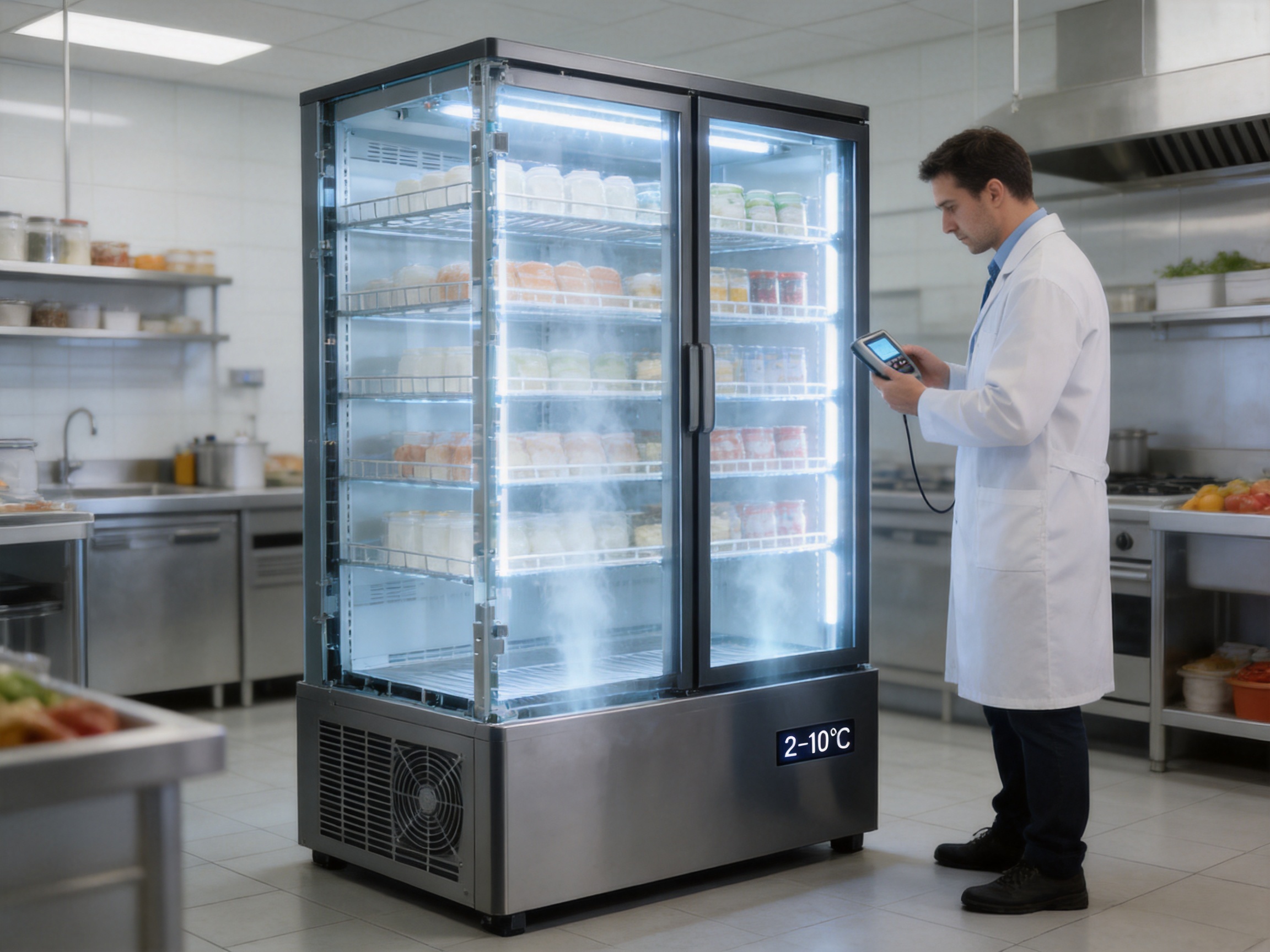
The XC-98L should not be viewed only as a smaller version of a storage refrigerator. Its value comes from combining refrigeration with product presentation. This distinction creates several advantages over conventional solid-door units in suitable commercial applications.
Feature |
Four-sided glass display cooler |
Conventional solid-door refrigerator |
Product visibility |
Visible from multiple sides |
Usually requires door opening |
Merchandising function |
Designed for direct product presentation |
Primarily designed for storage |
Space usage |
Uses vertical space with a compact footprint |
Varies by cabinet design |
Stock inspection |
Can often be performed without opening the door |
Usually requires door opening |
Lighting |
Internal top LED light as standard |
May not include display lighting |
Product access control |
Optional door lock available |
Depends on the specific model |
A solid-door refrigerator may remain the better choice for back-room storage, bulk inventory, or locations where appearance is not important. The four-sided display cooler is better suited to customer-facing applications where product visibility, presentation, and compact placement influence purchasing and workflow.
Compared with some open display coolers, the glass-sided configuration may provide a more enclosed storage environment. Open cases can offer fast access, but they may be more exposed to surrounding air and are often designed for larger retail installations. A compact glass display unit can be a practical alternative when a business needs visibility without an open front.
Manufacturing Capability and Engineering Strength
The product is manufactured by Ningbo XiangChi Electrical Co., Ltd., a company established in 2007 and focused on vertical display cabinets, cake cabinets, and warming cabinets. The company operates a modern management garden factory covering approximately 40,000 square meters and has more than a decade of experience in the field according to the supplied company information.
Experience in commercial refrigeration is important because display equipment must satisfy several requirements at the same time. The cabinet must provide stable cooling, reliable electrical operation, appropriate glass construction, practical shelf support, clean assembly, and a finish that can withstand commercial use. A manufacturer specializing in this product category can develop production knowledge across these interconnected areas.
Dedicated Research and Development
The company maintains its own professional research and development team. An internal R&D structure can support the improvement of cabinet design, cooling layouts, controls, lighting, materials, and production methods. It also allows product feedback to be evaluated within the same organization that manages manufacturing and quality improvement.
For international buyers, an active R&D capability is valuable because commercial refrigeration requirements vary between regions. Climate conditions, electrical standards, refrigerant preferences, market expectations, and installation practices may differ. A manufacturer with product development resources is better positioned to address configuration requirements and improve future models.
Testing Facilities
The supplied company information states that the manufacturer has advanced testing facilities. Testing is a central part of commercial refrigeration production. A finished cabinet must be evaluated not only for appearance but also for cooling behavior, electrical safety, glass performance, sealing, temperature control, and general operating reliability.
Testing facilities support the development process by helping engineers identify performance differences between prototypes and production units. They also provide a basis for quality checks before products are packed for shipment. Consistent testing is particularly important for export orders, where equipment may be transported over long distances and installed in climates different from the factory environment.
Production Lines and Process Control
Advanced R&D facilities and production lines give the manufacturer the capacity to continue improving product quality. In commercial refrigeration, production quality depends on the coordination of several processes, including cabinet preparation, insulation, glass installation, refrigeration-system assembly, electrical wiring, shelf fitting, control installation, inspection, and packaging.
A well-organized production system helps reduce variation between units. Consistent assembly is important for doors, glass panels, shelf supports, lighting, thermostat controls, and refrigeration components. It also helps manufacturers manage larger orders while preserving repeatability.
For distributors and project buyers, production capacity can be as important as individual product performance. The listed loading quantities of 110 units in a 20-foot general-purpose container and 230 units in a 40-foot high-cube container indicate that the model is suitable for organized export distribution. Efficient packaging and container planning can help buyers manage logistics and reduce unnecessary shipping space.
International Certifications
The company has obtained CE, GS, CCC, CB, RoHS, ETL, and other major certifications according to the provided information. Certifications do not replace proper installation or maintenance, but they can provide evidence that products have been evaluated against relevant requirements in different markets.
International certifications are important for distributors and commercial users because they may support import procedures, market access, project approval, and customer confidence. Buyers should confirm the exact certification scope, applicable model, voltage configuration, and destination-market requirements before placing an order.
Materials, Components, and Assembly Considerations
A commercial display cooler is the result of many component decisions rather than a single feature. The glass must be installed securely and aligned correctly. Shelves must support expected loads. Lighting must be positioned so that products are illuminated without creating unnecessary obstruction. The refrigeration system must be matched to the cabinet volume and intended temperature range.
The double-glass construction is one of the most visible aspects of the unit. Correct glass installation supports appearance, visibility, and thermal separation. The fog-preventing function must also work together with the cabinet design and operating environment to preserve a clear display surface.
The PVC-coated shelves are intended to balance practicality and easy maintenance. Shelf surfaces should be cleaned regularly using suitable methods. Heavy products should be distributed evenly, and shelf limits should not be exceeded. Proper loading helps maintain airflow and reduces stress on the internal support structure.
Electrical and refrigeration components require appropriate installation procedures. The unit should be connected to a suitable power supply and operated according to the manufacturer’s instructions. Buyers should confirm voltage, frequency, plug type, refrigerant configuration, and local compliance requirements before installation.
Refrigerant Considerations
The supplied specification lists R134a/R600a as the refrigerant information. This indicates that the model may be available with different refrigerant configurations or that the final refrigerant depends on a particular production or market version. Buyers should verify the exact refrigerant before ordering, importing, servicing, or replacing components.
Refrigerant selection can affect regulatory compliance, service procedures, environmental considerations, and technician requirements. R600a is a hydrocarbon refrigerant commonly used in certain refrigeration applications and requires appropriate handling because of its flammability. R134a has different service and environmental characteristics. Only trained and qualified personnel should carry out refrigeration-system work.
Distributors should request the correct technical documentation for the destination market. This may include the nameplate specification, electrical data, refrigerant charge information, service instructions, and certification documents. Clear confirmation before shipment helps prevent confusion during installation and after-sales service.
Installation Recommendations
Correct installation is essential for the performance and service life of any commercial refrigerator. The unit should be placed on a stable, level surface. A level installation helps the cabinet stand securely and supports correct door operation where applicable.
Ventilation space should be maintained around the refrigeration system. The exact clearance should follow the manufacturer’s installation instructions. The cabinet should not be pressed tightly against a wall if doing so blocks heat dissipation or restricts airflow around the condenser area.
The cooler should be kept away from direct sunlight and high-temperature equipment. Placing it beside an oven, fryer, radiator, or strong heat source can increase the refrigeration load. It should also be protected from excessive water exposure and installed in an environment appropriate for its climate classification.
After positioning the cabinet, operators should allow the refrigeration system to operate before loading products, following the instructions supplied with the unit. Products should be loaded in an organized manner without blocking internal air circulation. Overloading can reduce cooling effectiveness and make it more difficult for air to move across the shelves.
The appliance should be connected to a suitable electrical circuit. Grounding and electrical protection should comply with local regulations. If the unit is being installed in a commercial project, a qualified electrician or refrigeration professional should verify the connection and commissioning procedure.
Maintenance and Daily Care
Regular maintenance supports hygiene, cooling performance, and long-term reliability. The interior should be cleaned at appropriate intervals using products that are suitable for food-service equipment. Shelves can be removed or repositioned as necessary, allowing staff to clean areas that are difficult to reach during normal operation.
The glass should be kept clean so that products remain visible. Abrasive materials should be avoided if they could scratch the glass or damage the surface finish. Spills should be cleaned promptly, especially when they involve dairy products, sauces, or sugary foods.
Door seals and glass edges should be inspected regularly. Damaged or poorly seated seals can allow warm air to enter the cabinet and may increase condensation or cooling demand. If a door does not close correctly, the cause should be investigated rather than ignored.
Ventilation openings and condenser areas should be kept free from dust and debris. A dirty condenser can reduce heat transfer and increase the workload on the refrigeration system. Cleaning procedures should be performed with the power disconnected when required and should follow applicable safety instructions.
Operators should also monitor product rotation. Older products should be placed where they will be used first, while newly delivered stock should be positioned behind or below existing inventory when appropriate. Good stock rotation improves food management and reduces waste.
How the Product Can Improve Merchandising Efficiency
Merchandising efficiency is the ability to present the right products in a way that supports fast recognition, easy access, and effective use of available space. The XC-98L supports this objective through its vertical structure, glass enclosure, internal lighting, and adjustable shelving.
Businesses can organize products by category, brand, flavor, size, price, or consumption occasion. For example, a café may place ready-to-drink beverages on the upper shelves and desserts on the lower shelves. A bakery may use a dedicated cabinet for premium chilled cakes. A convenience store may arrange products according to customer traffic patterns and promotional priorities.
The cabinet can also be used to create a visual focal point. Because customers can see the contents from multiple directions, the unit may be positioned at the end of a counter, near an entrance, or in the center of a designated display area. The best position depends on traffic flow, electrical access, staff workflow, and the need to keep the equipment away from heat sources.
Good merchandising should not compromise refrigeration. Products should not be packed so tightly that air cannot circulate. Labels and packaging should remain visible without obstructing vents. The most attractive display is one that combines a clear visual arrangement with correct product storage practices.
Selection Guidance for Buyers and Distributors
Buyers should begin by identifying the intended application. A 98-liter display cooler is suitable for focused product presentation and supplementary chilled storage. It may not replace a large walk-in cooler or a high-capacity back-room refrigerator. Understanding this distinction helps ensure that the cabinet is used within its intended purpose.
The available space should be measured carefully. Buyers should consider the cabinet dimensions as well as packaging dimensions, doorway access, service clearance, and customer circulation. The package size is approximately 502 × 456 × 1160 millimeters, so transport routes should be checked before delivery.
Product requirements should also be reviewed. The 2–10°C temperature range is appropriate for many refrigerated products, but not every food category has the same storage requirements. Buyers should compare the cabinet’s operating range with the instructions on the products they plan to store.
Optional features should be selected according to the business model. A door lock may be useful for controlled-access locations. Two or four LED light bars may be appropriate for brighter display requirements. Chromed shelves or tempered glass may be chosen for a particular visual style or project specification.
Importers should confirm the exact electrical configuration, refrigerant type, certification documents, packaging details, spare-parts policy, warranty conditions, and after-sales support process. These details are important when the product will be distributed across different markets.
Quality, Service, and Partnership Value
Commercial refrigeration buyers generally evaluate more than the equipment itself. They also consider whether the manufacturer can provide consistent production, technical documentation, customization support, replacement parts, and communication throughout the order cycle.
Ningbo XiangChi Electrical Co., Ltd. presents itself as a specialized manufacturer with its own R&D team, testing facilities, production resources, and international certifications. These capabilities can be valuable to wholesalers, importers, hospitality suppliers, and commercial equipment distributors that need a stable manufacturing partner rather than a one-time product source.
The company’s experience since 2007 and its focus on vertical display cabinets, cake cabinets, and warming cabinets suggest a product portfolio centered on display-oriented commercial appliances. This category specialization may help support practical design improvements because the manufacturer can apply experience from related models and customer applications.
A long-term supply relationship also benefits from clear technical communication. Product specifications should be confirmed in writing, and any requirements for branding, packaging, voltage, lighting, shelves, locks, or certification should be agreed before production. A structured process helps reduce errors and improves the likelihood of consistent repeat orders.
Environmental and Operational Responsibility
Responsible operation of a refrigerated display cabinet includes attention to energy use, product waste, refrigerant handling, and equipment disposal. Although the XC-98L has a compact 200-watt input rating, actual energy consumption depends on how and where it is used.
Energy performance can be supported by keeping the glass clean, maintaining correct door closure, avoiding excessive heat around the cabinet, cleaning ventilation areas, and loading products in a way that preserves airflow. Operators should also avoid leaving the door open longer than necessary.
Refrigerants must be handled by qualified professionals. At the end of the appliance’s service life, the unit should be disposed of according to local requirements for electrical equipment, glass, metal, insulation, and refrigerant recovery. These practices help reduce environmental impact and support responsible commercial operations.
Frequently Asked Questions
What is the capacity of the XC-98L display cooler?
The stated capacity is 98 liters. This makes the unit suitable for focused product displays, supplementary chilled storage, cafés, small retail spaces, hospitality areas, and other commercial applications that do not require a large inventory cabinet.
What temperature range does the cooler provide?
The specified temperature range is 2–10°C. Users should compare this range with the storage requirements of their products and follow applicable food-safety procedures.
Is the unit suitable for beverages and desserts?
Yes. The cabinet is suitable for many chilled beverages, packaged foods, cakes, desserts, dairy products, and prepared items, provided that the product storage requirements fall within the operating range and local regulations are followed.
Does the cooler have glass on all four sides?
The standard features specify four-sided double glass. This provides visibility from multiple directions and supports the cabinet’s role as a customer-facing display appliance.
Does the display cooler include internal lighting?
Yes. An internal top LED light is included as a standard feature. Two-strip and four-strip LED light bars are available as options for customers who require expanded or brighter illumination.
Are the shelves adjustable?
Yes. The standard model includes adjustable PVC-coated shelves. Chromed shelves are available as an option, and tempered glass is also listed as an optional configuration.
Does the cooler prevent glass fogging?
The standard features include a glass fog-preventing system. Its performance will also depend on ambient humidity, door use, installation, and maintenance.
Does the unit defrost automatically?
Yes. Automatic defrost is included among the standard features. Routine cleaning and inspection are still required to maintain hygiene and reliable performance.
Is a door lock included?
A door lock is available as an option. It may be useful in staff-controlled areas, offices, hotels, institutions, or other locations where access needs to be restricted.
What cooling system does the model use?
The unit uses a ventilated cooling system. Air circulation helps distribute cooled air within the cabinet, although products should be loaded without blocking the airflow paths.
What refrigerant does the model use?
The supplied specification lists R134a/R600a. Buyers should confirm the exact refrigerant configuration for the model, destination market, and order before purchase or service.
How much power does the unit require?
The listed input power is 200 watts. Actual energy consumption can vary according to ambient conditions, temperature setting, loading, door operation, and maintenance.
How large is the cooler?
The product size is approximately 447 × 400 × 1119 millimeters. The package size is approximately 502 × 456 × 1160 millimeters. Buyers should allow additional space for installation, ventilation, service, and customer access.
What is the climate classification?
The stated climate type is 4. Buyers should verify the intended ambient operating conditions and installation requirements before placing the cooler in a particular environment.
Who manufactures the product?
The product is manufactured by Ningbo XiangChi Electrical Co., Ltd., a company specializing in vertical display cabinets, cake cabinets, and warming cabinets. The supplied company information states that the business was established in 2007 and operates a factory of approximately 40,000 square meters.
What manufacturing strengths does the supplier offer?
The company states that it has a professional R&D team, advanced testing facilities, modern production lines, and certifications including CE, GS, CCC, CB, RoHS, and ETL. Buyers should confirm the exact certification and documentation applicable to their order.
How should the cooler be maintained?
Maintenance should include regular cleaning of the interior, shelves, glass, door seals, ventilation openings, and condenser area. Staff should also monitor temperature, avoid overloading, preserve airflow, and arrange professional service for refrigeration or electrical repairs.
Conclusion
The 4 Sided Glass Refrigerated Standing Display Cooler provides a practical combination of cold storage, product visibility, compact placement, and commercial presentation. With a 98-liter capacity, 2–10°C operating range, ventilated cooling, automatic defrost, fog-preventing glass, digital temperature control, internal LED lighting, and adjustable shelves, the XC-98L is designed for businesses that need more than a basic refrigerator.
Its four-sided double-glass construction supports visibility from multiple directions, making it suitable for customer-facing environments. The vertical format helps businesses use available height while preserving floor space. Optional door locks, additional LED light bars, chromed shelves, and tempered glass provide further flexibility for different projects and operating models.
The manufacturer’s experience in commercial display equipment, internal R&D resources, testing facilities, production capabilities, and stated international certifications strengthen the product’s position as a solution for global distributors and commercial users. As with all refrigeration equipment, performance depends on correct installation, suitable loading, regular maintenance, and operation within the specified conditions.
For cafés, bakeries, convenience stores, hotels, restaurants, offices, and specialty retailers, the XC-98L can serve as an efficient display-focused refrigeration unit. It helps turn chilled storage into an organized merchandising opportunity while supporting the daily needs of businesses that value visibility, flexibility, and professional presentation.
References
Ningbo XiangChi Electrical Co., Ltd. Product Specification Sheet for Model XC-98L, Four-Sided Glass Refrigerated Standing Display Cooler.
Ningbo XiangChi Electrical Co., Ltd. Company Profile and Manufacturing Information.
Commercial Refrigeration Equipment Operating and Maintenance Principles.
General Food-Service Refrigeration Temperature Management Practices.
International Commercial Appliance Safety and Energy-Use Considerations.
Product: 4 Sided Glass Refrigerated Standing Display Cooler

You May Also Like
.jpg?imageView2/2/w/500/h/500/format/jp2/q/100 "Four Sides Glasses Display Cooler")
.jpg?imageView2/2/w/500/h/500/format/jp2/q/100 "White 4-Sided Glass Refrigerated Display Case")
.jpg?imageView2/2/w/500/h/500/format/jp2/q/100 "Refrigerated Display Cake Countertop Four Sides Glasses Display Cooler")
.jpg?imageView2/2/w/500/h/500/format/jp2/q/100 "Four Sides Glasses Display Cooler")

-
- Navigation
- Home
- About Us
- Products
- News
- Contact Us
 East Zone, Guanhaiwei Industrial Park, Cixi City, Ningbo, Zhejiang, China
 +86-574-63668678
 +86-574-63668108
Copyright © Ningbo XiangChi Electrical Co.,Ltd All Rights Reserved.
