
 简体中文
简体中文 English
 Español
News
Open Automatic Defrost Refrigerated Showcase: A Practical Guide to High-Visibility Commercial Chilled Display
In modern food retail, refrigeration is no longer only about keeping products cold. A commercial display cabinet must also present food attractively, support fast service, maintain stable temperatures, simplify daily operation, and make efficient use of valuable floor space. The Open Automatic Defrost Refrigerated Showcase XCS-950Z, XCS-1250Z, and XCS-1550Z is designed around these combined requirements.
As an open display cooler, the series provides immediate product visibility and convenient customer access without requiring a door to be opened for every purchase. Its refrigerated environment is suitable for chilled foods that need to remain within a controlled range of 2–10°C, or 35.6–50°F. The cabinet is available in three practical widths, allowing retailers, food-service operators, supermarkets, cafés, bakeries, convenience stores, and hospitality businesses to select a format that matches their available space and merchandising volume.
The showcase combines a stainless steel body, tempered glass, ventilated cooling, automatic defrost, digital temperature control, dedicated power and lighting switches, and four castors with front brakes. These features create a balance between product presentation, operational convenience, mobility, and long-term commercial use.
Manufactured by Ningbo XiangChi Electrical Co., Ltd., the product reflects the company’s specialization in vertical display cabinets, cake cabinets, warming cabinets, and other commercial refrigeration equipment. The manufacturer reports more than ten years of industry experience, a 40,000-square-meter modern factory, professional research and development capabilities, advanced testing facilities, and multiple international certifications.
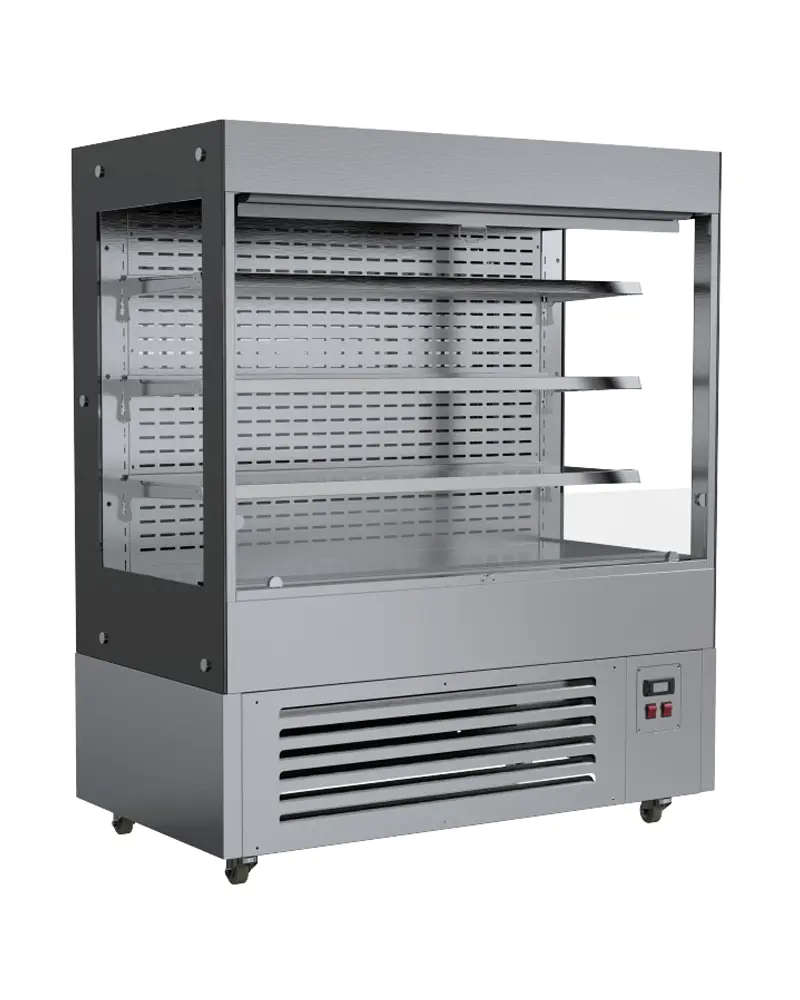
Open Automatic Defrost Refrigerated Showcase XCS-950Z/1250Z/1550Z/1550Z
1. The Role of an Open Refrigerated Showcase in Commercial Food Display
Retail refrigeration serves two purposes at the same time. First, it must help protect food quality by maintaining the required temperature. Second, it must encourage customers to notice, understand, and purchase the products on display. A closed refrigerator may provide strong insulation, but it adds a physical barrier between the customer and the merchandise. An open showcase removes that barrier and creates a more immediate shopping experience.
An open display cooler is particularly useful in locations where customers are moving quickly or where products are intended for impulse purchases. Chilled beverages, prepared foods, dairy products, desserts, packaged meals, sandwiches, salads, fruit portions, and other ready-to-eat items can be arranged so that customers can see them from several directions. Staff can also replenish or retrieve products without repeatedly opening a door.
The XCS series is especially suitable for businesses that need a refrigerated merchandising area rather than a simple storage refrigerator. Its vertical configuration uses height to increase display capacity while maintaining a relatively narrow footprint. The three models offer gross capacities of approximately 300 liters, 410 liters, and 510 liters, making them appropriate for different sales volumes and store layouts.
The open design can support smoother customer flow. In a supermarket, the cabinet may be placed in a prepared-food section, beverage aisle, entrance area, or checkout zone. In a café or bakery, it can display chilled cakes, desserts, salads, and packaged refreshments. In a hotel, restaurant, or catering operation, it can provide a visible self-service or staff-service station.
Because the products are visible without opening a door, the cabinet can also help staff monitor stock levels. A quick visual inspection makes it easier to identify empty areas, mixed products, or items that need to be rearranged. This can improve the consistency of product presentation throughout the day.
2. Product Range and Main Specifications
The refrigerated showcase is offered in three primary sizes. The models share the same operating temperature range, refrigerant, climate class, rated input power, and principal construction features. Their main differences are width, capacity, weight, package dimensions, and loading quantity.
| Specification | XCS-950Z | XCS-1250Z | XCS-1550Z |
|---|---|---|---|
| Gross capacity | 300 L / 10.6 cu. ft. | 410 L / 14.5 cu. ft. | 510 L / 18.0 cu. ft. |
| Temperature range | 2–10°C / 35.6–50°F | 2–10°C / 35.6–50°F | 2–10°C / 35.6–50°F |
| Input power | 1500 W | 1500 W | 1500 W |
| Refrigerant | R290 | R290 | R290 |
| Climate type | 6 | 6 | 6 |
| Net weight | 126 kg | 155 kg | 190 kg |
| Gross weight | 172 kg | 210 kg | 257 kg |
| Product dimensions | 900 × 656 × 1435 mm | 1200 × 656 × 1435 mm | 1500 × 656 × 1435 mm |
| Product dimensions | 35.4 × 25.8 × 56.5 in. | 47.2 × 25.8 × 56.5 in. | 59.1 × 25.8 × 56.5 in. |
| Package dimensions | 970 × 750 × 1580 mm | 1270 × 750 × 1580 mm | 1570 × 750 × 1580 mm |
| Package dimensions | 38.2 × 29.5 × 62.2 in. | 50.0 × 29.5 × 62.2 in. | 61.8 × 29.5 × 62.2 in. |
| 20GP / 40HQ loading quantity | 18 / 36 pcs | 13 / 27 pcs | 10 / 22 pcs |
All three models have a depth of 656 millimeters and a height of 1435 millimeters. This consistent height and depth simplify planning when several units are installed together. A retailer can combine different widths while maintaining a visually coordinated merchandising line.
The XCS-950Z is the most compact option and may be suitable for smaller shops, cafés, limited-service restaurants, or locations where floor space is restricted. The XCS-1250Z provides a mid-size balance between capacity and footprint. The XCS-1550Z is intended for higher-volume display requirements, larger retail areas, and operations that need more linear product presentation.
3. Temperature Control for Chilled Food Merchandising
The stated temperature range of 2–10°C provides a practical operating window for many chilled food applications. The precise temperature selected by an operator should always be matched to the food category, packaging instructions, local food-safety requirements, and the operating conditions of the store.
A digital temperature controller and display are included as standard features. This gives operators a direct way to monitor the cabinet’s setpoint and displayed temperature. Compared with a basic mechanical control, a digital interface generally makes routine checking easier and provides a clearer indication of operating status.
Temperature visibility is important in a commercial environment because refrigeration performance can be affected by ambient conditions, product loading, air movement, cleaning routines, and how frequently the cabinet is accessed. An integrated display helps staff identify changes earlier and supports more consistent operating procedures.
Because the cabinet is open, correct loading and operating practice are particularly important. Products should be arranged without blocking designed air paths, and the display should not be overloaded beyond its intended capacity. The unit should be positioned away from strong heat sources and should be allowed sufficient clearance for ventilation and servicing. These practices help the cooling system operate as intended.
The climate type is listed as 6 for each model. This indicates that the cabinet is designed for demanding ambient conditions according to the applicable classification used by the manufacturer. Even so, actual performance depends on installation, room conditions, product temperature at loading, maintenance, and compliance with the operating instructions.
4. Ventilated Cooling and Automatic Defrost
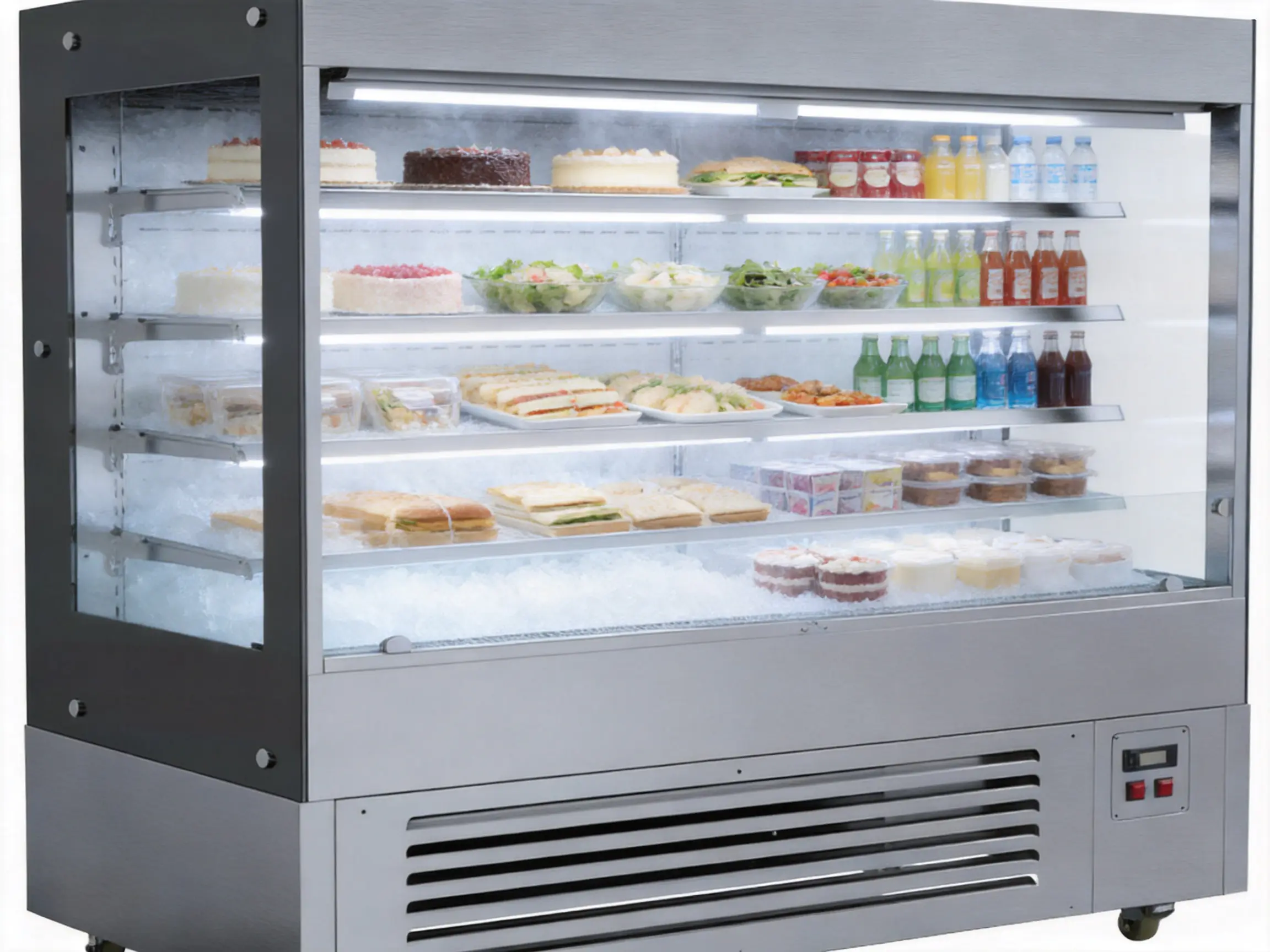
The series uses a ventilated cooling system. Forced air circulation helps distribute refrigerated air through the display area and supports a more uniform environment than a purely static arrangement. For an open commercial cabinet, controlled air movement is important because the front opening allows ambient air to interact with the refrigerated space.
Ventilated cooling can also support the presentation of products across multiple display levels. When the cabinet is correctly loaded, refrigerated airflow can reach a wider portion of the merchandise. Staff should still avoid tightly packing products against air outlets or return paths, since poor arrangement can interfere with circulation.
Automatic defrost is another significant operating feature. In a refrigerated cabinet, moisture from ambient air can accumulate as frost on cold surfaces. If frost is allowed to build up unchecked, it can reduce heat-transfer efficiency, obstruct airflow, and increase maintenance demands. Automatic defrost reduces the need for frequent manual defrosting and helps maintain practical day-to-day usability.
Automatic defrost does not eliminate the need for cleaning and inspection. Operators should still follow the recommended maintenance schedule, keep air passages clear, clean accessible surfaces, and check for unusual water accumulation or changes in cooling behavior. However, the automatic function can reduce routine labor compared with equipment that requires regular manual defrost cycles.
The combination of ventilated cooling and automatic defrost gives the XCS series an advantage over simpler display units that may depend on static cooling or manual frost removal. For busy retail environments, reducing repetitive maintenance can be just as valuable as increasing nominal capacity.
5. Product Visibility and Merchandising Advantages
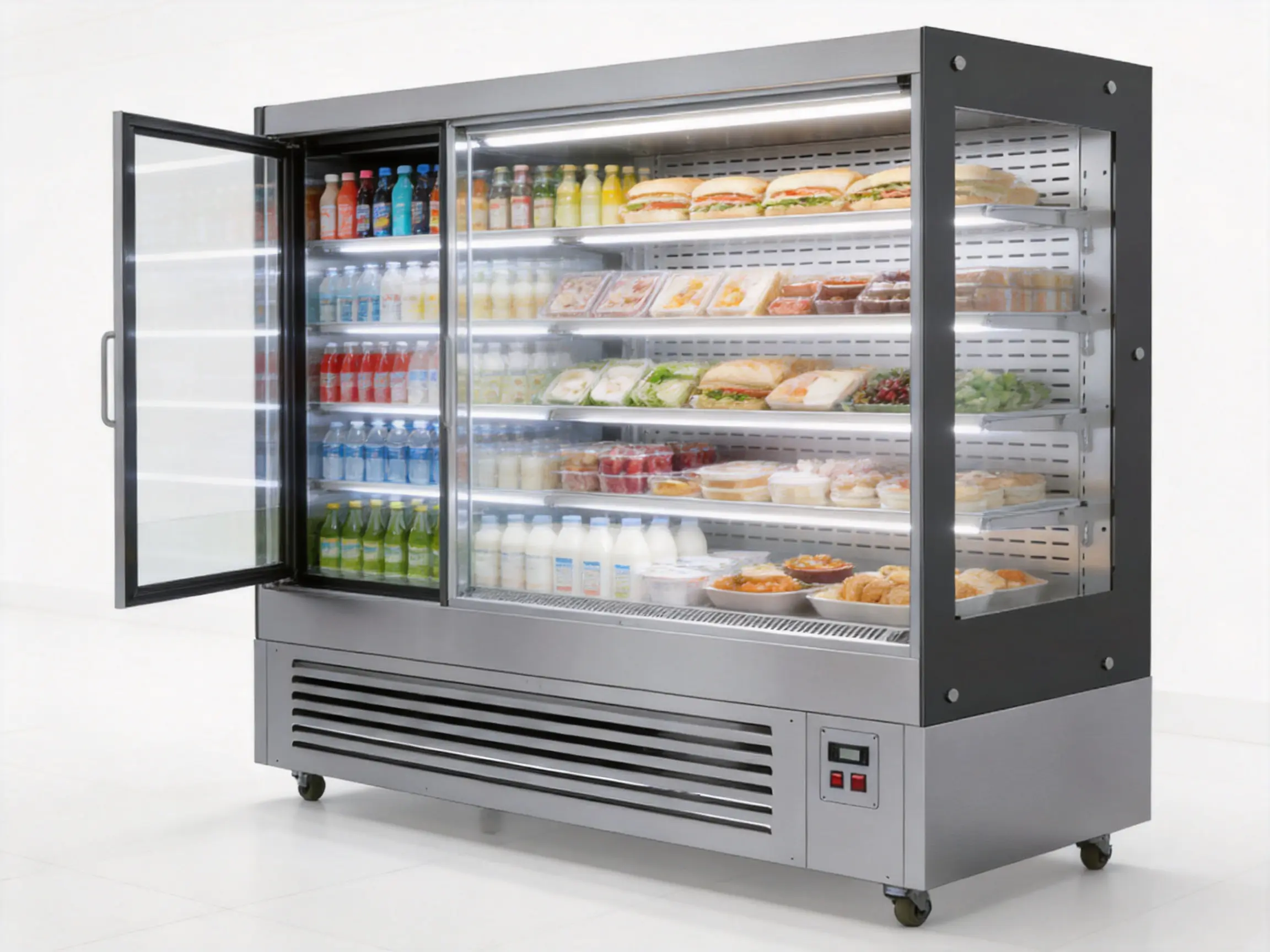
The main commercial advantage of an open display cooler is visibility. Customers can see the products immediately, often from several steps away. This makes the cabinet suitable for point-of-sale merchandising, product grouping, seasonal promotions, and high-frequency purchases.
Tempered glass is used as part of the cabinet construction. It provides a clear viewing area while offering greater resistance to ordinary impact and temperature stress than standard glass. The glass also helps define the display zone and gives the cabinet a clean commercial appearance.
Product presentation has a direct effect on perceived freshness and value. A well-organized display can make color, packaging, portion size, and product variety easy to recognize. The cabinet’s vertical format allows businesses to arrange products in visual layers, helping customers compare multiple items without bending down or searching through a deep storage space.
The display area can be organized according to sales strategy. Frequently purchased products may be placed at convenient eye or hand level. Premium products can be grouped in a prominent area. Complementary products can be arranged together, such as sandwiches with beverages or desserts with ready-to-serve drinks. Seasonal items can be given a dedicated section without changing the basic equipment.
A separate light button is included as a standard feature. The dedicated switch gives operators independent control over display lighting, allowing the light to be managed according to store hours, merchandising needs, and energy-use policies. Lighting can make labels and packaging easier to read while improving the visual impact of the products.
The open front also supports fast staff access. In a busy food-service environment, employees can retrieve products without repeatedly opening and closing a hinged door. This can simplify service during peak periods. In self-service retail, customers can select goods with less friction, which may support faster purchasing decisions.
Compared with a closed vertical refrigerator, the XCS series offers a more accessible shopping experience. Compared with an uncooled open shelf, it provides a controlled refrigerated environment. This combination places the product between storage refrigeration and open merchandising, providing a specialized solution for chilled display.
6. Stainless Steel Construction and Commercial Durability
The cabinet uses a stainless steel body. Stainless steel is widely used in commercial food equipment because it offers a combination of strength, cleanability, and resistance to common workplace conditions. Its smooth surfaces can support regular sanitation and help maintain a professional appearance in retail and food-service areas.
Commercial refrigeration equipment must withstand more than normal cooling operation. It may be exposed to frequent stocking, movement, cleaning, contact with packaging, and daily changes in workload. A robust exterior structure helps the cabinet maintain its appearance and function in environments where equipment is used continuously.
Stainless steel also complements the tempered glass display area. The combination creates a neutral appearance that can fit supermarkets, convenience stores, bakeries, cafés, restaurants, hotels, and institutional food-service spaces. It does not compete visually with the products, which remain the main focus of the display.
Ease of cleaning is especially important for equipment used with ready-to-eat food. Operators should use cleaning agents and procedures compatible with stainless steel, tempered glass, seals, and other cabinet components. Routine cleaning should be performed according to the manufacturer’s instructions and applicable hygiene regulations.
The use of durable materials is one area where a commercial showcase can distinguish itself from light-duty consumer equipment. Consumer refrigerators are not generally designed for constant public access, frequent product handling, or the intensive cleaning routines found in food retail. The XCS series is positioned for professional use and incorporates construction features appropriate to that environment.
7. Mobility, Placement, and Store Flexibility
Each cabinet is fitted with four castors, with brakes on the front two. This design allows the unit to be moved for installation, cleaning, layout adjustments, or service access. Once the cabinet is correctly positioned, the front brakes help secure it in place.
Mobility is valuable in retail spaces because store layouts may change over time. A business may adjust its product mix, relocate seasonal displays, remodel a sales area, or change the direction of customer traffic. Castors make these changes easier than they would be with a fixed cabinet.
The castors also simplify cleaning around and beneath the unit. Dirt and packaging debris can accumulate in high-traffic areas, so the ability to move equipment can support better housekeeping. Before moving the cabinet, operators should follow safety procedures, disconnect power when appropriate, and ensure that the equipment is handled on a suitable floor surface.
When installing the showcase, businesses should consider customer flow, staff access, power availability, ventilation, nearby equipment, and the location of heat-producing appliances. The open front should face the intended customer or service area. Sufficient space should be left for cleaning, loading, inspection, and technical maintenance.
The three model widths provide additional planning flexibility. Multiple XCS-950Z units may be used where separate merchandising zones are desired. A larger XCS-1550Z may be preferable where a continuous high-volume display is more important. The XCS-1250Z serves as an intermediate option for operators who require more capacity without selecting the widest cabinet.
8. Comparing the Three Available Models
XCS-950Z: Compact Display Capacity
The XCS-950Z offers 300 liters of gross capacity and a product width of 900 millimeters. It is the most compact model in the range, making it practical for smaller sales areas or businesses testing an open refrigerated merchandising concept.
Its smaller footprint can be useful in cafés, bakeries, convenience shops, hotel lobbies, small supermarkets, and restaurant service areas. It can also function as a dedicated display for a specific category, such as chilled desserts, packaged sandwiches, bottled beverages, or prepared salads.
With a net weight of 126 kilograms and a gross shipping weight of 172 kilograms, the XCS-950Z is the easiest of the three models to plan for when floor access or handling space is limited. Its loading quantity is also the highest, with stated container loading of 18 units in a 20GP container and 36 units in a 40HQ container.
XCS-1250Z: Balanced Capacity and Footprint
The XCS-1250Z provides 410 liters of gross capacity and a 1200-millimeter product width. It is a balanced choice for operations that need a larger presentation area but do not require the full width of the largest model.
This size may suit medium-sized supermarkets, busy cafés, convenience stores, delis, and food-service counters. It provides more room for product variety, promotional grouping, and multiple display levels while retaining the same 656-millimeter depth and 1435-millimeter height as the other models.
The model has a stated net weight of 155 kilograms and a gross shipping weight of 210 kilograms. Container loading is listed as 13 units in a 20GP container and 27 units in a 40HQ container.
XCS-1550Z: Maximum Linear Presentation
The XCS-1550Z is the largest model, offering 510 liters of gross capacity and a product width of 1500 millimeters. It is designed for high-volume display requirements and locations where a broad, continuous product presentation can improve merchandising.
The wider cabinet can accommodate more product categories in one unit or provide additional facings for fast-selling items. It may be appropriate for supermarkets, larger convenience stores, institutional dining areas, high-volume cafés, hotels, and prepared-food departments.
The XCS-1550Z weighs 190 kilograms net and 257 kilograms gross. Its listed container loading quantity is 10 units in a 20GP container and 22 units in a 40HQ container. Buyers should account for the higher handling requirements of the larger cabinet during delivery and installation.
9. Why the Series Can Compete Effectively
Commercial refrigeration buyers commonly compare equipment according to price, capacity, appearance, temperature stability, serviceability, energy use, maintenance, delivery, and expected working life. No single specification determines the best choice. The value of the XCS series comes from combining several useful features in one cabinet family.
First, the range provides a choice of widths without changing the principal operating concept. This gives buyers a consistent platform for different store formats. The same temperature range, refrigerant, climate type, and standard features are shared across the models, which can simplify staff training and operational procedures when several sizes are installed.
Second, the open format supports stronger product accessibility than closed-door equipment. In many retail situations, fast access and visibility are commercially important. The showcase can reduce the physical barrier between products and customers while maintaining refrigerated display conditions.
Third, ventilated cooling and automatic defrost offer practical operating benefits over more basic open shelving or static refrigeration designs. The cooling system is intended to distribute refrigerated air, while automatic defrost reduces the need for manual intervention.
Fourth, the stainless steel body and tempered glass construction provide a professional appearance and support commercial use. The cabinet is designed to be part of a visible sales environment rather than hidden in a back-of-house storage room.
Fifth, separate power and light switches provide greater operational control. Staff can manage the refrigeration and lighting functions independently according to store requirements. The digital temperature display also makes daily monitoring more direct.
Finally, four castors with front brakes improve placement flexibility. A cabinet that can be moved and secured more easily may reduce installation inconvenience and make future layout changes less disruptive.
These advantages should be considered alongside the needs of each application. Open cabinets may require more attention to loading practices and ambient conditions than closed cabinets. Buyers should evaluate the product category, store climate, expected customer access, available power, maintenance capability, and local compliance requirements before selecting equipment.
10. Refrigerant and Environmental Considerations
The XCS series uses R290 refrigerant. R290 is propane used as a refrigerant and is recognized in many commercial refrigeration applications for its low global warming potential compared with several older refrigerant choices. Its use reflects the broader industry movement toward refrigerants with a lower environmental impact.
Because R290 is flammable, equipment containing it must be installed, serviced, transported, and handled by appropriately trained personnel. Operators should never modify the refrigeration circuit or attempt unauthorized repairs. The manufacturer’s safety instructions and local regulations should always be followed.
Refrigerant choice is only one part of environmental performance. Actual sustainability also depends on cabinet maintenance, operating temperature, loading, installation, product turnover, electrical supply, service life, and end-of-life recovery. A well-maintained cabinet can support reliable performance and help avoid premature replacement.
Buyers evaluating commercial refrigeration should request the relevant technical documentation for their market, including electrical requirements, safety instructions, refrigerant information, compliance records, and maintenance guidance. This is particularly important for international projects where electrical standards and refrigerant regulations may differ.
11. Digital Controls and Daily Operation
The digital temperature controller provides an accessible interface for operating staff. A clearly displayed temperature helps employees perform routine checks at opening, during operating hours, and before closing. Businesses may also incorporate readings into their internal food-safety records where required.
The separate power button allows the refrigeration system to be switched independently. The separate light button provides control over display illumination. This separation is useful when the business wants to maintain refrigeration while reducing unnecessary lighting outside customer hours, or when lighting needs to be adjusted for cleaning and maintenance.
Daily operation should begin with a visual inspection. Staff should check that the display is clean, the temperature is within the appropriate range, products are arranged correctly, and no packaging is blocking airflow. The glass should be inspected for damage, and the castor brakes should be confirmed when the cabinet is in its operating position.
Products should be loaded at suitable temperatures rather than using the showcase as a rapid-cooling device unless the manufacturer specifically permits that use. Overloading can restrict airflow and may compromise temperature uniformity. Good stock rotation should be practiced, with older products placed where they will be selected first according to the business’s food-safety procedures.
At closing, staff should inspect the cabinet for spills, remove damaged packaging, clean accessible surfaces, and record any unusual temperature or operating behavior. A consistent routine helps protect both product quality and equipment performance.
12. Cleaning and Maintenance Practices
Regular cleaning supports hygiene, appearance, and reliable operation. The frequency should depend on the product category, store traffic, spill risk, and local sanitation requirements. Ready-to-eat food displays generally require particularly disciplined cleaning procedures.
Glass surfaces should be cleaned with suitable products that do not damage the material or leave residues. Stainless steel surfaces should be cleaned in a way that preserves their finish. Abrasive tools and aggressive chemicals should be avoided unless specifically approved by the manufacturer.
Air inlets, outlets, and ventilation areas should remain clear of dust, packaging, and other obstructions. Restricted airflow can reduce cooling performance and place additional stress on the refrigeration system. Technical components should be inspected and serviced by qualified professionals.
The automatic defrost function reduces manual defrost work, but it does not replace preventive maintenance. Operators should monitor for excessive frost, unusual water, abnormal sounds, repeated temperature alarms, or longer-than-usual cooling cycles. Such signs should be investigated promptly rather than ignored.
Service records can help businesses identify recurring issues and plan preventive maintenance. Records may include cleaning dates, temperature checks, service visits, component replacement, and observations about cabinet performance. For operations with multiple units, a standardized checklist can make staff responsibilities clearer.
Proper maintenance can also support a longer service life. Commercial refrigeration represents a significant investment, and protecting the cabinet’s cooling system, electrical components, glass, body, and castors can reduce avoidable downtime.
13. Manufacturing Strengths of the Producer
Ningbo XiangChi Electrical Co., Ltd. specializes in vertical display cabinets, cake cabinets, warming cabinets, and related commercial equipment. The company was established in 2007 and reports more than ten years of experience in the field. This specialization is relevant because commercial display refrigeration requires knowledge of cooling systems, product presentation, cabinet construction, electrical controls, and the practical needs of retail operators.
The manufacturer reports a modern management garden factory covering 40,000 square meters. A facility of this scale can provide space for organized production, component handling, assembly, quality inspection, testing, packaging, and logistics coordination. Efficient factory organization is particularly important for products that are large, heavy, and shipped internationally.
The company also reports its own professional research and development team. In commercial refrigeration, product development involves more than selecting a compressor or assembling a cabinet. Engineers must consider air distribution, cabinet geometry, insulation, glass performance, defrost behavior, control systems, service access, material selection, and transportation requirements.
Advanced testing facilities are identified as another company strength. Testing is essential for evaluating temperature performance, electrical safety, structural integrity, control accuracy, operating stability, and suitability for intended markets. Testing also supports the refinement of new products and helps manufacturers identify potential issues before shipment.
The company states that it has obtained CE, GS, CCC, CB, RoHS, ETL, and other major certifications. Certification requirements vary by market and product configuration, so buyers should confirm which approvals apply to the specific model and destination. Nevertheless, the reported certification portfolio indicates experience in preparing commercial appliances for different regulatory environments.
A manufacturer’s ability to supply different product categories can also benefit distributors and commercial buyers. Customers seeking open display coolers may also require four-sided glass display coolers, countertop display refrigerators, cake showcases, sushi showcases, display warmers, or four-sided glass freezers. A supplier with a broader commercial refrigeration range may simplify sourcing and product coordination.
14. Manufacturing Process Considerations
Although detailed internal production procedures are not provided, the stated factory, R&D, testing, and certification capabilities point to several important manufacturing stages that influence the final product. These include material preparation, cabinet forming, stainless steel fabrication, glass integration, refrigeration-system assembly, electrical installation, functional testing, cleaning, packaging, and shipping inspection.
Stainless steel body production requires accurate cutting, forming, joining, surface finishing, and dimensional control. Consistent cabinet dimensions are important because they affect glass installation, internal volume, panel alignment, castor placement, and overall appearance.
Tempered glass must be handled carefully throughout production and packing. Proper fitting and protection are necessary to reduce the risk of damage during assembly and transportation. Since the glass is part of the customer-facing display, its clarity and condition are also important to the merchandising function.
Refrigeration assembly includes the installation and connection of the cooling circuit, compressor-related components, heat-transfer components, controls, and refrigerant charge. The use of R290 makes safety discipline especially important. Production and service personnel require suitable procedures for handling a flammable refrigerant.
Electrical assembly must integrate the digital temperature controller, display, power switch, light switch, fans, lighting components, and refrigeration controls. Proper wiring, insulation, grounding, and functional testing are necessary for safe commercial operation.
Testing should verify that the cabinet reaches and maintains the intended temperature range under appropriate conditions. It should also confirm that the cooling fans, lights, digital display, power controls, defrost function, and other relevant systems operate correctly. Packaging inspection is important because the product must withstand handling during domestic and international transport.
The manufacturer’s emphasis on R&D and advanced testing suggests an approach that combines product development with validation. This is valuable in commercial refrigeration, where small design differences can influence temperature distribution, service access, cleaning, noise, energy use, and reliability.
15. Logistics and International Supply
The listed package dimensions and container loading quantities are useful for distributors, importers, contractors, and project planners. The XCS-950Z can be loaded at 18 units in a 20GP container and 36 units in a 40HQ container. The XCS-1250Z is listed at 13 and 27 units respectively, while the XCS-1550Z is listed at 10 and 22 units.
These figures help buyers estimate transportation requirements and compare the logistics implications of different models. The larger the cabinet, the fewer units can be shipped per container, but the greater the display capacity available per installation.
Package dimensions are larger than product dimensions to allow protective materials and shipping structure. Buyers should ensure that receiving docks, doors, elevators, corridors, and storage areas can accommodate the packaged unit. Handling equipment may be necessary because the gross weights range from 172 kilograms to 257 kilograms.
International buyers should also confirm voltage, frequency, plug configuration, labeling, certification, import documentation, warranty terms, replacement-part availability, and after-sales support before placing an order. These details can vary by market and should be agreed in the purchase documentation.
16. Recommended Application Scenarios
Supermarkets and Grocery Stores
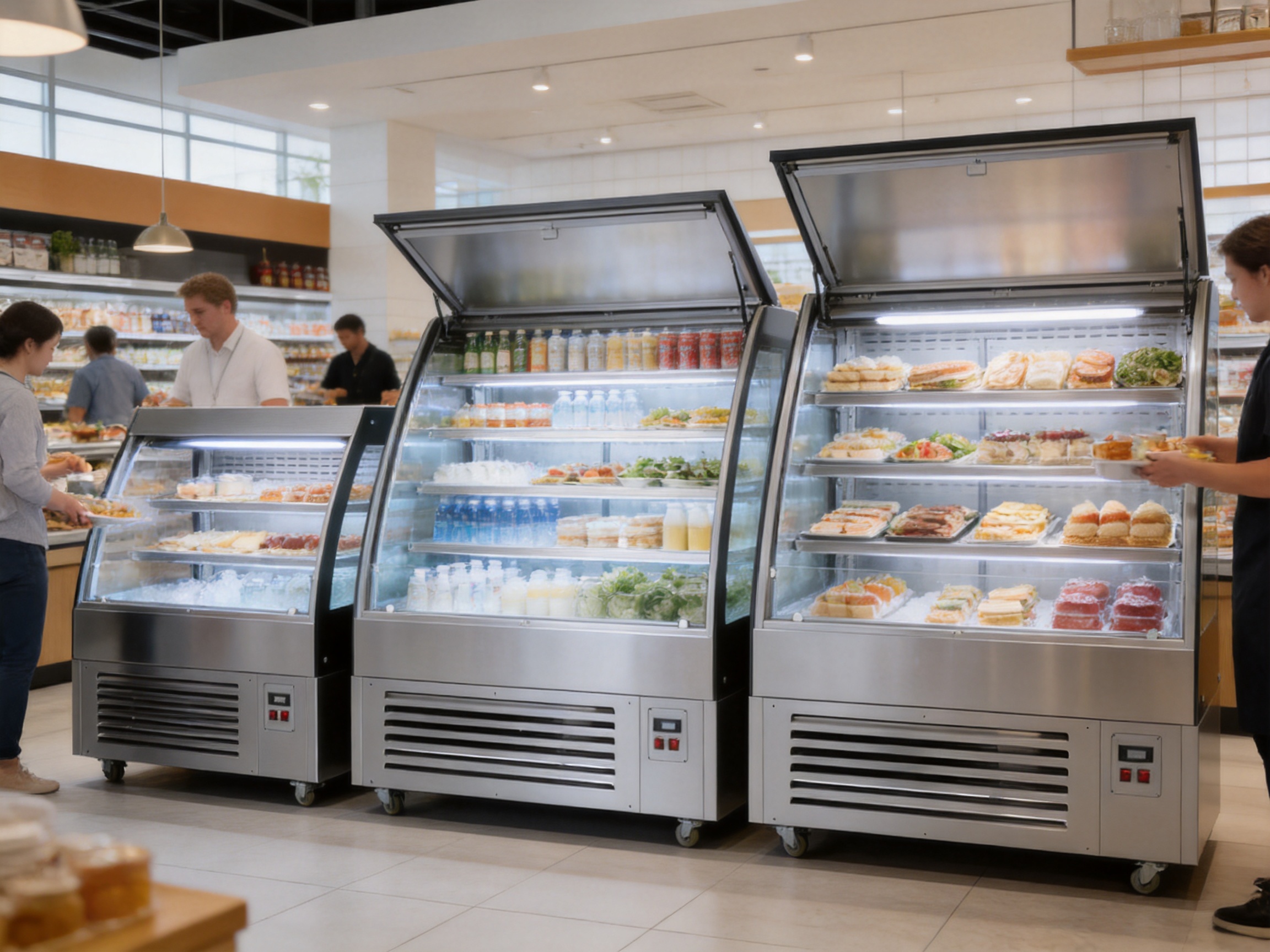
Supermarkets can use the showcase for chilled ready-to-eat meals, dairy products, drinks, salads, packaged sandwiches, desserts, and promotional products. The open design supports convenient browsing, while the range of widths allows the equipment to fit different departments.
Convenience Stores
Convenience stores often depend on fast purchasing and high product turnover. An open refrigerated showcase near the entrance, food counter, or checkout area can make chilled products immediately noticeable and accessible.
Bakeries and Cafés
Bakeries and cafés may use the cabinet for chilled cakes, pastries requiring refrigeration, desserts, bottled drinks, sandwiches, and prepared foods. The glass display helps customers view the product range before ordering.
Hotels and Restaurants
Hotels and restaurants can use the showcase in breakfast areas, buffet zones, lobby cafés, banquet preparation areas, or staff service stations. The castors can be useful when the layout changes for events or different service periods.
Institutional Food Service
Schools, hospitals, offices, and other institutions may use an open refrigerated display to organize pre-packed meals, beverages, fruit portions, and snacks. Operators should select products and temperature settings in accordance with their specific food-safety procedures.
17. Selecting the Right Size
Capacity should be selected according to product turnover rather than capacity alone. A cabinet that is too small may require frequent replenishment and create a crowded presentation. A cabinet that is too large may use unnecessary floor space and may not display products efficiently.
The XCS-950Z is a sensible starting point for compact locations or focused product categories. The XCS-1250Z offers additional space for variety and moderate volume. The XCS-1550Z is more suitable when broad product presentation and high capacity are priorities.
Businesses should measure the planned installation area carefully. The product depth is 656 millimeters and the height is 1435 millimeters for all three models, while the widths are 900, 1200, and 1500 millimeters. Clearance for ventilation, cleaning, customer movement, and service access should be added to the equipment dimensions.
Buyers should also consider how the cabinet will be delivered to its final location. Door widths, turning areas, floor strength, ramps, elevators, and unloading equipment may affect the choice between models.
18. Frequently Asked Questions
What type of equipment is the XCS series?
The XCS-950Z, XCS-1250Z, and XCS-1550Z are open refrigerated display showcases designed for commercial chilled-food merchandising. They are categorized as open display coolers.
What temperature range do the models provide?
The stated temperature range is 2–10°C, equivalent to 35.6–50°F. The correct operating point should be selected according to the product category, packaging requirements, local regulations, and operating instructions.
What are the capacity options?
The XCS-950Z has a gross capacity of 300 liters, the XCS-1250Z has a gross capacity of 410 liters, and the XCS-1550Z has a gross capacity of 510 liters.
Do the models use the same refrigerant?
Yes. All three listed models use R290 refrigerant. Because R290 is flammable, installation and service should be performed according to the manufacturer’s safety procedures and applicable regulations.
What does automatic defrost do?
Automatic defrost helps reduce frost accumulation on refrigerated surfaces and decreases the need for frequent manual defrosting. It does not replace routine cleaning, inspection, or professional maintenance.
How does ventilated cooling benefit the cabinet?
Ventilated cooling circulates refrigerated air through the display area, helping support a more consistent refrigerated environment when products are loaded correctly and airflow paths remain unobstructed.
Is the cabinet easy to move?
The cabinet includes four castors, with brakes on the front two. This supports movement during installation, cleaning, layout changes, and service access. The brakes help secure the cabinet in its operating position.
What materials are used in the construction?
The standard features include a stainless steel body and tempered glass. These materials provide a professional appearance and are suitable for regular commercial cleaning when handled according to the relevant care instructions.
Does the cabinet have lighting controls?
Yes. A separate light button is listed as a standard feature. The cabinet also has a separate power button and a digital temperature controller and display.
Which model is best for a small shop?
The XCS-950Z is the most compact model and may be suitable for smaller stores or focused product categories. The final choice should be based on available floor space, product turnover, delivery access, and required display capacity.
Which model provides the largest display area?
The XCS-1550Z is the widest model, with a product width of 1500 millimeters and a gross capacity of 510 liters. It is intended for applications requiring a broad, high-volume display.
Can the showcase be used for every type of food?
No refrigeration cabinet should be assumed to be suitable for every food category. Operators must confirm that the temperature range, display design, packaging, hygiene procedures, and local regulations are appropriate for the products being sold.
What should be considered before installation?
Buyers should confirm the available floor area, ventilation clearance, electrical supply, receiving route, floor strength, customer flow, service access, ambient conditions, and local compliance requirements.
What manufacturing strengths does the producer report?
The producer reports specialization in commercial display cabinets, establishment in 2007, more than ten years of industry experience, a 40,000-square-meter factory, a professional R&D team, advanced testing facilities, and certifications including CE, GS, CCC, CB, RoHS, and ETL.
19. Final Evaluation
The Open Automatic Defrost Refrigerated Showcase XCS-950Z, XCS-1250Z, and XCS-1550Z is designed for businesses that need refrigerated product presentation, quick customer access, and practical commercial operation. Its open format supports visibility and convenience, while the 2–10°C temperature range provides a suitable operating framework for many chilled-food applications.
The product family offers three widths and capacities, allowing buyers to match equipment to store size and sales volume. The XCS-950Z provides compact merchandising, the XCS-1250Z offers a balanced solution, and the XCS-1550Z supports high-volume linear display.
Ventilated cooling, automatic defrost, a digital temperature display, separate power and lighting controls, stainless steel construction, tempered glass, and castors with front brakes create a practical feature package. Together, these features distinguish the series from basic open shelving and simpler display equipment.
The manufacturer’s reported factory scale, R&D capability, testing facilities, product specialization, and international certifications add further value for distributors and commercial buyers. These strengths suggest that the company is equipped to support product development, quality control, market compliance, and international supply.
For the best results, the cabinet should be selected according to the products being displayed, installed in a suitable environment, loaded without obstructing airflow, cleaned regularly, and serviced by qualified personnel. When these conditions are met, the XCS series can serve as both a refrigeration appliance and a merchandising tool, helping businesses protect chilled products while presenting them in a clear and accessible way.
References
1. Ningbo XiangChi Electrical Co., Ltd. Product specification information for the XCS-950Z, XCS-1250Z, and XCS-1550Z refrigerated showcase series.
2. Ningbo XiangChi Electrical Co., Ltd. Company information concerning manufacturing facilities, product development, testing capabilities, experience, and certifications.
3. General commercial refrigeration principles concerning ventilated cooling, automatic defrost, temperature monitoring, cabinet loading, and preventive maintenance.
4. General food-retail equipment guidance concerning refrigerated display, sanitation, product rotation, installation planning, and safe equipment operation.
5. General refrigerant safety principles concerning equipment using R290 and the need for qualified installation and servicing.
Product: Open Automatic Defrost Refrigerated Showcase XCS-950Z/1250Z/1550Z/1550Z

You May Also Like
.jpg?imageView2/2/w/500/h/500/format/jp2/q/100 "Four Sides Glasses Display Cooler")
.jpg?imageView2/2/w/500/h/500/format/jp2/q/100 "White 4-Sided Glass Refrigerated Display Case")
.jpg?imageView2/2/w/500/h/500/format/jp2/q/100 "Refrigerated Display Cake Countertop Four Sides Glasses Display Cooler")
.jpg?imageView2/2/w/500/h/500/format/jp2/q/100 "Four Sides Glasses Display Cooler")

-
- Navigation
- Home
- About Us
- Products
- News
- Contact Us
 East Zone, Guanhaiwei Industrial Park, Cixi City, Ningbo, Zhejiang, China
 +86-574-63668678
 +86-574-63668108
Copyright © Ningbo XiangChi Electrical Co.,Ltd All Rights Reserved.
