
 简体中文
简体中文 English
 Español
News
Commercial Fan-Cooling Refrigerated Cake Display Cabinets with Steam Humidification
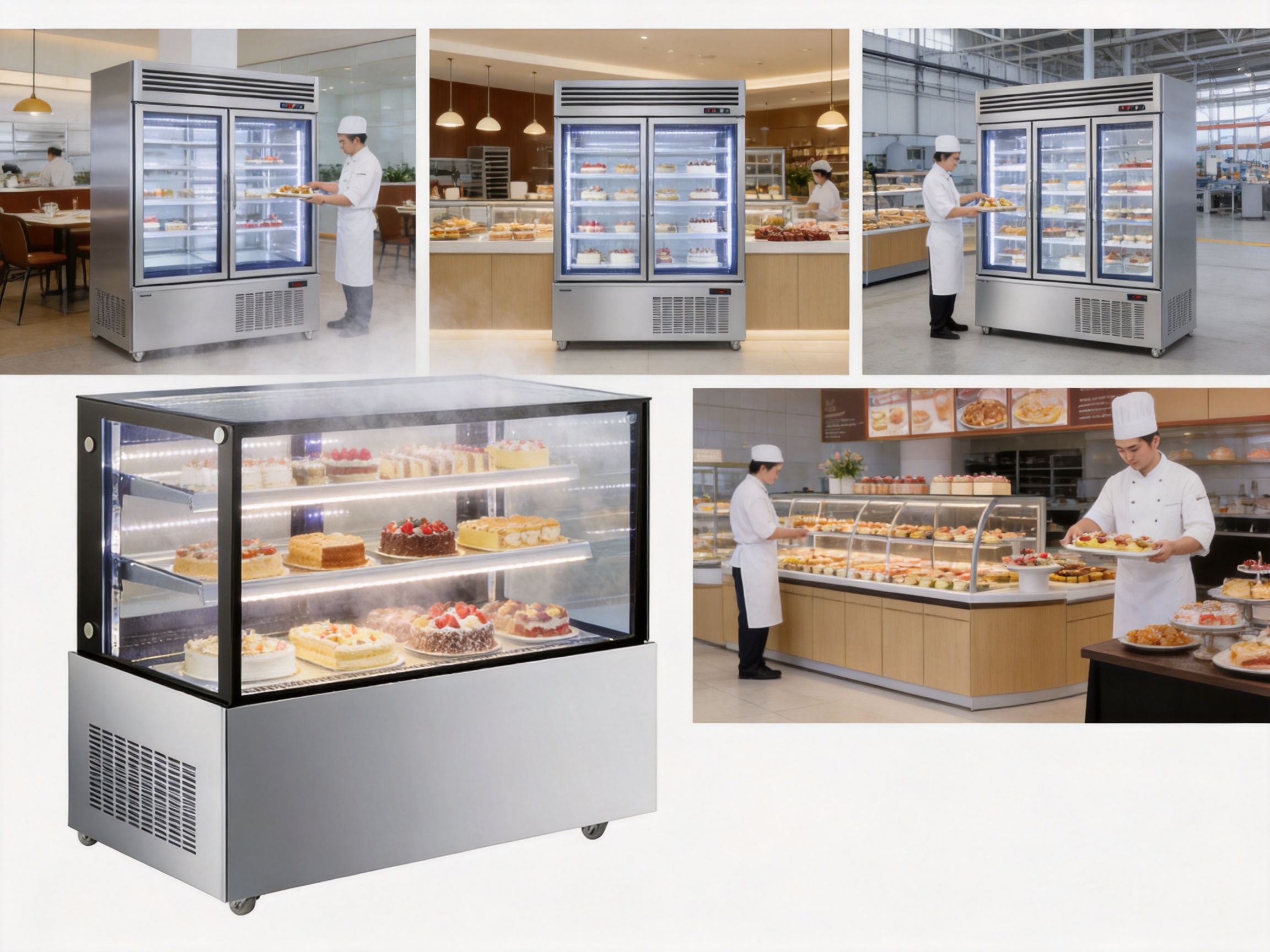
In professional food retail, presentation and preservation must work together. A cake may have an attractive shape, delicate decoration, and premium ingredients, but its commercial value can decline quickly if the display environment causes drying, temperature instability, condensation, or poor visibility. The Commercial Fan Cooling Refrigerated Cake Display Cabinet with Steam for Humidification, model XC-370ZS, is designed to address these challenges through a combination of refrigerated air circulation, multi-sided visibility, organized interior presentation, and humidity support.
This type of cake showcase is suitable for bakeries, pastry shops, cafés, hotels, restaurants, dessert counters, catering businesses, supermarkets, and specialty food retailers. It provides a professional way to display cakes and other chilled desserts while helping operators maintain an attractive, hygienic, and organized service area. The cabinet is not simply a cold storage unit. It is a merchandising appliance intended to encourage purchases while supporting the quality of products throughout the business day.
Developed for commercial use, the XC-370ZS reflects the needs of modern food businesses that require reliable refrigeration, efficient use of floor space, attractive product visibility, and consistent daily operation. Its fan-cooling system is intended to distribute refrigerated air through the cabinet, while the steam humidification function helps reduce the excessive dryness that can affect exposed cakes and pastries. Together, these features create a display environment more appropriate for sensitive desserts than a basic refrigerator or static cold cabinet.
Why Cake Display Conditions Matter
Cakes are among the most visually sensitive products in food retail. Customers often make their purchasing decisions according to the appearance of icing, cream, fruit, chocolate decoration, glazing, and layered fillings. Even small changes in surface condition can influence how fresh a cake appears. A dry sponge, cracked cream, dull glaze, or hardened decorative layer may reduce customer confidence even when the product remains technically safe to consume.
Temperature is one important factor, but it is not the only one. Refrigeration helps slow the growth of microorganisms and supports the safe holding of many cream-based, fruit-based, dairy-based, and mousse products. However, an excessively dry refrigerated environment can remove moisture from exposed surfaces. This may lead to a less attractive texture and appearance, especially when products remain in the showcase for several hours.
Humidity management can therefore be valuable in a cake display application. The purpose of a steam humidification system is to add controlled moisture to the cabinet environment, helping support the appearance and texture of suitable products. Humidification must be used responsibly and in accordance with the food operator’s procedures, because excessive moisture can cause condensation or affect certain decorations. The advantage of an integrated system is that the operator has a purpose-built method of supporting the display environment instead of relying on improvised containers or uncontrolled room humidity.
Visibility also matters. A cake cabinet is part of the sales area, and customers want to inspect products before making a selection. A clear, multi-sided glass design allows products to be viewed from different angles and can make the cabinet more effective in open retail layouts. The display itself becomes a merchandising tool, helping businesses communicate variety, quality, and freshness.
Product Overview
The XC-370ZS is a commercial fan-cooling refrigerated cake display cabinet with steam humidification. Its product category is Cake Showcase, and its design is intended for businesses that need chilled display storage rather than hidden back-room refrigeration. The cabinet combines refrigeration, glass presentation, interior product arrangement, and environmental support in a single commercial appliance.
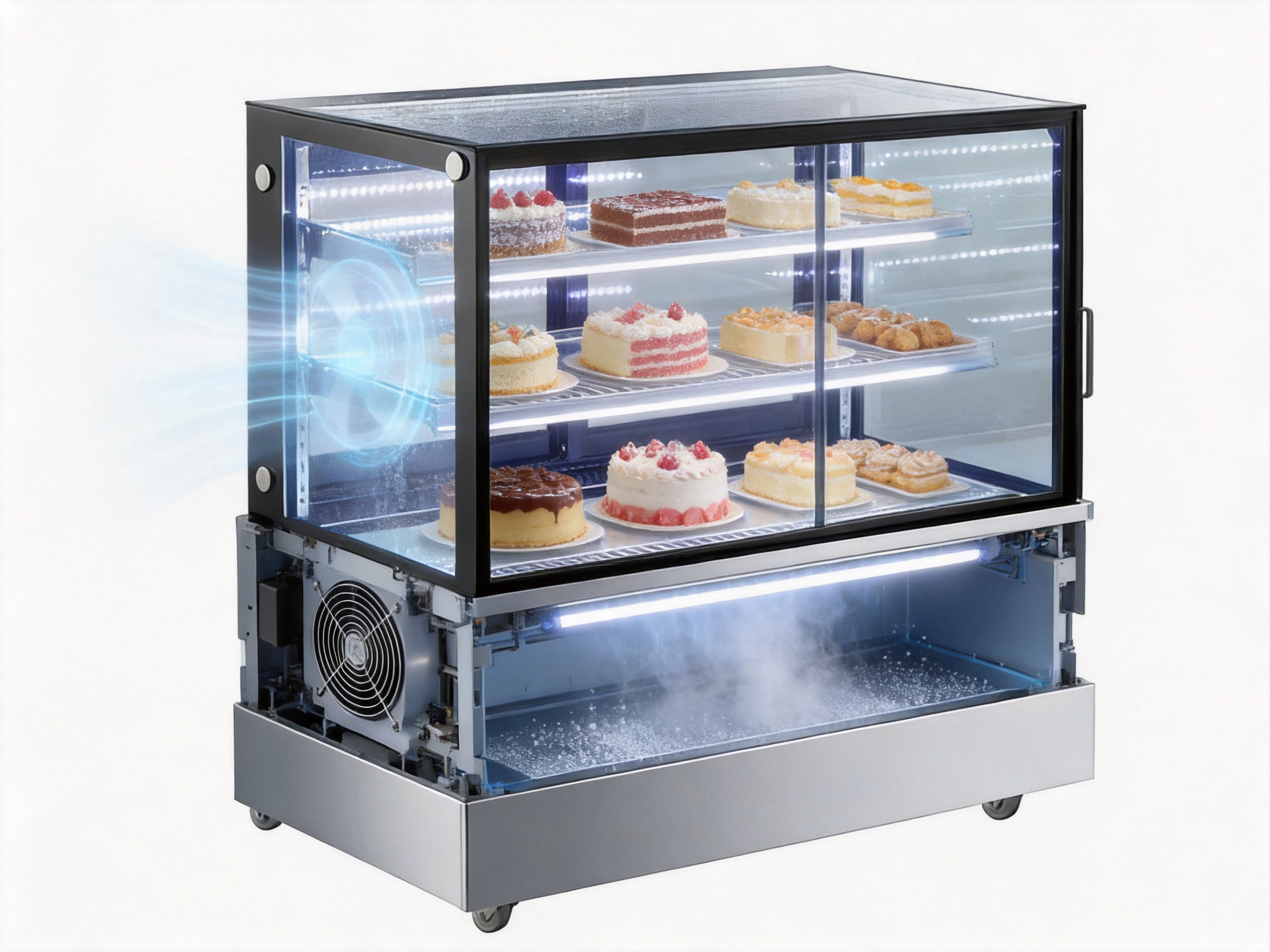
The central cooling method uses a fan-assisted system. Instead of depending only on still air, fan cooling circulates refrigerated air within the display area. This can help reduce temperature differences between areas of the cabinet when the unit is correctly loaded and operated. More consistent air movement is particularly useful in a display cabinet where shelves contain products at several levels.
The cabinet’s humidification function is especially relevant to cakes and pastries that may lose surface moisture in a continuously refrigerated environment. Steam or moisture generation can help create a more suitable atmosphere for selected products. The system should be managed according to the type of food being displayed, the length of display time, ambient conditions, and the operator’s sanitation procedures.
The product is also designed around customer-facing presentation. Glass panels provide a clear view of the products, while the vertical cabinet format makes use of upward display space. This allows operators to present multiple products without occupying the same floor area required by a wide, low counter. For businesses working with limited retail space, vertical display can improve the efficiency of the sales area.
| Product Element | Commercial Function | Business Benefit |
|---|---|---|
| Fan-assisted refrigeration | Circulates cooled air through the cabinet | Supports a more consistent refrigerated display environment |
| Steam humidification | Adds controlled moisture to the display atmosphere | Helps support the appearance of suitable cakes and pastries |
| Glass display construction | Provides visual access to products | Improves product presentation and customer engagement |
| Vertical cabinet format | Uses height for product arrangement | Helps maximize display capacity within a compact footprint |
| Commercial design approach | Supports repeated daily operation | Provides a practical solution for professional food businesses |
| Organized internal shelving | Separates product levels and categories | Improves presentation, access, and stock control |
Fan Cooling for More Even Refrigerated Air
Fan cooling is one of the key features that distinguishes a commercial display cabinet from a simple static refrigerator. In a static system, cold air may naturally settle in lower areas while warmer air remains above, especially when the cabinet is frequently opened. A fan-assisted arrangement moves air through the refrigerated compartment, helping the cabinet manage temperature distribution more effectively.
For cake display, air movement should be balanced. Strong or poorly directed airflow may dry exposed products, while insufficient circulation may create uneven conditions. A purpose-designed commercial cabinet seeks to combine refrigeration and air movement in a way that supports both product preservation and attractive presentation. The integrated humidification function adds another layer of environmental control for products that are sensitive to moisture loss.
Fan cooling can also support faster recovery after door opening, depending on the operating configuration and surrounding conditions. In a busy bakery or café, customers and staff may access products repeatedly. Every opening allows warmer ambient air to enter. A properly engineered refrigerated system is expected to restore its operating environment efficiently after routine access, although performance will always depend on loading, room temperature, door usage, cleaning, and maintenance.
Air circulation also makes it important to load the cabinet correctly. Products should not block air outlets or return paths. Trays should be arranged with enough space to allow the refrigerated air to move around the display area. Operators can obtain better results by following the manufacturer’s loading recommendations and avoiding excessive stacking.
Steam Humidification for Cake Presentation
Steam humidification is a valuable feature for a cake showcase because refrigeration alone does not automatically protect every visual and textural characteristic of a dessert. Cold air can be relatively dry, particularly in commercial environments where air is repeatedly circulated. When cakes are exposed for long periods, the outer surface may gradually lose moisture.
A humidification system introduces moisture into the cabinet in a controlled manner. This may help support the softness of cake surfaces, the appearance of cream, and the visual quality of selected pastries. The result is not intended to replace proper packaging, safe food handling, or correct temperature control. Instead, it complements refrigeration by addressing a different aspect of product quality.
Different foods respond differently to humidity. A cake with an exposed sponge, cream layer, or soft icing may benefit from a more supportive moisture environment. Products with crisp coatings, delicate sugar decorations, or moisture-sensitive toppings may require a different setting or display strategy. Operators should evaluate products individually and use the humidification function according to product requirements.
Good sanitation is essential whenever water or steam is used in food equipment. The water supply, internal surfaces, drains, and humidification components should be inspected and cleaned in accordance with the operating instructions. Stagnant water, mineral deposits, or unclean surfaces can undermine the benefits of the system. Proper maintenance ensures that humidification remains a controlled food-display feature rather than a source of hygiene problems.
Compared with improvised humidity methods, an integrated steam system offers greater control and a more professional appearance. Open containers of water may spill, occupy display space, or create inconsistent humidity. A built-in solution is designed as part of the cabinet’s operating system and can be managed alongside refrigeration and daily cleaning routines.
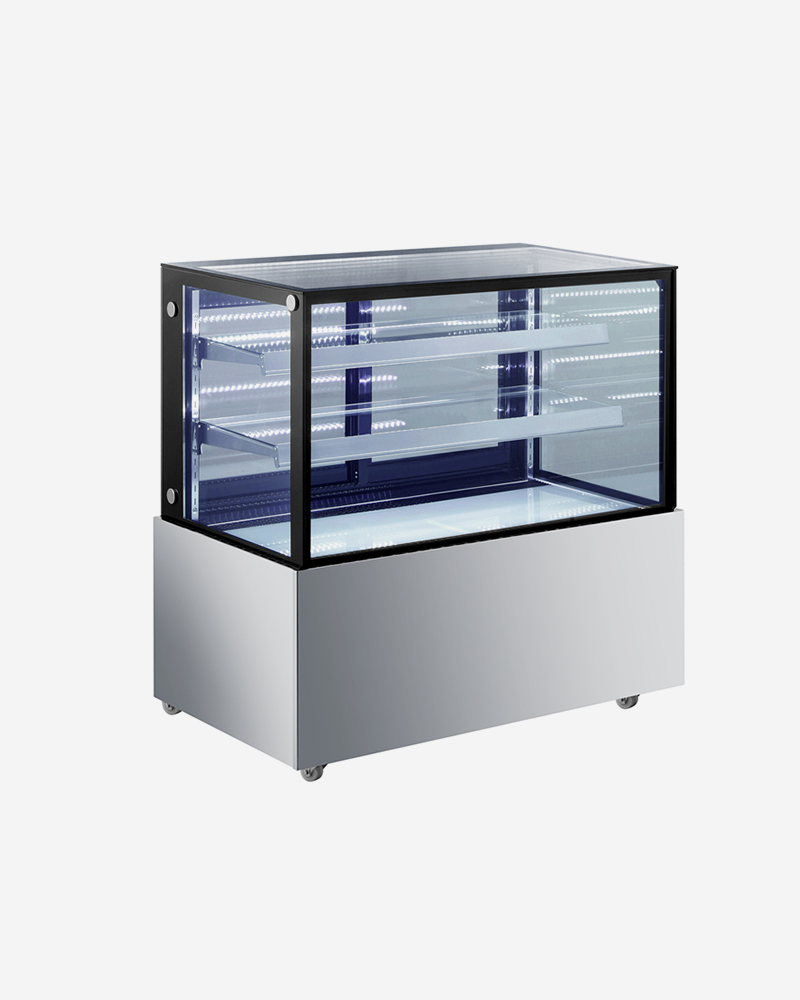
Commercial Fan Cooling Refrigerated Cake Display Cabinets Steam For Humidification
Glass Visibility and Merchandising Value
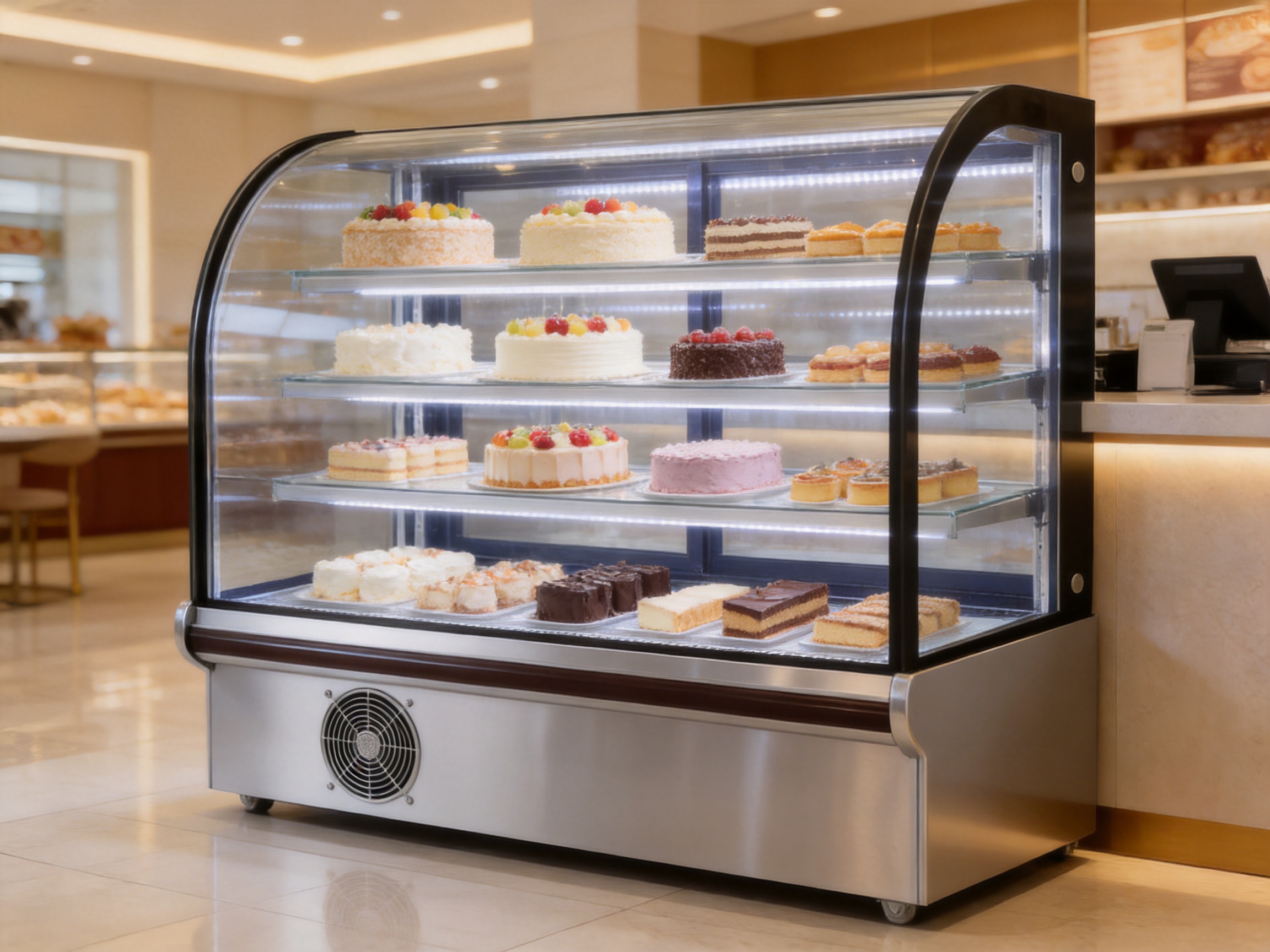
The glass enclosure is central to the role of a cake showcase. Customers expect to see the products before ordering, and a clear view can communicate freshness, craftsmanship, and variety. A well-organized glass cabinet lets shoppers compare sizes, colors, decorations, and product types without requiring staff to open the unit repeatedly.
Multi-sided visibility is particularly useful in open commercial layouts. A cabinet positioned near a service counter, entrance, seating area, or self-selection zone can attract attention from several directions. Instead of presenting cakes only to customers standing directly in front of a counter, the display can contribute to the visual identity of the entire shop.
Glass also helps protect displayed products from unnecessary handling, airborne contaminants, and accidental contact. It creates a physical separation between food and the customer area while maintaining visual access. For bakeries that invest heavily in decoration, this protection is important because a damaged topping or displaced garnish can reduce the perceived value of the product.
Lighting, cleanliness, and arrangement influence the performance of the glass display. Operators should keep panels free from fingerprints, condensation, dust, and food residue. Products should be positioned so that labels and decorations remain visible. A cabinet with strong refrigeration but poor merchandising may not achieve its full commercial value; the display should be treated as part of the sales process.
Vertical Space Utilization
Retail floor space is expensive, especially in shopping centers, cafés, hotels, and compact urban bakeries. A vertical display cabinet allows a business to use height rather than relying exclusively on a wide countertop or long refrigerated case. This can create a larger visual presentation while preserving room for customer circulation, service equipment, seating, or additional merchandise.
Vertical organization also supports product segmentation. Different shelves can be used for whole cakes, individual slices, seasonal products, premium desserts, or ready-to-serve items. Clear separation makes stock rotation easier and helps staff maintain a more attractive arrangement throughout the day.
Product capacity should always be considered together with air circulation. Filling every available space may reduce visibility and restrict cooling. A professional display strategy leaves sufficient room between products and avoids covering air passages. The most effective arrangement is not necessarily the one with the largest quantity; it is the one that combines good capacity with clean presentation and reliable refrigeration.
The vertical format can also strengthen impulse purchasing. Products positioned at eye level are more likely to receive attention, while lower and upper levels can create a layered visual composition. Operators can place signature cakes, new products, or high-margin desserts in prominent positions and use the remaining shelves for supporting varieties.
Advantages Compared with Basic Refrigerated Storage
A standard refrigerator can keep food cold, but it is not always appropriate for customer-facing cake presentation. Basic refrigeration units may have solid doors, limited visibility, inadequate product organization, or no humidity support. They are primarily designed for storage rather than merchandising.
The XC-370ZS addresses the broader requirements of a commercial cake display application. Its fan-assisted refrigeration supports the cold environment, its glass construction presents products attractively, and its steam humidification feature addresses moisture-sensitive display conditions. These functions reduce the need to combine several separate pieces of equipment.
Using a dedicated showcase can also improve workflow. Staff can identify products quickly, monitor stock visually, and serve customers without repeatedly transferring cakes from a back-room refrigerator. A well-planned display may reduce handling, protect decorations, and make daily replenishment more efficient.
The cabinet can also support brand presentation at the shop level, even though the appliance itself is a functional piece of equipment. A neat, bright, clean, and well-organized showcase communicates professionalism. Customers may associate the quality of the display with the care given to the products inside.
Advantages Compared with Non-Humidified Display Cabinets
Many refrigerated display cabinets provide cooling but do not include a dedicated humidification system. These units may be suitable for packaged products or desserts that are less sensitive to moisture loss. However, businesses selling decorated cakes, cream cakes, mousse products, and other exposed desserts may require more than temperature control.
The addition of steam humidification gives the operator another tool for managing the cabinet environment. It can help reduce the visual effects of dryness when used correctly. This is an important distinction for products whose value depends on a soft, fresh, and appealing appearance.
A non-humidified cabinet may force staff to use packaging or coverings that reduce visibility. Alternatively, operators may need to shorten display periods or accept a gradual change in surface quality. An integrated humidification function can support a more open presentation, although products must still be evaluated according to their individual characteristics.
The advantage is therefore not simply that the cabinet adds steam. Its stronger value comes from combining refrigerated display, visual presentation, and moisture support within one coordinated appliance. This integrated approach can be more practical than adapting general-purpose equipment to a specialized cake-retail requirement.
Advantages Compared with Static-Cooling Showcases
Static-cooling showcases may have a simpler structure, but their air distribution can be less active. In a busy commercial environment, uneven cooling may become more noticeable when the cabinet is frequently opened or heavily loaded. Fan-assisted circulation is intended to create a more active refrigerated environment and support temperature consistency across the display area.
Active air movement can also help the cabinet respond to changing operating conditions. The result depends on the refrigeration design, ambient temperature, product load, and maintenance condition, but fan cooling generally offers a more suitable platform for a professional multi-level display than a completely static arrangement.
There is an important balance between airflow and product protection. Operators should follow loading instructions, avoid placing products directly in front of air outlets, and select appropriate humidity settings. When these operating practices are followed, fan cooling and humidification can work together rather than competing with each other.
Suitable Commercial Applications
Bakeries and Pastry Shops
Bakeries are natural users of refrigerated cake showcases. They may display whole celebration cakes, sliced cakes, cream pastries, fruit tarts, cheesecakes, mousse desserts, and seasonal specialties. The cabinet allows the products to remain visible while supporting chilled holding conditions.
For a bakery, the display can be positioned near the ordering counter so customers can inspect the selection while speaking with staff. It can also be placed near the entrance to create an immediate visual impression. Product arrangement can be changed throughout the day to highlight fresh batches, special orders, or limited-time items.
Cafés and Coffee Shops
Cafés often need a compact display solution for desserts served alongside coffee, tea, and cold beverages. A vertical cake cabinet can add a strong visual element without taking up the full length of a traditional refrigerated counter. The clear glass presentation encourages customers to add a dessert to their order.
Because café staff may access the cabinet frequently during busy periods, an active refrigeration system is useful for supporting recovery after routine opening. Staff should still minimize unnecessary door opening and maintain a consistent stock rotation system.
Hotels and Restaurants
Hotels and restaurants may use the cabinet for buffet service, dessert counters, banqueting preparation, or front-of-house display. Its professional appearance can complement a high-quality dining environment. The cabinet can help present desserts in an orderly way while protecting them from direct customer contact.
Restaurants can also use different shelves for different service periods, such as lunch desserts, evening pastries, or special event products. The ability to see stock at a glance helps service teams plan replenishment.
Supermarkets and Specialty Food Retailers
Supermarkets and delicatessen retailers require display equipment that combines product visibility with organized chilled storage. A cake showcase can be used for premium desserts, freshly prepared cakes, seasonal gift products, and ready-to-serve portions.
In a supermarket environment, the glass cabinet can support impulse sales by presenting products in a high-traffic location. Clear labeling, attractive shelf arrangement, and consistent cleaning are especially important when the cabinet is accessible to a large number of shoppers.
Catering and Event Businesses
Catering companies may require a display solution for reception areas, hotel events, dessert stations, or temporary retail counters. The cabinet provides a professional method of presenting cakes while keeping them in a refrigerated environment. Event operators should evaluate transport, installation, power supply, ambient temperature, and local food-service requirements before deployment.
Product Presentation Best Practices
A cake showcase performs best when the products inside are arranged with the same care used in their preparation. Staff should avoid overcrowding shelves, mixing products in a confusing manner, or allowing empty packaging and tools to remain in the display area. Every item should have a clear position and be easy to identify.
Grouping products by type is often effective. For example, whole cakes may be placed together, while slices, individual pastries, and specialty desserts occupy separate levels. Another approach is to group items by flavor profile, price category, or occasion. The preferred method depends on the business model, but the display should be intuitive to customers.
Labels should be legible and positioned so they do not obstruct the product view. Important information may include product name, flavor, allergens, portion size, price, and storage guidance. Staff should ensure that labels remain accurate when products are replaced or recipes change.
Color arrangement can also affect the visual impact of the cabinet. Light-colored cream cakes, brightly decorated fruit cakes, dark chocolate desserts, and colorful seasonal products can be distributed to create contrast. However, decoration should never interfere with safe handling or air circulation.
Stock rotation is essential. Products should be dated according to the business’s food safety procedure and rotated so that older suitable stock is sold first. Staff should inspect surfaces regularly for drying, condensation, damage, or changes in appearance. A humidified display does not eliminate the need for product monitoring.
Manufacturing Strengths and Engineering Approach
The company behind the product, Ningbo XiangChi Electrical Co., Ltd., was established in 2007 and specializes in vertical display cabinets, cake cabinets, and warming cabinets. Its manufacturing background is focused on commercial refrigeration and food display equipment rather than unrelated consumer appliances. This specialization supports a clearer understanding of the practical requirements faced by bakeries, cafés, restaurants, and retailers.
The company operates a modern management garden factory covering approximately 40,000 square meters. A facility of this scale can support coordinated production, quality control, assembly, testing, warehousing, and product development activities. Commercial refrigeration manufacturing requires cooperation between refrigeration engineering, sheet-metal fabrication, glass installation, electrical assembly, insulation, finishing, and inspection. An integrated factory environment can help organize these stages efficiently.
The company also maintains a professional research and development team. In commercial display equipment, research and development is not limited to appearance. It includes cooling performance, air distribution, condensation control, humidity management, energy use, structural durability, service access, user safety, and ease of cleaning. A dedicated R&D capability gives the manufacturer a foundation for improving these areas over time.
Advanced testing facilities are another important strength. Refrigerated cabinets must perform under changing ambient conditions, different product loads, repeated door opening, and long operating periods. Testing can be used to assess temperature behavior, refrigeration reliability, electrical safety, component performance, cabinet sealing, humidity operation, and overall product quality.
The company states that it has obtained major certifications including CE, GS, CCC, CB, RoHS, and ETL. Certification requirements vary according to the destination market, product configuration, and applicable standards. These certifications indicate the manufacturer’s effort to address international safety, conformity, environmental, and market-entry requirements. Buyers should confirm the specific certification documentation relevant to the exact model and destination country.
Advanced Production Process
Product Design and Engineering
The manufacturing process begins with product planning and engineering. Designers must consider cabinet dimensions, glass visibility, shelf layout, refrigeration capacity, fan placement, humidification components, electrical control, service access, and cleaning requirements. The objective is to create a cabinet that works as a complete system rather than as a collection of separate parts.
For a cake showcase, design decisions must account for both food preservation and visual merchandising. Shelves must support the weight of products while maintaining a clear line of sight. Glass panels must be integrated securely into the cabinet structure. Refrigerated air must move through the display area without creating an unsuitable environment for sensitive decorations.
Cabinet Fabrication
Cabinet fabrication commonly involves precision cutting, forming, joining, surface treatment, and insulation assembly. Accuracy at this stage contributes to structural stability and consistent fitting of doors, panels, shelves, and refrigeration components. Proper insulation is particularly important because it helps reduce unwanted heat transfer between the refrigerated interior and the surrounding room.
A well-controlled fabrication process also supports a clean external appearance. Commercial equipment is visible to customers, so surface quality affects the perceived professionalism of the business using it. Smooth, accessible surfaces are easier to clean and can help reduce the accumulation of food residue.
Glass Integration
Glass installation requires careful alignment and sealing. Panels must provide clear visibility while remaining stable during daily operation. Correct fitting helps reduce air leakage, supports refrigeration efficiency, and contributes to safe use. Glass surfaces should be checked for damage, edge defects, and proper installation during quality inspection.
The design must also consider condensation. Temperature differences between the interior and surrounding environment can cause moisture to form on glass surfaces. Cabinet design, airflow, room conditions, door usage, and humidity levels all influence this issue. Engineering and testing help the manufacturer identify suitable solutions for typical commercial environments.
Refrigeration and Fan Assembly
Refrigeration components are installed and connected according to the product design. The fan system must be positioned to support air circulation without creating excessive noise or directing strong airflow toward sensitive products. Electrical connections, controls, refrigerant circuits, and protective components require careful assembly and inspection.
Each part of the cooling system contributes to performance. A high-quality compressor cannot compensate for poor insulation, blocked air passages, incorrect control settings, or inadequate assembly. For this reason, commercial refrigeration production depends on process coordination and final system testing.
Humidification Assembly
The steam humidification system is integrated into the cabinet so that moisture can be introduced into the display environment in a controlled way. Components must be positioned for effective operation, safe electrical connection, cleaning access, and maintenance. Water contact areas require special attention because mineral scale and residue can affect performance over time.
Testing should verify that the humidification function operates as intended and does not interfere with refrigeration, visibility, or electrical safety. Operators should use the system according to the manufacturer’s instructions and establish a regular cleaning routine from the first day of installation.
Final Testing and Quality Control
Before shipment, a commercial display cabinet should undergo visual, electrical, mechanical, and functional inspection. Testing may include startup operation, cooling behavior, fan operation, humidification function, control response, glass and door inspection, lighting or display features where applicable, and packaging verification.
Quality control is especially important for export products because equipment may travel long distances and operate in different climatic regions. Packaging must protect glass, corners, controls, and external surfaces during handling. Documentation should also help customers install, operate, clean, and maintain the cabinet correctly.
Operational Efficiency and Long-Term Value
The value of a cake showcase extends beyond its initial purchase price. Businesses should consider product loss, labor, presentation quality, maintenance, energy use, service access, and expected operating life. A cabinet that supports better display organization may help staff work more efficiently and reduce unnecessary product handling.
Good refrigeration management can also contribute to product consistency. When products remain within the appropriate operating environment, businesses may reduce the frequency of appearance-related complaints and avoid premature disposal. The result depends on correct temperature settings, stock rotation, sanitation, and product selection, but suitable equipment provides an important foundation.
Operators can improve efficiency by placing the cabinet away from direct sunlight, ovens, hot cooking equipment, and strong air-conditioning outlets. Adequate ventilation around the refrigeration system is important. The cabinet should not be overloaded, and doors should be closed promptly after access.
Regular cleaning is another part of equipment value. Glass, shelves, gaskets, interior surfaces, water components, and ventilation areas should be maintained according to the operating manual. Dust accumulation around refrigeration components can reduce performance, while unclean internal surfaces can create food safety concerns.
Installation and Daily Operation
The cabinet should be installed on a stable, level surface with sufficient clearance for ventilation and service. Electrical supply requirements must be checked before connection. If the unit includes a water-fed or water-reservoir humidification arrangement, the operator should follow the specified water and cleaning requirements.
After installation, the cabinet should be allowed to reach its operating condition before it is fully loaded with products. Staff should confirm that the cooling system, fan, controls, glass, doors, shelves, and humidification function are operating correctly. Any unusual noise, leakage, odor, or temperature behavior should be investigated promptly.
Products should be pre-chilled when required by the food safety procedure. A display cabinet is generally intended to maintain suitable product conditions, not to rapidly cool large quantities of warm food. Loading warm products can increase the internal temperature and place additional demand on the refrigeration system.
Staff should keep the interior organized and avoid blocking air circulation. Large cakes should be positioned securely, with adequate clearance from glass panels and air outlets. Small products should be arranged on trays or shelves that can be removed for cleaning and replenishment.
The humidification function should be adjusted according to the products being displayed. Operators should monitor the surface condition of cakes and inspect the glass for excessive condensation. If moisture becomes excessive, the setting, product arrangement, room conditions, or cleaning status should be reviewed.
Cleaning, Maintenance, and Food Safety
Cleaning should be included in the daily operating schedule. Staff should remove products according to the business’s food handling procedure, disconnect or secure the equipment as required, and clean accessible surfaces with suitable materials. Abrasive products should be avoided if they can damage glass, finishes, seals, or internal surfaces.
Shelves and trays should be cleaned regularly, especially after spills or contact with cream, fruit, chocolate, or syrup. Food residue can attract contamination and may affect the appearance of products placed in the cabinet later. A clean display also improves customer confidence.
The humidification system requires particular attention. Water reservoirs, steam outlets, internal channels, and related components should be checked for scale and residue. Cleaning frequency depends on water quality, operating hours, and usage. If the manufacturer specifies a particular cleaning method or descaling procedure, staff should follow it carefully.
Door seals and other gaskets should be inspected for deformation, dirt, or damage. A poor seal can allow warm air to enter, increase condensation, and reduce refrigeration efficiency. Fans and ventilation areas should remain clear of dust and obstructions. Maintenance personnel should inspect electrical and refrigeration components according to a planned schedule.
Food safety procedures remain the responsibility of the operator. The cabinet supports refrigerated display, but it does not replace temperature monitoring, hygiene training, allergen control, safe preparation, correct labeling, or local regulatory compliance. Businesses should establish written procedures for cleaning, temperature checks, stock rotation, and responding to equipment alarms or faults.
What Makes the Product Competitive
The XC-370ZS is competitive because it addresses several commercial needs in one product. A basic refrigerator may offer cold storage, but this cabinet adds customer-facing visibility. A conventional glass showcase may provide presentation, but this model adds fan-assisted cooling. A standard refrigerated display may control temperature, but the steam humidification function provides additional support for products affected by dryness.
This combination is especially relevant to businesses whose products are sold partly through visual appeal. Cakes are often purchased for celebrations, gifts, gatherings, and personal indulgence. Customers want confidence that the product looks fresh, carefully made, and worth its price. A professional display cabinet helps communicate those qualities before the transaction is completed.
The cabinet can also reduce the need for separate storage and presentation equipment. When products are stored in one area and displayed in another, staff must move them repeatedly, and customers may have less opportunity to see the full selection. An integrated refrigerated showcase simplifies the path from product preparation to customer decision.
Its commercial positioning is further supported by the manufacturer’s experience in vertical display cabinets, cake cabinets, and warming cabinets. This product focus suggests an understanding of the balance between refrigeration performance, product visibility, cabinet construction, and retail usability.
Purchasing Considerations for Commercial Buyers
Buyers should first identify the types of products they intend to display. Whole cakes, sliced cakes, mousse desserts, cream pastries, fruit products, and decorated items may have different refrigeration and humidity requirements. The cabinet should be selected according to the product range rather than appearance alone.
The available installation space should be measured carefully. Buyers should consider cabinet width, depth, height, customer access, staff access, ventilation clearance, electrical connection, and delivery routes. A vertical cabinet can save floor space, but it still requires sufficient room for safe installation and maintenance.
Climate and store conditions are also important. A hot kitchen, humid coastal environment, poorly ventilated room, or location near an oven can affect performance. Buyers should communicate the intended operating environment and destination market to the supplier so that the correct configuration and documentation can be confirmed.
Commercial purchasers should request information about power requirements, temperature range, refrigerant, control method, shelf arrangement, water requirements, cleaning access, packaging, spare parts, warranty, and technical support. Certification documents should be checked against the destination country and the exact model ordered.
Businesses should also consider staff training. A showcase provides the best results when employees understand loading, temperature monitoring, humidity adjustment, cleaning, and stock rotation. Training reduces misuse and helps protect the investment over the long term.
Q&A
What is the XC-370ZS designed for?
The XC-370ZS is designed as a commercial refrigerated cake display cabinet. It is intended for bakeries, pastry shops, cafés, hotels, restaurants, supermarkets, catering businesses, and other food retailers that need to display chilled cakes and desserts attractively while supporting suitable holding conditions.
How does fan cooling benefit a cake showcase?
Fan cooling actively circulates refrigerated air through the cabinet. This can help reduce temperature differences between shelf levels and support a more consistent display environment. Correct loading and regular maintenance are still necessary for effective operation.
Why is steam humidification useful for cakes?
Refrigerated air can cause exposed products to lose moisture over time. Steam humidification adds controlled moisture to the cabinet environment and may help support the appearance and surface condition of suitable cakes and pastries. The setting should be adjusted according to the product type and operating conditions.
Can every cake be displayed with humidification?
No. Different products respond differently to moisture. Some cakes and cream-based desserts may benefit from a supportive humidity level, while crisp coatings, delicate sugar work, or moisture-sensitive decorations may require special care. Operators should test products and follow professional food handling guidance.
Is the cabinet suitable for packaged desserts?
It can be used for suitable packaged or semi-packaged chilled desserts, provided the products fit the cabinet’s operating requirements. Businesses should confirm product dimensions, temperature needs, packaging materials, and local food safety rules before use.
Does the cabinet replace a back-room refrigerator?
Not necessarily. The cabinet is primarily a customer-facing display appliance. Many businesses use a separate storage refrigerator for bulk stock and use the showcase for the products currently being offered to customers.
How should products be arranged inside the cabinet?
Products should be arranged with enough space for visibility and air circulation. Staff should avoid blocking air outlets, overcrowding shelves, or placing cakes where they may touch glass panels. Grouping products by type, size, price, or occasion can improve customer understanding.
What maintenance does the humidification system require?
The humidification system should be inspected and cleaned according to the operating instructions. Water-related components may require regular cleaning or descaling, depending on water quality and usage. Proper sanitation is essential to prevent residue and maintain safe operation.
What certifications are associated with the manufacturer?
The manufacturer reports certifications including CE, GS, CCC, CB, RoHS, and ETL. Certification applicability can depend on the specific model, configuration, and destination market. Importers should request current documentation for the exact product being purchased.
What makes this cabinet different from a standard glass refrigerator?
In addition to refrigerated glass display, the XC-370ZS combines fan-assisted cooling with steam humidification. This combination is intended to support both product visibility and the environmental needs of suitable cakes and pastries.
What should buyers confirm before placing an order?
Buyers should confirm dimensions, power specifications, operating temperature, humidity function, shelf layout, water requirements, certifications, delivery conditions, warranty, spare parts, installation instructions, and after-sales support. They should also describe the intended products and the environmental conditions of the installation site.
Conclusion
The Commercial Fan-Cooling Refrigerated Cake Display Cabinet with Steam Humidification is designed for businesses that need more than basic cold storage. It combines refrigerated air circulation, glass product visibility, vertical presentation, and humidity support in a commercial cake showcase format. These features are particularly relevant to bakeries, pastry retailers, cafés, hotels, restaurants, supermarkets, and catering operations where product appearance directly influences customer decisions.
Fan cooling helps support active air circulation throughout the cabinet, while steam humidification provides an additional method of managing moisture-sensitive display conditions. The glass enclosure protects products from unnecessary contact and allows customers to inspect the selection. The vertical design helps businesses use available floor space efficiently and organize products in a clear, attractive manner.
Its competitive strength comes from the integration of these functions. Instead of treating refrigeration, presentation, and humidity as separate concerns, the cabinet addresses them within one purpose-built appliance. The value is further supported by the manufacturer’s specialization in commercial display cabinets, its professional R&D team, advanced testing facilities, large-scale production site, and stated international certifications.
For best results, the cabinet should be installed correctly, loaded responsibly, cleaned consistently, and operated according to product requirements. Humidification should be managed carefully, and staff should continue to follow all applicable food safety procedures. When used as part of a complete retail and maintenance program, the XC-370ZS can help businesses present cakes more professionally, protect product quality, improve service workflow, and create a stronger customer-facing display.
References
1. Manufacturer product information for the XC-370ZS commercial refrigerated cake display cabinet.
2. Manufacturer company information concerning vertical display cabinets, cake cabinets, warming cabinets, research and development, production facilities, and quality certifications.
3. General commercial refrigeration principles concerning forced-air circulation, temperature distribution, cabinet loading, and maintenance.
4. General food retail guidance concerning chilled dessert display, sanitation, stock rotation, product labeling, and temperature monitoring.
5. General equipment engineering practices for glass display cabinets, refrigeration systems, humidity control, electrical safety, and commercial appliance testing.
Product: Commercial Fan Cooling Refrigerated Cake Display Cabinets Steam For Humidification

You May Also Like
.jpg?imageView2/2/w/500/h/500/format/jp2/q/100 "Four Sides Glasses Display Cooler")
.jpg?imageView2/2/w/500/h/500/format/jp2/q/100 "White 4-Sided Glass Refrigerated Display Case")
.jpg?imageView2/2/w/500/h/500/format/jp2/q/100 "Refrigerated Display Cake Countertop Four Sides Glasses Display Cooler")
.jpg?imageView2/2/w/500/h/500/format/jp2/q/100 "Four Sides Glasses Display Cooler")

-
- Navigation
- Home
- About Us
- Products
- News
- Contact Us
 East Zone, Guanhaiwei Industrial Park, Cixi City, Ningbo, Zhejiang, China
 +86-574-63668678
 +86-574-63668108
Copyright © Ningbo XiangChi Electrical Co.,Ltd All Rights Reserved.
