
 简体中文
 English
 Español

News
Countertop Beverage Coolers: A Practical Guide to Compact Display Refrigeration
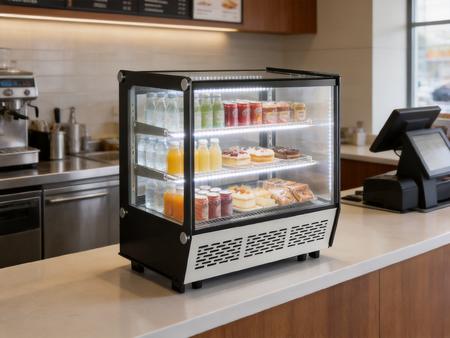
Countertop beverage coolers are designed for businesses that need reliable chilled storage and attractive product presentation without giving up valuable floor space. The XCW-120Z countertop display cooler combines a compact footprint with a 135-liter capacity, front-facing visibility, adjustable merchandising space, and a temperature range suitable for many beverages and chilled foods. It is intended for locations such as cafés, convenience stores, bakeries, restaurants, hotel reception areas, offices, supermarkets, and service counters.
Unlike a basic under-counter refrigerator, a display cooler is designed to sell products as well as preserve them. Customers can see bottles, cans, desserts, packaged foods, and other chilled merchandise through the curved tempered-glass front. Internal LED lighting improves product visibility, while chromed adjustable shelves help operators organize different package sizes. The result is a refrigeration unit that supports both cold-chain performance and impulse purchasing.
This article examines the product’s construction, technical performance, merchandising value, manufacturing strengths, operating considerations, and advantages compared with less specialized refrigeration equipment. It also explains how a professional commercial refrigeration manufacturer can use product development, quality control, testing, and production management to deliver a dependable countertop solution for international markets.
Why Countertop Display Refrigeration Matters
Retail refrigeration has two simultaneous jobs. First, it must maintain a stable temperature that protects the quality of the products inside. Second, it must present those products in a clean, organized, and visually appealing way. Conventional storage refrigerators may perform the first function, but they often perform poorly as sales and presentation tools. Their solid doors, limited lighting, and inaccessible shelves can make products difficult to identify.
A countertop display cooler addresses these limitations by bringing chilled merchandise into the customer’s direct line of sight. The unit can be installed on a counter, worktop, service station, or other suitable elevated surface. In locations where floor area is limited, this arrangement allows the operator to create an additional cold display zone without installing a large upright cabinet.
The XCW-120Z has a product size of approximately 710 millimeters wide, 568 millimeters deep, and 686 millimeters high. This format provides a useful compromise between capacity and compactness. It is large enough to hold a practical range of beverages and packaged items, yet small enough to fit into many commercial service environments.
Countertop placement can also improve workflow. Staff members can position the cooler near a checkout point, beverage preparation area, buffet station, bakery counter, or customer service desk. Chilled products remain close to the point of sale or point of consumption. This can reduce unnecessary movement for employees and make replenishment more convenient.
Product Overview
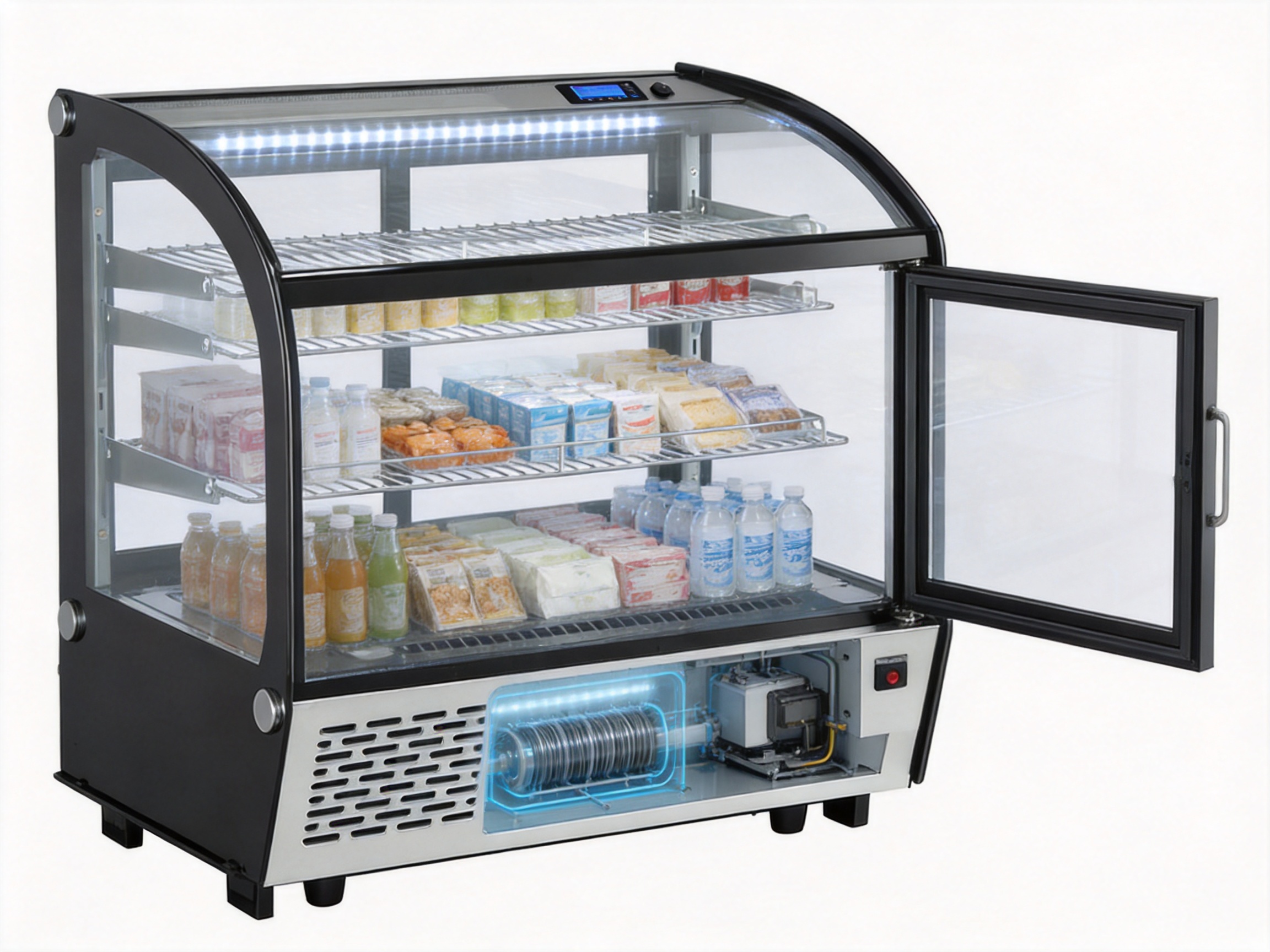
The XCW-120Z is a countertop display refrigerator with a 135-liter internal capacity and a working temperature range of 2 to 10 degrees Celsius. Its ventilated cooling system is designed to circulate cold air through the cabinet, while automatic defrost helps reduce the need for manual maintenance.
The front uses double-layer curved tempered glass. This construction supports product visibility while providing a stronger and more insulating viewing panel than a single thin pane. The curved profile can also give the cabinet a more polished appearance than a plain flat-front storage refrigerator.
At the rear, sliding glass doors provide access for stocking and cleaning. Rear access is particularly useful when the display cooler is positioned with its front facing customers. Staff can replenish products without opening the customer-facing side or moving the entire cabinet.
An internal strip LED light illuminates the shelves and product labels. LED lighting generally produces less heat and consumes less energy than older lighting technologies, while providing clear illumination across the display area. A digital thermostat and temperature display allow operators to check the cabinet setting and monitor operating conditions more easily than with a basic mechanical dial.
| Specification | XCW-120Z Information |
|---|---|
| Product category | Countertop display refrigerator |
| Capacity | 135 liters |
| Temperature range | 2 to 10 degrees Celsius |
| Input power | 240 watts |
| Refrigerant | R134a or R600a, depending on configuration |
| Climate class | 4 |
| Net weight | 57 kilograms |
| Gross weight | 60 kilograms |
| Product dimensions | 710 × 568 × 686 millimeters |
| Package dimensions | 773 × 627 × 735 millimeters |
| 20-foot general-purpose container loading | 81 units |
| 40-foot high-cube container loading | 162 units |
The product is supplied with adjustable chromed shelves, a separated power button, automatic defrost, and a ventilated cooling system. These features make the cabinet suitable for both self-service and staff-served environments.

Countertop Beverage Coolers Countertop Display Cooler
Compact Capacity for Commercial Use
A 135-liter capacity gives operators more flexibility than a small personal beverage refrigerator while avoiding the footprint of a full-size vertical display cabinet. The usable storage volume can be arranged for cans, bottles, cartons, dessert containers, prepared foods, and other packaged products, subject to the dimensions and weight limits of the shelves.
The internal organization is supported by adjustable chromed shelves. Shelf adjustment is important because commercial products are not uniform in height. A display filled with cans may require a different shelf arrangement from one used for tall bottles, boxed drinks, yogurt containers, or dessert cups. Rather than forcing the operator to accept fixed spacing, adjustable shelves permit the interior to be configured around the merchandise being sold.
Chromed shelf surfaces also provide a clean commercial appearance. Their open visual structure helps avoid making the cabinet look overly crowded, and the finish is appropriate for retail, hospitality, and food-service environments. Shelves should be loaded evenly, with adequate air circulation maintained around products and ventilation openings.
The countertop format can be especially valuable for smaller businesses. A café may use the cooler for bottled water, juice, milk drinks, and ready-to-eat snacks. A bakery may use it for cream desserts, chilled cakes, fruit cups, and packaged beverages. A restaurant may place it near the host stand or takeaway counter. A hotel can use it in a breakfast service area or reception zone.
Temperature Performance and Product Protection
The specified temperature range is 2 to 10 degrees Celsius. This range is appropriate for many non-frozen beverages and chilled packaged foods. It offers the flexibility to maintain cold products without entering freezer temperatures. The correct setting should always be selected according to the product manufacturer’s storage instructions and applicable food-safety requirements.
The ventilated cooling system distributes refrigerated air through the cabinet rather than relying only on natural convection. In a commercial display environment, this is an important distinction. Frequent door opening, product replenishment, warm ambient conditions, and uneven loading can all affect internal temperature. Air circulation helps promote more uniform conditions from one shelf level to another.
Operators should avoid blocking internal air passages with tightly packed products. A cabinet can have adequate cooling capacity but still experience uneven temperatures if shelves are overloaded or air outlets are covered. Correct loading practices are therefore part of the product’s performance system.
The digital thermostat and display provide a convenient way to check the selected temperature. This is more informative than a simple power indicator because staff can identify the control setting and observe whether adjustments are needed. Regular checks remain advisable, particularly in businesses that store temperature-sensitive food.
Climate class 4 indicates that the cabinet is designed for a defined warm commercial ambient environment. Actual performance will depend on room temperature, humidity, ventilation, loading, door-opening frequency, and installation clearance. The unit should be positioned away from direct sunlight, ovens, hot air outlets, and other heat sources.
Glass Construction and Product Visibility
The front curved tempered glass is one of the most important visual elements of the cabinet. A display cooler must show the merchandise clearly from a customer-facing position. Curved glass can create a broad viewing area and give the unit a distinctive presentation compared with a plain solid-door refrigerator.
The use of double-layer glass supports insulation and can help reduce the impact of the surrounding environment on the refrigerated interior. Tempered glass is processed to provide improved resistance compared with ordinary untreated glass. Even so, it should be handled carefully, and the operator should inspect it periodically for damage.
Glass doors can influence purchasing behavior because customers can quickly identify available products without opening the cabinet. This reduces unnecessary door opening and keeps the display visually accessible. Clean glass is essential. Fingerprints, condensation, dust, and advertising residue can significantly reduce presentation quality, so a regular cleaning schedule should be included in daily operations.
The rear sliding doors are practical for commercial service. They allow employees to stock the cooler from behind while the front remains dedicated to customer viewing. Sliding doors can also be useful in narrow spaces where hinged doors would require additional opening clearance.
Compared with an open display cooler, a glass-door countertop refrigerator offers a more enclosed storage environment. The closed display can help limit the escape of cold air and protect products from dust and direct contact. An open display may provide faster customer access, but it can require greater cooling effort and may expose merchandise more directly to the surrounding environment.
Lighting and Merchandising Advantages
The internal strip LED light is designed to make products easier to see. Lighting is especially important in countertop units because shelves are often positioned below eye level or inside a relatively compact cabinet. A well-lit interior helps customers identify flavors, sizes, colors, and packaging details.
LED lighting can support a more modern presentation while producing less heat than many traditional lamps. Lower heat release is beneficial in a refrigerated environment because unnecessary heat inside the cabinet increases the cooling burden. Lighting should still be kept clean and checked periodically to ensure that the full display remains illuminated.
Merchandising performance depends on more than lighting alone. Products should be grouped logically, labels should face forward, and the most profitable or popular items can be placed in the most visible positions. Operators may reserve lower shelves for heavier products and upper shelves for smaller packages or high-visibility items.
The cooler can function as a point-of-sale display rather than simply a back-of-house storage device. Positioning it near a payment terminal, waiting line, service counter, or food pickup point can increase exposure. Because the unit is compact, it can be integrated into existing commercial layouts without requiring a complete redesign of the premises.
Automatic Defrost and Daily Convenience
Automatic defrost is a useful feature for commercial operators because it reduces the need to stop production and manually remove ice from the cooling surfaces. In refrigerated cabinets, moisture can accumulate over time. If frost is allowed to build up excessively, it can interfere with cooling performance and reduce usable space.
An automatic defrost cycle helps manage this accumulation according to the equipment’s control design. Operators should still keep the cabinet clean and follow the manufacturer’s maintenance recommendations. Automatic defrost does not eliminate the need to clean shelves, wipe the interior, inspect door seals, or clear external ventilation areas.
The separated power button provides an additional operating convenience. Staff can switch the cabinet off when required for cleaning, relocation, servicing, or extended periods of non-use. Separating the power control from the thermostat interface can also help prevent accidental changes to the temperature setting during routine operation.
For a busy café or retail counter, these small control features can contribute to easier staff training. Employees can understand the basic functions quickly: switch the unit on, check the digital display, load the shelves correctly, and maintain a clear front presentation.
How the Unit Compares with Other Refrigeration Options
Compared with Undercounter Refrigerators
An undercounter refrigerator is usually selected for storage capacity and integration beneath a work surface. It may have solid doors and limited visibility. A countertop display cooler serves a different purpose: it places products above the counter and makes them visible to customers.
For businesses that need a combination of cold storage and retail presentation, the XCW-120Z can be more suitable than a conventional undercounter model. It allows operators to add a display zone without sacrificing existing cabinets or work surfaces. The correct choice depends on whether the priority is hidden storage, customer visibility, or a combination of both.
Compared with Open Display Coolers
Open display coolers make products immediately accessible, which can be helpful in self-service retail environments. However, open fronts can allow more cold air to escape and may expose products to dust, airborne particles, and inconsistent ambient conditions.
The XCW-120Z uses a closed glass display format. The front glass provides visibility while maintaining a more enclosed refrigerated space. This can be advantageous where product protection, temperature control, and a clean presentation are priorities.
Compared with Large Upright Cabinets
Large upright display cabinets may offer greater total capacity, but they also demand more floor space and can be excessive for a small product range. A countertop cooler is more scalable. Businesses can begin with one unit and add another if sales volume or product variety increases.
The smaller form factor can also simplify placement in locations where floor space is already committed to seating, preparation equipment, shelving, or customer circulation. For compact stores and hospitality sites, reducing the amount of occupied floor area can be a significant operational advantage.
Compared with Domestic Refrigerators
Domestic refrigerators are designed for household use, not continuous commercial display. They may lack commercial lighting, adjustable merchandising shelves, rear loading access, or a professional display appearance. They may also be less appropriate for the repeated opening and restocking patterns found in retail and food-service operations.
A purpose-built commercial display cooler is designed around visibility, accessibility, cleanability, and continuous business use. These design priorities make it a more suitable option for professional environments than a household appliance adapted for commercial service.
Manufacturing Expertise and Product Development
The manufacturer behind the product is a professional producer of vertical display cabinets, cake cabinets, warming cabinets, and related commercial refrigeration equipment. Its experience across several cabinet categories supports a broader understanding of refrigeration design, display presentation, heating and cooling systems, materials, and commercial operating conditions.
Established in 2007, the company has developed more than a decade of industry experience and operates a management and production facility covering approximately 40,000 square meters. A facility of this scale can support specialized production zones, component handling, assembly, quality inspection, warehousing, and shipping preparation.
A dedicated research and development team is an important strength in commercial refrigeration manufacturing. Product development must consider more than appearance. Engineers need to evaluate cabinet geometry, air circulation, insulation, glass construction, lighting, thermostat control, electrical safety, refrigerant selection, service access, packaging, and production repeatability.
Advanced testing facilities further support product improvement. Refrigeration equipment should be evaluated under controlled conditions to verify temperature performance, electrical behavior, defrost operation, component reliability, and overall safety. Testing helps identify design issues before products are delivered to customers and provides information for continuous improvement.
The manufacturer states that it has obtained CE, GS, CCC, CB, RoHS, ETL, and other major international certifications. Certification requirements vary by market and product configuration, so buyers should confirm the applicable approval, voltage, plug, refrigerant, and documentation requirements for their destination country before placing an order.
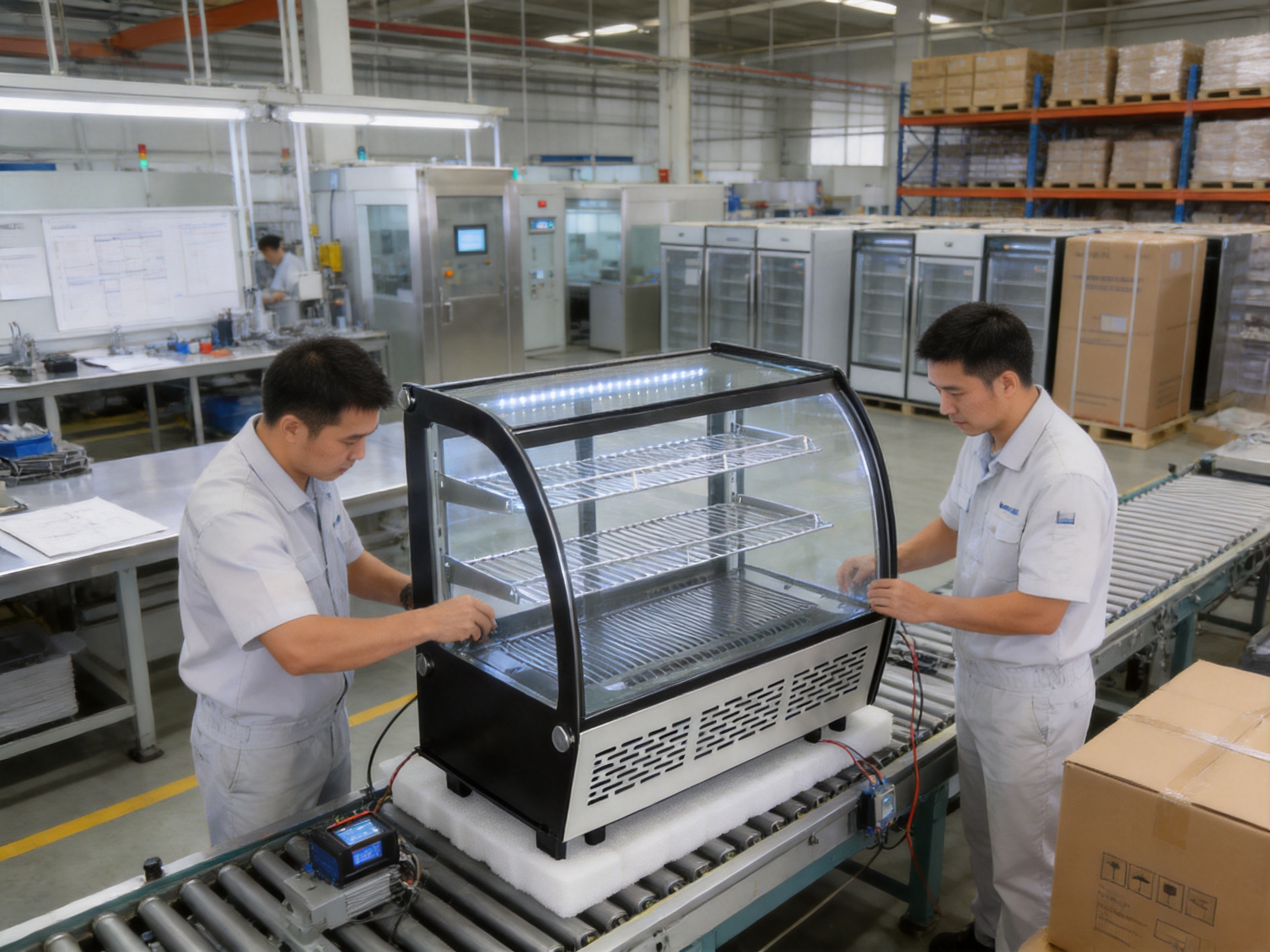
Production Process for Commercial Display Cabinets
Design and Engineering
Manufacturing begins with product planning and engineering. The design team defines the target capacity, dimensions, cooling range, shelf arrangement, viewing area, electrical system, and intended commercial applications. Computer-aided design can be used to coordinate the cabinet structure and reduce interference between components.
At this stage, engineers also consider how the product will be assembled. A design that performs well in a prototype may still require modification if it is difficult to manufacture consistently. Efficient production depends on repeatable processes, accessible service points, controlled tolerances, and clear assembly instructions.
Material Preparation
Cabinet production typically requires prepared metal panels, glass components, insulation materials, shelves, electrical parts, refrigeration components, seals, handles, lighting assemblies, and packaging materials. Consistent material inspection helps reduce variation during assembly.
The cabinet’s external finish must support commercial use. Surfaces should be easy to clean and resistant to the normal handling associated with stocking and maintenance. Internal components should be selected for compatibility with refrigerated conditions and frequent cleaning.
Cabinet Assembly
The cabinet body is assembled around the insulated refrigerated compartment. Proper alignment is essential because gaps can affect insulation performance, door operation, appearance, and structural stability. The glass front and rear sliding doors must be fitted carefully so that they move smoothly and close correctly.
Shelf supports are installed to allow adjustment at practical height intervals. The LED strip, thermostat display, power control, fan system, and defrost-related components are connected according to the electrical design. Work instructions and process checks help operators maintain consistency from unit to unit.
Refrigeration System Installation
The refrigeration circuit includes the compressor, condenser, evaporator, expansion or metering components, tubing, controls, and refrigerant. Depending on the specified configuration and target market, the unit may use R134a or R600a. Refrigerant selection affects system design, service procedures, regulatory compliance, and shipping documentation.
Refrigeration assembly requires careful control of tubing connections and circuit cleanliness. The system must be evacuated and charged according to the engineering specification. Leak testing is a critical step because even a small leak can reduce performance and create long-term reliability concerns.
Electrical and Functional Testing
Electrical testing can include checks for insulation resistance, grounding continuity, wiring accuracy, power consumption, switch operation, lighting performance, thermostat response, and display function. Functional testing verifies that the fan, compressor, defrost system, and temperature controls operate together correctly.
Temperature testing is particularly important. The cabinet should be observed under controlled conditions to confirm that the specified operating range can be achieved. Testing also helps evaluate temperature uniformity, recovery after door opening, and performance under the intended climate class.
Final Inspection and Packaging
Before shipment, finished units should be inspected for visual quality, glass condition, door movement, shelf installation, control labeling, surface finish, and packaging security. The gross packaged weight is approximately 60 kilograms, compared with a net product weight of approximately 57 kilograms. The packaging must protect the glass and cabinet during handling and transport.
The listed package dimensions are approximately 773 × 627 × 735 millimeters. Accurate packaging design supports safer logistics and helps distributors plan warehouse space, loading operations, and final delivery. Container loading information is also useful for importers planning commercial orders.
Quality Control as a Competitive Advantage
In commercial refrigeration, reliability is a business issue. A failure can result in product loss, service interruption, emergency repair expenses, and customer dissatisfaction. For that reason, manufacturing quality control should cover the full product lifecycle rather than focus only on final appearance.
Incoming component inspection helps ensure that critical parts meet the required specification before entering production. In-process inspection can identify incorrect wiring, poor sealing, misaligned doors, missing fasteners, or other issues while correction is still efficient. Final performance testing provides another layer of protection before shipment.
A manufacturer with its own research, production, and testing resources can respond more quickly to recurring problems than a company that only resells equipment. Engineering feedback from production and customer service can be used to revise components, improve assembly methods, update work instructions, and refine future product models.
Quality also includes documentation. Commercial buyers may require technical data sheets, electrical information, certification records, packaging details, spare-parts support, and operating instructions. Clear documentation makes installation and after-sales service more efficient, especially for international distributors.
Installation Recommendations
The countertop must be strong, level, clean, and capable of supporting the product’s operating weight. The cooler should not be positioned on an unstable, vibrating, or uneven surface. A level installation helps the sliding doors operate correctly and supports consistent cabinet performance.
Airflow around the refrigeration system must not be blocked. The unit should have adequate clearance according to the manufacturer’s installation guidance. Placing the cabinet directly against a heat-producing appliance, in an enclosed cabinet without ventilation, or under intense sunlight may reduce cooling performance.
The electrical supply must match the product’s approved voltage, frequency, plug, and local installation requirements. A qualified professional should handle electrical connection where required by local regulations. The power cord and plug should be protected from water, heat, crushing, and excessive bending.
After installation, the cabinet should be allowed to reach its operating temperature before being fully loaded. Products should be pre-chilled whenever possible. Loading large quantities of warm merchandise at once can temporarily raise the internal temperature and increase compressor operating time.
Efficient Operating Practices
Good operating habits help preserve both product quality and equipment life. Staff should minimize unnecessary door opening and keep the rear sliding doors closed except during stocking or cleaning. Products should not extend beyond the shelf edges or press against the glass and door tracks.
The internal load should be arranged to permit air circulation. Overstocking may create warm zones, obscure product labels, and make rotation difficult. A clear and organized display is usually more effective than a crowded one because customers can see the merchandise more easily.
Product rotation should follow the business’s inventory-control procedure. Older items should generally be positioned for earlier sale, while newly delivered products are placed behind them where practical. This reduces waste and helps maintain a consistent display.
The glass, shelves, door tracks, and interior surfaces should be cleaned with products suitable for commercial refrigeration equipment. Abrasive cleaners and harsh chemicals may damage finishes or seals. Before cleaning, the power should be managed according to the operating procedure, and water should never be allowed to enter electrical components.
Maintenance and Service Considerations
Routine maintenance should include checking the condition of door seals, cleaning accessible surfaces, inspecting the condenser area, confirming that the fan is unobstructed, and verifying that the temperature display is functioning. Dust accumulation around ventilation areas can reduce heat transfer and cause the refrigeration system to work harder.
The glass should be checked for cracks, chips, or unusual stress. Damaged tempered glass must be handled by qualified personnel. Sliding door tracks should remain clean so that the doors move smoothly and close completely.
If the cabinet displays an abnormal temperature, unusual noise, persistent condensation, or repeated cycling, the operator should investigate promptly. Continuing to operate a malfunctioning unit may increase product risk and lead to more extensive equipment damage. Refrigeration-system service should be performed by trained technicians with the appropriate tools and refrigerant knowledge.
For international buyers, after-sales support is an important part of supplier evaluation. Questions to confirm may include spare-parts availability, warranty terms, technical documentation, approved service procedures, electrical options, replacement glass, door hardware, controllers, fans, and refrigeration components.
Applications Across Different Businesses
Cafés and Coffee Shops
Cafés can use the cooler to display bottled water, juices, milk-based drinks, cold brew beverages, desserts, sandwiches, and packaged snacks. Placing the unit near the ordering or pickup counter can connect chilled products with the customer’s purchase decision.
Bakeries and Dessert Counters
The glass display and LED lighting are suitable for products that benefit from visual presentation. Depending on food-safety requirements and product specifications, the cabinet may be used for chilled desserts, prepared portions, cream-based items, or packaged bakery products.
Convenience Stores
Convenience retailers can use the cabinet as a supplementary display for high-demand beverages. Its countertop design allows the store to add chilled merchandise near the checkout area without committing floor space to another tall cabinet.
Restaurants and Takeaway Locations
Restaurants can position the unit near the host stand, takeaway counter, or beverage service area. Customers waiting for orders can see available cold drinks and packaged items, while staff can replenish the unit from the rear.
Hotels, Offices, and Institutional Sites
Hotels may use countertop display refrigeration in breakfast areas, lounges, or reception spaces. Offices, clinics, schools, and other institutions may use it for controlled beverage storage where a visible and professional presentation is preferred.
Commercial Value and Total Cost Considerations
Purchase price is only one part of the value calculation for commercial refrigeration. Operators should also consider capacity, energy use, maintenance requirements, product visibility, installation space, service support, expected working life, and the potential sales benefit created by the display.
A countertop display cooler can generate value by making products more visible and easier to purchase. It can also reduce the need for separate display furniture. The unit’s compact dimensions may help a business use existing space more effectively, while the adjustable shelves allow the display to change as the product mix changes.
The 240-watt input power specification provides a reference for electrical planning, although actual energy consumption will depend on ambient conditions, duty cycle, thermostat setting, loading, door opening, and maintenance. Buyers should request the appropriate energy data for their market and configuration when comparing models.
Container loading information is also relevant to importers and distributors. The stated capacity is 81 units in a 20-foot general-purpose container and 162 units in a 40-foot high-cube container. Actual loading may vary according to packaging arrangement, shipping restrictions, and other cargo requirements, but these figures assist with preliminary logistics planning.
Selection Checklist for Buyers
Before purchasing a countertop display refrigerator, buyers should confirm the required capacity and available counter dimensions. The 135-liter format is suitable for many commercial uses, but the best choice depends on the product range, replenishment frequency, and expected sales volume.
The temperature range should be compared with the storage requirements of the intended products. Buyers should also confirm the climate class, electrical supply, refrigerant option, certification requirements, plug type, and local installation rules.
Door configuration is another practical consideration. Rear sliding doors are convenient for staff replenishment, but the operator should ensure that adequate space is available behind the unit. The front glass should be positioned where customers can see the products clearly and where glare from windows or strong lighting will not reduce visibility.
Finally, buyers should assess supplier capabilities. A manufacturer with established production experience, dedicated research and development, testing facilities, international certifications, and export knowledge can provide more comprehensive support than a supplier with limited technical resources.
Frequently Asked Questions
What is the capacity of the XCW-120Z countertop display cooler?
The stated capacity is 135 liters. The actual number of products that can be stored will depend on package dimensions, shelf arrangement, product spacing, and the need to maintain proper air circulation.
What temperature range does the unit provide?
The specified temperature range is 2 to 10 degrees Celsius. Operators should select the appropriate setting according to the storage instructions for the products being displayed and applicable local food-safety requirements.
Is this unit suitable for frozen products?
No. The product is a refrigerated display cooler, not a freezer. Its specified temperature range is intended for chilled, non-frozen products. Frozen goods require equipment designed for freezer temperatures.
What type of doors does the cooler have?
The unit has back sliding glass doors for stocking and access. The front uses double-layer curved tempered glass for customer-facing product visibility.
Does the cooler include interior lighting?
Yes. The standard features include internal strip LED lighting. This helps illuminate products and improve the visual presentation of the display.
Can the shelves be adjusted?
Yes. The unit is supplied with adjustable chromed shelves. Operators can arrange shelf spacing according to the height and type of products being displayed.
How does the ventilated cooling system work?
The system circulates refrigerated air through the cabinet to support more even cooling. Products should still be loaded with adequate space around air outlets and should not be packed so tightly that circulation is restricted.
Does the unit have automatic defrost?
Yes. Automatic defrost is listed as a standard feature. Regular cleaning and maintenance are still required because automatic defrost does not replace normal equipment care.
Which refrigerant does the cabinet use?
The listed refrigerant options are R134a and R600a. The applicable refrigerant depends on the product configuration and destination-market requirements. Buyers should confirm the exact specification before ordering.
What is the input power?
The listed input power is 240 watts. Actual electricity consumption depends on operating conditions such as ambient temperature, loading, thermostat setting, door opening, and maintenance.
Where can the cooler be installed?
It can be installed on a suitable countertop, worktop, service station, retail counter, or other stable commercial surface. The installation area must support the unit’s weight and provide the ventilation and electrical conditions required by the manufacturer.
Is the cooler appropriate for restaurants and cafés?
Yes. Its capacity, customer-facing glass, internal LED lighting, adjustable shelves, and rear sliding doors make it suitable for cafés, restaurants, bakeries, convenience stores, hotels, offices, and similar commercial environments.
What should be checked before international purchase?
Buyers should confirm dimensions, packaging, electrical voltage and frequency, plug type, refrigerant, certification, climate class, warranty, spare-parts support, and shipping requirements. Local regulations may impose additional requirements.
What manufacturing strengths support this product?
The manufacturer has experience in commercial display cabinets and related refrigeration equipment, an established production history, a large manufacturing facility, a professional research and development team, advanced testing facilities, and multiple international certifications.
Conclusion
The XCW-120Z countertop beverage cooler is designed for businesses that need a compact but professional refrigerated display. Its 135-liter capacity, 2 to 10 degree Celsius temperature range, ventilated cooling, automatic defrost, adjustable chromed shelves, internal LED lighting, digital thermostat, rear sliding doors, and curved double-layer tempered glass provide a balanced combination of storage, visibility, and operating convenience.
Its main advantage over ordinary domestic refrigerators is its commercial display orientation. The unit is built to place products in front of customers while allowing staff to stock and manage the cabinet efficiently. Compared with larger upright cabinets, it offers a space-saving format. Compared with open displays, it provides a more enclosed glass-front presentation that can help protect products and support temperature control.
The manufacturer’s experience, research and development resources, testing facilities, production capability, and international certification coverage further strengthen the product proposition. For cafés, bakeries, restaurants, convenience stores, hotels, offices, and other commercial users, this countertop display refrigerator can provide a practical way to expand chilled merchandising while preserving valuable floor space.
References
1. Product specification sheet for the XCW-120Z countertop display refrigerator.
2. Commercial refrigeration equipment design and maintenance principles.
3. General food-service refrigeration and chilled-storage practices.
4. International guidance on commercial appliance safety and conformity assessment.
5. General principles of refrigerated cabinet airflow, defrost control, and temperature management.
6. Manufacturer information regarding commercial display cabinets, research and development, production facilities, testing resources, and certification capabilities.
Product: Countertop Beverage Coolers Countertop Display Cooler

You May Also Like





-
- Navigation
- Home
- About Us
- Products
- News
- Contact Us
 East Zone, Guanhaiwei Industrial Park, Cixi City, Ningbo, Zhejiang, China
 +86-574-63668678
 +86-574-63668108

Copyright © Ningbo XiangChi Electrical Co.,Ltd All Rights Reserved.
