
 简体中文
 English
 Español

News
Commercial Food Display Warmer and Cake Showcase: A Practical Guide to Heated Product Presentation
In foodservice, presentation and temperature control are closely connected. Prepared foods may be carefully cooked, arranged, and garnished, but their commercial value can decline quickly if they are displayed at an unsuitable temperature or in an unattractive cabinet. A professional food display warmer addresses both concerns by keeping products warm while presenting them clearly to customers. The XCR-136L Display Equipment Food Display Warmer Cake Showcase is designed for restaurants, cafés, bakeries, hotel breakfast areas, convenience stores, catering counters, and other food businesses that need an efficient countertop display solution.
With a 136-liter capacity, a temperature range of 30°C to 90°C, a rated input power of 1,100 watts, and a compact footprint, the XCR-136L provides a practical balance between display capacity and counter utilization. Its glass presentation area allows customers and staff to view the products easily, while its heating and control systems help maintain a consistent serving environment. The cabinet is suitable for many types of prepared foods, including pastries, cakes, sandwiches, pizza portions, cooked meals, fried snacks, breakfast items, and other products that benefit from warm presentation.
This article examines the product’s construction, operating features, commercial advantages, applications, maintenance requirements, and manufacturing background. It also explains how the XCR-136L compares with less specialized display methods and why professional production processes, quality testing, and product development capabilities are important when selecting commercial display equipment.
1. The Role of a Heated Food Display Cabinet
A heated display cabinet is more than a storage unit. It is a point-of-sale appliance that supports merchandising, food quality, service speed, and customer confidence. In a busy food business, customers often make purchasing decisions after seeing the products available. A clear and well-lit display can encourage impulse purchases, help customers understand portion options, and reduce the time required for staff to explain or retrieve products.
Cold refrigeration is appropriate for products that must remain chilled, while open ambient displays may be suitable for a limited range of dry goods. However, many prepared foods are best presented warm. A heated display cabinet creates a controlled environment for these products and keeps them ready for service. This can be especially useful during peak periods when repeatedly reheating individual portions would slow down operations.
The XCR-136L has been designed as a display warmer rather than as a general-purpose cooking appliance. Its purpose is to maintain and present prepared foods. Operators should therefore load it with products that have already been cooked or prepared according to their food safety procedures. The unit can then support a more organized service process by keeping suitable products visible and ready for purchase.
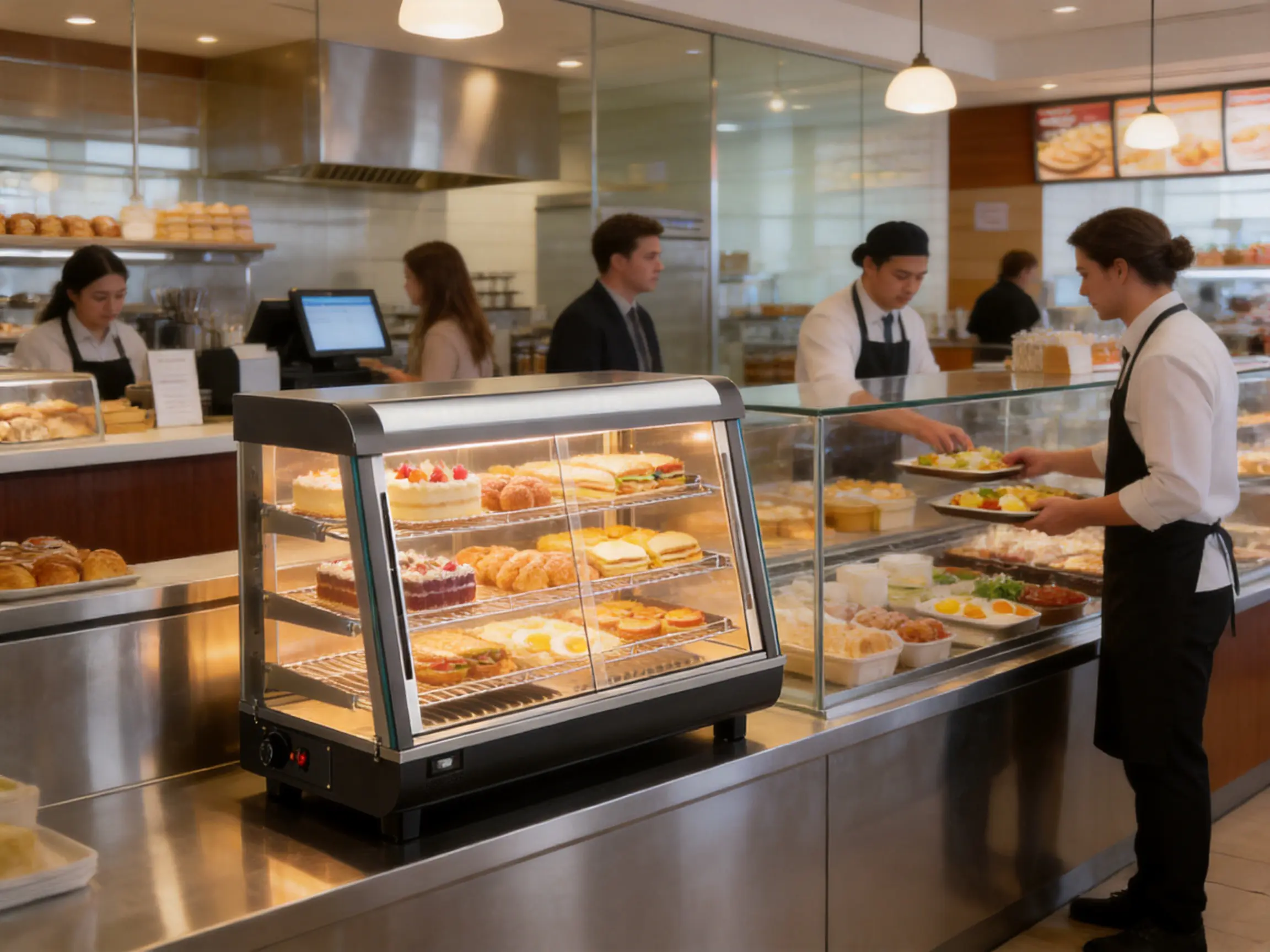
Its countertop format is particularly useful for businesses with limited floor space. A countertop warmer can be placed near a checkout counter, service line, buffet, bakery worktop, café collection point, or self-service area. This arrangement keeps products within the customer’s field of view without requiring a large freestanding cabinet.
2. Product Overview
The XCR-136L is a commercial food display warmer and cake showcase with a nominal capacity of 136 liters. It combines heated product storage with transparent product presentation. The cabinet’s temperature range is specified at 30°C to 90°C, allowing operators to select a setting appropriate to the product type and service requirements.
The display warmer uses both a top and bottom evaporator according to the stated standard features. In the context of this heated display design, these components support heat distribution through the upper and lower areas of the cabinet. A water channel is positioned under the top evaporator. This arrangement is intended to help manage moisture associated with the upper section and to contribute to the cabinet’s internal operating design.
An internal top LED light illuminates the products from above. The digital thermostat and display provide a clear method for setting and monitoring the cabinet temperature. Direct cooling is listed as part of the operating system, and automatic defrost is included as a standard feature. Together, these elements are intended to simplify everyday operation and reduce the need for frequent manual intervention.
| Specification | XCR-136L Details |
|---|---|
| Product category | Display warmer and cake showcase |
| Model | XCR-136L |
| Capacity | 136 liters |
| Temperature range | 30°C to 90°C |
| Input power | 1,100 watts |
| Net weight | 38 kilograms |
| Gross weight | 41 kilograms |
| Product dimensions | 904 × 486 × 636 millimeters |
| Package dimensions | 963 × 549 × 675 millimeters |
| Estimated 20-foot GP loading quantity | 72 units |
| Estimated 40-foot HQ loading quantity | 192 units |
The dimensions provide a relatively broad display width while keeping the cabinet shallow enough for many commercial counters. The product size is approximately 904 millimeters wide, 486 millimeters deep, and 636 millimeters high. This footprint can offer meaningful display capacity without occupying the same floor area as a tall vertical cabinet.
The net weight is 38 kilograms, while the gross shipping weight is 41 kilograms. The difference reflects packaging materials and shipping protection. The listed package dimensions are larger than the assembled product dimensions, which should be considered when planning receiving areas, storage space, transport routes, and installation access.
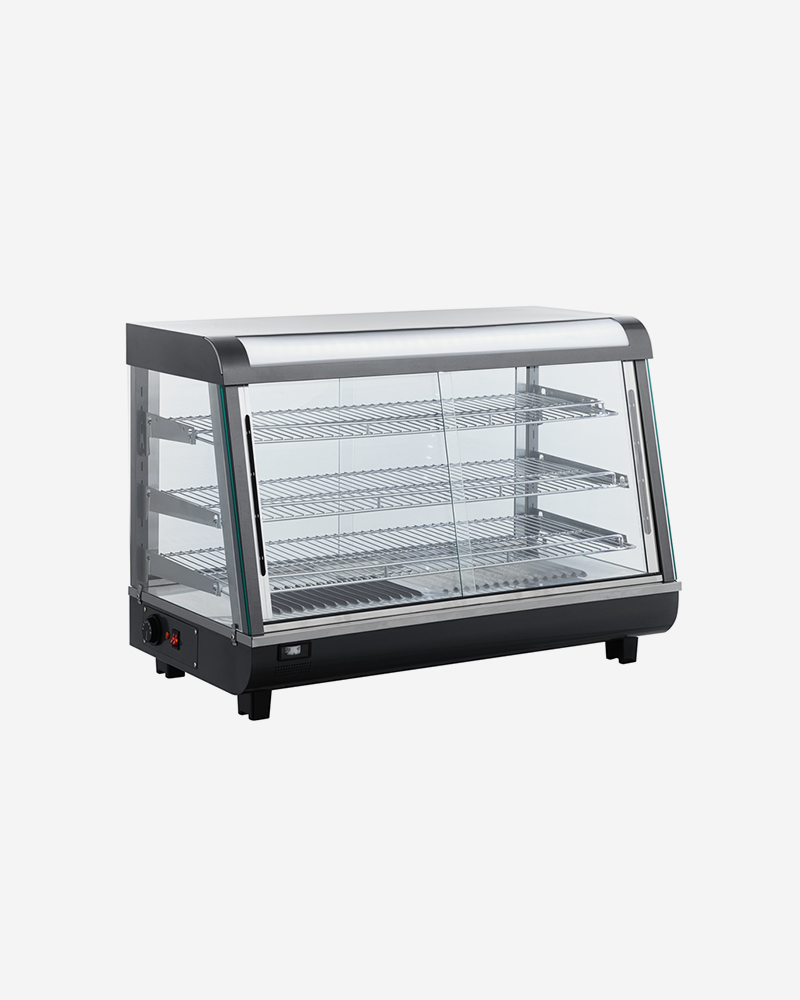
Display Equipment Food Display Warmer Cake Showcase
3. Main Design Advantages
3.1 A balance between capacity and countertop size
One of the main advantages of the XCR-136L is the balance between a 136-liter internal capacity and a countertop-oriented exterior. Many food businesses require more display space than a small pastry case can provide but do not have enough room for a full-height cabinet. The XCR-136L occupies an intermediate position. It can display a useful selection of products while remaining suitable for placement on a stable commercial counter.
This format can improve workflow because staff can place the unit close to the preparation or serving area. Products do not need to be stored in a distant warming oven and then carried to the sales counter. The display warmer can form part of a direct movement sequence from preparation to presentation to customer service.
3.2 Broad temperature adjustment
The 30°C to 90°C temperature range gives operators flexibility. Lower settings may be useful when products need gentle warming or when a business wants to maintain a mild serving temperature. Higher settings may be appropriate for products that require a hotter presentation environment, provided that the selected temperature is suitable for the food and consistent with local food safety procedures.
A broad adjustment range is more useful than a single fixed setting because food products differ in size, moisture content, density, and serving expectations. A small pastry, a covered sandwich, and a cooked meal do not necessarily require the same cabinet temperature. Digital temperature control allows the operator to make a deliberate selection rather than relying on a general estimate.
3.3 Digital thermostat and display
The digital thermostat and display are important for operational consistency. An analog control can be difficult to interpret precisely, especially when several employees use the same equipment. A digital interface gives staff a clearer reference point and can help standardize daily procedures.
For multi-shift operations, the ability to see the selected temperature quickly is valuable. Managers can establish operating guidelines, train employees to use the same settings, and check the equipment more efficiently during service. Digital controls also support more systematic troubleshooting because the operator can compare the set temperature with the observed product condition and cabinet behavior.
3.4 Internal LED illumination
Lighting directly influences display quality. The internal top LED light helps customers see the shape, color, texture, and arrangement of the products. This is particularly important for cakes, pastries, filled sandwiches, and prepared foods where visual appeal influences purchasing decisions.
LED lighting is also appropriate for a commercial display because it can provide strong illumination with relatively low heat generation compared with many traditional lighting technologies. Positioning the light at the top helps illuminate the cabinet from above and can make the displayed products easier to identify during busy service periods.
3.5 Automatic defrost
Automatic defrost is designed to reduce manual maintenance associated with frost or moisture accumulation. A cabinet that requires frequent manual defrosting may create interruptions in service and can be more difficult to keep in a consistent operating condition. An automatic cycle helps simplify routine operation and can support more stable long-term performance when the unit is used and maintained correctly.
Operators should still follow the recommended cleaning and maintenance procedures. Automatic defrost does not eliminate the need to clean product residue, wipe glass surfaces, inspect seals, or maintain ventilation clearance. It is a convenience feature that complements, rather than replaces, responsible equipment care.
3.6 Water channel under the top evaporator
The water channel under the top evaporator is a distinctive standard feature in the listed design. Moisture can develop in heated display environments due to food products, temperature changes, and cabinet operation. A dedicated channel helps manage water in the upper section and supports a more organized internal layout.
Moisture management is important for both appearance and hygiene. Excess water can affect the visual clarity of the display, create dripping, or contribute to unwanted residue if it is not controlled. Operators should inspect the water channel regularly and keep it free from food particles and other obstructions.
3.7 Top and bottom heat distribution components
The inclusion of both top and bottom evaporators reflects an effort to support more balanced cabinet performance. Products placed on different levels should receive a suitable warming environment rather than having one area become noticeably hotter or cooler than another. Actual results depend on loading pattern, product packaging, ambient conditions, and operating settings, but upper and lower heat distribution components provide a stronger design basis than a single heating point.
Even distribution is particularly useful in a display cabinet because products are often arranged on multiple shelves or levels. A cabinet that warms only from one direction may require frequent rearrangement. A design with components at both the top and bottom can make product placement more flexible and can help operators use the available volume more effectively.
4. Product Presentation and Customer Experience
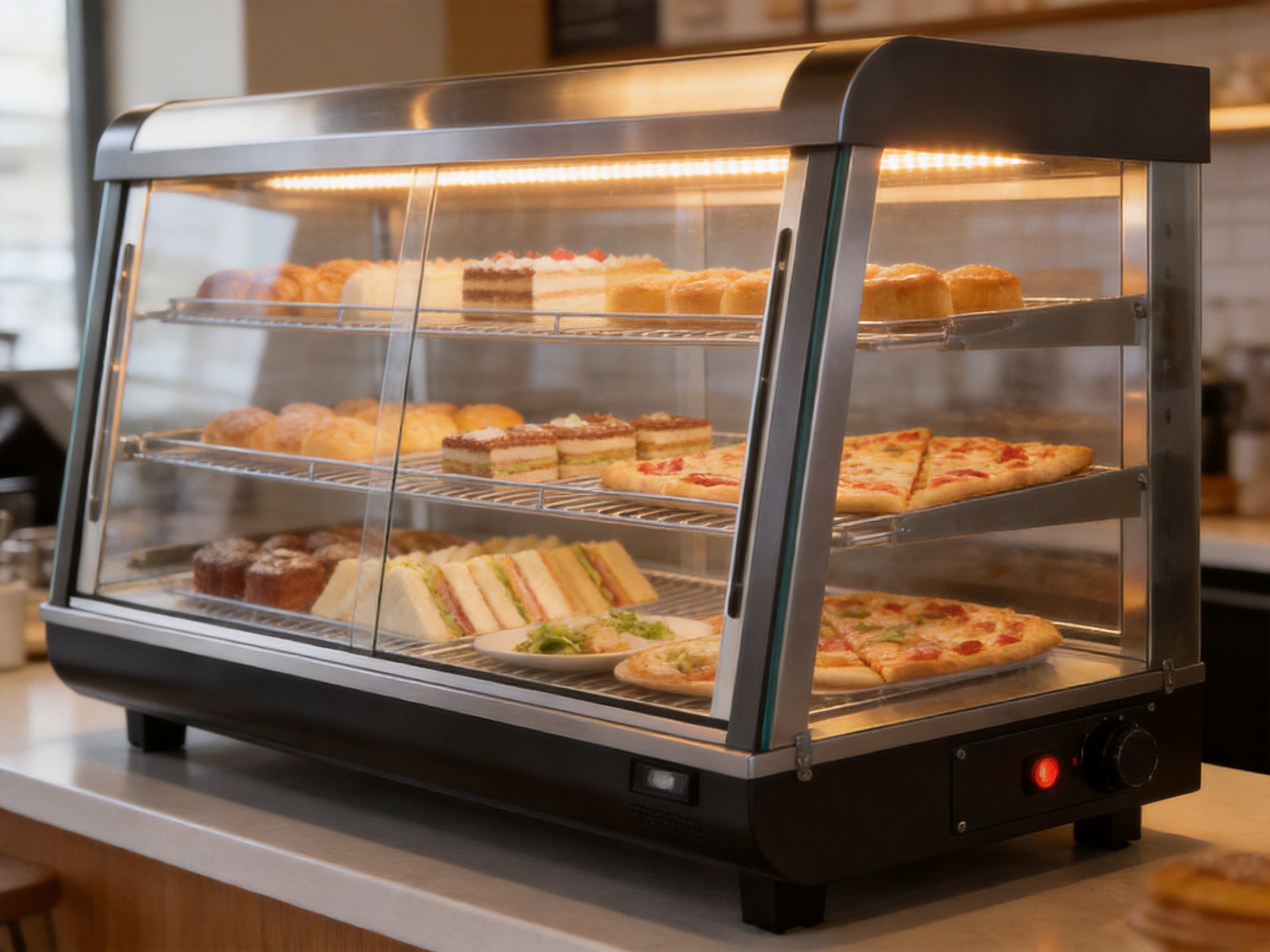
A food warmer should support sales as well as temperature management. Transparent display construction allows customers to view products before ordering. This reduces uncertainty and can make the purchasing process more efficient. Customers can compare available items, see portion sizes, and identify products that match their preferences.
The clear presentation of cakes and pastries is especially important. Layered cakes, decorated desserts, filled rolls, and specialty baked goods often depend on appearance to communicate value. A well-lit glass showcase can present these products in a way that is more persuasive than a closed metal warming unit.
Prepared savory foods can also benefit from visual access. In cafés and takeaway businesses, customers may need to choose between several sandwiches, pies, pizza portions, breakfast products, or cooked snacks. A countertop display warmer allows the operator to keep popular items available and visible during the busiest part of the day.
Visible products can also improve staff efficiency. Instead of answering repeated questions about what is available, employees can direct customers to the display. This is useful in self-service and semi-self-service environments, where clear product visibility supports faster decision-making.
Product organization remains important. The display warmer should not be overloaded, and products should be arranged so that air can circulate around them. Labels, trays, and product dividers can help create a clean presentation. Operators should select food containers that are suitable for the operating temperature and should avoid blocking the light or internal airflow path.
5. Applications Across Foodservice Environments
5.1 Bakeries and pastry shops
Bakeries can use the XCR-136L to display selected warm pastries, filled rolls, savory baked goods, and other products that are best served above room temperature. The glass showcase can also support the presentation of cakes and specialty desserts when the operating conditions are suitable for those products.
For a bakery, the display warmer can be positioned near the checkout area or beside the production counter. This creates a visual connection between the product and the purchase process. A bakery may use one section for sweet products and another for savory items, depending on its range and cabinet organization.
5.2 Cafés and coffee shops
Cafés often serve sandwiches, breakfast pastries, quiche portions, rolls, and small hot meals. These products may be prepared in batches and held for service throughout the day. A heated display cabinet can help maintain readiness while keeping products visible to customers ordering coffee or other beverages.
The countertop format is well suited to cafés where every square meter is valuable. It can be placed close to the point where customers order, pay, or collect their food. The cabinet can also support combination sales, such as a pastry displayed beside a beverage menu or coffee preparation station.
5.3 Convenience stores
Convenience stores depend on quick service and strong product visibility. Warm sandwiches, snacks, breakfast items, and prepared foods can be presented in a display warmer near the checkout. The digital control allows employees to monitor the setting, while the internal LED light keeps the selection visible during daytime and evening operation.
Because convenience stores may have changing staffing levels, simple controls and clear temperature information are valuable. The automatic defrost feature can also reduce the number of manual tasks required during daily operation, although cleaning and inspection must remain part of the store’s routine.
5.4 Hotels and breakfast service
Hotels can use a display warmer for selected breakfast foods, pastries, rolls, cooked snacks, and prepared portions. A countertop cabinet can be placed at a buffet station or service counter. Its transparent design allows guests to identify items without opening multiple containers.
For hotel operations, the appearance of the equipment matters. A clean, illuminated cabinet can contribute to an organized buffet presentation. Staff can replenish products as needed while keeping the cabinet positioned as a clear service feature rather than an unseen back-of-house appliance.
5.5 Catering and event service
Caterers may use heated display equipment at temporary service stations, corporate events, exhibitions, and private functions. The 136-liter capacity can provide a useful amount of holding space for selected items without requiring a large floor-standing unit.
Before transporting the cabinet, operators should consider the gross packaged weight, access routes, electrical requirements, and stability of the final installation surface. The equipment should be allowed to stand securely, with sufficient ventilation clearance and protection from impact or excessive moisture.
5.6 Restaurants and takeaway counters
Restaurants with takeaway operations can use a display warmer to present ready-to-serve products near the order collection point. This can help separate hot holding from the cooking line and make the pickup area more attractive. It may also encourage customers to add side dishes, snacks, or desserts to their orders.
The cabinet is especially useful when the restaurant serves a rotating selection of prepared products. Staff can adjust the display throughout the day without changing the overall counter arrangement. The equipment should be loaded according to the restaurant’s food handling plan, with clear time and temperature procedures.
6. Advantages Over Less Specialized Display Methods
The XCR-136L offers several advantages compared with ordinary open shelving or non-heated display furniture. Open shelving may provide visibility, but it does not offer controlled warming. Products may cool quickly, become less appealing, or require frequent replacement. A heated cabinet gives operators more control over the presentation environment.
Compared with a basic warming tray, the glass showcase offers a stronger merchandising function. A warming tray may keep food warm but usually provides limited product protection and less visual structure. The XCR-136L combines product visibility with a defined cabinet environment, making it more suitable for front-of-house presentation.
Compared with a conventional oven, the display warmer is designed for holding and displaying prepared foods rather than cooking large batches. It can be positioned closer to customers and can keep products visible while they await purchase. This separation between cooking and display can improve the layout of a commercial kitchen or service counter.
Compared with a large vertical warmer, the countertop design may offer easier access and a smaller installation footprint. A tall cabinet may provide greater total capacity, but it can be excessive for a small café, bakery counter, or limited menu. The XCR-136L is more suitable when the operator wants a medium-capacity presentation cabinet without committing to a full-size floor unit.
Compared with a purely ambient cake showcase, the adjustable heating function gives the operator additional flexibility for products that should be presented warm. The key advantage is not that every product should be heated, but that the cabinet can support product categories requiring a controlled warm display environment.
These comparisons should be evaluated according to the operator’s menu, counter size, expected sales volume, and local food safety requirements. No single cabinet is ideal for every product category. The strength of the XCR-136L is its combination of capacity, presentation, digital control, lighting, moisture management, and automatic defrost in one countertop unit.
7. Manufacturing Strengths and Product Development Capability
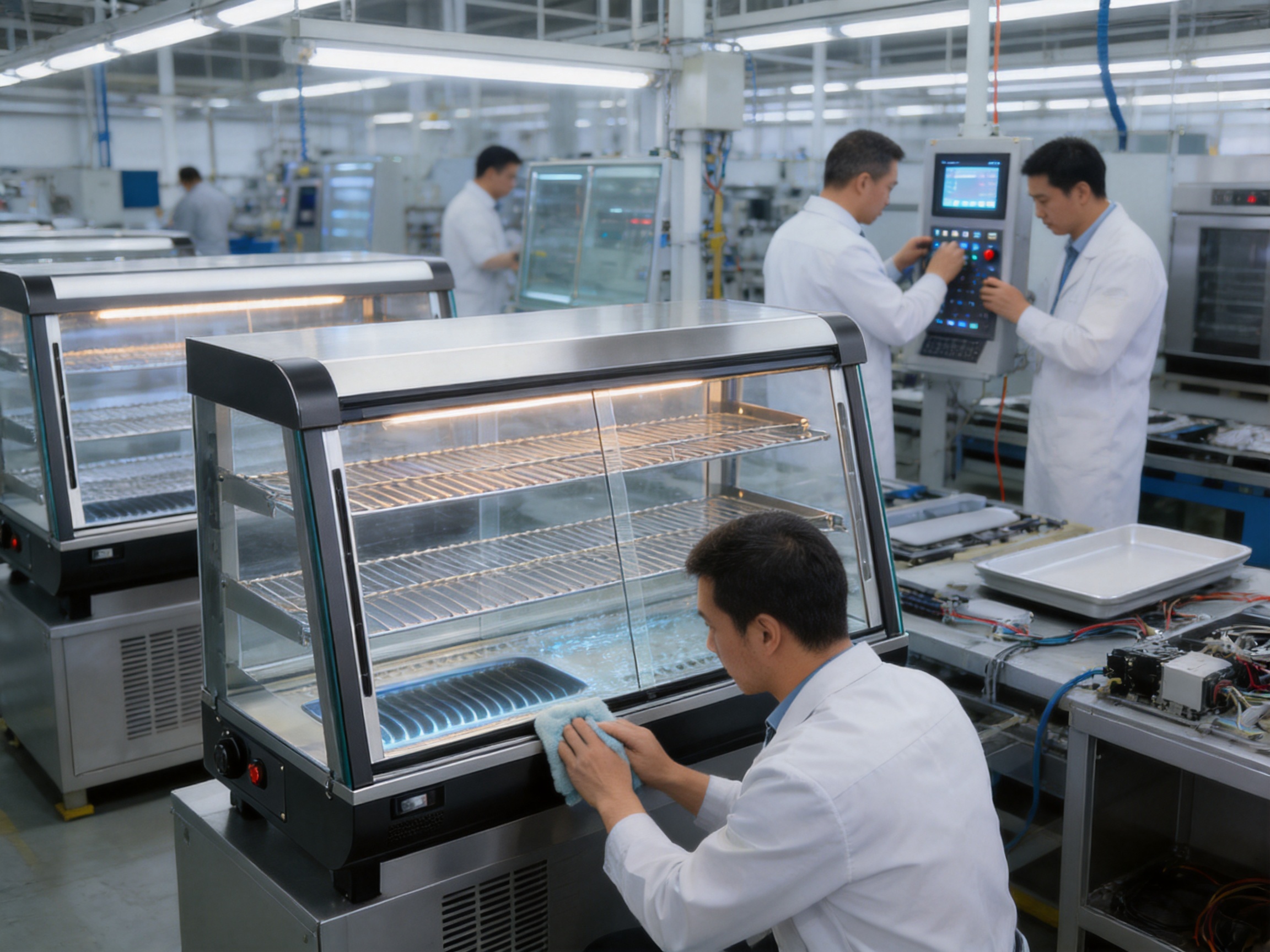
The manufacturer, Ningbo XiangChi Electrical Co., Ltd., is described as a professional producer of vertical display cabinets, cake cabinets, and warming cabinets. The company was established in 2007 and has more than ten years of experience in this field according to the supplied company information. Its stated manufacturing site covers approximately 40,000 square meters and is described as a modern management garden factory.
Experience in commercial refrigeration and warming equipment can provide practical advantages during product development. Display cabinets must balance thermal performance, appearance, electrical safety, durability, shipping requirements, and ease of maintenance. A manufacturer that focuses on this product category can build specialized knowledge around these design challenges.
The company reports having its own professional research and development team. In a commercial equipment environment, an internal R&D capability can support faster product improvements and more direct coordination between design, production, testing, and customer requirements. It can also help the manufacturer refine cabinet dimensions, control systems, lighting, insulation, component placement, and production methods.
Advanced testing facilities are also identified as part of the company’s capabilities. Testing is important because a commercial display warmer must operate under changing ambient conditions and repeated daily use. Temperature stability, electrical performance, control accuracy, defrost operation, lighting, component reliability, packaging strength, and overall safety should be evaluated before products are released for regular production.
The company states that it has obtained CE, GS, CCC, CB, RoHS, ETL, and other major certifications. Certification requirements vary by market and product configuration, and buyers should confirm the exact certification documents applicable to the model and destination country. Nevertheless, the stated certification portfolio indicates that the manufacturer has experience preparing products for multiple regulatory environments.
International production also requires attention to packaging and logistics. The XCR-136L includes specified package dimensions and shipping quantities for 20-foot GP and 40-foot HQ containers. These details help importers and distributors estimate transport efficiency, warehouse requirements, and landed costs. A factory with experience in export production can coordinate product protection, labeling, documentation, and container loading more effectively.
7.1 Quality-oriented production
Quality in commercial display equipment is not limited to the appearance of the finished cabinet. It includes consistency between units, correct installation of electrical components, reliable temperature control, proper sealing, secure glass installation, stable structural assembly, and protection during shipment.
A systematic production process can reduce variation between batches. Incoming components may be checked against specifications before assembly. During production, wiring, controls, lighting, cabinet panels, and thermal components can be inspected at defined stages. Finished units can then be tested before packing.
For buyers, this process matters because commercial equipment is often used for long operating hours and frequent door or service access. Even small inconsistencies can affect energy use, temperature behavior, maintenance needs, or product presentation. A structured factory process supports more predictable performance across multiple units.
7.2 Research and development as a competitive advantage
Product development is especially important in a competitive display equipment market. Customers may require different dimensions, temperature ranges, door arrangements, lighting configurations, voltage options, or branding treatments. A manufacturer with an established R&D team is better positioned to study these requirements and determine which changes are technically and commercially practical.
R&D also supports continuous improvement. Feedback from distributors and end users can reveal opportunities to improve cleaning access, control layout, product visibility, internal arrangement, packaging protection, or energy performance. These improvements can make a cabinet more competitive without changing its primary purpose.
The XCR-136L demonstrates a product development approach that combines multiple functions: display lighting, temperature control, automatic defrost, moisture management, top and bottom heat distribution, and a space-efficient form. The value lies in how these features work together rather than in any one component alone.
7.3 Manufacturing scale and supply capability
A factory of substantial size can offer advantages in production planning, component organization, staff specialization, and order coordination. The stated 40,000-square-meter facility provides a foundation for managing manufacturing operations, testing areas, storage, and administrative functions.
The listed container loading quantities also suggest that the product is intended for organized volume distribution. The ability to supply 72 units in a 20-foot GP container and 192 units in a 40-foot HQ container can be useful for wholesalers, chain businesses, project buyers, and regional distributors. Actual loading quantities may depend on packaging arrangements and shipping conditions, so buyers should verify final logistics data before placing an order.
8. Operating the XCR-136L Effectively
8.1 Site selection
Place the display warmer on a level, stable, load-bearing counter. The surface should be strong enough to support the product weight and the weight of the displayed food. The unit should not be positioned where it can be struck by carts, exposed to excessive water, or placed next to a heat source that could affect its operation.
Allow suitable clearance around the cabinet for ventilation and service access. Do not obstruct air openings or place objects directly against areas that require heat dissipation. The exact clearance requirements should be confirmed in the product manual or installation documentation supplied with the unit.
8.2 Preheating
Before loading food, switch on the cabinet and allow it to reach the selected operating temperature. Preheating helps create a stable internal environment before products are introduced. Loading a cold cabinet with a large quantity of food may temporarily reduce the internal temperature and make it more difficult to achieve consistent holding conditions.
Use the digital thermostat and display to select the required setting. The correct temperature depends on the food type, portion size, packaging, service period, and applicable local regulations. Operators should use a separate calibrated food thermometer where required by their food safety program rather than relying only on the cabinet display.
8.3 Loading practices
Arrange products with sufficient space for air movement. Avoid stacking items so tightly that warm air cannot circulate. Do not place products directly against internal components, drainage channels, or areas intended for airflow.
Use trays and containers that are stable, clean, and rated for the selected temperature. Keep labels visible and rotate products according to a first-in, first-out procedure where appropriate. Avoid mixing products with incompatible temperature or allergen requirements unless they are properly separated and managed.
8.4 Temperature monitoring
Check the digital display during operation and establish a schedule for recording temperatures if required by the business’s food safety system. The cabinet setting should be reviewed when the ambient temperature changes, when the product load increases, or when the display is opened frequently.
If products appear excessively dry, overheated, or unevenly warmed, review the temperature setting, loading pattern, container design, and service time. If the cabinet appears unable to reach the selected temperature, remove unnecessary load, check that ventilation is not obstructed, and contact qualified service personnel if the issue continues.
9. Cleaning and Maintenance
Regular cleaning supports hygiene, appearance, and equipment life. Switch off and isolate the cabinet according to the manufacturer’s instructions before cleaning internal areas or performing any maintenance. Allow hot components to cool to a safe temperature.
Clean the glass surfaces with materials suitable for commercial display equipment. Avoid abrasive tools that could scratch the glass or damage finishes. Wipe spills promptly, especially sugary sauces, oils, dairy products, and food particles that may harden or produce odors.
Inspect the water channel under the top evaporator and keep it free from residue. A blocked channel can interfere with moisture management and may lead to water accumulation. Cleaning tools should be selected carefully so that they do not damage internal surfaces or drainage components.
Check door seals, hinges, handles, trays, and internal supports as part of a routine inspection. A damaged seal may affect cabinet performance, while loose hardware may create safety or presentation problems. The internal LED light should also be checked so that products remain clearly visible.
Keep the area around the cabinet clean and unobstructed. Dust and grease accumulation near ventilation areas can restrict heat dissipation and place additional load on the system. Commercial users should arrange periodic professional inspection, particularly when the cabinet operates for long hours or is used in a demanding environment.
10. Energy and Operating Efficiency
The XCR-136L has a stated input power of 1,100 watts. Actual energy consumption depends on operating temperature, ambient conditions, loading pattern, usage duration, defrost cycles, and how often the cabinet is opened or exposed to outside air. The rated input power should therefore be used for electrical planning rather than treated as a fixed daily consumption figure.
Efficient operation begins with selecting an appropriate temperature. Setting the cabinet higher than necessary may increase energy use and can affect product quality. Operators should also avoid leaving the cabinet empty and running for long periods without a business need.
Organized loading can improve efficiency. Products should be prepared in suitable quantities so that the cabinet remains commercially useful without excessive overloading. Frequent rearrangement or unnecessary opening can disturb the internal environment. Staff training can help employees retrieve and replenish items efficiently.
Clean ventilation areas are also important. If heat cannot dissipate properly, the equipment may operate less efficiently and experience additional stress. Correct installation, routine cleaning, and timely service can support reliable performance over the product’s working life.
11. Purchasing Considerations for Commercial Buyers
Before ordering the XCR-136L, buyers should evaluate the product range that will be displayed, the expected daily volume, the available counter space, the required electrical specification, and the destination country’s compliance requirements. The 904 × 486 × 636 millimeter product dimensions should be compared with the exact counter area, including space needed for staff movement and cleaning.
Importers should also plan for the 963 × 549 × 675 millimeter package dimensions. The packaged unit must pass through receiving doors, storage aisles, elevators, and installation access points. The 41-kilogram gross weight should be considered when arranging unloading and internal movement.
Buyers purchasing multiple units should confirm container loading plans, packaging configuration, spare parts availability, warranty arrangements, technical documentation, and after-sales support. The listed container quantities offer a starting point for logistics planning, but final shipping information should be confirmed with the supplier.
It is also advisable to confirm the exact voltage, frequency, plug type, internal shelf configuration, glass arrangement, finish, and available options before purchase. Certification requirements can differ according to the destination market, so the buyer should request documentation applicable to the exact model and electrical version being supplied.
12. Why Manufacturer Capability Matters
Commercial buyers are not purchasing a decorative cabinet alone. They are investing in equipment that affects food presentation, service speed, operating routines, and customer perception. Manufacturer capability therefore matters as much as the visible product design.
Ningbo XiangChi Electrical Co., Ltd. presents itself as a specialized manufacturer with experience in vertical display cabinets, cake cabinets, and warming cabinets. Its reported R&D resources, testing facilities, production site, and range of international certifications provide a foundation for serving wholesale and commercial customers.
A specialized manufacturer can understand the practical requirements of display equipment, including thermal control, glass presentation, moisture handling, lighting, cabinet organization, and shipping protection. This expertise may help reduce the risk of selecting a product that looks attractive but performs poorly in daily commercial use.
Manufacturing strength also supports communication. Professional buyers often require drawings, specifications, sample approval, packaging details, inspection records, and compliance documents. A company with established engineering and production systems is more likely to provide structured technical information and coordinate these requirements efficiently.
For distributors, consistent supply and product support are important competitive factors. For restaurant groups and bakery chains, repeatable product specifications across locations can simplify training and maintenance. For project contractors, reliable documentation and delivery planning can help integrate the equipment into larger commercial installations.
13. Recommended Use Cases by Product Type
| Product Type | Potential Display Benefit | Operational Consideration |
|---|---|---|
| Pastries and baked snacks | Warm presentation and clear visual merchandising | Monitor holding time to avoid drying |
| Sandwiches and filled rolls | Ready-to-serve visibility near checkout areas | Use suitable packaging and follow food safety procedures |
| Cakes and desserts | Illuminated glass presentation | Select a temperature appropriate to the specific recipe and finish |
| Pizza portions and savory slices | Efficient display during peak service | Arrange portions to allow heat circulation |
| Breakfast foods | Convenient buffet or café presentation | Monitor replenishment and service times |
| Prepared takeaway meals | Visible product selection and faster customer decisions | Use trays and containers rated for the operating environment |
The table provides general commercial examples rather than a substitute for product-specific food safety instructions. Each business should validate the suitability of its menu items, containers, holding times, and temperature settings.
14. Q&A
Q1: What is the primary purpose of the XCR-136L?
The XCR-136L is a commercial heated food display warmer and cake showcase. It is intended to keep suitable prepared foods warm while presenting them behind a transparent display area. It is not primarily designed to replace a cooking oven.
Q2: What is the capacity of the cabinet?
The listed capacity is 136 liters. The usable arrangement will depend on the size of trays, containers, shelves, and products placed inside the cabinet.
Q3: What temperature range does it provide?
The specified temperature range is 30°C to 90°C. Operators should select a setting based on the product and their food safety procedures. A separate food thermometer may be required for verification.
Q4: Does the cabinet include digital controls?
Yes. The standard features include a digital thermostat and display, allowing the operator to set and observe the selected temperature more clearly than with a basic mechanical dial.
Q5: Does it have internal lighting?
Yes. An internal top LED light is included as a standard feature. It helps illuminate the displayed products and improve visual presentation.
Q6: What is the benefit of automatic defrost?
Automatic defrost reduces the need for frequent manual defrosting and helps simplify routine operation. It does not replace regular cleaning, inspection, or professional maintenance.
Q7: What does the water channel do?
The water channel is located under the top evaporator. It helps manage moisture in the upper part of the cabinet. Operators should keep it clean and free from food residue or blockages.
Q8: Is the XCR-136L suitable for small cafés?
Its countertop format and 136-liter capacity can be suitable for cafés, bakeries, takeaway counters, and other businesses that need a medium-capacity display warmer without installing a full-height floor cabinet. The available counter space and menu requirements should be checked before purchase.
Q9: Can it be used for cakes?
It is identified as a cake showcase as well as a display warmer. However, cakes and desserts differ significantly in their temperature and moisture requirements. The operator should confirm that the selected setting is appropriate for the specific cake or dessert before using the cabinet.
Q10: What are the product dimensions?
The product dimensions are listed as 904 × 486 × 636 millimeters. The package dimensions are 963 × 549 × 675 millimeters. Buyers should consider both sets of dimensions when planning installation and delivery.
Q11: How much does the unit weigh?
The net weight is listed as 38 kilograms, and the gross shipping weight is 41 kilograms. The counter, unloading equipment, and installation team should be prepared for these weights.
Q12: What manufacturing strengths does the supplier report?
The supplier reports more than ten years of industry experience, a modern factory of approximately 40,000 square meters, an internal R&D team, advanced testing facilities, and certifications including CE, GS, CCC, CB, RoHS, and ETL. Buyers should request current documents for the exact model and destination market.
Q13: How can operators keep the warmer efficient?
Operators can select an appropriate temperature, avoid excessive opening, maintain correct loading, keep ventilation areas clean, inspect seals, and arrange regular servicing. Preheating the cabinet before loading can also support a more stable operating environment.
Q14: What should be checked before placing an order?
Buyers should confirm electrical specifications, dimensions, capacity, temperature requirements, shelf and tray arrangements, certifications, packaging, shipping quantities, warranty terms, spare parts, and after-sales support. The installation counter should also be checked for size, stability, ventilation, and service access.
15. Conclusion
The XCR-136L Display Equipment Food Display Warmer Cake Showcase is designed for businesses that need visible, organized, and temperature-controlled presentation of prepared foods. Its 136-liter capacity and countertop dimensions make it a practical option for cafés, bakeries, convenience stores, restaurants, hotels, catering operations, and takeaway counters.
The product combines a 30°C to 90°C temperature range, 1,100-watt input power, digital thermostat and display, internal top LED lighting, top and bottom evaporator components, a water channel under the top evaporator, direct cooling, and automatic defrost. These features work together to support food presentation, service efficiency, moisture management, and simplified operation.
Its advantages over ordinary shelving, basic warming trays, conventional ovens, and larger floor-standing cabinets come from its combination of functions and format. It offers more control than an ambient display, more visual merchandising than a simple warming surface, and a more space-conscious solution than a large vertical unit.
The manufacturing background is also significant. Ningbo XiangChi Electrical Co., Ltd. reports specialized experience, an internal R&D team, advanced testing facilities, a substantial production site, and multiple international certifications. These strengths can support product consistency, technical development, export supply, and commercial customer requirements.
For the best results, operators should install the cabinet correctly, select suitable temperature settings, load products with adequate spacing, monitor food conditions, maintain the water channel, clean the glass and interior regularly, and follow all applicable food safety procedures. Used in this way, the XCR-136L can serve as both a practical warming appliance and an effective front-of-house merchandising tool.
References
1. Product specification sheet for Display Equipment Food Display Warmer Cake Showcase, model XCR-136L.
2. Standard feature information supplied for the XCR-136L display warmer.
3. Commercial foodservice equipment planning principles for heated holding and product presentation.
4. General guidance on hygienic handling, temperature monitoring, and cleaning of commercial food display equipment.
5. Manufacturer profile and company information supplied for Ningbo XiangChi Electrical Co., Ltd.
6. General commercial refrigeration and food display equipment quality-control practices.
Product: Display Equipment Food Display Warmer Cake Showcase

You May Also Like





-
- Navigation
- Home
- About Us
- Products
- News
- Contact Us
 East Zone, Guanhaiwei Industrial Park, Cixi City, Ningbo, Zhejiang, China
 +86-574-63668678
 +86-574-63668108

Copyright © Ningbo XiangChi Electrical Co.,Ltd All Rights Reserved.
