
 简体中文
 English
 Español

News
Commercial Cake Showcase Refrigeration: Design, Performance, and Manufacturing Excellence
In professional food retail, presentation and preservation must work together. Cakes, pastries, desserts, chilled snacks, and decorated bakery products need to look attractive while remaining within a stable refrigerated environment. A commercial cake showcase is therefore more than a piece of furniture with glass panels. It is a carefully engineered refrigeration system, merchandising platform, lighting unit, and customer-facing display cabinet in one product.
The XC-370Z cake showcase is designed for businesses that need a practical refrigerated display with generous capacity, clear product visibility, efficient internal organization, and a professional appearance. With a 370-liter capacity, a temperature range of 2–8°C, ventilated cooling, automatic defrost, LED illumination, double tempered glass, and a stainless steel base, the unit is suitable for bakeries, cafés, dessert shops, hotels, restaurants, supermarkets, convenience stores, and catering environments.
This article examines the product’s technical characteristics, display advantages, refrigeration design, construction quality, operating features, maintenance requirements, and manufacturing strengths. It also explains how an experienced commercial refrigeration producer can support consistent quality through research and development, testing, production management, and international certification.
1. The Role of a Modern Cake Showcase
A cake display cabinet must satisfy several requirements at the same time. First, it must maintain an appropriate temperature for products that are sensitive to heat. Second, it must present the merchandise from attractive viewing angles. Third, it must allow staff to load, arrange, and retrieve products conveniently. Finally, it must withstand frequent opening, cleaning, transportation, and commercial use.
Traditional open shelving may offer easy access, but it can expose products to dust, ambient heat, humidity fluctuations, and accidental contact. A closed refrigerated cake showcase provides a more controlled environment while still allowing customers to view the products clearly. This balance is particularly valuable for cream cakes, mousse cakes, cheesecakes, fruit tarts, cream-filled pastries, and other chilled desserts.
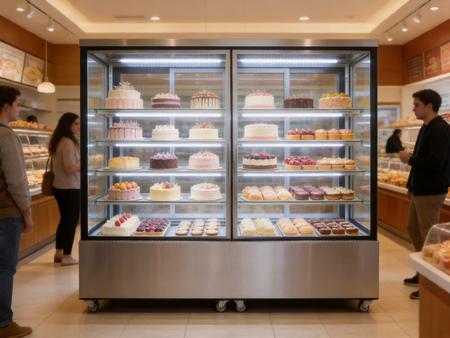
The XC-370Z uses a four-sided display concept with glass visibility around the cabinet. This design helps make the unit a central merchandising feature rather than a simple storage appliance. Products can be viewed from different directions, which is useful when the showcase is positioned in the middle of a sales area, near a service counter, or at the entrance of a bakery or café.
Good visibility can influence purchasing decisions. Customers often respond to the color, decoration, texture, and arrangement of desserts before they read a menu or ask a member of staff for information. Clear glass, internal LED lighting, and organized shelves help the products communicate their quality directly from the display.
2. Product Overview
The XC-370Z is identified within the XC-370Y/Z model family. It has a rated capacity of 370 liters and a refrigerated operating range of 2–8°C. This range is appropriate for many chilled cake and dessert applications, although the exact storage requirements of individual products should always be confirmed according to the recipe, ingredients, packaging, and local food-safety procedures.
Specification |
Stated Value |
Model |
XC-370Y/Z |
Product designation |
XC-370Z Cake Showcase |
Capacity |
370 liters |
Temperature range |
2–8°C |
Input power |
490 watts |
Refrigerant options |
R134a or R290 |
Climate classification |
4 |
Net weight |
155 kilograms |
Gross weight |
188 kilograms |
Product dimensions |
1215 × 675 × 1215 millimeters |
Standard lighting |
Three LED light bars |
Shelves |
Two glass shelves |
Defrost system |
Automatic defrost |
Cooling system |
Ventilated cooling |
The stated product dimensions create a relatively broad and balanced display footprint. With a width of approximately 1215 millimeters and a depth of approximately 675 millimeters, the unit can provide substantial display volume without requiring the depth of a large walk-in or wall-mounted cabinet. The height of approximately 1215 millimeters also supports a comfortable viewing level for customers and convenient access for staff.
Packaging information supplied for the product includes more than one package-size entry, including 1325 × 765 × 1195 millimeters and another entry recorded as .1045 × 785 × 1180 millimeters. Because the second figure appears to contain a formatting or transcription error, buyers and logistics teams should confirm the final carton or crate dimensions with the manufacturer before arranging transport, container loading, warehouse receiving, or installation access.
3. Display Visibility as a Sales Advantage
One of the most important advantages of the XC-370Z is its emphasis on product visibility. Four-sided glass construction allows customers to see the contents from multiple directions. In a busy commercial environment, this can create more opportunities for visual engagement than a cabinet that can only be viewed from the front.
Four-sided visibility is particularly useful for island placement. A bakery may position the cabinet between the ordering area and the seating area, while a hotel may use it in a lobby café or buffet zone. A supermarket may place it at the end of a chilled-food aisle. The cabinet can serve as a visual anchor that guides customer movement and draws attention to premium products.
Double tempered glass contributes to both appearance and practical durability. Tempered glass is processed to improve its resistance to ordinary impacts and temperature changes compared with standard untreated glass. The double-glazing structure also supports the thermal separation between the refrigerated interior and the surrounding room. As with any glass appliance, proper handling and regular inspection remain important, but the specification provides a stronger commercial display solution than ordinary single-pane construction.
The glass surfaces should be kept clean and free from fingerprints, condensation residue, food particles, and cleaning streaks. A clean display improves perceived product quality. Customers often associate a clear, well-maintained cabinet with better hygiene and more carefully prepared food.
The smooth back sliding glass doors provide access for loading and service while helping maintain a neat appearance at the rear of the cabinet. Sliding doors are often practical in spaces where hinged doors could interfere with nearby counters, walls, or customer traffic. They also allow staff to open only the necessary section when arranging or retrieving products.

Cake Showcase
4. Internal Arrangement and Merchandising Flexibility
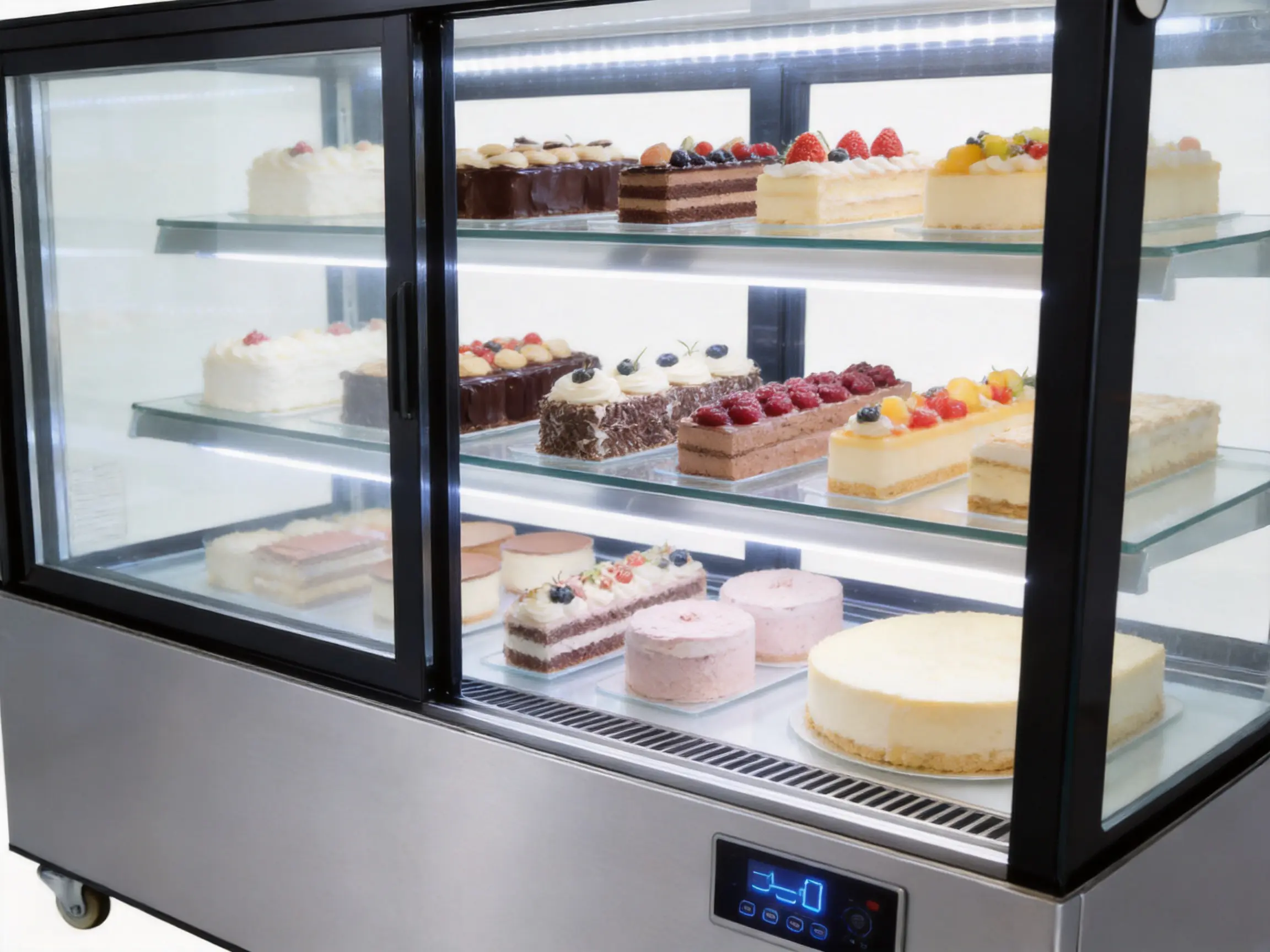
The showcase is equipped with two glass shelves. These shelves create multiple presentation levels, allowing staff to separate product types, sizes, colors, or price categories. Layered presentation is especially effective for cakes because it enables customers to see both large celebration cakes and smaller individual desserts within the same cabinet.
Glass shelving helps preserve visual openness. Solid shelves can create dark or obstructed areas, especially in a four-sided cabinet. Transparent shelves allow light to pass through and reduce visual interruption, making more of the refrigerated volume available for customer inspection.
Although the cabinet provides a substantial 370-liter capacity, the usable arrangement should be planned carefully. Products should not be packed tightly against air outlets or internal surfaces. Space should be left around products to support the intended airflow pattern. Staff should also avoid placing tall items where they block the view of lower shelves or interfere with sliding doors.
Recommended Merchandising Practices
Place high-margin or signature products at the most visible eye-level positions. These may include decorated celebration cakes, seasonal specialties, limited editions, or products that best represent the business. Smaller desserts can be grouped on lower levels, while larger cakes should be positioned where their decoration can be seen without obstruction.
Use consistent trays, plates, labels, and price cards. A coordinated arrangement makes the display look more professional and helps customers understand the product selection quickly. Labels should be positioned so that they do not cover the main viewing area or restrict air movement.
Leave sufficient space between products. Overcrowding can make the cabinet appear untidy and may restrict cooling circulation. A slightly more open arrangement often improves both visual appeal and temperature performance.
Organize products according to practical service needs. Frequently sold items should be placed where staff can reach them quickly. Products with similar handling requirements can be grouped together, while allergen information and product identification should be managed according to the retailer’s food-safety procedures.
5. Refrigeration Performance and Temperature Control
The XC-370Z has a temperature range of 2–8°C and uses a ventilated cooling system. This type of cooling circulates refrigerated air through the cabinet rather than depending only on natural convection. The result is intended to provide more even temperature distribution across the display area, particularly when the cabinet is correctly loaded and operated in suitable ambient conditions.
Temperature stability is essential for many chilled desserts. Excessive warmth can affect cream firmness, icing structure, fruit freshness, chocolate decoration, and overall product appearance. Temperature fluctuations may also shorten shelf life and increase the risk of food-quality problems. A display cabinet that combines refrigeration with clear digital monitoring gives staff a practical way to observe operating conditions during daily service.
The digital thermostat and display allow users to set and monitor the cabinet temperature. Digital controls are generally easier to read than analog gauges and can help staff identify abnormal conditions more quickly. The display should be checked as part of routine opening and closing procedures, especially during periods of high customer traffic or warm weather.
Actual internal temperature can be affected by several factors, including ambient temperature, humidity, product load, product temperature at loading, door-opening frequency, airflow obstruction, condenser cleanliness, and power stability. The specified climate type 4 indicates that the unit is designed for a defined commercial climate condition, but installation teams should still assess the local environment before placing the cabinet into service.
Products should normally be pre-chilled before being placed inside the showcase. Loading large quantities of warm products can temporarily raise the internal temperature and increase the workload on the refrigeration system. When a new batch must be loaded, staff should work efficiently, keep the sliding doors closed whenever possible, and avoid leaving the cabinet open for extended periods.
Automatic Defrost and Daily Operation
Automatic defrost is another practical feature. Moisture can accumulate on refrigerated surfaces during normal operation, particularly when warm, humid air enters the cabinet. If frost builds up excessively, it can reduce heat-transfer efficiency and restrict airflow. An automatic defrost cycle helps manage this accumulation without requiring staff to switch off the cabinet for frequent manual defrosting.
Automatic defrost does not eliminate the need for cleaning and inspection. Staff should still check that drainage paths remain clear, that no water is collecting abnormally, and that the interior remains hygienic. Any unusual ice formation, water leakage, temperature instability, or repeated alarm condition should be investigated promptly.
6. Lighting and Product Presentation
The standard configuration includes three LED light bars. LED lighting is well suited to commercial display applications because it can provide bright, focused illumination with relatively low heat output compared with many traditional lighting sources. Lower heat emission is valuable in a refrigerated cabinet because unnecessary heat inside the display can increase the cooling load.
Lighting influences how customers perceive color and freshness. Properly placed LED bars can make cream, fruit, chocolate, icing, and decorative details easier to see. They can also reduce dark areas between shelves and improve the appearance of products during evening service or in shops with subdued ambient lighting.
Lighting should be used to support the merchandise rather than overwhelm it. Excessive glare, strong reflections, or poorly positioned signs can reduce visibility. The transparent shelves and glass panels should be arranged so that the light reaches the products without creating unnecessary visual obstruction.
LED bars are also useful for maintaining a consistent visual identity across multiple cabinets. A bakery operating several units can arrange products with similar illumination levels, creating a more organized and premium sales environment.
7. Construction Details for Commercial Use
Commercial equipment must be designed for repeated daily use. The XC-370Z includes a stainless steel base, which supports a clean and professional appearance while offering a durable surface in an area exposed to contact with floors, cleaning materials, carts, and occasional spills.
Stainless steel is widely used in food-service environments because it is relatively resistant to corrosion, easy to wipe clean, and compatible with routine sanitation procedures when appropriate cleaning products are used. Staff should follow the recommended cleaning method and avoid abrasive materials that may scratch the finish.
The cabinet also includes four castors, two of which have brakes. Castors make it easier to move the showcase during installation, cleaning, layout changes, or service access. The two locking castors help stabilize the cabinet once it has been positioned. Operators should engage the brakes before loading products and confirm that the cabinet is level and secure.
Mobility is an important practical advantage over fixed display furniture. A retail layout may change seasonally, and access to the rear or sides of a cabinet may be necessary for cleaning and maintenance. Castors reduce the need for heavy lifting and can simplify the work of trained service personnel.
The separate power button provides a straightforward way to control the unit. A dedicated switch can be useful during cleaning, maintenance, or periods when the cabinet is not in use. Operating staff should use power controls in accordance with the manufacturer’s instructions and local electrical-safety requirements.
8. Advantages Compared with Basic Display Cabinets
The XC-370Z offers several advantages when compared with basic, non-refrigerated display furniture or simpler single-view cabinets.
Multi-Angle Customer Access to Information
A four-sided glass design makes products visible from more positions in the store. This is especially beneficial for island placement and open-plan retail environments. A basic front-display unit may limit visual contact to customers standing directly in front of it, while the four-sided layout can attract attention from passing customers on different sides.
More Controlled Product Conditions
Refrigerated operation at 2–8°C provides a more suitable environment for many chilled desserts than room-temperature display. The ventilated cooling system and digital thermostat offer greater control than an open shelf or decorative cabinet without active refrigeration.
Better Lighting Integration
Three LED light bars provide dedicated product illumination. Compared with relying only on ceiling lights, integrated lighting can create a more consistent appearance and make products easier to evaluate.
Practical Access and Mobility
Sliding glass doors can be more space-efficient than outward-opening hinged doors, particularly behind a counter. Four castors, including two with brakes, make the cabinet easier to position and service than a fixed unit.
Reduced Routine Defrost Work
Automatic defrost reduces the need for frequent manual defrosting. This can save staff time and help maintain more consistent operation when the equipment is correctly installed and maintained.
Commercial-Grade Presentation
Double tempered glass, a stainless steel base, transparent shelves, and integrated LED lighting combine to create a professional display. The cabinet is not only a cooling appliance but also a merchandising tool capable of supporting a premium retail image.
9. Energy and Operating Considerations
The rated input power is 490 watts. Actual energy consumption over a day depends on operating time, ambient conditions, temperature settings, product load, door-opening frequency, defrost operation, and the cleanliness of the refrigeration system. Buyers should distinguish between input power and total energy consumption when calculating operating costs.
Several simple practices can support efficient use. Install the cabinet away from direct sunlight, ovens, cooking equipment, radiators, and other heat sources. Maintain adequate clearance around ventilation areas. Do not block air inlets or outlets. Keep doors closed when the cabinet is not being loaded or serviced. Load products that are already suitably chilled whenever possible.
Condenser cleanliness is also important. Dust and grease on heat-exchange surfaces can reduce the system’s ability to release heat, increasing operating stress and potentially affecting cabinet temperature. Cleaning schedules should reflect the environment. A bakery or restaurant with flour, grease, or airborne particles may require more frequent inspection than a low-dust retail area.
The use of R134a or R290 should be confirmed for the specific order and market. R290 is propane-based and is commonly selected in some modern commercial refrigeration applications for its environmental characteristics, but it is flammable and requires suitable system design, handling, installation, and servicing procedures. R134a has different regulatory and environmental considerations. The final refrigerant choice should be documented on the product label and technical paperwork.
Electrical requirements, plug type, voltage, frequency, and protection devices should also be confirmed before shipment. Export buyers may require a specific configuration for their national market. Professional manufacturers typically coordinate these details during order review.
10. Manufacturing Strengths Behind the Product
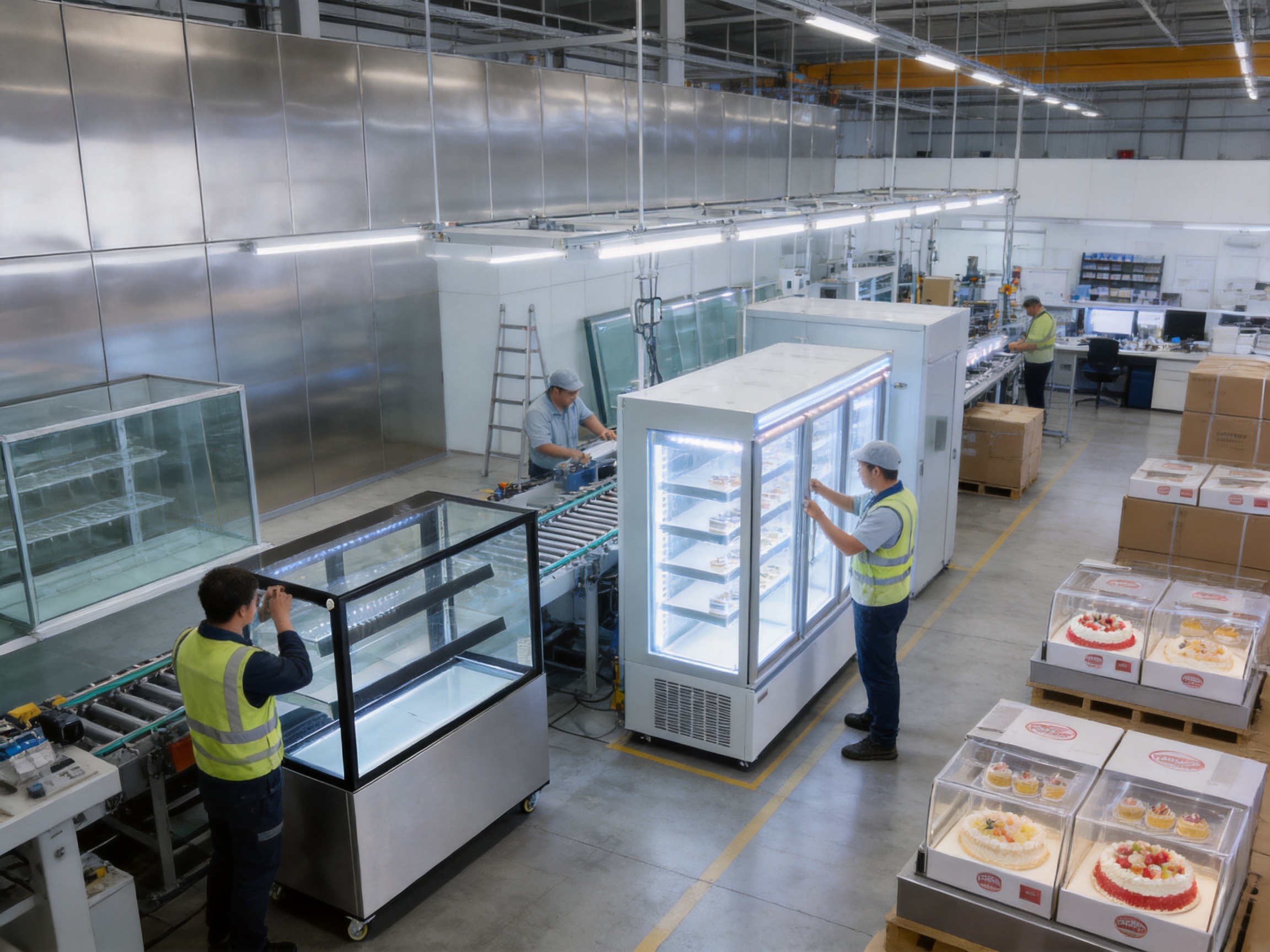
A reliable display cabinet depends on more than the visible final assembly. Quality is influenced by design engineering, material selection, component control, production consistency, testing, packaging, and after-sales support. The manufacturer of this product has experience in vertical display cabinets, cake cabinets, and warming cabinets, with operations established in 2007.
The company operates a modern factory covering approximately 40,000 square meters and maintains a professional research and development team. These resources are important because commercial refrigeration products must balance thermal performance, appearance, structural strength, serviceability, safety, and cost. A dedicated development team can evaluate these factors together rather than treating the cabinet as a collection of unrelated components.
Research and development capability can support improvements in cabinet airflow, door sealing, shelf positioning, lighting arrangement, insulation, controller operation, and component integration. It can also help manufacturers adapt products for different markets, including different electrical standards, refrigerant requirements, packaging conditions, and certification expectations.
Product Development and Prototyping
Before a commercial cabinet enters mass production, its structure and refrigeration design should be assessed through engineering review and prototype evaluation. Important questions include whether the cabinet maintains the required temperature under expected ambient conditions, whether the glass structure remains stable, whether doors slide smoothly, whether shelves support their intended load, and whether service components can be accessed efficiently.
Prototyping also allows manufacturers to examine the customer-facing details that influence retail performance. Light distribution, glass reflection, shelf spacing, base construction, castor placement, control visibility, and the overall relationship between cabinet size and usable capacity can all be refined before final production.
Production Process Control
Consistent production requires controlled procedures for cabinet assembly, glass installation, refrigeration piping, electrical wiring, insulation, sealing, lighting installation, and final inspection. Each stage affects the finished product. For example, an incomplete seal can contribute to air leakage, while incorrect wiring can affect safety or controller operation.
Process control is particularly important when producing cabinets for export. Customers may order repeated batches and expect the same dimensions, performance, finish, and component configuration. Clear work instructions, trained operators, incoming-material inspection, and final quality checks help reduce variation between units.
Testing Facilities
Advanced testing facilities allow the manufacturer to evaluate performance before products leave the factory. Typical commercial refrigeration checks may include temperature operation, electrical safety, leakage inspection, door function, lighting operation, defrost performance, noise observation, and general appearance.
Testing is valuable not only for finding defective products but also for improving the design. Test results can reveal how the cabinet responds to warm loading, high ambient temperature, repeated door opening, or different refrigerant configurations. A manufacturer that uses test data in product development is better positioned to make controlled improvements.
Certification and Market Readiness
The company reports obtaining CE, GS, CCC, CB, RoHS, ETL, and other major certifications. Certification requirements vary by country, product configuration, and intended market, so buyers should request current documentation for the exact model, voltage, refrigerant, and electrical version being purchased.
International certifications can make the procurement process more efficient, particularly for importers, distributors, hotel groups, supermarket chains, and commercial equipment dealers. They also demonstrate that the manufacturer has experience addressing regulatory and testing requirements beyond the domestic market.
11. Quality Management from Factory to Customer
Manufacturing quality does not end when the refrigeration system reaches its target temperature. The product must also arrive safely, remain functional after installation, and be supported during its service life. Commercial display cabinets contain glass, metal panels, shelves, lighting, refrigeration components, electrical controls, and moving doors. Each element requires protection during handling and transport.
The stated net weight is 155 kilograms, while the gross weight is 188 kilograms. The difference reflects packaging materials and shipping protection. Because the unit is heavy and includes glass surfaces, logistics planning should include suitable lifting equipment, pallet or crate handling, doorway measurements, elevator capacity, and a clear installation route.
Packaging design should protect corners, glass panels, doors, shelves, castors, and external finishes. The final packaging method should be confirmed for the destination and transport mode. Long-distance sea freight, truck transport, and warehouse handling can expose the cabinet to vibration, humidity, impact, and repeated movement.
Upon arrival, the buyer should inspect the packaging before opening it. Any visible damage should be recorded according to the agreed shipping procedure. After unpacking, staff should check the glass, shelves, doors, cabinet surfaces, castors, power cable, controller, light bars, and refrigeration performance before the showcase is placed into normal retail service.
12. Installation Guidance
Professional installation helps protect both performance and product life. The cabinet should be placed on a stable, level surface with adequate ventilation around the refrigeration system. The castor brakes should be engaged after positioning. The unit should not be pushed against a wall or another appliance if doing so blocks required airflow or prevents service access.
The cabinet should be allowed to settle after transportation according to the manufacturer’s instructions before power is connected. This is especially important when the unit has been transported in a position that may allow compressor oil to move within the refrigeration circuit. The exact waiting period should be confirmed in the installation manual or with technical support.
Once connected, the cabinet should be allowed to reach its operating temperature before products are loaded. The digital display should be checked, and the cabinet temperature should be verified using an appropriate independent thermometer where required by the operator’s food-safety plan.
Electrical connection must comply with local regulations. The power supply should match the product’s rated requirements. Grounding, circuit protection, plug configuration, and extension-cord use should be reviewed by a qualified professional. An unsuitable electrical supply can damage the equipment or create a safety hazard.
13. Cleaning and Maintenance
Regular cleaning protects hygiene, appearance, and operating performance. Before cleaning, staff should follow the operating instructions and use the separate power button or other approved shutdown procedure where necessary. Electrical parts, controls, and lighting components should not be exposed directly to excessive water.
Glass panels and sliding doors should be cleaned with a suitable non-abrasive product. Food residue should be removed promptly because dried sugar, cream, fruit syrup, and chocolate can become more difficult to clean later. Shelves should be removed carefully, washed according to the recommended procedure, dried fully, and replaced securely.
The stainless steel base should be wiped regularly to remove spills, dust, and fingerprints. Abrasive pads, aggressive chemicals, and chlorine-based products that are not approved for the surface should be avoided. Maintaining the base helps preserve the professional appearance expected in a customer-facing environment.
Staff should inspect the door tracks and sliding mechanism for crumbs or debris. A blocked track can make the doors difficult to operate and may lead to unnecessary force being applied. The cabinet’s drainage area should also be checked so that defrost water can leave the system properly.
Ventilation openings and condenser areas should be inspected by trained personnel. Cleaning frequency depends on the operating environment. Restaurants, bakeries, and food-preparation areas may produce more airborne grease, flour, and dust than ordinary retail spaces.
Preventive maintenance should include checking temperature performance, door alignment, glass condition, lighting, electrical connections, castors, brakes, seals, and refrigeration operation. Early attention to small problems can reduce the risk of product loss and unplanned downtime.
14. Suitable Business Applications
The XC-370Z can support a variety of commercial applications. In a bakery, it can display decorated cakes, slices, pastries, and chilled desserts near the sales counter. In a café, it can encourage impulse purchases by placing attractive products within clear view of customers waiting to order.
Hotels can use the cabinet in lobby cafés, breakfast areas, banquet preparation zones, or dessert stations. Restaurants may display ready-to-serve cakes and desserts near the entrance or point of sale. Supermarkets and convenience stores can use the four-sided format to create a destination display within a larger chilled-food area.
Catering businesses may benefit from the capacity and mobility when preparing for events, although the cabinet’s operating environment, transport requirements, and electrical supply must be considered carefully. The unit is most suitable for stable commercial installation rather than uncontrolled outdoor use.
Because the cabinet has a 2–8°C range, it is intended for chilled display applications. It should not be treated as a frozen-food freezer or as a substitute for specialized storage equipment requiring temperatures below 0°C. The product category should always match the intended food application.
15. Purchasing Considerations for Importers and Distributors
Commercial buyers should evaluate more than the purchase price. A complete assessment should include capacity, temperature range, dimensions, electrical configuration, refrigerant, certification, packaging, spare parts, delivery conditions, warranty terms, technical support, and expected operating environment.
For distributors, model consistency is important. The XC-370Y/Z model designation and XC-370Z product description should be confirmed on quotations, labels, manuals, packing lists, and shipping documents. This avoids confusion when different versions or refrigerant options are available.
Buyers should also confirm whether the quoted unit includes all standard features: three LED light bars, digital thermostat and display, two glass shelves, double tempered glass, sliding glass doors, ventilated cooling, automatic defrost, stainless steel base, separate power button, and four castors with two brakes.
Technical documentation should state the final product dimensions and packaging dimensions clearly. The package-size information supplied for this model contains two entries, one of which appears incomplete or incorrectly formatted. Confirming the correct dimensions before shipment is especially important for container planning and warehouse receiving.
Where the equipment will be installed in a warm or humid market, buyers should discuss climate conditions, ventilation, ambient temperature, and service arrangements with the manufacturer. Climate type 4 provides useful information, but local installation conditions still influence real-world performance.
16. Why Experienced Manufacturing Matters
Experience in commercial refrigeration helps a manufacturer understand the difference between a product that looks attractive in a catalog and one that performs reliably in daily operation. A display cabinet must integrate refrigeration, electrical control, glass construction, lighting, insulation, doors, shelving, mobility, and cleanability without allowing one feature to undermine another.
A company established in 2007 has had the opportunity to develop production experience across multiple product categories, including vertical display cabinets, cake cabinets, and warming cabinets. This broader product knowledge can support component selection, factory training, quality control, and product customization.
A 40,000-square-meter modern factory provides space for organized production, testing, warehousing, material handling, and engineering activities. Factory scale alone does not guarantee quality, but when combined with professional management, trained personnel, testing facilities, and a research and development team, it can support more consistent output and stronger delivery capability.
The stated business philosophy of innovation, quality, and service is relevant to commercial buyers because these products are normally purchased for continuous business use. Retailers need equipment that supports sales every day, while distributors need predictable quality and responsive technical communication. Manufacturing strength is therefore part of the product value, not merely a background detail.
17. Operating Checklist
Before opening the store, check that the cabinet is connected to the correct power supply, the temperature display is operating, the doors close and slide correctly, the shelves are stable, and the interior is clean. Confirm that the castor brakes are engaged and that the display is positioned safely.
During operation, avoid leaving the sliding doors open unnecessarily. Monitor the displayed temperature, keep products arranged with adequate airflow, and remove expired or damaged items promptly. Clean spills as soon as practical to protect hygiene and appearance.
At closing, follow the business’s food-safety procedure for product storage. Do not switch off the cabinet if products are intended to remain refrigerated overnight unless the operating plan specifically permits it. Inspect the cabinet for unusual noise, water accumulation, ice formation, damaged glass, or temperature changes.
Operating Area |
Recommended Practice |
Temperature |
Monitor the digital display and verify settings according to the food-safety plan. |
Loading |
Use pre-chilled products and avoid blocking air circulation. |
Doors |
Keep sliding doors closed whenever loading or service is not taking place. |
Lighting |
Keep glass and shelves clean so the LED illumination remains effective. |
Mobility |
Engage the two castor brakes after positioning the cabinet. |
Cleaning |
Use suitable non-abrasive cleaners and protect electrical components from water. |
Maintenance |
Inspect seals, tracks, drainage, ventilation, and temperature performance regularly. |
18. Frequently Asked Questions
What products are suitable for the XC-370Z cake showcase?
The cabinet is suitable for many chilled cakes, pastries, desserts, cream products, fruit-based desserts, cheesecakes, mousse cakes, and similar bakery items. Product requirements vary, so the operator should confirm the correct storage temperature for each recipe and follow applicable food-safety guidance.
What is the temperature range?
The stated temperature range is 2–8°C. The actual temperature inside the cabinet can vary according to ambient conditions, loading, door opening, airflow, maintenance, and installation quality.
How much product can the cabinet hold?
The rated capacity is 370 liters. Usable merchandising capacity depends on product dimensions, shelf arrangement, trays, packaging, and the need to maintain adequate air circulation. Capacity should not be interpreted as a recommendation to fill every available space tightly.
Does the cabinet have automatic defrost?
Yes. Automatic defrost is listed as a standard feature. Staff should still inspect drainage and monitor the cabinet for abnormal frost or water accumulation.
How many shelves are included?
The standard features list specifies two glass shelves. Buyers should confirm shelf dimensions, load capacity, adjustability, and any optional shelf configurations when placing an order.
Can customers see the products from all sides?
The product is designed as a four-sided glass display cabinet, allowing visibility from multiple directions. This makes it suitable for island positioning and open retail layouts.
What type of doors does it use?
The cabinet has smooth back sliding glass doors. Sliding doors can help save space behind the cabinet and provide practical access for staff during loading and service.
Is the cabinet easy to move?
Four castors are included, and two have brakes. The castors assist with positioning and cleaning access, while the brakes help stabilize the unit during operation. Because the showcase is heavy, movement should be performed carefully by suitable personnel.
What refrigerant does the cabinet use?
The supplied specification lists R134a/R290. The exact refrigerant should be confirmed for the specific order because the choice may depend on market requirements, product configuration, regulatory conditions, and customer preference.
What does climate type 4 mean?
Climate type 4 is a classification relating to the environmental conditions under which the cabinet is designed to operate. Buyers should still confirm the expected ambient temperature and humidity of the installation location with the supplier.
What should be confirmed before importing the product?
Importers should confirm the exact model, voltage, frequency, plug, refrigerant, certifications, product dimensions, package dimensions, gross weight, warranty conditions, spare parts, installation requirements, and shipping documentation. The package-size information supplied for this product should receive particular confirmation because two entries are listed and one appears to contain a formatting error.
What makes this product different from a decorative cake cabinet?
The XC-370Z combines active refrigeration, ventilated cooling, digital temperature control, automatic defrost, LED lighting, glass shelving, double tempered glass, sliding doors, and commercial mobility. A decorative cabinet without active refrigeration cannot provide the same controlled chilled display function.
Where is the product manufactured?
The product is manufactured by Ningbo XiangChi Electrical Co., Ltd., located in Cixi City, Ningbo, Zhejiang, China. The manufacturer operates a modern factory, maintains research and development capabilities, and produces vertical display cabinets, cake cabinets, and warming cabinets.
19. Final Assessment
The XC-370Z cake showcase is designed for businesses that want to combine reliable chilled storage with strong product presentation. Its 370-liter capacity, 2–8°C temperature range, ventilated cooling system, digital thermostat, automatic defrost, and practical internal shelving provide the foundation for commercial dessert display.
Its most visible advantages are the four-sided glass construction, three LED light bars, double tempered glass, smooth sliding doors, stainless steel base, and castors with two brakes. Together, these details help the cabinet function as an attractive retail centerpiece while remaining practical for staff.
Compared with basic display furniture, the product offers active temperature management, improved visibility, integrated illumination, easier mobility, and reduced manual defrost work. These features can support a cleaner, more organized, and more commercially effective display environment.
The manufacturer’s experience, factory capacity, research and development team, testing facilities, and reported international certifications add further value for professional buyers. For the best result, customers should confirm the exact technical configuration, refrigerant, electrical requirements, certifications, final packaging dimensions, and installation conditions before ordering.
When installed correctly and maintained consistently, the XC-370Z can help bakeries, cafés, hotels, restaurants, supermarkets, and dessert retailers protect chilled products while presenting them in a way that encourages customer attention and purchase.
References
1. Product specification sheet for the XC-370Y/Z cake showcase, including capacity, temperature range, power, dimensions, refrigerant options, and standard features.
2. Commercial refrigeration equipment maintenance and hygiene practice guidelines.
3. General food-service refrigeration principles for chilled desserts and bakery products.
4. International standards and conformity assessment practices for commercial electrical refrigeration equipment.
5. Manufacturer-provided company profile and information regarding research and development, factory operations, testing facilities, certifications, and product categories.
6. General technical guidance concerning tempered glass, LED display lighting, ventilated cooling, automatic defrost, and stainless steel construction in commercial display equipment.
Product: Cake Showcase

You May Also Like





-
- Navigation
- Home
- About Us
- Products
- News
- Contact Us
 East Zone, Guanhaiwei Industrial Park, Cixi City, Ningbo, Zhejiang, China
 +86-574-63668678
 +86-574-63668108

Copyright © Ningbo XiangChi Electrical Co.,Ltd All Rights Reserved.
