
 简体中文
 English
 Español

News
Four-Sided Glass Display Cooler: A Practical Guide to High-Visibility Commercial Refrigeration
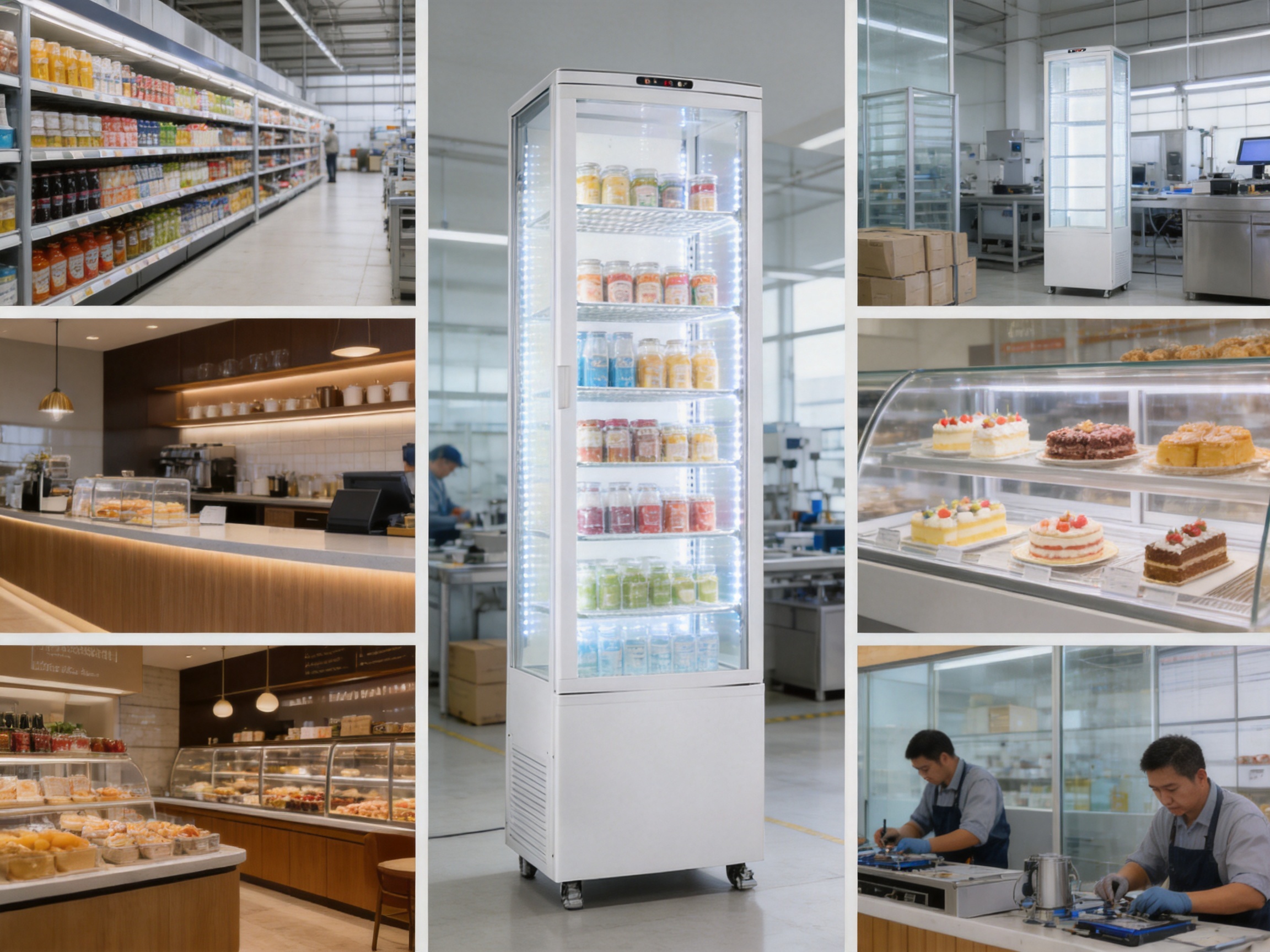
In modern food retail and professional hospitality, refrigeration does more than preserve products. It also presents them. A well-designed display cooler protects temperature-sensitive food while making beverages, desserts, dairy products, packaged meals, fresh snacks, and other merchandise easy for customers to see and select. The XC-278L four-sided glass display cooler is designed around this combined requirement: dependable refrigerated storage, strong product visibility, organized merchandising, and convenient daily operation.
With a 278-liter capacity, a temperature range of 2–10°C, ventilated cooling, automatic defrost, internal LED lighting, adjustable shelves, and four-sided double-glass construction, this vertical display cabinet is suitable for shops, cafés, restaurants, bakeries, convenience stores, hotel breakfast areas, supermarkets, and food-service counters. Its tall and relatively narrow footprint allows businesses to use vertical space efficiently while keeping products visible from several directions.
The cooler is manufactured by Ningbo XiangChi Electrical Co., Ltd., a professional producer of vertical display cabinets, cake cabinets, warming cabinets, and related commercial refrigeration equipment. The company combines product research and development, testing facilities, controlled production processes, and international certification experience to serve different markets and application requirements.
This article examines the product’s construction, cooling performance, merchandising advantages, manufacturing strengths, installation considerations, operating practices, and suitability for different commercial environments.

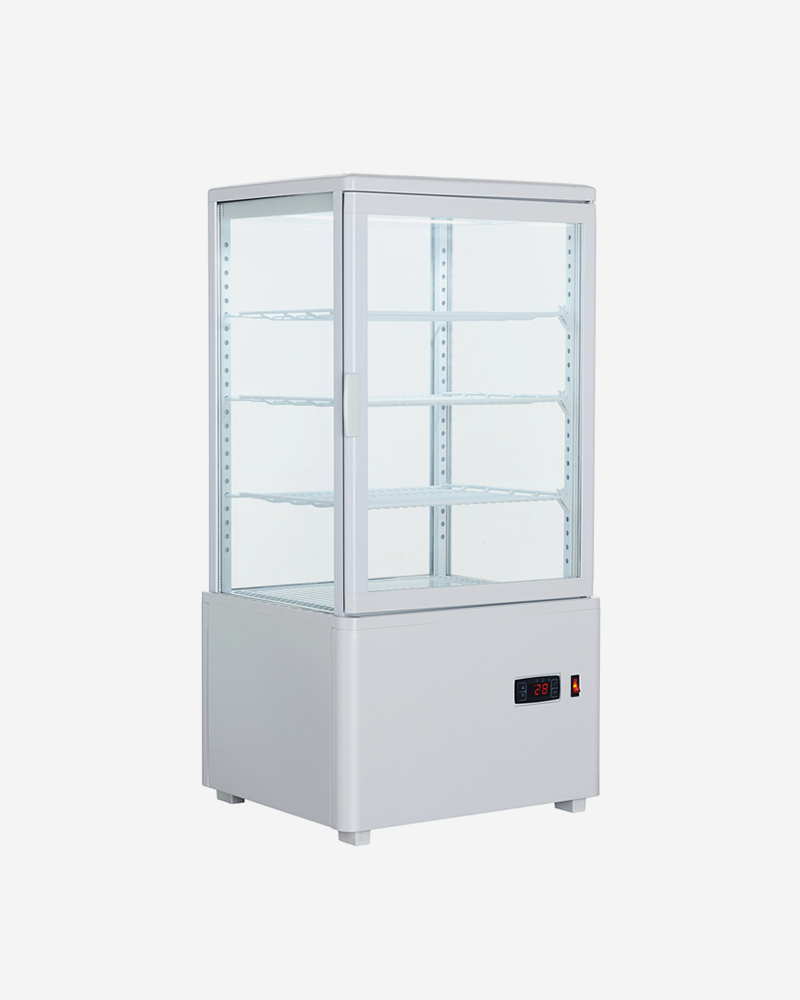
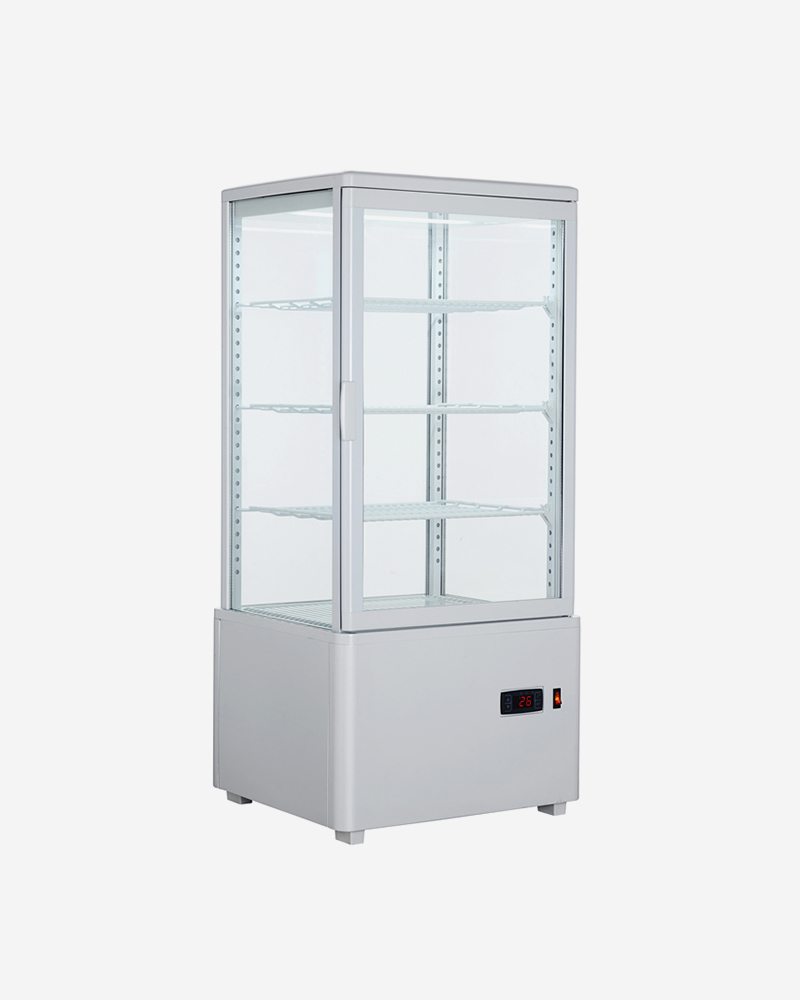
Four Sides Glasses Display Cooler
1. Product Overview
The XC-278L is a four-sided glass display cooler intended for chilled product presentation. Its design provides a broad visual area around the cabinet, allowing customers to view stored goods from the front, sides, and, depending on the installation position, multiple approach angles. This makes it particularly useful in open retail environments where products must attract attention from more than one direction.
The cabinet has a rated capacity of 278 liters and operates within a temperature range of 2–10°C. This range is appropriate for many chilled products, including bottled and canned beverages, packaged dairy products, desserts, prepared foods, sandwiches, fruit portions, salads, and other merchandise that requires cool holding rather than freezing.
A ventilated cooling system distributes cold air through the cabinet to help maintain a consistent refrigerated environment. Automatic defrost reduces the need for frequent manual intervention, while the digital thermostat and display give operators a clear method of monitoring and adjusting the temperature.
The cabinet includes adjustable PVC-coated shelves as standard. These shelves help retailers create different vertical storage arrangements according to the size and shape of their products. Optional chromed shelves and tempered glass are also available for applications requiring a different appearance, additional presentation value, or enhanced material characteristics.
Key Technical Specifications
Model | XC-278L |
Product category | Four-sided glass display cooler |
Capacity | 278 liters |
Temperature range | 2–10°C |
Input power | 340 W |
Refrigerant options | R134a or R290 |
Climate class | 4 |
Net weight | 93 kg |
Gross weight | 98 kg |
Product dimensions | 515 × 485 × 1915 mm |
Package dimensions | 590 × 550 × 1960 mm |
20-foot general-purpose container capacity | 36 units |
40-foot high-cube container capacity | 80 units |
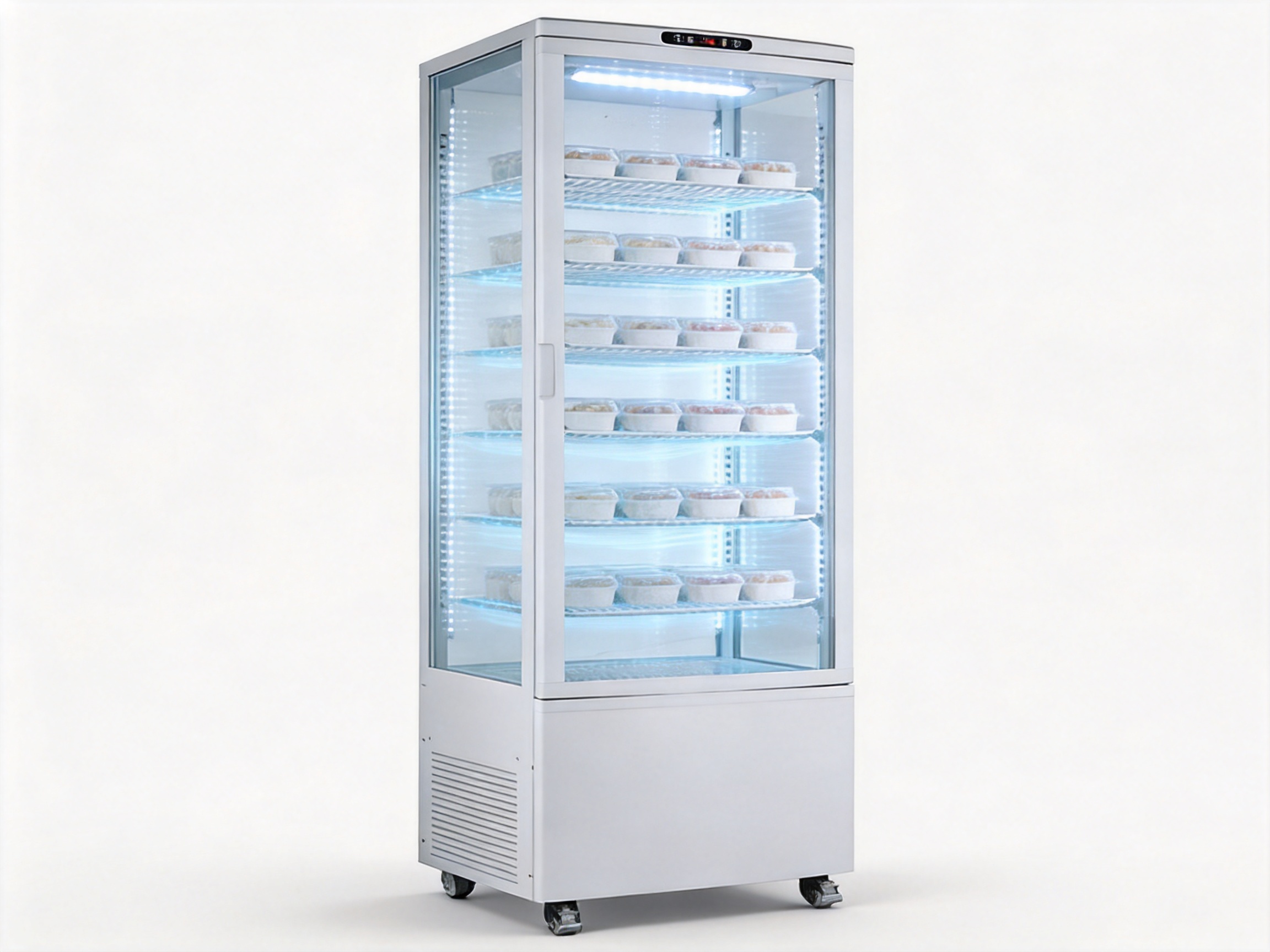
The combination of a tall profile and compact floor dimensions is one of the product’s most useful characteristics. At approximately 515 mm wide and 485 mm deep, the unit can fit into locations where a wider horizontal merchandiser would be impractical. Its height of 1915 mm provides substantial display volume without requiring a large floor area.
2. High-Visibility Four-Sided Glass Construction
The primary selling advantage of this product is its high-visibility design. The cabinet uses four-sided double glass, with a curved front glass panel that contributes to a contemporary appearance and helps create a more open visual presentation. Instead of hiding products behind solid panels, the cooler turns the stored merchandise into part of the store’s visual communication.
Four-sided visibility is valuable in island displays, central sales areas, restaurant dining zones, hotel lobbies, and self-service spaces. A customer approaching from the side can see the contents without walking around to the front. This can increase product awareness and make the cabinet more flexible in relation to store layout.
The glass enclosure also creates a clean separation between merchandise and the surrounding environment. Products remain protected inside the refrigerated cabinet while customers can inspect labels, colors, package formats, and product arrangement before opening the door or requesting service, depending on the operating configuration.
Compared with a solid-door refrigerator, a glass display cooler places greater emphasis on presentation. Compared with an open-front merchandiser, a fully enclosed glass cabinet can offer a more controlled refrigerated space and may reduce the amount of cold air escaping into the room. This balance between visibility and enclosure makes the four-sided format suitable for businesses that want attractive merchandising without giving up cabinet protection.
Double-Glass Benefits
The use of double glass supports the cabinet’s professional appearance and contributes to the separation between the chilled interior and the ambient environment. In commercial use, glass surfaces must withstand frequent cleaning, repeated customer contact, temperature variation, and continuous operation. A double-glass structure is therefore a practical choice for a display cabinet intended for demanding retail conditions.
Glass performance depends on correct installation, room conditions, cleaning practices, and routine maintenance. Operators should keep the glass clean, avoid blocking air circulation, and follow the recommended operating conditions. These simple actions help preserve visibility and support stable cabinet performance.
3. Internal LED Lighting for Product Presentation
Product visibility is not determined by glass alone. Lighting plays an equally important role. The XC-278L includes an internal top LED light as a standard feature. LED illumination helps brighten the display area, improve label visibility, and make products stand out during daytime and evening operation.
Compared with older lighting technologies, LED systems are generally valued for their low heat output, long service life, compact form, and efficient illumination. Reduced heat release inside the cabinet can be beneficial because the refrigeration system does not need to remove as much unnecessary heat from the display area.
The internal top position allows light to spread downward across the shelves. Operators can improve the result further by arranging products so that larger packages do not block smaller items. Products with strong colors, recognizable packaging, or high purchase frequency can be positioned at eye level or in the most illuminated areas.
For businesses requiring stronger or more specialized presentation, the cooler can be ordered with two or four strip LED light bars as optional configurations. These options can help create a brighter and more evenly illuminated display, especially when the cabinet is used for visually important products such as cakes, premium beverages, packaged desserts, or specialty foods.
4. Ventilated Cooling and Temperature Management
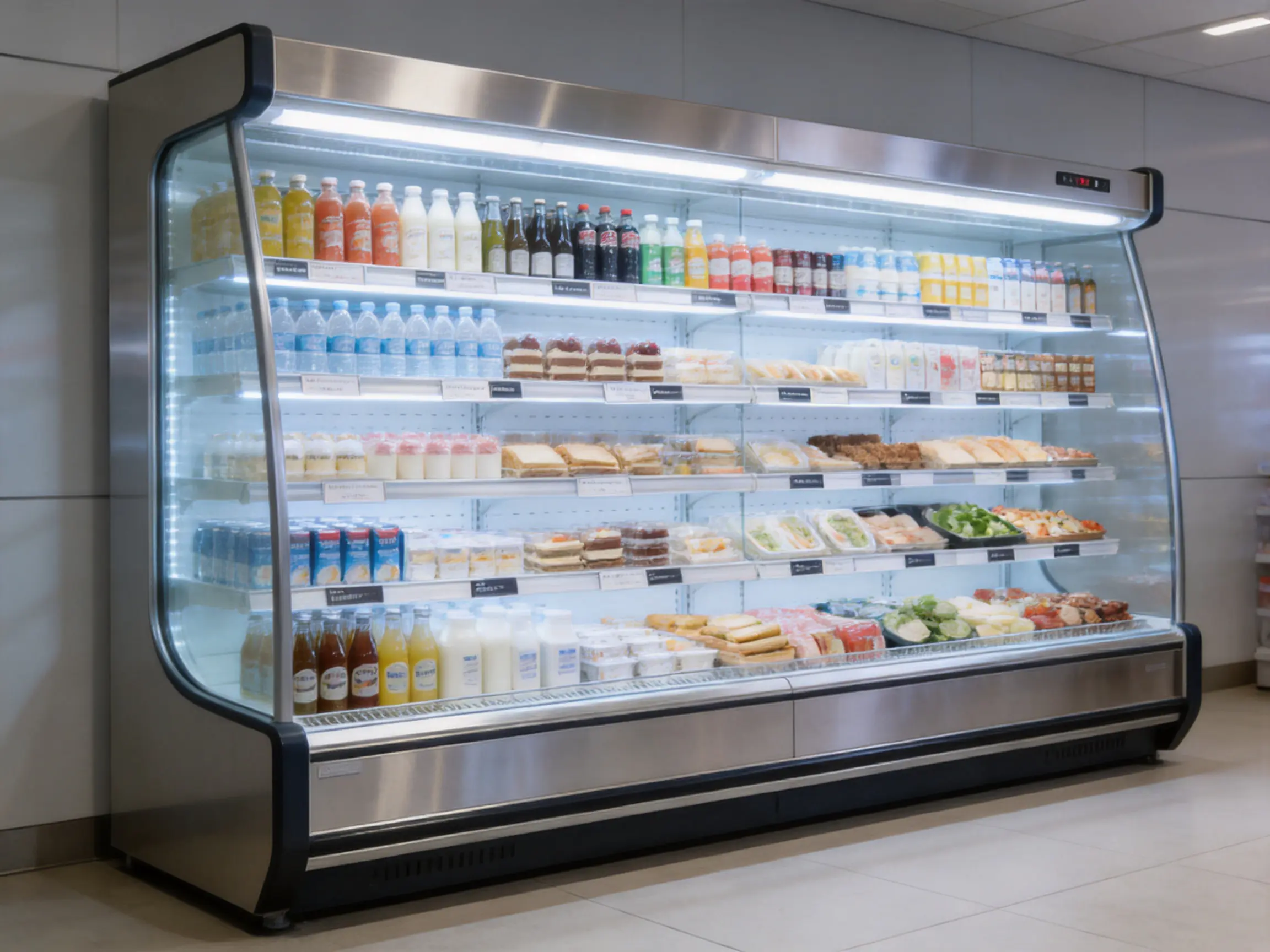
The XC-278L uses a ventilated cooling system. In a ventilated system, cooled air is circulated through the cabinet rather than relying only on natural convection. This supports more even temperature distribution between the upper, middle, and lower display areas when the shelves are correctly loaded and the air passages remain unobstructed.
The operating range of 2–10°C gives the cabinet flexibility for a broad group of chilled goods. The exact setting should be selected according to the requirements of the products being stored, local food-safety procedures, and the recommendations of the product manufacturers. Businesses should not assume that one temperature is suitable for every food type.
The digital thermostat and display provide an accessible control interface. Operators can check the cabinet setting and monitor operation without using a separate external thermometer as the only source of information. However, periodic verification with a calibrated independent thermometer is still a sensible practice, particularly in food-service and retail environments where temperature records are required.
Climate Class 4
The stated climate type is 4. Climate classification is important because commercial refrigeration equipment operates in rooms with different ambient temperatures and humidity levels. A cabinet selected for the wrong environment may experience reduced efficiency, longer compressor operation, condensation, or difficulty maintaining its target temperature.
A climate class 4 specification generally indicates suitability for a warm commercial environment within the applicable testing framework. Installation should nevertheless take place in a well-ventilated indoor area, away from ovens, direct sunlight, steam sources, radiators, and other equipment that produces heat.
Maintaining clearance around the refrigeration system is essential. Airflow around the condenser and other heat-releasing components must not be blocked by walls, cartons, curtains, or adjacent equipment. Good ventilation helps the unit reject heat efficiently and supports reliable operation.
5. Automatic Defrost and Operational Convenience
Frost can accumulate on refrigerated surfaces when moisture enters the cabinet and comes into contact with cold components. Excessive frost can reduce cooling efficiency, restrict airflow, and increase operating costs. The XC-278L includes automatic defrost to reduce the need for frequent manual defrosting.
Automatic defrost is particularly helpful in retail environments where the cooler operates for long periods and staff members need to focus on replenishment, customer service, sanitation, and stock control. The feature does not eliminate the need for cleaning or inspection, but it simplifies routine ownership compared with a cabinet that requires frequent manual defrost cycles.
During defrost operation, the internal temperature may change temporarily. This is a normal part of the refrigeration cycle. Operators should avoid leaving the door open unnecessarily and should maintain sensible loading levels so that the cabinet can recover efficiently after defrosting.
The cooler also includes four castors, two of which have brakes. Castors make positioning, cleaning, and layout adjustments easier. The two locking castors help stabilize the unit after it has been moved into its operating position. For safety, all castors should be positioned correctly and the brakes engaged when the cabinet is in service.
6. Adjustable Shelves and Merchandising Flexibility
Commercial products vary considerably in size. A cabinet intended for cans and small bottles may require a different arrangement from one used for cakes, large beverage containers, boxed desserts, or prepared food trays. The adjustable PVC-coated shelves allow operators to alter the vertical spacing and create a more efficient use of the 278-liter interior.
PVC-coated shelves are practical for general commercial use because they provide a protective surface that is easy to wipe and maintain. The shelf design also supports organized product grouping. Operators can create dedicated levels for beverages, dairy items, desserts, snacks, or promotional goods rather than placing everything in a single undifferentiated space.
Optional chromed shelves are available for customers who prefer a different visual effect or material finish. Chromed shelving can give the interior a brighter, more polished appearance and may be particularly appropriate in premium retail, bakery, hospitality, and showroom applications.
When loading the cabinet, shelves should not be covered with solid cartons or overfilled to the point that airflow is restricted. Air must circulate around the products. A well-organized display usually performs better than a crowded display because it allows the cooling system to work more effectively and makes products easier for customers to identify.
Merchandising Recommendations
Place frequently purchased products between eye and hand level whenever possible. Use lower shelves for heavier packages and reserve upper shelves for lighter merchandise. Keep similar products together, and use product orientation consistently so that labels face outward.
Leave suitable space between products and the internal air outlets. Do not push products tightly against the rear wall if doing so blocks circulation. Rotate stock according to the first-in, first-out principle where appropriate, and remove damaged or expired packages promptly.
Lighting, shelf spacing, and product color should be considered together. A display is most effective when customers can quickly understand what is available without searching through an overcrowded cabinet.
7. Suitable Commercial Applications
The XC-278L can serve many businesses that need refrigerated display combined with vertical space efficiency. Its use is not limited to one product category, provided the stored products are compatible with the 2–10°C operating range and the relevant food-safety requirements.
Convenience Stores
Convenience stores often need compact refrigeration near entrances, checkout zones, and high-traffic aisles. The tall format allows the store to display a useful quantity of chilled beverages and snacks without using a large amount of floor space. Four-sided glass can also make the unit effective as an island display or as a focal point at the end of an aisle.
Cafés and Restaurants
Cafés can use the cabinet for bottled beverages, desserts, sandwiches, salads, and ready-to-serve items. In a restaurant, it can be placed near a service counter, buffet area, or waiting space. The clear display allows guests and staff to identify products quickly while the refrigerated interior supports chilled holding.
Bakeries and Dessert Retailers
Bakeries may use a glass display cooler for chilled cakes, cream-based desserts, pastries requiring refrigeration, and packaged sweet products. The curved front and internal lighting can give the display a more inviting appearance. For specialized cake presentation, operators should confirm that the shelf dimensions, tray sizes, and temperature requirements match the products being sold.
Hotels and Hospitality Venues
Hotels can position the cabinet in breakfast areas, lobby shops, meeting facilities, and staff dining zones. Its vertical design helps preserve floor space, while the glass enclosure provides a professional presentation for beverages and chilled food. The castors can also support occasional layout changes during events or seasonal operations.
Supermarkets and Specialty Food Shops
Specialty retailers can use several units to create a modular refrigerated display. Different cabinets may be assigned to beverages, dairy products, desserts, prepared meals, or promotional lines. The optional LED configurations and shelf choices allow the appearance to be adapted to the store’s merchandising concept.
8. Advantages Compared with Conventional Display Solutions
Every refrigeration format involves trade-offs. A solid-door refrigerator may provide strong insulation but offers limited product visibility. An open display cooler can provide quick customer access but may expose the refrigerated space to more ambient air. A wide horizontal cabinet can hold large quantities but occupy substantial floor area. The four-sided glass format provides an alternative balance among visibility, capacity, and footprint.
Design characteristic | Benefit in commercial use |
Four-sided double glass | Improves product visibility from several directions and supports island placement |
Curved front glass | Creates a contemporary appearance and broadens the front viewing angle |
278-liter capacity | Provides useful chilled storage for retail and food-service operations |
2–10°C temperature range | Supports a wide range of chilled products |
Ventilated cooling | Helps circulate cold air throughout the display area |
Automatic defrost | Reduces manual maintenance requirements |
Internal LED light | Improves product presentation and label visibility |
Adjustable shelves | Allows the interior to be adapted to different product sizes |
Four castors with two brakes | Supports mobility while allowing the cabinet to be secured in position |
These features can create a lower total operating burden when they are combined with good installation and maintenance. The cabinet is not simply a storage box; it is a merchandising tool that can improve the way products are presented, replenished, and managed.
9. Manufacturing and Engineering Strengths
The performance of a commercial display cooler depends on more than its visible exterior. Material selection, refrigeration assembly, electrical control, glass installation, insulation, testing, packaging, and quality management all influence the finished product. A manufacturer with experience across these areas is better positioned to deliver consistent equipment for different markets.
Ningbo XiangChi Electrical Co., Ltd. was established in 2007 and has developed experience in vertical display cabinets, cake cabinets, warming cabinets, and other commercial equipment. The company operates a modern management and production facility covering approximately 40,000 square meters. This scale supports dedicated production processes, organized material handling, and the ability to serve wholesale and project-based customers.
Research and Development
The company maintains a professional research and development team focused on product innovation and quality improvement. Research and development in commercial refrigeration may include cabinet structure, airflow design, lighting integration, temperature control, component selection, energy performance, appearance, and ease of maintenance.
An effective product development process considers how the cabinet will be used in real stores and food-service environments. Operators need equipment that is attractive but also practical to clean, load, move, monitor, and service. R&D work therefore connects customer requirements with engineering decisions.
Testing Capability
Advanced testing facilities help a manufacturer evaluate equipment before it reaches the market. Testing may cover temperature performance, control accuracy, electrical safety, component operation, refrigeration stability, glass and cabinet assembly, and packaging strength. Testing is especially important for products that will be exported to different climates and commercial environments.
The stated climate class 4 rating reflects the importance of evaluating equipment under defined ambient conditions. Proper testing helps confirm that the cabinet can perform within the intended operating parameters rather than relying only on visual inspection.
Production Process Integration
A modern commercial refrigeration factory must coordinate several processes. Sheet metal components need accurate forming and finishing. Insulation must be applied consistently to reduce unwanted heat transfer. Glass panels must be installed securely and aligned correctly. Refrigeration circuits must be assembled, evacuated, charged, and checked. Electrical controls and lighting must be connected and inspected.
Process integration helps reduce variation between units. It also makes it easier
Product: Four Sides Glasses Display Cooler

You May Also Like





-
- Navigation
- Home
- About Us
- Products
- News
- Contact Us
 East Zone, Guanhaiwei Industrial Park, Cixi City, Ningbo, Zhejiang, China
 +86-574-63668678
 +86-574-63668108

Copyright © Ningbo XiangChi Electrical Co.,Ltd All Rights Reserved.
