
 简体中文
 English
 Español

News
Refrigerated 60-Inch Sushi Showcase: A Practical Guide to Performance, Design, and Commercial Value
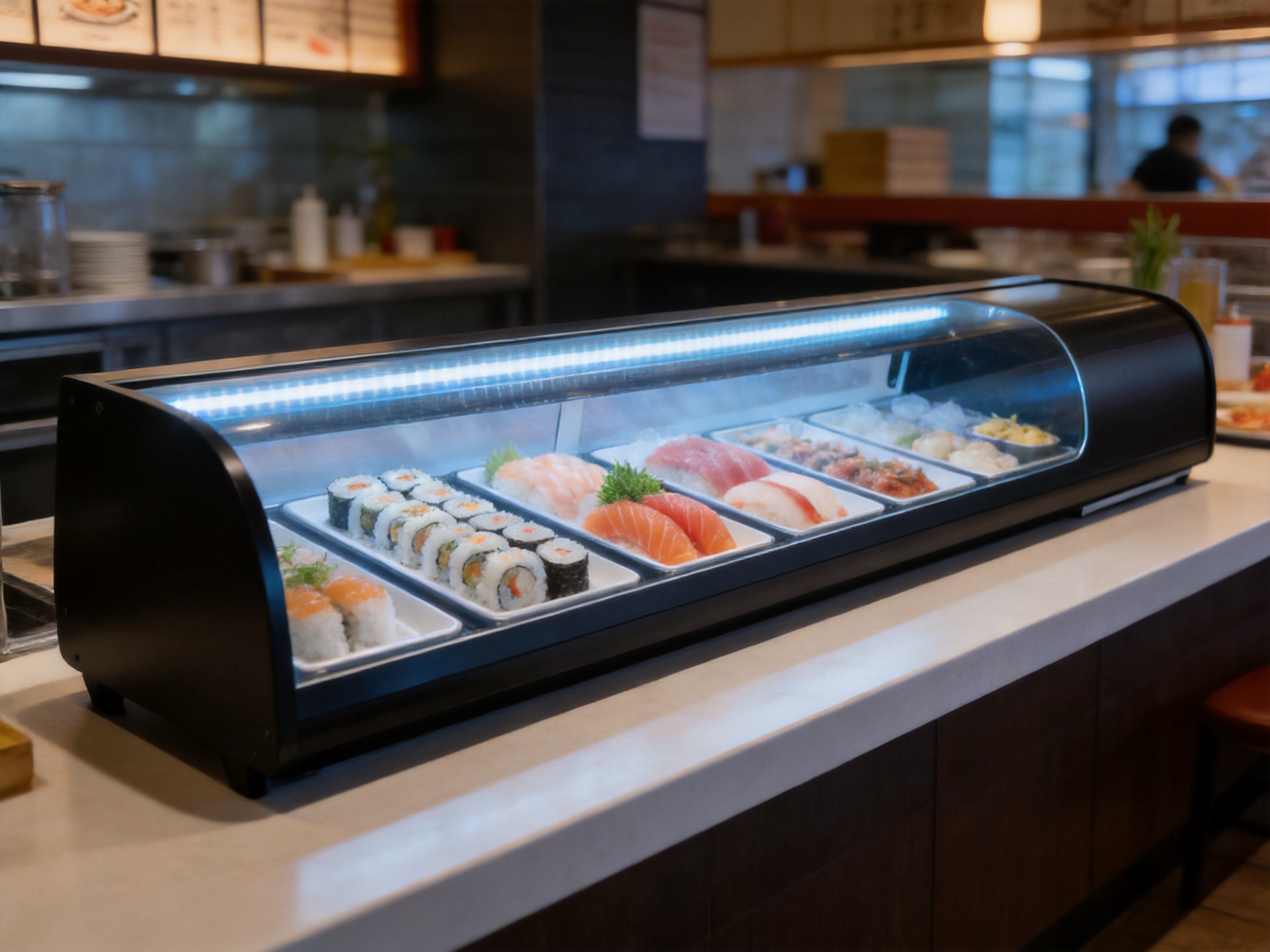
A well-designed sushi display case must do much more than present food attractively. It must help protect product quality, maintain a stable refrigerated environment, support efficient daily operation, and give customers a clear view of every dish. In a busy restaurant, hotel buffet, takeaway counter, supermarket, or specialty food store, the display refrigerator becomes part of both the food-safety system and the sales environment.
The Refrigerated 60 Inch Sushi Showcase, identified as model XCS-132L, is designed for businesses that need a dedicated refrigerated presentation area for sushi and other chilled prepared foods. Its configuration combines top and bottom evaporators, a water channel beneath the upper evaporator, internal top LED lighting, a digital thermostat and display, direct cooling, and automatic defrost. Together, these features support dependable refrigeration while helping operators create an attractive and manageable food display.
This article examines the product’s structure, operating advantages, application value, maintenance requirements, and manufacturing background. It also explains why the equipment can be a strong alternative to less specialized countertop refrigerators or improvised food-display solutions.
Understanding the Role of a Sushi Showcase
Sushi is a visually sensitive food category. Color, arrangement, moisture, garnish, and surface appearance all influence customer perception. Even when the food is prepared to an excellent standard, an unsuitable display unit can reduce its appeal. Excessive condensation may obscure the view, inconsistent cooling can affect product quality, and poor lighting can make fresh ingredients look dull.
A sushi showcase is therefore both a refrigeration appliance and a merchandising tool. It needs to keep food within an appropriate chilled environment while providing a clear and appealing view. The operator must also be able to load, arrange, monitor, clean, and service the case without unnecessary complexity.
The 60-inch format provides a useful balance between display capacity and counter-space efficiency. It is long enough to create a substantial product presentation while remaining suitable for many service counters and food-preparation areas. The format can be valuable for sushi restaurants, Japanese restaurants, hotel breakfast areas, supermarket food halls, catering operations, and prepared-food retailers.
Unlike a general-purpose refrigerator, a dedicated sushi showcase is designed around visibility and product presentation. Its internal lighting, glass display structure, refrigeration arrangement, and accessible design work together to make chilled food easier to see and manage. This specialization can provide a meaningful advantage over using a standard under-counter refrigerator with separate trays or an open ambient display shelf.
Product Overview
The XCS-132L Refrigerated 60 Inch Sushi Showcase belongs to the sushi showcase category. It is intended for commercial foodservice and retail environments where prepared sushi and similar chilled foods need to be displayed at the point of sale.
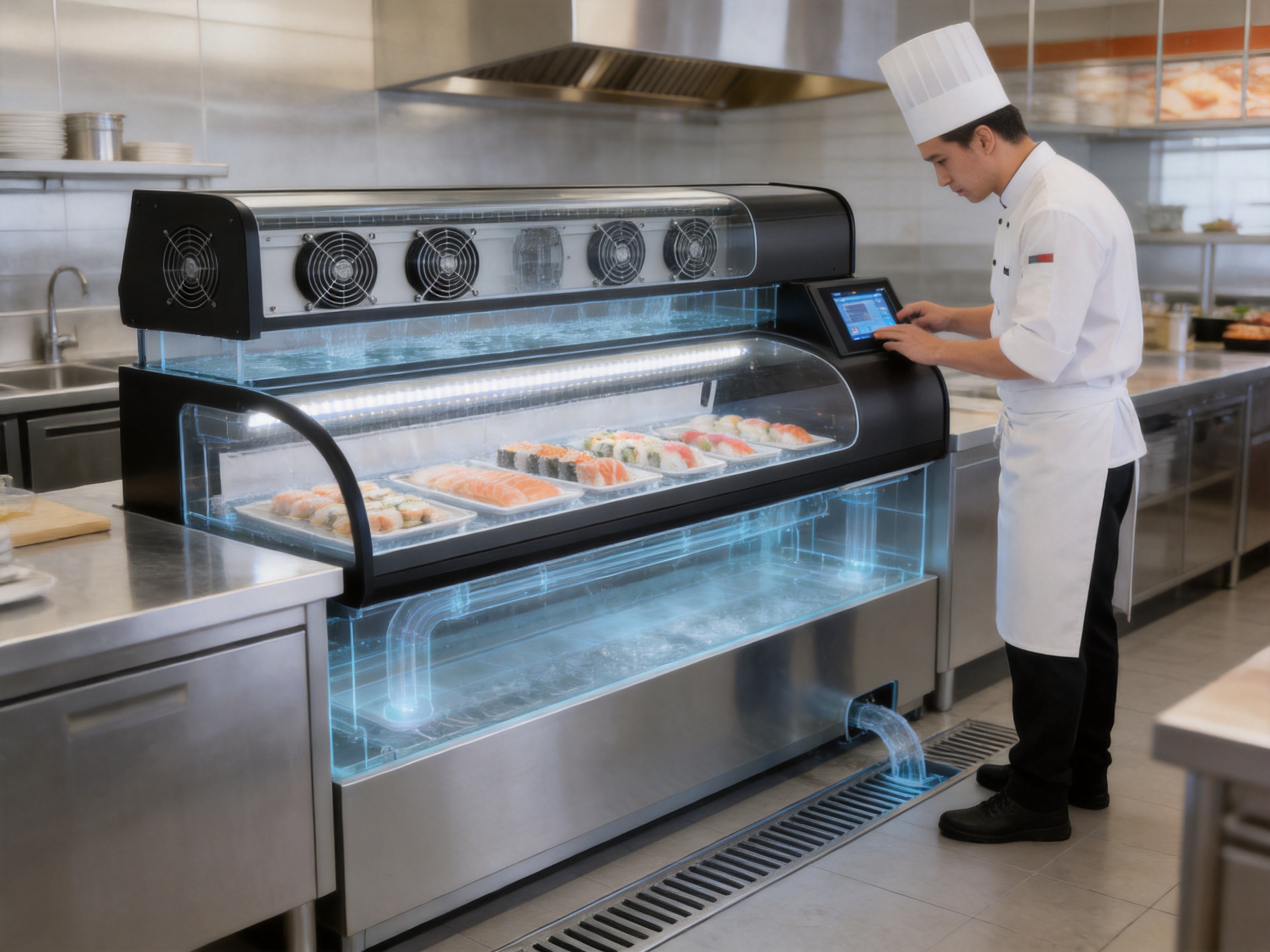
The standard configuration includes both top and bottom evaporators. This arrangement is important because a display case has a different refrigeration challenge from a closed storage cabinet. Food is frequently accessed, the display area is opened during service, and the internal arrangement must support an even refrigerated environment. Evaporators positioned at both the top and bottom can help distribute cooling more effectively across the display zone when the system is correctly operated and loaded.
The unit also includes a water channel under the top evaporator. This component provides a controlled route for water produced during condensation or defrosting. Managing water inside a refrigerated display is essential because uncontrolled moisture can collect on surfaces, interfere with cleaning, or affect the visibility of the glass.
An internal top LED light illuminates the product area from above. LED lighting is well suited to commercial display equipment because it provides clear illumination with relatively low heat output compared with older lighting technologies. The top-mounted position helps spread light across the displayed dishes and supports a cleaner, more professional visual presentation.
The digital thermostat and display give operators a direct way to monitor and adjust the refrigeration setting. Instead of relying on a less precise mechanical control or estimating the internal condition by touch, staff can use the digital interface as an operational reference. This supports more consistent day-to-day management.
The showcase uses a direct cooling system and automatic defrost. Direct cooling is a practical approach for refrigerated display applications, while automatic defrost reduces the need for frequent manual intervention. These functions are particularly useful in commercial settings where equipment must remain available throughout demanding service schedules.
Product element |
Operational purpose |
Commercial benefit |
60-inch sushi display format |
Provides a substantial refrigerated presentation area |
Supports attractive product merchandising without requiring a full-size walk-in installation |
Top and bottom evaporators |
Supports cooling from more than one position within the display structure |
Helps address the refrigeration demands of a visible, frequently accessed food case |
Water channel under the top evaporator |
Guides collected water during condensation or defrosting |
Helps improve moisture management and simplify routine cleaning |
Internal top LED light |
Illuminates sushi and other displayed foods |
Improves visibility and strengthens the sales presentation |
Digital thermostat and display |
Provides a visible control and monitoring point |
Supports repeatable operating procedures and easier staff supervision |
Direct cooling system |
Provides the primary refrigeration method |
Offers a straightforward cooling design for commercial display use |
Automatic defrost |
Manages frost and ice accumulation through an automatic cycle |
Reduces manual maintenance requirements |

Refrigerated 60 Inch Sushi Showcase
How the Refrigeration System Supports Daily Use
Refrigeration performance is the central function of any sushi showcase. The equipment must maintain a chilled environment while coping with repeated service activity, product loading, room-temperature exposure, and the presence of moisture. The XCS-132L addresses these needs through a combination of direct cooling, upper and lower evaporator positioning, and automatic defrost.
Top and Bottom Evaporator Arrangement
The presence of both top and bottom evaporators is one of the model’s most important design characteristics. In a display case, cooling requirements are not always uniform. The top section may be affected by ambient air, lighting, and repeated opening or handling, while the lower section may contain trays of product with a different thermal load.
A two-position evaporator arrangement is intended to support more balanced cooling throughout the display compartment. It can also help reduce the risk that one part of the case becomes noticeably warmer or colder than another when the case is properly arranged. This is valuable for operators who need the front, middle, and lower display areas to present food consistently.
As with any refrigeration equipment, actual performance depends on ambient temperature, product temperature at loading, air circulation, service practices, and compliance with the operating instructions. The evaporator arrangement is not a substitute for proper loading or temperature monitoring. Instead, it provides a stronger design foundation for maintaining the refrigerated display environment.
Direct Cooling
The direct cooling system provides a practical refrigeration method for the showcase. Direct cooling systems are widely used in commercial refrigeration because their construction can be straightforward and their operation can be suited to compact display equipment.
For sushi operators, a direct cooling configuration can be useful when the priority is a stable, clearly managed refrigerated display rather than a complicated multi-zone system. The operator can organize the case according to the product arrangement and use the digital control to maintain the selected operating condition.
Direct cooling also works well when the display case is integrated into a broader foodservice workflow. Food can be prepared nearby, placed into trays, arranged in the case, and monitored by service staff. The showcase remains focused on its primary task: keeping chilled foods visible and ready for sale.
Water Management and the Lower Surface
Condensation and defrost water are normal considerations in refrigerated equipment. When cold surfaces interact with humid ambient air, moisture may form. During automatic defrost, accumulated frost is converted into water that must be directed away from sensitive areas.
The water channel under the top evaporator is designed to provide a defined path for this moisture. This is preferable to allowing water to collect unpredictably inside the display structure. A managed drainage route can make cleaning more systematic and help staff identify whether water is moving as expected.
Operators should still inspect the water channel and drainage areas as part of a routine cleaning schedule. Food particles, packaging fragments, dust, or mineral deposits can obstruct drainage over time. Keeping the channel clean helps preserve the intended function of the refrigeration system and supports hygienic operation.
Automatic Defrost
Automatic defrost is particularly valuable in a commercial setting. Manual defrosting requires staff to remove products, stop or empty the equipment, wait for ice to melt, clean the surfaces, and restore the display. This process can interrupt sales and consume labor hours.
The automatic defrost feature reduces the need for this type of routine intervention. By managing frost accumulation through a programmed cycle, it helps the case remain available for normal operation. Staff should nevertheless follow the recommended maintenance schedule and should not assume that automatic defrost eliminates the need for cleaning or inspection.
Automatic defrost can also support more stable refrigeration performance. Excessive frost may restrict heat transfer and reduce the effectiveness of an evaporator. By controlling frost accumulation, the system helps preserve the intended operating condition between maintenance visits.
Display Quality and Customer Appeal
Food presentation has a direct relationship with customer confidence. When sushi is arranged in a well-lit, clean, and organized case, customers can quickly identify the available choices. A clear display may also encourage impulse purchases, larger orders, and repeat visits.
Internal Top LED Lighting
The internal top LED light is an important merchandising feature. It directs illumination into the food display rather than relying only on surrounding room light. This helps reveal the colors and textures of sushi, sashimi, rolls, garnishes, vegetables, and other prepared foods.
LED lighting is generally considered suitable for commercial food displays because it produces clear light with efficient electrical operation and relatively low heat generation. Lower heat output is helpful in a refrigerated environment because unnecessary heat inside the cabinet can place an additional burden on the cooling system.
The top position can also provide a cleaner appearance than scattered or exposed lighting components. When the display is arranged correctly, the light can create an even visual field that allows customers to see products without excessive shadowing.
Glass Visibility
A sushi showcase depends on visibility. Customers should be able to view the food without repeatedly opening the case or asking staff to identify every option. Clear glass helps create a direct connection between the product and the customer.
Good visibility also supports staff productivity. Employees can inspect product levels, identify empty trays, observe presentation quality, and plan replenishment more quickly. This is especially useful during busy periods when opening and closing the case repeatedly would slow service or affect the internal environment.
Operators should clean the glass regularly using methods suitable for commercial food equipment. Fingerprints, grease, condensation residue, and dust can reduce the visual advantage of a display case. A clean surface makes the equipment appear more professional and helps preserve the intended merchandising effect.
Presentation Flexibility
A 60-inch showcase gives operators enough room to create distinct product groups. For example, a restaurant may separate premium sushi from standard rolls, organize items by ingredient, or dedicate a section to seasonal offerings. A supermarket may arrange products by price point, package size, or customer preference.
Display planning should allow adequate space around products so that air circulation is not unnecessarily restricted. Trays should be arranged neatly, labels should remain visible, and staff should avoid overloading the case. Attractive merchandising and effective refrigeration should be treated as complementary goals rather than competing priorities.
Digital Control and Operational Consistency
The digital thermostat and display provide a practical management tool for staff. Commercial foodservice environments often have multiple employees working across different shifts. A visible digital control can reduce uncertainty by showing the selected operating setting and making adjustments more systematic.
Digital controls can also support internal operating procedures. A business may define a daily opening inspection, record the displayed temperature, check the product arrangement, and confirm that the showcase is clean. These steps are easier to standardize when the equipment offers a clear digital reference.
Operators should use the thermostat according to the product requirements, local food-safety rules, and the equipment manual. The display setting should not be treated as the only food-safety measurement. Businesses may also use an independent calibrated thermometer or a documented monitoring system where required by their food-safety program.
Temperature management begins before food enters the showcase. Sushi and other chilled products should be prepared using safe procedures, cooled as appropriate, and loaded without unnecessary delays. Placing warm products into a crowded display can increase the refrigeration load and affect the condition of food already inside.
Consistent staff training is another advantage of a clear digital interface. New employees can learn the basic operating procedure more quickly when controls are easy to identify. Managers can also check whether the display is operating within the business’s established guidelines.
Advantages Compared with Less Specialized Alternatives
Businesses may consider several types of equipment for presenting sushi. These include open ambient shelves, standard countertop refrigerators, closed storage refrigerators, improvised chilled trays, and larger multi-purpose display cabinets. Each option has a place, but a dedicated sushi showcase offers several advantages when visible chilled merchandising is the priority.
Compared with Open Ambient Display Shelves
An open ambient shelf may be inexpensive and visually accessible, but it does not provide the same refrigerated environment as a dedicated showcase. It can expose food to room-temperature air, dust, handling, and environmental fluctuations. The Refrigerated 60 Inch Sushi Showcase combines visibility with active cooling, making it more appropriate for chilled prepared foods.
Compared with Standard Storage Refrigerators
A standard storage refrigerator is built primarily for holding food, not for presenting it. Its interior may be dark, its shelves may not be arranged for customer viewing, and the door or solid cabinet can separate the product from the sales area. A sushi showcase places visibility, lighting, and point-of-sale presentation at the center of the design.
Compared with Basic Countertop Display Coolers
A general countertop display cooler may offer glass visibility but lack features specifically useful for sushi presentation. The XCS-132L’s top and bottom evaporators, water channel, internal top LED, digital thermostat, direct cooling system, and automatic defrost form a more complete configuration for this application.
Compared with Improvised Chilled Trays
Improvised solutions may be difficult to clean, difficult to monitor, and inconsistent in temperature. They can also create a less professional appearance. A purpose-built commercial unit provides a defined structure, integrated controls, designed moisture management, and a consistent presentation platform.
Compared with Oversized Refrigeration Equipment
A large vertical cabinet or walk-in refrigerator may provide considerable storage capacity, but it can occupy more floor space and may not deliver the same customer-facing presentation. A 60-inch showcase is better suited to businesses that need a substantial display area without converting the entire service zone into a storage installation.
These advantages do not mean that one refrigerator is suitable for every business. Equipment selection should consider the menu, volume, available counter space, local climate, electrical requirements, service access, and regulatory obligations. However, when the business needs refrigerated product visibility, the dedicated showcase format is a logical choice.
Applications Across Different Commercial Environments
Sushi Restaurants
Sushi restaurants can use the showcase to present ready-to-serve rolls, nigiri, sashimi, side dishes, and seasonal selections. It can support counter service, takeaway ordering, buffet-style presentation, or a hybrid service model.
For counter-service restaurants, the display allows customers to see the available selection before ordering. Staff can replenish the case during the day while maintaining a consistent visual arrangement. Premium products can be positioned in the most visible areas, while popular standard items can be grouped for fast selection.
Japanese Restaurants and Food Halls
Japanese restaurants that serve multiple chilled specialties can use the display as a central merchandising feature. Food halls may also benefit from a dedicated refrigerated showcase because it provides a clear boundary between the food operation and customer traffic while keeping products visible.
Supermarkets and Prepared-Food Retailers
Supermarkets often rely on visual presentation to encourage quick purchases. A refrigerated sushi display can be positioned near a prepared-food department, entrance area, checkout zone, or refrigerated meal section. The internal lighting can help packaged or tray-served products stand out from surrounding merchandise.
Retail operators should maintain careful stock rotation and labeling procedures. The case can support presentation, but inventory control, use-by dates, allergen communication, and food-safety documentation remain essential parts of the retail process.
Hotels and Catering Operations
Hotels may use a sushi showcase during breakfast service, themed dining events, banquets, or buffet presentations. Catering operations can also use the unit for controlled service areas where chilled prepared foods need to remain visible for a defined period.
In these applications, the equipment should be integrated into the event plan. Operators should consider transportation, placement, loading time, power availability, customer traffic, and post-service cleaning. The digital display and automatic defrost features can be especially useful when different staff teams share responsibility for the equipment.
Takeaway and Convenience Food Businesses
Takeaway stores and convenience-oriented food businesses need customers to make fast decisions. A clear 60-inch display can provide enough space to show several product categories without requiring customers to open individual storage compartments. The visible arrangement can also help staff identify which products need replenishment before peak periods.
Manufacturing Strengths and Production Capability
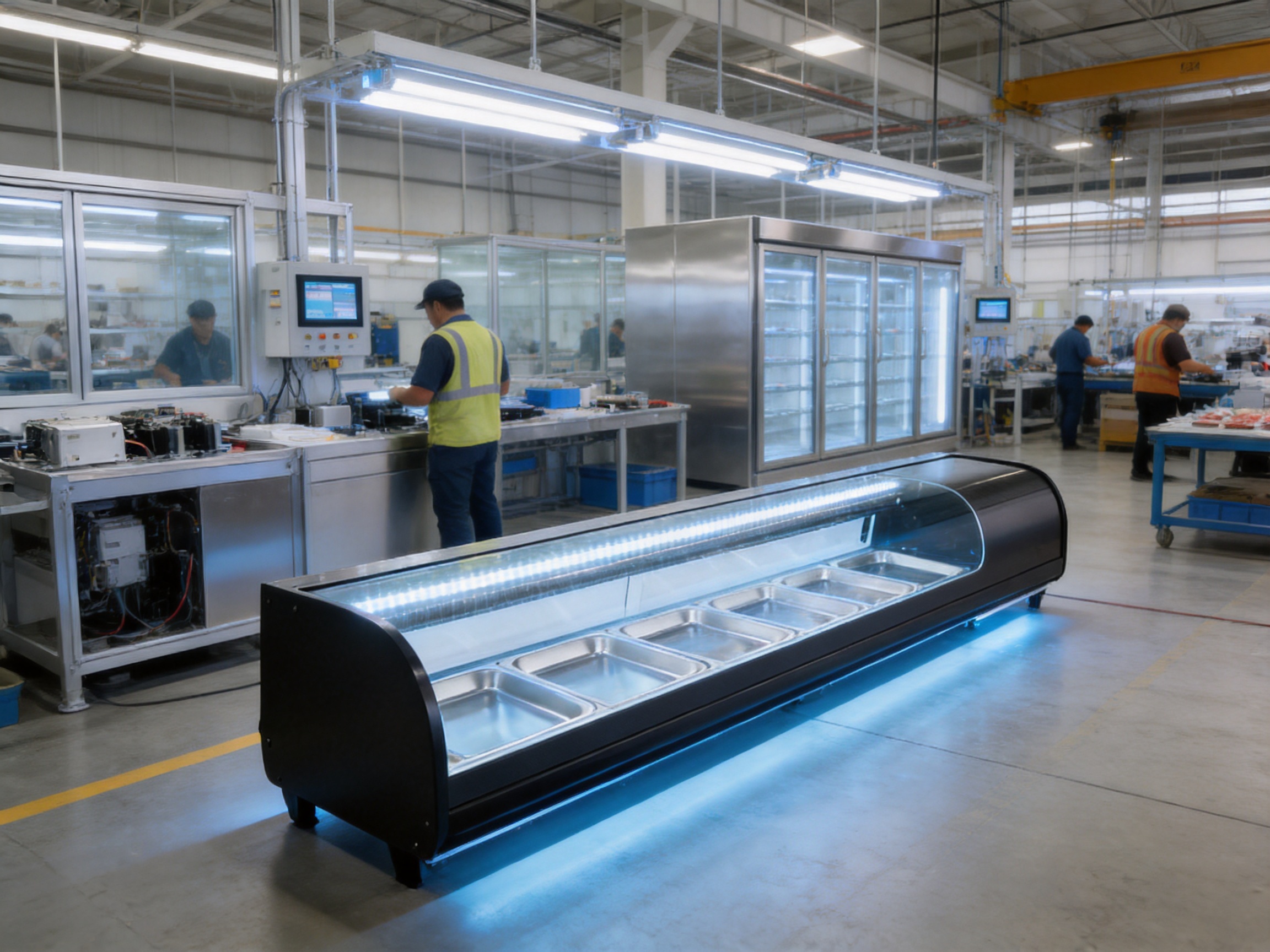
The product is manufactured by Ningbo XiangChi Electrical Co., Ltd., a company specializing in vertical display cabinets, cake cabinets, warming cabinets, and related commercial refrigeration equipment. The company was established in 2007 and has developed more than a decade of experience in this field according to the supplied company information.
The company operates a modern management garden factory covering 40,000 square meters. A facility of this scale can support organized production planning, dedicated assembly areas, material handling, quality-control stations, product testing, and coordinated logistics. Factory size alone does not determine product quality, but it can provide the infrastructure needed to manage commercial equipment production systematically.
A significant strength is the company’s professional research and development team. Commercial refrigeration products must balance cabinet design, thermal performance, electrical operation, user convenience, cleanability, and manufacturing efficiency. An active R&D function helps a manufacturer refine these details and respond to the practical requirements of international customers.
The company also reports advanced testing facilities. Testing is important because a display refrigerator may experience demanding conditions during shipping, installation, and daily operation. Relevant checks can include refrigeration performance, control operation, lighting function, electrical safety, component reliability, cabinet assembly, and general product inspection.
For a buyer, manufacturing capability should be evaluated not only by the final appearance of the product but also by the consistency of the production process. Repeatable assembly methods, documented inspection procedures, trained personnel, controlled component sourcing, and final testing can all contribute to reliable commercial equipment.
Research and Development as a Competitive Advantage
Commercial refrigeration customers increasingly expect equipment to be efficient, attractive, durable, and simple to operate. Meeting all of these expectations requires more than copying an existing cabinet. It requires development work that considers how the appliance is used in real businesses.
The features of the XCS-132L reflect this practical approach. The top and bottom evaporators address display-cooling requirements, the water channel addresses moisture management, the top LED supports merchandising, the digital thermostat supports control, and automatic defrost supports operational convenience. These elements are not isolated features; they form a coordinated product concept.
A manufacturer with its own R&D resources can also make improvements over time. Feedback from restaurants, retailers, distributors, and service teams can be used to refine product construction, controls, lighting, internal arrangement, packaging, and service procedures.
Testing and International Market Readiness
The company states that it has obtained CE, GS, CCC, CB, RoHS, ETL, and other major certifications. Certification requirements vary according to the destination market, product configuration, electrical system, and applicable standards. Buyers should confirm that the specific model and supplied version carry the approvals required for their country.
These certifications and testing capabilities demonstrate an orientation toward international market requirements. They also indicate that the manufacturer understands the importance of electrical safety, material compliance, and product evaluation in different regions.
International customers should still discuss voltage, frequency, plug type, refrigerant information, labeling, documentation, warranty terms, spare parts, and after-sales support before placing an order. Clear technical communication between the manufacturer, importer, installer, and end user helps prevent avoidable problems.
Quality-Oriented Production Considerations
A commercial display refrigerator contains multiple systems that must work together. A strong manufacturing process should therefore include control over the cabinet structure, refrigeration components, electrical wiring, lighting, thermostat, drainage arrangement, glass installation, insulation, doors or access panels, and final assembly.
Insulation quality is important because it helps separate the refrigerated interior from the surrounding environment. Seals, joints, and access points should be assembled carefully to limit unnecessary heat transfer and moisture entry. Glass components should be installed securely and inspected for damage or poor alignment.
The refrigeration circuit should be assembled and checked by trained personnel. Incorrect connections, insufficient evacuation, leakage, or poor component installation can reduce performance and shorten service life. Factory testing provides an opportunity to identify these problems before the unit is shipped.
Electrical quality is equally important. The thermostat, display, LED lighting, compressor-related components, wiring, switches, and protective devices must be assembled according to applicable standards. Cable routing should be orderly, and accessible components should be positioned for service where appropriate.
Final inspection should confirm that the display case is clean, complete, correctly labeled, and free from visible damage. It should also confirm that the control display, internal light, refrigeration operation, defrost function, and drainage route work as intended. A detailed inspection process protects both the buyer and the manufacturer.
Installation and Commissioning Guidance
Correct installation is necessary for the showcase to deliver its intended performance. The unit should be positioned on a stable, level surface with sufficient clearance for ventilation, service access, electrical connection, and cleaning. Installation details should always follow the supplied technical documentation.
The surrounding environment should be considered before placement. Excessive heat from ovens, fryers, direct sunlight, heating equipment, or poorly ventilated rooms may increase the refrigeration load. The case should not be placed where airflow is blocked or where it is likely to receive repeated splashes, grease, or unnecessary mechanical impact.
After positioning, the operator should allow the equipment to settle for the period specified by the manufacturer before starting it if transportation conditions require such a procedure. The electrical supply should match the rated requirements, and the connection should comply with local electrical regulations.
Before loading food, the operator should verify that the showcase reaches the intended operating condition. The digital thermostat and display should be checked, the internal LED should be tested, and the drainage area should be inspected. Food should be loaded only after the unit has been properly commissioned.
Products should be arranged without blocking evaporator areas, drainage routes, or designed air paths. Overloading can reduce cooling effectiveness and make the display visually crowded. Trays should be positioned so that staff can remove and replace them safely during service.
Cleaning, Hygiene, and Maintenance
Cleanliness is essential for any unit used to display ready-to-eat food. The showcase should be included in the business’s written cleaning schedule. Cleaning frequency depends on usage, product type, local regulations, and the level of handling, but visible spills and food debris should be addressed promptly.
Before cleaning, staff should follow the manufacturer’s safety instructions. Where necessary, the unit should be disconnected from the power supply. Food should be removed and stored safely, and cleaning chemicals should be appropriate for food-contact environments.
The glass should be cleaned with a suitable non-abrasive product. Abrasive pads, sharp tools, and harsh chemicals may damage surfaces or leave residues. Interior surfaces, product trays, supports, and accessible corners should be cleaned and dried thoroughly.
The water channel beneath the top evaporator deserves particular attention. Staff should check for food particles, dust, slime, mineral deposits, or other obstructions. A blocked channel can interfere with water management and may lead to unwanted accumulation inside the display.
The LED light area should also be inspected. Although LED lighting generally requires little maintenance, condensation, grease, or residue can reduce the quality of illumination. Cleaning should be performed according to the manufacturer’s instructions, especially around electrical components.
Routine maintenance should include checking the thermostat display, listening for unusual operating sounds, observing the defrost cycle, inspecting seals and glass, and confirming that the unit maintains the expected operating condition. Any abnormal noise, repeated temperature fluctuation, water leakage, or control error should be investigated by qualified service personnel.
Preventive maintenance can reduce downtime. Refrigeration equipment often performs better when condenser areas, drainage routes, electrical connections, and moving components are inspected at planned intervals. The exact maintenance schedule should be based on the technical manual and the operating environment.
How to Use the Showcase Efficiently
Efficient operation begins with preparation. Food should be chilled appropriately before it is placed in the case. The showcase is designed to maintain a refrigerated display environment; it should not be treated as a rapid-cooling device for large quantities of warm food unless the manufacturer specifically permits that use.
Staff should avoid leaving the case open longer than necessary. During replenishment, trays should be prepared in advance so that the display can be restored quickly. Efficient handling helps reduce the entry of warm air and moisture.
Stock rotation should follow a documented first-in, first-out procedure unless another approved method is required. Clear labels and organized tray placement make it easier to monitor product age, identify popular items, and reduce waste.
The case should not be overloaded simply because unused space is available. Air circulation, visibility, cleaning access, and safe handling all depend on sensible arrangement. A moderately full, well-organized display can be more attractive and operationally effective than a crowded case.
Lighting can be used strategically. Products that benefit from strong visual appeal may be placed in the best-lit areas, while labels should remain readable and not be hidden by excessive packaging or garnish. The goal is to make the display easy for customers to understand at a glance.
Staff should monitor the display throughout the service period. A quick visual inspection can identify empty spaces, disorganized trays, condensation, spills, or products that need attention. A structured inspection routine helps maintain both food quality and presentation standards.
Purchasing Considerations for Commercial Buyers
Businesses evaluating the Refrigerated 60 Inch Sushi Showcase should begin by defining their operational needs. Important questions include the expected daily product volume, display location, available counter length, ambient temperature, customer traffic, service style, electrical requirements, and local compliance requirements.
The buyer should request technical information for the exact configuration being purchased. This may include external dimensions, internal display dimensions, temperature range, power consumption, voltage, frequency, refrigerant details, net and gross weight, packaging dimensions, and installation clearances. These specifications were not included in the supplied product information and should be confirmed directly before ordering.
Buyers should also clarify shipping arrangements, warranty coverage, spare-parts availability, service response, user manuals, and commissioning support. Commercial equipment is a long-term operational asset, so after-sales support can be nearly as important as the initial purchase price.
When comparing suppliers, it is useful to evaluate the whole ownership cost rather than only the purchase cost. Energy consumption, maintenance requirements, expected service life, downtime risk, cleaning effort, product waste, and merchandising value all influence the financial outcome.
A showcase that provides better visibility may improve sales. A unit with automatic defrost may reduce labor. A clear digital control may support more consistent operation. Strong manufacturing and testing may reduce the likelihood of early service problems. These factors should be considered alongside the quoted price.
Why the Manufacturer’s Background Matters
Ningbo XiangChi Electrical Co., Ltd. presents itself as a professional manufacturer rather than only a trading supplier. Its product focus includes vertical display cabinets, cake cabinets, and warming cabinets, which are closely related to the needs of foodservice and retail operators.
The company’s history since 2007 suggests experience in developing and producing commercial display equipment. Its stated 40,000-square-meter factory, R&D team, and testing facilities indicate the infrastructure to support product development and manufacturing at a larger scale.
The company’s stated certifications, including CE, GS, CCC, CB, RoHS, and ETL, demonstrate attention to recognized international requirements. Customers should verify the documents for the exact model and market, but the certification portfolio is a positive indicator when assessing an export-oriented equipment supplier.
The company also emphasizes innovation, quality, and service. These principles are relevant to refrigeration buyers because commercial equipment must perform consistently after installation, not merely appear attractive in a catalog. A supplier that combines product development, production, testing, and customer support is better positioned to address the complete equipment lifecycle.
Environmental and Compliance Awareness
Modern commercial refrigeration purchasing increasingly includes environmental considerations. Energy use, refrigerant selection, material compliance, packaging, maintenance, and product lifespan all affect the environmental profile of an appliance.
The supplied company information references RoHS certification, which relates to restrictions on certain hazardous substances in applicable electrical and electronic products. Buyers should confirm the relevant documentation for the specific model and destination market.
Efficient operation also depends on correct installation and maintenance. A dirty or poorly ventilated system may consume more energy or operate under unnecessary strain. Keeping the drainage route clear, maintaining appropriate loading practices, and ensuring suitable ambient conditions can help the showcase operate closer to its intended performance.
Long service life can also reduce the environmental impact associated with frequent replacement. Durable construction, available spare parts, repairable components, and responsive technical support may help extend the useful life of commercial refrigeration equipment.
Frequently Asked Questions
What type of business can use the Refrigerated 60 Inch Sushi Showcase?
The showcase is suitable for sushi restaurants, Japanese restaurants, supermarkets, prepared-food retailers, hotel buffets, catering operations, food halls, takeaway stores, and other businesses that need to display chilled prepared foods. The final suitability depends on the menu, volume, local regulations, available space, and technical requirements.
What is the model number?
The product information identifies the model as XCS-132L.
What are the main standard features?
The listed standard features are top and bottom evaporators, a water channel under the top evaporator, an internal top LED light, a digital thermostat and display, a direct cooling system, and automatic defrost.
Why are there evaporators at both the top and bottom?
The top and bottom evaporator arrangement is intended to support more balanced cooling throughout the display area. It addresses the fact that different parts of a visible food case can experience different thermal conditions. Actual performance depends on loading, ambient conditions, product temperature, and correct operation.
What is the purpose of the water channel?
The water channel beneath the top evaporator provides a managed route for condensation or defrost water. It should be kept clean and free from obstructions as part of routine maintenance.
Does the showcase include lighting?
Yes. The standard configuration includes an internal top LED light designed to illuminate the displayed products.
How does the digital thermostat help staff?
The digital thermostat and display provide a visible control and monitoring point. They help staff follow consistent operating procedures and make it easier to identify the selected refrigeration setting.
Does automatic defrost eliminate maintenance?
No. Automatic defrost reduces the need for manual defrosting, but the unit still requires regular cleaning, drainage inspection, temperature monitoring, and professional preventive maintenance.
Can the showcase be used to cool warm sushi quickly?
It should not be assumed that the unit is designed as a rapid-cooling appliance. Food should be prepared and cooled according to safe food-handling procedures before being placed into the display. Buyers should consult the technical documentation for approved operating conditions.
What should be confirmed before purchase?
Buyers should confirm dimensions, electrical specifications, temperature range, power consumption, refrigerant details, shipping information, warranty terms, spare-parts support, installation requirements, and certifications applicable to the destination market.
How should the display be cleaned?
Food should be removed safely, the unit should be handled according to the manufacturer’s instructions, and suitable food-safe, non-abrasive cleaning products should be used. The glass, interior surfaces, trays, water channel, and accessible components should be cleaned and dried regularly.
What makes this product different from a general display refrigerator?
The product is configured specifically for sushi and similar chilled food presentation. Its top and bottom evaporators, water channel, internal top LED, digital control, direct cooling, and automatic defrost provide a combination of refrigeration and merchandising features suited to this application.
Where is the manufacturer located?
The manufacturer is located in the East Zone of Guanhaiwei Industrial Park, Cixi City, Ningbo, Zhejiang, China.
How can a buyer contact the manufacturer?
The supplied contact information includes the telephone numbers +86-574-63668678 and +86-574-63668108, as well as the email address [email protected]. Buyers should confirm current contact details before communication.
Conclusion
The Refrigerated 60 Inch Sushi Showcase is designed to meet the combined demands of chilled food preservation, attractive presentation, and practical commercial operation. Its 60-inch format offers a substantial display area, while the internal top LED light helps highlight sushi and other prepared foods at the point of sale.
The top and bottom evaporators are intended to support more consistent cooling across the display structure. The water channel beneath the upper evaporator addresses moisture management, while automatic defrost helps reduce routine manual intervention. The digital thermostat and display give staff a clearer way to manage daily operation, and the direct cooling system provides a straightforward refrigeration foundation.
Compared with open shelving, ordinary storage refrigerators, or improvised chilled trays, a dedicated sushi showcase provides a more professional combination of visibility, cooling, lighting, and operational control. Its value is especially clear in businesses where product presentation influences customer decisions and where staff need to replenish and monitor food throughout the day.
The manufacturer’s stated experience since 2007, 40,000-square-meter factory, professional R&D team, advanced testing facilities, and international certifications add important context for commercial buyers. These strengths suggest an established production organization capable of developing and manufacturing equipment for global markets.
For the best results, buyers should confirm the exact technical configuration, destination-market requirements, installation conditions, service arrangements, and operating instructions before purchase. When correctly selected, installed, loaded, cleaned, and maintained, the Refrigerated 60 Inch Sushi Showcase can become a dependable part of a modern sushi restaurant, food retailer, hotel, or catering operation.
References
1. Product information supplied for the Refrigerated 60 Inch Sushi Showcase, model XCS-132L.
2. Manufacturer information supplied for Ningbo XiangChi Electrical Co., Ltd.
3. General commercial refrigeration equipment maintenance principles.
4. General food-service guidance for refrigerated display, cleaning, stock rotation, and temperature monitoring.
5. General principles of retail food merchandising and refrigerated prepared-food presentation.
6. General international product-compliance concepts relating to CE, GS, CCC, CB, RoHS, and ETL certifications.
Product: Refrigerated 60 Inch Sushi Showcase

You May Also Like





-
- Navigation
- Home
- About Us
- Products
- News
- Contact Us
 East Zone, Guanhaiwei Industrial Park, Cixi City, Ningbo, Zhejiang, China
 +86-574-63668678
 +86-574-63668108

Copyright © Ningbo XiangChi Electrical Co.,Ltd All Rights Reserved.
