
 简体中文
 English
 Español

News
Open Sliding Door Refrigerated Showcase: A Practical Guide to High-Visibility Commercial Cooling
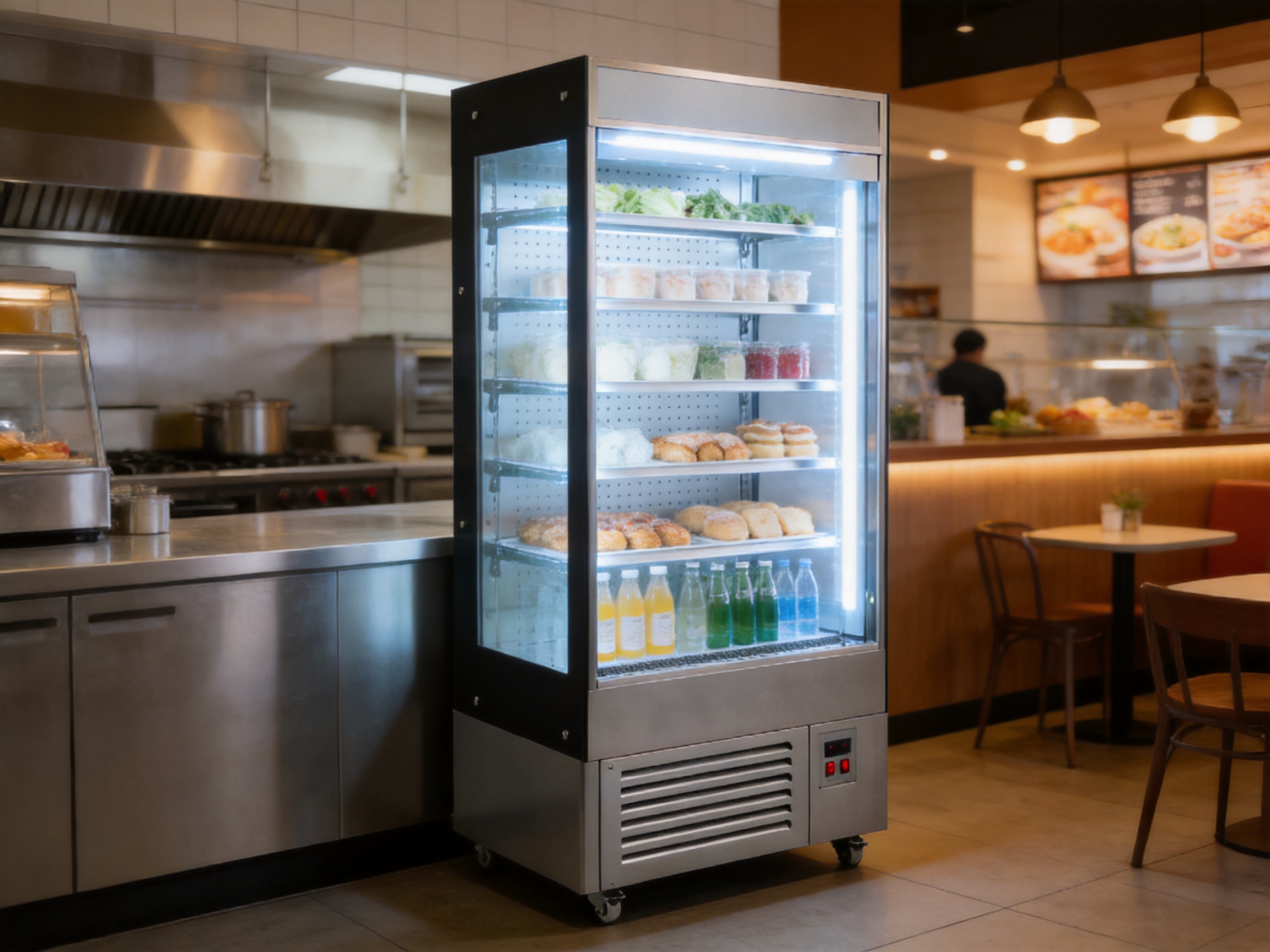
In modern food retail, refrigeration is no longer limited to preserving products. A commercial display cooler must also attract attention, organize merchandise, support fast service, control operating conditions, and contribute to a clean and professional sales environment. The Open Sliding Doors Refrigerated Showcase XCS-520L, 520Z, 720Z, 920Z, and 1120Z series is designed around these combined requirements.
As an open display cooler with optional sliding doors, this series gives retailers flexibility in how they present chilled food and beverages. It can support supermarkets, convenience stores, cafés, bakeries, restaurants, catering operations, food halls, and other commercial environments where products need to remain visible and accessible. Its vertical format uses valuable floor space efficiently while providing a broad merchandising area.
The series combines a 2–10°C operating range, ventilated cooling, automatic defrost, tempered glass, stainless steel construction, digital temperature control, advertisement lighting, independent power controls, and mobile castors. These features are not simply added for appearance. Together, they help create a practical refrigeration platform for daily commercial use.
The available models are intended to cover different capacity requirements. The 520L versions provide a relatively compact footprint, while the 720L and larger configurations offer more display volume for stores with higher product turnover. The 920Z and 1120Z models are included in the product family for broader merchandising requirements, although detailed technical values for those two versions should be confirmed according to the final quotation and configuration.
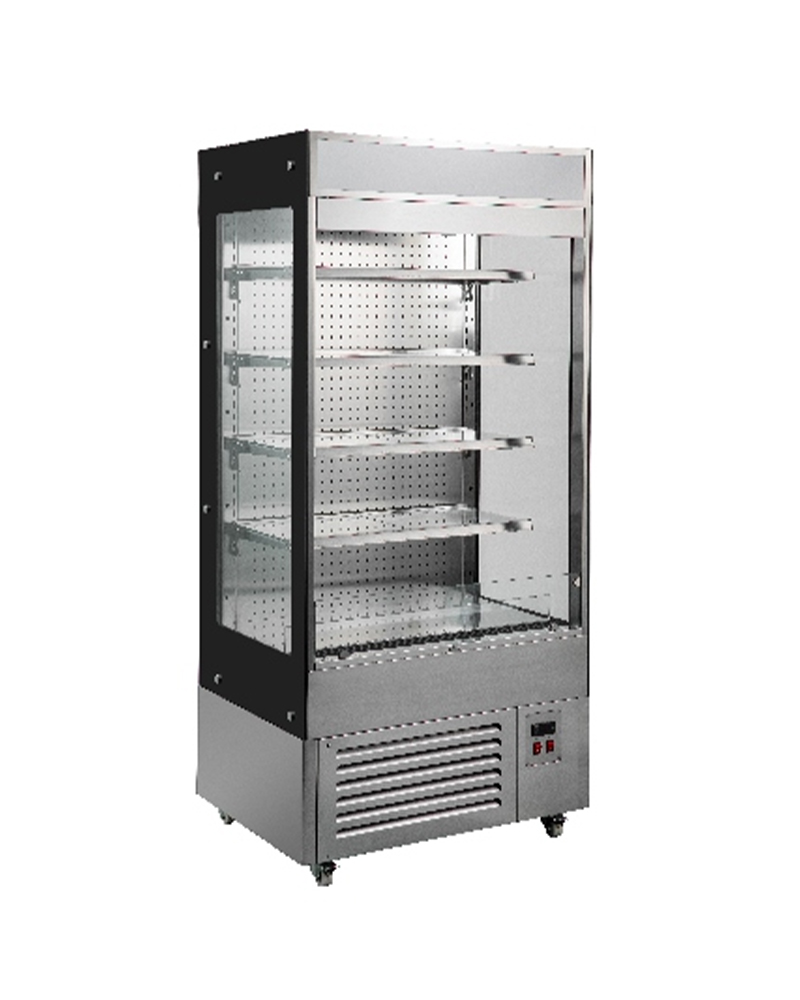
Open Sliding Doors Refrigerated Showcase XCS-520L /520Z /720Z /920Z /1120Z
Why Display Refrigeration Matters in Commercial Food Sales
Commercial refrigeration has two primary responsibilities: maintaining a suitable product temperature and presenting goods in a way that encourages purchase. A unit that performs well technically but hides its products, creates difficult access, or looks unsuitable for the sales area may not deliver the best overall value.
A refrigerated showcase addresses this challenge by combining cold storage and product presentation. Transparent glass allows customers to see food and beverages before opening a door. Internal lighting helps products remain visible in different store conditions, including areas with uneven ambient light. A well-organized display can shorten shopping time and help staff replenish inventory more efficiently.
The open configuration is particularly useful where frequent access is essential. Customers can quickly reach chilled drinks, packaged foods, dairy products, ready-to-eat meals, desserts, and other merchandise. In assisted-service environments, staff can also retrieve products without repeatedly opening a conventional hinged door.
At the same time, the optional sliding-door design provides an alternative for businesses that want greater separation between the refrigerated interior and the surrounding room. Sliding doors can help reduce unnecessary exposure during quieter periods, support a more controlled merchandising environment, and provide additional protection for displayed products.
This combination of accessibility and flexibility is one of the main advantages of the series. Instead of offering only a fully open cabinet or only a fully enclosed refrigerator, the product family can be configured around the operating style of different commercial locations.
Product Family and Capacity Options
The product line includes the XCS-520L, XC-520Z, XC-720Z, XC-920Z, and XC-1120Z designations. The available specification information identifies the 520L and 520Z models at approximately 520 liters gross capacity, while the 720Z model provides approximately 720 liters gross capacity.
The 520L and 520Z versions share the listed dimensions of approximately 900 × 656 × 1900 mm. The 720Z version is approximately 1200 × 656 × 1900 mm. These dimensions create a tall, narrow display profile that can provide substantial vertical merchandising space without requiring the depth of a large horizontal case.
For stores planning a complete refrigeration wall, the different widths can help create a coordinated layout. Smaller units may fit beside checkout areas, along narrow aisles, or in compact cafés. Wider units can be used for beverages, fresh packaged food, dairy categories, or mixed product displays with higher demand.
Capacity selection should be based on more than total liters. Buyers should also consider product dimensions, shelf arrangement, replenishment frequency, available aisle width, electrical capacity, delivery access, and the required number of display sections. A larger cabinet is not always the most efficient choice if the store has limited floor space or lower sales volume.
| Model | Listed Gross Capacity | Temperature Range | Input Power | Refrigerant | Product Size |
|---|---|---|---|---|---|
| XCS-520L | 520 L / 18.4 cu. ft. | 2–10°C / 35.6–50°F | 1350 W | R290 | 900 × 656 × 1900 mm |
| XC-520Z | 520 L / 18.4 cu. ft. | 2–10°C / 35.6–50°F | 690 W | R290 | 900 × 656 × 1900 mm |
| XC-720Z | 720 L / 25.4 cu. ft. | 2–10°C / 35.6–50°F | 690 W | R290 | 1200 × 656 × 1900 mm |
| XC-920Z | Confirm final configuration | Confirm final configuration | Confirm final configuration | Confirm final configuration | Confirm final configuration |
| XC-1120Z | Confirm final configuration | Confirm final configuration | Confirm final configuration | Confirm final configuration | Confirm final configuration |
The technical differences between the 520L and 520Z versions demonstrate why buyers should review the final model code carefully. Although both are listed at the same gross capacity and external size, their stated input power, climate type, and weight values differ. The final purchase specification should therefore identify the exact model, electrical version, door arrangement, and market certification requirements.
Temperature Control for Chilled Merchandise
The listed temperature range of 2–10°C is suitable for many common chilled food and beverage applications. It provides a practical operating window for products that require refrigeration but are not intended to be frozen. Typical product categories may include bottled drinks, dairy items, prepared foods, sandwiches, desserts, packaged salads, and other chilled retail goods, subject to each product’s own storage requirements.
A digital temperature controller and display provide a direct way to monitor cabinet conditions. This is valuable in busy commercial environments because staff can quickly check the displayed setting or reading without relying only on a separate thermometer. Visible control information also supports routine operating checks and can help identify abnormal conditions earlier.
Temperature management depends on correct installation and operation as well as the refrigeration system itself. The cabinet should be positioned with sufficient clearance for ventilation, connected to an appropriate electrical supply, and loaded without blocking internal air movement. Products should not be packed so tightly that cold air cannot circulate around the display area.
Retailers should also remember that displayed product temperature can be affected by ambient conditions, loading practices, door usage, store traffic, and the time required for newly loaded products to cool. A stable operating routine is essential for achieving consistent results.
The use of a ventilated cooling system helps distribute refrigerated air through the cabinet. Compared with a purely static cooling arrangement, forced air can support more uniform cooling across multiple display levels when the cabinet is loaded correctly. The precise result will depend on ambient temperature, humidity, product placement, and the final equipment configuration.
Ventilated Cooling and Automatic Defrost
Ventilated cooling is an important feature for a vertical display cabinet because products are arranged across a tall internal space. The system is designed to move cooled air through the display area rather than depending only on natural circulation. This supports the practical need for stable conditions across different shelves and product zones.
Automatic defrost reduces the need for staff to stop operation and manually remove accumulated ice. In commercial settings, this can improve convenience and help maintain usable display space. Manual defrosting can be time-consuming, especially when several cabinets are installed together, so an automatic cycle is an important operational advantage.
Automatic defrost should not be interpreted as eliminating all maintenance. Condensation management, drain inspection, condenser cleaning, door seal inspection, and general hygiene remain necessary. Dust on heat-exchange surfaces can reduce efficiency, while blocked drainage can create water-related problems around the cabinet.
For best results, operators should establish a regular maintenance schedule. Cleaning frequency should reflect the store environment. A cabinet placed near cooking equipment, open doors, dusty warehouse areas, or high-traffic entrances may require more frequent attention than one installed in a clean, climate-controlled retail area.
Open Access and Sliding Door Flexibility
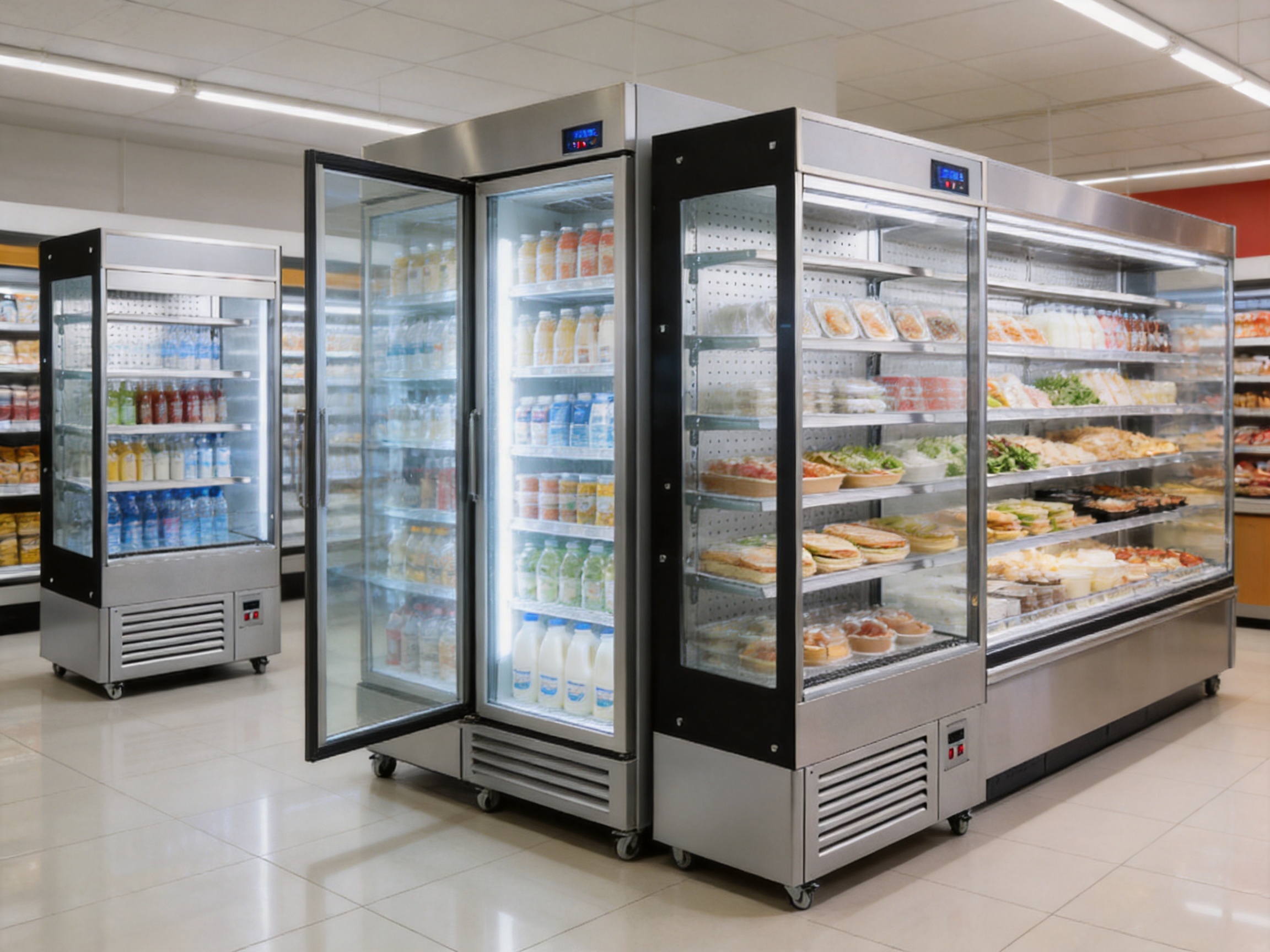
The defining feature of this product family is its flexible approach to access. Open display operation makes merchandise immediately visible and easy to reach. This arrangement is useful in convenience stores, self-service food areas, cafés, and supermarkets where quick access contributes to a smooth customer experience.
Open cabinets can support impulse purchases because customers do not need to operate a hinged door before taking an item. The absence of a swinging door also reduces conflicts with adjacent equipment, shelves, shopping carts, and narrow aisles. This can be particularly helpful in compact retail layouts.
Sliding doors provide a different set of benefits. They can be selected for stores that prefer a more enclosed display, want to reduce direct exposure to the surrounding environment, or need a cabinet that can operate in a more controlled access mode. Because sliding doors move horizontally, they generally require less clearance in front of the cabinet than hinged doors.
The sliding-door option can also support display organization. Glass panels create a visual barrier while keeping merchandise visible. Staff can use the doors to separate the chilled interior from customer traffic, reducing casual contact with products and helping maintain a cleaner presentation.
When selecting between an open arrangement and sliding doors, a business should evaluate customer behavior, product type, aisle width, climate conditions, labor practices, and energy priorities. Open access may be the best option for fast-moving beverages, while sliding doors may be preferable for packaged food or lower-turnover merchandise.
Visibility, Lighting, and Merchandising
Commercial refrigeration must be designed for the sales floor rather than only the back room. The use of tempered glass gives customers a clear view of the interior and helps staff monitor stock levels from outside. Visibility reduces the need to open the cabinet simply to inspect inventory.
The standard feature list includes a light box for advertising and separate lighting control. A light box can be used to communicate a category, promotion, store message, or product identity. It turns the upper section of the cabinet into a useful merchandising surface instead of leaving it visually inactive.
The separate light button provides operating flexibility. Store staff can control lighting according to opening hours, promotional schedules, or energy-management practices. The ability to operate lighting independently from the main power system is also useful during cleaning, restocking, or display preparation.
Good merchandising depends on more than illumination. Products should be grouped logically, labels should face forward, high-demand items should be positioned where they are easy to reach, and the display should not be overloaded. A clean, balanced arrangement generally makes better use of the glass frontage and reduces the time needed for replenishment.
Tempered glass is well suited to commercial display applications because it is designed to provide improved resistance compared with ordinary glass. Nevertheless, it should be handled carefully during transportation, installation, and cleaning. Staff should use appropriate cleaning materials and avoid striking edges or applying excessive pressure.
Stainless Steel Construction and Commercial Durability
The cabinet uses a stainless steel body, a material commonly selected for commercial food equipment because it combines a professional appearance with practical cleanability. Smooth metal surfaces can be wiped down efficiently, which is important in environments where spills, condensation, packaging dust, and food residue may occur.
Stainless steel also supports a consistent visual identity across a commercial kitchen, supermarket, bakery, restaurant, or food-service counter. Its neutral appearance can work with many interior design styles and does not distract from the products inside the cabinet.
Durability depends on the quality of material selection, forming, joining, insulation, hardware, refrigeration components, and final assembly. A strong manufacturing system must control each of these stages rather than focusing only on the visible exterior.
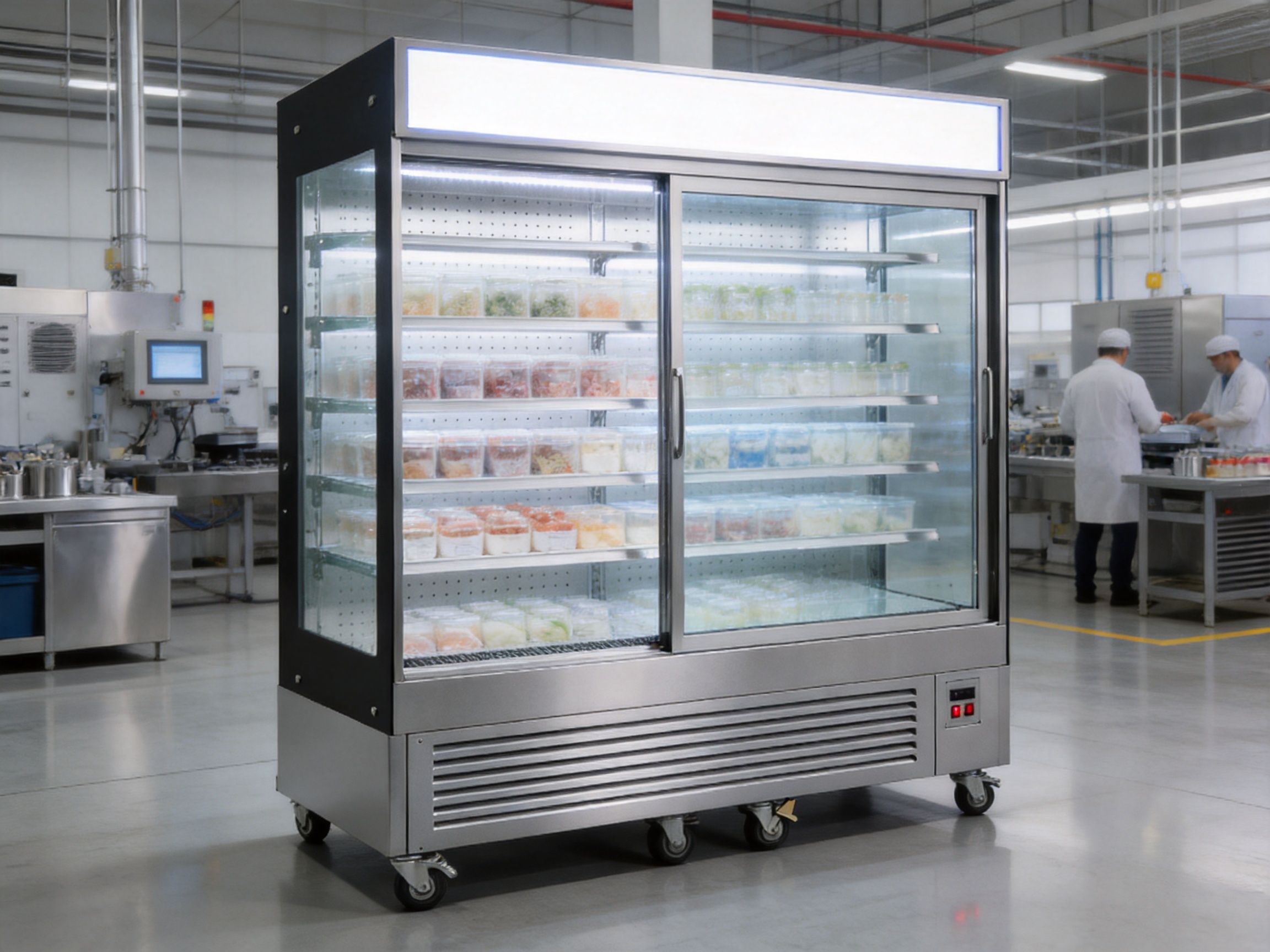
The manufacturer’s stated production background includes a modern management garden factory covering approximately 40,000 square meters. This scale can support dedicated production areas, organized material flow, quality checkpoints, assembly operations, testing areas, and warehousing. Facility size alone does not guarantee quality, but it provides a foundation for systematic manufacturing when supported by effective management.
For importers and distributors, consistent construction is especially important. A product may be installed in many markets and exposed to different transport conditions, ambient temperatures, voltage standards, and operating habits. Repeatable production helps reduce variation between batches and supports more predictable after-sales service.
Mobility and Installation Practicality
The standard feature list includes four castors, with brakes on the front two. This arrangement gives the cabinet practical mobility during installation, cleaning, store remodeling, and layout changes. Staff can move the equipment into position without treating it as a permanently fixed fixture.
Front brakes are important because a tall display cabinet must remain stable during normal use. Once the equipment is positioned, the castors can be locked to reduce unwanted movement. The brakes also support safer restocking and cleaning by helping keep the cabinet in place.
Before installation, the floor should be checked for level and adequate load-bearing capacity. The listed net weights range from approximately 180 kg to 214 kg for the specified models, while gross shipping weights range from approximately 214 kg to 275 kg. These figures show why delivery planning, suitable lifting equipment, and adequate access routes are necessary.
Package dimensions are larger than product dimensions because of protective materials and shipping space. The listed package sizes for the 520 models are approximately 970 × 750 × 2060 mm, while the 720Z package is approximately 1270 × 750 × 2060 mm. Doorways, elevators, loading bays, corridors, and store entrances should be measured before shipment arrives.
After positioning, the cabinet should be allowed to settle according to the carrier and installation instructions before being energized, particularly if it has been transported in a non-upright position. The final installation procedure should always follow the equipment manual and local electrical requirements.
Refrigerant Selection and Environmental Considerations
The listed models use R290 refrigerant. R290 is propane used as a refrigerant and is widely recognized in modern commercial refrigeration for its low global warming potential compared with many older refrigerant options. Its use reflects the industry’s continuing movement toward refrigerants with lower environmental impact.
Because R290 is flammable, equipment using it must be installed, serviced, and handled by appropriately trained personnel. Service procedures should follow the manufacturer’s instructions and applicable safety regulations. Ventilation, electrical protection, refrigerant charge limits, and ignition-source controls are important considerations.
Environmental performance is influenced by more than the refrigerant. Cabinet insulation, compressor efficiency, fan operation, defrost programming, ambient conditions, maintenance, product loading, and daily usage patterns all affect total energy consumption.
The published input power values show a distinction between the listed models. The XCS-520L is specified at 1350 W, while the XC-520Z and XC-720Z are each listed at 690 W. These values should be treated as model-specific information rather than a universal consumption figure. Actual energy use depends on operating conditions and duty cycle.
Buyers should request the final electrical specification, rated current, voltage, frequency, plug type, energy information, and certification documentation for the intended market. This is particularly important for international procurement, where electrical standards and labeling requirements differ.
Manufacturing Strength and Product Development
The manufacturer, Ningbo XiangChi Electrical Co., Ltd., reports that it was established in 2007 and has more than ten years of experience in the commercial refrigeration field. Its product scope includes vertical display cabinets, cake cabinets, and warming cabinets. This product specialization provides a relevant foundation for developing equipment intended for professional retail and food-service use.
The company also reports having its own professional research and development team. In a competitive refrigeration market, in-house product development can help a manufacturer respond more quickly to changing customer requirements, regional standards, display trends, and component improvements.
Research and development is especially important for display refrigeration because the product must balance multiple design objectives. Airflow must support cooling without damaging merchandise. Glass must provide visibility without creating excessive heat gain. The cabinet must be attractive without becoming difficult to clean. Doors, controls, fans, lighting, insulation, and refrigeration components must operate together as one system.
Advanced testing facilities are another stated strength. Testing can cover temperature stability, electrical safety, insulation performance, component reliability, door operation, lighting, defrost behavior, and transportation durability. Effective testing helps identify problems before products reach customers and supports more consistent production.
A modern factory environment can also improve manufacturing control through organized workstations and repeatable procedures. Sheet metal forming, stainless steel fabrication, insulation assembly, refrigeration system installation, electrical wiring, glass fitting, final cleaning, and performance testing should each be managed with documented standards.
For buyers comparing suppliers, the most valuable manufacturing advantages are often found in process discipline. These include traceable components, trained assembly personnel, inspection records, reliable testing equipment, documented corrective actions, and the ability to maintain consistent specifications over repeated orders.
Quality Certifications and International Market Readiness
The company reports obtaining CE, GS, CCC, CB, RoHS, ETL, and other major certifications. These certifications and approvals are relevant to different markets and product requirements, but the exact scope should always be verified for the specific model and configuration being purchased.
Certification can provide evidence that a product has been assessed against particular safety, electrical, material, or market requirements. It can also simplify the work of importers, distributors, and commercial users who need technical documentation for procurement or compliance records.
However, certification marks should be reviewed carefully. Buyers should confirm the certificate holder, covered model numbers, rated electrical specifications, applicable standards, validity, and whether the certificate applies to the complete cabinet or only selected components. Documentation should match the actual product supplied.
The manufacturer’s experience serving global customers is also valuable for export projects. International orders may require customized plugs, voltage systems, language labels, packaging marks, manuals, pallet arrangements, and shipping documents. A supplier with established export processes is more likely to understand these practical requirements.
How the Series Compares with Conventional Refrigerated Cabinets
Compared with a basic back-room refrigerator, an open sliding-door refrigerated showcase is designed to perform directly in the customer-facing sales area. Its glass frontage, lighting, vertical display format, and advertisement box make it more suitable for merchandising.
Compared with a fully open cooler, the sliding-door option provides greater flexibility for stores that want a more enclosed display. The choice can be made according to product type and selling environment rather than forcing every retailer to use the same access format.
Compared with a conventional hinged-door display refrigerator, sliding doors can be advantageous where front clearance is limited. They do not swing into the aisle, which can help preserve customer circulation space. The vertical design can also provide a large display area without the full floor depth of some horizontal cases.
Compared with lower-cost cabinets that use minimal controls, the series includes a digital temperature controller and display, independent power and light buttons, automatic defrost, and ventilated cooling. These features can support more convenient daily operation and more professional store management.
Compared with products made primarily for occasional use, the stainless steel body, tempered glass, castors, commercial cooling system, and stated manufacturing infrastructure indicate a design intended for regular business operation. Final performance will still depend on correct model selection, installation, maintenance, and operating conditions.
| Evaluation Area | Potential Advantage of This Series | Value to the Operator |
|---|---|---|
| Product access | Open display operation with sliding-door option | Supports both quick access and more controlled enclosure |
| Merchandising | Tempered glass, internal display area, light box | Improves visibility and promotional presentation |
| Temperature management | 2–10°C range, digital controller, ventilated cooling | Supports common chilled product applications |
| Maintenance | Automatic defrost and cleanable stainless steel body | Reduces routine service burden when properly maintained |
| Mobility | Four castors with two front brakes | Simplifies positioning, cleaning, and layout changes |
| Environmental design | R290 refrigerant | Uses a lower-global-warming-potential refrigerant option |
| Business scalability | Multiple widths and capacity choices | Allows equipment selection for different sales volumes |
Recommended Applications
Supermarkets and Convenience Stores
Supermarkets can use the cabinets for chilled beverages, ready-to-eat food, dairy items, desserts, and packaged meals. The different widths allow stores to create a compact display or a complete refrigerated section. Convenience stores can place a smaller unit near checkout or along a high-traffic wall to encourage quick purchases.
Cafés and Restaurants
Cafés can use a refrigerated showcase to present bottled drinks, cakes, sandwiches, salads, and cold desserts. The glass display enables customers to view the selection before ordering. Restaurants may use the cabinet for front-of-house grab-and-go products or for organized storage in a service area.
Bakeries and Dessert Shops
Although the product family is categorized as an open display cooler, its 2–10°C range may suit chilled cakes, cream desserts, mousse products, and other refrigerated bakery items when their storage requirements match the cabinet’s operating range. Product placement and humidity management should be evaluated carefully for delicate desserts.
Food Halls and Catering Operations
Food halls and catering sites often require equipment that is easy to reposition as menus, tenants, or service layouts change. Castors and a vertical format can support these environments. The cabinet can also provide a visible central display for pre-packed food and drinks.
Institutional and Hospitality Settings
Hotels, schools, hospitals, offices, and recreational facilities may use the equipment for chilled self-service products, provided the final application meets all relevant hygiene, safety, and food-storage requirements. Sliding doors may be useful in locations where access needs to be controlled outside peak service hours.
Installation and Operating Best Practices
Place the cabinet on a stable, level surface with sufficient clearance for airflow and servicing. Do not position it directly beside heat-producing equipment unless the installation design accounts for the additional thermal load.
Connect the cabinet to a suitable dedicated electrical supply where required. Voltage and frequency must match the product nameplate. Extension cords, overloaded circuits, and unsuitable adapters can create safety risks and may affect performance.
Allow the cabinet to reach its normal operating condition before loading large quantities of warm product. Loading should be staged when possible, especially during initial installation or after a prolonged power interruption.
Do not block air outlets or overload shelves. Leave enough space between packages to support circulation. Products should be rotated using a first-in, first-out procedure and should be arranged so that older stock is sold before newer stock.
Clean glass surfaces with suitable non-abrasive materials. Wipe stainless steel in the direction of the finish where practical. Avoid harsh chemicals that may damage seals, printed surfaces, coatings, or metal finishes.
Inspect door tracks and sliding components regularly if the enclosed configuration is used. Remove debris that may interfere with smooth movement. Check door alignment and seals as part of routine maintenance.
Clean condenser areas according to the service schedule. Dust accumulation can reduce heat rejection and increase operating stress. Maintenance involving refrigerant or sealed-system components should be completed only by qualified technicians.
Keep the front and rear areas accessible enough for inspection and cleaning. A visually attractive display should not prevent service personnel from reaching electrical and refrigeration components when required.
Procurement Guidance for Distributors and Project Buyers
When ordering this product family, the buyer should identify the exact model code rather than referring only to the general series name. The available information shows that models with similar capacity may have different power ratings, climate classifications, weights, and configurations.
The purchase specification should include cabinet dimensions, package dimensions, gross and net weight, capacity, temperature range, refrigerant, electrical rating, door arrangement, lighting requirements, castor configuration, certification requirements, and packaging method.
For the 920Z and 1120Z versions, buyers should request a complete technical sheet because detailed numerical data was not included in the available specification table. This should include capacity, dimensions, power, weight, package size, loading quantity, and the applicable climate class.
Importers should also verify whether the unit is intended for open operation, sliding-door operation, or a combined configuration. The product title identifies open sliding doors, while the listed standard features present sliding doors as an option. The final configuration should therefore be written clearly in the purchase order.
Loading quantities may be important for container planning. The listed 20GP and 40HQ quantities are approximately 17/36 pieces for the 520L and 520Z versions and 12/27 pieces for the 720Z version. These quantities should be reconfirmed with the supplier because packaging, pallet use, and shipment arrangements can affect actual loading.
Why Manufacturer Capability Matters
A refrigeration cabinet is a system product. Its performance depends on the interaction of metalwork, insulation, refrigeration components, electrical controls, fans, lighting, glass, seals, wheels, and software or controller settings. A supplier that only assembles visible parts may not provide the same level of consistency as a manufacturer with dedicated research, testing, and production resources.
The manufacturer’s reported experience, factory scale, R&D capability, testing facilities, and international certifications provide useful indicators for buyers evaluating long-term supply. These strengths can support product customization, quality control, export documentation, and after-sales cooperation.
Manufacturing capability is particularly important for wholesale customers. A single retail user may purchase one cabinet, but a distributor may need dozens or hundreds of units with consistent dimensions and performance. Repeatability affects installation planning, spare parts management, branding, warranty handling, and customer satisfaction.
A structured factory can also help coordinate customized requirements. These may include color changes, logo application, electrical adaptations, packaging labels, product manuals, shelf arrangements, lighting specifications, and regional certification. Any customization should be confirmed during the technical approval stage before mass production begins.
Maintenance, Service, and Long-Term Value
The value of commercial refrigeration is measured over its operating life, not only by the purchase price. A cabinet that is easy to clean, simple to monitor, stable in operation, and supported by available parts can reduce disruption to a business.
Digital controls help staff identify the operating condition quickly. Automatic defrost reduces manual intervention. Castors support cleaning behind and beneath the unit. Stainless steel surfaces simplify routine hygiene. Independent lighting control gives operators greater flexibility. These practical details can produce meaningful value when repeated every day.
Preventive maintenance should be treated as part of the equipment investment. Regular cleaning, temperature checks, electrical inspection, seal inspection, fan inspection, and condenser care can help preserve performance. Operators should record service activity and investigate unusual noise, water, temperature fluctuation, or excessive condensation promptly.
Warranty terms, spare parts availability, technician support, and response procedures should be reviewed before purchase. Distributors may also benefit from receiving exploded diagrams, component lists, wiring diagrams, installation manuals, and troubleshooting guides for the models they stock.
Q&A: Common Questions About the Refrigerated Showcase
What products can be stored in this cabinet?
The listed 2–10°C temperature range is suitable for many chilled products, including beverages, dairy products, packaged meals, sandwiches, salads, desserts, and other refrigerated merchandise. The final decision should always follow the storage instructions for each product.
Is the cabinet fully open or enclosed?
The product family is designed around open display operation with sliding doors available as an option. Buyers should confirm the exact access arrangement in the final quotation because the open and sliding-door configurations may be supplied differently.
What is the capacity of the smallest listed model?
The XCS-520L and XC-520Z are both listed at approximately 520 liters gross capacity, equal to approximately 18.4 cubic feet.
What is the capacity of the XC-720Z?
The XC-720Z is listed at approximately 720 liters gross capacity, equal to approximately 25.4 cubic feet.
What refrigerant does the series use?
The listed models use R290 refrigerant. Because R290 is flammable, installation and service must follow the manufacturer’s instructions and applicable safety regulations.
Does the cabinet have automatic defrost?
Yes. Automatic defrost is included in the listed standard features. Routine cleaning and maintenance are still necessary.
Can the cabinet be moved after installation?
Four castors are included, with brakes on the front two. This supports positioning and relocation, although the cabinet should be moved carefully because of its substantial weight and height.
Does it include lighting?
The standard features include a light box for advertising and a separate light button. The final internal lighting arrangement should be confirmed in the model specification.
Why do the listed 520L models have different input power values?
The available data lists 1350 W for the XCS-520L and 690 W for the XC-520Z. This may reflect differences in configuration or electrical design. Buyers should confirm the nameplate data and final technical sheet for the selected model.
Are the 920Z and 1120Z models available?
They are included in the product family title. However, detailed specifications for these two models were not included in the provided table. Capacity, dimensions, power, weight, and loading information should be confirmed before ordering.
What certifications are associated with the manufacturer?
The manufacturer reports CE, GS, CCC, CB, RoHS, ETL, and other major certifications. The specific certificate, model coverage, and market applicability should be verified for the intended purchase.
What should be checked before installation?
Check the entrance route, floor strength, electrical supply, ventilation space, final dimensions, door clearance, service access, ambient conditions, and required product storage temperature. Confirm that the cabinet can be safely moved into its final position.
How can energy performance be supported?
Keep the condenser clean, avoid blocking air circulation, do not overload the display, maintain appropriate ambient conditions, use the lighting controls responsibly, and keep sliding doors properly aligned and closed when the enclosed configuration is used.
Conclusion
The Open Sliding Doors Refrigerated Showcase XCS-520L, 520Z, 720Z, 920Z, and 1120Z series is designed for commercial environments where refrigeration and merchandising must work together. Its vertical format, glass construction, stainless steel body, digital controls, ventilated cooling, automatic defrost, advertisement light box, independent switches, castors, and optional sliding doors provide a strong combination of operating convenience and sales-floor visibility.
The 520L and 720L specifications demonstrate the series’ ability to serve different capacity needs, while the broader family offers additional options for larger display programs. The 2–10°C range supports a wide selection of chilled goods, and R290 refrigerant reflects the use of a lower-global-warming-potential refrigerant option.
Its competitive value is strengthened by the manufacturer’s reported experience since 2007, dedicated R&D team, advanced testing facilities, 40,000-square-meter factory, international certifications, and specialization in commercial display and warming equipment. These capabilities provide a useful foundation for consistent manufacturing and global wholesale cooperation.
For the best result, purchasers should select the exact model, verify the final configuration, confirm the complete technical documentation, and plan installation and maintenance carefully. When correctly specified and operated, this refrigerated showcase can support attractive product presentation, efficient store organization, and dependable daily commercial service.
References
1. Manufacturer-provided product specification for the Open Sliding Doors Refrigerated Showcase series.
2. Manufacturer-provided company profile and manufacturing capability information.
3. General commercial refrigeration installation and maintenance principles.
4. General guidance on chilled-food temperature management and retail merchandising.
5. General technical information concerning R290 refrigerant and commercial refrigeration safety.
Product: Open Sliding Doors Refrigerated Showcase XCS-520L /520Z /720Z /920Z /1120Z

You May Also Like





-
- Navigation
- Home
- About Us
- Products
- News
- Contact Us
 East Zone, Guanhaiwei Industrial Park, Cixi City, Ningbo, Zhejiang, China
 +86-574-63668678
 +86-574-63668108

Copyright © Ningbo XiangChi Electrical Co.,Ltd All Rights Reserved.
