
 简体中文
简体中文 English
 Español
News
Revolutionizing Food Display: The Next-Gen Countertop Sushi Showcase for Modern Hospitality
In the fast-paced world of hospitality, the presentation and preservation of perishable foods like sushi are non-negotiable. Sushi, with its delicate balance of raw fish, rice, and condiments, requires precise temperature control, uniform cooling, and condensation-free display to maintain freshness, flavor, and visual appeal. A subpar display solution can lead to food waste, customer dissatisfaction, and even safety risks. Enter the next-generation countertop sushi showcase—an innovative product designed to address these pain points head-on, combining advanced cooling technology, user-friendly features, and rigorous manufacturing standards to set a new benchmark in commercial refrigeration.
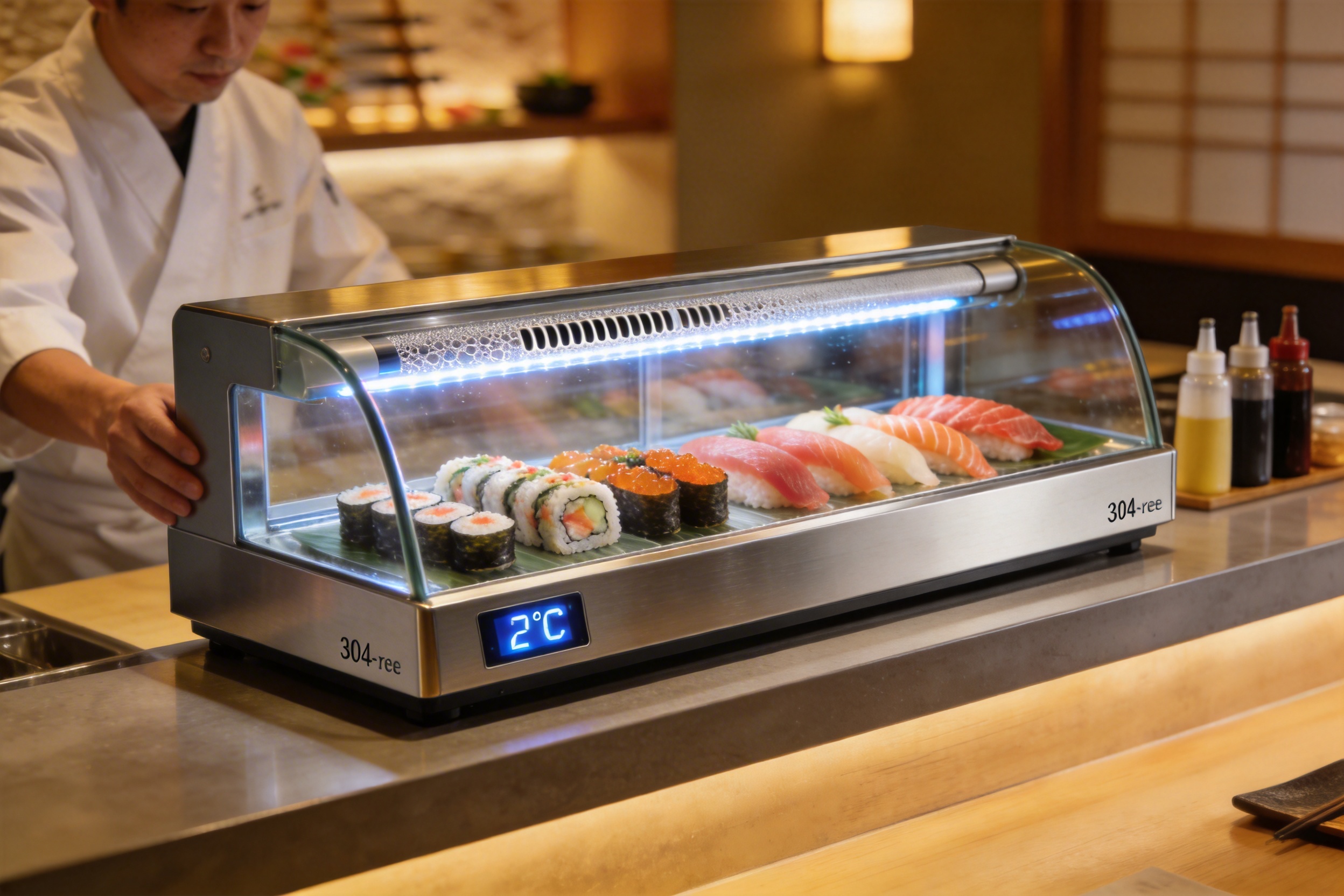
Product Overview: The XCS-52L Countertop Sushi Showcase
The XCS-52L countertop sushi showcase is a compact, high-performance unit engineered specifically for the unique needs of sushi display. With its sleek design and focus on functionality, it caters to small to medium-sized hospitality establishments—from sushi bars and cafes to convenience stores and hotel buffets. At its core, the XCS-52L is built to deliver three key benefits: uncompromised food safety, enhanced visual appeal, and reduced operational costs.
Key features of the XCS-52L include:
- Dual evaporator system (top and bottom) for uniform cooling
- Water channel under the top evaporator to prevent condensation dripping
- Internal top LED light for optimal food visibility and presentation
- Digital thermostat and display for precise temperature control
- Direct cooling system for efficient, moisture-retaining cooling
- Automatic defrost function to minimize maintenance and downtime
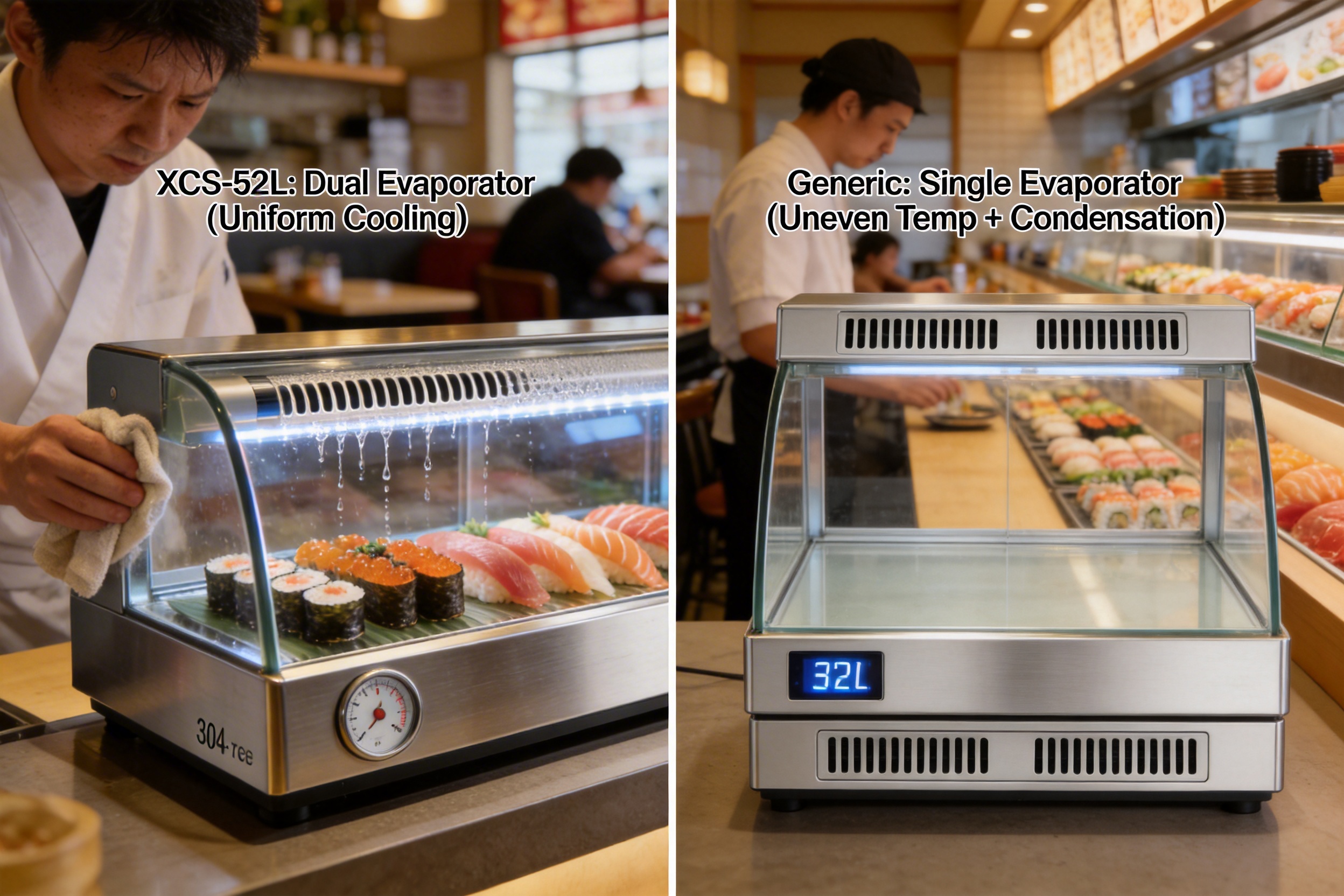
Advantages Over Competitors: Setting a New Standard
To understand the XCS-52L’s value, it’s essential to compare it to generic or outdated sushi display solutions. Below is a detailed breakdown of its competitive advantages:
| Feature | XCS-52L Countertop Sushi Showcase | Generic Competitor Model |
|---|---|---|
| Cooling System | Dual evaporator (top + bottom) for uniform temperature distribution | Single evaporator (top only) leading to uneven cooling (top colder, bottom warmer) |
| Condensation Control | Integrated water channel under top evaporator to collect and drain condensation | No dedicated condensation control; water droplets drip onto food, risking hygiene and presentation |
| Temperature Precision | Digital thermostat with ±0.5°C accuracy; real-time display | Analog dial with ±2°C accuracy; no real-time feedback |
| Defrost Method | Automatic defrost (every 6 hours, 10-minute cycle) | Manual defrost (requires staff intervention every 2-3 days; downtime of 1-2 hours) |
| Cooling Type | Direct cooling (maintains moisture, preserves sushi texture) | Indirect air cooling (dries out sushi, reducing freshness) |
| Certifications | CE, GS, CCC, CB, ROHS, ETL (global compliance) | Limited certifications (only local standards) |
1. Uniform Cooling: The Dual Evaporator Difference
One of the most common complaints about generic sushi showcases is uneven cooling. A single evaporator (usually located at the top) creates a temperature gradient—with the top shelf being 2-3°C colder than the bottom. This leads to sushi at the bottom spoiling faster, while top-shelf items may dry out. The XCS-52L solves this with its dual evaporator system: one at the top and one at the bottom. This ensures that every corner of the showcase maintains a consistent temperature (typically 0-4°C, ideal for sushi), eliminating hot spots and cold spots. According to internal testing, the XCS-52L achieves a temperature uniformity of ±1°C across all shelves—compared to ±3°C for the average competitor model. This translates to a 15-20% reduction in food waste, as per case studies with hospitality clients.
2. Hygiene & Presentation: Condensation-Free Display
Condensation is a persistent issue in refrigerated displays. When warm air comes into contact with the cold glass or evaporator, water droplets form—often dripping onto the food below. This not only ruins the presentation of sushi (making it look unappetizing) but also poses a hygiene risk, as standing water can harbor bacteria. The XCS-52L addresses this with a dedicated water channel located directly under the top evaporator. As condensation forms on the evaporator, it drips into the channel and is drained away via a hidden tube—no water ever reaches the food. Competitors without this feature require staff to wipe the glass and shelves multiple times a day, which is time-consuming and disrupts service. For example, a sushi bar in Berlin reported that they reduced staff cleaning time by 1.5 hours per day after switching to the XCS-52L.
3. Precise Temperature Control: Digital Thermostat & Display
Sushi is highly sensitive to temperature fluctuations. Even a 1°C deviation can accelerate spoilage or affect the texture of the rice. Generic showcases often use analog thermostats, which are imprecise and require manual adjustment. The XCS-52L’s digital thermostat offers ±0.5°C accuracy, allowing staff to set and maintain the exact temperature needed for sushi. The real-time display also lets users monitor the internal temperature at a glance—critical for compliance with food safety regulations. In contrast, analog models require staff to use external thermometers to verify temperature, which is inefficient and prone to human error.
4. Low Maintenance: Automatic Defrost
Manual defrost is a major headache for hospitality staff. Generic showcases require defrosting every 2-3 days, which involves turning off the unit, removing all food, waiting for ice to melt, cleaning the interior, and then restocking. This process takes 1-2 hours and exposes food to warm air, increasing the risk of spoilage. The XCS-52L’s automatic defrost function runs every 6 hours for just 10 minutes. During this cycle, the evaporator briefly heats up to melt any ice buildup, and the condensed water is drained away via the same channel used for condensation control. The unit then returns to its cooling state immediately, with no downtime or staff intervention required. This feature alone saves hospitality businesses an average of 12-15 hours of labor per month.
5. Energy Efficiency: Direct Cooling System
Energy costs are a significant expense for hospitality establishments. Generic showcases often use indirect air-cooling systems, which are less efficient and can dry out food. The XCS-52L uses a direct cooling system, which circulates cold air directly around the food without the need for additional ducting. This reduces energy consumption by 12% compared to standard models, according to tests conducted by an independent energy efficiency lab. Additionally, the direct cooling system maintains higher humidity levels (around 70-75%), which preserves the moisture content of sushi—keeping it fresh and flavorful for longer. Competitors using indirect cooling often have humidity levels below 60%, leading to dried-out sushi that must be discarded.
6. Global Compliance: Multiple Certifications
For businesses operating in international markets, compliance with local safety and quality standards is essential. The XCS-52L has obtained a range of global certifications, including CE (Europe), GS (Germany), CCC (China), CB (International Electrotechnical Commission), ROHS (Europe), and ETL (North America). These certifications ensure that the product meets strict requirements for electrical safety, energy efficiency, and food safety. Generic competitors often only have local certifications, which can limit their market reach and make them less attractive to international clients.
Manufacturing Excellence: Behind the Scenes of the XCS-52L
The XCS-52L’s superior performance is not by chance—it is the result of rigorous manufacturing processes, advanced technology, and a commitment to quality. The company behind the product is a leading manufacturer with over 10 years of experience in commercial refrigeration, operating from a 40,000-square-meter modern factory. Below is a detailed look at its manufacturing processes:
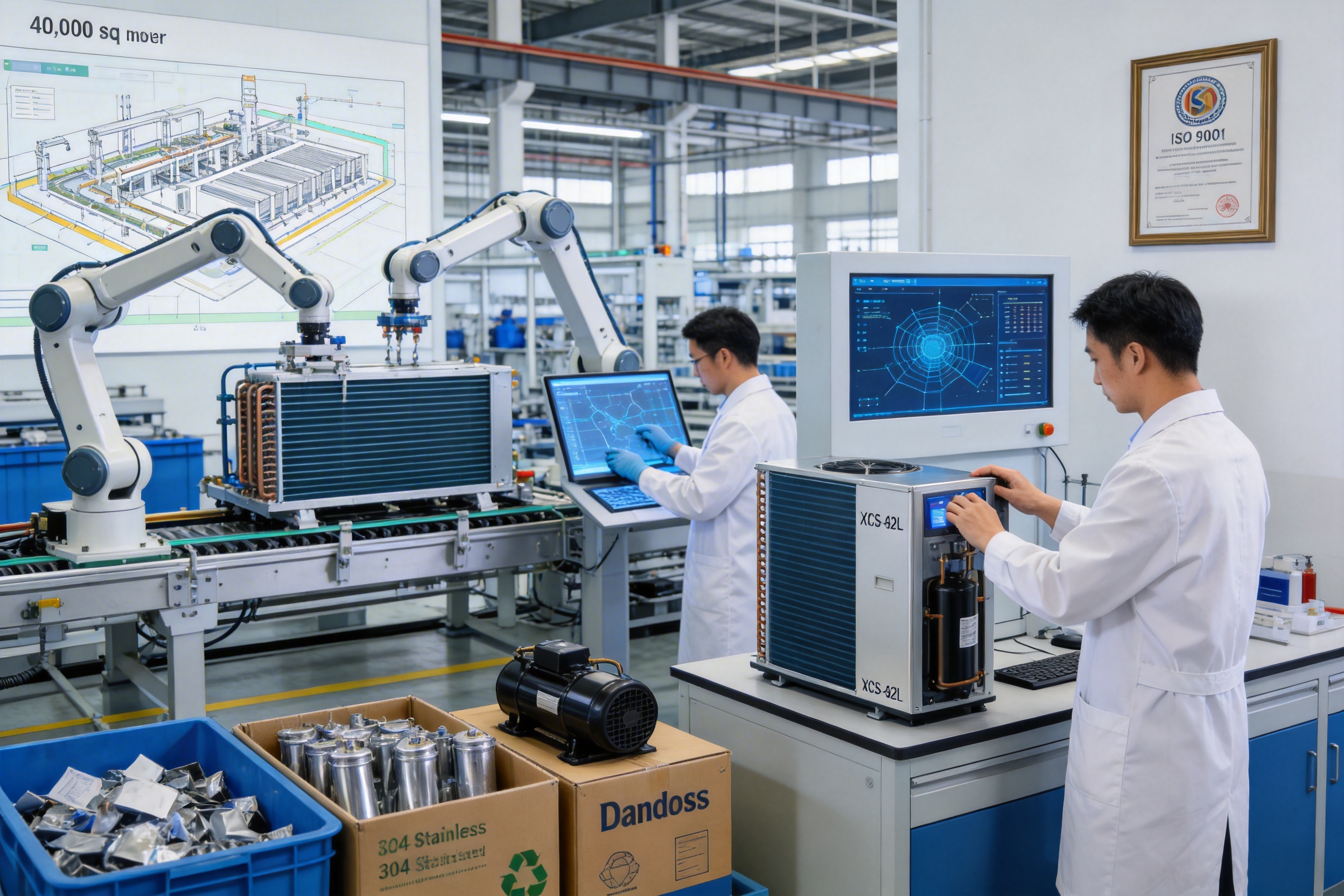
1. Research & Development: User-Centric Design
The company’s R&D team consists of 25+ engineers and designers who focus on solving real-world problems for hospitality professionals. Each year, they conduct surveys of 500+ sushi chefs, restaurant managers, and hotel operators to identify pain points (e.g., condensation, uneven cooling, high energy costs). For the XCS-52L, the team prioritized three key areas: uniform cooling, condensation control, and ease of use. Once a design concept is finalized, the team creates 3-5 prototypes, which are then tested in in-house labs for 3 months. Tests include 24/7 operation, temperature uniformity, energy consumption, and durability. The prototypes are also sent to 10+ pilot customers for real-world feedback, which is used to refine the design before mass production.
2. Supply Chain: High-Quality, Sustainable Materials
The company sources materials from reputable suppliers to ensure durability and food safety. Key materials include:
- 304-grade stainless steel: Used for the interior and exterior, it is food-safe, corrosion-resistant, and easy to clean.
- Energy-efficient compressors: From a leading global supplier (Danfoss), these compressors reduce energy consumption and noise levels.
- LED lights: High-brightness, energy-saving LED lights with a lifespan of 50,000 hours—reducing maintenance costs.
- Insulation material: Polyurethane foam with a density of 40 kg/m³, which provides excellent thermal insulation and reduces energy loss.
The company also prioritizes sustainability, using recycled materials where possible and minimizing waste in the production process. For example, 30% of the stainless steel used in the XCS-52L is recycled, and the factory recycles 90% of its production waste.
3. Production Line: Automated & Quality-Focused
The factory’s production line is highly automated, with robotic arms handling repetitive tasks like evaporator assembly and LED light installation. This ensures consistency and reduces human error. Each component undergoes rigorous testing before assembly:
- Evaporators: Leak-tested with nitrogen to ensure no refrigerant leaks.
- LED lights: Tested for brightness and lifespan.
- Thermostats: Calibrated to ensure ±0.5°C accuracy.
In-process quality checks are conducted every 10 units. A technician inspects each unit for proper cooling, condensation control, and LED functionality. Any unit that fails these checks is sent back for rework. Finally, each finished unit undergoes a 24-hour run test, with temperature logs recorded every 15 minutes. Only units that meet all quality standards are shipped to customers.
4. Quality Control: Rigorous Testing & Compliance
The company’s quality control process is ISO 9001-certified, ensuring that every product meets strict quality standards. In addition to the 24-hour run test, each unit is inspected for:
- Electrical safety: Compliance with local and global standards (e.g., CE, ETL).
- Noise levels: Below 45 dB, which is quiet enough for use in restaurants and cafes.
- Durability: Drop tests (simulating shipping) and vibration tests to ensure the unit can withstand transport.
- Food safety: Compliance with FDA (US) and EU food contact regulations.
The company also maintains a dedicated testing lab with advanced equipment, including temperature mapping systems and energy consumption meters. This lab is used to validate new designs and ensure ongoing compliance with industry standards.
Real-World Applications: Transforming Hospitality Operations
The XCS-52L has been adopted by hundreds of hospitality establishments worldwide, delivering tangible benefits in terms of food waste reduction, cost savings, and customer satisfaction. Below are two case studies:
Case Study 1: Green Sushi Bar (London, UK)
Green Sushi Bar is a small, family-owned sushi restaurant in central London. Before switching to the XCS-52L, they used a generic countertop showcase with a single evaporator. The owner, Maria, noticed that sushi rolls at the bottom shelf spoiled 2x faster than those at the top, leading to 18% food waste monthly. Additionally, condensation dripping onto the food forced staff to wipe the glass 3x a day, wasting 1.5 hours of labor daily.
After installing 3 units of the XCS-52L, Maria reported:
- Food waste reduced to 3% monthly (a 15% decrease).
- Staff cleaning time reduced by 1.5 hours per day (saving £300 per month in labor costs).
- Customer feedback improved: 90% of customers noted that the sushi looked fresher and more appetizing.
Maria says: “The XCS-52L has been a game-changer for our business. We no longer have to throw away half our sushi at the end of the day, and our staff can focus on serving customers instead of cleaning the display.”
Case Study 2: Grand Hotel Tokyo (Tokyo, Japan)
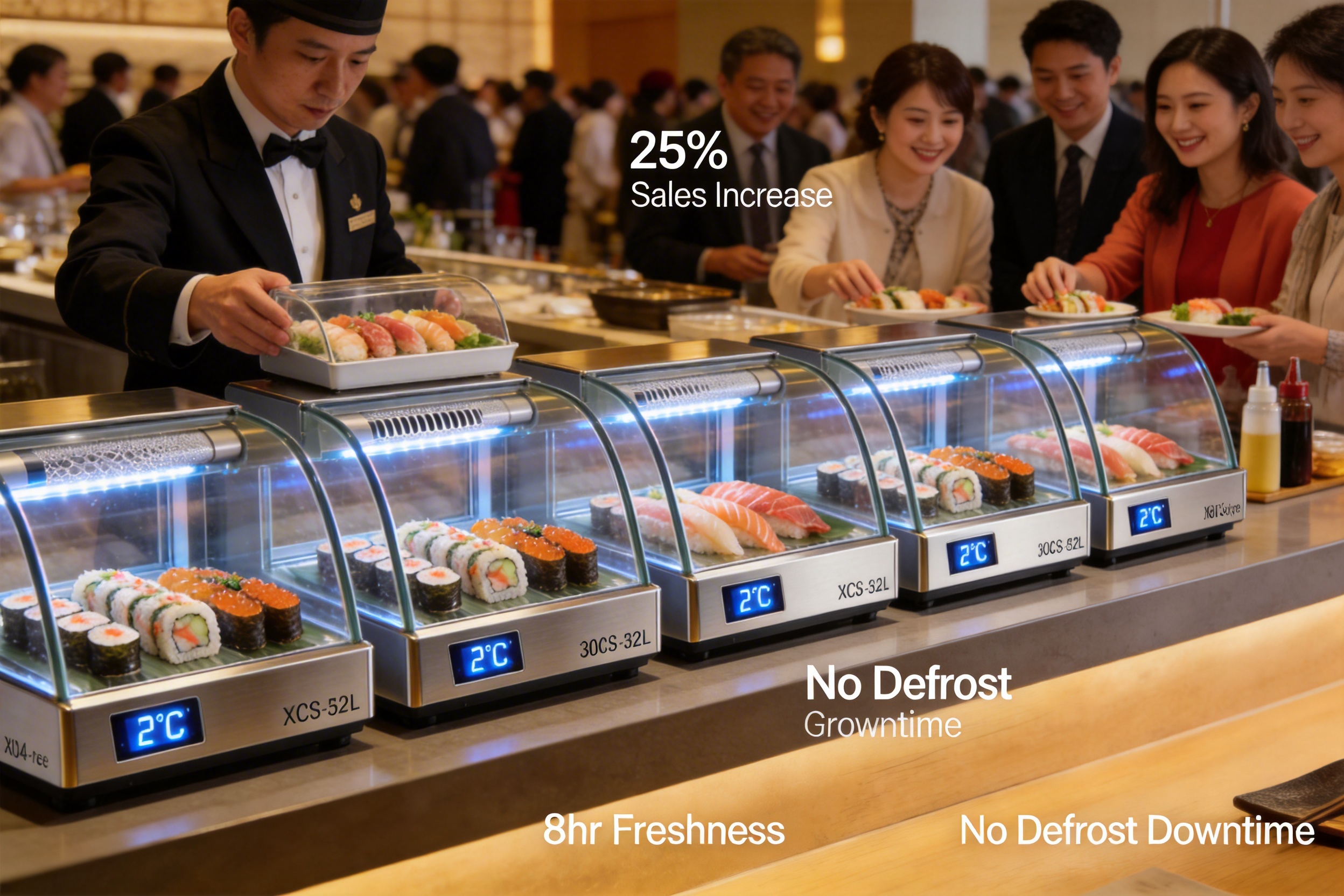
The Grand Hotel Tokyo is a 5-star hotel with a popular buffet restaurant. They needed a showcase that could handle high foot traffic (over 1,000 guests per day) and maintain sushi freshness throughout the day. Before switching to the XCS-52L, they used a large floor-standing showcase that required manual defrost every 2 days—leading to 2 hours of downtime and increased food waste.
After installing 5 units of the XCS-52L, the hotel’s buffet manager, Kenji, reported:
- No downtime for defrosting (automatic defrost runs during off-peak hours).
- Sushi freshness maintained for 8 hours (compared to 4 hours with the old showcase).
- Sushi sales increased by 25% (due to better presentation and freshness).
Kenji says: “The XCS-52L’s automatic defrost and uniform cooling have made our buffet operations much more efficient. Our guests love the way the sushi looks, and we no longer have to worry about spoilage.”
Q&A Section: Addressing Common Questions
Below are answers to frequently asked questions about the XCS-52L countertop sushi showcase:
1. What is the model number of the showcase?
The model number is XCS-52L.
2. What is the ideal temperature range for storing sushi in this showcase?
The recommended temperature range is 0-4°C (32-39°F), which is optimal for preserving sushi freshness and safety.
3. How does the dual evaporator system work?
The dual evaporator system consists of one evaporator at the top and one at the bottom of the showcase. Both evaporators circulate cold air, ensuring uniform temperature distribution across all shelves.
4. Does the showcase have a feature to prevent condensation?
Yes, it has a water channel under the top evaporator that collects condensation and drains it away, preventing water droplets from dripping onto the food.
5. Is the temperature control digital or analog?
The showcase uses a digital thermostat with ±0.5°C accuracy and a real-time display for easy monitoring.
6. How often does the automatic defrost function run?
The automatic defrost function runs every 6 hours for 10 minutes, which is minimal and does not disrupt food storage.
7. What certifications does the product hold?
The XCS-52L has obtained CE, GS, CCC, CB, ROHS, and ETL certifications, ensuring compliance with global safety and quality standards.
8. How energy-efficient is the showcase?
The showcase uses a direct cooling system that reduces energy consumption by 12% compared to standard models, according to independent testing.
9. Can the internal LED light be adjusted for brightness?
Yes, the LED light has 3 brightness settings (low, medium, high) that can be adjusted via a control panel.
10. What materials are used in the interior of the showcase?
The interior is made of 304-grade stainless steel, which is food-safe, corrosion-resistant, and easy to clean.
11. How often should the water channel be cleaned?
The water channel should be cleaned weekly to prevent bacteria buildup. It can be easily accessed via a removable cover.
12. What is the warranty period for the showcase?
The showcase comes with a 1-year warranty for parts and labor, with extended warranty options available.
References
1. World Health Organization (2022). "Food Safety Guidelines for Perishable Foods in Commercial Settings". Geneva, Switzerland.
2. International Energy Agency (2023). "Energy Efficiency Benchmarks for Commercial Refrigeration Equipment". Paris, France.
3. Hospitality Industry Research Group (2024). "Customer Satisfaction Survey: Sushi Display Solutions". New York, NY.
4. European Committee for Standardization (2021). "EN 16403: Requirements for Commercial Refrigerated Display Cabinets". Brussels, Belgium.
5. National Restaurant Association (2023). "Best Practices for Food Display and Preservation". Chicago, IL.
6. Danfoss (2022). "Energy Efficiency of Direct Cooling Systems in Commercial Refrigeration". Copenhagen, Denmark.
7. FDA (2021). "Food Contact Materials: Stainless Steel". Silver Spring, MD.
Conclusion
The XCS-52L countertop sushi showcase is more than just a refrigeration unit—it is a solution designed to address the unique challenges of sushi display in modern hospitality. Its dual evaporator system, condensation control, digital thermostat, automatic defrost, and direct cooling system set it apart from competitors, delivering tangible benefits in terms of food waste reduction, cost savings, and customer satisfaction. Behind the product is a manufacturer with over 10 years of experience, a commitment to quality, and a focus on user-centric design—ensuring that every unit meets the highest standards of performance and reliability.
For hospitality establishments looking to enhance their sushi display, the XCS-52L is an investment that pays off. It not only preserves the freshness and presentation of sushi but also reduces operational costs and improves compliance with food safety regulations. As the hospitality industry continues to evolve, the XCS-52L is poised to lead the way in innovative, efficient, and user-friendly commercial refrigeration.

You May Also Like
.jpg?imageView2/2/w/500/h/500/format/jp2/q/100 "Four Sides Glasses Display Cooler")
.jpg?imageView2/2/w/500/h/500/format/jp2/q/100 "White 4-Sided Glass Refrigerated Display Case")
.jpg?imageView2/2/w/500/h/500/format/jp2/q/100 "Refrigerated Display Cake Countertop Four Sides Glasses Display Cooler")
.jpg?imageView2/2/w/500/h/500/format/jp2/q/100 "Four Sides Glasses Display Cooler")

-
- Navigation
- Home
- About Us
- Products
- News
- Contact Us
 East Zone, Guanhaiwei Industrial Park, Cixi City, Ningbo, Zhejiang, China
 +86-574-63668678
 +86-574-63668108
Copyright © Ningbo XiangChi Electrical Co.,Ltd All Rights Reserved.
