
 简体中文
简体中文 English
 Español
News
Open Sliding Door Refrigerated Showcase for High-Impact Merchandising
Open Sliding Doors Refrigerated Showcase XCS-520L /520Z /720Z /920Z /1120Z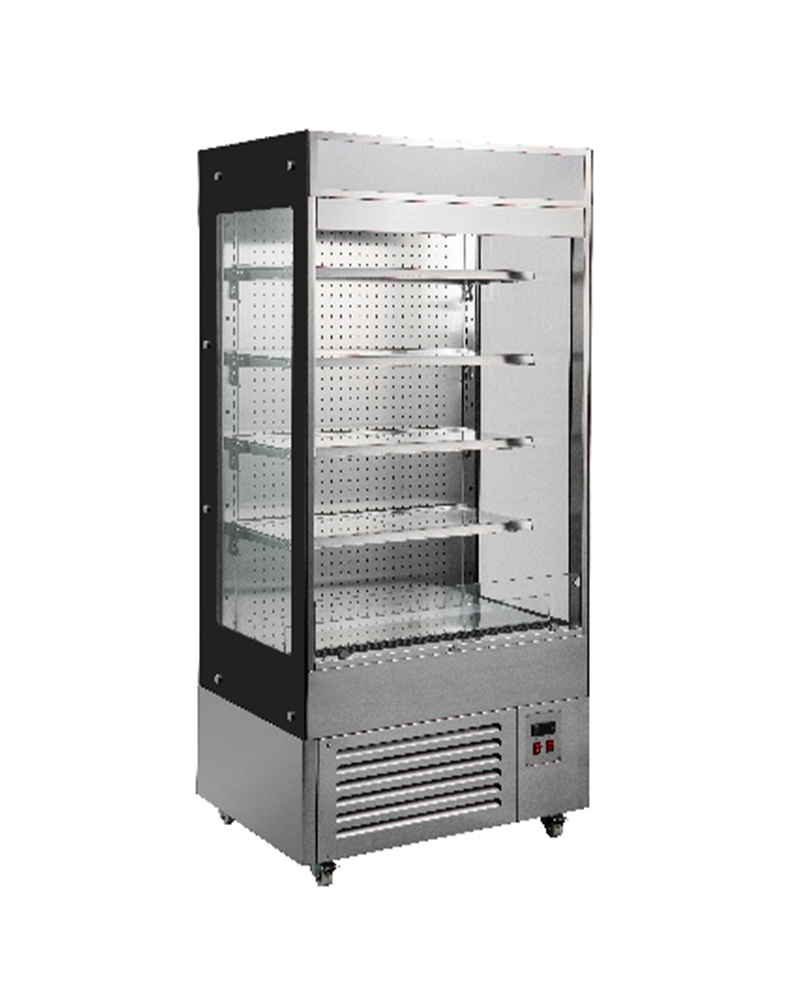
Introduction: A Display Cooler Built for Modern Retail
In competitive food retail, refrigeration is no longer only a back-of-house utility. It is a sales tool, a merchandising platform, a product protection system, and a visible part of the customer experience. The Open Sliding Doors Refrigerated Showcase XCS-520L / XC-520Z / XC-720Z / XC-920Z / XC-1120Z series is designed for businesses that need reliable chilled display, attractive product presentation, and efficient daily operation in one commercial refrigeration solution.
This refrigerated showcase belongs to the open display cooler category and is intended for supermarkets, convenience stores, bakeries, beverage shops, delicatessens, cafés, food courts, and other commercial environments where chilled products must be clearly visible and easy to access. With a temperature range of 2–10℃ / 35.6–50°F, the series is suitable for displaying beverages, dairy products, packaged salads, desserts, sandwiches, fruit cups, sushi packs, ready-to-eat meals, and other chilled goods that require stable refrigeration conditions.
Unlike ordinary storage refrigerators, this showcase is designed to bring products closer to customers. Its tall vertical display structure, ventilated cooling system, light box for advertising, digital temperature controller, stainless steel body, tempered glass, castors, and optional sliding doors create a practical balance between merchandising appeal and operational performance.
The series is supported by a manufacturer with extensive experience in vertical display cabinets, cake showcases, display warmers, and commercial refrigeration. Established in 2007, the manufacturer operates a modern production facility of approximately 40,000 square meters and maintains professional research and development capabilities, advanced testing facilities, and internationally recognized certifications including CE, GS, CCC, CB, ROHs, and ETL. These strengths help ensure that the refrigerated showcase is not only visually effective but also engineered for dependable commercial use.
Product Overview
The Open Sliding Doors Refrigerated Showcase series is available in multiple capacities and configurations, including 520L and 720L models, with larger versions such as 920Z and 1120Z included in the series range. The available technical data highlights three representative models: XCS-520L, XC-520Z, and XC-720Z. These models are designed around a consistent commercial philosophy: efficient refrigerated display with strong product visibility, easy operation, and durable construction.
The XCS-520L and XC-520Z both provide 520L / 18.4 cu.ft of gross capacity, making them suitable for compact and medium-sized retail locations. The XC-720Z increases gross capacity to 720L / 25.4 cu.ft, offering additional display space for higher-volume stores or wider product assortments. All three models share the same temperature range of 2–10℃ / 35.6–50°F and use R290 refrigerant, a refrigerant widely valued in commercial refrigeration for its low environmental impact and efficient thermodynamic performance.
One of the most important design values of the series is flexibility. A retailer can choose the appropriate model according to shop size, product volume, merchandising layout, and energy strategy. Smaller stores may prefer the 520L models, while larger supermarkets and food retail chains may select higher-capacity models for increased display volume and greater product variety.
The product is also designed for ease of use. A digital temperature controller and display allow staff to monitor and adjust operating conditions conveniently. Separate power and light buttons allow operators to control refrigeration and illumination independently, supporting practical energy management and daily cleaning routines. The ventilated cooling system helps distribute cold air evenly through the cabinet, while automatic defrost reduces manual maintenance and supports consistent performance.
Key Product Specifications
The following table summarizes the available specifications for the representative models in the series.
Specification |
XCS-520L |
XC-520Z |
XC-720Z |
Gross Capacity |
520L / 18.4 cu.ft |
520L / 18.4 cu.ft |
720L / 25.4 cu.ft |
Temperature Range |
2–10℃ / 35.6–50°F |
2–10℃ / 35.6–50°F |
2–10℃ / 35.6–50°F |
Input Power |
1350W |
690W |
690W |
Refrigerant |
R290 |
R290 |
R290 |
Climate Type |
3 |
4 |
4 |
Net Weight |
180kg |
190kg |
214kg |
Gross Weight |
214kg |
230kg |
275kg |
Product Size |
900 × 656 × 1900mm |
900 × 656 × 1900mm |
1200 × 656 × 1900mm |
Product Size |
35.4 × 25.8 × 74.8inch |
35.4 × 25.8 × 74.8inch |
47.2 × 25.8 × 74.8inch |
Package Size |
970 × 750 × 2060mm |
970 × 750 × 2060mm |
1270 × 750 × 2060mm |
Package Size |
38.2 × 29.5 × 81.1inch |
38.2 × 29.5 × 81.1inch |
50.0 × 29.5 × 81.1inch |
Loading Quantity |
17 / 36 pcs, 20GP / 40HQ |
17 / 36 pcs, 20GP / 40HQ |
12 / 27 pcs, 20GP / 40HQ |
Commercial Advantages Over Conventional Display Refrigerators
The open sliding door refrigerated showcase provides several practical advantages when compared with conventional commercial coolers. These advantages are especially important for retailers who need equipment that improves product exposure, supports customer convenience, and reduces operational difficulty.
High-Visibility Merchandising
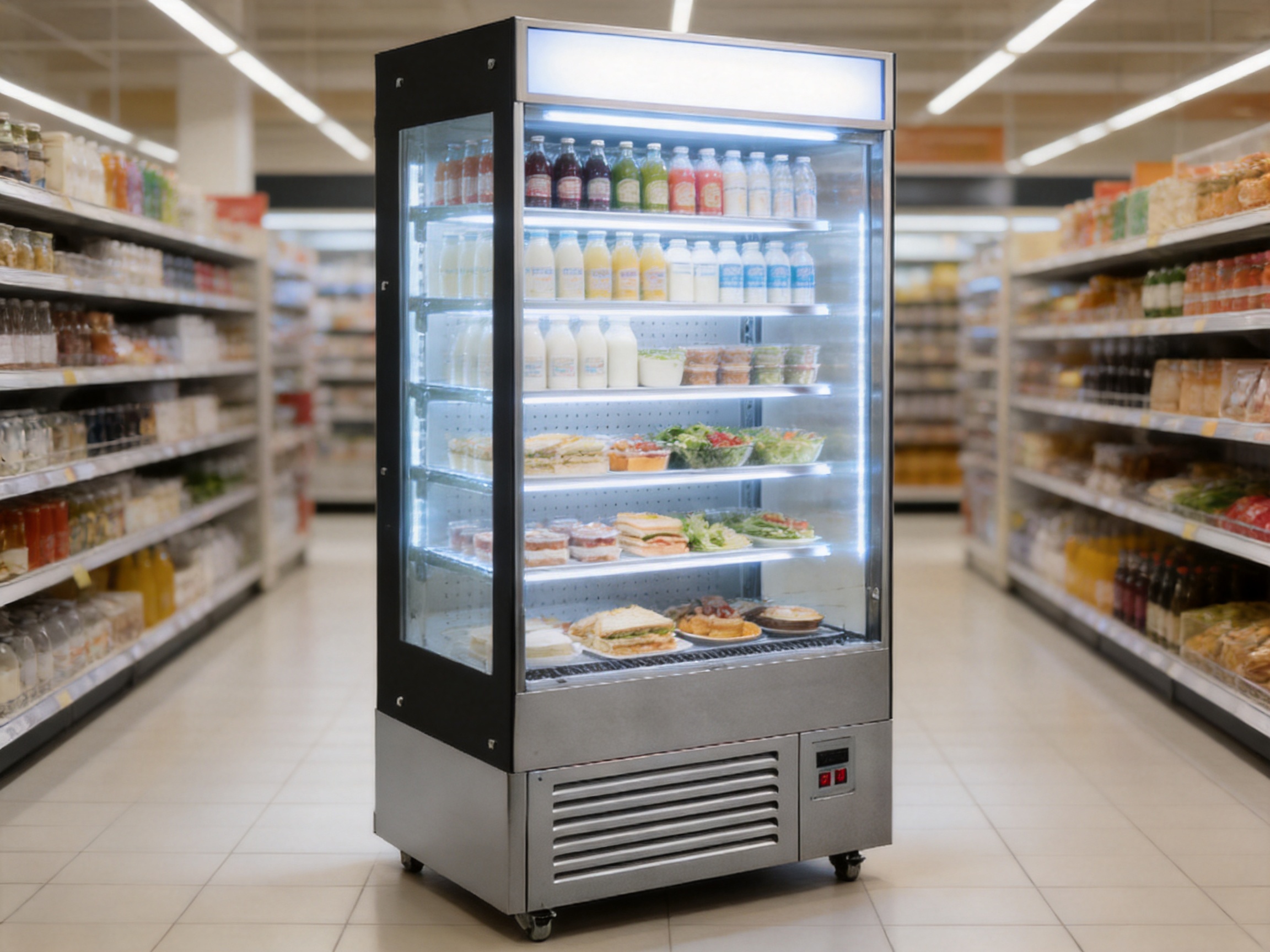
In retail refrigeration, visibility directly affects sales performance. Customers are more likely to purchase chilled products when they can quickly see product labels, colors, freshness, and variety. The showcase structure provides a tall display area that allows products to be arranged across multiple shelves and viewed easily from the shopping aisle.
The light box for advertisement is another important feature. It helps businesses promote product categories, store branding, seasonal campaigns, or special offers. Instead of relying only on shelf labels, retailers can use the illuminated advertising area to attract customer attention from a distance. This is a significant advantage over basic display refrigerators that provide only cold storage without promotional impact.
Efficient Product Access
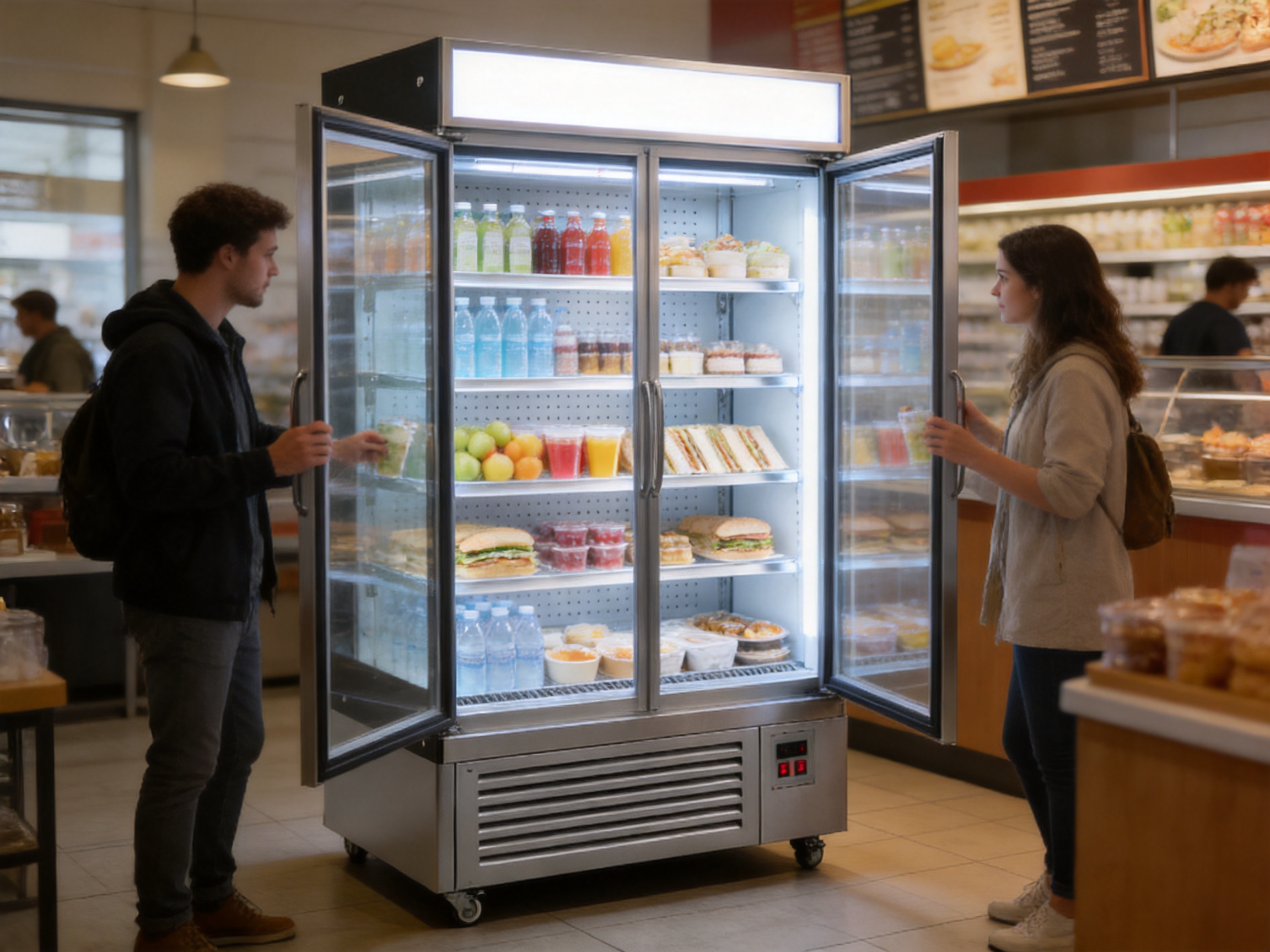
Open display coolers are valued because they allow customers to select products quickly. When sliding doors are used, the unit can provide a balance between accessibility and better cold-air retention. Sliding doors are especially practical in narrow retail aisles because they do not swing outward and do not block customer movement. This makes the series suitable for compact shops, supermarkets, service stations, and food retail locations where space efficiency matters.
Compared with hinged-door coolers, sliding doors can help improve traffic flow. Customers can open the display area with less effort and less aisle interference. Staff can also restock products more efficiently because access to the cabinet is direct and convenient.
Stable Chilled Display Temperature
The 2–10℃ / 35.6–50°F temperature range is a practical range for many chilled food and beverage categories. A display refrigerator must maintain suitable conditions even during frequent door openings or busy sales periods. The ventilated cooling system helps circulate cold air through the cabinet, supporting more consistent temperature distribution across the display area.
Many lower-quality coolers struggle with uneven internal temperatures. Products placed near the front may become too warm, while products near the air outlet may become too cold. A ventilated system helps reduce this risk by moving air more evenly, making the showcase more suitable for professional retail use.
Automatic Defrost for Reduced Maintenance
Frost accumulation can reduce cooling efficiency, block airflow, increase energy use, and make the cabinet less attractive. Automatic defrost helps solve this problem by reducing manual intervention. Retail staff can focus more on merchandising, cleaning, and customer service instead of frequently managing frost buildup.
For busy retail stores, this is an important advantage. Equipment that requires less manual maintenance is easier to integrate into daily operations and helps reduce the risk of performance problems caused by neglected defrosting.
Durable Stainless Steel Body
The stainless steel body contributes to long-term durability, hygiene, and visual quality. Commercial refrigeration equipment is frequently exposed to moisture, cleaning chemicals, food residues, and continuous handling by staff and customers. Stainless steel is widely used in professional food equipment because it is strong, relatively easy to clean, and resistant to corrosion under normal commercial conditions.
Compared with lower-cost painted materials, stainless steel gives the cabinet a more professional appearance and improves long-term value. A display cooler used in the customer-facing area of a store should remain attractive after years of operation, and material quality plays a major role in that result.
Design Features That Support Daily Retail Operation
The value of a refrigerated showcase is measured not only by its technical specifications but also by its ability to simplify everyday work. The XCS / XC series includes several standard features that help retailers operate more efficiently.
Digital Temperature Controller and Display
A digital temperature controller allows operators to monitor the cabinet temperature clearly and make adjustments when required. In commercial environments, accurate temperature management protects product quality and helps businesses meet food safety expectations. The display also makes daily checks easier for staff, supervisors, and maintenance teams.
Compared with analog control systems, digital temperature control provides better readability and more convenient operation. Retailers can identify abnormal conditions more quickly and respond before products are affected.
Separate Power and Light Buttons
The showcase includes separate power and light buttons. This simple design feature is useful in daily operation. For example, staff may turn off the light during non-business hours while maintaining refrigeration. During cleaning, restocking, or maintenance, the independent controls provide more flexible management.
Separate light control can also support energy-saving routines. Instead of keeping the lighting on continuously, operators can control illumination according to store hours and merchandising needs.
Tempered Glass for Safety and Presentation
Tempered glass is an important feature in customer-facing refrigeration. It provides visibility while improving safety compared with ordinary glass. In retail environments, equipment must withstand frequent customer interaction, cleaning activity, and accidental contact. Tempered glass supports a safer and more durable display structure.
From a merchandising perspective, clear glass helps maintain product visibility and supports a bright, clean display. Customers can view products without visual obstruction, which is essential for impulse purchases and chilled product promotion.
Castors With Front Brakes
The unit is equipped with four castors, including front two brakes. Mobility is a practical advantage for stores that need to adjust layout, clean behind equipment, or reposition showcases during seasonal campaigns. The front brakes help keep the unit stable during regular use.
This design is especially useful for supermarkets and convenience stores that frequently change product zones. Instead of treating the refrigerated showcase as a fixed object, retailers can adapt the merchandising layout when needed.
Light Box for Advertisement
The advertisement light box adds marketing value beyond basic refrigeration. It helps identify the product category, attract customers, and create a professional retail atmosphere. In many stores, the top of a refrigerator is underused. By turning this space into an illuminated promotional area, the showcase becomes both equipment and advertising media.
Competitor products without a light box may provide refrigeration but fail to contribute to visual promotion. For retailers, the difference can influence customer attention and sales conversion.
Energy and Environmental Considerations
Commercial refrigeration operates for long hours, often continuously. Therefore, energy performance and refrigerant selection are important purchasing factors. The showcase series uses R290 refrigerant, a hydrocarbon refrigerant recognized for its low global warming potential and strong cooling efficiency when used in properly designed systems.
R290 is increasingly adopted in commercial refrigeration because it supports environmental responsibility and can help manufacturers meet stricter international refrigeration standards. For retailers, using equipment with R290 refrigerant can support sustainability goals and future-proof equipment investments as regulations continue to evolve.
The XC-520Z and XC-720Z models show an input power of 690W in the available data, while the XCS-520L shows 1350W. This difference may reflect structural or configuration variations. For buyers, it is important to select the model that best matches store operating conditions, climate type, product loading, access frequency, and energy expectations.
The climate type information also deserves attention. The XCS-520L is listed as climate type 3, while the XC-520Z and XC-720Z are listed as climate type 4. Climate classification helps indicate the environmental conditions in which the equipment is designed to perform. Buyers should confirm the most suitable model according to ambient temperature, store ventilation, air-conditioning conditions, and humidity levels.
Manufacturing Strength Behind the Product
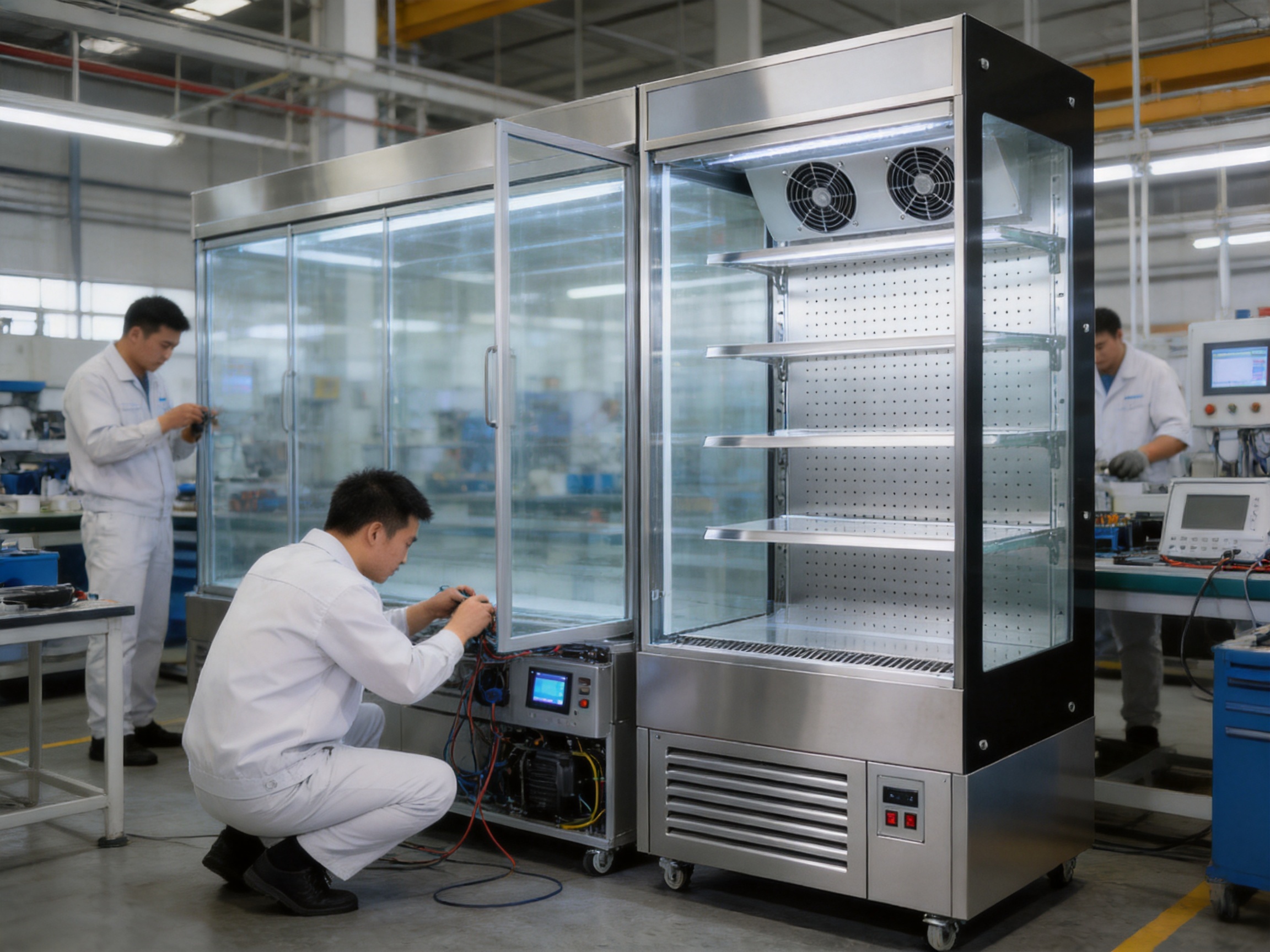
A commercial refrigerator is a long-term investment. Buyers should evaluate not only the appearance of the equipment but also the manufacturing foundation behind it. This showcase is produced by Ningbo XiangChi Electrical Co., Ltd, a professional manufacturer specializing in vertical display cabinets, cake cabinets, warming cabinets, countertop display coolers, and related commercial refrigeration equipment.
The company was established in 2007 and has accumulated more than ten years of industry experience. Its modern factory covers approximately 40,000 square meters, providing the production capacity required for stable supply, quality management, and export-oriented manufacturing. For wholesalers, distributors, supermarket groups, and food service equipment buyers, this production scale is important because it supports reliable delivery and consistent product availability.
The company maintains a professional research and development team. In commercial refrigeration, R&D capability is essential because product requirements continue to evolve. Retailers need better energy performance, stronger cooling stability, improved display design, safer materials, and compliance with international standards. A dedicated R&D team helps improve cabinet structures, airflow design, lighting integration, electrical control, and manufacturing efficiency.
Advanced testing facilities also play a key role. Before a commercial cooler reaches the market, it should be tested for temperature performance, electrical safety, cooling stability, durability, and operating reliability. Proper testing reduces the risk of field failures and helps maintain consistent product quality across production batches.
The company has obtained major international certifications including CE, GS, CCC, CB, ROHs, and ETL. These certifications demonstrate a broad commitment to safety, compliance, and export readiness. For international buyers, certification support can simplify market entry and provide confidence that the equipment has been developed according to recognized requirements.
Advanced Manufacturing Processes and Quality Control
The quality of a refrigerated showcase depends heavily on manufacturing processes. A visually attractive cabinet can still underperform if its structure, refrigeration system, electrical system, and assembly are not carefully controlled. The manufacturer’s production strengths help create a reliable foundation for the XCS / XC series.
Material Selection and Cabinet Construction
The stainless steel body is one of the most visible indicators of product quality. During production, stainless steel panels must be cut, formed, joined, and finished with accuracy to ensure proper appearance and structural strength. Clean panel edges, stable cabinet geometry, and precise assembly all contribute to a professional final product.
Good cabinet construction also affects cooling performance. Poorly aligned panels, weak sealing areas, and inconsistent assembly can allow cold air leakage and reduce efficiency. A modern manufacturing environment helps control these details more effectively.
Glass Processing and Safety Considerations
Tempered glass requires proper sourcing and handling. It must be strong enough for commercial use while maintaining clarity for product display. During assembly, glass components need careful alignment to avoid stress points, rattling, or poor fit. In customer-facing equipment, glass quality affects both safety and presentation.
Compared with basic glass displays, a well-assembled tempered glass structure gives retailers greater confidence in daily operation. Customers interact with display equipment frequently, and durability is essential.
Refrigeration System Integration
The refrigeration system is the core of the showcase. A ventilated cooling system must be engineered to deliver air evenly across the display area. Component selection, refrigerant charging, airflow path design, fan placement, evaporator performance, and controller settings all influence cabinet reliability.
In high-quality production, refrigeration systems are assembled with attention to sealing, pressure stability, and performance testing. R290 refrigerant requires careful system design and manufacturing discipline because it is a flammable refrigerant and must be handled according to appropriate safety practices. A manufacturer with advanced facilities and international certification experience is better positioned to manage these requirements responsibly.
Electrical Assembly and Control Testing
The digital temperature controller, display, separated power button, and separated light button all require proper electrical integration. Commercial equipment must operate safely under continuous use, sometimes in humid retail environments. Proper wiring layout, insulation, grounding, component placement, and final inspection are important for safety and long-term reliability.
The manufacturer’s certification background supports confidence in electrical safety management. Certifications such as CE, CB, GS, and ETL require attention to design and production compliance, making them valuable indicators for global buyers.
Performance Testing Before Shipment
Testing is essential in refrigeration manufacturing. Each cabinet should be evaluated for cooling performance, controller function, airflow, lighting operation, defrost function, and basic mechanical stability. Package inspection is also important because display coolers are large products that must survive long-distance transport.
The provided loading information shows that logistics planning has been considered. For example, the XCS-520L and XC-520Z can load 17 pcs in a 20GP container and 36 pcs in a 40HQ container, while the XC-720Z can load 12 pcs in a 20GP container and 27 pcs in a 40HQ container. This information helps distributors plan import volume and warehouse capacity.
Applications in Food Retail and Hospitality
The open sliding door refrigerated showcase is suitable for a wide variety of commercial applications. Its combination of cooling performance, product visibility, and advertisement capability makes it adaptable for both independent shops and chain stores.
Supermarkets and Grocery Stores
Supermarkets can use the showcase for packaged drinks, yogurt, cheese, fresh-cut fruit, salads, chilled snacks, and ready-to-eat meals. The vertical structure helps maximize display volume within a controlled floor footprint. The light box can be used to promote dairy, beverages, fresh food, or private-label products.
Convenience Stores
Convenience stores depend heavily on impulse purchases. A bright, accessible refrigerated showcase placed near customer traffic areas can improve sales of bottled drinks, sandwiches, desserts, and prepared foods. The sliding door option is especially useful in narrow aisles where hinged doors may disrupt movement.
Bakeries and Dessert Shops
Although cake showcases are specialized products, this refrigerated showcase can support packaged desserts, cream products, puddings, bottled milk tea, and chilled bakery items. The clear display and lighting help create an attractive presentation while keeping products within a chilled temperature range.
Cafés and Beverage Shops
Cafés can use the unit for cold drinks, bottled coffee, fruit cups, sandwiches, and takeaway desserts. The advertisement light box can support menu promotion or highlight seasonal offerings. Because the unit is mobile with castors, shop owners can reposition it for promotional events or layout changes.
Food Courts and Grab-and-Go Areas
Food courts and transportation hubs need fast-access chilled display solutions. Customers often make purchasing decisions quickly, and products must be easy to see and reach. The showcase supports grab-and-go merchandising while maintaining a professional appearance.
Why This Showcase Is Competitive in the Market
The commercial refrigeration market includes many display cooler options, from simple beverage refrigerators to high-end supermarket cases. The XCS / XC open sliding door refrigerated showcase series offers a competitive balance of practical features, capacity options, construction quality, and manufacturing support.
Balanced Capacity Choices
Some competitors offer only one or two fixed sizes, limiting layout flexibility. This series includes 520L, 720L, and larger model options, helping buyers match the unit to their sales environment. A store with limited floor space can choose a compact model, while a larger retailer can select a wider cabinet for increased product volume.
Professional Standard Features
The standard feature set includes a light box for advertisement, digital temperature controller and display, separated power button, separated light button, stainless steel body, tempered glass, castors with front brakes, ventilated cooling system, and automatic defrost. These features are not merely decorative; they directly support merchandising, temperature management, cleaning, mobility, and maintenance.
Retail-Focused Design
Many refrigeration products are designed mainly for storage. This series is designed for display. The difference is important. Retail display equipment must attract customers, protect products, allow fast access, and look professional in the sales area. The showcase’s advertising light box, vertical presentation, glass visibility, and optional sliding door configuration help meet these expectations.
Environmentally Conscious Refrigerant
R290 refrigerant gives the series an advantage over older systems that rely on refrigerants with higher environmental impact. As global refrigeration standards move toward lower-GWP solutions, R290-equipped commercial coolers are increasingly attractive to environmentally conscious buyers.
Manufacturing Reliability
Product competitiveness also depends on the manufacturer’s ability to deliver consistent quality. A producer with a 40,000-square-meter modern factory, professional R&D team, advanced testing facilities, and international certifications provides stronger assurance than suppliers with limited production infrastructure. For distributors and project buyers, manufacturing reliability can be as important as the product itself.
Operational Best Practices
To achieve the best performance from the refrigerated showcase, users should follow practical operation and maintenance habits. Proper use helps maintain stable temperature, reduce energy consumption, and extend service life.
Allow Sufficient Ventilation
Commercial refrigeration equipment needs proper airflow around the cabinet and condenser area. Install the showcase in a location with suitable ventilation, away from direct heat sources, strong sunlight, and blocked air outlets. Good ventilation helps the refrigeration system work efficiently.
Do Not Overload the Display Area
While the showcase offers generous capacity, products should be arranged to allow internal airflow. Blocking airflow can create uneven temperature zones and reduce cooling efficiency. Retail staff should follow organized merchandising practices and avoid stacking products beyond recommended levels.
Monitor Temperature Regularly
The digital temperature display should be checked during daily operation. Regular monitoring helps staff identify changes caused by product loading, store temperature, door opening frequency, or maintenance issues.
Clean Glass and Stainless Steel Surfaces
Clean presentation improves customer confidence and supports food retail hygiene. Glass surfaces should be cleaned to maintain visibility, while stainless steel surfaces should be wiped with suitable cleaning materials. Avoid harsh methods that may damage finishes or seals.
Use the Brakes After Positioning
After moving the showcase, lock the front brakes to maintain stability. This is important in customer-facing areas where accidental movement could create safety risks.
Schedule Preventive Maintenance
Even with automatic defrost, commercial refrigeration equipment benefits from periodic inspection. Fans, condensers, seals, electrical components, and drainage areas should be checked according to the user’s maintenance schedule. Preventive maintenance helps avoid unexpected downtime.
Purchasing Considerations for Wholesalers and Retail Buyers
When purchasing refrigerated showcases, buyers should consider more than the initial price. Long-term performance, energy use, durability, spare parts support, certifications, shipping efficiency, and supplier reliability are all important.
Capacity selection should be based on product category and sales volume. A 520L model may be ideal for compact locations, while a 720L or larger model may be more suitable for supermarkets and high-traffic stores. Product dimensions should be compared with the planned installation area, including aisle width, restocking access, and ventilation space.
Buyers should also evaluate climate conditions. The listed climate type indicates that different models may be suited to different ambient environments. Stores in warmer or more humid regions should confirm the appropriate model configuration before purchase.
For international buyers, certifications are especially important. Equipment intended for different regions may require specific electrical safety and compliance documentation. The manufacturer’s certification background helps support export business and distributor confidence.
Logistics planning is another important factor. The package sizes and loading quantities help buyers calculate container utilization, freight costs, and warehouse planning. Efficient loading can reduce per-unit shipping cost, especially for wholesale orders.
Company Strengths Supporting Global Buyers
Ningbo XiangChi Electrical Co., Ltd is located in the East Zone of Guanhaiwei Industrial Park, Cixi City, Ningbo, Zhejiang, China. The company focuses on commercial refrigeration and display equipment, including vertical display coolers, countertop display coolers, cake showcases, display warmers, four-sided glass display coolers, and four-sided glass freezers.
Its long-term specialization gives it a strong understanding of customer-facing refrigeration. Display coolers are different from industrial refrigeration because they must satisfy both technical and visual requirements. The company’s experience across multiple display equipment categories supports product development that considers cooling performance, appearance, user convenience, and merchandising function.
The company’s R&D team supports continuous product improvement. In commercial refrigeration, innovation may include better airflow design, improved energy performance, upgraded control systems, stronger materials, safer electrical structures, and more attractive cabinet design. Such improvements help the manufacturer remain competitive in global markets.
Advanced testing facilities help ensure that product concepts are translated into reliable equipment. Testing is particularly important for products using R290 refrigerant, digital controls, and ventilated cooling systems. Quality testing reduces the likelihood of temperature instability, electrical issues, and transport-related failures.
The factory’s scale supports both standard production and wholesale supply. Buyers who require repeated orders, customized planning, or stable shipment schedules benefit from working with a manufacturer that has sufficient production capacity and management systems.
The company follows the business concept of innovation, quality, and service. This approach is important for global cooperation because commercial buyers need more than a product. They need responsive communication, technical support, documentation, production consistency, and a partner capable of long-term improvement.
Q&A Section
Q1: What types of products can be displayed in this refrigerated showcase?
A: The showcase is suitable for chilled foods and beverages that require a temperature range of 2–10℃ / 35.6–50°F. Typical products include bottled drinks, dairy products, packaged desserts, salads, sandwiches, fruit cups, sushi packs, and ready-to-eat meals.
Q2: What is the main advantage of the open sliding door design?
A: The design improves customer access while helping retailers manage display efficiency. Sliding doors are practical in narrow aisles because they do not swing outward, and they can help reduce cold-air loss compared with fully open access during certain operating conditions.
Q3: Why is the advertisement light box useful?
A: The light box turns the refrigerated showcase into a promotional tool. It helps attract customer attention, identify product categories, and support special campaigns or brand messaging in the retail area.
Q4: What does the ventilated cooling system do?
A: The ventilated cooling system circulates cold air inside the cabinet to support more even temperature distribution. This helps protect product quality and reduces the risk of uneven cooling.
Q5: Why is R290 refrigerant important?
A: R290 is a low-GWP refrigerant commonly used in modern commercial refrigeration. It supports environmental responsibility and can provide efficient cooling performance when used in a properly designed system.
Q6: What are the available capacities?
A: The available data includes 520L and 720L representative models, and the series title also includes larger options such as 920Z and 1120Z. Buyers can select the proper capacity based on store size, product volume, and merchandising requirements.
Q7: Is the unit easy to move?
A: Yes. The showcase is equipped with four castors, including front two brakes. This allows easier movement for cleaning, layout changes, or seasonal merchandising, while the brakes help keep the unit stable during use.
Q8: What makes the product different from lower-cost competitors?
A: Key differences include stainless steel body construction, tempered glass, digital temperature control, advertising light box, ventilated cooling, automatic defrost, mobility with braking castors, R290 refrigerant, and support from a manufacturer with professional R&D, advanced testing facilities, large-scale production, and international certifications.
Q9: What certifications support the manufacturer’s export capability?
A: The manufacturer has obtained certifications including CE, GS, CCC, CB, ROHs, and ETL. These certifications help demonstrate attention to safety, compliance, and global market requirements.
Q10: How should buyers choose between the 520L and 720L models?
A: Buyers should consider available floor space, product volume, expected sales traffic, aisle width, and shipping plans. The 520L models are suitable for compact or medium locations, while the 720L model provides more display capacity for larger stores or higher product turnover.
Conclusion
The Open Sliding Doors Refrigerated Showcase XCS-520L / XC-520Z / XC-720Z / XC-920Z / XC-1120Z series is a strong solution for retailers seeking a balance between attractive product display and reliable commercial refrigeration. Its temperature range of 2–10℃ / 35.6–50°F supports a wide range of chilled products, while the ventilated cooling system, automatic defrost, digital temperature controller, stainless steel body, tempered glass, advertisement light box, separated controls, and mobile castor design make it practical for daily retail operation.
Compared with ordinary commercial refrigerators, this showcase offers stronger merchandising value, better customer access, and a more professional appearance. Compared with suppliers that lack production depth, the manufacturer provides the added advantages of industry experience, a 40,000-square-meter modern facility, professional R&D, advanced testing equipment, and international certifications.
For supermarkets, convenience stores, cafés, bakeries, food courts, and wholesale refrigeration buyers, the series provides a dependable and visually effective refrigerated display platform. It is not only a cooler; it is a retail asset designed to protect products, attract customers, improve merchandising, and support long-term commercial value.
References
Commercial Refrigeration Equipment Design and Application Guidelines.
Food Retail Merchandising and Refrigerated Display Best Practices.
Hydrocarbon Refrigerants in Commercial Refrigeration Systems.
International Electrical Safety Standards for Commercial Refrigeration Equipment.
Retail Food Storage Temperature Management Handbook.
Commercial Display Cabinet Manufacturing and Quality Control Principles.
Product: Open Sliding Doors Refrigerated Showcase XCS-520L /520Z /720Z /920Z /1120Z

You May Also Like
.jpg?imageView2/2/w/500/h/500/format/jp2/q/100 "Four Sides Glasses Display Cooler")
.jpg?imageView2/2/w/500/h/500/format/jp2/q/100 "White 4-Sided Glass Refrigerated Display Case")
.jpg?imageView2/2/w/500/h/500/format/jp2/q/100 "Refrigerated Display Cake Countertop Four Sides Glasses Display Cooler")
.jpg?imageView2/2/w/500/h/500/format/jp2/q/100 "Four Sides Glasses Display Cooler")

-
- Navigation
- Home
- About Us
- Products
- News
- Contact Us
 East Zone, Guanhaiwei Industrial Park, Cixi City, Ningbo, Zhejiang, China
 +86-574-63668678
 +86-574-63668108
Copyright © Ningbo XiangChi Electrical Co.,Ltd All Rights Reserved.
