
 简体中文
 English
 Español

News
Stainless Steel Refrigerated Bakery Showcase for Professional Cake and Food Presentation
In commercial food retail, a refrigerated showcase must do more than keep products cold. It must protect product quality, present food attractively, support efficient daily operation, and maintain a professional appearance throughout years of service. The XC-270Y/Z stainless steel refrigerated bakery showcase is designed around these practical requirements. With a 270-liter capacity, a temperature range of 2–8°C, ventilated cooling, double tempered glass, LED illumination, automatic defrost, and a stainless steel base, it provides a balanced solution for bakeries, cafés, pastry shops, restaurants, hotels, supermarkets, and other food-service environments.
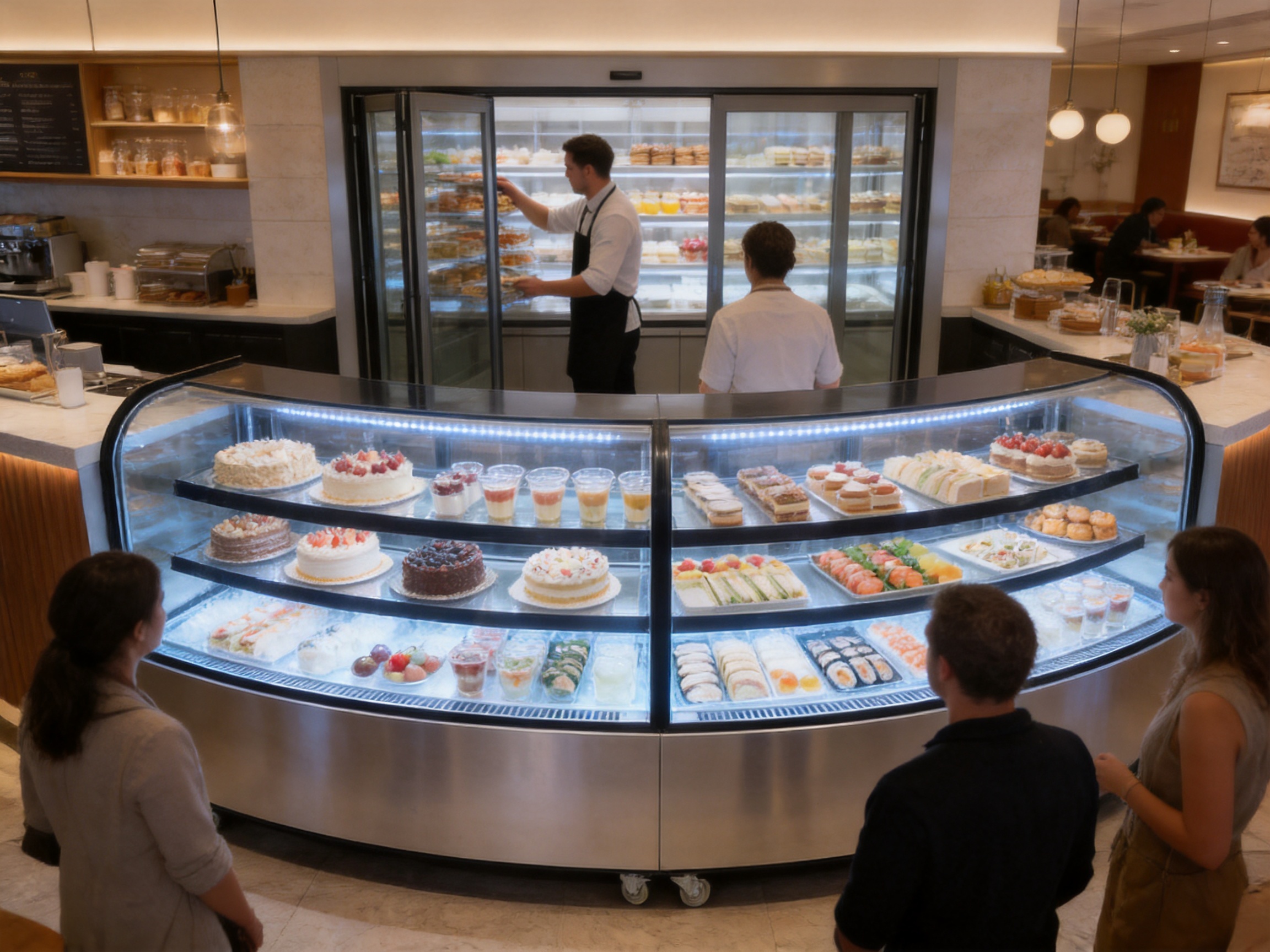
This cake showcase is intended for products that need controlled chilled storage while remaining visible to customers. Cakes, pastries, desserts, sandwiches, prepared foods, sushi, dairy-based products, and other temperature-sensitive items can be displayed behind clear glass while the cabinet maintains a stable refrigerated environment. The combination of presentation, accessibility, mobility, and cooling performance makes the unit suitable for businesses that need a dependable display cabinet without occupying the floor space of a large walk-in or multi-door refrigerator.
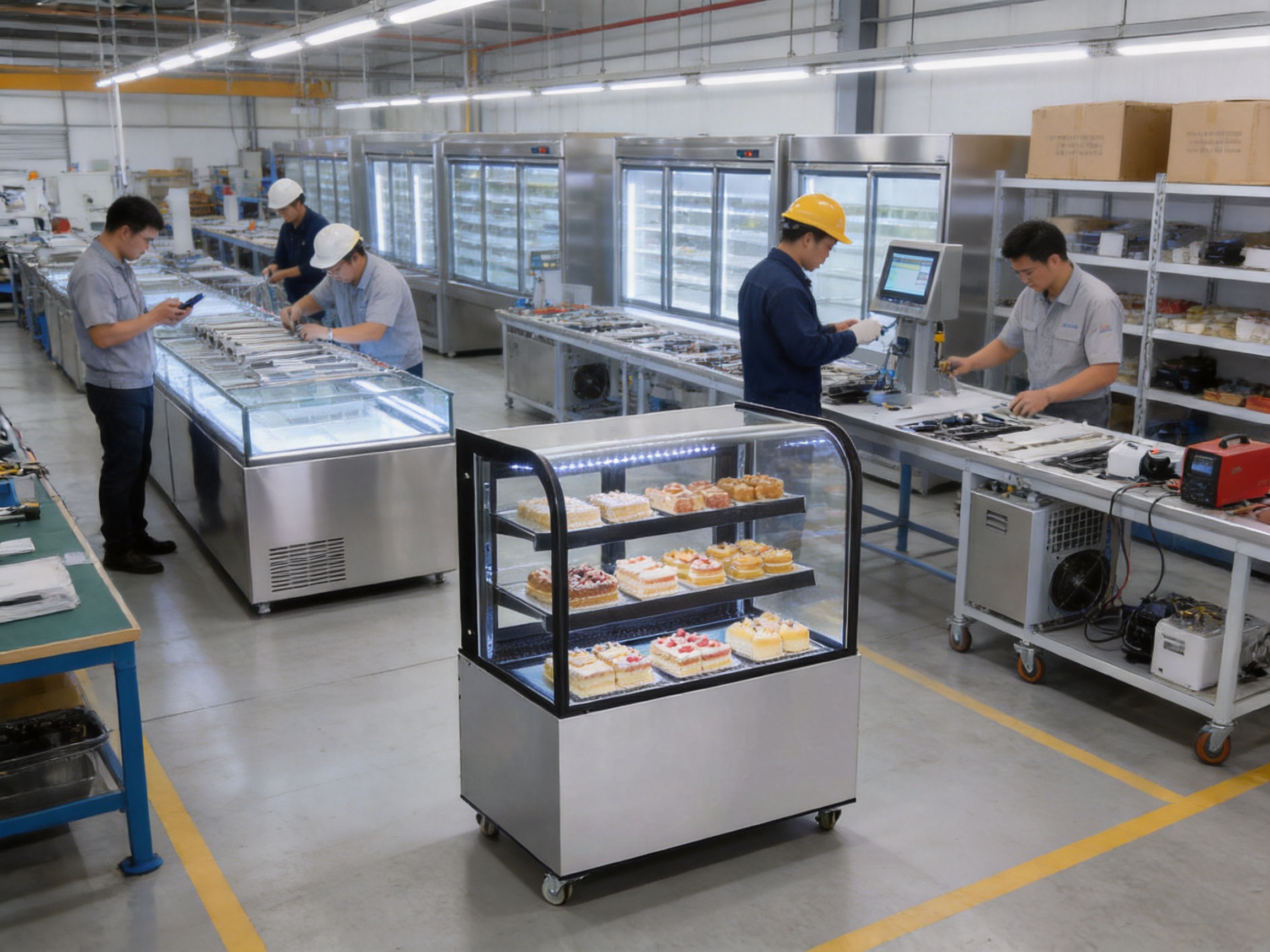
The cabinet is manufactured by Ningbo XiangChi Electrical Co., Ltd., a professional producer of vertical display cabinets, cake cabinets, and warming cabinets. The company has operated since 2007 and has developed a 40,000-square-meter modern factory, dedicated research and development resources, advanced testing facilities, and production lines intended to support consistent quality and continuous product improvement. These capabilities are important because commercial refrigeration equipment must meet demanding expectations for performance, reliability, safety, appearance, and ease of maintenance.
Product Overview
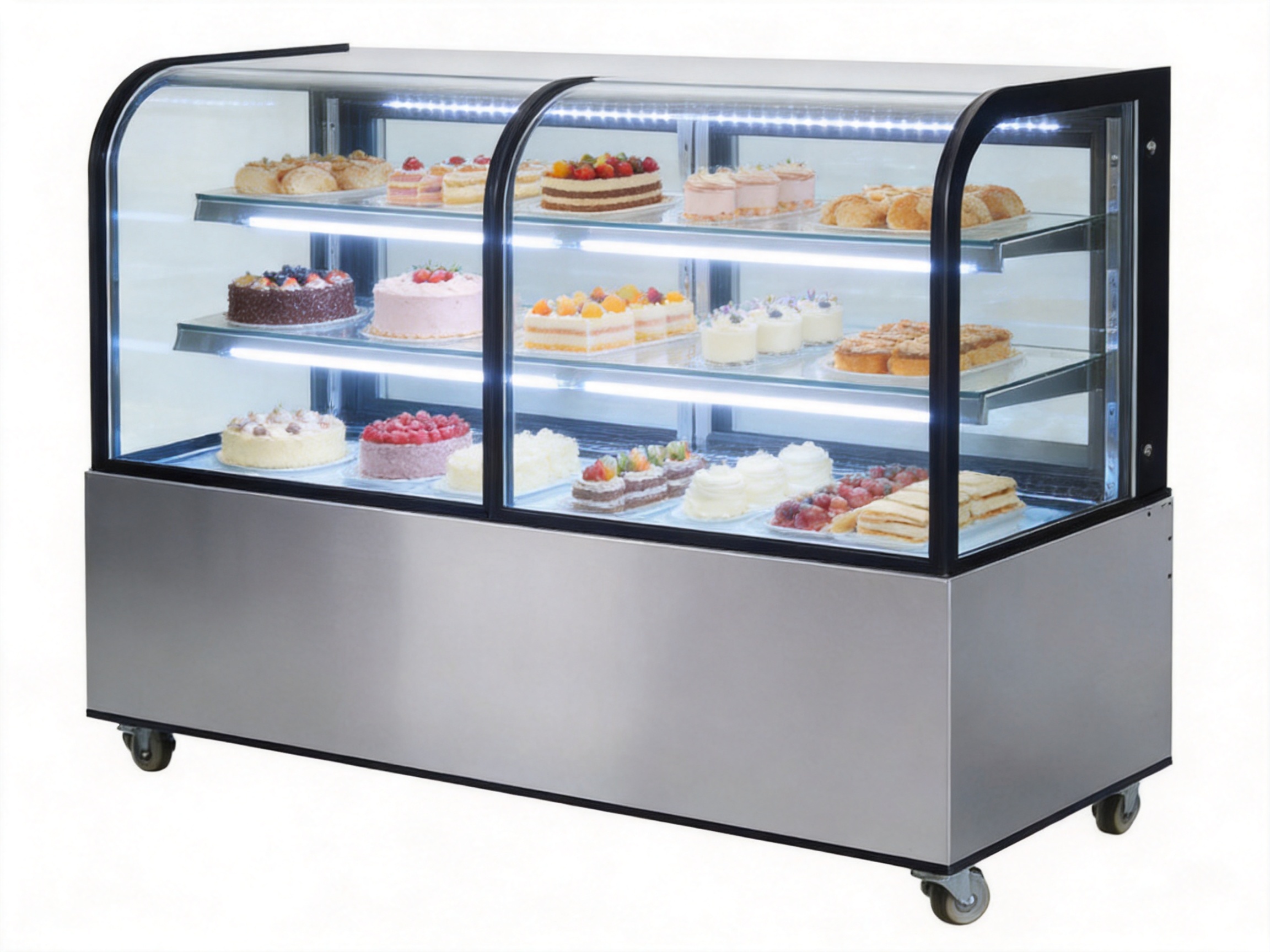
The XC-270Y/Z is a refrigerated bakery showcase with a stainless steel base and a glass display enclosure. Its 270-liter internal capacity offers enough room for a practical range of retail products while retaining a relatively compact footprint. The product measures 940 millimeters in width, 686 millimeters in depth, and 1,415 millimeters in height. This vertical format allows the cabinet to make good use of limited commercial floor space and gives customers a clear viewing angle from the front.
The cabinet operates within a temperature range of 2–8°C. This range is suitable for many chilled bakery and prepared-food applications, especially products that benefit from cold storage but need to remain visually accessible. A digital thermostat and display allow operators to monitor and adjust the operating temperature more conveniently than with a basic mechanical control system.
Three LED light bars illuminate the interior. Lighting is a particularly important feature in a cake and bakery display because customers often make purchasing decisions based on color, decoration, texture, and freshness. Appropriate interior lighting helps products stand out without requiring the operator to open the doors. The result is a more attractive presentation and less unnecessary exposure of the cabinet interior to ambient air.
The showcase includes two glass shelves. These shelves divide the interior into practical display levels, allowing operators to organize products by type, size, flavor, price, or serving occasion. A carefully arranged multi-level presentation can make a cabinet look fuller and more appealing while allowing staff to use the available capacity efficiently.
Double tempered glass provides a combination of visibility, strength, and improved protection in a demanding commercial environment. The glass enclosure allows customers to inspect products clearly while helping separate the refrigerated interior from the surrounding room. Tempered glass is also better suited to commercial use than ordinary untreated glass because it is processed for improved resistance to daily handling and temperature changes.
The rear sliding glass doors are designed for smooth operation. Staff can open the rear of the cabinet to replenish products, rearrange shelves, clean the interior, and serve customers from behind the counter. Sliding doors are especially practical where the cabinet is placed close to another piece of equipment or behind a service counter, because they do not require the clearance needed by hinged doors.
Product Attribute | Specification |
Model | XC-270Y/Z |
Category | Refrigerated cake and bakery showcase |
Capacity | 270 liters |
Temperature range | 2–8°C |
Input power | 480 watts |
Refrigerant options | R134a or R290 |
Climate type | 4 |
Net weight | 135 kilograms |
Gross weight | 154 kilograms |
Product dimensions | 940 × 686 × 1,415 millimeters |
Package dimensions | 1,025 × 765 × 1,530 millimeters |
Why Refrigerated Display Matters for Bakery Retail
Bakery products are often purchased with the eyes before they are purchased with the wallet. A decorated cake, cream pastry, fruit tart, dessert cup, or specialty sandwich must be easy to see and visually appealing. A closed storage refrigerator may protect the product, but it does not create the same sales opportunity as a well-organized display cabinet. A refrigerated showcase combines preservation with presentation, allowing the product to remain visible during the entire customer journey.
For businesses selling cakes and chilled desserts, temperature control can be essential to maintaining shape, texture, and appearance. Cream, mousse, custard, fruit toppings, chocolate decorations, and dairy fillings may be affected by heat and prolonged exposure to room conditions. A cabinet operating from 2–8°C helps create a controlled environment for these products, subject to the specific storage requirements of the food being displayed.
Refrigerated display also supports better merchandising. Products can be arranged according to best-selling status, seasonal promotion, product size, or customer occasion. The two shelves provide vertical separation, while the illuminated interior makes the products easier to compare. This can help staff explain product differences and make it easier for customers to select an item without repeatedly opening a storage unit.
Another benefit is operational separation. Stock can be stored in a larger back-of-house refrigerator, while the showcase holds the selection intended for immediate sale. This approach can make the sales area more organized and reduce the need for staff to retrieve every item from a separate refrigerator. The cabinet therefore contributes not only to food presentation but also to service efficiency.
Core Advantages Compared with Basic Display Refrigerators
Stable Refrigerated Display
The XC-270Y/Z uses a ventilated cooling system to circulate chilled air through the display compartment. Compared with a simple static cooling arrangement, ventilated cooling is designed to distribute cold air more evenly across the cabinet. This is valuable in a display unit with several levels because products placed on different shelves should be kept within an appropriate chilled environment.
The 2–8°C operating range gives the operator a useful control window for chilled bakery and food products. The digital thermostat and display make the cabinet easier to supervise during normal operation. Staff can check the displayed temperature as part of opening routines, product replenishment, cleaning procedures, and closing inspections.
Clear Product Visibility
The double tempered glass enclosure is a major presentation feature. It protects the products from direct contact with the surrounding environment while allowing customers to see the merchandise from outside. Unlike an opaque refrigerator, the glass showcase can function as a sales display throughout the day.
Three LED light bars improve interior visibility and help present products in a clean, attractive way. LED lighting is well suited to display equipment because it provides bright illumination in a compact format. It also avoids the visual clutter of bulky traditional lighting fixtures, leaving more attention on the products themselves.
Practical Staff Access
Smooth rear sliding glass doors give service staff access from the working side of the counter. This arrangement supports quick replenishment and serving without forcing staff to move the entire cabinet or interrupt the customer-facing area. The sliding design is also useful in compact shops where space in front of the display is limited.
Because the doors slide rather than swing outward, the operator can position the showcase in a relatively tight service line. This can be an advantage over display refrigerators with large hinged doors, particularly in cafés, bakeries, hotel breakfast areas, and retail counters where several pieces of equipment may be placed side by side.
Efficient Use of Floor Space
The vertical cabinet format makes the 270-liter capacity accessible without requiring a wide footprint. Its width of 940 millimeters offers a substantial display area while remaining suitable for many counter or service-line layouts. The cabinet can be used as a dedicated cake showcase or as part of a broader merchandising arrangement that includes other refrigerated, frozen, or heated display equipment.
Four castors make the cabinet easier to reposition during installation, cleaning, store renovation, or changes in product layout. Two castors include brakes, helping operators stabilize the unit after it has been placed in the desired position. Mobility is especially useful for businesses that regularly deep-clean the sales area or change their service configuration.
Professional Stainless Steel Construction
The stainless steel base provides a clean commercial appearance and supports practical daily use. Stainless steel is widely used in food-service equipment because it is durable, visually professional, and easier to wipe down than many porous or heavily textured materials. The base also gives the cabinet a solid appearance that suits modern bakeries, restaurants, supermarkets, and hospitality environments.
The combination of stainless steel and glass creates a product that can fit into different interior styles. It can complement polished café counters, stainless steel kitchen equipment, contemporary bakery interiors, hotel service areas, and supermarket departments. A professional appearance is important because the display cabinet is part of the customer-facing environment, not merely a back-room appliance.
Detailed Feature Analysis
Digital Thermostat and Temperature Display
Temperature visibility is one of the most important operating functions of a commercial refrigerated showcase. The digital thermostat and display provide a clear reference for the operator and make temperature management more direct. Instead of relying only on the appearance or condition of the products, staff can observe the cabinet’s displayed temperature and respond when adjustments or service checks are needed.
Digital control also supports more consistent operation across different working shifts. Employees can use the same displayed information when opening the shop, checking the cabinet during service, or preparing for closing. Clear controls reduce uncertainty and can contribute to more disciplined food-handling procedures when combined with the operator’s own monitoring and sanitation practices.
Ventilated Cooling System
The ventilated cooling system is intended to move refrigerated air through the cabinet rather than relying only on naturally occurring cold air movement. In a multi-level showcase, this can help support a more consistent environment from one display position to another. It is an appropriate approach for a cabinet where products are arranged across shelves and need to remain visible and chilled throughout the operating day.
Ventilated cooling can also help the cabinet recover after routine door opening. Every time the rear sliding doors are opened for replenishment or service, some conditioned air is exchanged with the surrounding air. Air circulation supports the return of the cabinet to its operating condition, although actual performance depends on ambient temperature, loading, door-opening frequency, product temperature, and installation conditions.
Automatic Defrost
Automatic defrost reduces the need for staff to stop operation and manually remove accumulated frost from the cooling system. In a commercial setting, manual defrost can be disruptive because it may require products to be temporarily transferred to another refrigerator. An automatic defrost function supports a more convenient routine and helps the operator maintain the cabinet with less interruption.
Automatic defrost does not eliminate the need for cleaning and inspection. Staff should still follow the equipment manual, keep air passages clear, check door and glass condition, and maintain good hygiene practices. The feature is best understood as a way to simplify routine refrigeration management rather than as a replacement for proper maintenance.
Separated Power Button
The separated power button provides a straightforward way to control the cabinet independently. This can be helpful when staff need to stop the unit for cleaning, relocation, servicing, or other procedures. A clearly separated control also makes the operating interface easier to understand for employees who may not be familiar with more complicated refrigeration controls.
Refrigerant Options
The cabinet is specified for R134a or R290 refrigerant, depending on the selected configuration and applicable market requirements. Offering refrigerant options can help address different regional standards, customer specifications, and project conditions. The correct refrigerant configuration should always be confirmed with the supplier before ordering, especially when equipment is being prepared for export or installation in a market with specific regulatory requirements.
Refrigerant selection is only one part of overall refrigeration performance. Compressor matching, insulation, airflow design, temperature controls, condenser maintenance, installation conditions, and loading practices all influence actual operation. The manufacturer’s technical specifications and service instructions should therefore be used when selecting, installing, and maintaining the equipment.
Applications Across Commercial Food Environments
Bakeries and Pastry Shops
The most direct application is the display of cakes, pastries, tarts, mousse desserts, cream products, and other chilled bakery items. The two glass shelves allow a bakery to create a layered presentation, with larger cakes on one level and individual desserts or packaged items on another. The LED lighting helps decorations and colors remain visible, while the temperature range supports chilled storage during business hours.
A bakery can also use the showcase for seasonal products. Holiday cakes, celebration desserts, fruit pastries, gift boxes, and limited-edition items can be placed in the most visible positions. Since the cabinet is customer-facing, staff can change the display according to the day’s production schedule or promotional plan.
Cafés and Coffee Shops
Cafés often need a compact display for cakes, sandwiches, chilled desserts, yogurt products, and ready-to-serve snacks. The XC-270Y/Z can be placed behind a service counter where staff serve products from the rear. The vertical design helps cafés use display height without consuming excessive counter-line width.
In a café, product visibility can encourage impulse purchases. Customers ordering coffee may notice a cake slice or dessert that they had not originally planned to buy. A well-lit refrigerated display supports this type of cross-selling while keeping products organized and protected behind glass.
Restaurants and Hotels
Restaurants can use the showcase for desserts, prepared cold dishes, appetizers, or specialty products offered near the entrance or service counter. Hotels may use it in breakfast areas, banquet preparation zones, lobby cafés, or dessert stations. The stainless steel base suits professional hospitality settings where equipment must look clean and consistent with the surrounding service environment.
Because the cabinet has castors, it can be repositioned when a restaurant changes its dining-room layout or prepares for a special event. The two lockable castors help keep it steady during use, while the remaining castors support movement when the unit must be cleaned or relocated.
Supermarkets and Convenience Retail
Supermarkets and convenience stores can use the unit for chilled bakery items, packaged desserts, sandwiches, prepared foods, and grab-and-go products. The glass front allows merchandise to remain visible from customer pathways, while the rear sliding doors allow replenishment from the staff side.
The 270-liter capacity offers a practical middle ground between a small countertop refrigerator and a large multi-door cabinet. It may be suitable for stores that need a dedicated specialty display but do not require a full wall of refrigeration. The exact product mix and expected sales volume should be considered when determining whether one unit or several units are appropriate.
Sushi and Prepared-Food Counters
Although primarily described as a bakery showcase, the cabinet’s chilled display format can also support selected sushi, cold meal, dessert, and prepared-food applications. Businesses should confirm that the product temperature requirements, packaging method, hygiene procedures, and local food regulations are appropriate for their intended use.
Clear glass and interior lighting are valuable for prepared foods because customers want to inspect portion size, ingredients, color, and arrangement before purchase. The shelves can separate different product categories, such as individual meals, side dishes, desserts, or packaged beverages.
Manufacturing Strengths Behind the Product
Established Industry Experience
Ningbo XiangChi Electrical Co., Ltd. was established in 2007 and has more than ten years of experience in the commercial refrigeration and display equipment field. Experience does not replace technical verification, but it provides a foundation for understanding recurring customer requirements, product usage conditions, manufacturing challenges, and international market expectations.
A manufacturer with a focused product history can refine details that matter in daily operation, including cabinet proportions, shelf arrangement, glass installation, control placement, castor selection, lighting integration, and service access. These details collectively influence whether a showcase is merely functional or genuinely convenient for commercial users.
Modern Factory Infrastructure
The company operates a modern management garden factory covering 40,000 square meters. A facility of this scale can support organized material handling, dedicated production areas, product assembly, testing, warehousing, and quality management. Commercial refrigeration equipment involves multiple processes, so coordination between these areas is important for consistent output.
Factory infrastructure also supports production flexibility. A manufacturer serving international customers may need to manage different voltage requirements, refrigerant configurations, packaging specifications, labeling expectations, and market certifications. Organized production and quality systems make it easier to handle these requirements in a controlled way.
Professional Research and Development
The manufacturer has its own professional research and development team. For a refrigerated display cabinet, research and development may involve more than creating an attractive exterior. It can include airflow arrangement, temperature control, refrigeration component matching, glass configuration, lighting placement, shelf support, cabinet insulation, user access, and ease of cleaning.
Continuous product development is especially important in commercial refrigeration because customers expect equipment to combine performance with practical operating cost. Product improvements may focus on better temperature stability, more convenient controls, stronger materials, improved presentation, simpler maintenance, or compatibility with changing market and environmental expectations.
Advanced Testing Facilities
Advanced testing facilities help a manufacturer evaluate products before they reach customers. Testing can support assessment of cooling operation, temperature performance, electrical functions, structural fit, lighting, door movement, packaging integrity, and other production requirements. The specific tests applied depend on the product design and applicable standards, but the presence of testing resources demonstrates a commitment to verification rather than relying only on visual inspection.
Testing is particularly important for a glass refrigerated showcase because several systems must work together. The cabinet must display products clearly, maintain refrigeration, illuminate the interior, support shelves, allow smooth door operation, and remain stable on its castors. A structured evaluation process helps identify issues earlier in the manufacturing cycle.
International Certification Capability
The company has obtained CE, GS, CCC, CB, RoHS, ETL, and other major certifications. Certification requirements vary by market and product configuration, so buyers should confirm the exact certification coverage for the model and destination country. Nevertheless, experience with international certification demonstrates familiarity with global compliance expectations and export-oriented product preparation.
Certification capability can also make project communication more efficient. Importers, distributors, retailers, and commercial contractors often require technical files, safety information, product labels, test documentation, or compliance declarations. A manufacturer accustomed to international markets is better positioned to discuss these requirements at the quotation and ordering stages.
Production Process and Quality Considerations
Material Preparation and Cabinet Fabrication
A commercial showcase begins with the selection and preparation of materials. Stainless steel panels, glass components, shelves, insulation materials, electrical parts, refrigeration components, lighting assemblies, castors, and hardware must be matched to the intended cabinet design. Accurate cutting, forming, and preparation help ensure that panels fit correctly and that the finished cabinet has clean lines.
Stainless steel fabrication requires attention to surface quality, edge finishing, alignment, and joint construction. A commercial customer expects the visible base to look professional while also tolerating repeated wiping, movement, and contact with the surrounding service environment. Consistent fabrication contributes to both appearance and long-term usability.
Insulation and Refrigeration Assembly
The refrigerated compartment depends on the correct integration of insulation, evaporating components, airflow channels, controls, and refrigeration machinery. Poor coordination between these elements can reduce cooling consistency or increase operating difficulty. A dedicated production process allows technicians to assemble the refrigeration system according to the cabinet design and verify that components operate together.
The 480-watt input power specification provides a reference for electrical planning and installation. Actual energy consumption can vary depending on ambient conditions, operating duration, loading, door opening, temperature settings, and maintenance. Buyers should use the manufacturer’s technical documentation when evaluating electrical capacity and operating costs for a particular site.
Glass Installation and Door Adjustment
Glass is central to the showcase’s function and appearance. Double tempered glass must be installed securely and aligned correctly so that customers receive an unobstructed view and staff can use the rear sliding doors smoothly. Door movement, sealing, track alignment, and hardware fit are all important for daily operation.
Smooth sliding doors are especially valuable in busy shops. Staff may open and close them frequently during replenishment and service, so resistance, alignment, and handle placement affect the working experience. Factory inspection of door operation can help ensure that the cabinet is ready for commercial use after installation.
Electrical and Lighting Integration
The digital thermostat, temperature display, LED light bars, power button, and refrigeration controls must be wired and positioned correctly. Electrical assembly should be carried out with attention to safety, insulation, connection reliability, and service accessibility. Lighting should illuminate the shelves without creating unnecessary glare that would make it difficult for customers to view the products.
Separating the power button from other controls gives the operator a simple primary control point. Combined with the digital display, it provides a straightforward interface suitable for daily retail operation. Clear control design is valuable in businesses where several employees may share responsibility for the equipment.
Final Inspection and Packaging
Before shipping, the cabinet must be checked for visible damage, component completeness, glass condition, shelf placement, door operation, castor movement, electrical function, and packaging stability. The product has a net weight of 135 kilograms and a gross shipping weight of 154 kilograms, so appropriate handling equipment and procedures are necessary during transport and installation.
The package dimensions are 1,025 × 765 × 1,530 millimeters. These dimensions should be considered when planning warehouse storage, delivery access, elevator use, doorway clearance, and final positioning. Confirming logistics conditions before shipment can reduce installation delays and prevent avoidable handling problems.
Installation and Operating Recommendations
The showcase should be installed on a stable, level surface with sufficient clearance for ventilation, service access, and door operation. It should not be positioned where surrounding equipment blocks air movement or where direct heat sources place an excessive load on the refrigeration system. The installation site should also provide an appropriate electrical supply that matches the product specification and local requirements.
After positioning the cabinet, the castors should be checked and the two braking castors engaged where appropriate. The unit should be allowed to stabilize according to the manufacturer’s instructions before being loaded with products. Staff should avoid placing hot food directly into the refrigerated showcase because this can increase the internal temperature and place additional demand on the cooling system.
Products should be arranged so that air circulation is not blocked. The two shelves should be loaded with attention to product height, package shape, customer visibility, and airflow. Overloading the cabinet may reduce cooling performance and make the display appear crowded. A balanced presentation usually provides better visibility and easier staff access.
Operators should monitor the digital temperature display as part of their routine. Door opening should be limited to the time needed for service and replenishment. The glass, shelves, door tracks, and stainless steel base should be cleaned using methods suitable for commercial food equipment. Abrasive materials and unsuitable chemicals should be avoided if they could damage the finish or glass.
Regular maintenance should include inspection of the condenser area, air passages, door tracks, shelf supports, castors, electrical controls, and visible seals or fittings. The automatic defrost function reduces manual work, but it does not remove the need for general cleaning and technical inspection. Any unusual noise, temperature change, condensation issue, or control problem should be investigated promptly.
Value for Distributors and Commercial Buyers
For distributors, a product with multiple applications can be easier to position across different customer segments. The XC-270Y/Z can be promoted to bakeries, cafés, restaurants, hotels, supermarkets, convenience stores, and prepared-food retailers. Its combination of cake display capability and broader chilled-food usefulness gives distributors flexibility when developing product lines.
The equipment also offers a clear specification profile for quotation and project planning. Capacity, temperature range, input power, dimensions, weight, refrigerant options, climate type, shelf count, lighting, glass type, cooling system, and mobility features can all be communicated to customers. Detailed specifications help buyers compare products based on actual operating requirements rather than appearance alone.
Commercial buyers can also evaluate the product according to total workflow. The cabinet supports customer visibility from the front, staff access from the rear, movement during cleaning, temperature monitoring during operation, and organized product presentation across two shelves. These workflow benefits can be as important as the refrigeration system itself in a busy retail environment.
Comparison with Alternative Display Formats
Compared with an ordinary upright storage refrigerator, the refrigerated bakery showcase is designed for customer-facing presentation. Transparent glass, interior LED lighting, and shelves make products easier to see and select. A storage refrigerator may provide greater bulk capacity, but it usually does not offer the same merchandising value.
Compared with an open display cooler, the glass enclosure provides a more protected refrigerated space. Open displays can offer quick customer access, but they may expose products to more surrounding air and require careful management of airflow and temperature. The sliding glass doors of this model allow staff access while keeping the front of the display enclosed.
Compared with a small countertop refrigerator, the 270-liter capacity and 1,415-millimeter height provide more vertical display space. The cabinet can present multiple product levels and a broader selection while retaining a manageable footprint. It may therefore be appropriate for businesses that have outgrown a compact countertop unit but do not need a large wall-mounted cabinet.
Compared with a heated showcase, this unit is designed for chilled products rather than hot holding. Bakeries and food retailers may use both types of equipment in the same business, placing chilled cakes and desserts in a refrigerated display while using a warming cabinet for products that require heat. Selecting the correct display temperature is essential for food quality and safe operation.
Frequently Asked Questions
What products can be displayed in this showcase?
The unit is suitable for many chilled bakery products, including cakes, pastries, cream desserts, mousse products, fruit tarts, and dessert cups. It may also be used for selected sandwiches, prepared foods, sushi, dairy-based products, and other chilled merchandise when the product temperature requirements are compatible with the 2–8°C operating range and local food regulations.
What is the capacity of the cabinet?
The nominal capacity is 270 liters. Actual usable display space depends on the size and arrangement of the products, the position of the two glass shelves, and the amount of space required for proper air circulation.
How many shelves are included?
The standard configuration includes two glass shelves. These shelves create multiple display levels and can be used to separate products by type, size, price, or sales category.
Does the cabinet have interior lighting?
Yes. The standard features include three LED light bars. These lights improve product visibility and support a more attractive presentation in bakery, café, restaurant, hotel, and retail environments.
Is the glass tempered?
Yes. The standard configuration uses double tempered glass. This provides a clear display enclosure designed for the demands of commercial use, while the double-glass construction helps separate the refrigerated interior from the surrounding environment.
How do staff access the products?
Staff access the cabinet through smooth rear sliding glass doors. This arrangement is convenient for service counters because employees can replenish and serve products from the working side without opening the customer-facing area.
What temperature can the cabinet maintain?
The specified temperature range is 2–8°C. Actual operating performance depends on ambient conditions, loading, installation, door-opening frequency, product temperature, maintenance, and correct use of the equipment.
Does the cabinet have automatic defrost?
Yes. Automatic defrost is included as a standard feature. It helps reduce the need for manual defrosting interruptions, although routine cleaning, inspection, and maintenance remain necessary.
Can the cabinet be moved?
Yes. The unit includes four castors, two of which have brakes. The castors support movement during installation, cleaning, or layout changes, while the brakes help stabilize the cabinet during normal operation.
What are the product dimensions?
The product measures 940 millimeters wide, 686 millimeters deep, and 1,415 millimeters high. Buyers should also consider delivery routes, doorways, elevators, service clearances, and the package dimensions before ordering.
What refrigerants are available?
The listed refrigerant options are R134a and R290. The applicable option should be confirmed when placing an order because requirements can differ according to model configuration, destination market, regulations, and customer preference.
What certifications does the manufacturer have experience with?
The manufacturer has obtained CE, GS, CCC, CB, RoHS, ETL, and other major certifications. Buyers should request the current technical and compliance documents for the exact model and intended market.
What should be checked before installation?
Before installation, buyers should check the available space, floor stability, ventilation clearance, electrical supply, delivery route, package dimensions, and service access. The cabinet should be positioned level and away from excessive heat sources or conditions that could overload the refrigeration system.
Conclusion
The XC-270Y/Z stainless steel refrigerated bakery showcase combines chilled storage with effective product presentation. Its 270-liter capacity, 2–8°C temperature range, ventilated cooling, digital thermostat, automatic defrost, double tempered glass, three LED light bars, two glass shelves, rear sliding doors, stainless steel base, and four castors create a practical specification for professional food retail.
Its main advantage over basic storage refrigeration is the way it supports the entire sales process. Products remain visible, illuminated, organized, and accessible while being kept in a controlled refrigerated environment. The cabinet is suitable for bakeries and cake shops, but its application can extend to cafés, restaurants, hotels, supermarkets, convenience stores, sushi counters, and prepared-food retailers.
The product is also supported by the manufacturing strengths of Ningbo XiangChi Electrical Co., Ltd. The company’s experience since 2007, 40,000-square-meter factory, professional research and development team, advanced testing facilities, international certification experience, and focus on innovation, quality, and service provide a foundation for commercial equipment production.
For businesses seeking a professional display cabinet that combines refrigeration, merchandising, mobility, and stainless steel durability, this model offers a well-rounded solution. Final selection should be based on the intended food products, local regulations, installation environment, electrical requirements, refrigerant configuration, and expected operating conditions.

Stainless Steel Refrigerated Bakery Showcase Cake Showcase
References
1. Product Technical Specification Sheet, Model XC-270Y/Z, refrigerated bakery showcase.
2. Commercial Refrigeration Equipment Installation and Maintenance Principles.
3. Food Retail Display Design and Chilled Product Merchandising Practices.
4. Tempered Glass Applications in Commercial Food-Service Equipment.
5. General Guidance for Refrigerated Storage of Cakes, Pastries, Prepared Foods, and Chilled Desserts.
6. Manufacturer Information for Ningbo XiangChi Electrical Co., Ltd., including company history, factory capability, research and development resources, testing facilities, and certification experience.
Product: Stainless Steel Refrigerated Bakery Showcase Cake Showcase

You May Also Like





-
- Navigation
- Home
- About Us
- Products
- News
- Contact Us
 East Zone, Guanhaiwei Industrial Park, Cixi City, Ningbo, Zhejiang, China
 +86-574-63668678
 +86-574-63668108

Copyright © Ningbo XiangChi Electrical Co.,Ltd All Rights Reserved.
