
 简体中文
简体中文 English
 Español
News
Automatic Defrost LED Countertop Display Cooler for Cakes, Desserts, and Fresh Food Merchandising
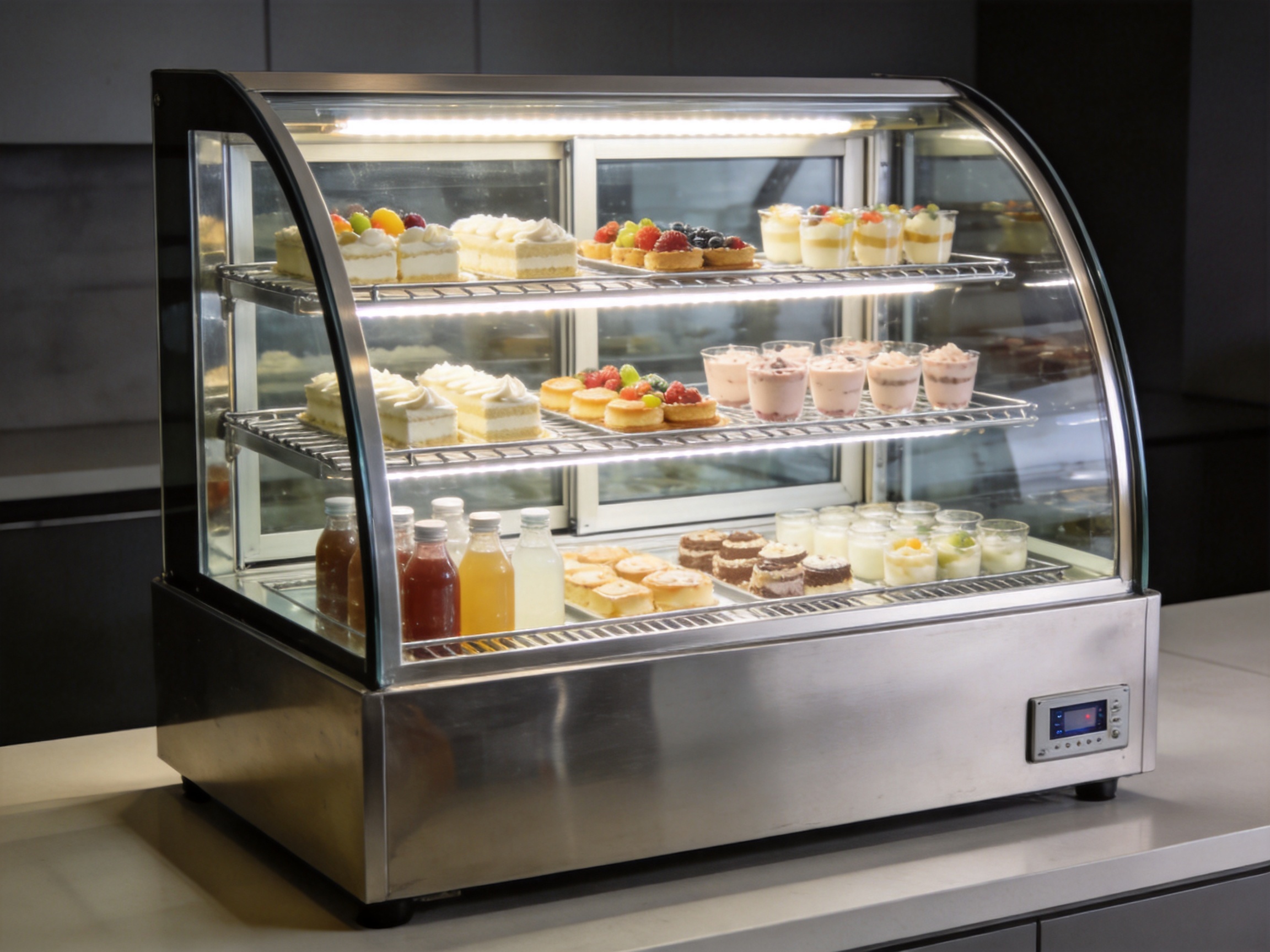
In modern food retail, presentation and temperature control are inseparable. A cake, dessert, sushi pack, dairy snack, bottled drink, or ready-to-eat item must not only look attractive; it must also be stored within a stable and safe temperature range. The Automatic Defrost LED Lighting Countertop Display Cooler, model XCW-160Z, is designed for businesses that need a compact yet professional refrigerated showcase for front-of-house merchandising. With a 172-liter capacity, a 2°C to 10°C temperature range, internal strip LED lighting, digital thermostat control, adjustable chromed shelves, back sliding glass doors, double-layer curved tempered front glass, ventilated cooling, and automatic defrost, it provides a balanced combination of visibility, preservation, ease of use, and countertop efficiency.
This display cooler is particularly suitable for cake shops, cafés, bakeries, convenience stores, dessert bars, beverage counters, hotel breakfast areas, sushi takeaway shops, and commercial foodservice locations that require chilled display in limited floor space. Instead of occupying the footprint of a large vertical cabinet, it is designed for countertop placement, allowing products to be presented at eye level and within easy reach. This makes it a strong solution for impulse purchasing, premium dessert presentation, and compact retail layouts where every square meter matters.
Compared with ordinary countertop refrigerators, the XCW-160Z emphasizes merchandising quality as much as refrigeration performance. The curved front tempered glass gives products a polished appearance, while the internal LED lighting makes colors, textures, toppings, and packaging details easier to see. The ventilated cooling system helps distribute cold air more evenly throughout the cabinet, which is important for products displayed on multiple shelves. The automatic defrost function reduces the need for manual maintenance and helps keep visibility clear, supporting both product appeal and operational convenience.
For commercial buyers, a display cooler is not just an appliance; it is a revenue-supporting tool. The right cooler can improve product rotation, reduce spoilage, strengthen brand image, and make staff operations easier. This article explores the XCW-160Z countertop display cooler in detail, including its technical specifications, practical benefits, competitive advantages, manufacturing background, quality considerations, application scenarios, and frequently asked questions.
Product Overview
The XCW-160Z is a countertop refrigerated display cooler with a nominal capacity of 172 liters. It is engineered for chilled food and beverage presentation within a temperature range of 2°C to 10°C. This range is well suited for many retail display products such as cakes, pastries, cream desserts, chilled snacks, bottled drinks, yogurt, salads, sandwiches, fruit cups, and selected packaged ready-to-eat foods. The design combines a compact body with a broad viewing area, helping businesses display a variety of products without requiring a full-size floor-standing cabinet.
The unit uses internal strip LED lights to illuminate the display area. LED lighting is especially valuable for desserts and cakes because it enhances visual contrast without generating excessive heat inside the cabinet. Compared with older lighting systems, LED lamps generally offer lower energy consumption, longer service life, and better visual clarity. For a commercial shop where lighting may remain on for many operating hours each day, this can contribute to both appearance and efficiency.
A digital thermostat and display allow operators to monitor and adjust the cooling environment more accurately than with a simple mechanical control. This is important in commercial settings where product quality, food safety, and consistency matter. The operator can check the cabinet temperature at a glance, and the digital control helps maintain a suitable display environment for chilled goods.
The cooler includes adjustable chromed shelves. Shelf adjustability gives operators flexibility when displaying products of different heights, such as tall cake slices, dessert cups, small beverage bottles, packaged sandwiches, or trays of pastries. Chromed shelves also provide a clean, professional appearance that fits well in food retail environments. The back sliding glass doors allow staff to access items from the service side while keeping the customer-facing front visually clean and uninterrupted.
The front curved tempered glass is double-layered, which enhances both appearance and performance. Curved glass creates a premium display effect by reducing the box-like look of ordinary cabinets. Tempered glass offers improved strength compared with standard glass, and the double-layer structure supports insulation and helps reduce temperature loss. This feature is especially important for stores where the cooler is placed near customers, counters, or service areas.
Core Technical Specifications
The following table summarizes the main specifications of the XCW-160Z countertop display cooler.
Item |
Specification |
Model |
XCW-160Z |
Capacity |
172 L |
Temperature Range |
2°C to 10°C |
Input Power |
240 W |
Refrigerant |
R134a or R600a |
Climate Type |
4 |
Net Weight |
66 kg |
Gross Weight |
70 kg |
Product Size |
888 mm × 568 mm × 686 mm |
Package Size |
951 mm × 627 mm × 735 mm |
Container Loading, 20 GP |
63 units |
Container Loading, 40 HP |
126 units |
These specifications show that the cooler is designed as a compact commercial unit rather than a domestic appliance. The 172-liter capacity provides practical merchandising volume, while the 888 mm width allows the unit to fit on many counters and service stations. The 240 W input power indicates a focus on efficient commercial operation, and the temperature range supports the display of many chilled items commonly sold in cafés, bakeries, convenience stores, and foodservice outlets.
Designed for Countertop Merchandising
Countertop display cooling has several important advantages. First, it places products directly in the customer’s field of vision. When a dessert cabinet is located on or behind a counter, customers can easily see cakes, pastries, fruit cups, beverages, or packaged snacks while ordering. This increases the chance of add-on sales. A customer who enters a café for coffee may decide to buy a slice of cake when the product is clearly displayed and attractively lit.
Second, countertop placement saves valuable floor space. Many food businesses operate in compact premises, especially bakeries, kiosks, takeaway shops, coffee bars, hotel lounges, and convenience counters. A full-height cabinet may not be practical in such environments. A countertop cooler allows chilled display without redesigning the store layout or sacrificing customer movement areas.
Third, countertop display improves staff efficiency. The back sliding glass doors allow service staff to access products quickly from behind the counter. Staff do not need to walk around a front-opening unit, and customers do not handle the products directly. This supports hygiene, speed, and better control of inventory. In busy environments, these small operational advantages can significantly improve service flow.
Fourth, a countertop cooler helps create a premium presentation zone. Cakes and delicate desserts often benefit from being displayed separately from general beverages or packaged goods. The curved glass and bright internal lighting make the cabinet look like a showcase rather than simply a refrigerator. For businesses that rely on product appearance, this can support a stronger brand impression.
LED Lighting for Better Product Visibility
Lighting is one of the most important factors in refrigerated display. A product may be fresh and well prepared, but if it is poorly lit, customers may not notice it. The XCW-160Z uses internal strip LED lights to improve product visibility throughout the cabinet. LED lighting helps highlight the color of fruit toppings, chocolate layers, cream textures, decorative details, packaging labels, and beverage colors.
Compared with fluorescent lighting, LED lighting can offer several commercial benefits. It produces less heat, which is useful in a refrigerated environment. Excess heat from lighting can make the refrigeration system work harder, especially in compact cabinets. LED systems also typically consume less electricity and have a longer service life, reducing replacement frequency. For operators, this means lower maintenance effort and a more consistent appearance over time.
LED lighting also contributes to customer psychology. Bright, clean illumination suggests freshness and care. In dessert sales, visual appeal is often the deciding factor. A well-lit cake showcase can make products look more premium, encourage impulse purchases, and improve perceived value. For cafés and bakeries, this may help justify premium pricing and support a better customer experience.
Because the lighting is internal, the display is not dependent only on shop lighting conditions. Even if the store has warm ambient lighting, dim corners, or changing daylight exposure, the cabinet can still provide consistent product illumination. This is especially useful in shopping malls, hotel service areas, and food courts where external lighting may not be controlled by the operator.
Automatic Defrost for Easier Daily Operation
Manual defrosting can be inconvenient in commercial environments. Frost buildup can reduce cooling performance, obstruct visibility, create uneven temperature zones, and require staff to stop using the cabinet temporarily. The XCW-160Z is equipped with automatic defrost, helping reduce these operational challenges. By managing frost accumulation automatically, the cabinet supports more stable performance and a cleaner display appearance.
Automatic defrost is particularly valuable for businesses with long operating hours. Cafés, convenience stores, and dessert counters may operate from early morning until late evening. Staff may not have time to empty a display cooler, turn it off, wait for ice to melt, clean the interior, and restart operation. Automatic defrost reduces the burden on staff and helps keep the unit ready for daily service.
In addition to convenience, automatic defrost can help protect product presentation. Frost on glass, shelves, or internal surfaces can make the cabinet look neglected. Customers may associate visible frost with poor maintenance or uncertain product freshness. A clean and clear display environment helps create trust, especially when selling cakes, dairy-based desserts, sushi, and chilled ready-to-eat foods.
Compared with entry-level countertop coolers that require frequent manual defrosting, the automatic defrost feature provides a clear competitive advantage. It saves labor, reduces downtime, and supports consistent merchandising quality. For business owners, the long-term value is not only in the hardware feature itself but also in the reduced operational disruption.
Ventilated Cooling System for More Uniform Temperature
The XCW-160Z uses a ventilated cooling system. In a refrigerated display cabinet, airflow design is critical. Without proper air circulation, the temperature can vary significantly between shelves, corners, and areas close to the glass. Some products may become too warm while others may become too cold. Ventilated cooling helps distribute cold air through the cabinet, supporting a more consistent storage environment.
Uniform temperature is important for product quality. Cakes with cream, mousse, custard, or fruit toppings can be sensitive to temperature fluctuations. Beverages should remain pleasantly chilled. Packaged foods need stable refrigeration to maintain freshness during display. A ventilated cooling system helps reduce hot spots and improves the overall reliability of the cabinet.
For operators, better temperature distribution can also simplify product placement. In some low-grade display coolers, staff learn that certain shelf areas are colder or warmer and must arrange products accordingly. With improved air circulation, product placement can be more flexible. This is valuable when restocking quickly during busy hours or arranging products based on visual appeal rather than refrigeration limitations.
The temperature range of 2°C to 10°C provides versatility for different chilled display needs. Operators can select a suitable setting depending on the product type, ambient conditions, and food safety requirements. The digital thermostat makes this process easier by providing a clear reading and control interface.
Curved Double-Layer Tempered Glass for Presentation and Insulation
The front curved tempered glass is one of the most visible design elements of the XCW-160Z. Curved glass creates a refined appearance and allows customers to view products from a comfortable angle. It avoids the plain, industrial look of flat-front cabinets and makes the unit more suitable for bakeries, cafés, boutique dessert shops, and hospitality environments where presentation is central to sales.
The use of tempered glass adds durability. Commercial display coolers are placed in active environments where staff move quickly, customers approach the counter, and cleaning is performed frequently. Tempered glass is stronger than ordinary glass and better suited to commercial use. The double-layer structure supports insulation, helping reduce heat transfer from the surrounding environment into the refrigerated interior.
Good glass design affects both energy performance and product visibility. If the glass surface fogs easily or transfers too much heat, the refrigeration system must work harder and customers may have difficulty seeing the products. By combining curved form, tempered material, and double-layer construction, the cooler balances aesthetics with practical refrigeration needs.
Compared with simple single-layer glass cabinets, this design provides a more professional image. For businesses selling premium cakes or desserts, the display case should match the quality of the products inside. A visually appealing cabinet can reinforce the perception that the food is carefully prepared, fresh, and worth purchasing.
Back Sliding Glass Doors for Staff Access and Hygiene
The back sliding glass doors are designed for service-side access. This arrangement is ideal for counters where staff serve products to customers. Customers can view the products from the front, while employees open the rear doors to retrieve items. This helps maintain hygiene because customers do not touch the displayed goods, shelves, or internal surfaces.
Sliding doors are space-efficient. Unlike hinged doors, they do not require clearance behind the counter for swinging open. This is useful in narrow service areas where staff may be working with coffee machines, cash registers, packaging materials, and other equipment. The sliding mechanism supports smooth access without interfering with workflow.
Glass doors also allow staff to see the contents from the service side, helping with quick identification and restocking. During peak hours, efficient access can improve customer service speed. Staff can quickly select a cake slice, bottled drink, or packaged dessert without searching through a closed or opaque storage area.
Hygienic service is increasingly important in food retail. A rear-access display cooler helps create a controlled product environment, which is especially valuable for unpackaged cakes and desserts. When combined with regular cleaning procedures and proper food handling practices, the cabinet supports a professional and trustworthy service model.
Adjustable Chromed Shelves for Flexible Display
Product variety is a major part of modern food retail. One day a shop may display tall mousse cakes; another day it may need to show small tartlets, bottled drinks, or layered dessert cups. The adjustable chromed shelves of the XCW-160Z allow operators to configure the interior according to their product mix.
Adjustability supports both practical storage and visual merchandising. Taller products can be placed on shelves with greater vertical clearance, while smaller items can be arranged on multiple levels to maximize capacity. This flexibility is important for seasonal promotions, new product launches, and changing menu offerings.
Chromed shelves provide a clean, bright, and durable appearance. They allow air to circulate more freely than solid shelves, supporting the ventilated cooling system. They are also suitable for frequent cleaning, which is essential in food display environments. A clean shelf system helps maintain the overall impression of freshness and quality.
Compared with fixed-shelf cabinets, adjustable shelving gives business owners more long-term value. The cooler can adapt as the business evolves. A café that initially sells beverages may later introduce desserts; a bakery may expand into packaged chilled items; a convenience counter may rotate promotions. Flexible shelving helps the equipment remain useful across different product strategies.
Digital Thermostat and Display for Accurate Control
Temperature control is central to refrigerated display. The XCW-160Z is equipped with a digital thermostat and display, giving operators a clearer and more convenient way to manage the cabinet environment. Unlike basic mechanical controls, a digital display allows staff to see the temperature setting or reading more precisely.
This feature supports consistency. When multiple staff members operate the same cabinet, a digital interface reduces confusion. Managers can set the desired temperature range, and employees can monitor whether the cabinet is operating normally. If an issue arises, such as a door left open or abnormal ambient heat, staff can respond more quickly after noticing a temperature change.
Accurate control is particularly important for businesses that sell sensitive products. Cream cakes, dairy desserts, and sushi-type chilled foods require careful temperature management. While the cabinet is designed for display rather than long-term storage of all product categories, maintaining the proper display range helps protect quality during service hours.
The digital thermostat also improves the professional feel of the equipment. Customers may not directly interact with the control panel, but staff benefit from easier operation, and the business gains confidence in day-to-day performance. In competitive food retail, reliable temperature management is not optional; it is a core operating requirement.
Separated Power Button for Operational Convenience
A separated power button may appear to be a small feature, but in commercial use it adds practical value. Operators can control the unit conveniently without relying only on plug connection or complex internal controls. This supports easier startup, shutdown, maintenance, and cleaning routines.
In many shops, equipment is cleaned at closing time or during scheduled maintenance periods. A clearly separated power switch helps staff follow proper procedures. It can reduce unnecessary handling of power cords and improve operational safety. When equipment is used daily by different employees, simple and accessible controls matter.
This type of user-oriented design reflects attention to real workplace conditions. Commercial foodservice equipment must be easy to operate, not only technically capable. Features such as a digital thermostat, back sliding doors, automatic defrost, adjustable shelves, and a separated power button combine to make the cabinet suitable for busy retail environments.
Advantages Over Ordinary Countertop Display Refrigerators
The countertop display refrigerator market includes many basic units, but not all are designed with the same level of commercial practicality. The XCW-160Z offers several advantages that distinguish it from simpler alternatives.
One advantage is its combination of display aesthetics and cooling function. Some low-cost countertop refrigerators are designed mainly for storage and do not provide strong visual appeal. The curved double-layer tempered glass, LED lighting, and chromed shelves create a more attractive presentation. This matters because the purpose of a display cooler is not merely to keep products cold; it is to help sell them.
Another advantage is automatic defrost. Basic units may require manual defrosting, creating downtime and labor demands. Automatic defrost helps keep the cabinet cleaner and more consistent in daily use. For commercial operators, reduced maintenance can be as valuable as technical performance.
The ventilated cooling system also gives the unit an advantage over static cooling designs. Static cooling may be suitable for some applications, but it can create uneven temperature distribution in a multi-shelf display. Ventilated cooling supports more uniform conditions and better product consistency.
The back sliding glass doors provide better service workflow than many front-access designs. In a professional bakery or café, staff-side access is often preferable because it keeps the front display area clean and customer-facing. Sliding doors are also space-saving and efficient.
The 172-liter capacity is another practical advantage. The unit is compact enough for countertop use but large enough to display a meaningful product selection. Smaller cabinets may look attractive but limit sales potential because they cannot hold enough inventory during peak periods. Larger cabinets may provide capacity but require more space. The XCW-160Z strikes a useful balance between volume and footprint.
Finally, the product is backed by a manufacturer with extensive commercial refrigeration experience, professional research and development capability, advanced testing facilities, and international certifications. This manufacturing background gives buyers confidence that the cooler is not an improvised retail appliance but part of a broader commercial refrigeration product platform.
Manufacturing Strength and Industrial Experience
The manufacturer behind this product is a professional producer of vertical display cabinets, cake cabinets, warming cabinets, countertop display coolers, and related commercial refrigeration equipment. Established in 2007, the company has accumulated more than a decade of experience in the field. This experience is important because refrigeration manufacturing requires coordinated expertise in cabinet structure, airflow design, insulation, temperature control, electrical safety, glass processing, component matching, and quality testing.
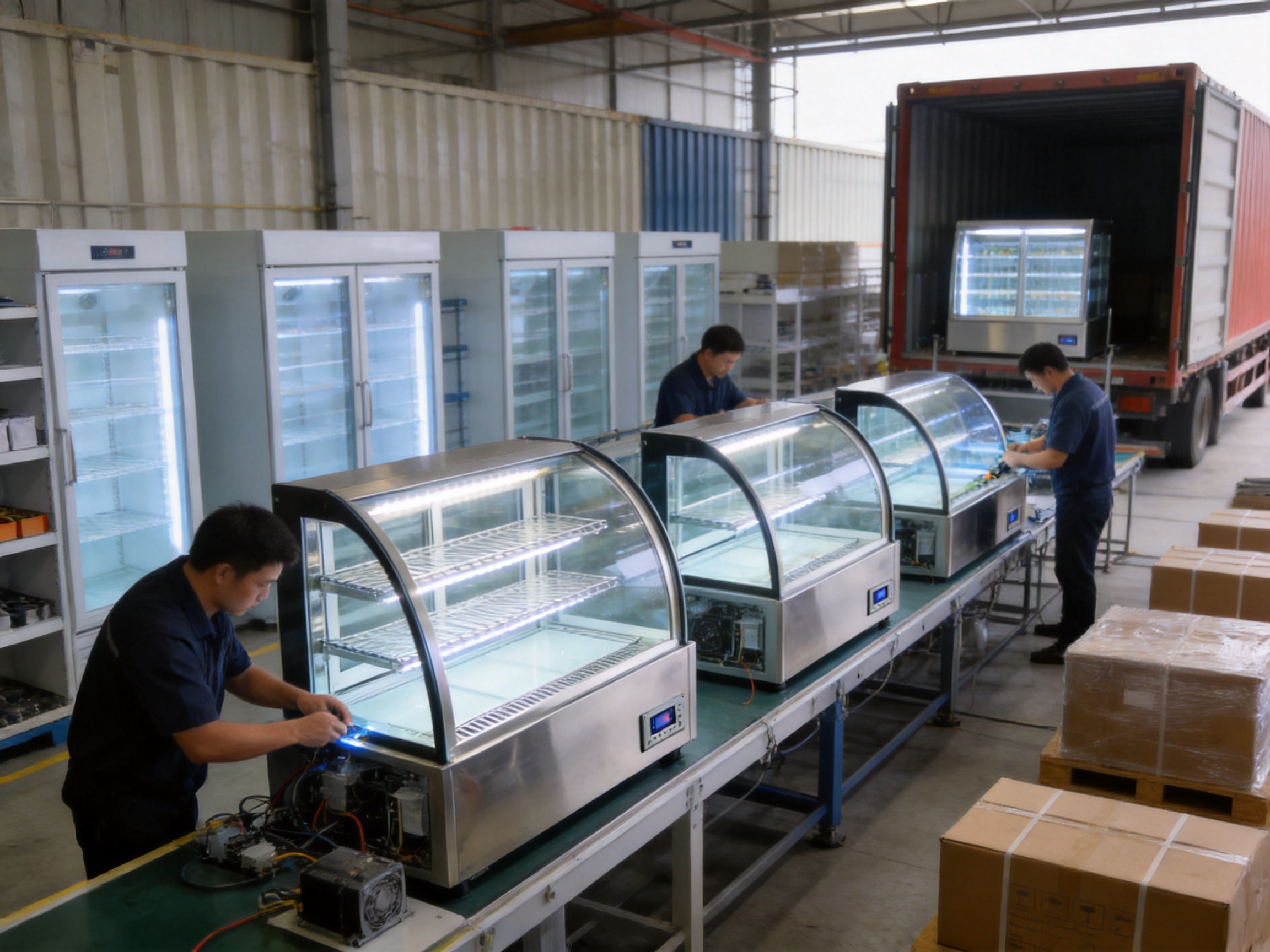
The production base includes a modern factory environment of approximately 40,000 square meters. A manufacturing facility of this scale supports stable production capacity, organized workflows, and the ability to serve wholesale and international customers. For buyers who need consistent supply, container loading efficiency, and reliable after-sales communication, manufacturing scale is a practical advantage.
The company has its own professional research and development team. In commercial refrigeration, R&D capability affects product innovation, energy efficiency, cabinet design, temperature stability, user convenience, and adaptation to different global markets. A dedicated R&D team can refine airflow systems, improve structural durability, update controls, and respond to changing customer needs.
Advanced testing facilities further strengthen product reliability. Refrigerated display equipment must perform under varying ambient conditions, door-opening patterns, loading conditions, and climate requirements. Testing helps verify cooling performance, temperature recovery, electrical safety, insulation effectiveness, and overall durability. Products intended for global markets must be designed and tested with a broader range of operating conditions in mind.
The manufacturer has obtained certifications including CE, GS, CCC, CB, RoHS, ETL, and other major international approvals. These certifications reflect attention to safety, compliance, and market access. For distributors, importers, and commercial buyers, certified products can reduce procurement risk and simplify acceptance in different regions.
In addition to certifications, the company emphasizes innovation, quality, and service. These values are relevant to commercial equipment buyers because a display cooler must perform reliably after purchase, not only look attractive in a catalog. Strong service awareness supports communication, customization discussions, technical documentation, and long-term cooperation with global partners.
Advanced Manufacturing Processes Behind the Cooler
A professional countertop display cooler depends on multiple manufacturing processes working together. The cabinet structure must be accurate, the glass must be properly fitted, the refrigeration system must be correctly assembled, the electrical system must be safe, and the final product must be inspected before shipment. The manufacturing strengths behind the XCW-160Z help ensure that these processes are controlled in a systematic way.
Cabinet fabrication begins with precise structural design. The product dimensions, insulation thickness, airflow channels, shelf positions, compressor space, and glass fitting areas must all align. Accurate design and production reduce assembly gaps, improve appearance, and help maintain refrigeration efficiency. A poorly fitted cabinet can leak cold air, create condensation problems, or reduce durability over time.
Glass processing is another key stage. The curved front tempered glass must meet both visual and safety requirements. The glass needs proper curvature, edge finishing, and installation alignment. Double-layer glass must be assembled in a way that supports insulation and visibility. In a display cooler, glass quality directly affects customer perception, so manufacturing precision is essential.
Refrigeration system assembly involves matching the compressor, evaporator, condenser, capillary or expansion components, refrigerant charge, and airflow design. The XCW-160Z supports refrigerants such as R134a or R600a, allowing adaptation to different market requirements. Correct refrigerant handling and system sealing are critical for performance and long-term reliability.
Electrical assembly includes the digital thermostat, LED lighting, power button, wiring, and safety components. Commercial refrigeration equipment must withstand frequent daily operation, so wiring layout, insulation protection, and component installation must be carefully controlled. A clean electrical assembly also simplifies maintenance and improves product safety.
Foaming and insulation processes influence energy performance. Good insulation reduces heat gain from the surrounding environment, allowing the refrigeration system to maintain temperature more efficiently. For a countertop display cooler with a glass front, insulation in the cabinet body remains important because it reduces unnecessary cooling load.
Final testing is essential. Each unit should be checked for appearance, function, cooling performance, electrical safety, door operation, lighting, thermostat response, and packaging integrity. This type of testing reduces the likelihood of problems after delivery. For international shipments, packaging strength is also important because products must withstand handling, stacking, and transport vibration.
Quality Control and Certification Value
Quality control in commercial refrigeration is not limited to visual inspection. A display cooler may look good when new, but its true value is proven through stable operation. The XCW-160Z benefits from a manufacturing environment that emphasizes testing, certification, and continuous improvement.
International certifications such as CE, GS, CCC, CB, RoHS, and ETL are meaningful because they relate to safety, electrical standards, material restrictions, and market compliance. Although certification requirements vary by region, having multiple approvals demonstrates a commitment to meeting global expectations. For wholesalers and distributors, this can be a significant advantage when selecting a supplier.
Quality control also includes component selection. Commercial equipment must use components that can tolerate long operating hours. The compressor, fan motors, thermostat, lighting, switches, and door hardware all affect user satisfaction. A weakness in one component can reduce the reliability of the whole cabinet. Experienced manufacturers understand the importance of matching components to the intended application.
Packaging quality is another often-overlooked factor. The XCW-160Z has a package size of 951 mm × 627 mm × 735 mm and a gross weight of 70 kg. Proper packaging helps protect the unit during export shipment and inland delivery. Since the cabinet includes glass components, careful packaging design is especially important.
The container loading figures, 63 units in a 20 GP container and 126 units in a 40 HP container, are useful for wholesale planning. Importers and distributors can estimate shipping quantities and plan inventory more efficiently. This reflects that the product is designed not only for individual end users but also for organized commercial supply chains.
Applications in Bakeries and Cake Shops
Bakeries and cake shops are among the most natural users of the XCW-160Z. Cakes and pastries depend heavily on presentation. A beautifully decorated cake should be visible from multiple angles, well lit, and kept within a suitable chilled range. The curved front glass and LED lighting help create a showcase effect that enhances the visual appeal of desserts.
The 2°C to 10°C temperature range is suitable for many chilled bakery products, including cream cakes, mousse cakes, cheesecakes, fruit tarts, custard desserts, and selected pastries. Operators should always follow the storage requirements of their specific recipes and local food safety regulations, but the cooler provides a practical display environment for common chilled bakery items.
The adjustable shelves allow bakeries to display products of different sizes. Whole cakes may require more height, while cake slices, dessert cups, and small pastries can be arranged on multiple shelves. This flexibility supports both daily sales and seasonal promotions. During holidays, the cabinet can be rearranged for special cakes or gift desserts.
For cake shops, customer trust is strongly influenced by cleanliness. A bright, clear, frost-free display suggests professionalism. Automatic defrost helps maintain this appearance with less staff effort. Back sliding doors support hygienic service because staff control product handling.
Applications in Cafés and Coffee Shops
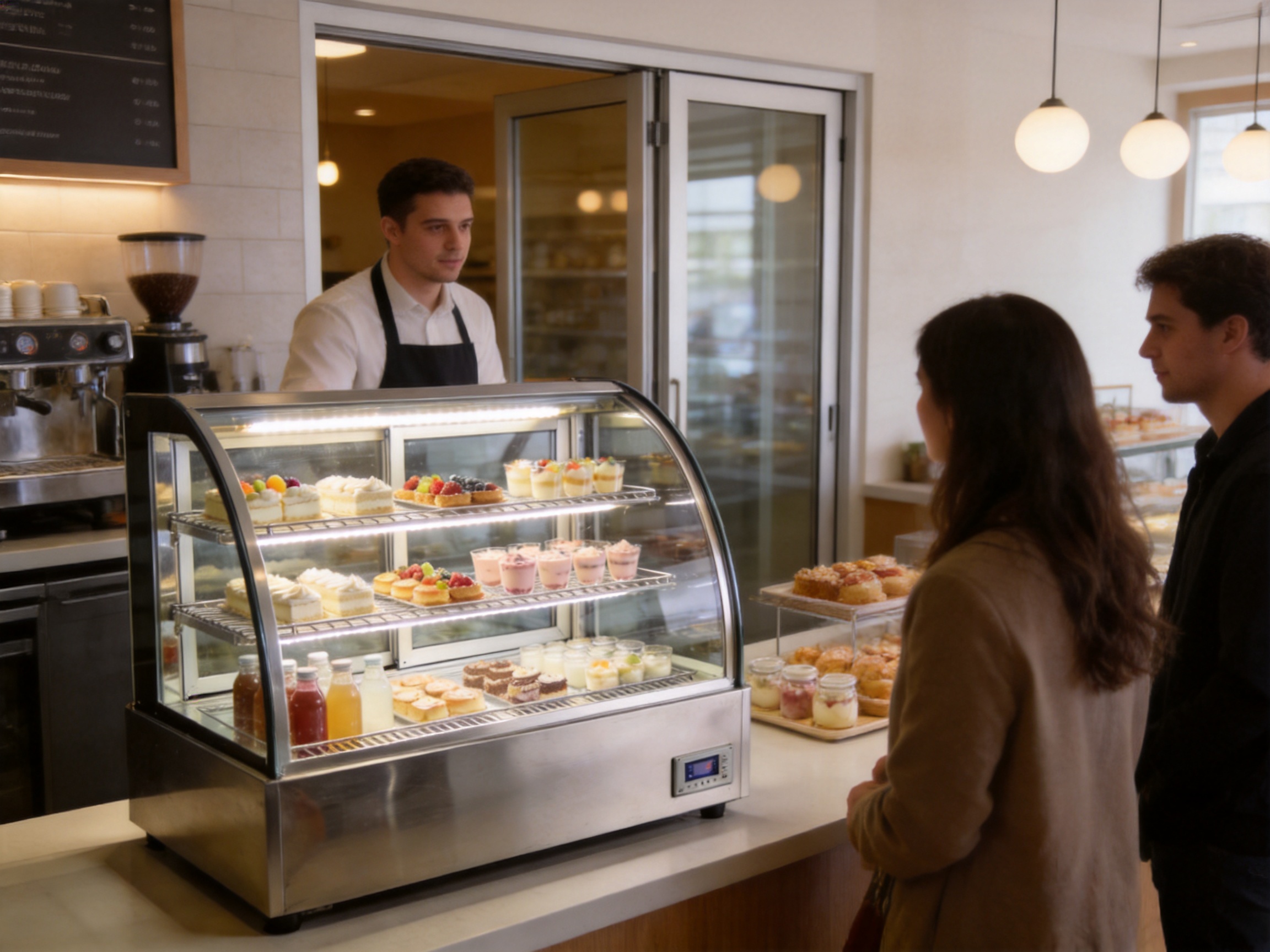
Cafés often depend on add-on sales. Customers may enter for coffee but decide to purchase a dessert, sandwich, yogurt, or bottled drink when these items are displayed attractively near the ordering point. A countertop cooler is ideal for this environment because it can be placed close to the cash register or service counter.
The XCW-160Z helps cafés present chilled items without using excessive floor space. Its product size of 888 mm × 568 mm × 686 mm makes it suitable for many counter layouts. The cabinet can display cakes, tiramisu, pudding cups, fruit cups, salads, packaged sandwiches, and cold beverages. The internal LED lighting gives products a fresh appearance even in cafés with warm or dim ambient lighting.
Staff-side sliding doors are especially helpful in cafés, where baristas and service staff often work in tight spaces. Sliding doors do not swing into the work area, allowing smoother movement. The separated power button and digital thermostat also make daily operation straightforward.
For independent cafés, equipment appearance is part of the store identity. A bulky or unattractive refrigerator can weaken the atmosphere. The curved glass design of the XCW-160Z fits well with modern café interiors and helps create a professional dessert display area.
Applications in Convenience Stores and Retail Counters
Convenience stores need compact equipment that supports fast product turnover. While large open chillers and vertical cabinets are common, a countertop display cooler can be useful for premium chilled products, promotional items, or checkout-area impulse purchases. The XCW-160Z can display yogurt, bottled drinks, dessert cups, salads, sandwiches, and packaged snacks.
Because the unit is countertop-based, it can be used near payment counters, service desks, or promotional islands. Products placed near checkout often benefit from impulse buying behavior. Customers waiting to pay may notice a chilled dessert or beverage and add it to their purchase.
The digital thermostat and automatic defrost help reduce staff workload. Convenience store employees already manage multiple tasks, including stocking, cashier work, cleaning, and customer service. Equipment that requires less manual intervention is valuable in this setting.
The 172-liter capacity provides enough space for meaningful product display without requiring a large footprint. Retailers can use the adjustable shelves to organize products by type, price, brand, or promotion. The glass display helps customers see available options quickly.
Applications in Sushi, Salad, and Ready-to-Eat Food Displays
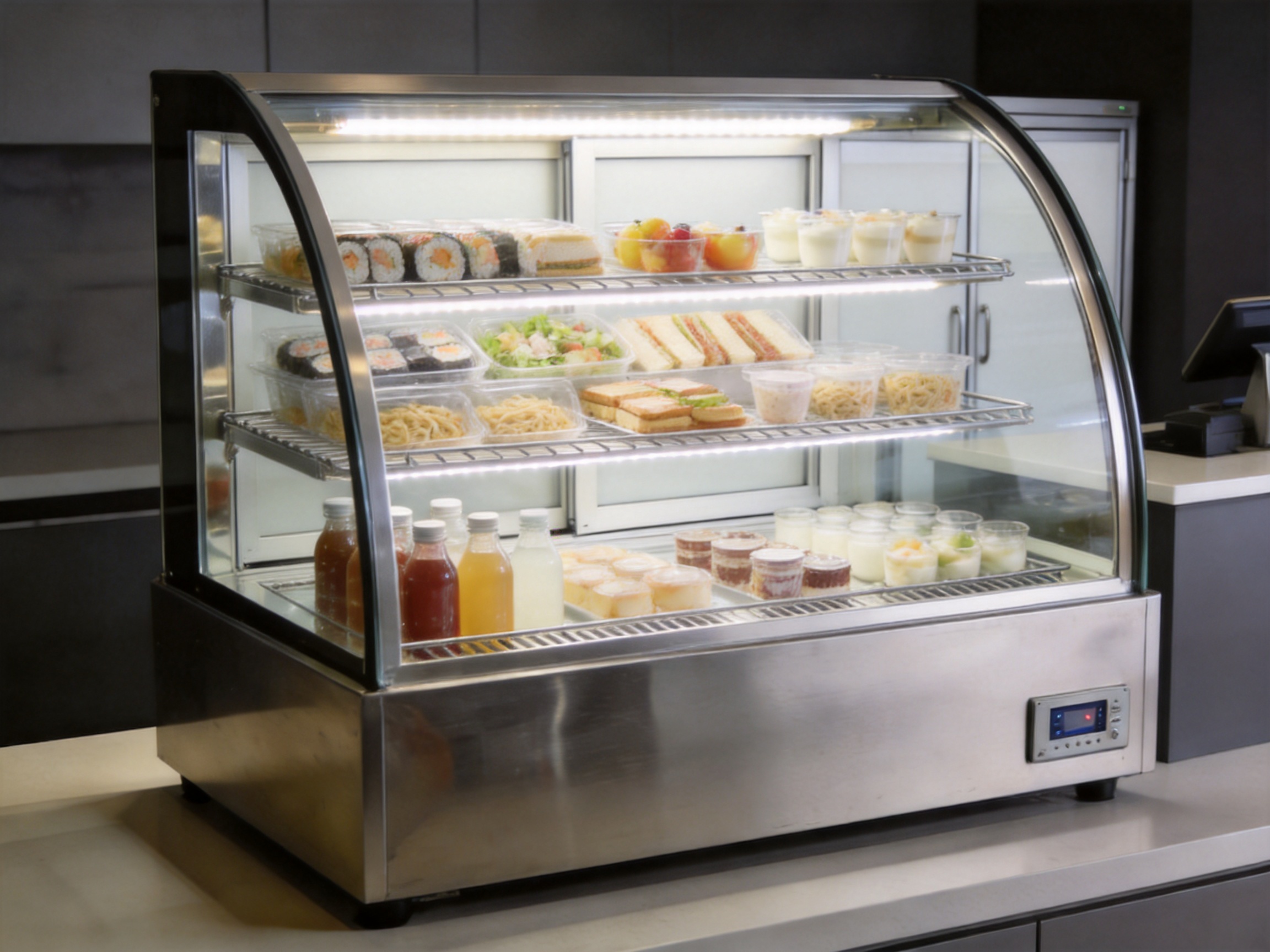
Although the product title emphasizes cake display, the XCW-160Z can also be used for selected chilled ready-to-eat foods when proper food safety practices are followed. Sushi packs, salads, fruit cups, chilled noodles, sandwiches, and packaged meals require clean presentation and stable temperature during display. The 2°C to 10°C range and ventilated cooling system support these needs for many product categories.
For sushi and prepared foods, visibility and hygiene are extremely important. Customers want to see freshness, color, packaging condition, and arrangement. LED lighting improves visibility, while rear sliding doors allow staff to manage products without customer handling. The glass showcase design also helps separate food from the surrounding environment.
Operators should always verify that the selected temperature setting meets local regulations and the specific requirements of the food being displayed. Some highly perishable products may require stricter control. However, for many chilled retail display applications, the cabinet provides a practical and attractive platform.
Energy and Operational Efficiency
Commercial refrigeration equipment operates for many hours each day, so efficiency matters. The XCW-160Z has an input power of 240 W, which supports practical countertop operation. Energy performance depends on many factors, including ambient temperature, door opening frequency, product loading, thermostat setting, ventilation clearance, and maintenance. However, the cabinet includes several features that help support efficient operation.
LED lighting reduces heat contribution compared with older lighting methods. Less internal heat can reduce the load on the refrigeration system. Double-layer front glass supports insulation. Automatic defrost helps maintain heat exchange efficiency by preventing excessive frost buildup. The ventilated cooling system distributes cold air effectively, helping the cabinet maintain a balanced temperature environment.
Operational efficiency also includes labor savings. A unit that is easy to access, easy to monitor, and less demanding to defrost can reduce daily staff effort. Over months and years, these small efficiencies can contribute to lower operating costs and smoother management.
Proper installation and use are important. The cooler should be placed where airflow around the machine is not blocked. Hot equipment, direct sunlight, and high ambient heat can increase energy consumption. Doors should be closed promptly after product access. Products should be loaded in a way that does not block internal airflow. Regular cleaning of glass, shelves, and ventilation areas helps maintain both appearance and performance.
Commercial Design Details That Improve User Experience
The best commercial equipment is designed around daily routines. The XCW-160Z includes several details that make it practical for real retail environments. The back sliding glass doors simplify service. The adjustable shelves support different product sizes. The digital thermostat improves monitoring. The LED lighting enhances display. The automatic defrost reduces maintenance. The separated power button supports easy control.
These details work together. For example, attractive lighting may bring customer attention, but staff still need easy access to serve products quickly. A good cooling system may preserve quality, but without automatic defrost, maintenance becomes more demanding. Adjustable shelves improve display flexibility, but lighting and glass design make the arrangement visible. The value of the cabinet comes from the combination of features rather than a single specification.
Commercial buyers should evaluate display coolers based on total usability. A low-cost cabinet may seem attractive initially but can create inconvenience if it has poor visibility, uneven cooling, manual defrost requirements, weak shelving, or limited access. The XCW-160Z is designed to address these common pain points in a compact countertop format.
Why This Cooler Supports Better Merchandising
Merchandising is the art and science of presenting products in a way that encourages purchase. In chilled food retail, the display cooler itself becomes part of the merchandising strategy. The XCW-160Z supports better merchandising through visibility, lighting, organization, accessibility, and freshness preservation.
Visibility is created by the curved front glass and internal lighting. Customers can quickly see products and evaluate their appearance. Organization is supported by adjustable shelves, allowing operators to create neat product groupings. Accessibility is supported by rear sliding doors, helping staff serve quickly. Freshness preservation is supported by ventilated cooling, digital temperature control, and automatic defrost.
For cakes and desserts, visual merchandising is especially powerful. Customers often buy based on appearance, mood, and impulse. A well-lit chilled showcase can turn a simple dessert selection into a premium experience. For packaged foods and beverages, clear visibility helps customers make quick decisions. In both cases, the cooler contributes directly to sales potential.
The unit also helps businesses communicate quality. A professional refrigerated display suggests that the operator cares about product condition and customer experience. This can strengthen repeat business and brand reputation.
Procurement Advantages for Wholesalers and Distributors
For wholesalers and distributors, product performance is only one part of the purchasing decision. Supply capacity, container loading, certifications, product consistency, and manufacturer experience are also important. The XCW-160Z offers practical procurement advantages in these areas.
The stated container loading quantities, 63 units for a 20 GP container and 126 units for a 40 HP container, help buyers plan shipments. The package dimensions and gross weight support logistics calculations. A manufacturer with a large production facility and experience in export-oriented commercial refrigeration can provide more predictable supply than smaller workshops.
The broad product category background, including four-sided glass display coolers, countertop display refrigerators, cake showcases, sushi showcases, open display coolers, display warmers, and four-sided glass freezers, indicates wide manufacturing knowledge. This is useful for distributors who may want to source multiple product types from a single supplier. A complete product range can simplify procurement and strengthen market coverage.
Certification experience also supports international distribution. Different markets may require different safety or compliance documentation. A manufacturer familiar with CE, GS, CCC, CB, RoHS, ETL, and related certifications is better positioned to support global sales. This reduces risk for distributors and helps build confidence with end customers.
Installation and Placement Recommendations
To achieve the best performance, the cooler should be installed on a stable, level countertop capable of supporting its net weight of 66 kg plus product load. The location should allow adequate ventilation around the refrigeration components. Blocking ventilation can increase operating temperature and reduce efficiency.
The unit should not be placed in direct sunlight or next to heat-producing equipment such as ovens, grills, hot display cases, or dishwashing machines. Excessive ambient heat can force the refrigeration system to work harder and may affect temperature stability. If the cabinet is used in a bakery, it should be positioned away from oven exhaust and high-temperature production zones.
Before loading products, operators should allow the cooler to reach the desired temperature. Products should ideally be pre-chilled before placement in the display cabinet. Display coolers are designed to maintain product temperature, not rapidly chill warm food. Loading warm products can raise cabinet temperature and affect other items.
Products should be arranged so that internal airflow is not blocked. Overloading the cabinet can reduce cooling uniformity. Shelves should be adjusted to allow proper circulation, and staff should avoid pressing products directly against vents or glass surfaces. Regular temperature checks are recommended as part of good foodservice practice.
Cleaning and Maintenance Guidance
Regular cleaning maintains both hygiene and sales appeal. Glass surfaces should be cleaned frequently to remove fingerprints, smudges, condensation marks, and food residue. Clear glass improves customer confidence and product visibility. Shelves should be removed and cleaned according to the operator’s hygiene schedule.
The automatic defrost function reduces frost-related maintenance, but it does not replace routine cleaning. Staff should still inspect the interior, remove spills promptly, and keep door tracks clean. Sliding glass doors should move smoothly, and their contact areas should be kept free of debris.
The digital thermostat should be monitored regularly. If the displayed temperature appears abnormal, operators should check whether doors are fully closed, products are blocking airflow, the ambient environment is too hot, or ventilation around the unit is restricted. If problems continue, qualified service personnel should inspect the refrigeration system.
LED lighting generally requires less frequent maintenance than older lighting systems, but staff should report any lighting failure quickly because display appearance directly affects sales. A dark cabinet can make fresh products look less appealing. Maintaining consistent lighting is part of merchandising quality.
Long-Term Value for Food Businesses
The long-term value of a countertop display cooler comes from its ability to support sales while reducing operational problems. The XCW-160Z offers value through product visibility, stable cooling, flexible display, compact placement, automatic defrost, and commercial-grade design. These benefits are especially important for businesses where chilled products contribute significantly to revenue.
A bakery may use the cooler to increase cake slice sales. A café may use it to promote desserts and bottled drinks. A convenience store may use it to create a premium checkout display. A hotel or catering counter may use it to present breakfast items, fruit, yogurt, or desserts. In each case, the cooler serves as both refrigeration equipment and a sales presentation tool.
Compared with cheaper alternatives, a more capable display cooler can offer better return over time. Reduced maintenance, improved appearance, better product organization, and stronger customer appeal can all contribute to business performance. Equipment that supports consistent operation is especially valuable in commercial settings, where downtime can mean lost sales.
Frequently Asked Questions
What is the main purpose of this countertop display cooler?
The main purpose is to display chilled food and beverages attractively while maintaining a suitable refrigerated environment. It is especially suitable for cakes, desserts, pastries, chilled snacks, bottled drinks, salads, sandwiches, fruit cups, and selected ready-to-eat products.
What is the capacity of the cooler?
The XCW-160Z has a capacity of 172 liters, providing enough space for a practical countertop display while remaining compact enough for cafés, bakeries, convenience stores, and service counters.
What temperature range does it support?
The cooler operates within a temperature range of 2°C to 10°C. Operators should select the setting according to the product type, ambient conditions, and applicable food safety requirements.
Why is automatic defrost important?
Automatic defrost reduces frost buildup, lowers maintenance effort, helps maintain clear visibility, and supports more stable cooling performance. It is especially useful for businesses with long daily operating hours.
How does LED lighting help sales?
Internal strip LED lighting makes products brighter and more attractive. It highlights colors, textures, decorations, and packaging details, which can encourage impulse purchases and improve the perceived freshness of displayed items.
What are the advantages of curved double-layer tempered glass?
Curved glass improves product presentation and gives the cabinet a premium appearance. Tempered glass adds strength, while the double-layer structure helps improve insulation and reduce heat transfer.
Is the cooler suitable for small shops?
Yes. With a product size of 888 mm × 568 mm × 686 mm, it is designed for countertop use and is suitable for small and medium-sized food retail environments where floor space is limited.
Can the shelves be adjusted?
Yes. The cooler includes adjustable chromed shelves, allowing operators to display products of different heights and organize the interior according to changing product needs.
What type of cooling system does it use?
It uses a ventilated cooling system, which helps distribute cold air more evenly throughout the cabinet and supports consistent product display conditions.
What refrigerants can be used?
The unit can be configured with R134a or R600a refrigerant, depending on market and application requirements.
Why are back sliding glass doors useful?
Back sliding glass doors allow staff to access products from the service side while customers view items from the front. This improves workflow, saves space, and supports hygienic service.
What makes this product competitive compared with basic countertop refrigerators?
Its competitive advantages include automatic defrost, LED lighting, ventilated cooling, digital thermostat control, curved double-layer tempered glass, adjustable shelves, rear sliding doors, countertop design, and support from an experienced commercial refrigeration manufacturer.
Is it suitable for wholesale distribution?
Yes. The product has defined packaging dimensions, container loading data, and manufacturing support from an experienced factory. A 20 GP container can load 63 units, and a 40 HP container can load 126 units.
What certifications support manufacturing credibility?
The manufacturer has obtained major certifications such as CE, GS, CCC, CB, RoHS, ETL, and others, reflecting attention to international safety and compliance requirements.
Conclusion
The Automatic Defrost LED Lighting Countertop Display Cooler XCW-160Z is a practical and attractive solution for businesses that need professional chilled display in a compact format. Its 172-liter capacity, 2°C to 10°C temperature range, LED lighting, digital thermostat, adjustable chromed shelves, back sliding glass doors, curved double-layer tempered front glass, ventilated cooling, automatic defrost, and countertop design make it suitable for a wide range of food retail and foodservice environments.
Its value lies in the balance between merchandising and refrigeration. It helps products look appealing while supporting stable chilled display conditions. It saves space while offering useful capacity. It reduces maintenance through automatic defrost and improves workflow through rear sliding doors. It enhances product presentation through LED lighting and curved glass. For cafés, bakeries, dessert shops, convenience stores, hotels, and prepared-food counters, these benefits can translate into stronger customer appeal and smoother daily operations.
The manufacturing background further strengthens the product’s appeal. With extensive experience in commercial refrigeration, a large modern production facility, professional research and development capability, advanced testing facilities, and multiple international certifications, the manufacturer provides the industrial foundation needed for consistent quality and global supply. For end users, wholesalers, and distributors, this combination of product design and manufacturing strength makes the XCW-160Z a compelling countertop display cooler for competitive chilled merchandising.
References
ASHRAE Handbook: Refrigeration. American Society of Heating, Refrigerating and Air-Conditioning Engineers.
Food Code. United States Food and Drug Administration.
Commercial Refrigeration Equipment: Energy Performance and Testing Principles. International refrigeration industry technical literature.
Refrigerated Display Cabinets: Performance, Safety, and Merchandising Considerations. Food retail equipment engineering references.
Principles of Food Display, Temperature Control, and Retail Merchandising. Hospitality and foodservice management publications.

You May Also Like
.jpg?imageView2/2/w/500/h/500/format/jp2/q/100 "Four Sides Glasses Display Cooler")
.jpg?imageView2/2/w/500/h/500/format/jp2/q/100 "White 4-Sided Glass Refrigerated Display Case")
.jpg?imageView2/2/w/500/h/500/format/jp2/q/100 "Refrigerated Display Cake Countertop Four Sides Glasses Display Cooler")
.jpg?imageView2/2/w/500/h/500/format/jp2/q/100 "Four Sides Glasses Display Cooler")

-
- Navigation
- Home
- About Us
- Products
- News
- Contact Us
 East Zone, Guanhaiwei Industrial Park, Cixi City, Ningbo, Zhejiang, China
 +86-574-63668678
 +86-574-63668108
Copyright © Ningbo XiangChi Electrical Co.,Ltd All Rights Reserved.
