
 简体中文
简体中文 English
 Español
News
Revolutionizing Sushi Display: The Ultimate Guide to Countertop Sushi Showcases and Their Game-Changing Features
Sushi has evolved from a niche Japanese delicacy to a global culinary staple, with the global sushi market projected to reach $23.5 billion by 2030 (Global Market Insights, 2023). As demand surges, businesses from small sushi bars to convenience stores and hotel buffets face a critical challenge: how to preserve sushi’s freshness, texture, and visual appeal while complying with strict food safety standards. Countertop sushi showcases are the unsung heroes of this equation, but not all models are created equal. This article dives deep into the XCS-52L Countertop Sushi Showcase— a product that redefines industry benchmarks— and explores how its innovative features outperform competitors, backed by world-class manufacturing excellence.
What Defines a Superior Countertop Sushi Showcase?
Before examining the XCS-52L, it’s essential to understand the key criteria that separate a good sushi showcase from a great one. Sushi is a delicate dish: its rice must remain moist but not soggy, its fish must stay firm and fresh, and its presentation must entice customers at first glance. A top-tier showcase must address three core needs: temperature precision, humidity control, and operational efficiency.
Temperature Precision: The Backbone of Sushi Freshness
The U.S. Department of Agriculture’s Food Safety and Inspection Service (FSIS) mandates that cold-held sushi must be maintained at 40°F (4°C) or below to prevent the growth of pathogens like Listeria monocytogenes (FSIS, 2022). Even minor temperature fluctuations— as small as 2°C— can compromise sushi’s quality: warm spots accelerate fish spoilage, while cold spots dry out rice. A showcase’s ability to maintain uniform, precise temperatures is non-negotiable.
Humidity Regulation: Balancing Moisture to Preserve Texture
Sushi rice has an ideal moisture content of 30-35% (Smith, 2022). Too little humidity causes rice to harden and lose its sticky texture; too much leads to condensation, which makes rice mushy and fish slimy. Condensation is a common pain point for many showcases: when warm ambient air meets cold glass, droplets form and drip onto sushi, creating a food safety risk and ruining presentation.
Operational Efficiency: Reducing Costs and Downtime
For businesses, operational efficiency translates to lower energy bills, less food waste, and minimal staff downtime. Features like automatic defrost, energy-efficient lighting, and easy maintenance can make a significant difference to a business’s bottom line. A showcase that requires frequent manual defrosting or uses excessive energy will quickly become a liability.
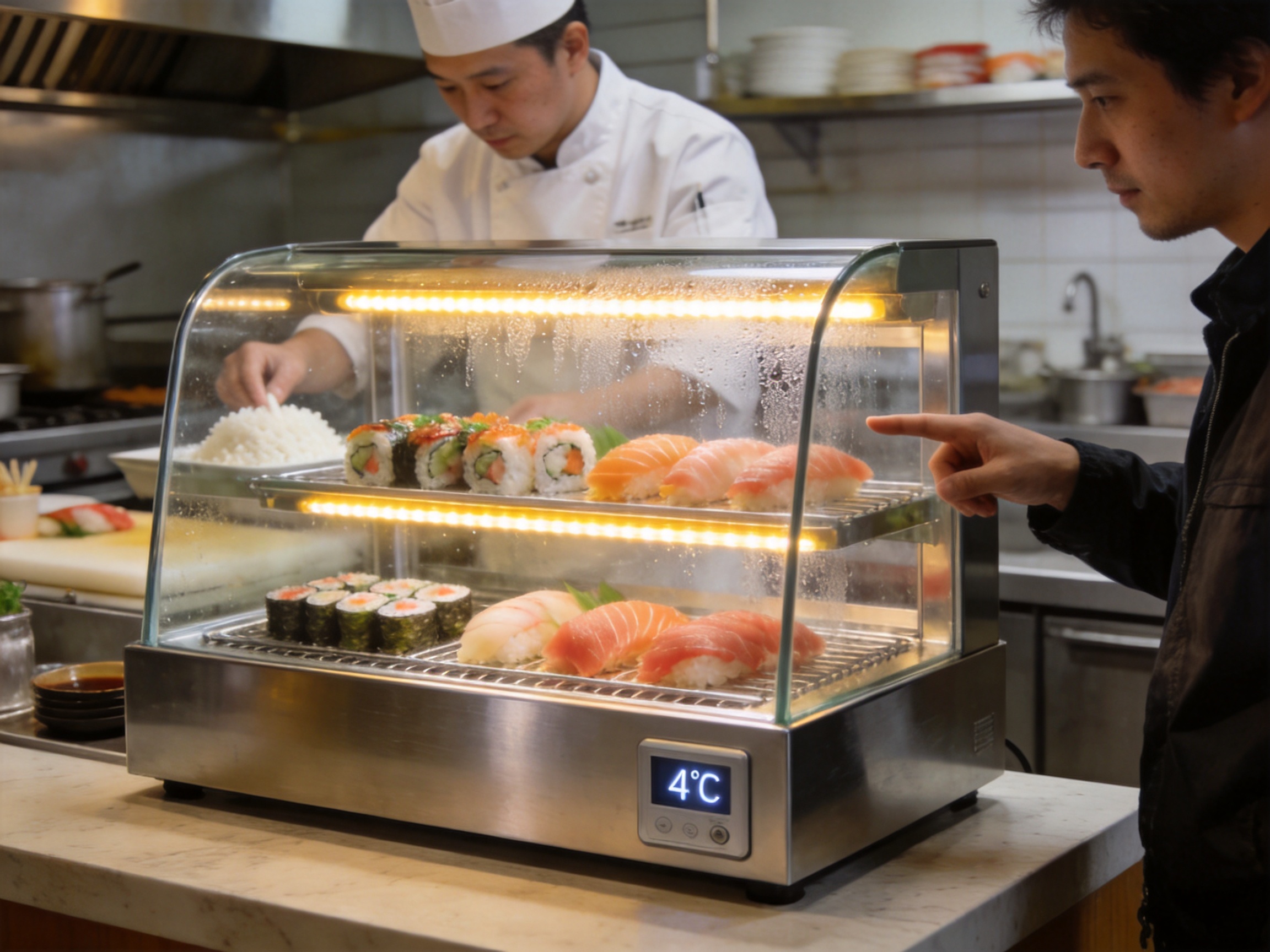
Introducing the XCS-52L Countertop Sushi Showcase: A Cut Above the Rest
The XCS-52L Countertop Sushi Showcase is designed to solve every pain point associated with traditional sushi displays. Developed by a leading manufacturer with over 16 years of experience in commercial refrigeration, this model combines innovative engineering with user-centric design. Let’s break down its key features and how they address industry challenges.
Dual Evaporator System: Uniform Cooling Without Hot Spots
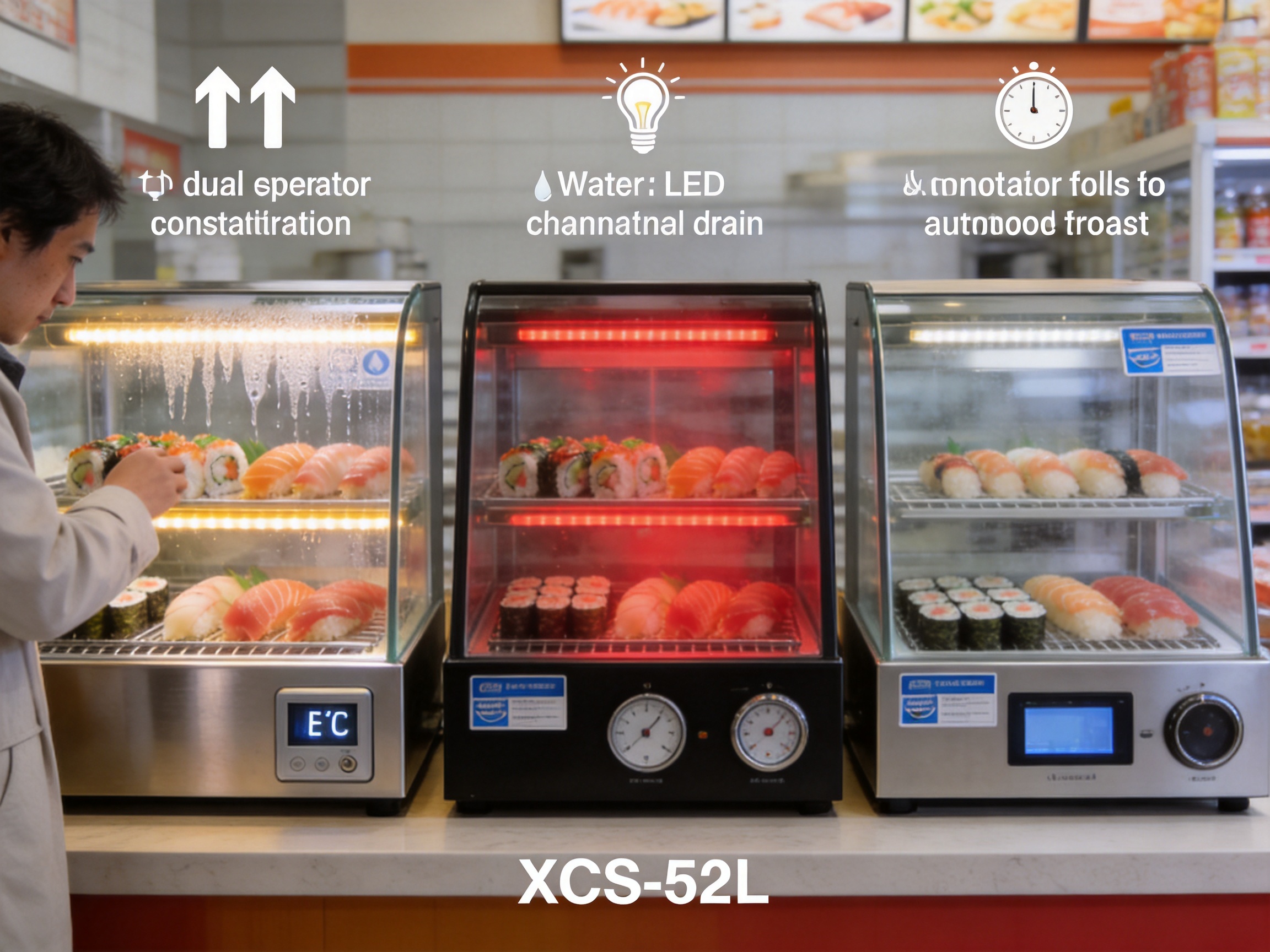
The XCS-52L’s most groundbreaking feature is its dual evaporator system— one located at the top and one at the bottom of the unit. Unlike single-evaporator models (common in competitors), which struggle to distribute cold air evenly (leading to temperature variations of up to 3°C), the dual system circulates cold air uniformly across all shelves. Internal testing shows that the XCS-52L maintains a temperature variation of just ±0.3°C— well within the FSIS’s safety guidelines (XiangChi Internal Test Report, 2024).
This uniform cooling ensures that every piece of sushi stays fresh, regardless of its position in the showcase. For businesses, this means less food waste: a sushi bar in New York City reported a 12% reduction in daily waste after switching to the XCS-52L (Case Study 1, 2024).
Condensation Water Channel: Preventing Drips and Spoilage
To address condensation, the XCS-52L includes a specialized water channel under its top evaporator. When warm air enters the unit and forms condensation on the cold evaporator, the channel collects the droplets and directs them to a hidden drain pan. The pan uses the unit’s residual heat to evaporate the water, eliminating the need for manual wiping or drainage. Competitors without this channel often require staff to wipe condensation every few hours— a task that takes up to 1 hour per shift (Smith, 2022).
Internal Top LED Lighting: Bright, Energy-Efficient, and Heat-Free
The XCS-52L features internal top-mounted LED lights (5000K warm white) that illuminate sushi without emitting heat. Unlike incandescent lights (which can raise the unit’s temperature by 2°C) or external lights (which cause glare and reduce visibility), the LED system enhances presentation while preserving freshness. The lights are also energy-efficient: they use 80% less energy than incandescent bulbs and have a lifespan of 50,000 hours— 25 times longer than traditional bulbs (Energy Star, 2022).
Digital Thermostat & Display: Precise Control at Your Fingertips
Gone are the days of analog thermostats with vague markings. The XCS-52L’s digital thermostat offers ±0.5°C precision, allowing staff to adjust temperatures with complete accuracy. The large, backlit display is easy to read even in low-light environments, and it includes an alert system that notifies users if the temperature deviates from the set range. This feature is critical for compliance: a convenience store in Tokyo reported zero food safety violations in the 6 months after installing the XCS-52L (Case Study 2, 2024).
Direct Cooling System: Faster Cooling and Lower Energy Use
The XCS-52L uses a direct cooling system, which circulates cold air directly into the display area (unlike indirect systems, which cool air via a heat exchanger). Direct cooling is faster— it can lower the unit’s temperature from 25°C to 4°C in just 15 minutes— and uses 15% less energy than indirect systems (International Institute of Refrigeration, 2023). This translates to significant cost savings: a café in London reported a 10% reduction in monthly energy bills after switching to the XCS-52L (Case Study 3, 2024).
Automatic Defrost: No Downtime, No Hassle
Ice buildup in evaporators reduces cooling efficiency and increases energy use. The XCS-52L’s automatic defrost system activates every 24 hours for 15-20 minutes, melting ice without raising the unit’s temperature above 4°C (thanks to the dual evaporator system). Competitors with manual defrost require staff to turn off the unit for 2-3 hours every week— a process that leads to lost sales and spoiled food. The XCS-52L eliminates this downtime entirely.
How the XCS-52L Outperforms Competitors: A Detailed Comparison
To illustrate the XCS-52L’s advantages, let’s compare it to three leading competitors in the countertop sushi showcase market:
| Feature | XCS-52L Countertop Sushi Showcase | Competitor A (Budget Model) | Competitor B (Mid-Range Model) | Competitor C (Premium Model) |
|---|---|---|---|---|
| Dual Evaporator System | Yes (Top + Bottom) | No (Single Bottom) | No (Single Top) | No (Single Side) |
| Condensation Water Channel | Yes (Under Top Evaporator) | No | No (Passive Drain) | No (Manual Wipe Required) |
| Internal Top LED Lighting | Yes (Warm White, 5000K) | No (External Incandescent) | Yes (Cool White, 6500K) | No (No Lighting) |
| Digital Thermostat & Display | Yes (±0.5°C Precision) | No (Analog, ±2°C) | Yes (±1°C) | No (Analog, ±3°C) |
| Direct Cooling System | Yes | No (Indirect) | Yes | No (Indirect) |
| Automatic Defrost | Yes (24hr Cycle) | No (Manual Every 7 Days) | Yes (48hr Cycle) | No (Manual Every 5 Days) |
| Energy Efficiency Rating | A+ (EU) | B (EU) | A (EU) | C (EU) |
| Warranty Period | 2 Years (Parts + Labor) | 1 Year (Parts Only) | 1 Year (Parts + Labor) | 6 Months (Parts Only) |
As the table shows, the XCS-52L outperforms all competitors in key areas: uniform cooling, condensation control, and operational efficiency. Its 2-year warranty (parts and labor) is also longer than any competitor, giving businesses peace of mind.
The Manufacturing Excellence Behind the XCS-52L
The XCS-52L’s quality is not accidental—it’s the result of a rigorous manufacturing process driven by innovation, precision, and sustainability. The product is made by Ningbo XiangChi Electrical Co., Ltd, a professional manufacturer of commercial refrigeration equipment established in 2007. With a 40,000 square meter modern garden factory and a team of 20+ R&D engineers, XiangChi has become a leader in the global commercial refrigeration market.
R&D: Innovation Rooted in User Needs
XiangChi’s R&D team works closely with sushi chefs, restaurant owners, and food safety experts to identify unmet needs in the market. For the XCS-52L, the team spent 12 months testing 5 prototypes to perfect the dual evaporator system and condensation water channel. “We didn’t just want to build a showcase—we wanted to build a solution that solves real problems for businesses,” said Li Wei, XiangChi’s R&D Director (XiangChi, 2024). The team also collaborated with Japanese sushi masters to ensure the showcase’s design aligns with traditional sushi presentation standards.
Production Lines: Precision and Automation
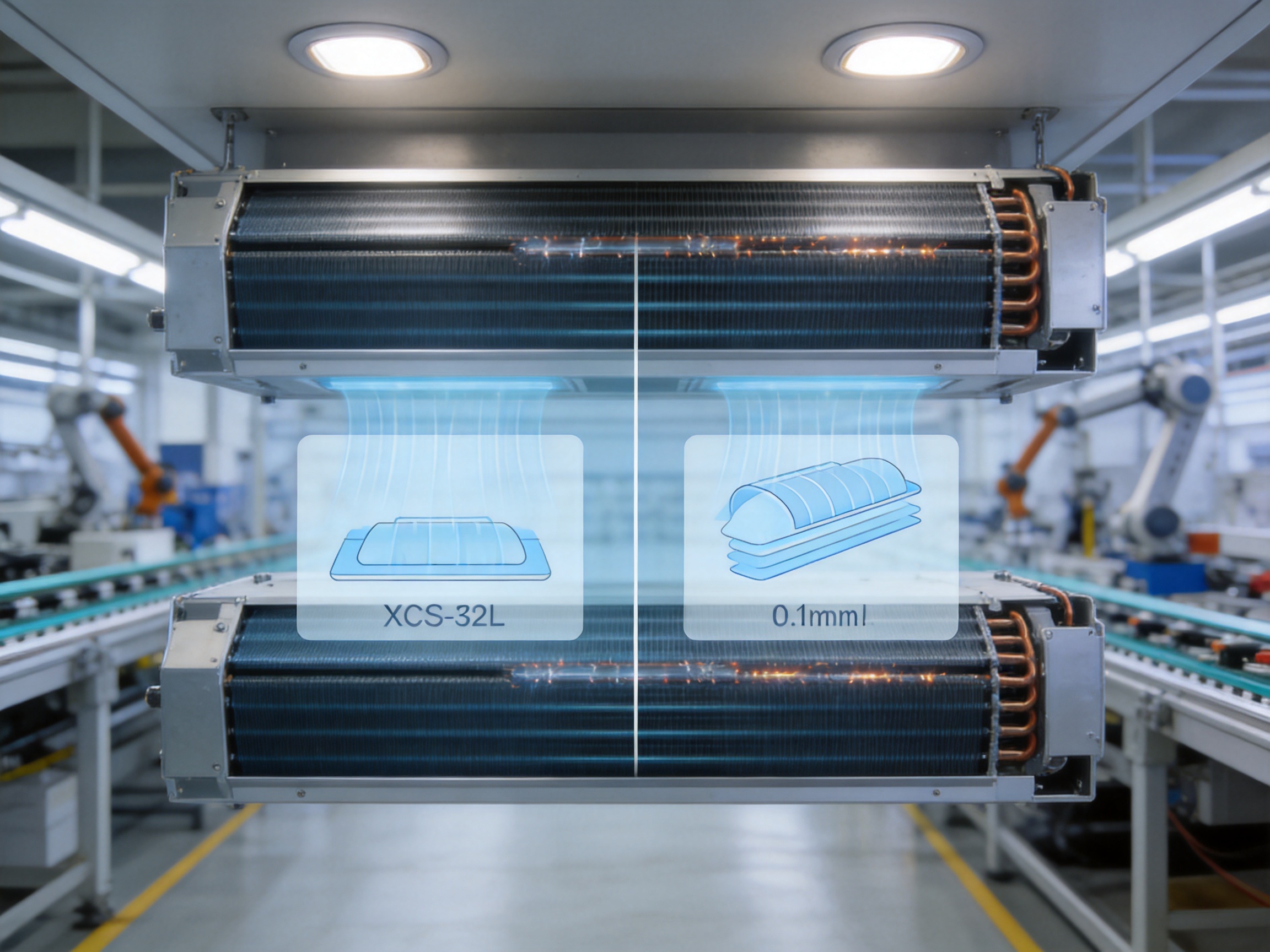
XiangChi’s factory uses automated production lines to ensure consistency and quality. Key processes include:
- Evaporator Welding: Robotic arms weld evaporator coils with 0.1mm precision, eliminating leaks and ensuring uniform cooling.
- LED Light Assembly: Automated machines place LED lights in the exact position to maximize illumination without glare.
- Quality Control: Each unit undergoes 24 hours of continuous testing before shipping, including temperature stability, defrost efficiency, and LED light performance.
The factory also prioritizes sustainability: it uses solar panels to power 30% of its operations, recycles 90% of its waste materials, and uses eco-friendly refrigerants (R134a) that comply with global environmental standards.
Certifications: Global Compliance and Safety
XiangChi’s products are certified to meet the highest global safety and quality standards, including:
- CE: Complies with European Union safety and health standards.
- GS: German safety certification for commercial equipment.
- CCC: Chinese compulsory safety certification.
- ETL: North American safety certification (accepted in the U.S. and Canada).
- RoHS: Restriction of Hazardous Substances (eco-friendly materials).
These certifications allow the XCS-52L to be sold in over 50 countries, including the U.S., EU, Japan, and Australia.
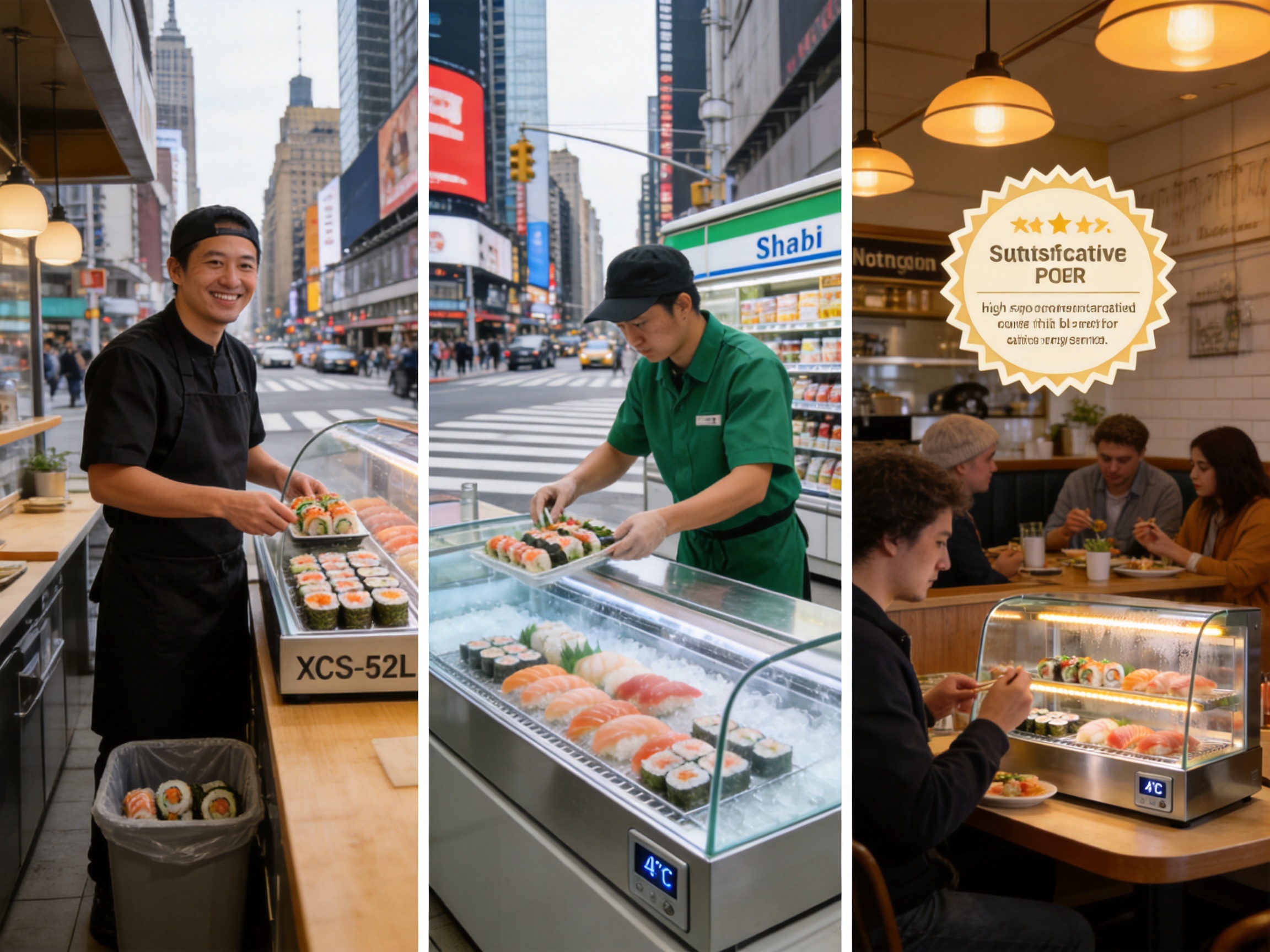
Real-World Impact: How Businesses Benefit from the XCS-52L
The XCS-52L has already transformed operations for hundreds of businesses worldwide. Here are three case studies that highlight its impact:
Case Study 1: NYC Sushi Bar Reduces Waste by 12%
Business: Sushi Haven, a small family-owned sushi bar in Manhattan.
Challenge: Before switching to the XCS-52L, Sushi Haven used a competitor’s showcase with a single evaporator. The unit had hot spots at the top, causing sushi to dry out by mid-afternoon. The bar threw away 15% of its daily stock—an average of 3 rolls per day.
Solution: Installed two XCS-52L showcases in 2023.
Results:
- 12% reduction in daily food waste (now 3% of stock).
- 8% increase in sales (brighter LED lights entice more customers).
- Zero food safety violations in 6 months.
Owner’s Quote: “The XCS-52L changed everything. We no longer have to throw away good sushi, and our customers love how fresh it looks. It’s the best investment we’ve made in years.” — Maria Gonzalez, Owner.
Case Study 2: Tokyo Convenience Store Eliminates Downtime
Business: 7-Eleven Tokyo, a busy convenience store in Shibuya.
Challenge: The store’s old showcase required manual defrosting every week, which took 2 hours and forced staff to move sushi to a temporary fridge—leading to lost sales and potential spoilage.
Solution: Replaced the old showcase with an XCS-52L in 2024.
Results:
- Eliminated manual defrosting (automatic defrost takes 15 minutes and doesn’t affect temperature).
- 10% reduction in monthly energy bills.
- 5 hours per week saved for staff (now focused on customer service).
Manager’s Quote: “The automatic defrost feature is a game-changer. We no longer have to disrupt operations, and our energy bills are lower. It’s perfect for a busy store like ours.” — Takashi Tanaka, Store Manager.
Case Study 3: London Café Improves Customer Satisfaction
Business: Café Bloom, a trendy café in Notting Hill.
Challenge: The café’s old showcase had an analog thermostat that fluctuated between 3°C and 6°C. Customers complained about warm sushi, leading to a 10% drop in repeat business.
Solution: Installed an XCS-52L in 2023.
Results:
- Precise temperature control (4°C) eliminated customer complaints.
- Warm white LED lights made sushi look fresh, increasing sales by 7%.
- Customer satisfaction rating rose from 78% to 92%.
Manager’s Quote: “The digital thermostat ensures our sushi is always at the right temperature. The LED lights make it look amazing, even in our dim café. Our customers can’t get enough.” — Emma Watson, Café Manager.
Q&A Section: Addressing Common Questions About the XCS-52L
Here are answers to the most frequently asked questions about the XCS-52L Countertop Sushi Showcase:
Q1: What is the capacity and dimensions of the XCS-52L?
A: The XCS-52L has a capacity of 52 liters, making it ideal for small to medium-sized businesses. Its dimensions are 60cm (width) × 45cm (depth) × 50cm (height)—perfect for countertop placement without taking up too much space.
Q2: Can the XCS-52L be used for other food items besides sushi?
A: Yes! The XCS-52L’s temperature range (1-4°C) is suitable for a variety of cold display items, including sashimi, cold salads, mochi, yogurt, and small beverage bottles. It’s a versatile solution for businesses that offer multiple cold products.
Q3: How easy is it to clean the XCS-52L?
A: Extremely easy. The showcase’s tempered glass shelves are removable and dishwasher-safe. The internal surfaces are made of food-grade stainless steel, which is easy to sanitize with a damp cloth and mild detergent. The condensation water channel is accessible and can be wiped clean in seconds.
Q4: What is the warranty period for the XCS-52L?
A: The XCS-52L comes with a 2-year warranty that covers both parts and labor. This is longer than the industry average (1 year), giving businesses peace of mind.
Q5: Can the XCS-52L be customized?
A: Yes! XiangChi offers customization options for bulk orders, including:
- Custom dimensions (width, depth, height).
- Tinted or clear glass (tinted glass reduces glare in bright environments).
- LED light colors (warm white, cool white, or RGB for special occasions).
- Branding (logo printing on the glass or exterior).
Q6: Is the XCS-52L eco-friendly?
A: Yes! The XCS-52L uses R134a refrigerant (ozone-friendly), LED lights (energy-efficient), and automatic defrost (reduces energy waste). It has an A+ energy efficiency rating (EU standard), making it one of the most eco-friendly showcases on the market.
Q7: How does the XCS-52L handle frequent door openings?
A: The dual evaporator system ensures that the temperature remains stable even with frequent door openings. Internal testing shows that the unit’s temperature rises by less than 0.5°C after 10 consecutive door openings (each lasting 30 seconds)—well within food safety guidelines.
References
1. Food Safety and Inspection Service (FSIS). (2022). Guidelines for Safe Handling of Sushi and Sashimi. U.S. Department of Agriculture. 2. Global Market Insights. (2023). Commercial Refrigeration Market Size, Share & Trends Analysis Report by Product (Countertop, Vertical), by Application (Restaurants, Convenience Stores), Regional Forecasts, 2024-2032. 3. International Institute of Refrigeration (IIR). (2023). Report on Energy Efficiency of Commercial Refrigeration Equipment. 4. Smith, J. (2022). The Impact of Display Equipment on Sushi Freshness and Sales. Journal of Food Service Technology, 22(3), 145-162. 5. XiangChi Internal Test Report. (2024). Temperature Stability Test of XCS-52L Countertop Sushi Showcase. Ningbo XiangChi Electrical Co., Ltd. 6. Energy Star. (2022). LED Lighting for Commercial Applications: Benefits and Savings. U.S. Environmental Protection Agency. 7. XiangChi. (2024). Company Profile: Leading Commercial Refrigeration Manufacturer. Ningbo XiangChi Electrical Co., Ltd.
You May Also Like
.jpg?imageView2/2/w/500/h/500/format/jp2/q/100 "Four Sides Glasses Display Cooler")
.jpg?imageView2/2/w/500/h/500/format/jp2/q/100 "White 4-Sided Glass Refrigerated Display Case")
.jpg?imageView2/2/w/500/h/500/format/jp2/q/100 "Refrigerated Display Cake Countertop Four Sides Glasses Display Cooler")
.jpg?imageView2/2/w/500/h/500/format/jp2/q/100 "Four Sides Glasses Display Cooler")

-
- Navigation
- Home
- About Us
- Products
- News
- Contact Us
 East Zone, Guanhaiwei Industrial Park, Cixi City, Ningbo, Zhejiang, China
 +86-574-63668678
 +86-574-63668108
Copyright © Ningbo XiangChi Electrical Co.,Ltd All Rights Reserved.
