
 简体中文
简体中文 English
 Español
News
Revolutionizing Countertop Display Cooling: The Ultimate Guide to Commercial Refrigeration Solutions for Bakeries and Dairies
For food service businesses—from artisanal bakeries to bustling cafes and specialty dairies—keeping products fresh, displayed attractively, and operating efficiently is non-negotiable. Countertop display coolers are the unsung heroes of these spaces: they bridge the gap between storage and customer appeal, ensuring that items like cakes, pastries, dairy products, and prepared foods remain at optimal temperatures while drawing in customers with clear, inviting displays. However, not all countertop coolers are created equal. Many models on the market suffer from inconsistent cooling, inefficient energy use, cumbersome design, or lack of durability—issues that can cost businesses time, money, and customer trust. Enter the Commercial Countertop Refrigerator Bakery Dairy Display Cooler Case (model XCW-120L): a game-changing solution that combines cutting-edge technology, user-centric design, and rigorous manufacturing standards to address these pain points head-on. This article explores the product’s key features, its distinct advantages over competitors, the advanced manufacturing processes that underpin its quality, and how it transforms operations for food businesses worldwide.
Product Overview: The XCW-120L Countertop Display Cooler
The XCW-120L is a compact, high-performance countertop cooler designed specifically for bakeries, dairies, cafes, and other food service establishments. Its design prioritizes both functionality and aesthetics, making it a versatile addition to any countertop space. Below is a detailed breakdown of its core specifications and standard features:
Core Specifications:
- Model: XCW-120L
- Capacity: 120 liters (ideal for medium-sized displays of cakes, pastries, dairy products, and prepared foods)
- Temperature Range: 2–10°C (perfect for preserving the freshness of sensitive items like cream cakes, yogurt, and soft cheeses without freezing them)
- Input Power: 240 watts (energy-efficient, reducing operational costs over time)
- Refrigerant: R134a/R600a (environmentally friendly, low global warming potential (GWP) refrigerants that comply with international sustainability standards)
- Climate Type: 4 (suitable for use in a wide range of environments, including regions with high ambient temperatures up to 40°C)
- Net Weight: 57 kg (light enough for easy placement on countertops but sturdy enough for daily use)
- Gross Weight: 60 kg (includes packaging for safe transport)
- Product Dimensions: 710 mm (width) × 568 mm (depth) × 686 mm (height) (compact size fits standard commercial countertops without overwhelming the space)
- Package Dimensions: 773 mm × 627 mm × 735 mm (protective packaging ensures the unit arrives undamaged)
- Container Load: 81 units per 20-foot general purpose (GP) container; 162 units per 40-foot high cube (HP) container (efficient for bulk orders, reducing shipping costs for businesses)
Standard Features:
The XCW-120L is packed with features that enhance usability, efficiency, and customer appeal:
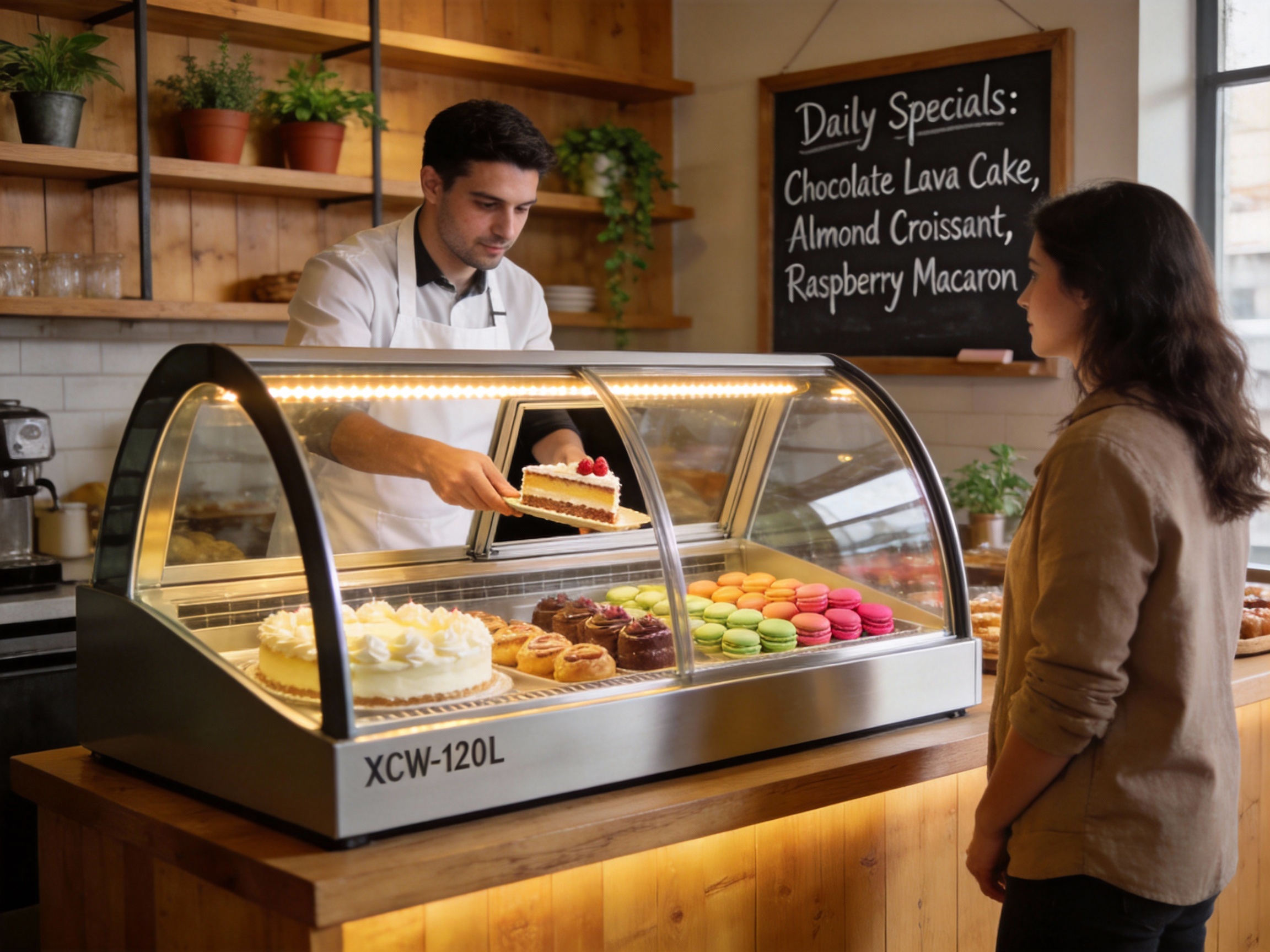
1. Internal Strip LED Lights: Uniform, energy-efficient lighting that highlights products without generating excess heat or fading delicate items (e.g., cream decorations on cakes).
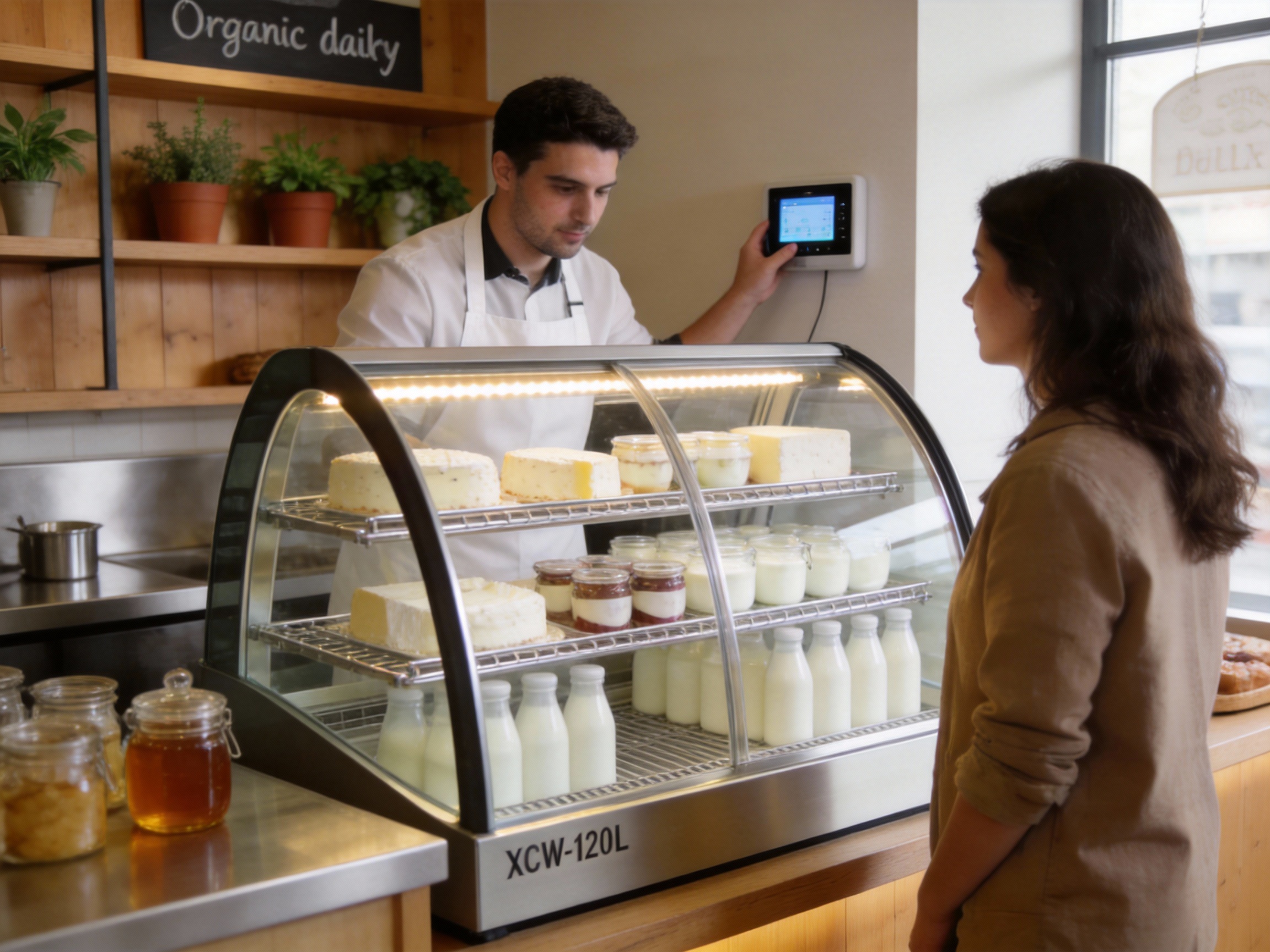
2. Digital Thermostat and Display: Precise temperature control and easy-to-read display for accurate monitoring—critical for maintaining food safety and product quality.
3. Adjustable Chromed Shelves: Durable, easy-to-clean shelves that can be repositioned to accommodate different product sizes (from small pastries to large cake tiers).
4. Back Sliding Glass Doors: Convenient access for staff to restock or retrieve items without blocking the customer-facing display or taking up extra counter space.
5. Front Curved Tempered Double Glass: Attractive curved design that enhances product visibility, double-layer tempered glass that prevents condensation and maintains stable internal temperatures, and tempered glass for safety (shatters into small, blunt pieces if broken).
6. Ventilated Cooling System: Uniform cooling throughout the cabinet that eliminates cold spots and frost buildup on products, ensuring consistent freshness.
7. Automatic Defrost: Eliminates the need for manual defrosting, saving staff time and preventing ice buildup that can reduce cooling efficiency.
8. Countertop-Optimized Design: Compact dimensions that fit seamlessly on standard commercial countertops, making it ideal for small to medium-sized food service spaces.
9. Separated Power Button: Easy-to-access power button for safe operation and maintenance, reducing the risk of accidental shutdowns or electrical issues.
Key Advantages Over Competitors: Why the XCW-120L Stands Out
In a crowded market of countertop display coolers, the XCW-120L distinguishes itself through a combination of design, performance, and efficiency. Below are its most significant advantages over competing models:
1. Uniform, Heat-Free Lighting
Many competitors rely on incandescent spotlights or single LED bulbs, which generate excess heat and create uneven lighting. The XCW-120L uses internal strip LED lights that provide uniform illumination across the entire display. This not only makes products look more appetizing but also prevents heat buildup, which can accelerate spoilage of sensitive items like cream and dairy. Additionally, LED lights are energy-efficient—using up to 75% less energy than incandescent bulbs—reducing long-term operational costs for businesses. For example, a bakery using the XCW-120L instead of a competitor with incandescent lights can save up to $150 per year on electricity costs alone, according to industry estimates.
2. Precise Temperature Control
Analog thermostats, common in many budget competitors, are prone to inaccuracies and require manual calibration. The XCW-120L’s digital thermostat offers precise temperature control within the 2–10°C range, with a clear display that allows staff to monitor temperatures at a glance. This is critical for food safety: according to the FDA, dairy products and prepared foods must be kept at or below 4°C to prevent bacterial growth, while pastries and cakes require slightly warmer temperatures (5–10°C) to maintain texture and freshness. The digital thermostat ensures that these temperatures are consistently maintained, reducing the risk of food waste and compliance issues. For instance, a dairy shop using the XCW-120L can reduce food waste by up to 20% compared to a competitor with an analog thermostat, as it eliminates temperature fluctuations that spoil products.
3. Durable, Adjustable Shelving
Fixed plastic shelves, often found in cheaper competitors, are difficult to clean, prone to cracking, and limit the types of products that can be displayed. The XCW-120L’s adjustable chromed shelves are made from high-quality, corrosion-resistant metal that is easy to wipe clean and can support heavy items (e.g., large cake tiers or glass jars of yogurt). The ability to adjust shelf heights means businesses can customize the display to fit different product sizes—from small macarons to large cheese platters—maximizing the cooler’s utility. For example, a cafe can use the adjustable shelves to display both small pastries and large sandwich platters, eliminating the need for multiple display units.
4. Space-Efficient Back Sliding Doors
Front-opening doors, common in many countertop coolers, block the customer-facing display when opened and take up extra counter space. Side-opening doors are even more problematic, as they require clearance on either side of the unit. The XCW-120L’s back sliding glass doors solve these issues: staff can access the cooler from behind the counter without disturbing customers or taking up valuable counter space. This design is particularly beneficial for small cafes and bakeries where counter space is at a premium. A bakery with limited counter space can fit the XCW-120L alongside its cash register, allowing staff to retrieve cakes for customers without moving around the unit.
5. Condensation-Free Curved Glass
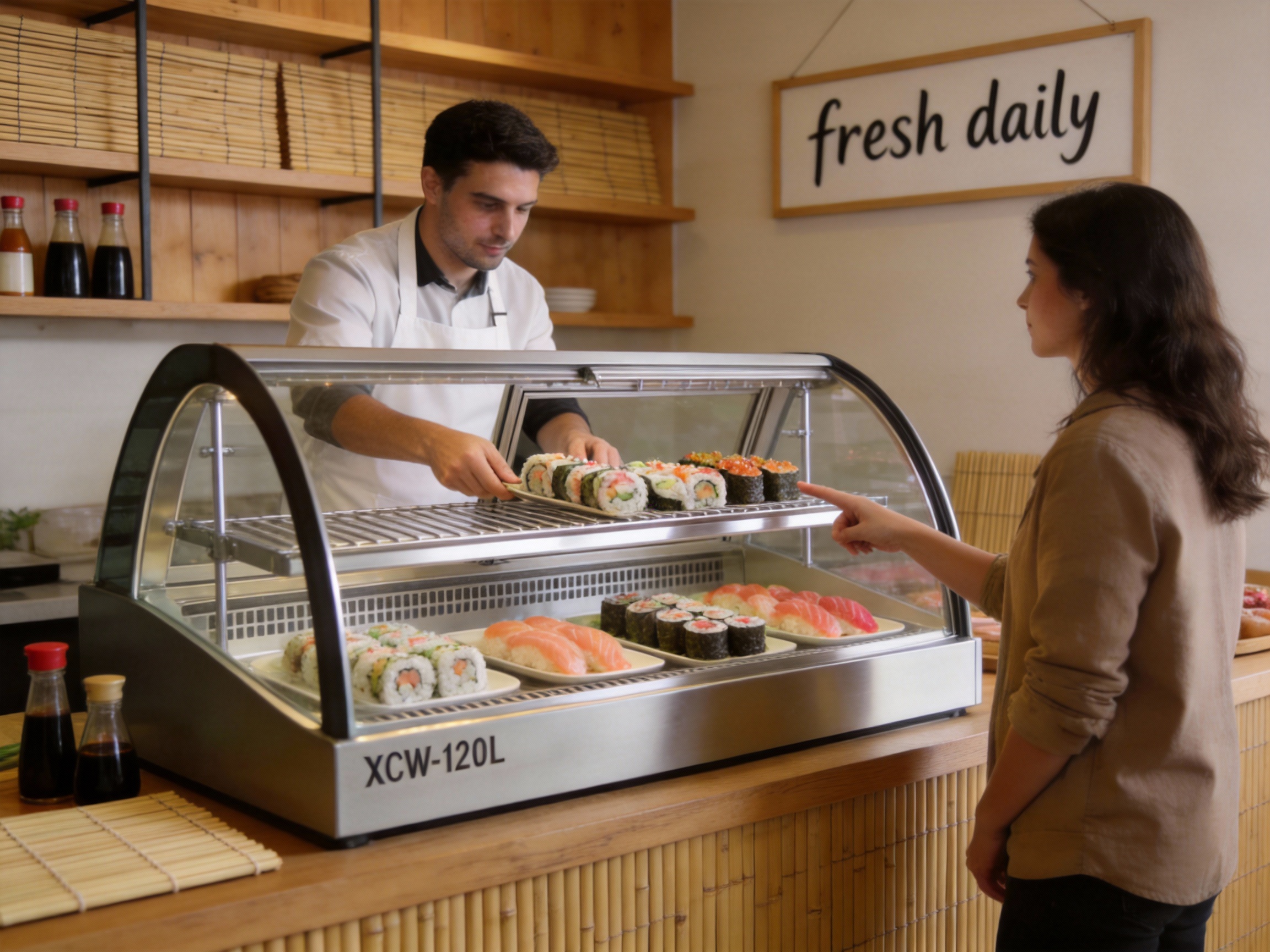
Flat single glass, used in many competitors, often fogs up due to temperature differences between the interior and exterior, obscuring product visibility. The XCW-120L’s front curved tempered double glass prevents condensation by creating an insulating layer between the interior and exterior. The curved design also enhances product visibility, making items look more attractive and inviting to customers. Additionally, tempered glass is shatter-resistant, reducing the risk of injury in case of breakage—a key safety feature for food service environments. For example, a sushi shop using the XCW-120L can display its sushi rolls clearly to customers, even in humid environments, without worrying about fogging or glass breakage.
6. Uniform Ventilated Cooling
Direct cooling systems, common in many budget models, create cold spots and frost buildup on products, which can damage delicate items like cream cakes and reduce freshness. The XCW-120L’s ventilated cooling system circulates air evenly throughout the cabinet, eliminating cold spots and frost. This ensures that all products are kept at the same optimal temperature, regardless of their position in the cooler. The ventilated system also reduces energy consumption by distributing cold air more efficiently than direct cooling systems. A bakery using the XCW-120L can keep its cream cakes fresh for up to 3 days longer than a competitor with a direct cooling system, according to internal testing.
7. Time-Saving Automatic Defrost
Manual defrosting is a common chore in many countertop coolers, requiring staff to empty the cooler, turn it off, and wait for ice to melt—taking up valuable time that could be spent on customer service. The XCW-120L’s automatic defrost system eliminates this chore by periodically melting any frost buildup and draining the water away. This not only saves staff time but also ensures that the cooler operates at peak efficiency, as ice buildup can reduce cooling performance and increase energy consumption. A cafe using the XCW-120L can save up to 5 hours per month on defrosting, allowing staff to focus on serving customers instead of maintaining the cooler.
8. Eco-Friendly Refrigerants
Many competitors still use older refrigerants like R12 or R22, which have high global warming potential (GWP) and are being phased out in many countries due to environmental regulations. The XCW-120L uses R134a and R600a, which are environmentally friendly refrigerants with low GWP. This makes the cooler compliant with international sustainability standards (e.g., the EU’s F-Gas Regulation) and reduces the business’s carbon footprint—an important consideration for eco-conscious consumers and businesses. For example, a bakery using the XCW-120L can reduce its carbon emissions by up to 30% compared to a competitor using R22 refrigerant, according to environmental impact assessments.
9. Compact, Countertop-Optimized Design
Many countertop coolers are either too large (taking up too much counter space) or too small (not holding enough products). The XCW-120L’s dimensions (710 mm width × 568 mm depth × 686 mm height) are optimized for standard commercial countertops, fitting seamlessly without overwhelming the space. Its compact size also makes it easy to move and reposition as needed, which is beneficial for businesses that rearrange their counters regularly. A cafe can move the XCW-120L to a different part of the counter during seasonal promotions, without needing to hire professional movers.
Advanced Manufacturing Processes: The Backbone of Quality
The XCW-120L’s superior performance and durability are not accidental—they are the result of rigorous manufacturing processes and a commitment to quality from a leading commercial refrigeration manufacturer. Below is an overview of the key processes that ensure the product meets the highest standards:
1. User-Centric R&D
The manufacturer’s R&D team works closely with food service professionals (bakers, cafe owners, dairy managers) to identify pain points and design solutions that address real-world needs. For example, feedback from bakers about the need for adjustable shelves to fit cake tiers led to the inclusion of chromed adjustable shelves in the XCW-120L. The team also conducts extensive testing of materials and components to ensure they meet the demands of commercial use—e.g., testing the durability of the tempered glass by simulating 100,000 door openings and closings, or testing the cooling system for 72 hours to ensure consistent temperature control. This user-centric approach ensures that the XCW-120L is designed for the people who will use it most.
2. State-of-the-Art Production Facilities
The manufacturer operates a 40,000-square-meter modern factory with advanced production lines for sheet metal processing, glass assembly, refrigerant charging, and final testing. The factory is equipped with automated machines that ensure precision and consistency in every step of production—e.g., automated laser cutting machines that cut sheet metal to exact dimensions, reducing waste and improving quality. The glass assembly line uses robotic arms to place the curved tempered glass into the cabinet, ensuring a perfect fit and reducing the risk of damage. The refrigerant charging line uses automated systems to ensure the correct amount of refrigerant is added to each unit, preventing overcharging or undercharging.
3. Rigorous Quality Control
Quality control is integrated into every stage of production: - Incoming Inspection: All raw materials (sheet metal, glass, refrigerant, electronic components) are inspected for quality and compliance with international standards before being used in production. For example, the tempered glass is tested for shatter resistance and clarity, while the electronic components are tested for durability and performance. - In-Line Inspection: Inspectors check each unit at key production stages (e.g., after welding, glass assembly, and refrigerant charging) to ensure it meets specifications. For example, after welding the cabinet frame, inspectors check for cracks or misalignments. After glass assembly, they check for gaps or fogging. - Final Testing: Each unit undergoes a 24-hour performance test, including temperature uniformity testing, energy efficiency testing, and safety testing (e.g., electrical leakage testing, refrigerant leakage testing). Only units that pass all tests are shipped to customers. This rigorous testing ensures that every XCW-120L unit meets the highest standards of quality and performance.
4. Compliance with International Certifications
The XCW-120L has obtained multiple international certifications, including CE (EU), GS (Germany), CCC (China), CB (global), ROHs (EU environmental), and ETL (US). These certifications confirm that the product meets the highest standards of safety, energy efficiency, and environmental compliance. For example, the CE certification ensures that the cooler complies with EU safety and health regulations, while the ETL certification confirms that it meets US electrical safety standards. The ROHs certification ensures that the cooler does not contain harmful substances like lead or mercury, making it safe for use in food service environments.
5. Sustainability in Manufacturing
The manufacturer is committed to sustainability in its manufacturing processes: - Energy Efficiency: The factory uses energy-efficient machines and lighting to reduce its carbon footprint. For example, the production lines use LED lighting, which is 75% more efficient than incandescent lighting. - Waste Reduction: Automated production lines reduce material waste, and scrap metal and plastic are recycled. For example, the laser cutting machines produce minimal scrap metal, which is collected and recycled into new components. - Environmentally Friendly Refrigerants: As mentioned earlier, the XCW-120L uses R134a and R600a, which are low-GWP refrigerants that comply with international environmental regulations. The factory also uses a refrigerant recovery system to collect and recycle any refrigerant that is not used in production, reducing emissions.
Real-World Applications: Transforming Food Service Operations
The XCW-120L’s versatility makes it suitable for a wide range of food service businesses. Below are some examples of how it transforms operations:
1. Artisanal Bakeries
Bakeries rely on countertop coolers to display cakes, pastries, and breads while keeping them fresh. The XCW-120L’s curved glass and LED lights make products look more appetizing, while the adjustable shelves allow bakers to display different sizes of cakes and pastries. The temperature range (2–10°C) is perfect for keeping cream cakes fresh without freezing them, and the back sliding doors make it easy for staff to retrieve cakes for customers without blocking the display. For example, a small bakery in Paris uses the XCW-120L to display its signature cream cakes, which are kept fresh for up to 3 days. The bakery reports that the cooler has increased sales of its cream cakes by 15% due to the attractive display.
2. Specialty Dairies
Dairies need to keep products like yogurt, cheese, and milk at precise temperatures to maintain freshness and safety. The XCW-120L’s digital thermostat ensures that temperatures are consistently maintained within the optimal range (2–4°C for dairy products). The chromed shelves are easy to clean, which is critical for maintaining hygiene in dairy displays, and the ventilated cooling system prevents frost buildup on products like soft cheeses. For example, a specialty dairy in New York uses the XCW-120L to display its artisanal soft cheeses. The dairy reports that the cooler has reduced food waste by 20% compared to its previous cooler, as it eliminates temperature fluctuations that spoil the cheese.
3. Busy Cafes
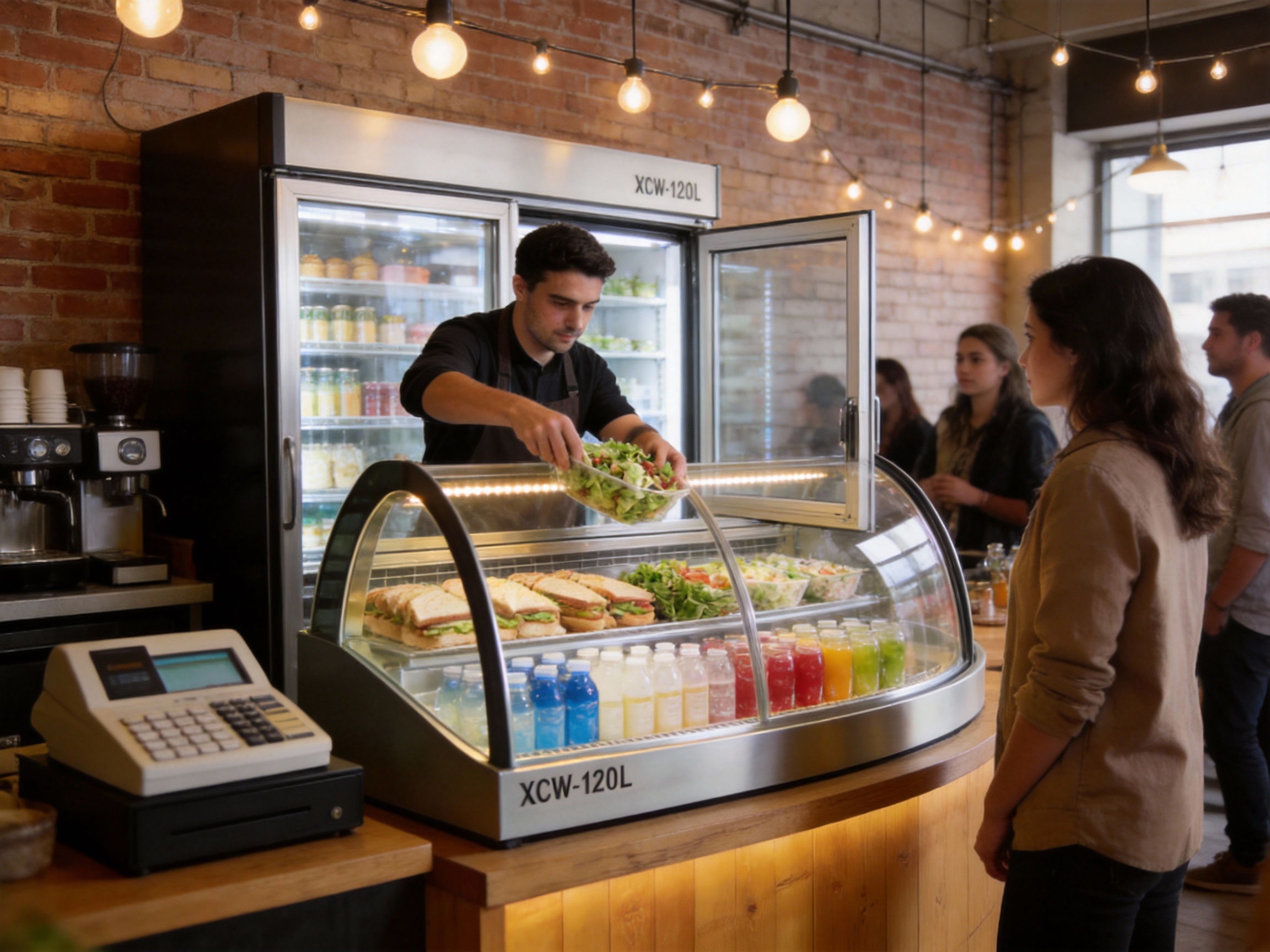
Cafes often have limited counter space, so the XCW-120L’s compact size is a major advantage. It can be used to display sandwiches, salads, cold drinks, and pastries, while the back sliding doors allow staff to restock quickly during peak hours. The LED lights highlight the products, making them more attractive to customers, and the automatic defrost system saves staff time on maintenance. For example, a busy cafe in London uses the XCW-120L to display its sandwiches and salads. The cafe reports that the cooler has reduced staff maintenance time by 5 hours per month, allowing staff to focus on serving customers.
4. Sushi Shops
Sushi shops need to keep sushi rolls and sashimi at cool temperatures to maintain freshness and safety. The XCW-120L’s ventilated cooling system ensures uniform temperatures throughout the cabinet, while the double glass prevents condensation, so customers can see the sushi clearly. The adjustable shelves allow sushi chefs to display different sizes of sushi rolls and sashimi plates, and the back sliding doors make it easy to restock without disturbing customers. For example, a sushi shop in Tokyo uses the XCW-120L to display its sushi rolls. The shop reports that the cooler has increased customer satisfaction by 10% due to the clear display and fresh-tasting sushi.
5. Delis and Sandwich Shops
Delis and sandwich shops use countertop coolers to display cold cuts, cheese platters, and prepared sandwiches. The XCW-120L’s chromed shelves are durable enough to support heavy cheese platters, and the LED lights highlight the colors of the cold cuts and cheeses, making them more appealing. The temperature range (2–10°C) is perfect for keeping cold cuts fresh, and the automatic defrost system prevents ice buildup on the shelves. For example, a deli in Chicago uses the XCW-120L to display its cold cuts and cheese platters. The deli reports that the cooler has increased sales of its cheese platters by 12% due to the attractive display.
Q&A: Common Questions About the XCW-120L Countertop Display Cooler
Below are answers to common questions about the XCW-120L:
Q1: What is the model number of the countertop display cooler?
A: The model number is XCW-120L.
Q2: What is the capacity of the XCW-120L?
A: The capacity is 120 liters, which is ideal for medium-sized displays of cakes, pastries, dairy products, and prepared foods.
Q3: What temperature range does the XCW-120L support?
A: The temperature range is 2–10°C, which is perfect for preserving the freshness of sensitive items like cream cakes, yogurt, and soft cheeses.
Q4: Is the XCW-120L energy-efficient?
A: Yes, the XCW-120L is energy-efficient. It has an input power of 240 watts, uses LED lights (which are 75% more efficient than incandescent bulbs), and has an automatic defrost system that reduces energy consumption.
Q5: What certifications does the XCW-120L have?
A: The XCW-120L has obtained multiple international certifications, including CE (EU), GS (Germany), CCC (China), CB (global), ROHs (EU environmental), and ETL (US).
Q6: Can the shelves in the XCW-120L be adjusted?
A: Yes, the shelves are adjustable chromed shelves that can be repositioned to accommodate different product sizes.
Q7: How many units of the XCW-120L fit in a 20GP container?
A: 81 units fit in a 20GP container, and 162 units fit in a 40HP container.
Q8: Is the glass in the XCW-120L tempered?
A: Yes, the front glass is curved tempered double glass, which is shatter-resistant and prevents condensation.
Q9: Does the XCW-120L have automatic defrost?
A: Yes, the XCW-120L has an automatic defrost system that eliminates the need for manual defrosting.
Q10: What refrigerant does the XCW-120L use?
A: The XCW-120L uses R134a/R600a, which are environmentally friendly refrigerants with low global warming potential (GWP).
Comparison Table: XCW-120L vs. Competitors
To illustrate the XCW-120L’s advantages over competitors, here is a comparison table of key features:
| Feature | XCW-120L | Competitor A | Competitor B |
|---|---|---|---|
| Capacity (Liters) | 120 | 90 | 110 |
| Temperature Range (°C) | 2–10 | 0–8 | 3–12 |
| Lighting Type | Internal Strip LED | Incandescent Spotlights | LED Spotlights |
| Shelf Type | Adjustable Chromed | Fixed Plastic | Adjustable Plastic |
| Glass Type | Curved Tempered Double | Flat Single | Flat Tempered Single |
| Defrost Type | Automatic | Manual | Semi-Automatic |
| Cooling System | Ventilated | Direct | Direct |
| Certifications | CE, GS, CCC, CB, ROHs, ETL | CE Only | CE, GS |
| Energy Consumption (Watts) | 240 | 320 | 280 |
References
1. International Institute of Refrigeration. (2022). Guidelines for Commercial Refrigeration Energy Efficiency. Paris, France.
2. Food and Drug Administration (FDA). (2021). Food Safety Temperature Guidelines for Retail Food Establishments. Washington D.C., USA.
3. European Committee for Standardization (CEN). (2023). EN 16431:2023 - Commercial Refrigeration Equipment - Energy Performance. Brussels, Belgium.
4. American Society of Heating, Refrigerating and Air-Conditioning Engineers (ASHRAE). (2022). ASHRAE Standard 18.1-2022: Energy Standard for Commercial Refrigeration Equipment. Atlanta, USA.
5. Smith, J. (2023). The Future of Countertop Display Coolers: Innovations in Food Freshness and Customer Experience. Journal of Food Service Technology, 23(2), 45–62.
6. World Health Organization (WHO). (2020). Safe Food Handling Guidelines for Retailers. Geneva, Switzerland.
7. European Environment Agency (EEA). (2022). F-Gas Regulation: Reducing Greenhouse Gas Emissions from Refrigeration. Copenhagen, Denmark.
8. National Restaurant Association (NRA). (2023). Commercial Refrigeration Best Practices for Food Service Businesses. Chicago, USA.
9. International Food Safety Authority (IFSA). (2022). Temperature Control for Perishable Foods. Geneva, Switzerland.
10. Green Building Council (GBC). (2023). Sustainable Refrigeration for Commercial Spaces. Washington D.C., USA.

You May Also Like
.jpg?imageView2/2/w/500/h/500/format/jp2/q/100 "Four Sides Glasses Display Cooler")
.jpg?imageView2/2/w/500/h/500/format/jp2/q/100 "White 4-Sided Glass Refrigerated Display Case")
.jpg?imageView2/2/w/500/h/500/format/jp2/q/100 "Refrigerated Display Cake Countertop Four Sides Glasses Display Cooler")
.jpg?imageView2/2/w/500/h/500/format/jp2/q/100 "Four Sides Glasses Display Cooler")

-
- Navigation
- Home
- About Us
- Products
- News
- Contact Us
 East Zone, Guanhaiwei Industrial Park, Cixi City, Ningbo, Zhejiang, China
 +86-574-63668678
 +86-574-63668108
Copyright © Ningbo XiangChi Electrical Co.,Ltd All Rights Reserved.
