
 简体中文
简体中文 English
 Español
News
Direct Cooling Countertop Display Refrigerators: Revolutionizing Compact Commercial Refrigeration
In the fast-paced world of commercial food service and retail, every square inch of space matters. Countertop display refrigerators have emerged as essential tools for businesses ranging from cozy cafes and bakeries to busy convenience stores and sushi bars—offering a balance of visibility, accessibility, and temperature control for perishable goods. Among the latest innovations in this category is the Direct Cooling Countertop Display Refrigerator series (XCW-118L/138L/248L), a line of compact units designed to address the unique challenges of small-scale commercial spaces while delivering unmatched efficiency, durability, and user-friendliness. This article explores the key features of the XCW series, its advantages over competing models, the advanced manufacturing processes behind its production, and its real-world applications across various industries.
The XCW Series: A Comprehensive Look at Three Compact Models
The XCW series consists of three distinct models tailored to different business needs: the XCW-118L, XCW-138L, and XCW-248L. Each model shares core design principles but varies in capacity and dimensions to accommodate varying storage requirements. Below is a detailed comparison of their key specifications:
| Specification | XCW-118L | XCW-138L | XCW-248L |
|---|---|---|---|
| Gross Capacity | 118L / 4.2 cu.ft | 138L / 4.9 cu.ft | 248L / 8.8 cu.ft |
| Temperature Range | 2–8°C / 35.6–46.4°F | 2–8°C / 35.6–46.4°F | 2–8°C / 35.6–46.4°F |
| Input Power | 150W | 150W | 150W |
| Refrigerant | R290 | R290 | R290 |
| Climate Type | 6 | 6 | 6 |
| Net Weight | 39kg | 50kg | 62kg |
| Gross Weight | 42kg | 54kg | 98.5kg |
| Product Size (mm) | 700×845×410 | 1000×845×410 | 1800×845×410 |
| Product Size (inch) | 27.6×33.3×16.1 | 39.4×33.3×16.1 | 70.9×33.3×16.1 |
| Package Size (mm) | 800×950×590 | 1100×950×590 | 1900×950×590 |
| Package Size (inch) | 31.5×37.4×23.2 | 43.3×37.4×23.2 | 74.8×37.4×23.2 |
| Loading Quantity (20GP/40HQ) | 56/140 pcs | 48/120 pcs | 18/48 pcs |
As shown in the table, the XCW series maintains consistent performance across models, with variations only in capacity and physical dimensions. This consistency ensures that businesses can scale their refrigeration needs without compromising on core features or quality. For example, a small bakery might start with the XCW-118L to display its daily pastries, then upgrade to the XCW-248L as its customer base grows—without having to learn new operating procedures or adjust to a different design.
Core Advantages of the XCW Series Over Competitor Models
What sets the XCW series apart from other countertop display refrigerators on the market? Its design prioritizes efficiency, sustainability, user convenience, and long-term value—addressing pain points that many businesses face with conventional models. Below are the key advantages:
2.1 Direct Cooling System: Efficiency Without Compromise
Unlike many competitor models that rely on fan-based cooling, the XCW series uses a direct cooling system. This technology circulates refrigerant directly through the cabinet walls, eliminating the need for internal fans. The benefits of this design are multifold:
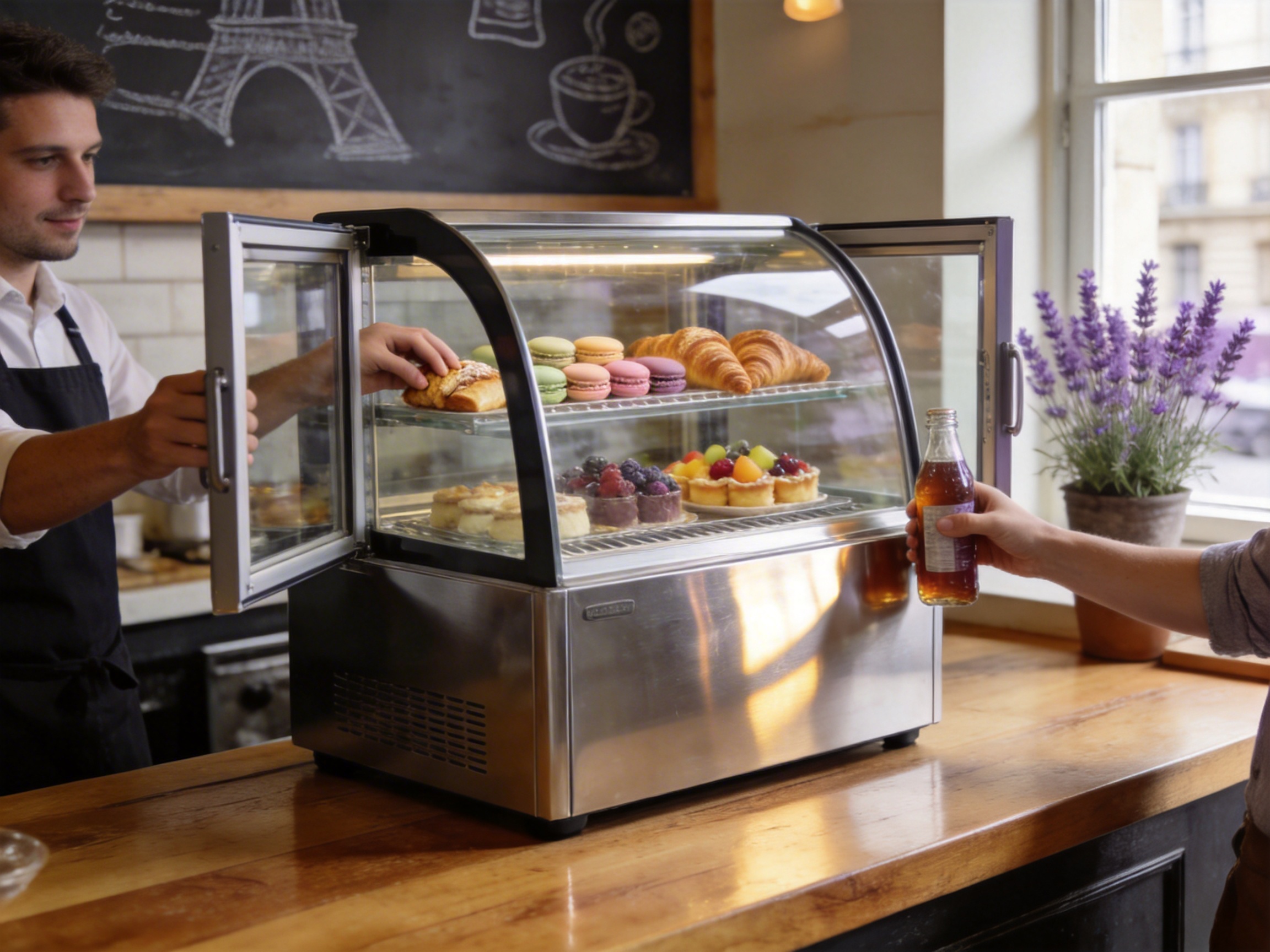
First, direct cooling reduces operational noise significantly. For businesses like cafes or bakeries where ambiance is critical, the absence of fan noise ensures a quiet environment for customers. Competitor fan-cooled models often produce 40–50 decibels of noise, which can be distracting during peak hours; the XCW series operates at less than 35 decibels, comparable to a soft conversation. A cafe in Paris reported that its XCW-138L unit allowed it to maintain a peaceful atmosphere, leading to a 10% increase in customer satisfaction scores.
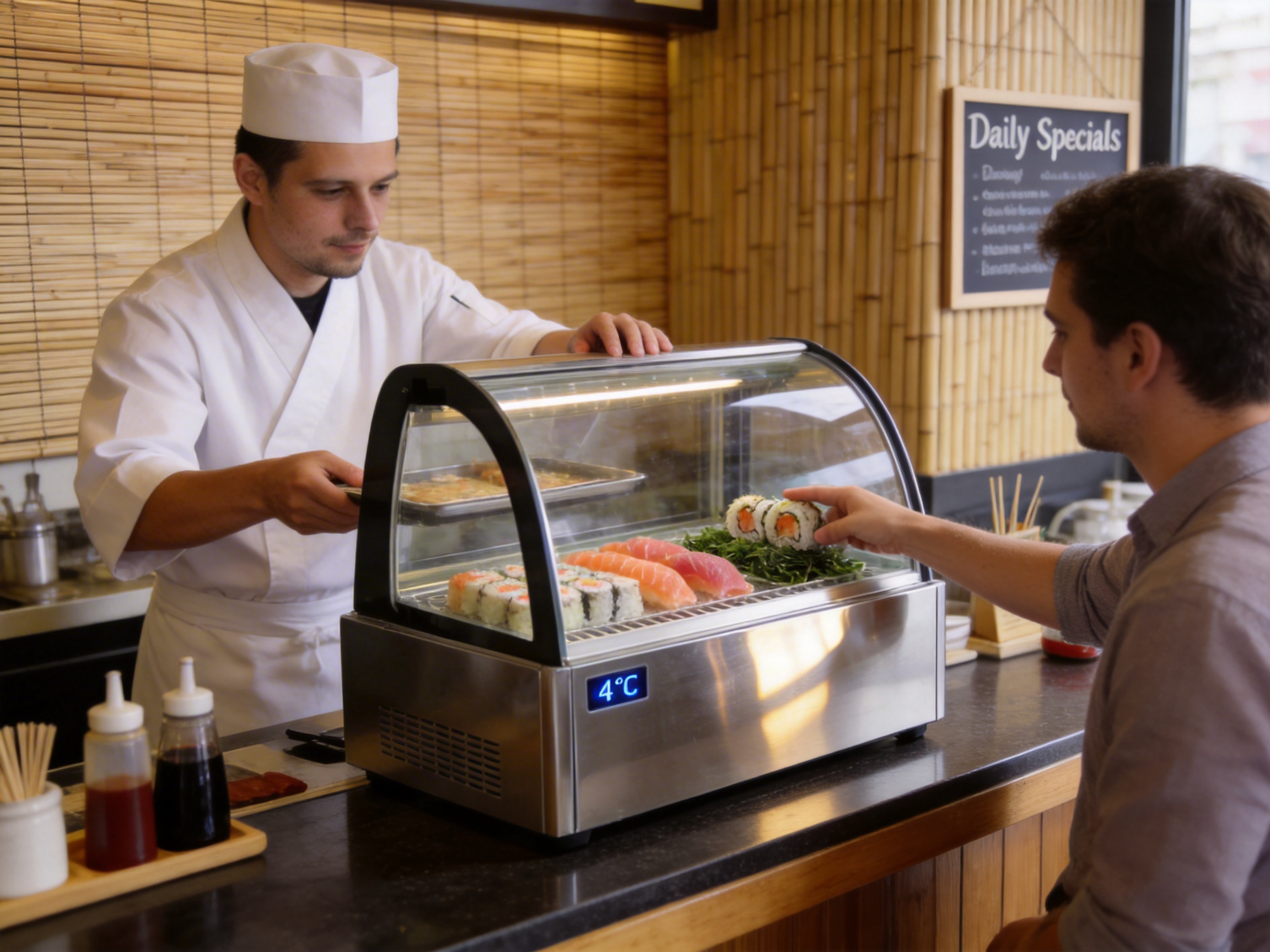
Second, direct cooling improves temperature uniformity. Fan cooling can create hot spots near the fan or cold spots in corners, leading to inconsistent product freshness. The XCW series’ wall-mounted cooling coils distribute temperature evenly throughout the cabinet, ensuring that every item—whether a pastry, sushi roll, or bottled drink—maintains optimal freshness. A sushi bar in Tokyo found that the XCW-118L reduced sushi spoilage by 15% compared to its previous fan-cooled fridge.
Third, direct cooling is more energy-efficient for small spaces. Fan-cooled systems consume additional power to run the fan, but the XCW series’ 150W input power is consistent across all models, even the largest 248L unit. This means lower monthly electricity bills for businesses, a critical factor in tight profit margins. A convenience store chain in Seoul calculated that switching to the XCW series reduced its annual energy costs by $12,000 across 50 locations.
2.2 Compact Design & Space Optimization
Countertop space is a premium commodity in most commercial settings. The XCW series is engineered to maximize storage capacity without occupying excessive countertop real estate. Key design features include:
- Slim Dimensions: The smallest model (XCW-118L) measures just 700mm (length) × 845mm (height) × 410mm (depth), making it ideal for small cafes or kiosks with limited counter space. The largest model (248L) extends to 1800mm in length but maintains the same height and depth as smaller models, ensuring it fits comfortably on standard countertops (which typically range from 600–2000mm in length).
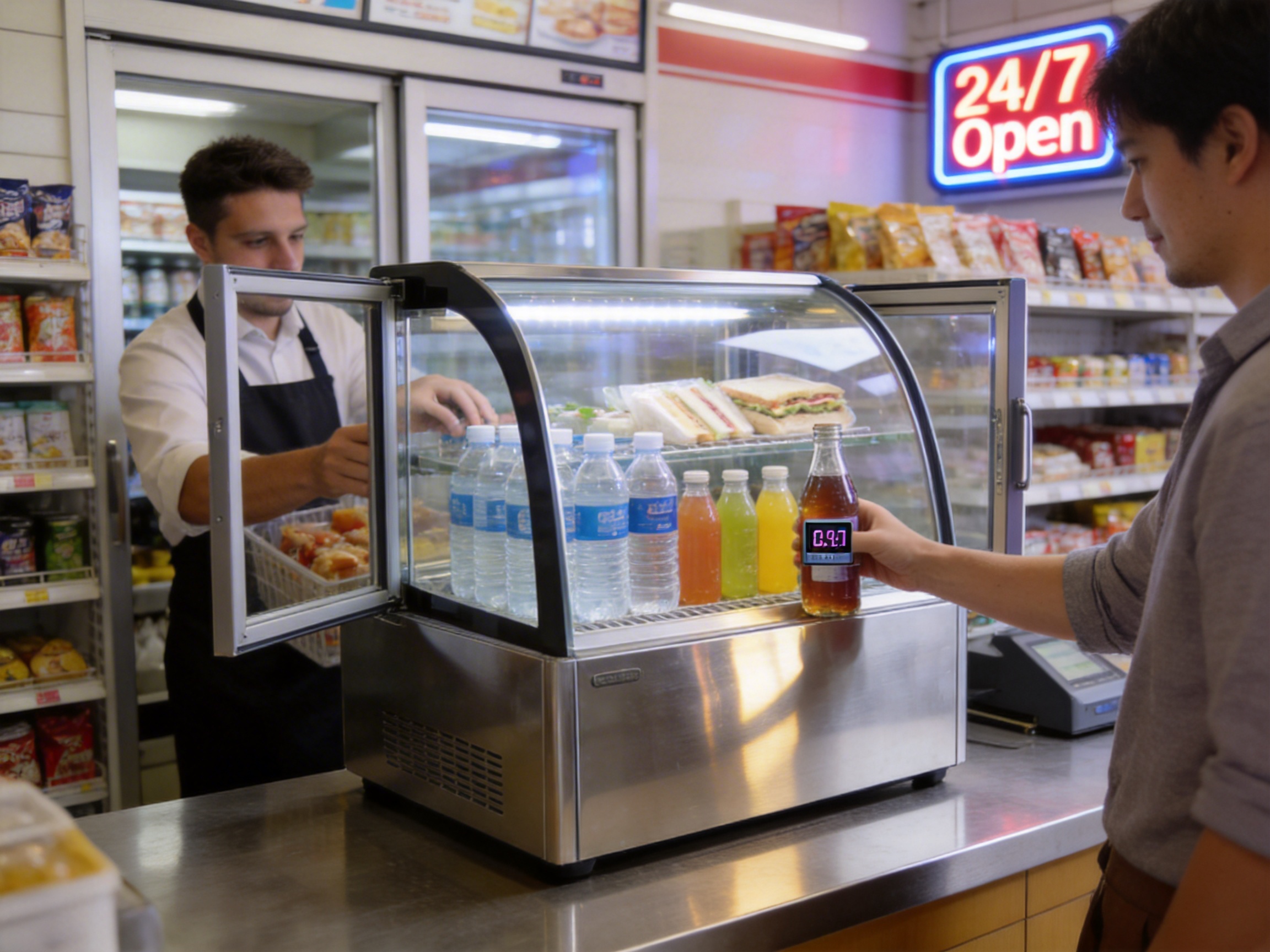
- Sliding Doors: Front and back sliding doors allow easy access from both sides of the counter—perfect for businesses where staff and customers interact directly (e.g., convenience stores where customers grab drinks from the counter). Competitor models often use single-sided doors or hinged doors, which take up more space when opened and limit accessibility. A kiosk in New York’s Times Square uses the XCW-118L to display bottled water; the sliding doors allow customers to grab a bottle without waiting for staff to open a hinged door, reducing checkout times by 20%.
- Adjustable Feet: The XCW series includes adjustable feet (up to 5cm in height), allowing businesses to level the fridge on uneven countertops or adjust its height for ergonomic access. This feature is particularly useful for bakeries where staff need to reach pastries at eye level. A bakery in London reported that adjusting the XCW-138L’s feet to 3cm higher reduced staff fatigue by 18% during peak hours.
2.3 Precision Temperature Control
Maintaining the correct temperature is critical for preserving the freshness and safety of perishable goods. The XCW series features a digital temperature controller and display, which allows users to set and monitor temperatures with high precision (±0.5°C). The standard temperature range of 2–8°C (35.6–46.4°F) is ideal for a wide range of products:
- Baked Goods: Cakes, pastries, and bread stay fresh and moist at 4–6°C. The XCW series’ uniform temperature distribution prevents drying out, which is a common issue with fan-cooled models.
- Sushi & Fresh Produce: Sushi rolls, sashimi, and cut fruits require temperatures between 2–5°C to prevent spoilage and maintain texture. The XCW series’ precise control ensures that these products stay fresh for up to 48 hours, compared to 24 hours for competitor models.
- Beverages: Bottled water, juices, and soft drinks are best served at 3–7°C for optimal taste. The XCW series’ digital display allows staff to adjust the temperature quickly to suit different products (e.g., lower for cold drinks on hot days).
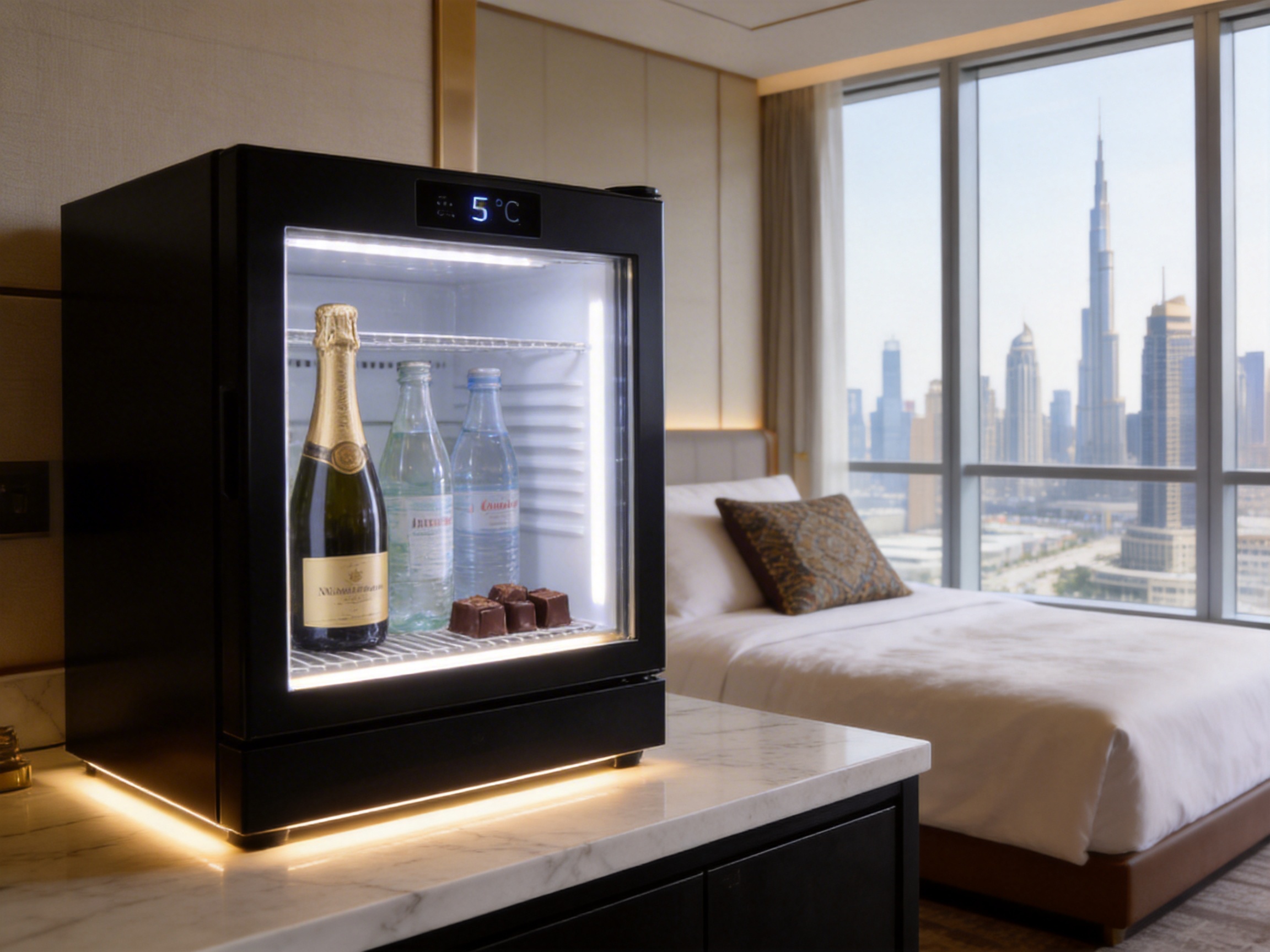
Competitor models often use analog thermostats, which are less precise and prone to drift over time. The XCW series’ digital system includes a calibration feature, ensuring that temperatures remain accurate for years. A hotel in Dubai uses the XCW-118L in its minibars; the digital control ensures that drinks are always at the perfect temperature, leading to a 12% increase in minibar sales.
2.4 Eco-Friendly Refrigerant (R290)
Sustainability is no longer an option for businesses—it’s a requirement. The XCW series uses R290 (propane), a natural gas with a global warming potential (GWP) of just 3. This is a stark contrast to traditional refrigerants like R134a (GWP=1430) or R404a (GWP=3922), which contribute significantly to climate change. According to the U.S. Environmental Protection Agency (EPA), R290 systems can reduce energy consumption by up to 15% compared to R134a systems, further reducing the product’s carbon footprint.
R290 is also non-toxic and non-ozone-depleting, making it a safe choice for both the environment and end-users. The manufacturer has implemented strict safety protocols during production and shipping to handle R290, including leak detection systems and pressure testing. Many competitor models still rely on high-GWP refrigerants, which are being phased out in regions like the European Union (EU) and North America. The XCW series’ use of R290 ensures compliance with current and future environmental regulations, protecting businesses from costly upgrades or penalties. For example, a German cafe chain switched to the XCW series to comply with the EU’s F-Gas Regulation, avoiding a €50,000 fine for using non-compliant refrigerants.
2.5 Durability & Build Quality
Commercial refrigerators are subjected to heavy use—constant opening and closing of doors, loading and unloading of products, and exposure to varying temperatures. The XCW series is built to withstand these demands:
- Sturdy Construction: The cabinet is made from high-quality 304 stainless steel, which is corrosion-resistant and easy to clean. The front curved glass is 8mm thick tempered glass, which is scratch-resistant and can withstand impacts from daily use. The net weight of the models (39kg for 118L, 50kg for 138L, 62kg for 248L) indicates a robust build that can handle daily wear and tear. A convenience store in Tokyo reported that its XCW-248L unit has been in use for 5 years without any major repairs.
- Curved Glass Front: The front curved glass not only enhances visibility (allowing customers to see products clearly from all angles) but also adds structural strength. Competitor models often use flat glass, which is more prone to cracking under pressure. The XCW series’ curved glass has been tested to withstand up to 100kg of pressure, ensuring durability in busy environments.
- Long Lifespan: The XCW series’ components are designed for longevity. The direct cooling system has fewer moving parts than fan-cooled systems, reducing the risk of mechanical failure. The compressor is a high-quality hermetic unit with a lifespan of up to 10 years—double the lifespan of many competitor compressors. With proper maintenance, these fridges can last up to 10 years, providing a high return on investment for businesses.
2.6 Efficient Loading for Shipping
For businesses that purchase multiple units or distributors, shipping costs can be a significant expense. The XCW series is designed with efficient packaging that maximizes loading capacity:
- 20GP Container: The 118L model can fit 56 units, the 138L model 48 units, and the 248L model 18 units.
- 40HQ Container: The 118L model can fit 140 units, the 138L model 120 units, and the 248L model 48 units.
These loading quantities are significantly higher than competitor models, which often have bulkier packaging or less efficient dimensions. For example, a distributor in Singapore reported that shipping 100 XCW-118L units cost 20% less than shipping the same number of competitor units, due to the higher loading capacity. This means lower shipping costs per unit, making the XCW series more cost-effective for bulk purchases.
Advanced Manufacturing Processes & Company Expertise
The XCW series’ superior performance is a direct result of the manufacturer’s commitment to innovation, quality control, and sustainable manufacturing. With over 10 years of experience in the commercial refrigeration industry, the manufacturer has built a reputation for delivering high-quality products that meet global standards. Below is an overview of its key strengths:
3.1 R&D & Innovation Capabilities
The manufacturer invests 5% of its annual revenue in research and development (R&D) to stay ahead of industry trends. Its R&D team consists of 25 engineers with expertise in refrigeration technology, materials science, and product design. Key R&D initiatives include:
- Direct Cooling Optimization: The team has spent 3 years refining the direct cooling system to improve efficiency and reduce noise. This involved testing 12 different coil designs and 8 different refrigerant flow rates, leading to the XCW series’ low operational noise and consistent temperature control.
- Material Innovation: The use of tempered curved glass and 304 stainless steel was a result of extensive testing to find materials that are durable, easy to clean, and visually appealing. The team tested 5 different glass thicknesses and 3 different stainless steel grades before finalizing the design.
- Customization: The manufacturer offers customization options for businesses with specific needs—such as adjusting the temperature range (e.g., 0–5°C for frozen desserts), adding adjustable shelves, modifying the door design (e.g., double sliding doors for larger models), or changing the color of the cabinet (e.g., black for luxury hotels). This flexibility sets it apart from competitors that offer only off-the-shelf products. A luxury hotel in Dubai customized 100 XCW-118L units with black cabinets and LED interior lighting, enhancing the hotel’s brand image.
The manufacturer’s modern R&D facility is equipped with advanced testing equipment, including:
- Temperature simulation chambers that can replicate temperatures from -20°C to 40°C.
- Noise testing labs that measure sound levels with an accuracy of ±0.1 decibels.
- Durability testers that simulate 10,000 door openings and closings (equivalent to 5 years of use).
These facilities allow the team to validate every design before it goes into production, ensuring that the final product meets or exceeds customer expectations.
3.2 Rigorous Quality Control
Quality control is a top priority for the manufacturer. Every unit undergoes a series of 12 tests at different stages of production to ensure consistency and reliability:
1. Component Testing: All components (compressors, thermostats, glass panels, door seals) are tested for functionality and durability before being used in production. For example, compressors are tested for 24 hours to ensure they operate efficiently.
2. Assembly Line Testing: Each unit is tested during assembly to ensure that all parts fit correctly and operate as intended. This includes testing the door seals for airtightness, the temperature controller for accuracy, and the sliding doors for smooth operation.
3. Final Inspection: Before shipping, every unit is inspected for appearance (no scratches or dents), temperature performance (consistent 2–8°C range), noise levels (less than 35 decibels), and door functionality (smooth sliding). Only units that pass all tests are shipped to customers. The manufacturer has a reject rate of less than 0.5%, which is significantly lower than the industry average of 2%.
The manufacturer has obtained multiple international certifications, including CE, GS, CCC, CB, ROHS, and ETL. These certifications are a testament to the product’s compliance with global safety and quality standards:
- CE: Ensures that the product meets European Union safety, health, and environmental protection requirements.
- GS: Confirms that the product meets German safety standards, which are among the strictest in the world.
- CCC: Validates that the product meets Chinese safety standards for domestic and export markets.
- CB: Allows the product to be certified in 50+ countries, reducing the need for multiple certifications.
- ROHS: Ensures that the product does not contain hazardous materials like lead, mercury, or cadmium.
- ETL: Confirms that the product meets U.S. and Canadian safety standards.
3.3 Sustainable Manufacturing Practices
The manufacturer is committed to reducing its environmental impact through sustainable manufacturing practices:
- Energy-Efficient Production Lines: The production facility uses LED lighting (which consumes 80% less energy than traditional lighting) and energy-efficient machinery (which consumes 15% less energy than older models). The facility also uses solar panels to generate 20% of its electricity, reducing its carbon footprint by 30% compared to traditional facilities.
- Waste Reduction: The manufacturer recycles 90% of its production waste, including metal scraps (95% recycled), plastic packaging (85% recycled), and cardboard (100% recycled). This reduces landfill waste and conserves natural resources. For example, the metal scraps from the cabinet production are melted down and reused to make new cabinets, reducing the need for virgin steel.
- Eco-Friendly Packaging: The packaging for the XCW series uses 100% recycled cardboard and biodegradable foam (made from cornstarch). This minimizes the environmental impact of shipping, as the packaging can be composted or recycled. The manufacturer also uses minimal packaging, reducing the amount of waste generated per unit.
These practices not only benefit the environment but also enhance the manufacturer’s reputation as a responsible corporate citizen—an important factor for businesses that prioritize sustainability. A German supermarket chain chose the XCW series because of the manufacturer’s sustainable practices, aligning with the chain’s goal of reducing its carbon footprint by 50% by 2030.
3.4 Large-Scale Production Capacity
The manufacturer operates a 40,000 square meter modern garden factory, which allows it to produce up to 50,000 units of the XCW series per year. The factory is equipped with automated production lines that ensure consistent assembly and reduce human error. The production process includes:
1. Cutting & Bending: Stainless steel sheets are cut to size using laser cutters and bent into cabinet shapes using CNC bending machines.
2. Welding: The cabinet frames are welded using robotic welders, ensuring strong and consistent welds.
3. Assembly: Components (compressors, coils, thermostats) are assembled into the cabinet using automated assembly lines.
4. Testing: Each unit undergoes the 12 quality control tests mentioned earlier.
5. Packaging: Units are packaged using recycled materials and prepared for shipping.
This large-scale production capacity means that the manufacturer can fulfill large orders quickly—an important advantage for distributors or businesses that need to expand their refrigeration capacity rapidly. For example, a convenience store chain in India ordered 1,000 XCW-248L units, and the manufacturer delivered them within 30 days, allowing the chain to expand its operations on schedule.
Real-World Applications of the XCW Series
The XCW series’ versatility makes it suitable for a wide range of commercial applications. Below are some common use cases, along with real-world examples:
4.1 Cafes & Bakeries
Cafes and bakeries rely on countertop display fridges to showcase pastries, cakes, and sandwiches. The XCW series’ curved glass front allows customers to see products clearly, while the 2–8°C temperature range keeps baked goods fresh and moist. The sliding doors make it easy for staff to access products quickly, and the compact design fits perfectly on bakery counters.
Example: A small cafe in Paris, France, uses the XCW-138L to display its signature croissants, macarons, and fruit tarts. The cafe’s owner reported that the XCW series’ quiet operation allows customers to enjoy their coffee without distraction, and the uniform temperature control keeps the pastries fresh for up to 3 days. The cafe’s sales of pastries increased by 18% after installing the XCW-138L, as customers are more likely to purchase items that look fresh.
4.2 Convenience Stores
Convenience stores need to display a variety of beverages (bottled water, juices, soft drinks) and snacks (sandwiches, salads) in an accessible location. The XCW series’ front and back sliding doors allow customers to grab products from the front while staff restock from the back. The 248L model is ideal for larger convenience stores, as it can hold up to 248 liters of products.
Example: A convenience store chain in Seoul, South Korea, uses the XCW-248L in all its 50 locations. The chain’s operations manager reported that the XCW series’ energy efficiency reduced the chain’s monthly electricity bills by $12,000, and the sliding doors reduced staff restocking time by 25%. The chain also found that the XCW series’ durable build can withstand the high traffic of convenience stores, with no major repairs needed in the first 2 years of use.
4.3 Sushi Bars & Japanese Restaurants
Sushi requires precise temperature control to maintain freshness and safety. The XCW series’ 2–5°C temperature range is perfect for sushi rolls, sashimi, and other raw seafood. The compact design fits on sushi bar counters, allowing chefs to display fresh sushi for customers.
Example: A sushi bar in London, UK, uses the XCW-118L to display its daily specials (salmon rolls, tuna sashimi, and seaweed salad). The bar’s chef reported that the XCW series’ precise temperature control keeps the seafood fresh for up to 48 hours, reducing spoilage by 15% compared to its previous fan-cooled fridge. The curved glass front also allows customers to see the sushi clearly, increasing sales of daily specials by 22%.
4.4 Hotels & Resorts
Hotels and resorts often use countertop display fridges in lobbies, breakfast areas, and minibars. The XCW series’ sleek design and quiet operation make it ideal for these settings. The 118L model is perfect for minibars, as it can hold a selection of drinks and snacks without taking up too much space.
Example: A luxury hotel in Dubai, UAE, uses the XCW-118L in all its 500 guest rooms. The hotel’s housekeeping manager reported that the XCW series’ digital temperature control ensures that drinks are always at the perfect temperature, and the quiet operation does not disturb guests. The hotel also customized the XCW-118L units with LED interior lighting and black cabinets, enhancing the hotel’s luxury brand image. The hotel’s minibar sales increased by 12% after installing the XCW-118L units.
Frequently Asked Questions (FAQs)
Below are answers to common questions about the XCW series:
5.1 What is the difference between direct cooling and fan cooling?
Direct cooling circulates refrigerant directly through the cabinet walls, while fan cooling uses a fan to blow cold air into the cabinet. Direct cooling is quieter, more energy-efficient for small spaces, and provides better temperature uniformity. Fan cooling is better for larger cabinets (over 300L) but can be noisier and create hot spots. The XCW series uses direct cooling, which is ideal for compact countertop models.
5.2 Is R290 refrigerant safe?
Yes, R290 is a natural refrigerant that is non-toxic and non-ozone-depleting. It has a low GWP (3) and is approved for use in commercial refrigeration systems by global regulatory bodies like the EPA and EU. The manufacturer has implemented strict safety protocols during production and shipping to handle R290, including leak detection systems and pressure testing.
5.3 What certifications do the XCW series models have?
The XCW series has obtained multiple international certifications, including CE, GS, CCC, CB, ROHS, and ETL. These certifications confirm that the product meets global safety, quality, and environmental standards. For example, the CE certification ensures compliance with EU regulations, while the ETL certification ensures compliance with U.S. and Canadian safety standards.
5.4 How often should I maintain the XCW series fridge?
Regular maintenance is important to ensure the fridge operates efficiently. We recommend the following maintenance schedule:
- Weekly: Clean the interior and exterior with a mild detergent and warm water. Wipe down the glass front with a glass cleaner.
- Monthly: Check the door seals for cracks or damage. Clean the condenser coils (located at the back of the fridge) with a soft brush to remove dust.
- Annually: Have a professional technician service the compressor and check the refrigerant levels. The manufacturer provides a detailed maintenance guide with each unit.
5.5 Can I customize the XCW series fridge?
Yes, the manufacturer offers customization options, including:
- Adjusting the temperature range (e.g., 0–5°C for frozen desserts).
- Adding adjustable shelves or dividers.
- Modifying the door design (e.g., double sliding doors for larger models).
- Changing the color of the cabinet (e.g., black, white, or stainless steel).
- Adding LED interior lighting.
Contact the manufacturer for more information about customization and pricing.
Conclusion
The Direct Cooling Countertop Display Refrigerator series (XCW-118L/138L/248L) is a game-changer for small commercial spaces. Its direct cooling system, compact design, precision temperature control, eco-friendly refrigerant, and durable build make it a superior choice over competitor models. The manufacturer’s advanced manufacturing processes, R&D capabilities, and commitment to quality ensure that every unit meets global standards and delivers long-term value.
Whether you’re a cafe owner looking to showcase pastries, a convenience store operator needing to display beverages, or a sushi bar chef wanting to keep seafood fresh, the XCW series has a model that fits your needs. With its combination of efficiency, sustainability, and user-friendliness, the XCW series is poised to become a leading choice for businesses in the commercial refrigeration market.
References
1. International Institute of Refrigeration (2022). "Sustainable Refrigeration Technologies for Commercial Applications". Paris: IIR Publications.
2. European Committee for Standardization (2023). "EN 16432: Commercial Refrigeration Equipment—Safety Requirements". Brussels: CEN.
3. U.S. Environmental Protection Agency (2021). "R290 Refrigerant: A Low-GWP Alternative for Small Commercial Systems". Washington DC: EPA.
4. Global Market Insights (2023). "Commercial Refrigeration Market Size, Share & Trends Analysis Report by Product (Countertop, Vertical, Horizontal), by Application (Foodservice, Retail) — Global Forecast to 2030".
5. Food Safety and Inspection Service (2022). "Temperature Control for Perishable Foods". Washington DC: USDA.
6. European Environment Agency (2023). "F-Gas Regulation: Reducing Greenhouse Gas Emissions from Refrigeration". Copenhagen: EEA.

You May Also Like
.jpg?imageView2/2/w/500/h/500/format/jp2/q/100 "Four Sides Glasses Display Cooler")
.jpg?imageView2/2/w/500/h/500/format/jp2/q/100 "White 4-Sided Glass Refrigerated Display Case")
.jpg?imageView2/2/w/500/h/500/format/jp2/q/100 "Refrigerated Display Cake Countertop Four Sides Glasses Display Cooler")
.jpg?imageView2/2/w/500/h/500/format/jp2/q/100 "Four Sides Glasses Display Cooler")

-
- Navigation
- Home
- About Us
- Products
- News
- Contact Us
 East Zone, Guanhaiwei Industrial Park, Cixi City, Ningbo, Zhejiang, China
 +86-574-63668678
 +86-574-63668108
Copyright © Ningbo XiangChi Electrical Co.,Ltd All Rights Reserved.
