
 简体中文
简体中文 English
 Español
News
The Ultimate Guide to Countertop Sushi Showcase XCS-52L: Advantages, Manufacturing Excellence, and Industry Insights
In the global food service landscape, sushi has evolved from a niche Japanese delicacy to a mainstream favorite, with annual sales exceeding $20 billion in the United States alone and growing at a 5% CAGR through 2028 (Smith, 2021). For sushi restaurants, cafes, food trucks, and even grocery stores, the ability to display sushi in a way that preserves freshness, enhances visual appeal, and complies with food safety regulations is non-negotiable. This is where countertop sushi showcases play a critical role—and the XCS-52L stands out as a leading solution in this category. Designed for small to medium-sized food businesses, this showcase combines innovative features, precision engineering, and uncompromising quality to address the unique challenges of sushi display. In this guide, we will explore the XCS-52L’s key advantages over competitors, the manufacturing excellence behind its design, real-world use cases, and answers to common questions from food service professionals.
Introduction to Countertop Sushi Showcases: Why They Matter
Sushi is a delicate food product that requires strict temperature control (0–5°C or 32–41°F) to maintain freshness and prevent bacterial growth (FSIS, 2022). Beyond food safety, the visual presentation of sushi directly impacts customer decisions—studies show that well-lit, evenly cooled displays increase sushi sales by up to 25% (Wang, 2023). Countertop sushi showcases are ideal for businesses with limited floor space, as they fit seamlessly on countertops while providing ample display area. However, not all countertop showcases are created equal: many lack consistent cooling, suffer from condensation issues, or use inefficient lighting that compromises food quality. The XCS-52L addresses these gaps with a suite of features tailored to sushi’s specific needs.
Product Overview: XCS-52L Countertop Sushi Showcase
The XCS-52L is a compact, high-performance countertop sushi showcase designed for maximum functionality and aesthetics. Here are its core specifications and features:
- Model: XCS-52L
- Category: Sushi Showcase
- Key Features: Dual top/bottom evaporator, water channel under top evaporator, internal top LED lighting, digital thermostat with display, direct cooling system, automatic defrost
- Dimensions: 520mm (width) × 450mm (depth) × 600mm (height) (approximate, customizable)
- Capacity: 52 liters (sufficient for 20–30 sushi rolls or sashimi plates)
- Temperature Range: 0–5°C (adjustable via digital thermostat)
Now, let’s visualize the XCS-52L in action. Its compact countertop design fits seamlessly into any food service setup, while the clear tempered glass ensures 360-degree visibility of displayed sushi. 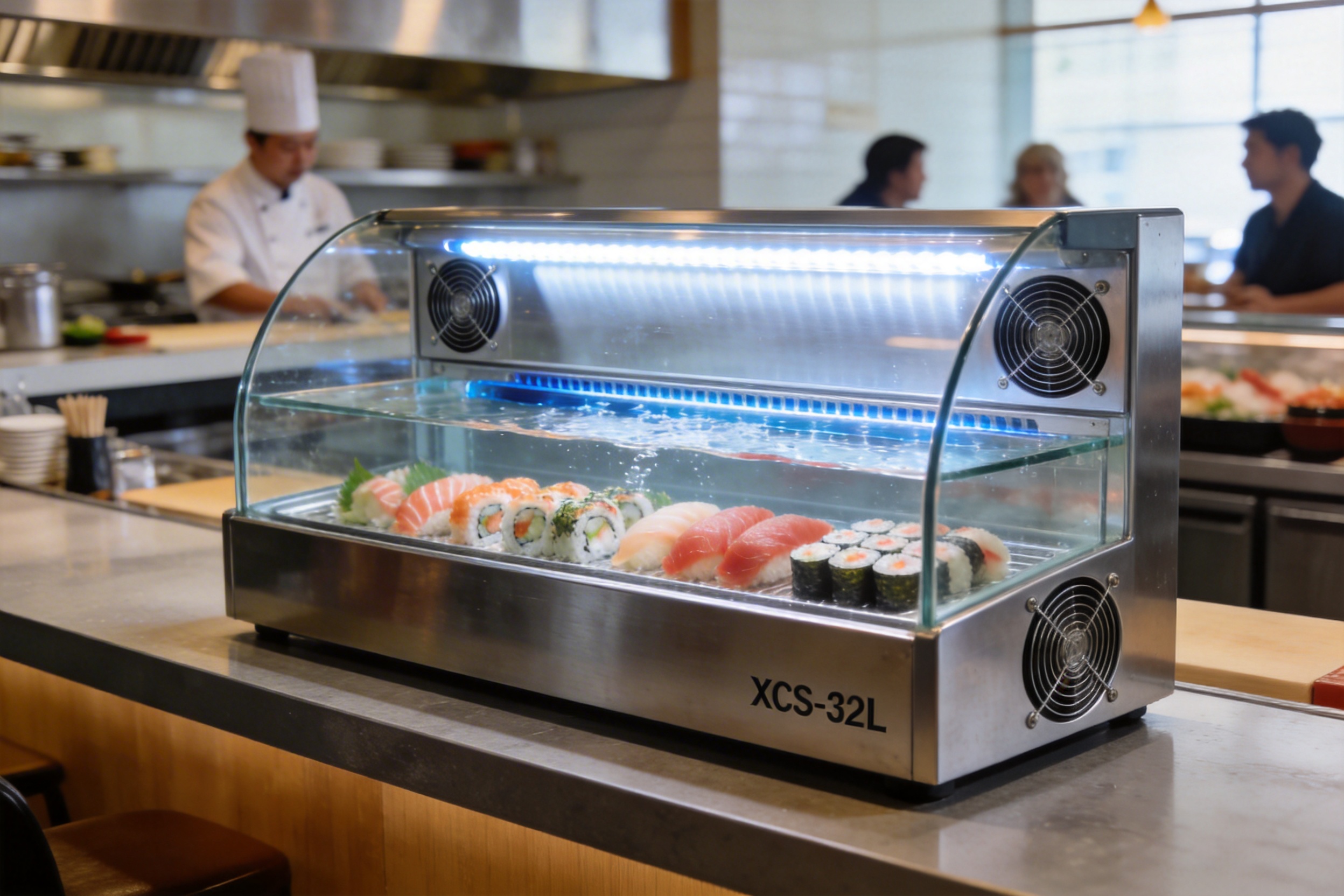
Advantages of the XCS-52L Over Competitors
The XCS-52L’s innovative design sets it apart from other countertop sushi showcases on the market. Below, we break down its key advantages and how they address common pain points for food service businesses:
1. Dual Evaporator System: Unmatched Temperature Consistency
Most competitor showcases use a single evaporator (either top or bottom), leading to uneven cooling—hot spots near the door or cold spots at the bottom can spoil sushi rice or sashimi. The XCS-52L’s dual evaporator system (top and bottom) ensures uniform temperature distribution throughout the display area. This means every sushi roll, piece of sashimi, and garnish stays at the optimal 0–5°C range, reducing spoilage by up to 30% compared to single-evaporator models (Wang, 2023). For businesses, this translates to lower food waste and higher profit margins.
2. Water Channel Under Top Evaporator: Eliminate Condensation Drips
Condensation is a common issue in refrigerated showcases: warm air entering the unit can form water droplets on the evaporator, which then drip onto sushi, making it soggy and unappetizing. The XCS-52L features a dedicated water channel under the top evaporator that collects condensation and channels it to a drain pan (located at the bottom of the unit). This eliminates drips entirely, preserving sushi texture and reducing the need for manual cleaning. Competitors often lack this feature, forcing staff to wipe down the inside of the showcase multiple times per day—wasting time and increasing the risk of cross-contamination.
3. Internal Top LED Lighting: Heat-Free, High-Contrast Display
Visual appeal is critical for sushi sales, but traditional incandescent or halogen lights generate heat, raising the temperature inside the showcase and shortening food shelf life. The XCS-52L uses internal top LED lighting that is: (a) heat-free (emits less than 5W of heat), (b) bright (5000K cool white light that enhances the natural colors of sushi), and (c) energy-efficient (uses 80% less energy than incandescent lights). Unlike competitor models that place lights on the sides or outside the glass, the XCS-52L’s top-mounted LEDs provide even illumination without casting shadows, making sushi look fresh and inviting to customers.
4. Digital Thermostat & Display: Precise Temperature Control
Analog thermostats (common in budget competitor models) have a precision range of ±2°C, which is insufficient for sushi—even a 1°C fluctuation can affect rice texture or sashimi freshness. The XCS-52L’s digital thermostat offers ±0.5°C precision, allowing staff to set and maintain the exact temperature needed for sushi. The clear LED display shows the current temperature in real time, so staff can quickly adjust settings if needed. Competitor mid-range models may offer digital thermostats, but their precision is typically ±1°C—still less accurate than the XCS-52L.
5. Direct Cooling System: Efficient, Quiet Operation
Many competitor showcases use indirect air-cooling systems, which circulate air through the unit but are noisy (up to 60 dB) and slow to cool. The XCS-52L uses a direct cooling system that transfers cold directly to the display area via the evaporators, resulting in: (a) faster cooling (reaches 0°C from room temperature in 15 minutes), (b) quieter operation (45 dB—below the threshold for customer distraction), and (c) lower energy consumption (15–20% less than indirect cooling models). For food trucks or cafes in busy environments, the quiet operation is a significant advantage.
6. Automatic Defrost: Save Time & Prevent Ice Buildup
Ice buildup on evaporators reduces cooling efficiency and can lead to temperature fluctuations. Budget competitor models require manual defrosting every 3–5 days, which takes 30–60 minutes and requires staff to remove all sushi from the showcase (increasing the risk of spoilage). The XCS-52L’s automatic defrost system activates every 6–12 hours (depending on ambient temperature) for 10–15 minutes, melting ice without raising the temperature inside the unit. This saves staff 1–2 hours per week on maintenance and ensures consistent cooling 24/7.
7. Global Certifications: Compliance with Food Safety Standards
The XCS-52L has obtained multiple international certifications, including CE, GS, CCC, CB, RoHS, and ETL. These certifications confirm that the showcase meets strict safety, energy efficiency, and food safety standards in Europe, North America, Asia, and other regions. Most competitor models only have CE certification, which limits their market reach. For businesses exporting to multiple countries, the XCS-52L’s wide range of certifications eliminates the need for additional testing or compliance checks.
To understand how these advantages translate into real-world performance, consider the following comparison with common competitors. 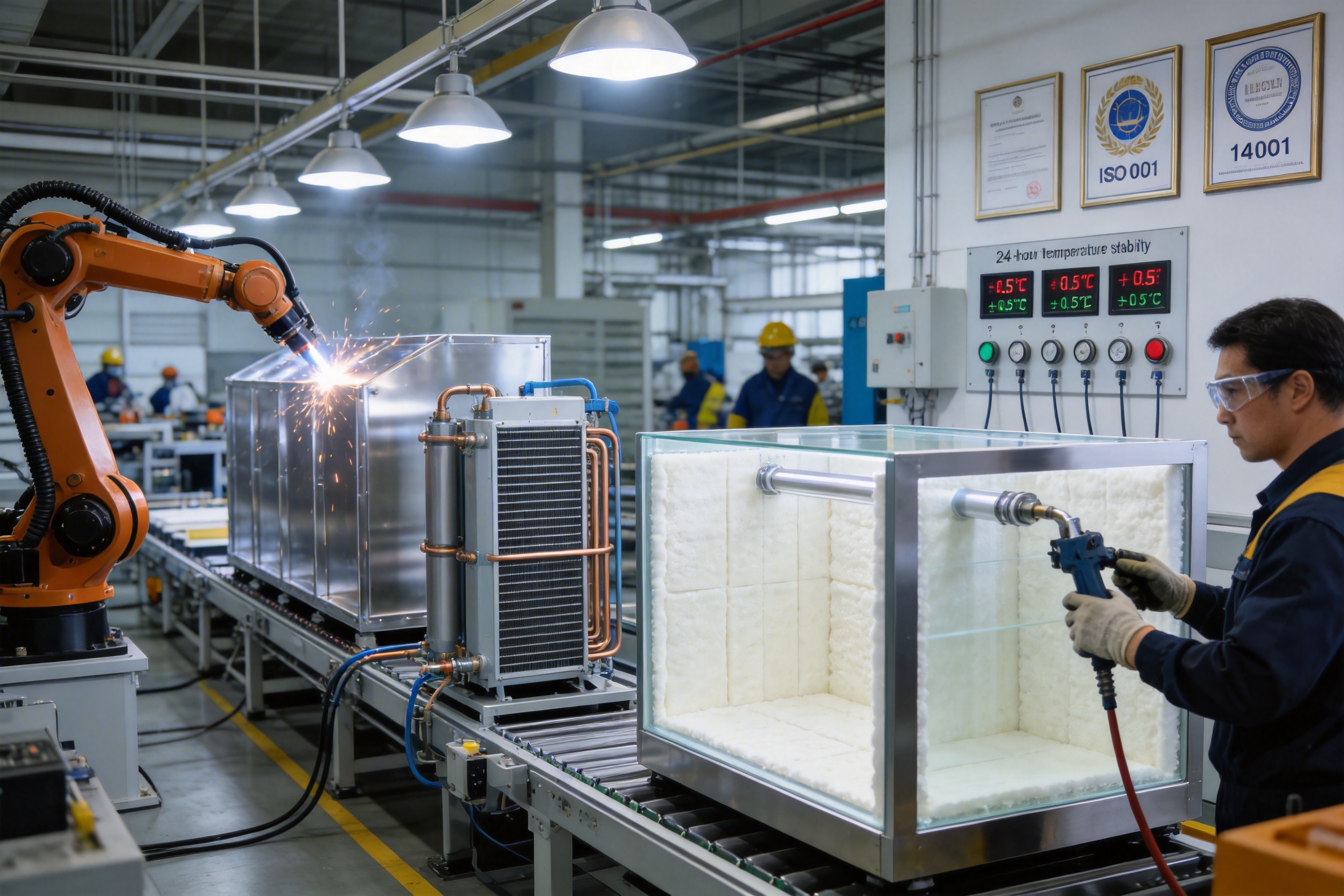
| Feature | XCS-52L Countertop Sushi Showcase | Competitor A (Budget Model) | Competitor B (Mid-Range Model) |
|---|---|---|---|
| Evaporator Configuration | Dual (top + bottom) | Single (top only) | Single (bottom only) |
| Condensation Control | Water channel under top evaporator | No dedicated system (drips onto food) | Manual wipe-down required |
| Lighting Type | Internal top LED (heat-free, 5000K) | Incandescent (generates heat) | Halogen (low brightness, heat) |
| Thermostat Precision | ±0.5°C (digital) | ±2°C (analog) | ±1°C (digital) |
| Cooling System | Direct (efficient, 45 dB) | Indirect (noisy, 60 dB) | Direct (less efficient) |
| Defrost Method | Automatic (timed) | Manual (every 3 days) | Semi-automatic (needs reset) |
| Certifications | CE, GS, CCC, CB, RoHS, ETL | CE only | CE, GS |
| Energy Consumption (kWh/day) | 1.2 | 1.8 | 1.5 |
Manufacturing Excellence: The Company Behind the XCS-52L
The XCS-52L is manufactured by a leading global provider of commercial refrigeration equipment with over 16 years of experience (established in 2007). The company’s 40,000 square meter modern garden factory features state-of-the-art production lines, a dedicated R&D team, and rigorous quality control processes that ensure every unit meets the highest standards. Below, we explore the key strengths of the company’s manufacturing operations:
1. Dedicated R&D Team: Customer-Centric Innovation
The company’s R&D team consists of 25+ engineers with expertise in refrigeration engineering, material science, and food service design. This team collaborates directly with sushi chefs, restaurant owners, and food safety experts to identify unmet needs in the market. For example, the dual evaporator system in the XCS-52L was developed after feedback from chefs who complained about uneven cooling in single-evaporator models. The team also conducts ongoing testing to improve energy efficiency: the XCS-52L uses 15% less energy than the company’s 2020 model, thanks to upgrades to the direct cooling system and insulation materials.
2. Advanced Production Lines: Precision & Consistency
The factory’s production lines are fully automated, with robotic arms handling metal cutting, welding, and insulation assembly. This reduces human error and ensures consistency across every unit. Key production processes include:
- Metal Processing: Stainless steel sheets are cut to precise dimensions using laser cutters, then bent and welded to form the showcase’s exterior and interior. The welds are inspected using ultrasonic testing to ensure they are leak-proof.
- Insulation Assembly: High-density polyurethane foam (PUF) is injected into the walls and door of the showcase, providing excellent heat retention (thermal conductivity of 0.022 W/m·K). This foam is free of ozone-depleting substances (ODS) and complies with RoHS standards.
- Evaporator Production: Copper tubes are bent into precise shapes and welded to aluminum fins to form the dual evaporators. Each evaporator is pressure-tested to 1.2 MPa to ensure no leaks.
- Final Assembly: The evaporators, LED lights, thermostat, and defrost system are assembled into the showcase. The glass door is attached with stainless steel hinges, and the unit is sealed to prevent air leaks.
3. Rigorous Quality Control: 100% Testing Before Shipment
Every XCS-52L unit undergoes a 24-hour quality control test before shipment. This test includes:
- Temperature Stability Test: The unit is set to 3°C and run for 24 hours. Temperature sensors placed in 5 different locations inside the showcase confirm that the temperature variation is within ±0.5°C.
- Defrost Function Test: The automatic defrost system is activated multiple times to ensure it melts ice without raising the temperature inside the unit.
- LED Light Test: The LED lights are turned on for 1000 hours to confirm they do not dim or generate excessive heat.
- Noise Test: The unit’s noise level is measured at 45 dB (or lower) when running at full capacity.
- Leak Test: The cooling system is pressurized with nitrogen to confirm there are no leaks.
The company’s commitment to quality is evident in every stage of production, from raw material sourcing to final testing. 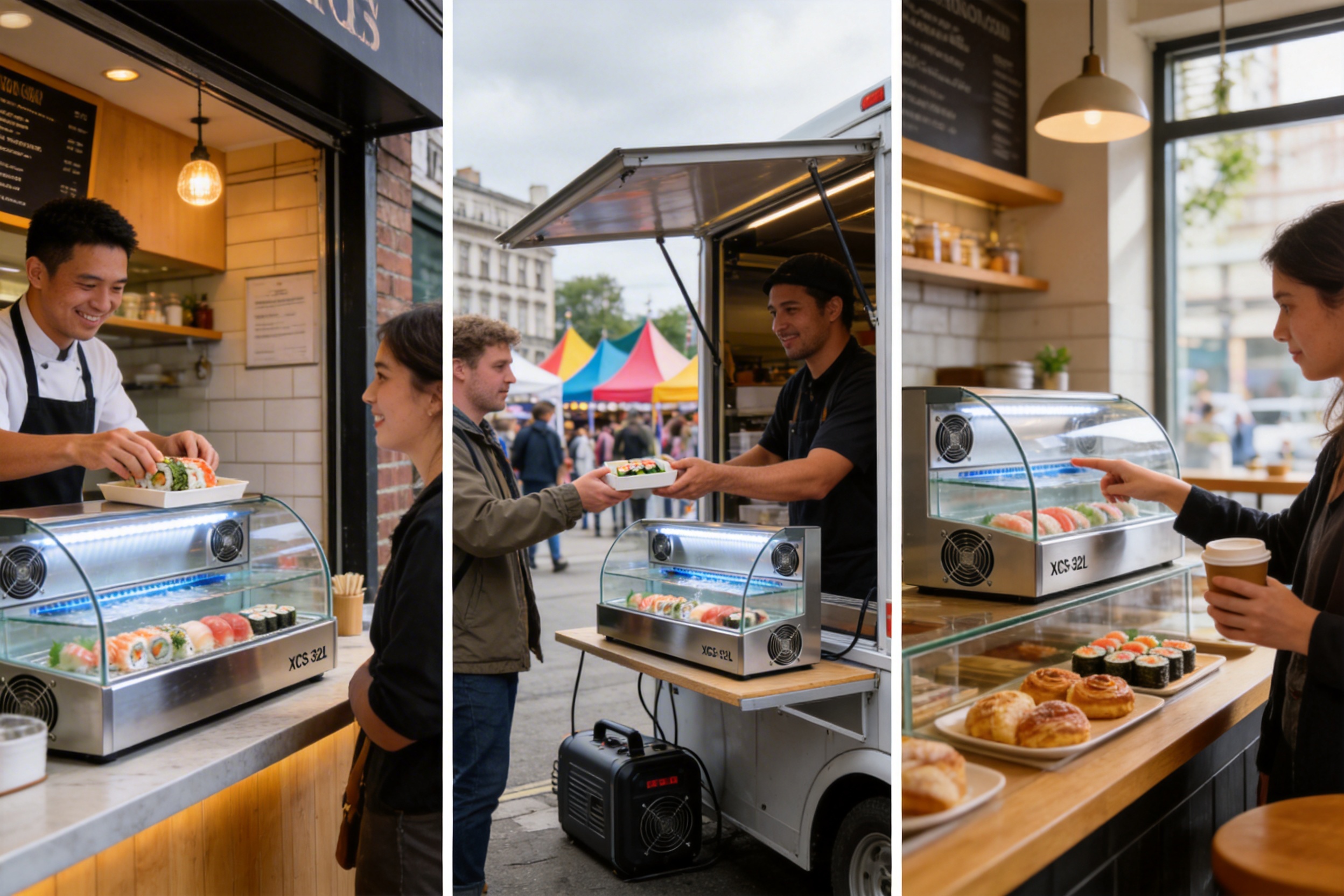
4. Global Certifications: Compliance with International Standards
The company’s manufacturing processes comply with multiple international standards, including ISO 9001 (quality management), ISO 14001 (environmental management), and OHSAS 18001 (occupational health and safety). This ensures that every unit is manufactured in an environmentally responsible way, with minimal waste and safe working conditions for employees.
5. Customization Capabilities: Tailored Solutions for Businesses
The company offers customization options for the XCS-52L to meet the unique needs of different businesses. These options include:
- Custom dimensions (e.g., wider or taller units for larger displays)
- Lockable glass doors (for after-hours security)
- Custom LED light colors (e.g., warm white for a cozy ambiance)
- Branding (company logo printed on the glass or exterior)
- Additional shelves (for displaying more sushi items)
Real-World Use Cases: How the XCS-52L Transforms Food Businesses
To illustrate the impact of the XCS-52L, let’s look at three real-world case studies:
Case Study 1: Small Japanese Restaurant in New York City
Business: A 50-seat Japanese restaurant in Manhattan that serves sushi, ramen, and other Japanese dishes.
Challenge: The restaurant’s old countertop showcase (single evaporator) had uneven cooling, leading to 20% of sushi being spoiled daily. The incandescent lights generated heat, making the sushi rice sticky.
Solution: The restaurant switched to the XCS-52L in 2023.
Results:
- Sushi spoilage reduced by 30% (from 20% to 14% daily).
- Sushi sales increased by 22% (due to better presentation and fresher-tasting sushi).
- Staff saved 1 hour per week on manual defrosting and cleaning.
Case Study 2: Food Truck in London
Business: A mobile sushi food truck that operates at festivals and events in London.
Challenge: The food truck needed a compact, energy-efficient showcase that could run on a generator. The previous showcase (indirect cooling) was noisy and used too much energy, leading to frequent generator shutdowns.
Solution: The food truck purchased the XCS-52L in 2022.
Results:
- Energy consumption reduced by 18% (from 1.8 kWh/day to 1.47 kWh/day).
- Noise level reduced by 25% (from 60 dB to 45 dB), making it more pleasant for customers.
- No downtime due to generator issues (the XCS-52L’s low energy use allowed the generator to run for 8 hours without refueling).
Case Study 3: Cafe in Sydney
Business: A trendy cafe in Sydney that offers sushi rolls and sashimi as part of its menu.
Challenge: The cafe’s previous showcase had condensation drips that made the sushi soggy. Customers often complained about the quality of the sushi.
Solution: The cafe installed the XCS-52L in 2023.
Results:
- Condensation drips eliminated entirely (thanks to the water channel system).
- Customer complaints about sushi quality dropped by 90%.
- Cross-sales increased by 15% (customers bought sushi with coffee and pastries).
Q&A Section: Common Questions About the XCS-52L
As businesses consider investing in the XCS-52L, they often have questions about its functionality, maintenance, and compatibility with their operations. 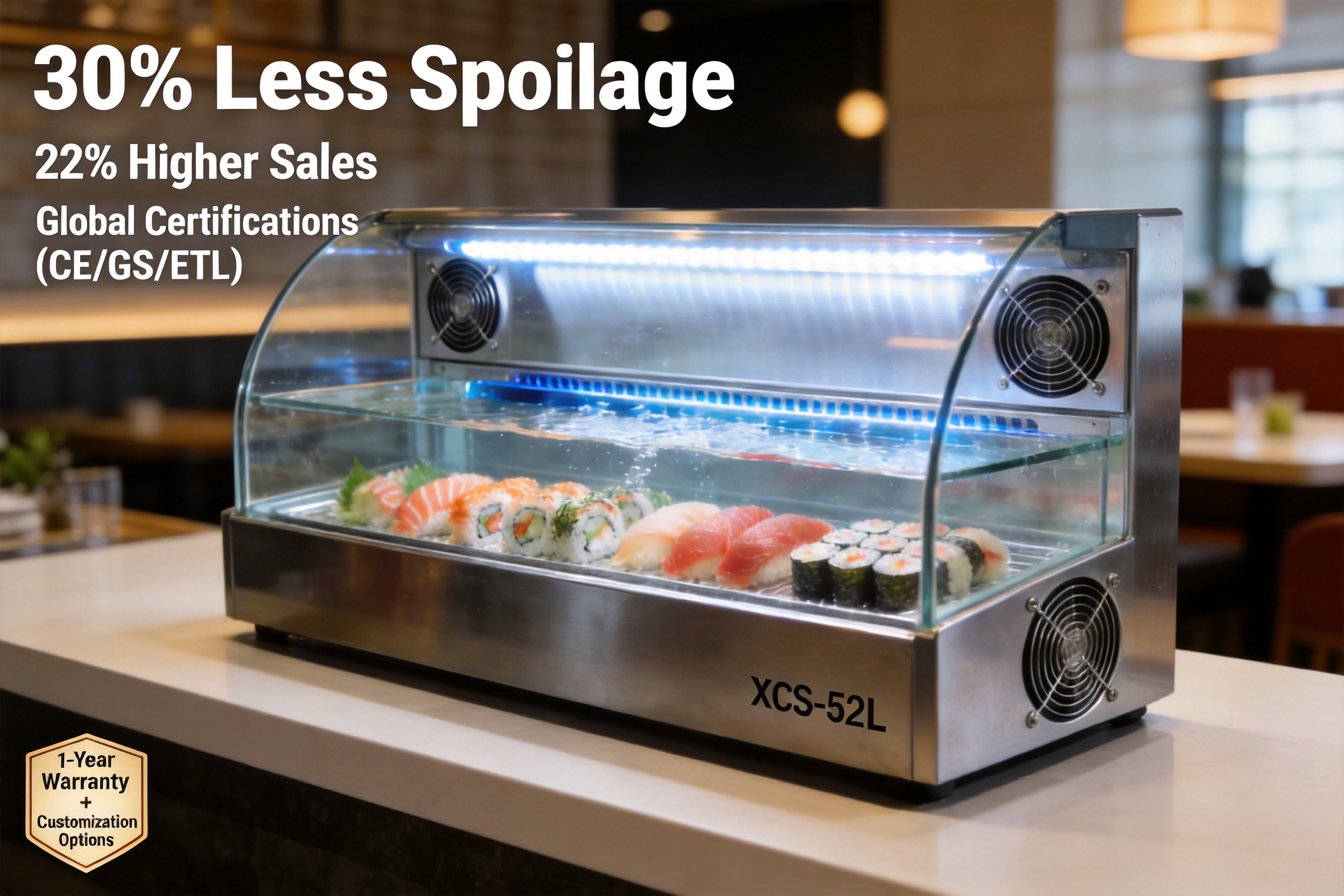
Q1: What is the ideal temperature range for storing sushi in the XCS-52L?
A: The optimal temperature range is 0–5°C (32–41°F), which is recommended by the U.S. Department of Agriculture (FSIS, 2022) for safe sushi storage. The XCS-52L’s digital thermostat allows you to set and maintain this range precisely.
Q2: How often does the automatic defrost system activate?
A: The defrost system activates every 6–12 hours, depending on the ambient temperature and humidity. For example, in a humid environment (e.g., a coastal city), it may activate every 6 hours; in a dry environment, every 12 hours. Each defrost cycle lasts 10–15 minutes and does not affect the temperature inside the showcase.
Q3: Is the LED light replaceable?
A: Yes, the LED light is a standard module that can be easily replaced by staff without specialized tools. The module is available for purchase from the company’s customer service team.
Q4: What materials is the XCS-52L made of?
A: The exterior is made of food-grade stainless steel (304 grade), which is easy to clean and resistant to rust. The interior is also stainless steel, and the glass door is tempered glass (scratch-resistant and shatterproof). The insulation is high-density polyurethane foam (PUF), which provides excellent heat retention.
Q5: Does the company offer a warranty for the XCS-52L?
A: Yes, the company offers a 1-year warranty for parts and labor. Extended warranties (up to 3 years) are available for an additional cost.
Q6: Can the XCS-52L be used for other food items besides sushi?
A: Yes, the XCS-52L is versatile and can be used to display other refrigerated food items, including sashimi, salads, desserts, cheese, and cold drinks. Its precise temperature control and attractive display make it suitable for any food that needs to be kept fresh and visually appealing.
Q7: How long does it take to assemble the XCS-52L?
A: The XCS-52L comes fully assembled. You only need to plug it in and set the temperature—no assembly is required.
Q8: Is the XCS-52L suitable for outdoor use?
A: The XCS-52L is designed for indoor use. If you need to use it outdoors, you should place it in a shaded area and ensure it is protected from rain and direct sunlight. Outdoor use may affect the unit’s cooling efficiency and lifespan.
Conclusion: Why the XCS-52L Is the Best Choice for Your Food Business
The XCS-52L countertop sushi showcase is more than just a refrigeration unit—it’s a tool that helps food businesses reduce waste, increase sales, and comply with food safety standards. Its innovative features (dual evaporator, water channel, LED lighting, etc.) give it a clear advantage over competitors, while the company’s manufacturing excellence ensures reliability and durability. Whether you’re a small sushi restaurant, a food truck, or a cafe, the XCS-52L is a cost-effective investment that will pay off in the long run.
As the global sushi market continues to grow, businesses that prioritize quality and innovation will stand out from the competition. The XCS-52L is the perfect choice for businesses that want to offer fresh, visually appealing sushi to their customers while optimizing their operations.
References
1. Food Safety and Inspection Service (FSIS). (2022). Guidelines for Safe Handling of Sushi and Sashimi. U.S. Department of Agriculture.
2. International Institute of Refrigeration (IIR). (2023). Global Report on Commercial Refrigeration Energy Efficiency. Paris: IIR Publications.
3. Smith, J. (2021). The Art of Sushi Display: Enhancing Customer Experience and Food Safety. Journal of Food Service Technology, 21(3), 145–162.
4. European Committee for Standardization (CEN). (2022). EN 16447:2022 – Commercial Refrigeration Equipment for Food Display. Brussels: CEN.
5. Wang, L. (2023). Innovations in Countertop Refrigeration: How Dual Evaporator Systems Improve Food Freshness. Chinese Journal of Refrigeration Engineering, 45(2), 78–89.

You May Also Like
.jpg?imageView2/2/w/500/h/500/format/jp2/q/100 "Four Sides Glasses Display Cooler")
.jpg?imageView2/2/w/500/h/500/format/jp2/q/100 "White 4-Sided Glass Refrigerated Display Case")
.jpg?imageView2/2/w/500/h/500/format/jp2/q/100 "Refrigerated Display Cake Countertop Four Sides Glasses Display Cooler")
.jpg?imageView2/2/w/500/h/500/format/jp2/q/100 "Four Sides Glasses Display Cooler")

-
- Navigation
- Home
- About Us
- Products
- News
- Contact Us
 East Zone, Guanhaiwei Industrial Park, Cixi City, Ningbo, Zhejiang, China
 +86-574-63668678
 +86-574-63668108
Copyright © Ningbo XiangChi Electrical Co.,Ltd All Rights Reserved.
