
 简体中文
简体中文 English
 Español
News
Commercial Countertop Display Fridge for High-Visibility Refrigerated Merchandising
In modern food retail, the display refrigerator is more than a cold storage appliance. It is a selling tool, a hygiene support system, a space-saving fixture, and a visual merchandising platform. The XCW-160L countertop display fridge is designed for operators who need reliable chilled presentation in a compact, attractive, and commercially practical format. With a 160-liter capacity, a 2°C to 10°C operating temperature range, curved tempered front glass, back sliding glass doors, adjustable chromed shelves, a top LED light, and a mechanical temperature controller, this countertop display cooler provides a balanced solution for cafés, bakeries, convenience stores, dessert shops, beverage counters, hotel breakfast areas, and quick-service food locations.
The product belongs to the category of countertop display refrigerators, a segment where space efficiency, visibility, stable cooling, and easy daily operation are essential. Unlike large vertical cabinets or floor-standing open display coolers, a countertop unit must perform effectively while occupying limited counter space. The XCW-160L addresses this challenge by combining a generous 160-liter internal volume with a compact product size of 888 mm × 568 mm × 686 mm. Its form allows operators to place chilled products directly at the customer’s eye level, helping to convert browsing into purchase decisions.
Countertop display fridge Countertop Display Cooler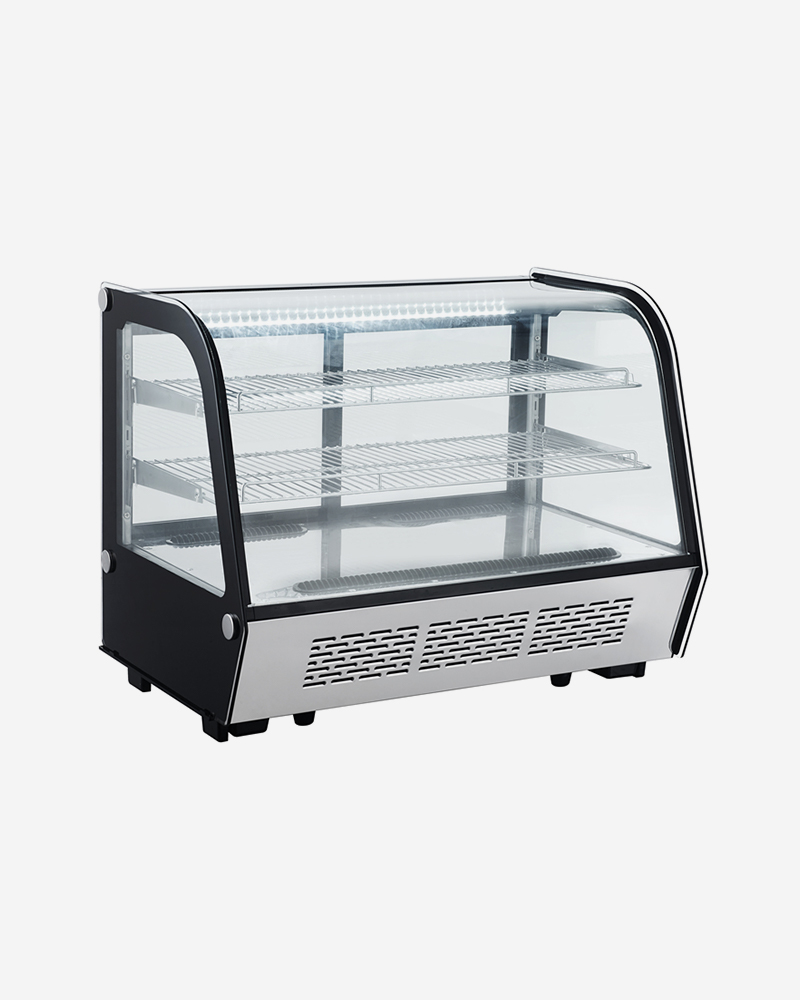
Product Positioning and Commercial Value
The XCW-160L countertop display fridge is built for businesses that depend on impulse sales and attractive product presentation. In foodservice and retail environments, customers often make quick purchasing decisions based on appearance, freshness, convenience, and trust. A well-designed countertop display cooler supports all four factors. It presents food and beverages clearly through glass, maintains a suitable chilled range, keeps products close to the serving area, and communicates professional handling.
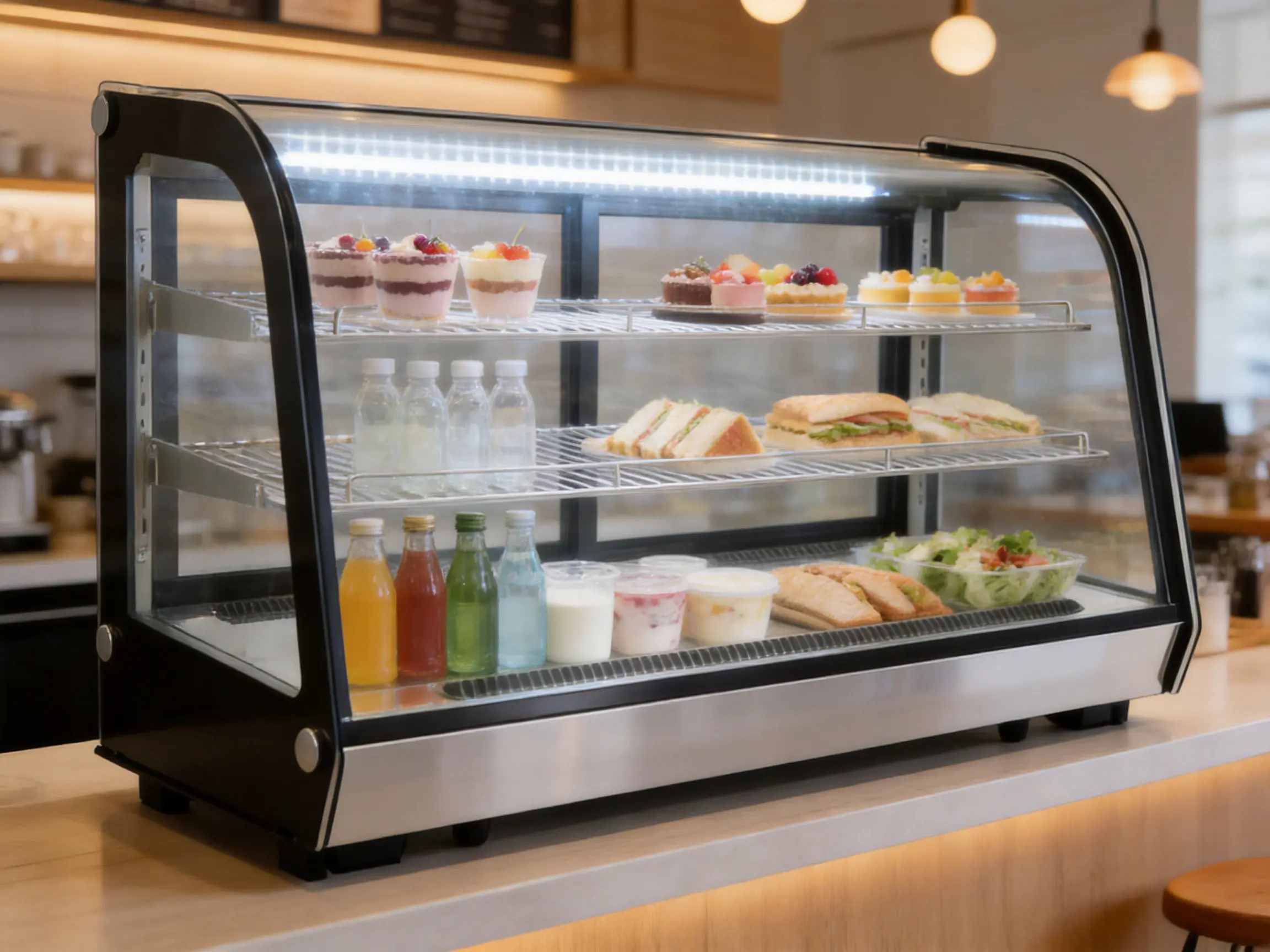
For bakeries, this unit can display chilled desserts, cream cakes, mousse cups, fruit tarts, puddings, and packaged pastries. For cafés, it is suitable for bottled drinks, sandwiches, yogurt, salads, and ready-to-eat snacks. For convenience stores, it provides a focused countertop solution for promotional chilled items. For hotels and catering counters, it can organize breakfast products, packaged dairy, and cold desserts in a visually appealing way. The combination of refrigeration and merchandising makes it a practical investment for businesses that need both storage and sales performance.
Compared with ordinary domestic-style refrigerators, this commercial countertop display cooler is designed specifically for front-of-house use. Domestic appliances typically emphasize household storage, while commercial display coolers prioritize visibility, accessibility, durability, and frequent customer-facing operation. The curved tempered glass front helps create a premium display effect, while the back sliding doors allow staff to replenish or serve items efficiently without interrupting the visual presentation at the front.
Core Technical Specification
The product specification provides a clear view of the XCW-160L’s commercial capabilities. Its 160-liter capacity offers meaningful display volume for a countertop unit. The 2°C to 10°C temperature range supports many refrigerated food and beverage applications. Its 240 W input power reflects a practical refrigeration design suitable for daily business operation. The available refrigerants, R134a or R600a, give buyers options depending on market requirements and environmental preferences.
Model |
XCW-160L |
Product Category |
Countertop Display Refrigerators |
Capacity |
160 L |
Temperature Range |
2°C to 10°C |
Input Power |
240 W |
Refrigerant |
R134a or R600a |
Climate Type |
4 |
Net Weight |
66 kg |
Gross Weight |
70 kg |
Product Size |
888 mm × 568 mm × 686 mm |
Package Size |
951 mm × 627 mm × 735 mm |
20-foot GP Loading Quantity |
63 units |
40-foot HP Loading Quantity |
126 units |
These specifications reveal an important advantage: the unit is designed for commercial usefulness without becoming oversized. A capacity of 160 liters is large enough for meaningful display but still compact enough for countertops, service counters, small food bars, and checkout zones. In many retail spaces, every square meter has commercial value. A countertop display cooler that can generate additional chilled sales without requiring floor space gives operators a practical way to improve revenue density.
High-Visibility Merchandising Through Curved Tempered Glass
The front curved tempered glass is one of the most important features of the XCW-160L. In chilled food presentation, customers must be able to see products clearly and attractively. Curved glass creates a softer, more premium visual profile than a purely flat front. It can reduce the box-like appearance of the appliance and help the displayed products become the focus. This matters especially for cakes, desserts, packaged meals, and beverages, where visual appeal directly influences purchasing behavior.
Tempered glass also supports commercial durability. In busy cafés and stores, display equipment may be exposed to frequent cleaning, staff movement, customer traffic, and accidental contact. Tempered glass is widely valued for its improved strength compared with ordinary glass. While all glass must be handled responsibly, tempered glass is a more suitable choice for commercial environments because it contributes to safety and long-term reliability.
Competitor products in the same category may use flat glass, thinner display structures, or less refined presentation designs. The XCW-160L’s curved front glass gives it a more attractive appearance, helping products look fresher and more desirable. For businesses selling high-margin desserts or specialty drinks, the display quality can be as important as refrigeration performance. A visually strong cooler can become part of the store’s merchandising strategy rather than merely a storage appliance.
Back Sliding Glass Doors for Efficient Service
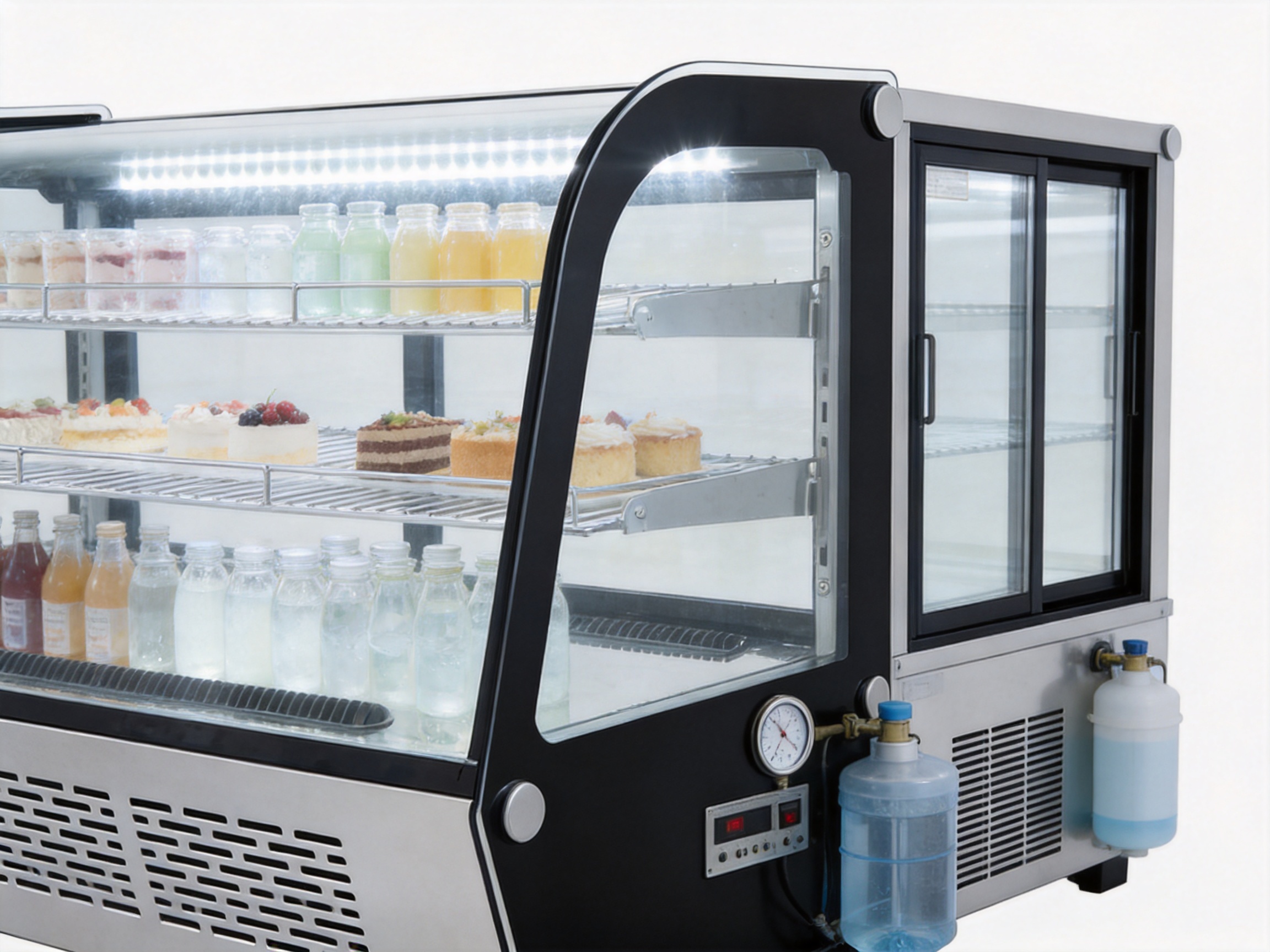
The XCW-160L uses back sliding glass doors, a practical feature for staff-facing access. In many commercial layouts, customers view the front while employees serve from behind the counter. Back sliding doors allow staff to retrieve, rotate, or restock products without opening a front door toward the customer area. This supports smoother service flow, especially during busy periods.
Sliding doors also help conserve space. Hinged doors require swing clearance, which may be inconvenient on narrow counters or in compact service stations. Sliding doors move within the width of the unit, making them better suited for tight areas. This is an important advantage over some competitor units that may use hinged access doors, which can interfere with counter layout or staff movement.
The glass-door design also allows staff to monitor inventory from the service side. Employees can see which products need replenishment and can arrange items neatly without repeatedly opening the cooler. Efficient access contributes to better temperature maintenance because doors can be opened for shorter periods. In everyday operation, small practical details like this can improve both product preservation and staff productivity.
Temperature Range Designed for Commercial Chilled Display
The 2°C to 10°C temperature range is suitable for a broad range of chilled display applications. Many beverages, dairy items, salads, desserts, and packaged foods require refrigeration but not freezing. A unit that operates within this range helps keep products fresh, appealing, and ready for sale. The temperature range is also flexible enough for different store needs, depending on product type and local operating conditions.
In competitive terms, stable chilled performance is a key differentiator. A display fridge that looks attractive but cannot maintain appropriate temperature is not suitable for serious commercial use. The XCW-160L is designed as a commercial display refrigerator, with the refrigeration system, airflow, insulation, and control components arranged to support product presentation and chilled holding. The inclusion of a mechanical temperature controller and thermometer gives operators direct awareness and control of the cabinet environment.
The mechanical controller has its own advantages. While digital controls are common in some appliances, mechanical controls are valued for simplicity, durability, and ease of operation. Staff can adjust settings without complicated menus. In markets where maintenance convenience and straightforward operation are important, a mechanical controller can be a practical choice. It reduces training requirements and supports dependable daily use.
Top LED Light for Strong Product Appeal
The top LED light enhances visibility inside the cabinet. Lighting is a critical element in food display because customers respond to clarity, color, and presentation. A well-lit chilled display helps beverages appear cold, desserts appear fresh, and packaged foods appear clean and organized. The top-mounted LED light illuminates the shelves from above, improving product visibility through the glass front.
LED lighting offers several commercial advantages compared with traditional lighting. It is generally more energy-conscious, produces less heat, and provides bright, consistent illumination. Lower heat output is especially relevant in refrigerated equipment because unnecessary heat inside the cabinet can increase cooling load. By using LED lighting, the unit supports attractive merchandising while helping maintain efficient refrigerated operation.
Competitor units with weak lighting can make products look dull or hidden, reducing the selling power of the display. The XCW-160L’s integrated top LED helps create a clean and professional appearance. For businesses that rely on visual quality, such as bakeries and cafés, this can make a meaningful difference in the customer experience.
Adjustable Chromed Shelves for Flexible Product Layout
Adjustable chromed shelves give operators the ability to configure the interior according to product size and merchandising goals. A café may need one layout for tall bottled beverages and another layout for dessert cups or sandwiches. A bakery may need space for layered cakes, pastries, or trays. The adjustable shelf system allows businesses to adapt the cooler without replacing equipment.
Chromed shelves also provide a clean commercial appearance. Their reflective surface complements the glass structure and LED lighting, creating a bright interior. In food display, the impression of cleanliness is essential. Customers often judge product quality by the condition of the display case. A well-organized interior with attractive shelves helps build confidence.
Compared with fixed-shelf designs, adjustable shelving is a clear advantage. Fixed shelves limit product selection and may create wasted vertical space. The XCW-160L allows better use of internal capacity, which is especially valuable in a 160-liter countertop format. Operators can change the layout for seasonal promotions, new menu items, or different serving periods throughout the day.
Water Tank and Practical Condensation Management
The inclusion of a water tank reflects attention to practical daily operation. Refrigerated display equipment can generate condensate depending on temperature, humidity, door openings, and usage conditions. A water tank helps manage moisture in a controlled way, supporting cleaner operation and easier maintenance.
In commercial environments, maintenance simplicity directly affects user satisfaction. Equipment that requires complicated cleaning or constant attention can become a burden for staff. By incorporating practical features such as a water tank, the XCW-160L supports routine operation in real foodservice conditions. This is one area where professional commercial design differs from basic refrigeration products.
Operators should still follow proper maintenance procedures, including regular cleaning, checking the water tank, keeping door tracks clean, and ensuring adequate ventilation around the appliance. When maintained correctly, the cooler can provide attractive presentation and dependable chilled storage over long periods.
Compact Footprint with Strong Display Capacity
The product size of 888 mm × 568 mm × 686 mm makes the XCW-160L compact enough for countertop placement while still offering 160 liters of display volume. This balance is especially important for small and medium-sized businesses. Many cafés, bakeries, and convenience stores do not have enough space for large floor-standing equipment, but they still need chilled merchandising capability.
By placing chilled goods on the counter, operators can position products close to the point of payment or service. This improves impulse sales opportunities. A customer ordering coffee may notice a chilled dessert. A customer buying lunch may add a beverage. A countertop display fridge can increase average transaction value simply by placing products in the right location.
Compared with larger vertical display cabinets, the XCW-160L is easier to integrate into existing store layouts. It does not require a dedicated floor zone and can be installed on a suitable stable counter. Compared with smaller mini display coolers, it provides more usable capacity and a more professional commercial appearance. This middle-position advantage makes it highly versatile.
Climate Type 4 and Suitability for Demanding Environments
The listed climate type is 4, which is relevant for commercial buyers evaluating operating conditions. Display refrigerators in real businesses may face higher ambient temperatures, frequent door openings, lighting exposure, and busy service conditions. A product intended for commercial use must be designed with these realities in mind.
Climate classification helps buyers understand the operating environment for which refrigeration equipment is designed. While actual performance depends on installation, ventilation, loading, maintenance, and ambient conditions, a climate type 4 designation indicates that the unit is intended for more demanding commercial settings than simple household storage. This matters for buyers in warm regions, high-traffic cafés, or retail counters where equipment must perform consistently throughout the business day.
For best operation, users should avoid overloading the cabinet, maintain airflow around the appliance, keep products organized, and ensure the doors close properly. When installed and operated correctly, the XCW-160L can support reliable chilled display in many professional environments.
Refrigerant Options: R134a and R600a
The XCW-160L is available with R134a or R600a refrigerant options. This flexibility is useful because refrigerant preferences and regulatory requirements vary across global markets. R134a has been widely used in commercial refrigeration for many years, while R600a is known for its favorable environmental characteristics and efficient performance in suitable systems.
Offering refrigerant options helps distributors and buyers select configurations appropriate for their region. It also reflects manufacturing flexibility. A supplier capable of providing different refrigerant configurations must understand refrigeration system design, component compatibility, safety requirements, and testing procedures. This is part of the broader manufacturing strength behind the product.
In competitor comparison, not every supplier can offer flexible refrigerant choices while maintaining consistent product quality. The ability to adapt products for different markets is important for wholesalers, importers, and commercial equipment distributors. It reduces market-entry barriers and helps meet customer expectations in diverse regions.
Logistics and Wholesale Advantages
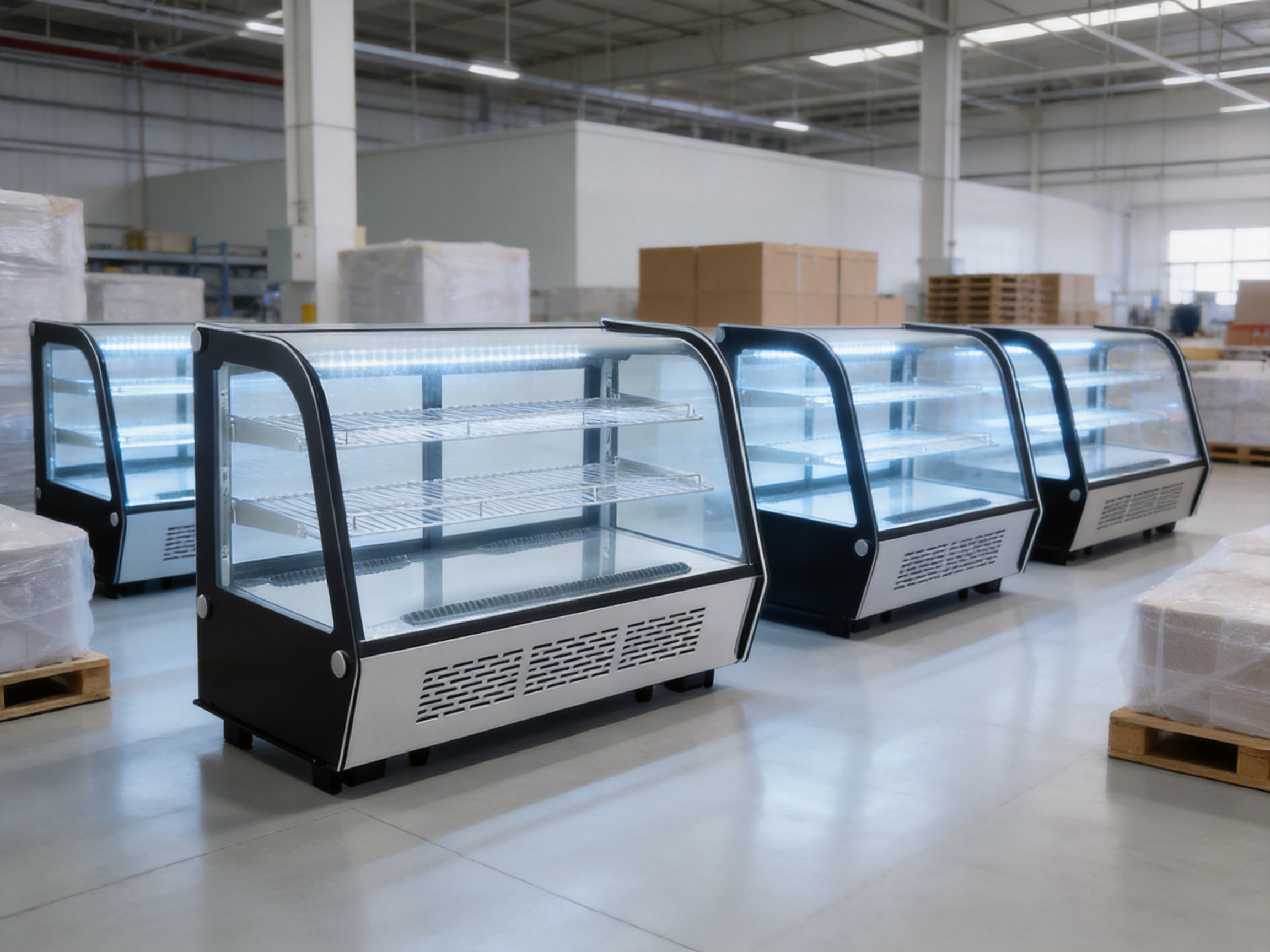
The packaging size of 951 mm × 627 mm × 735 mm and the loading quantities of 63 units in a 20-foot GP container and 126 units in a 40-foot HP container are important for wholesale buyers. Commercial refrigeration purchasing often involves container-based logistics, distributor inventory planning, and project supply. A product that is designed with transport efficiency in mind can reduce landed cost and improve supply-chain predictability.
For distributors, loading quantity affects freight cost per unit. Efficient packing supports more competitive pricing in the destination market. The XCW-160L’s dimensions and packaging allow meaningful container loading quantities while protecting the product during shipment. The gross weight of 70 kg also indicates a substantial commercial structure without becoming impractical for handling through standard logistics channels.
Compared with oversized countertop units, the XCW-160L provides a better balance of capacity and shipping efficiency. Compared with very small units, it offers stronger commercial value per unit shipped. This makes it suitable not only for single-store buyers but also for wholesalers, chain projects, and commercial refrigeration distributors.
Advantages Over Ordinary Competitor Units
The countertop display refrigerator market includes a wide range of products, from basic economy coolers to premium commercial showcases. The XCW-160L stands out because it combines essential commercial features in a balanced configuration. Its strongest advantages include practical capacity, attractive curved glass, service-side sliding doors, LED illumination, adjustable shelves, simple controls, and efficient logistics.
First, the 160-liter capacity gives it more usable display space than many compact countertop coolers. Smaller models may be easy to place but often fail to hold enough products for peak business hours. The XCW-160L helps operators maintain a stronger display without constant restocking.
Second, the curved tempered glass front improves visual appeal. Some competitor units use flat glass or less refined cabinet profiles, which can look more utilitarian. The curved front design supports a more premium presentation, making the cooler suitable for customer-facing environments where appearance matters.
Third, the back sliding doors support efficient staff access. In many stores, rear service access is preferable to front access because it keeps the customer-facing side clean and uninterrupted. Sliding doors also save space compared with hinged designs.
Fourth, the top LED lighting improves merchandising quality. Products are easier to see, colors appear clearer, and the cabinet looks more professional. Poorly lit display refrigerators can reduce customer interest even when products are fresh.
Fifth, adjustable chromed shelves provide layout flexibility. Businesses can display different product categories without changing equipment. This flexibility helps operators respond to seasonal products, menu changes, promotions, and customer preferences.
Sixth, the mechanical controller and thermometer offer simple, direct operation. Staff can monitor and adjust temperature without complicated interfaces. This is valuable for businesses that need reliable equipment with low training requirements.
Finally, the manufacturer’s production background, certification experience, R&D team, and testing facilities support product quality. A display cooler is only as reliable as the system behind it. Commercial buyers need confidence not only in the unit’s appearance but also in the company’s ability to produce consistent quality at scale.
Manufacturing Strength Behind the Product
Ningbo XiangChi Electrical Co., Ltd. is a professional manufacturer of vertical display cabinets, cake cabinets, warming cabinets, countertop display coolers, and related commercial refrigeration equipment. Established in 2007, the company has accumulated more than ten years of manufacturing experience and operates a modern garden-style factory of approximately 40,000 square meters. This foundation supports the development and production of commercial refrigeration products for global markets.
Advanced manufacturing strength matters greatly in refrigeration equipment. A display cooler includes multiple systems: cabinet structure, glass assembly, refrigeration circuit, electrical control, lighting, shelving, door components, insulation, packaging, and final testing. Reliable performance depends on the correct coordination of these systems. Manufacturers with experience and specialized facilities are better positioned to control quality from raw material selection to final inspection.
The company’s professional R&D team contributes to product innovation and improvement. In commercial refrigeration, product development is not limited to appearance. Engineers must consider cooling performance, airflow, energy use, noise, glass condensation, user access, serviceability, safety standards, and market preferences. Continuous research and development help refine details that customers may not immediately see but will notice during long-term use.
Advanced testing facilities further strengthen quality assurance. Testing is essential for verifying temperature performance, electrical safety, refrigeration system reliability, lighting performance, door function, packaging durability, and compliance with relevant standards. A manufacturer with in-house testing capabilities can identify issues early, improve design consistency, and support stable production quality.
Quality Certifications and Global Market Readiness
The manufacturer has obtained major certifications including CE, GS, CCC, CB, ROHs, and ETL. These certifications demonstrate experience with international compliance requirements and help commercial buyers enter different regional markets. For importers and distributors, certification readiness is a major advantage because it can reduce approval complexity and improve customer confidence.
CE certification is important in European markets, while GS relates to tested safety standards. CCC is required for certain products in China. CB certification supports international recognition of electrical safety testing. RoHS addresses restrictions on hazardous substances. ETL certification is widely recognized in North American contexts. Together, these certifications show that the manufacturer understands global commercial equipment expectations.
Competitors without strong certification support may offer attractive prices but create risk for buyers. Commercial refrigeration products must meet safety, environmental, and market-entry requirements. A supplier with broad certification experience can support long-term business relationships, especially for wholesalers and distributors serving multiple regions.
Production Process and Quality Control Focus
A high-quality countertop display refrigerator begins with structured product design. Engineers define the cabinet dimensions, cooling system layout, glass structure, airflow path, shelf positions, control arrangement, lighting placement, and user access points. For the XCW-160L, the result is a compact but capable unit with a curved tempered glass front, sliding rear access, and a 160-liter interior.
Material preparation follows design. Metal cabinet parts must be processed accurately to ensure proper fit, strength, and alignment. Glass components must meet safety and appearance requirements. Shelves must be finished for durability and cleanliness. Insulation materials must be correctly applied to reduce heat transfer and support stable cooling.
The refrigeration system requires careful assembly. Compressor selection, refrigerant compatibility, evaporator and condenser arrangement, tubing quality, sealing, and leak prevention are all essential. Even a visually attractive refrigerator will fail commercially if the refrigeration circuit is poorly manufactured. Skilled assembly and testing help ensure consistent performance.
Electrical installation includes the mechanical temperature controller, thermometer, LED light, wiring, and safety components. Commercial refrigeration equipment must be reliable under repeated daily use. Proper wiring layout, component selection, and inspection help reduce service issues.
Final assembly brings together the cabinet, glass, doors, shelves, lighting, refrigeration system, controller, and water tank. At this stage, alignment and finishing quality are important. Sliding doors should operate smoothly. Glass should be clean and secure. Shelves should fit properly. The unit should present a professional appearance from every customer-facing angle.
Testing and inspection are the final safeguards. Temperature testing confirms that the cabinet can reach and maintain the intended range. Electrical safety inspection helps ensure safe operation. Visual inspection confirms appearance quality. Packaging inspection helps protect products during transport. This structured process supports the product’s ability to perform in real commercial environments.
Design for Retail Psychology
The XCW-160L is not simply a cold box; it is a retail communication tool. Customers often associate visible refrigeration with freshness, hygiene, and readiness. When food is displayed behind clean glass and illuminated by internal lighting, it appears more trustworthy and desirable. The curved glass front adds a sense of refinement, helping the display feel intentional rather than improvised.
Placement also matters. A countertop unit can be positioned near checkout counters, coffee machines, bakery service areas, buffet lines, or beverage stations. This puts products in the customer’s decision path. Unlike back-room refrigeration, which stores inventory away from view, a display cooler turns inventory into visual selling content.
Good merchandising depends on organization. Adjustable shelves make it easier to arrange products by category, color, size, or price. Operators can place high-margin items at the most visible level and use lighting to highlight freshness. A well-filled but not overcrowded display can increase perceived abundance and product quality.
Applications in Cafés and Coffee Shops
For cafés, the XCW-160L can support both beverage and food sales. Coffee customers often purchase add-on products when they are visible and convenient. A countertop cooler can display bottled juices, sparkling drinks, milk beverages, yogurt, sandwiches, salads, and desserts. Because the unit is compact, it can be placed near the ordering area without requiring major layout changes.
The back sliding doors are especially useful in café environments. Staff can quickly serve chilled items while preparing drinks. The top LED light improves visibility even in cafés with warm or dim interior lighting. The curved glass front gives the counter a more polished appearance, supporting the overall atmosphere of the shop.
Compared with using a standard upright refrigerator placed away from the counter, the XCW-160L provides better impulse selling potential. Products are not hidden, and customers do not need to walk to a separate refrigeration area. The display becomes part of the ordering experience.
Applications in Bakeries and Dessert Shops
Bakeries and dessert shops depend strongly on presentation. Many chilled desserts are purchased because they look fresh, colorful, and indulgent. The XCW-160L’s glass display design, LED lighting, and adjustable shelves make it suitable for presenting individual cakes, mousse cups, fruit desserts, puddings, cream pastries, and packaged sweet items.
The 2°C to 10°C temperature range supports chilled holding for many dessert products, depending on recipe and food safety requirements. Operators should always follow local food safety rules and product-specific storage guidance. Within proper usage, the cooler helps preserve freshness while keeping items visible.
Compared with a large cake showcase, this countertop display fridge is more compact and easier to use for smaller stores or secondary display points. A bakery may use it near the cashier for premium individual desserts or promotional chilled items. It can also complement larger refrigerated showcases by adding flexible display capacity in another part of the shop.
Applications in Convenience Stores and Retail Counters
Convenience stores often need focused display solutions for limited-time promotions, premium drinks, chilled snacks, or checkout-area impulse products. The XCW-160L is well suited for these applications because it offers professional chilled display without requiring a full floor-standing cabinet.
Retail counters benefit from compact equipment that can increase sales per square meter. By positioning chilled products near payment areas, operators can encourage last-minute purchases. The transparent glass and internal lighting make products easy to identify quickly, which is important in fast-moving convenience environments.
The durable commercial structure, simple controls, and practical access design help support daily use by different staff members. The adjustable shelves allow the store to change product layout as promotions change. This flexibility is valuable in retail operations where product mix may shift frequently.
Applications in Hospitality and Catering
Hotels, catering venues, office pantries, and buffet services can use countertop display refrigerators to present chilled foods in an organized way. Breakfast counters may require yogurt, milk, fruit cups, desserts, or packaged items. Meeting rooms may need chilled beverages and snacks. A countertop display cooler gives these settings a professional solution that is easier to position than a large cabinet.
The visual design supports guest confidence. Food displayed in a clean, illuminated refrigerated cabinet appears more carefully managed than food placed in open containers or non-refrigerated areas. In hospitality, presentation and hygiene perception are essential parts of guest satisfaction.
The XCW-160L’s compact size also supports temporary or flexible service arrangements. It can be used in different areas where a suitable counter and electrical supply are available. This makes it valuable for operators who need adaptable refrigerated display capacity.
Energy and Operational Considerations
The input power of 240 W indicates the electrical demand of the unit. Actual energy consumption depends on operating conditions, ambient temperature, door opening frequency, thermostat settings, product loading, ventilation, and maintenance. Operators can support efficient use by installing the cooler away from heat sources, leaving adequate ventilation space, keeping doors closed when not in use, and loading products only after they have been properly chilled when possible.
LED lighting contributes to operational efficiency by providing good visibility with relatively low heat output. The mechanical controller allows straightforward adjustment, helping operators avoid unnecessarily low settings that may increase energy use. Regular cleaning of the condenser area, door tracks, and interior also helps maintain performance.
Compared with open display coolers, a closed glass countertop display fridge can generally help reduce cold air loss because the chilled space is enclosed. Open display coolers are useful for certain retail formats, but they often require more energy to maintain temperature due to continuous exposure. For countertop merchandising, a glass-enclosed design provides a strong balance of visibility and refrigerated containment.
Durability, Maintenance, and Daily Use
Commercial buyers evaluate equipment not only by initial appearance but also by daily reliability. The XCW-160L includes features that support routine use: tempered glass, sliding doors, adjustable shelves, a mechanical controller, a thermometer, LED lighting, and a water tank. These components are practical and understandable for staff.
Maintenance should include wiping glass surfaces, cleaning shelves, removing spills promptly, checking the water tank, ensuring the door tracks remain clean, and monitoring temperature. Operators should avoid blocking airflow inside the cabinet and should not overload shelves beyond their intended use. Good maintenance helps protect food quality and extend equipment life.
The simplicity of the mechanical controller is beneficial in multi-staff environments. Employees do not need advanced technical knowledge to operate the cooler. The thermometer provides visible temperature information, helping staff confirm that the cabinet is working within the intended range.
Why Manufacturer Experience Matters to Buyers
When purchasing commercial refrigeration equipment, the supplier’s experience is as important as the individual product specification. Refrigeration products must be manufactured consistently, packed safely, shipped internationally, and supported through wholesale channels. A company with more than a decade of industry experience is better positioned to understand the needs of distributors, foodservice operators, and retail buyers.
Ningbo XiangChi Electrical Co., Ltd. has developed a broad product range including vertical display coolers, countertop display coolers, cake showcases, display warmers, open display coolers, four-sided glass display coolers, and four-sided glass freezers. This product diversity indicates extensive knowledge of commercial temperature-controlled display equipment. Experience across multiple categories can improve design decisions because the manufacturer understands different use cases and customer expectations.
The company’s manufacturing base in Cixi City, Ningbo, Zhejiang, China provides access to an established industrial environment. Ningbo is known as an important manufacturing and export region, with logistics advantages for international trade. For global buyers, a supplier located in such a region can support container shipments, export documentation, and long-term procurement planning.
Innovation, Quality, and Service Concept
The company follows a concept centered on innovation, quality, and service. These values are especially relevant in commercial refrigeration because customer needs continue to evolve. Retailers want better display aesthetics, foodservice operators want easier cleaning, distributors want reliable quality, and markets increasingly require compliance with safety and environmental standards.
Innovation can appear in cabinet design, lighting, airflow, refrigerant choices, packaging, and production efficiency. Quality depends on material selection, process control, skilled assembly, and testing. Service includes communication, product support, customization capability, documentation, and cooperation with global partners. Together, these elements create a stronger foundation for long-term business relationships.
The XCW-160L reflects this concept by offering a practical combination of features rather than relying on a single selling point. It is attractive, functional, compact, flexible, and suitable for commercial use. This balanced design helps it meet the needs of many different customers.
Buyer Evaluation Guide
Before purchasing a countertop display fridge, buyers should evaluate several factors. The first is capacity. A unit should hold enough products for expected sales volume without becoming too large for the counter. The XCW-160L’s 160-liter capacity makes it suitable for moderate commercial display needs.
The second factor is temperature range. Buyers should confirm that the 2°C to 10°C range matches the products they intend to display. Different foods have different storage requirements, and local regulations must always be followed.
The third factor is visibility. Glass quality, lighting, shelf arrangement, and cabinet shape all affect product appeal. The XCW-160L’s curved tempered front glass and top LED light support strong visibility.
The fourth factor is access. Staff should be able to serve and restock products easily. Back sliding glass doors make the unit practical for counter-service environments.
The fifth factor is maintenance. The cooler should be easy to clean and monitor. Adjustable shelves, a thermometer, and a water tank support daily operation.
The sixth factor is supplier capability. Buyers should consider manufacturing experience, certifications, quality control, and logistics support. The manufacturer’s factory scale, R&D capability, testing facilities, and certification background provide important reassurance.
Q&A Section
What type of business is the XCW-160L countertop display fridge best suited for?
It is suitable for cafés, bakeries, dessert shops, convenience stores, hotel counters, catering areas, beverage stations, and quick-service restaurants. It is designed for businesses that need chilled product presentation in a compact countertop format.
What is the capacity of the unit?
The unit has a 160-liter capacity, which provides substantial display space for a countertop refrigerator while keeping the overall footprint manageable.
What temperature range does the product support?
The operating temperature range is 2°C to 10°C. This range is appropriate for many chilled beverages, desserts, dairy products, salads, sandwiches, and packaged foods, depending on product requirements and local food safety rules.
Why is the curved tempered glass front important?
The curved tempered glass front improves visual presentation and gives the cooler a more premium appearance. Tempered glass also supports commercial durability and safety compared with ordinary glass.
How do the back sliding glass doors benefit daily operation?
Back sliding doors allow staff to access products from the service side without opening the customer-facing front. They save space, support faster service, and help make restocking easier in compact counter layouts.
Does the unit include lighting?
Yes. The unit includes a top LED light that improves product visibility and helps create a bright, attractive display.
Are the shelves adjustable?
Yes. The cooler includes adjustable chromed shelves, allowing operators to change the internal layout for different product heights and merchandising plans.
What refrigerants are available?
The product can use R134a or R600a, depending on market requirements and buyer preference.
How does this product compare with ordinary countertop coolers?
It offers a strong combination of 160-liter capacity, curved tempered glass, back sliding doors, LED lighting, adjustable shelves, simple temperature control, and commercial manufacturing support. Many ordinary coolers may offer only part of this feature set.
Why is the manufacturer’s certification background important?
Certifications such as CE, GS, CCC, CB, RoHS, and ETL indicate experience with international safety, quality, and environmental requirements. This is important for distributors, importers, and commercial buyers.
Conclusion
The XCW-160L countertop display fridge is a practical and attractive refrigerated merchandising solution for commercial environments. It combines a 160-liter capacity, 2°C to 10°C temperature range, 240 W input power, curved tempered front glass, back sliding glass doors, mechanical temperature control, a thermometer, top LED lighting, adjustable chromed shelves, and a water tank. These features work together to support product freshness, customer visibility, staff convenience, and efficient countertop use.
Its advantages over many competitor units come from balance. It is not merely compact, and it is not merely decorative. It provides meaningful capacity, attractive presentation, flexible shelving, practical access, and commercial-grade usability. For cafés, bakeries, convenience stores, hotels, catering counters, and dessert shops, it can help transform chilled inventory into visible selling opportunities.
Behind the product is a manufacturer with established experience in commercial refrigeration, a large modern factory, professional R&D capabilities, advanced testing facilities, and international certifications. This manufacturing strength supports consistent quality, market adaptability, and wholesale confidence. For buyers seeking a countertop display cooler that combines presentation value with practical refrigeration performance, the XCW-160L is a strong candidate.
References
ASHRAE Handbook: Refrigeration, American Society of Heating, Refrigerating and Air-Conditioning Engineers.
International Electrotechnical Commission, Electrical Safety Standards for Commercial Refrigeration Equipment.
European Committee for Standardization, Commercial Refrigerating Appliances Performance and Safety Guidance.
Food and Agriculture Organization, General Principles of Food Storage and Cold Chain Management.
International Institute of Refrigeration, Commercial Refrigeration Technology and Application Notes.
RoHS Compliance Guidance for Electrical and Electronic Equipment.
Product: Countertop display fridge Countertop Display Cooler

You May Also Like
.jpg?imageView2/2/w/500/h/500/format/jp2/q/100 "Four Sides Glasses Display Cooler")
.jpg?imageView2/2/w/500/h/500/format/jp2/q/100 "White 4-Sided Glass Refrigerated Display Case")
.jpg?imageView2/2/w/500/h/500/format/jp2/q/100 "Refrigerated Display Cake Countertop Four Sides Glasses Display Cooler")
.jpg?imageView2/2/w/500/h/500/format/jp2/q/100 "Four Sides Glasses Display Cooler")

-
- Navigation
- Home
- About Us
- Products
- News
- Contact Us
 East Zone, Guanhaiwei Industrial Park, Cixi City, Ningbo, Zhejiang, China
 +86-574-63668678
 +86-574-63668108
Copyright © Ningbo XiangChi Electrical Co.,Ltd All Rights Reserved.
